Bird Mystery

Northern Flicker

The other day I heard an unfamiliar racket out the window and discovered a small flock of northern flickers had come to visit the garden.  They were eating bugs in the ground, and also poking their long beaks between the pavers on our patio, so I am going to guess they were eating ants.  They settled in for a feast, and made themselves at home.

They are so distinctive and beautiful, a spotted breast with a black bib (and cheek patches on the males), red heart shape patch on the back of their head, and white rump feathers visible when they fly.  Oh, and a bit of yellow on the tail.  I also saw a plain looking smaller bird that I believed was a juvenile flicker, but then noticed it had white spots on black instead of black on white. It was clearly hanging out with the male and female flickers, but it looks more like a starling juvenile.  Does anyone know if starlings ever drop eggs with the flickers to get them to raise the young starlings?

Stranger than it first appeared.

Northern Flickers

Update on Kale

Kale choppingSo right after my last post, I went outside, and cut about 40 big leaves off my kale plants–always from the lower part of the stems.  In between making and eating breakfast and washing dishes, I washed the leaves in groups of ten (by variety), and chopped them up, then washed them again in a salad spinner, which they filled up.

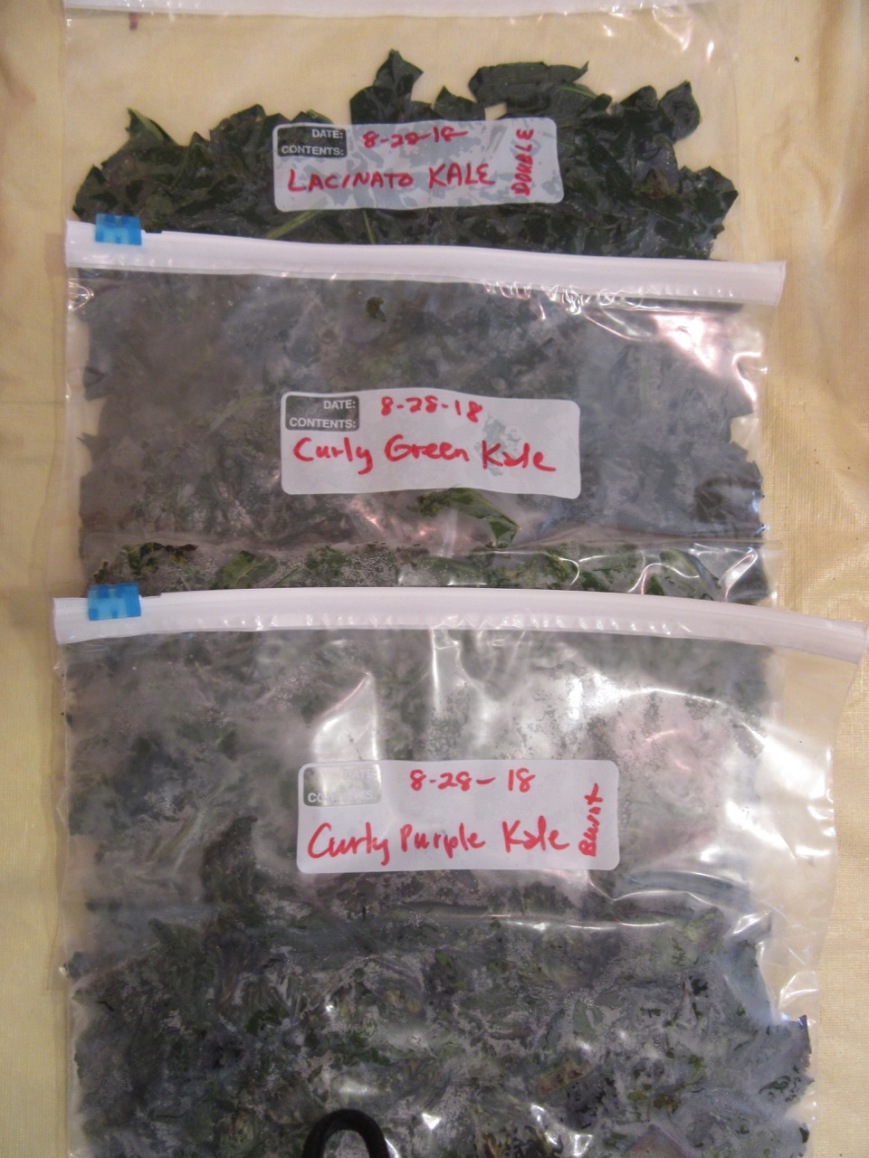
Kale washAfter doing the first batch, which used a lot of water, I figured out that I should save the wash water and bring it out to the garden, where I put it on the kale plants! Then I spinned the kale pieces to dry them, and sautéed them in our big cast iron pan.  I had to start with about half of the batch, then add the second half after the first had cooked down a bit.  I had green curly kale, red or purple curly kale and a double batch of lacinato kale. After sautéing, I cooled them in a bowl in the refrigerator before putting in bags. On the recommendation of other online gardeners, I used a straw to pull out all the air in the bags.

I still have plenty outside on the plants, but now I have these in the freezer.  Ten leaves only filled half a bag, at about 1/2 an inch thick.  That would be about three or four servings in our house, so this is a total of 12-16 servings.    This winter, I will see how they taste.Kale to freeze

Abundance

Myke with kale

[Photo by Margy Dowzer]

The kale has gone crazy this year! I eat some every day, and we’ve given a lot away, but it is still up to my waist in abundance. Not to mention the basil plants, also a few feet tall. Harvesting has always felt like the most challenging part of gardening–how to keep up with everything the earth is producing. I see posts of friends who are canning and drying and freezing–that is all still something I need to learn more about.  I search online for instructions, so information is not the main issue–just the time and energy to keep up with it and carry it out.

Most of our garden this year isn’t even to that stage yet–the fruit trees and bushes are still babies, the asparagus is in its first year.  And perennial herbs will keep coming back each year, whether I harvest them now or not.  In fact, I’ve got thyme drying in the basement, and will probably do some oregano after that is done.  I finally dug up the garlic that I had planted as companions to the fruit trees to help keep away pests.  But I especially feel a responsibility to the annuals like kale and basil.  This is it for them. And they are shining.

Last week, I experimented: I sautéed a dozen large leaves of kale, which cooked down quite a bit, and then I froze it–it only filled a small part of a plastic freezer bag.  I should be doing that with whole bunches of it, but it takes time to wash and cut and sauté and cool and bag.  We’ve been eating basil this week–especially yummy with an heirloom tomato we bought from the coop.  I learned not to put it in the refrigerator, but to keep cut stems in a vase with water.

For now, I just want to say thank you to the earth for creating such abundance!  Give me the strength to receive and cherish and preserve your gifts.  I’d better get outside and harvest some more!

Opossum sighting

Opossum

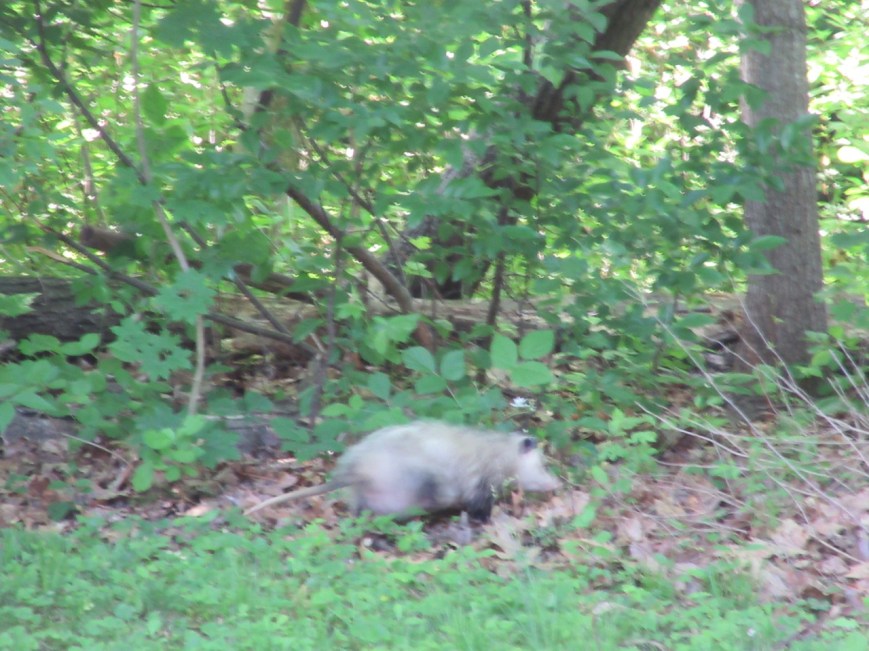
The photo came out a little blurry, but I was delighted to catch a glimpse of this little opossum neighbor, while I was sitting in the screen tent a few mornings ago. When it saw me, it speeded up its walk near the underbrush at the back corner of our yard. I understand that opossums eat ticks, among many other things, so I was glad to see it our neighborhood.

Reading more about them, I learned that they can also eat food from bird feeders and fruit trees.  They are nocturnal.  It will be an interesting balancing act–we intend to grow food for ourselves, yet we also love the critters that show up in this space we share. But perhaps that is the heart of the question–how do we live as neighbors in this land, rather than colonizers/occupiers/dominators?  How do we care for our own needs, while also caring for the needs of other beings on this earth?

Yes They Did Come!

HummingbirdWe put up the hummingbird feeders five days ago, and the hummingbirds showed up within a couple days.  Today I got some photos, while sitting on the deck a few feet away. This is a male ruby-throated hummingbird, and a female came around as well.  It is rather marvelous that they can find these feeders, considering the length of their travels.

Hummingbirds migrate to and from central America where they spend the winter, usually in the same place that their ancestors did.  They fly alone, not in flocks, and instinctively know where to go.  Isn’t that incredible?  Hummingbirds have an average life span of 3-5 years, so maybe these are the same hummingbirds as those who found the feeder we put up last year, before we had the roof on the deck.  Or maybe they are descendants.  Now we have two feeders, and they’ve already used both.  Hummingbirds are very territorial, so I wonder if we’ll see others, or these two will claim it all for themselves.

Medicine from the Yard

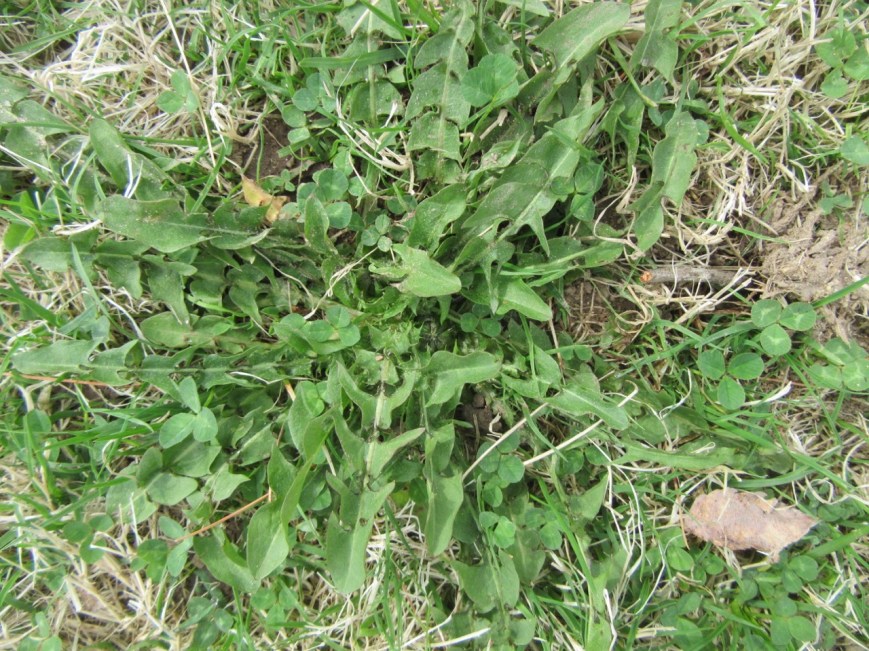
Dandelion Leaves

[Dandelion leaves]

Today and the past two days, I’ve been eating these lovely gifts from our yard–dandelion leaves.  They are best to eat before the bright yellow flowers appear, so you have to search for them by their pointy leaves arranged in a starburst pattern.  I asked the plant for permission to pick them, so that they might become a good medicine for me, and then picked some of the leaves from several plants.

Dandelion leaves are a blood purifier, great spring detoxing for the liver, have a lot of vitamins and minerals, and are full of anti-oxidants. (But be sure you pick them from a place with no chemicals or road run-off.)  I am just beginning to try eating them, so I rinsed them off and chopped them up, and mixed them into some kale I was stir-frying for breakfast, after the kale was already pretty much cooked.  They have a really mild flavor, and I enjoyed them.  You can also eat them raw or in salads.

So often, we just ignore the so-called “weeds” in our yard, or worse yet, try to eradicate them.  What if we saw them as gifts sent to us from the earth, to help our bodies with what they need?  This is what I learned from herbalists–the plants appear when we need them.  So, to ignore them or not use them would be rude, wouldn’t it?

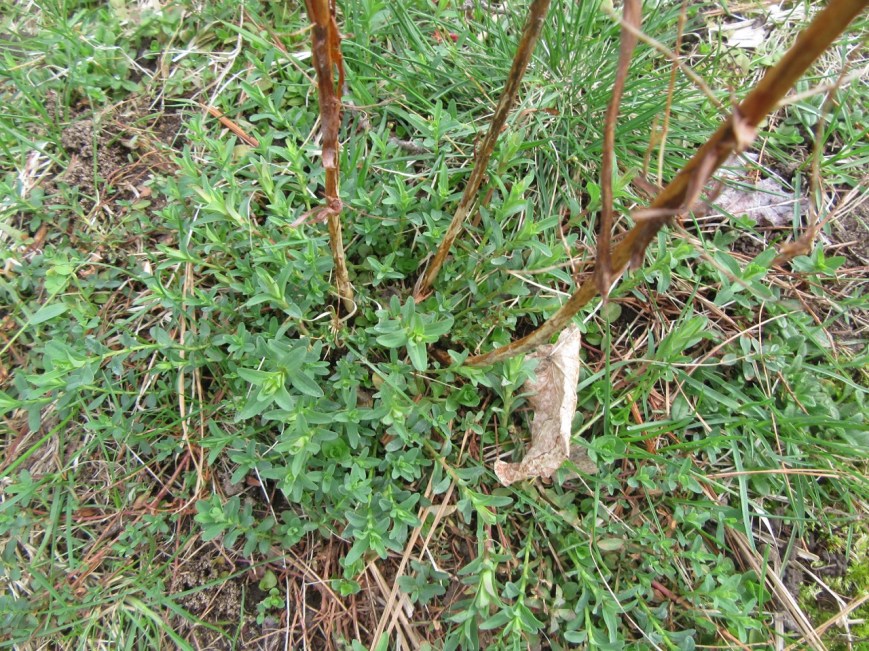
I first began to understand this when the St. John’s Wort started appearing in our yard last summer. St. John’s Wort has traditionally been understood as useful for depression and wound healing. Last summer, at the Healing the Wounds of Turtle Island ceremonies, the spiritual wound that revealed itself to me was the Great Forgetting:  first there was a great disconnection of my ancestors from their relationship with all of creation, and then there was a great forgetting so that the people would be unaware that they were wounded and disconnected, and thus never even seek to understand that they had once been connected. I heard in my mind, “St. John’s Wort can help when you remember the wound of disconnection from the earth, and when you open to the pain underneath the great forgetting.”

And the St. John’s Wort is returning to the yard this spring as well.  The flowers are best picked just after the Summer Solstice (feast of St. John the Baptist, which is where they got that name), but now the plants are starting to put forth new stems and leaves around the old stalks we picked the tops of last year.  I think picking them has helped them to grow and expand.

I like learning about the plants in this way, one by one, as they make themselves known to me here in this land I call home.
St. John's Wort

[St. John’s Wort]

May Day in Maine

Daffodils in orchard

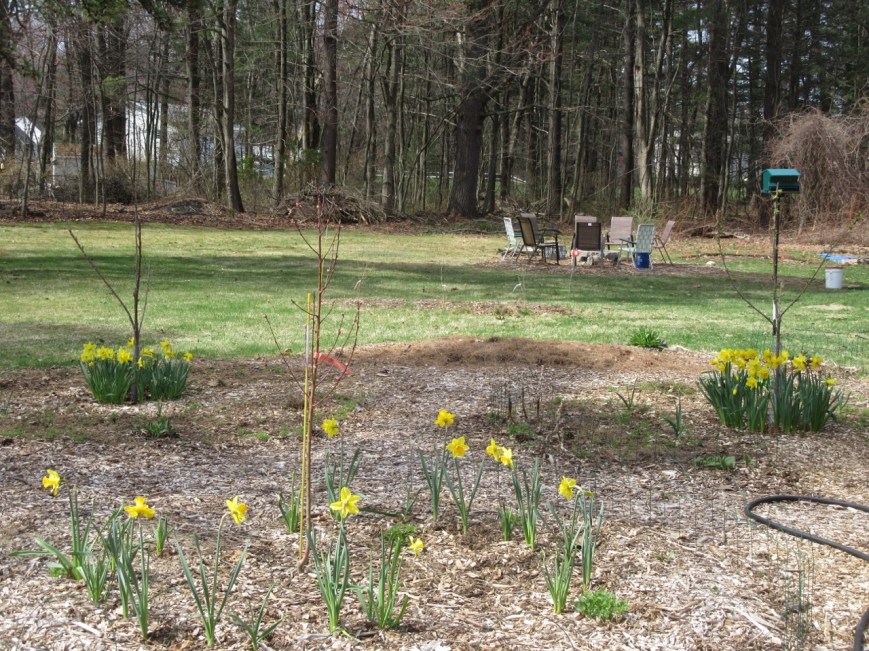
I arrived back home in Maine Monday night, and found Spring bursting forth with flowers, including all these daffodils around the fruit trees in our orchard.  I planted the bulbs last fall because the Holistic Orchard book suggested that they could be protective of the young fruit trees.  But they also create so much beauty as the tiny trees are waking up, and look so spindly and fragile.  But guess what?  If you look closely, you can see that the new peach tree has tiny pink flowers budding out too.

I think we’ve come to that week when everything seems to wake up all at once.  In years past, this has occurred in mid-April, but this year it is aligning with May Day.  As I took a walk around the block, the forsythias were bright yellow, the grass in people’s yards was green and exuberant, and the trees were budding out. I walked along the brook and the trout lily’s spotted leaves were poking up all along the path. Back in the yard, I noticed tiny asparagus stalks emerging from the trenches where I had planted the crowns!

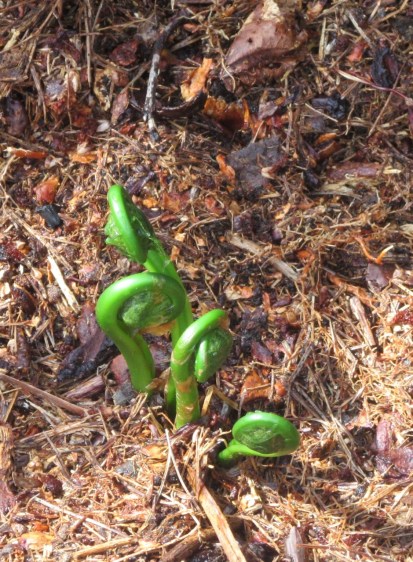
Ostrich Fern Fiddleheads – Version 2

Back in March, I had purchased an Ostrich Fern root at the Maine Garden Show, and kept it in the garage while it was frosty outside.  This morning I noticed that even the fern was already growing bright green, curled-up fiddleheads there in the dark, in its plastic bag, so I planted it next to the white pine tree.

Today the temperature is rising to 80 degrees, but hopefully it will even out again to the 50s and 60s that are our average for Maine in May.  I love this time of year!

May our hearts wake up, too, rising from the weariness of the long winter, into the joy and exuberance of this season of growth and life.

Healing Waters

Healing Mineral Waters Jemez Hot Spring

I am on retreat with my friend in Albuquerque, and we started off by visiting the Jemez Hot Springs, and soaked for an hour in their healing mineral waters.  All of our tensions floated away, and our bodies and souls felt renewed and relaxed. I loved that we were under the watchful arms of an ancient Egyptian river Goddess.

My intention for this time of retreat is to re-emerge myself in Spirit after a long hard winter, to prepare myself for the transition ahead as I retire this summer from my work as a parish minister, and venture into the next phase of my journey.

Times of big changes are liminal times, sacred times, but perhaps also times of anxiety and danger.  I want to stay true to the leadings of my body and spirit that have brought me to this crossroads.  One of those leadings came from the weariness of my body, its chronic illness and auto-immune flare-ups that left me bedraggled and exhausted. I know it is time to stop pushing it so hard.  How fitting for my first day here to bring my body to these healing springs.

I am also already absorbing so much nurture from deep conversations with a sister in spirit who understands the call of ministry and justice, and who understands the lessons of the body, the lessons we learn from limitation and illness.  I am nurtured by this sister traveler into the country of elderhood.  River Goddess


Emergence

Daffodils OpeningI love this week of the year in Maine!  The daffodils just opened today around one of the cherry trees.  Everything is late this year, the weather has been colder than usual.  But they are also just in time, because I am going to New Mexico tomorrow, and I was worried I would miss their grand openings.

Rhubarb opening

[Rhubarb]

I have also been watching the emergence of the perennials we planted last year.

Who knew that rhubarb looked so weird as it comes out?  Like a translucent reddish egg splitting open with wrinkled up green brains inside.

Sea Kale emerging

[Sea Kale]


And the sea kale is purple and wrinkly too.  It will get much bigger as it grows!

The turkish rocket looks healthy and multiple.  This will be the first year we can really taste these perennial vegetables–I hope we like them!  I’ve also now planted some lettuce and carrots, and the snap peas are just breaking the surface of the soil.  Margy is going to water them while I am away for these next few days.

turkish rocket

[Turkish Rocket]

The (Future) Pond

the future pond after rain

With all the excitement about the rain barrels toppling, I didn’t get a chance to share this other effect of the big rain storm:  our future pond actually looked like a pond (with a little island) on Tuesday.  I only had time last summer to dig up the grass and top soil for most of its surface, meanwhile using that soil in our new annual veggie bed.  This is the slow project–bit by bit digging and removing soil (and putting it someplace else) until the pond is as deep as it needs to be–a few feet in the center, with a foot deep shelf at the edges for plants.  Eventually, we’ll use a pond liner.  The water was gone by the next day.