Medicine from the Yard

Dandelion Leaves

[Dandelion leaves]

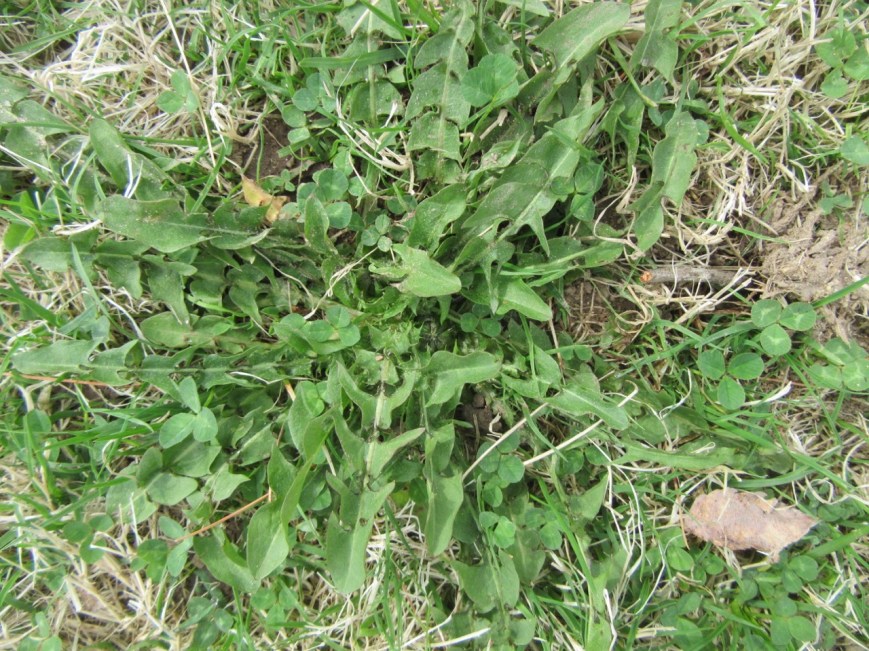
Today and the past two days, I’ve been eating these lovely gifts from our yard–dandelion leaves.  They are best to eat before the bright yellow flowers appear, so you have to search for them by their pointy leaves arranged in a starburst pattern.  I asked the plant for permission to pick them, so that they might become a good medicine for me, and then picked some of the leaves from several plants.

Dandelion leaves are a blood purifier, great spring detoxing for the liver, have a lot of vitamins and minerals, and are full of anti-oxidants. (But be sure you pick them from a place with no chemicals or road run-off.)  I am just beginning to try eating them, so I rinsed them off and chopped them up, and mixed them into some kale I was stir-frying for breakfast, after the kale was already pretty much cooked.  They have a really mild flavor, and I enjoyed them.  You can also eat them raw or in salads.

So often, we just ignore the so-called “weeds” in our yard, or worse yet, try to eradicate them.  What if we saw them as gifts sent to us from the earth, to help our bodies with what they need?  This is what I learned from herbalists–the plants appear when we need them.  So, to ignore them or not use them would be rude, wouldn’t it?

I first began to understand this when the St. John’s Wort started appearing in our yard last summer. St. John’s Wort has traditionally been understood as useful for depression and wound healing. Last summer, at the Healing the Wounds of Turtle Island ceremonies, the spiritual wound that revealed itself to me was the Great Forgetting:  first there was a great disconnection of my ancestors from their relationship with all of creation, and then there was a great forgetting so that the people would be unaware that they were wounded and disconnected, and thus never even seek to understand that they had once been connected. I heard in my mind, “St. John’s Wort can help when you remember the wound of disconnection from the earth, and when you open to the pain underneath the great forgetting.”

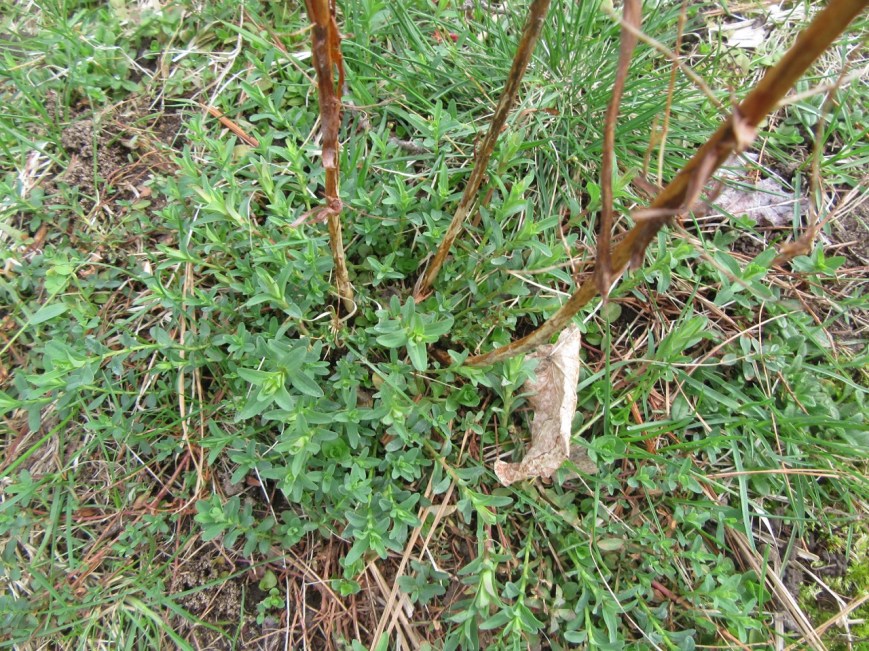
And the St. John’s Wort is returning to the yard this spring as well.  The flowers are best picked just after the Summer Solstice (feast of St. John the Baptist, which is where they got that name), but now the plants are starting to put forth new stems and leaves around the old stalks we picked the tops of last year.  I think picking them has helped them to grow and expand.

I like learning about the plants in this way, one by one, as they make themselves known to me here in this land I call home.
St. John's Wort

[St. John’s Wort]

May Day in Maine

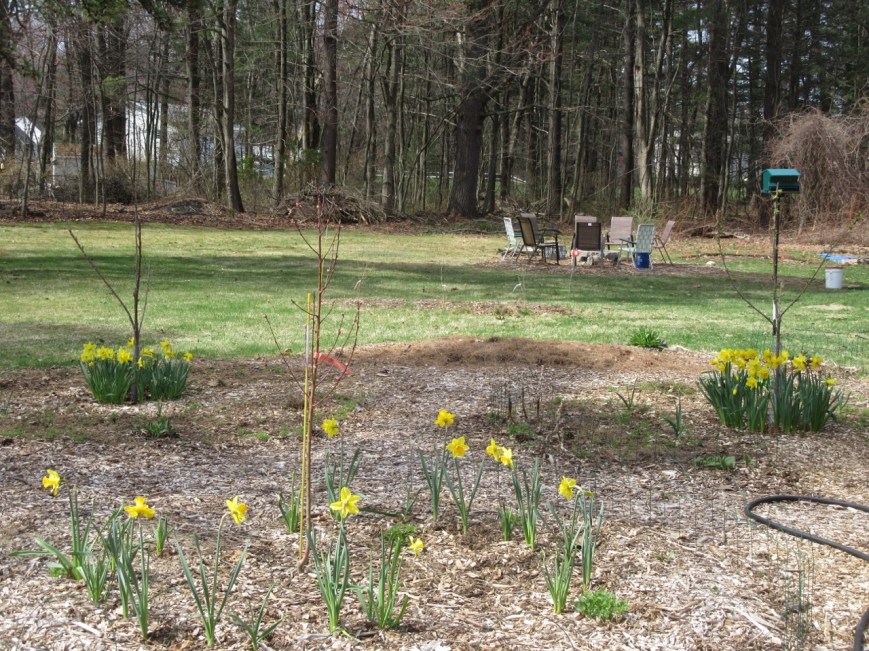
Daffodils in orchard

I arrived back home in Maine Monday night, and found Spring bursting forth with flowers, including all these daffodils around the fruit trees in our orchard.  I planted the bulbs last fall because the Holistic Orchard book suggested that they could be protective of the young fruit trees.  But they also create so much beauty as the tiny trees are waking up, and look so spindly and fragile.  But guess what?  If you look closely, you can see that the new peach tree has tiny pink flowers budding out too.

I think we’ve come to that week when everything seems to wake up all at once.  In years past, this has occurred in mid-April, but this year it is aligning with May Day.  As I took a walk around the block, the forsythias were bright yellow, the grass in people’s yards was green and exuberant, and the trees were budding out. I walked along the brook and the trout lily’s spotted leaves were poking up all along the path. Back in the yard, I noticed tiny asparagus stalks emerging from the trenches where I had planted the crowns!

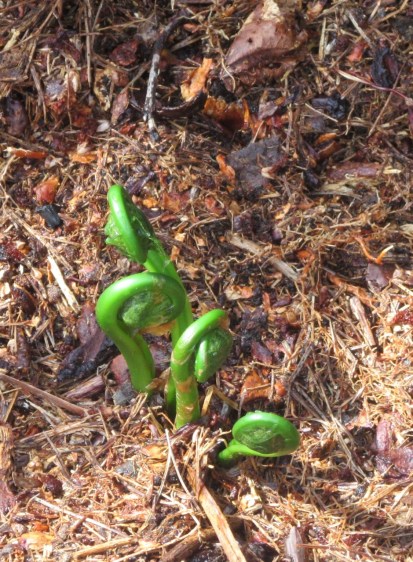
Ostrich Fern Fiddleheads – Version 2

Back in March, I had purchased an Ostrich Fern root at the Maine Garden Show, and kept it in the garage while it was frosty outside.  This morning I noticed that even the fern was already growing bright green, curled-up fiddleheads there in the dark, in its plastic bag, so I planted it next to the white pine tree.

Today the temperature is rising to 80 degrees, but hopefully it will even out again to the 50s and 60s that are our average for Maine in May.  I love this time of year!

May our hearts wake up, too, rising from the weariness of the long winter, into the joy and exuberance of this season of growth and life.

Healing Waters

Healing Mineral Waters Jemez Hot Spring

I am on retreat with my friend in Albuquerque, and we started off by visiting the Jemez Hot Springs, and soaked for an hour in their healing mineral waters.  All of our tensions floated away, and our bodies and souls felt renewed and relaxed. I loved that we were under the watchful arms of an ancient Egyptian river Goddess.

My intention for this time of retreat is to re-emerge myself in Spirit after a long hard winter, to prepare myself for the transition ahead as I retire this summer from my work as a parish minister, and venture into the next phase of my journey.

Times of big changes are liminal times, sacred times, but perhaps also times of anxiety and danger.  I want to stay true to the leadings of my body and spirit that have brought me to this crossroads.  One of those leadings came from the weariness of my body, its chronic illness and auto-immune flare-ups that left me bedraggled and exhausted. I know it is time to stop pushing it so hard.  How fitting for my first day here to bring my body to these healing springs.

I am also already absorbing so much nurture from deep conversations with a sister in spirit who understands the call of ministry and justice, and who understands the lessons of the body, the lessons we learn from limitation and illness.  I am nurtured by this sister traveler into the country of elderhood.  River Goddess


Emergence

Daffodils OpeningI love this week of the year in Maine!  The daffodils just opened today around one of the cherry trees.  Everything is late this year, the weather has been colder than usual.  But they are also just in time, because I am going to New Mexico tomorrow, and I was worried I would miss their grand openings.

Rhubarb opening

[Rhubarb]

I have also been watching the emergence of the perennials we planted last year.

Who knew that rhubarb looked so weird as it comes out?  Like a translucent reddish egg splitting open with wrinkled up green brains inside.

Sea Kale emerging

[Sea Kale]


And the sea kale is purple and wrinkly too.  It will get much bigger as it grows!

The turkish rocket looks healthy and multiple.  This will be the first year we can really taste these perennial vegetables–I hope we like them!  I’ve also now planted some lettuce and carrots, and the snap peas are just breaking the surface of the soil.  Margy is going to water them while I am away for these next few days.

turkish rocket

[Turkish Rocket]

The (Future) Pond

the future pond after rain

With all the excitement about the rain barrels toppling, I didn’t get a chance to share this other effect of the big rain storm:  our future pond actually looked like a pond (with a little island) on Tuesday.  I only had time last summer to dig up the grass and top soil for most of its surface, meanwhile using that soil in our new annual veggie bed.  This is the slow project–bit by bit digging and removing soil (and putting it someplace else) until the pond is as deep as it needs to be–a few feet in the center, with a foot deep shelf at the edges for plants.  Eventually, we’ll use a pond liner.  The water was gone by the next day.

Asparagus Drama

Asparagus Crown

Asparagus Crowns positioned

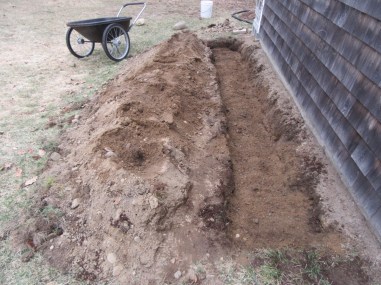
I am trying to catch up on my blogging about all the garden excitement last week, but then we had some more drama this week.  On Saturday, I was able to plant the second asparagus bed, along the side of the garage.  (Sylvia and I had planted the first bed last Wednesday and then started digging the trench for this one.)  Saturday, I finished digging the trench–which also involved pulling out lots of big and small rocks.  Then I added compost and a bit of rock phosphate and wood ashes.  I positioned the crowns on little mounds, spreading out their roots in a star shape around the center.

Asparagus Crowns buried

The part I couldn’t photograph was me trying to lean over the big pile of dirt on the side, to actually reach into the trench to position all those crowns.  It was pretty funny.  After that, I covered them with more compost, and then soil.  As the spikes emerge, you are meant to keep covering them so that only a couple inches show, until the soil is even with the ground again.  So this next photo is rather boring, just a trench of dirt really.  But now you know what is hiding underneath.


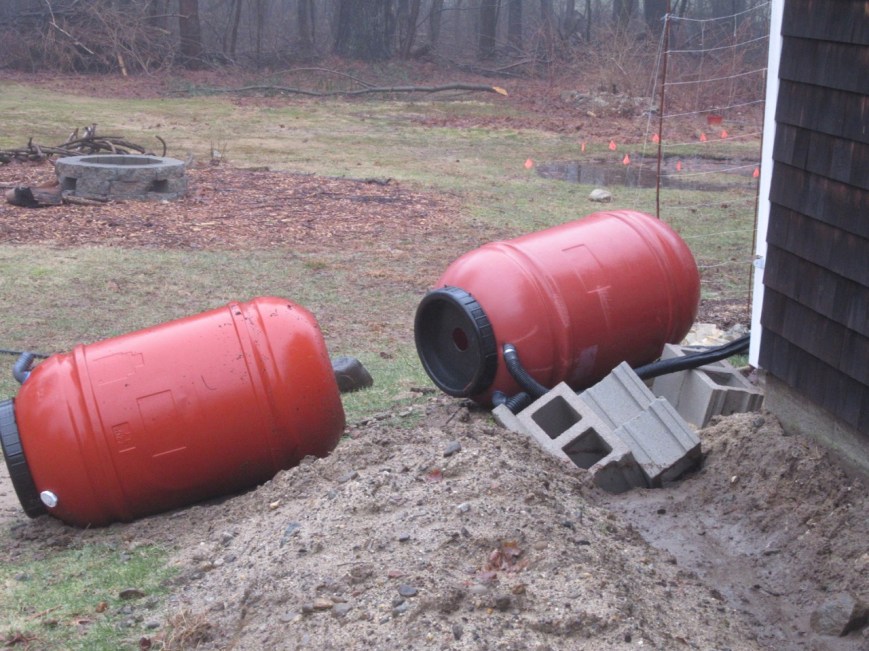
THEN, on Monday night we had torrential rain here in Maine.  Tuesday morning, when I woke up, this next photo was what I saw out my window.  The rain barrels and their foundations had toppled over.  I had extended the trench a couple feet beyond the garage wall, along the side of the rain barrel, thinking that the asparagus would be lovely next to it.  And all might have been well once the trench was filled in again.  But when the rains came pouring down, the soil was weakened, and the barrels were at their heaviest.  The cement block near the edge must have sunk down, destabilizing the balance of the barrels, and the whole set-up collapsed.  The cement blocks fell into the trench.

Rain Barrel calamity

I was able to pull out the blocks, and move the barrels, but will have to wait until the ground dries out a little to set them up again.  I guess I had better fill in that end of the trench before I do it too.  Margy always is reminding me that mistakes are a part of this process–that I am learning as I go along.  Yep–don’t dig a hole next to your rain barrel foundations!

Planting Peas

Planting peas

Friday, March 30, on the day before the full moon, I planted 32 sugar snap peas in the garden bed that I created last fall.  It seems early, but the ground was workable, and I set up the string trellis for them to climb, and re-attached the rain barrels near the back of the garage to make it easy to water them.  (And today it is raining!)  We’ll see how they do.  I will plant more a couple weeks later so that we get peas ripening in stages.  And we’ll add lettuce and carrots and spinach which like to grow with peas, and maybe other things too.  Last year I focused on perennials, but this will be an annual bed.

We noticed last spring that this area was free of snow before other parts of the yard, and got some good sun.  In permaculture, observation always comes first!  So we put this spot into our plan for a veggie bed.  Then, as I was starting to dig out the pond late last summer, I needed to put that top soil somewhere.  So I laid down cardboard over the grass in this spot, and then added layers of soil with compost and grass clippings and other amendments to create a raised bed.  There is still a long ways to go before the pond will be done–who knows how many more raised beds it will inspire?

By the way, that long black hose you can see in the photo is an overflow from the rain barrels, and eventually will be attached to another length of hose to be the water source for our pond.


Daffodils Awake

Daffodil shoots

The snow cover is gradually melting, and in the midst of a brown world, these shoots of green appear.  Last fall, I planted a multitude of daffodil bulbs and also some garlic, as companion plants for the cherries and other (future) fruit trees in the orchard.  So thrilling to see them emerge as the snow melts.

This dance begins so secretly, this creeping green… yet with an inevitable chorus soon to come, soon to be bursting everywhere.  I love these quiet first notes.

Synchronicity

Today I woke late, so I started my walk late–and just as I was coming out onto our street, I said hello to a woman who was walking with her big black dog.  Turns out, she grew up in our house–her family built it. Her dad, who passed away earlier this year, had a huge garden in the back yard. He used a rototiller, and brought in manure and loam, and involved all the neighbor children in planting vegetables.  He’d give them a stick and point to its length and say plant the seeds this far apart.

He planted a peach tree–which did very well, (sadly no longer here) and lots of raspberries and blackberries–which are still coming up behind the garage on the land just next to ours which had belonged to them.  (It still belongs to her mother who lives in a house we can see from our yard–which we already knew.)  Her dad would do the planting and her mother liked to weed.

The big spruce tree next door would be lit up like a Christmas tree every year, to the delight of all the kids.  The man who lived there was in the fire department, so when the tree got tall, he would put on the lights with a fire truck ladder.  (Sadly, that spruce, along with the others in our yard are no longer doing very well.)  At that time, all the families in the neighborhood knew each other, and the kids played together all the time.  She also spoke about the delight of wandering into the big woods behind the house.

She was thrilled about our solar panels and our rain barrels, and hoped she might do that where she now lives on an island.  She is staying with her mother a few nights a week while she takes a class in town. I invited her to come back sometime when the snow had cleared and we were able to be out in the yard.

It delights me to know that there were gardens in this place fifty years ago, and people who were tending to it with care. It delights me that a small unexpected change in my routine led to an unexpected encounter.  Meanwhile, the snow is melting, and the ground will soon be workable–maybe peas this weekend?

back yard

The Back Yard


Cascoak

Our Beloved KinI was excited to hear Lisa Brooks speak at the Maine Historical Society last night.  Lisa is the author of Our Beloved Kin: A New History of King Philip’s War, which is an amazing narrative.  She goes back to original documents and source material, combined with local Indigenous knowledge to reexamine the stories of the New England colonies and the Indigenous peoples during the later 1600s, particularly the unfolding of hostilities that came to be known as King Philip’s War.  I wrote about some of my first impressions in an earlier post.

In her talk, she focused on the parts of the book that were about Wabanaki territory, what we now know as Maine.  One of the things I especially noticed was the name of this place–greater Portland–before it was occupied by settlers–Cascoak.  The Fore River used to be called the Casco River.

I learned more about Skitterygusset, the sachem who first made an agreement for a settler to live near Capisic Brook and its uplands (where Margy and I now live).  Lisa talked about how after the deaths from disease that happened during first contact, many native people were building new alliances between regions, through marriage and family relationships.  Thus, Skitterygusset cannot be understood apart from his relationship to his sister, Warrabitta, who was the leader of Owaskoag (now Scarborough).  Women were often rulers, especially in places where planting fields were located, since women were responsible for the planting fields.  Owashkoag was a sweetgrass gathering place.  Their brother, Sagawetton, lived with his wife on the Saco River.

In settler narratives, when they talk about Indian raids, they write as if the hostilities were random acts of violence.  But Lisa talked about how the raids were focused on settlers who were upsetting the balance of communal subsistence living.  One example was the settlers who had built their houses at Amancongon, which was an important planting field on the Presumpscot River (now part of Westbrook).  Another target was to burn the mills, set up at falls on multiple rivers.  By the time of the “Indian wars” there were 50 saw mills that had been built: they cut and harvested the huge white pines of the forest, processing 1000 feet a day of pine board.  Destruction of the forests meant destruction of the game that was hunted.  The mills also prevented fish from migrating upriver, thus cutting off another important source of food.

I have to stop for now, but I was newly inspired in my quest to understand the history of this place.  I can’t recommend this book highly enough!