Young Cardinal-4 Photos

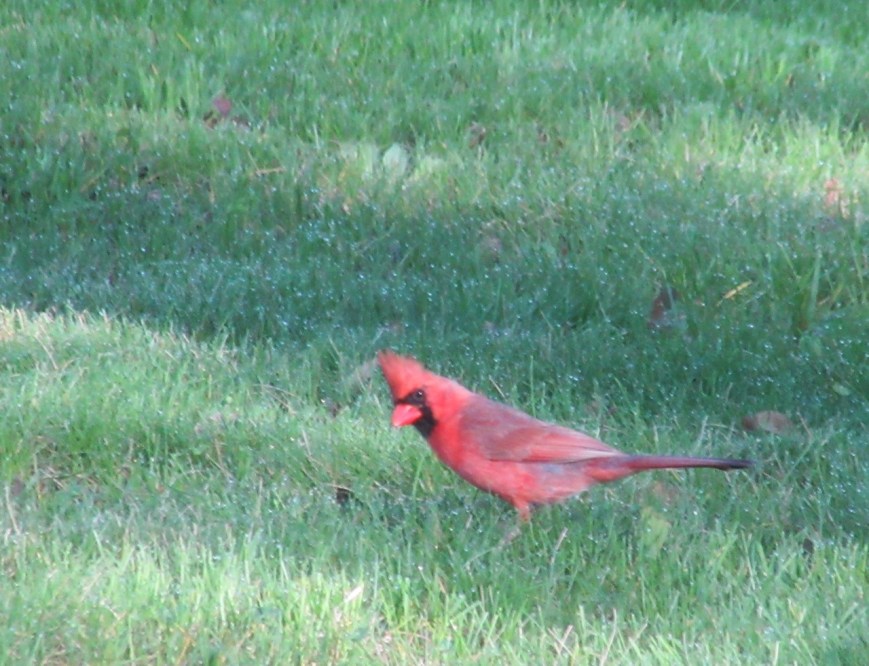
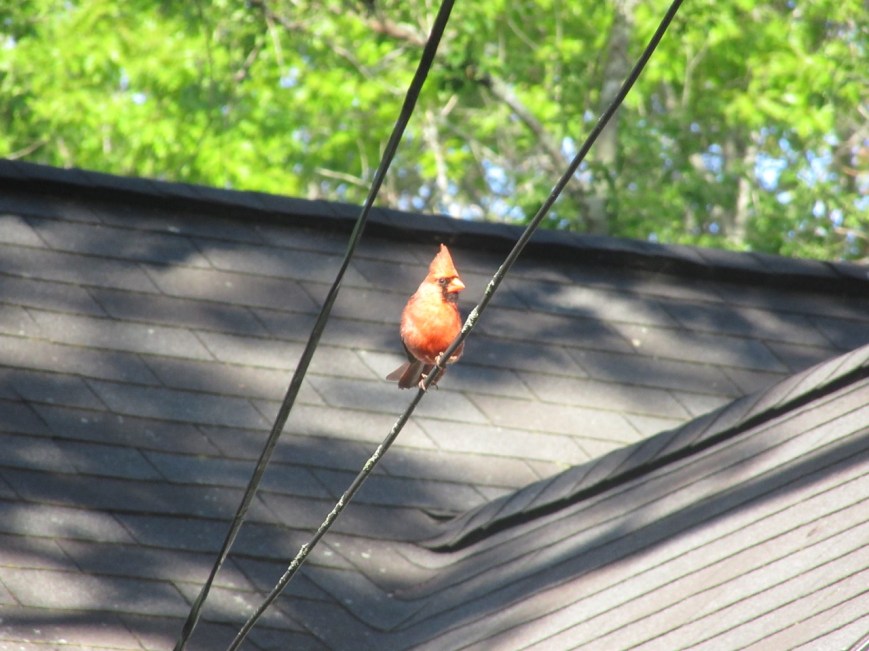
At first I wondered what a cardinal was doing, hover-flying near a flowering bush, almost like a hummingbird.  The next time I took a walk, I saw him sitting on the grass.  He let me take a photo, and then flew up in short stretches to a wire, another wire, a tree branch, another tree branch, and finally, all the way across the street.  That is when I figured out that he was learning to use his wings. The next day, in a misty rain, there he was again, perched on a white picket fence, before he flew up to a wire.  You go, cardinal! I hope you make it all the way.Young Cardinal 1 – Version 2

Young Cardinal 2Young Cardinal 3Young Cardinal 4

Hidden Mysteries

Hidden Mysteries One

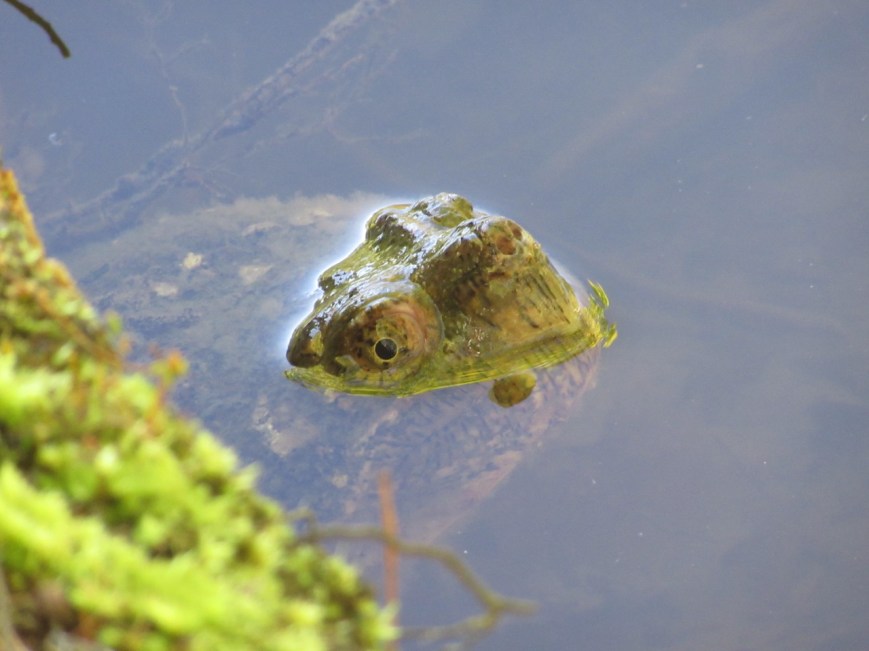
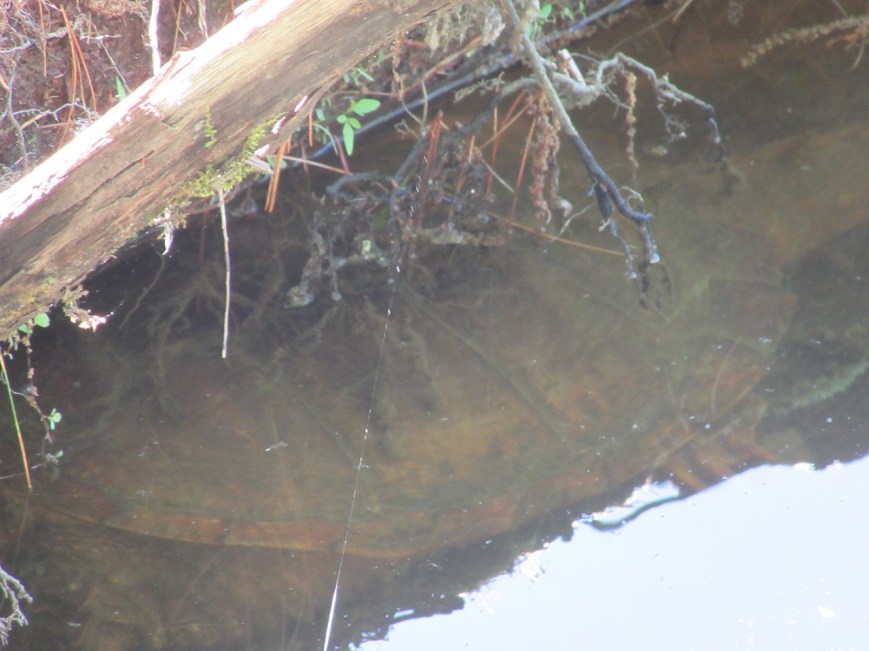
I walked to the cemetery ponds yesterday, and was sitting on a log. I suddenly noticed this strange creature in the water. Very quickly, they disappeared. How often do we walk by unaware of the mysteries hiding almost within our sight? Because I knew the snapping turtle was there, I could see enough to take this next photo, where they are barely visible beneath the water, in the shadow of the log. Can you see it?

Hidden Mysteries Two

How many other mysteries do we miss, how many beauties, how many blessings, lurking just beneath the shadows as we quickly pass by? May we slow down, may we pay attention, may we see what is all around us today.

Cherry Tree Guilds

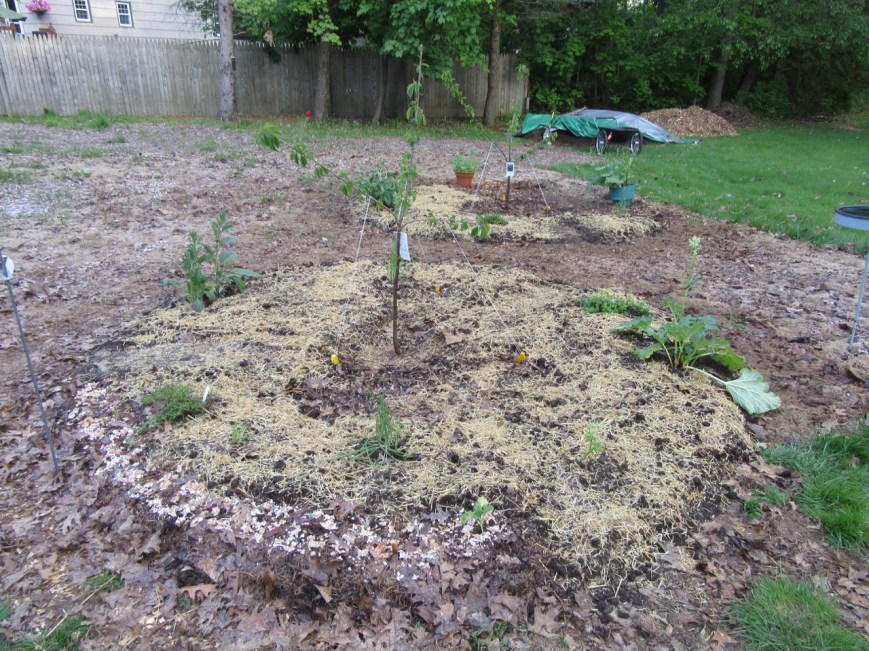
Cherry Tree GuildsToday I almost finished soil work and guild plantings around each of the cherry trees–still 1/3 to do around the second tree.  First I aerated the soil with our garden fork to a five foot radius around the tree. (The soil was already covered with mulch from last fall-wood chips, cut grass, sea weed, and dead leaves.)  Then I put down newspaper or cardboard along the outer half of each circle, and covered it with compost.  I planted the companion plants for each cherry tree guild.  Guilds are plants that work together so that each does better than if they were planted alone.  In this case, the primary focus is the health of the cherry tree.

The plants I used and their functions:

  • Comfrey is a nutrient accumulator–its roots go deep and bring up calcium and other vital nutrients, and then the leaves can be cut several times a season, and used as mulch. It also attracts pollinators and other beneficial insects.  It can be used in herbal medicine. It was recommended to plant it at least four feet from the trunk.
  • Chives accumulate nutrients, deter pests, are anti-fungal and attract pollinators… They bloom at the same time as the cherry will, and are also a culinary herb.  I had enough to do two per tree.
  • Oregano is an aromatic pest confuser, is anti-fungal, can take some foot traffic, and of course is a culinary herb.
  • Thyme is another insect pest repellant and culinary herb (my favorite.)
  • Chamomile accumulates nutrients, is anti-fungal, and attracts beneficial insects..
  • Rhubarb is another perennial food, and can be cut in place for mulch.
  • At the outer edge of the circle around the Lapins Cherry, I also planted a row of annual kale.  The cherry tree won’t reach that far for a couple years, so it works okay.  I mulched them with egg shells, which I understand will deter kale eating pests.
  • That guild also got one Sweet Cicely plant, which attracts beneficial insect predators to kill insect pests. Plus I hear it tastes like licorice/anise.
  • The other tree guild also got Lemon Balm, and maybe a Bee Balm plant–I haven’t planted it yet and I’m deciding if it will get too big–if so, maybe it will go nearby.  The Lemon Balm was from the plant swap, and attracts pollinators and repels ants and flies.  I just read that it will spread.  Bee Balm attracts pollinators.
  • Between all the other plants, I planted Red Clover seeds–they are a nitrogen fixer, and this variety is best for a fungally dominant soil.  It is a good ground cover to keep weeds away, easy to walk on too. I put some straw mulch on the seeds to get them started, but I think I will add wood chips over it all.

Later in the fall, I plan to add daffodils in a ring about 2 feet from the trunk, to deter munching pests.  I also ended up designating two paths into the tree for each circle–so I can get to the center easily.  Once again, I end the day with sore muscles, but so happy.

Training the Cherry Tree

Training the Cherry TreeToday was a day for food forests! My friend Mihku and I went to a tour of Edgewood Nursery in the morning, and then later she showed me how to train the branches of the cherry tree so that it will grow into a good shape for growing and picking cherries.

Aaron Parker of Edgewood is so knowledgeable about perennial fruits and vegetables, and also has so many great permaculture plants to taste and buy.  I fell in love with Turkish Rocket, a perennial vegetable that tastes somewhat like broccoli.  More on that in a later post.  But I also got to see a grown up cherry tree, and get a sense of what they might look like and how they are shaped at maturity.  Back at home, Mihku and I used kite string and tent stakes to bend three branches on each tree closer to the ground, so they grow into a stronger shape–which means developing a wider “crotch angle.”  One branch was left in the center as the leader.  I am so grateful that Mihku and others are willing to show me how–it is so much easier to see it done, than to try to figure it out from books.

After that, because our new garden fork had arrived in the mail, I started aerating the soil around the trees–or I should say, I got 1/3 of the way around one tree–it was a lot of hard work.  Our soil is very compacted, so this is important for soil health, but my whole body is aching now.  In order to feel a bit more accomplished, I focused on that one section, laid down some thick newspaper sections over the soil, added compost on top, and then planted 14 (annual) kale plants, a patch of thyme, some chamomile, and a sweet cicely plant.  These were all plants we got at the plant swap, and the kale were getting pretty leggy.  I added a bit of mulch.  Still much more to do tomorrow.

Finally, I put together a holistic spray that I learned about from The Holistic Orchard book, but was presented in a simple recipe at Fedco Seeds.  Fedco actually sells all the ingredients, but before I knew that, I had searched around and got Neem Oil at Lowes, and ordered two more ingredients on Amazon.  I didn’t have exactly what they recommended, and I didn’t “activate” the EM-1, but as I understand it, this spray will help to colonize the trees with helpful microbes so that they can resist pests and disease, just like probiotics for humans.  Margy had already purchased a sprayer for other yard uses, so all I had to do was mix it up, and spray all over our new trees; and then I also sprayed what I could reach of our ornamental cherries which have been very neglected for years. Here are the important ingredients of this tonic:

Fish Hydrolysate: Feeds soil and arboreal food web.
Neem Oil: Contains Azadirachtin compounds that deter pests and disrupt their life cycles. Neem also is said to stimulate the tree’s immune system, give nutrients to foliage and feed the arboreal food web. …
Liquid Kelp: Promotes growth and helps trees adapt to stress.
EM-1: A probiotic inoculant that colonizes the branches and fruit with beneficial microbes to promote fruit growth and disease resistance. Click here for info on fermenting, or “activating,” EM-1.

Cherry with new underplantings

[Cherry with branches trained, and thyme and chamomile below, plus if you look closely, you can see kale at the very bottom.]

Composts & Mulches

Who knew that there were so many kinds of compost?  According to Michael Phillips in The Holistic Orchard, tree fruits prefer a fungally dominant compost, which you can get by using lots of leaves and not turning your pile.  So that is the kind we’ve accidentally been making at home, since we use lots of leaves and hardly ever turn our pile.  Vegetables prefer bacterially dominant compost, which likes to be turned a lot.  To quote:

Orchard soils ideally contain a fungal presence ten times higher than that of bacteria…. Fungi respond to surface decomposition, whereas bacteria prefer soil disturbance.  We are building a fungal duff of organic matter where the biological action desired is going to take place.  Compost, deciduous wood chips, seaweed, and raked leaves can be added atop [the soil.]

So, last fall, when we spread the wood chips from the old maple tree, we were beginning to create this fungal duff.  Margy topped the wood chips with cut grass and seaweed and leaves.  But when we planted the cherry trees, we had to dig a big hole, so all of that was disturbed, and we put regular compost as part of the soil back fill in the holes; I guess that is not actually recommended so much.

I also learned that the type of mulch matters.  Margy had arranged for us to get some free wood mulch, (hurray!) which turned out to be from evergreen trees.  She had put some of that mulch, along with straw, around the newly planted cherry trees.  But I learned, in The Holistic Orchard, that fruit trees especially love mulch made from wood chips from deciduous trees–most particularly “ramial” wood chips made from twig wood less than 7 centimeters in diameter–because that contains soluble lignins.  The evergreen mulch actually contains compounds that suppress other plant growth.  Who knew?

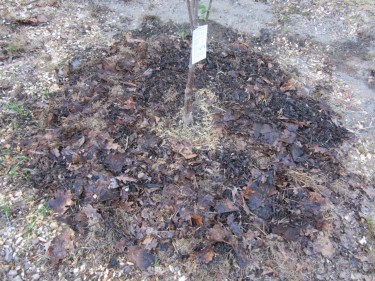
Fungal DuffSo the very next day, I went out and moved that evergreen mulch away, and dug up some of the starting-to-decompose deciduous wood & leaves mulch, piling it up in a six-foot diameter circle around each tree, careful to leave open space around the trunks themselves.  Next time, Margy can ask our wood chip supplier to save us some of the ramial chips.

All this to say, we just got 4 yards of compost delivered today from Wilshire Farm, composted manure to be exact, which we hope to use for creating growing medium for companion plants for the trees, some surface feeding for the trees, and for Sylvia’s herb garden.

I learned about The Holistic Orchard and Wilshire Farm from a workshop on fruit trees by Aaron Parker of Edgewood Nursery, held at the Resilience Hub.  It all seems much more complicated than just planting a tree and getting fruit a few years later.  I am trying to take it one or two steps at a time.Composted Manure

On My Walk

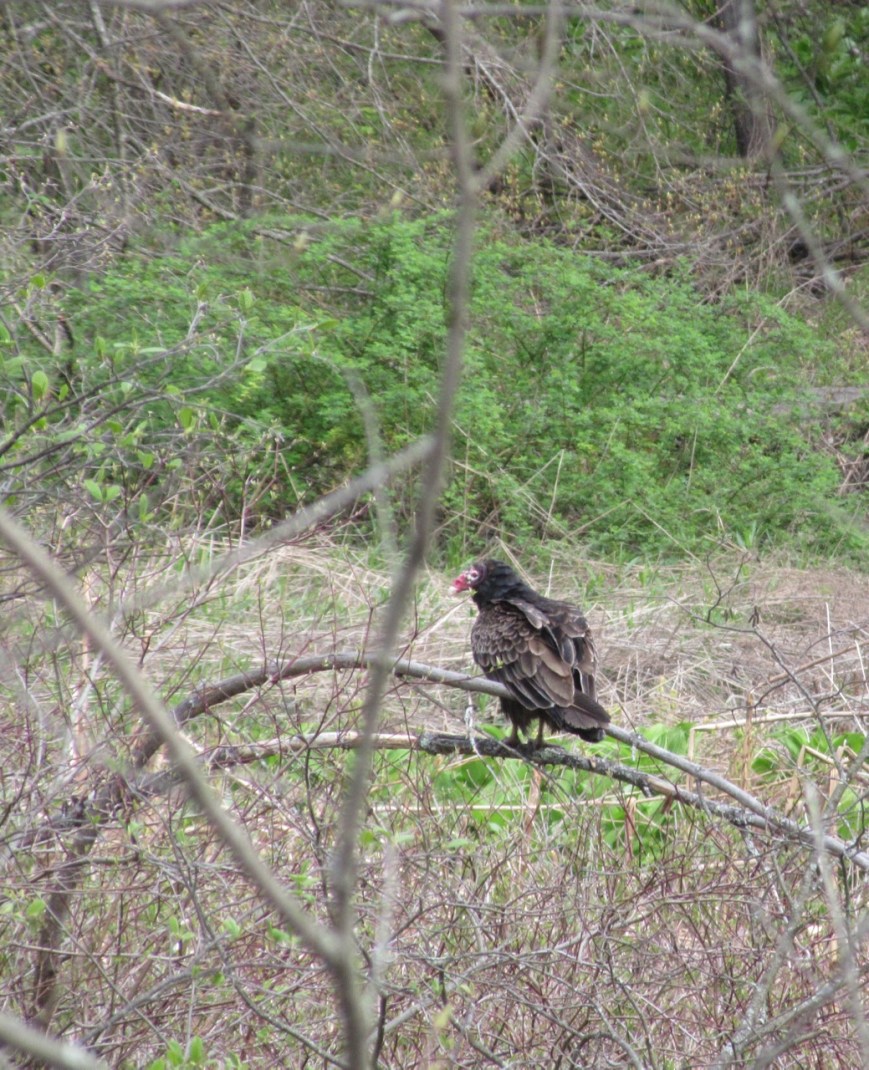
Turkey VulturesOn my walk yesterday, I followed the brook trail by the Hall School. Then, as I was going along the road that crosses over the brook, I happened to look through the chain link fence to my left, and saw these huge birds resting in the underbrush near the brook.  They had not been visible from the trail–in fact I went back to see if I could get a closer look, and they were completely hidden.  Turkey vultures.  I had never seen them in the neighborhood before, but while watching for several minutes, another bird emerged–looking scruffy like a juvenile.  So maybe this was mama and papa’s protected home for raising their baby.

Turkey Vulture Juvenile

You never know what you’ll see in the little thickets and woods along the brook.  Further along my walk, I cross over another branch of the brook.  (My neighborhood is situated between two branches of flowing water that both feed into Capisic Brook.)  Stopping to see what I might see, I almost missed this tiny bird. I want to guess that it might be a black and white warbler–I saw one of those last year on the warbler walk at Evergreen.  But I am not sure.  Anyone?

Black & White Warbler?

American Redstart

American Redstart

Yesterday, Margy found the binoculars, and I walked to the Evergreen Cemetery to join in the Audubon Warbler Walk.  During the walk, this American redstart flew right up to where our group was standing next to the pond.  I had never seen one before.  How amazing that I was able to take photos of a warbler with my small camera!

I love the warbler walk because wise folks will identify and point out birds that I might not have noticed–tiny, and often hidden in thick brush, or in high branches.  I am getting better at spotting them and moving between using my eyes alone and switching to binoculars. I can’t keep track of too many new species, though, so after seeing a wood thrush, a pine warbler and this American redstart, I made my way back home.

American Redstart 2

Permablitz!

We just found out that we were chosen to be a Permablitz site this season, on June 24!  Permablitzes are organized by the Resilience Hub in Portland, and as described on their website:

Permablitzes are essentially the mother of all work parties, permaculture-style.  With permablitz events we tap into our own local “barn raising” ethos to help each other install edible landscapes, renewable energy, water collection systems and more all in one day.

Our hopes are to install several rain barrels, create a frog pond and a fire circle, maybe help with our bittersweet control, and do more soil enhancements and aeration.  We think of these as structural components of our garden, and it is also suggested by permaculture experts to do any earth shaping projects near the start of your work–the frog pond is in that category.   Also, depending on where we are in our planting process, we might get help with sheet mulching and plantings for our cherry tree guilds, and Sylvia’s herb garden.  Our friend Sylvia, who helped us plant our cherry trees, has studied herbal healing.  She doesn’t have land where she lives, so we invited her to create an herb garden here at our home.  We are so excited about this collaboration!

I have been to several Permablitz work parties over the last few years, and while there is a great benefit to hosting a Permablitz, there is also a lot of benefit to participating as a worker. Along with the joy of helping someone’s garden grow, I have learned a little more each time about the principles of permaculture, about strategies for water collection, about soil health, about growing gardens in general, about ideas for edible landscapes that I might never have heard about.  It is also a lovely way to meet folks who care about the earth, and our relationship to it.  So if you will be in Portland on June 24th, you are invited to come to our  Permablitz.  When the event is posted with all the details, I’ll share it.

Permaculture Design, Phase OneThis is a section of our evolving Permaculture Design for our yard.  (It didn’t really work to try to put the whole design into one photo, so this is of the half of the yard nearest the house.) I had started this design by measuring everything in our yard and putting them on grid paper–the grids equate to 3 feet square.  Then we had lots more input with our Intro to Permaculture Design class, and a conversation afterward with the leaders, Heather and Julie.

Last weekend, I went back to the original, and filled in some trees that were already on our land, and then began adding the design elements that are among our first steps in the plan.  I added color!  I haven’t drawn in all of our future ideas.  We are growing our garden slowly, so that we can learn what we need to learn as we go, and not take on more than we can handle right now.  (I am thinking of taking this design and making copies on which to draw our speculations for future ideas.)  I also haven’t yet drawn in Sylvia’ herb garden, which will be near the ornamental cherries, but she hasn’t determined the configuration yet.

I love the design part of the process, and while I sit in the back yard, I am always getting new ideas about where future plants might go.  Blueberries, hazelnuts, apple trees… and then I step back and breathe, and let myself go slow, and enjoy.  Because every step of this process has been such a joy!
Planting the Cherry Trees

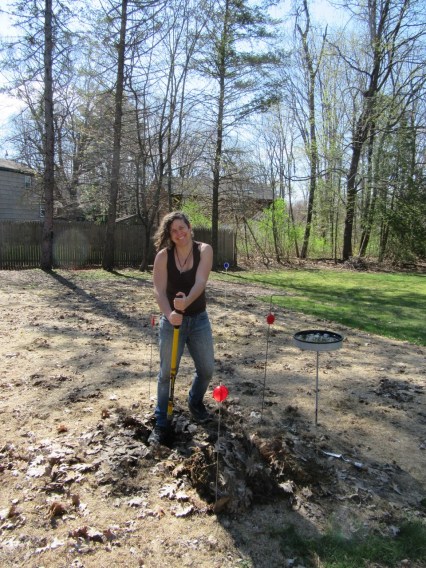
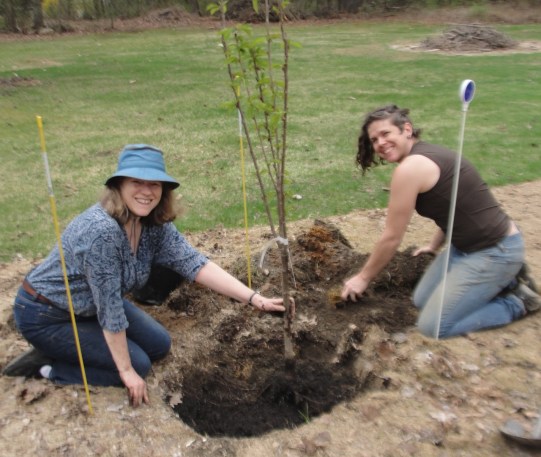
Today was the perfect day to plant our cherry trees, May Day Eve.  I had figured out the locations, and marked them the day before.  Our friend Sylvia came to help with strength and muscles.  She dug the holes!  Thanks, Sylvia!

Our friend Mihku had given us compost from her garden (Thanks, Mihku!) and we realized we needed even more, so Margy drove to buy some, while Sylvia and I positioned the first tree.  I applied mycorrhizal inoculant to the roots (from the wisdom of Mihku), while Sylvia held the tree.  Then we filled in what we could.

Cherry Planting Hands in Dirt

[Photo by Margy Dowzer]

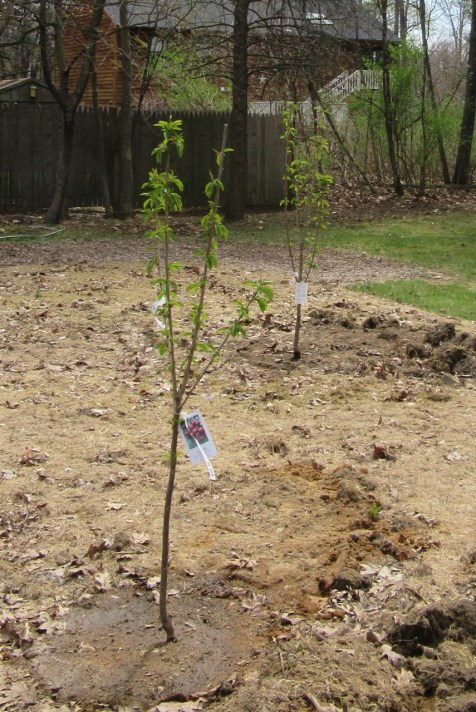
When Margy returned, she took photos while Sylvia and I finished filling the hole with compost and dirt.  I placed the Lapins Cherry closest to the patio, and the Black Tartorian Cherry about twelve feet beyond. We discovered the soil under the Black Tartorian was darker and richer, so we used some of that to fill the first hole too.

It felt so good to have my hands in the dirt, to give good energy and nutrients to these young beings that will live with us in our home.  It also felt good to have help from a younger stronger friend, my aging body just not able to do as much physical labor as I used to do.  It felt really good to share the process, to create a celebration of earth and sun and soil and friendship and the fertility of the land.

More photos:Sylvia starts digging

Myke & Sylvia – Version 2

[Photo by Margy Dowzer]

Cherry Trees in the Ground

Sylvia and Margy

Plant Swap

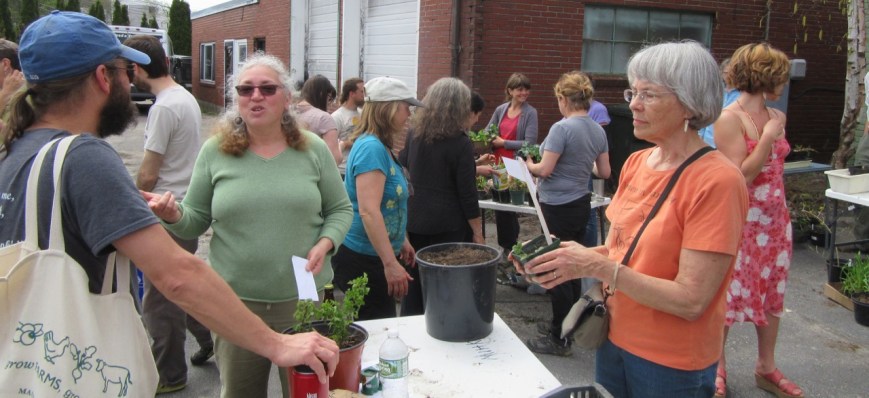
Yesterday, Margy and I participated in the annual plant swap at the Resilience Hub.  We didn’t have plants to swap, but Margy gathered seaweed to bring, and I made some grain-free, sugar-free cherry brownies to share.  We were able to get lots of plants we need for our cherry tree polycultures–plants that we will place around the trees that help the trees to thrive and also have benefits for us.  Back at home, I put them in pots and set up a little “nursery” area near our water spigot, for them to live until we are ready to put them in the ground.

Plant Nursery – Version 2Some of the plants and their functions:

  1. chives–use in a ring around the base of the tree to deter pests, attract pollinators, provide anti-fungal support (cherry trees are prone to fungal issues), plus herbs for eating
  2. comfrey–draw up nutrients from deep in the ground, attract pollinators and beneficial insects, cut the leaves to create mulch, and use for herbal healing
  3. rhubarb–more mulch, and delicious eating
  4. oregano–aromatic pest confuser, anti-fungal, can handle foot traffic when harvesting cherries, and cooking herb
  5. thyme–aromatic, one of my favorite herbs for cooking and health
  6. chamomile–anti-fungal , attract beneficial insects, draw up nutrients
  7. lupine–nitrogen fixer
  8. kale seedlings–especially as the tree is growing, to use the space for growing my favorite vegetable.

We also plan to plant daffodils around the drip line, to deter pests, attract pollinators and have beauty; plant the perennial seakale for good eating, maybe some asparagus; and sow white clover in the spaces between other things, as a nitrogen fixer.

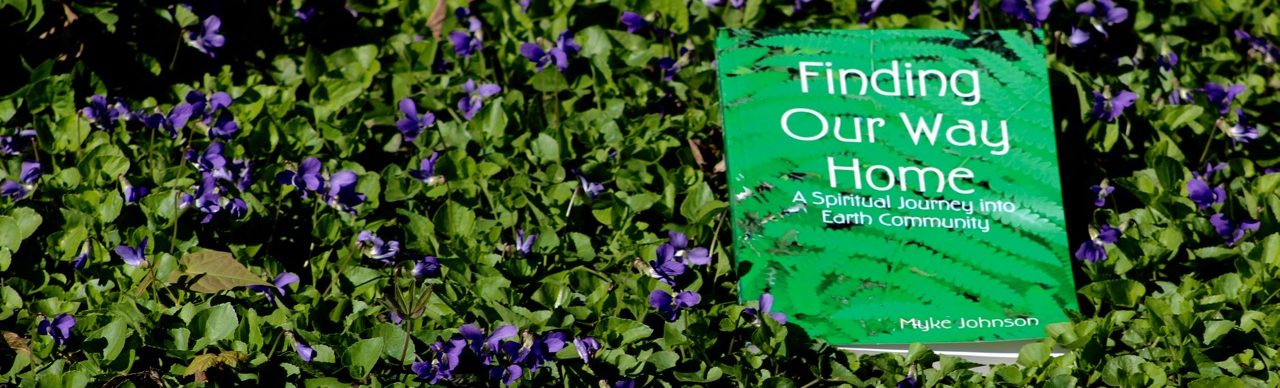
The plant swap was a lot of fun, meeting other permaculture gardeners, and learning more about some plants that I didn’t know about.  I also met someone who was using my book for teaching classes at her Quaker meeting. How great is that?

Plant Swap