The Red Bird is Singing

cardinal at dawn

On my walk this morning at sunrise, I heard the cardinal singing, and then, for the first time this season, I was able to see him up high in the trees.  There is a symphony of birds each morning, that has been going on for a couple weeks–since around Groundhog Day actually.  I read that birds have photoreceptors in the bases of their brains that record the length of the dark period each day. As the darkness shortens, and as days lengthen, birds get spring fever.  Just like us.  So their songs signal that spring is just around the corner.  Or at least that we are halfway there.  Maybe we in Maine should call Groundhog Day, “Bird Song Day” instead.

The Importance of Naming

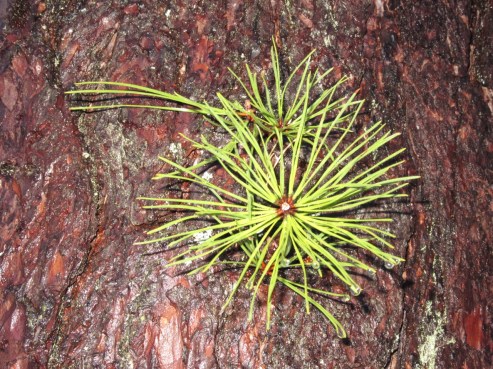
Pitch Pine needlesIn my attempts to get closer to the pine in our yard, I made an important discovery today.  It is not a red pine, it is a pitch pine. I discovered that its needles come in groups of three–and the red pine comes in groups of two.  So then I went searching for a resource I remembered from a couple years ago–an identification guide of the pines of Maine, and confirmed everything.

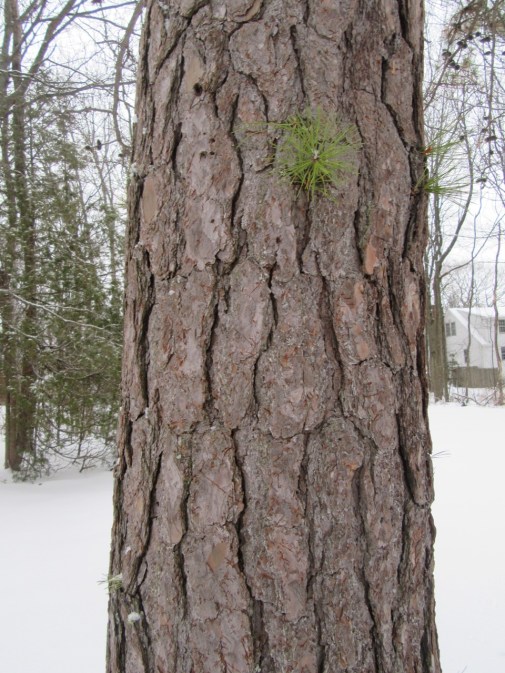
It is a funny thing.  I had used that resource earlier to identify the tree as a pitch pine, especially because of its habit of small patches of needles coming out of the trunk–as in the picture above.  But then the arborist said no, it was a red pine, and so I deferred to their judgment. Perhaps that is one of the lessons for me to learn–arborists don’t necessarily have intimate knowledge of all tree species. Sometimes it takes detective work, which is easier with the many resources that are available online.

So this naming is making a big difference in my relationship with the pine.  Now I understand the prickly feeling–according the guide, “Pitch pine cones have a sharp prickle at the end of each scale.”  They are prickly!  It also says, “Branches are horizontal, rigid, contorted and form an open crown.”  That describes so perfectly the irregular beauty of its shape.  “Pitch pine attains a diameter of 1–2 feet, and a height of only 30–40 feet.”  These height numbers relieve the anxiety I had about the tree possibly growing to shade our solar panels–it is likely fully mature at its current height.

What else?  It is native to eastern North America. It can live to be 200 years old. It tends to grow in acidic, sandy, and low-nutrient soils. It is a “pioneer species” and is often the first tree to vegetate a site after it has been cleared. So perhaps it speaks to the history of this land–that this land was cleared, that it was depleted. The tree can also regenerate itself–if the main trunk is cut or damaged by fire it can re-sprout using epicormic shoots, which is unusual for a conifer.  (This might make it a candidate for coppicing or pollarding–the practice of cutting a tree to use the wood, after which the tree regrows.)

According to Wikipedia, “Pitch pine provides a habitat and offers food for many wildlife species. They are used as cover and nesting for birds such as the pine warbler, wild turkey, blue jays, black-capped chickadees, black-and-white warblers, and chestnut-sided warblers. Small mammals and birds eat the seeds.”

I feel like the tree and I are starting all over again with getting to know each other–now that I know the tree’s actual family and species–now that I know its family name.

Red Pine

Red Pine[Edited: I learned 2/12/18 that this is actually a pitch pine. See my new blog post.] There is a red pine in the middle of our back yard… the only big tree (40 plus feet) that is not at the edge of the yard. But I have been struggling to create an affectionate relationship with this tree. I have had other very special trees in my life, and I loved the many trees that surrounded our home in North Yarmouth.  So why is this one hard?

I have been reading a lovely book, The Garden Awakening by Mary Reynolds, which is focused on creating a relationship with our land. She talks about trees as the guardians of the land.  So if we want to go deeper with the land, we need to go deeper with the trees.  That got me thinking again about the challenge of the red pine.

Perhaps it started when we first moved here, and were concerned about trees possibly shading the solar panels.  Or perhaps it is tied to my grief about the maple tree that was by the side of our house which we did have to take down because of dangerous branches and solar shading.  I loved that tree, and felt the contradiction so acutely: even though the maple tree was willing, and its wood became the ground layer mulch for our future orchard.  We decided that the solar panels would be okay with the pine tree’s slight shading, but it did get us off to a wary start.

So here it is.  It was identified as a red pine by an arborist who came by.  Right now, I have an intention to go deeper with this tree.  I want to understand all the dimensions of this relationship.  Some things that feel difficult to me:  The branches are all too high to reach, so it feels rather aloof.  When the pinecones drop, and there are lots of them, the ground underneath becomes difficult to walk on.  All around the tree there are old pinecones half buried in the grass from many years past.  If I could pick one word to describe my feeling of the tree, it would be “prickly.”

What helps? Last spring, we held an introduction to permaculture design course at our house, and many of the participants commented on the loveliness of the pine tree. There is a beautiful asymmetry in its branches. Their appreciation of the tree helped me to see its beauty.  The red pine is native to North America.  They can live up to 350-500 years.  Some sources said pine trees are symbols of longevity and wisdom.

Red Pine BarkOne website mentioned that its roots “are moderately deep and wide spreading. The lateral root masses also send down “sinkers” which anchor the tree very well in the soil. Red pines are very wind firm because of this dense root system.”

Okay, deep roots and anchors in the soil. I like that. I am investigating medicinal uses: one might be pine needle tea, which is good for immune function, bronchitis, and many other ailments.  More to research here.  This morning, I took pictures of the pine, and stood next to it, leaning against the bark.  What do you have to teach me, dear red pine?


A No-Win Gamble

The other day I read the “Medicare and You” brochure in preparation for my own “graduation” to Medicare this coming summer.  It has been hard since then to shake a sense of foreboding.  My first reaction to all of it is how can our society treat our elders with such lack of care?  I don’t mean that it is bad that we have Medicare–I wish we had something like Medicare for all–single-payer health care–in our country.  But what we have now seems so bereft of full medical care, that participants are encouraged to buy extra care to cover all the gaps in care.

But it is not merely that you can choose to spend a certain amount per month to cover the gaps–a kind of gambling in itself about whether you will save more than you will spend.  It is that you have to decide between a dozen or more types of options, which kind of product to buy–all seemingly based on making a guess about your own unknown future health needs and prescription needs.  The supposed explanations for the different types of plans amount to gobble-di-gook, if you ask me….

Does anyone besides me see this as a particularly insidious way to torture people?  “You can choose!  Read all this information!  Oh, whatever you choose today will affect your future!”  A gambling game based on what?  (Is it anything besides a way to bring further profit to insurance companies?)  Then in today’s paper I read Michelle Singletary’s column The Color of Money, “Medicare trend causes palpitations,” and felt even worse.  She writes:

New analysis by the Kaiser Family Foundation has found that out-of-pocket health care costs for Medicare beneficiaries are likely to take up half of their average Social Security income by 2030.

I hesitate to blog about this issue because by doing so I have to reveal elements of my own financial situation–and money is one of the last taboos.  But I am feeling bold today. I will admit that despite the many blessings in my life, when I stop working, I will be one of those senior citizens living on a fixed low income.  We have been very lucky–we have a home, with solar panels (lower electricity costs) and a yard for gardens.  But homes also cost money for upkeep.  I worry that eventually I will be one of those who has to decide between medical care and eating.  And I am so angry that elders are put into that position today!

In the world I dream of, “health insurance” would be something paid for by the healthy, to take care of anyone who becomes sick–which eventually will be most of us, as we age. In that world, no one would risk losing their home because they become ill, no one would have to gamble based on unknown future events, no one would be left to die because of a lack of money.  There is a lot more to say about all this, but I have to stop now and go to the ocean… get some perspective.IMG_4237

Deck Roof

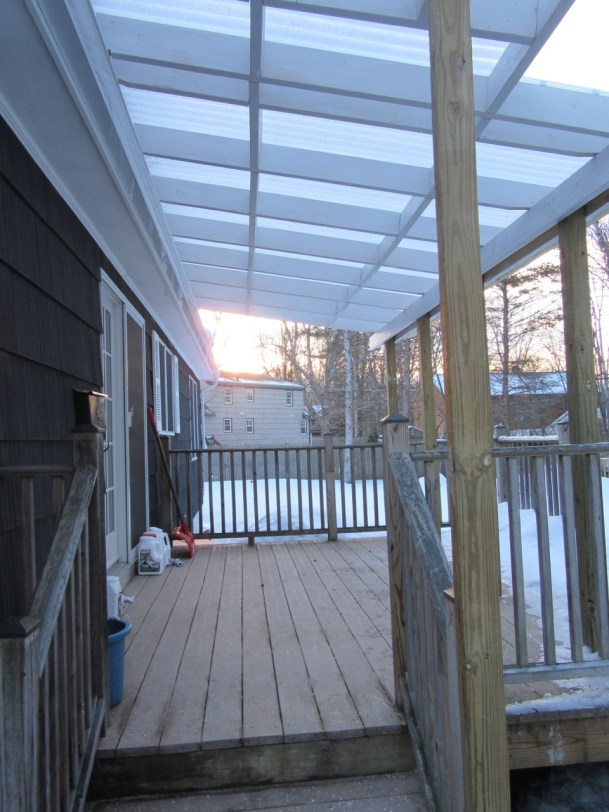
Deck RoofThe first winter after we installed solar panels on our new house, we discovered that when the snow melted on warm winter days, all the snow from the panels came down like an avalanche, right onto the deck, in the path from our back door that we used every day. I was out there shoveling first when the snow fell down, and then when the avalanche came down–sometimes in two or three segments.  And that second snow was always heavy wet and dense. #thingsyouforgottodesignfor

We needed some sort of new plan.  So we came up with an idea with our friend Ian, and he built this partial deck roof, using Tuftex polycarbonate roof panels and wood framing.  It was wider than we first imagined, to use the support beams under the deck for the framing.  Took longer than expected.  Doesn’t everything.  But such a relief now that it is up.  The panels are clear to let the light shine through–though in this photo they have some snow cover.  And they work–the snow avalanche slides down the solar panels, right cross the deck roof and lands in the space beyond.

Robins Flocking

Robins in Tree

Almost every morning, I take a walk around my neighborhood.  Even on cold days, or icy days, I never regret going outside.  I never know what I might see.  One day, a whole flock of robins had gathered in these ice-coated branches. I heard them before I saw them.

Today it was very icy.  I walked a few blocks down the street, and then ventured over a slick snow mound to get to the path by the brook.  Someone had cut a few steps into the huge pile, but once I reached the top, I just sat and slid the rest of the way down the other side.  After I stood up again I realized that I was committed now–there would be no way to get back up from that side.

So I walked over to where the trail began, and looked at the shininess of the frozen rain-covered snow.  In order to keep from slipping, even with yak-trax on my boots, I ended up stomping through the crust at the edges of the path.  Still, this has been my favorite part of my morning walk, to be next to the flowing water, surrounded by trees, breathing in the freshened air.

Even in the city there are these pockets of wild nature.  Even with construction going on just beyond the view of my lens.  Even when I think I want to stay inside, there so many wordless reasons to put on heavy coat, hat, scarf, and boots and greet my earthly neighbors.

icy path


Oh!!!!

Digger ProblemI had a revelation!  I have been thinking I was having a tug of war with a groundhog, because despite the fact that I had been using a very potent deterrent liquid, each morning I would discover this mess around my cherry tree beds.  But no more plants were being eaten.  So what to do?  I did more research and discovered that the mess in my garden was likely not caused by a groundhog at all.  Because the digger is nocturnal, and groundhogs are not.

Rather, it is likely a skunk (who is a nocturnal digger) is rooting in the mulch for the grubs of Japanese beetles.  And then I realized that the rooting appeared about the same time as the Japanese beetles on the cherry tree leaves (which I have been picking off and dumping in soapy water).  So I don’t really have a digger problem, I have a grub problem.  In fact, the skunk is helping get rid of the Japanese beetles.  But I’ve ordered some Milky Spore disease to inoculate the soil to create a more permanent and organic solution to the Japanese beetle problem and that will eventually deal with the digger problem.

I learn so much every week about gardening, usually through problems.  But I haven’t seen the groundhog lately!  (Knock on wood chips.)  Thank you, skunk!

Wounds Remembered

View from our tent MD

[View from our tent Friday morning, photo by Margy Dowzer]

Healing the Wounds of Turtle Island was a powerful, moving, four-day gathering, with teachings and ceremonies led by Indigenous elders from near and far.  It included the stories of so many people, many of which are not mine to tell. But I want to share some of my own story at the gathering.

Wabanaki means people of the dawn, and there were ceremonies at sunrise each day led by Bobby Billie, a spiritual leader from the Seminole in Florida. I am also a person called to the dawn, so I was present each day for that time.

The first day, several of us had gathered near the arbor in the mist around 5 a.m., but no one had yet arrived to lead the lighting of the fire.  So I prayed my own dawn prayers, and felt this message from the sun–“You are all bathed in love.”  Later that morning, Anishinaabe women from the Midewiwin Lodge sang a song about the love the Sun has for all of us.  I was so moved by the melody, the voices, the drumming on the Little Boy drum.  It went straight to my soul.  They said it was about the first woman to walk the earth, expressing her joy at seeing everything in creation.

The first day was devoted to healing the wounds carried within the hearts and minds of the people from our long history of violence.  The wound that became clear to me was a Great Forgetting:  first there was a great disconnection of my ancestors from their connection with all of creation, and then there was a great forgetting so that the people would be unaware that they were wounded, disconnected, and thus never realize that they had once been connected.  At the end of the ritual, we each were invited to offer tobacco to the fire and make a solemn promise.  My promise was to remember, to remember the wound and to remember the connection.

Also coming into my thoughts was the herb that has appeared on our land–St. John’s Wort–which has traditionally been understood as useful for depression, and also as a wound healer.  I seemed to hear in my mind, this plant can help when you remember the wound of disconnection, when you open to the pain underneath the great forgetting.  I had harvested some of the plants earlier in July, and they were infusing in oil at home–the oil turns red from the plants.  When I got home, I also harvested more of the plants and hung them to dry in our garage, for making tea.

I know that there will be many more rememberings, lessons I carry from this time, but perhaps that is enough for now.  I do want to offer my thanks to Sherri Mitchell who has carried the dream of these ceremonies for many years, and who called us together and enabled it to come alive.
 

Layers of Community-Composting

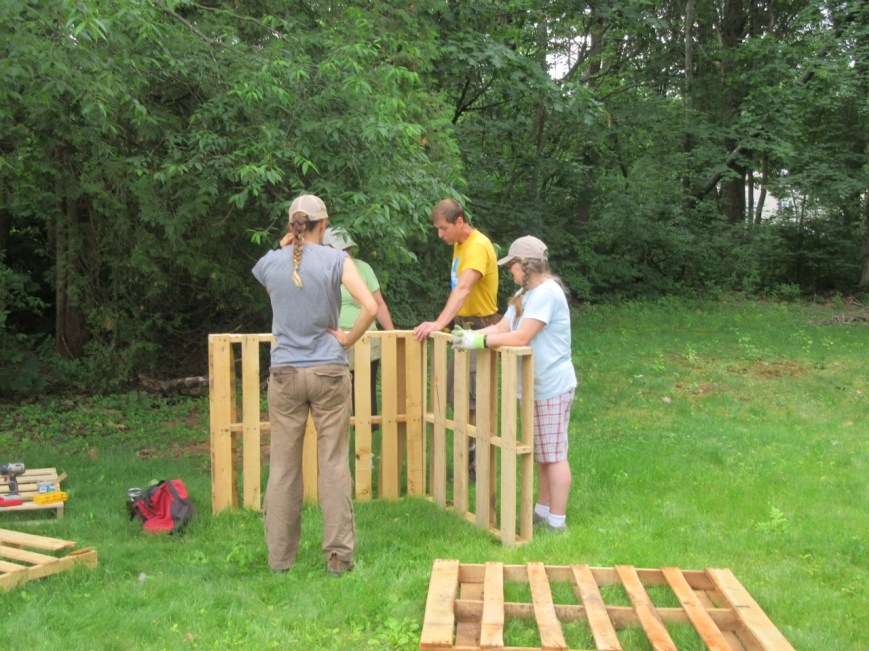
Compost Bin Team Ian, Sally, Ali, MihkuOne more post about the Permablitz!  We had a team of folks who created a composting system from recovered pallets.  We have been using a container system for our kitchen waste, but these will enable us to compost more yard waste.  One of the principles of permaculture comes from the fact that in nature there there is no such thing as “waste”–the “surplus” from any process is shared to be used by another process.  So too in the community of our yard–leaves, grass clippings, weeds, can all be repurposed to create great soil.  And it is a further repurposing to use surplus pallets for the construction!

These use deck screws to attach them together.  And by the way, if you want to make your own, it is important to find Heat Treated pallets, rather than chemically treated–so that your compost isn’t contaminated by arsenic or other metals.  Heat treated pallets are marked with an HT on the wood.  Heather found these lovely-looking pallets for us.  Margy and I had been finding them here and there, but most of ours were pretty banged up.

When you first establish a permaculture garden, you often have to import soil amendments and wood chips and such, but ultimately, you want a garden that is self-contained, that creates its own mulch and compost and good soil.  We imported 4 cubic yards of compost for our garden bed project, (and just the other day purchased more for the blueberry beds) but hopefully at some point in the future, we won’t have to import compost any more, because the yard itself will making enough of it.

What might our world be like if we eliminated the whole idea of “waste” from our communities?  If every surplus was shared for another process or function?  If nothing and no one was ever thrown away?

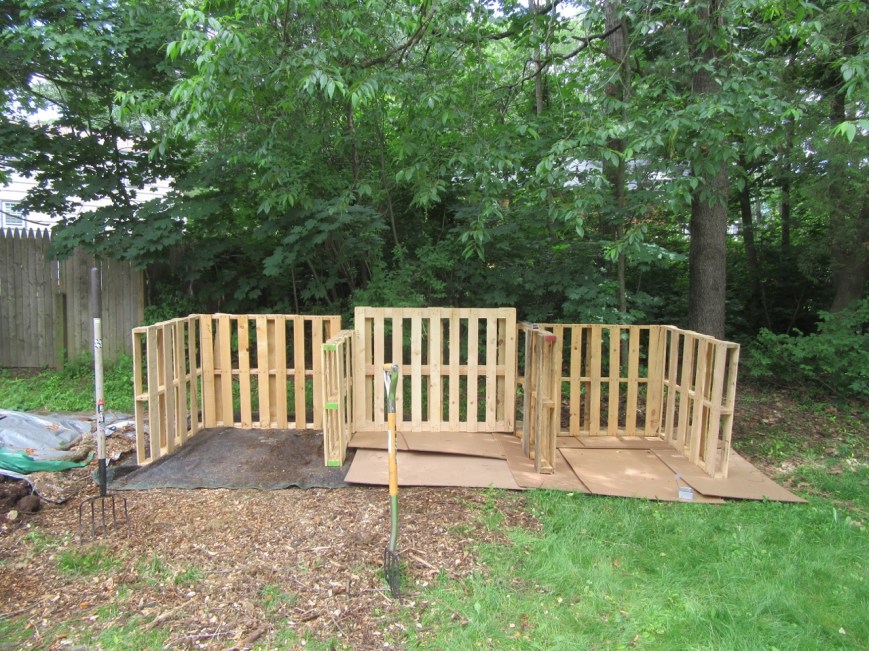
Compost Bins Done!

Finished!  By the way, you don’t have to put cardboard or tarps on the bottom–we did because of the bittersweet in our yard–to discourage it from growing into the compost bins.


Future blueberries

Blueberry bed complete.jpgThe last few days I have been working on a garden bed for two future high bush blueberry plants.  This was the toughest project so far, in terms of physical stamina.  I was following the guideline of Michael Phillips in the Holistic Orchard.  His first step is to dig a bed one foot deep and 3-4 feet in diameter per plant, (so for me that meant about 7-8 feet long and 3-4 feet wide).

Blueberry bed-bittersweet rootsOnce I had dug the hole, I came upon bittersweet roots, so then spent some time strategizing about what to do for that.  I eventually decided to clip them off where they emerged, and then line the sides of the hole with cardboard. Since I was also making paths around the bed, I bent the cardboard so that it covered the path as well.

Then, the next steps are to fill the hole with 50% peat moss, 40% soil from that you had taken out, and 10% compost.  Peat moss is somewhat controversial (because of environmental questions raised about its extraction), but I did some reading and learned that the percent of peat moss taken in Canada is very tiny compared to the amount of peat moss bogs they have–so in that context it might be considered renewable.  I had to go back to the store to get more stuff, because it was hard to estimate how much I would need.

Blueberry bed-half doneAnd it is a lot of work to dig out a hole, then fill it with other stuff, and then “stir” it around, which really means turn the soil over and over.  I am glad I only have to do it once.  So I would do what digging I could, and then stop and rest for most of the day, and return to it in the evening if I could.  After the peat moss, soil, & compost mix was in, I added 2 cups elemental sulfur, 4 cups green sand, and 2 cups rock phosphate, all organic nutrients.  This whole mix is meant to create the type of soil that blueberries love, with an acid leaning ph, and the nutrients they need.  (You may notice that I purchased more composted manure, because we used up our big pile.)

I topped it off with a few inches of pine bark mulch that is also good for blueberries, and then some pine needles that Margy had collected last year.  After that, I hauled the rest of the unused sandy soil over to our materials area, and did the paths around the bed with more cardboard and hardwood mulch.  And watered all of it well.  Now it is all ready to do its own thing for several months:  the plan is to plant blueberries in the spring.