We’ve had a string of very hot weather and then lots of rain, and I hadn’t seen our three bullfrogs in the pond for a while. I wondered what that might indicate? Today, I went out and a pond lily was blooming, and there were three new tiny green frogs sitting on lily pads. Who knows where they came from?
I woke this morning feeling heavy and sad with all the problems in the world, with isolation, with a lack of direction or purpose. So I brought myself outside and this little surprise happened and it lifted my spirits. I am grateful for that.
While on my morning walk, I suddenly saw a monarch caterpillar on a milkweed that had planted itself in our roadside strip. The next day (today), I saw three more. All we did with the milkweed was let it keep growing where it showed up on its own. There are two plants by the road, and three or four more in a patch out back near the pond. But the monarchs found them all the same.
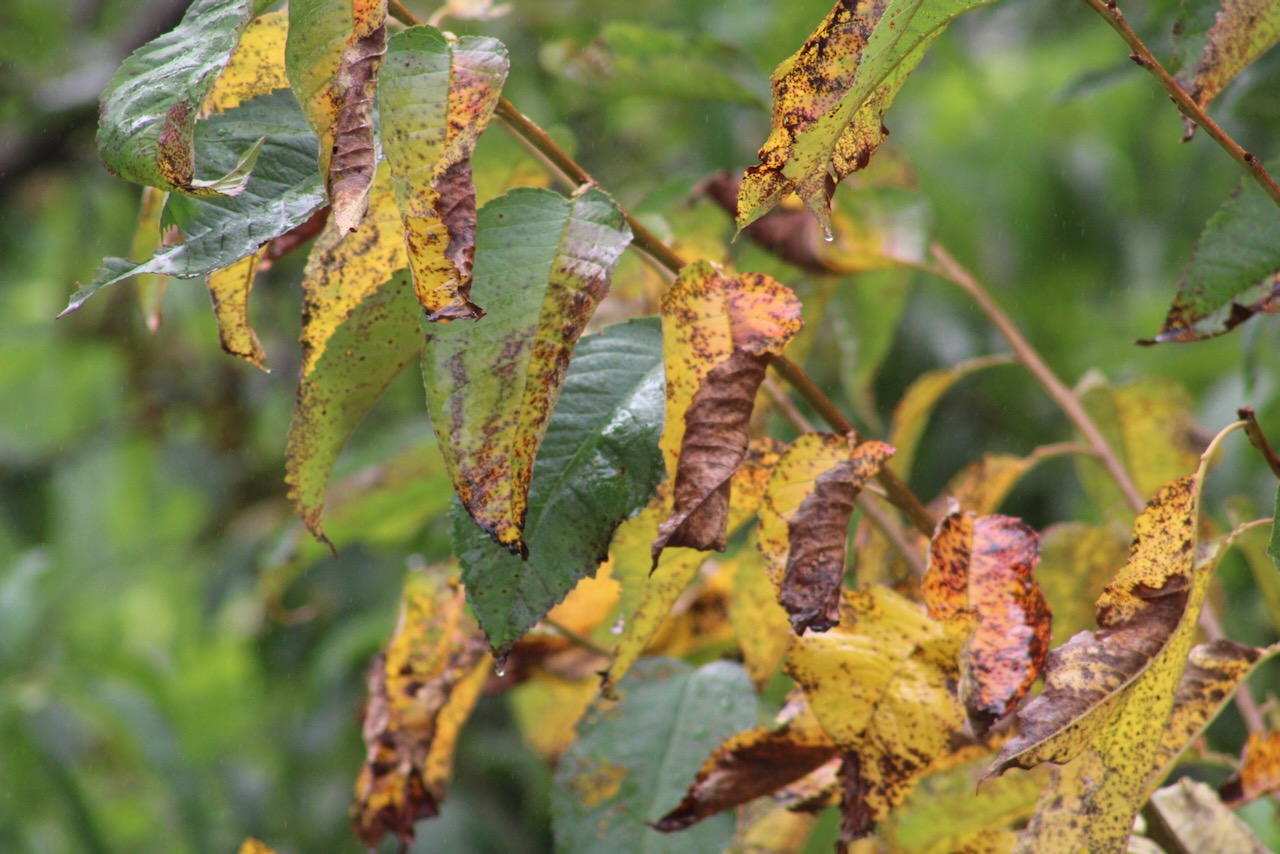
I have been feeling discouraged lately about my ability to garden. First of all there is the challenge of chronic fatigue that limits my energy such that even one small project outside in the morning can wipe me out for the rest of the day. But then there is the limitation of my own knowledge about the green growing beings. Right now, it is the cherry trees that are struggling with some disease. I am thankful to Aaron Parker of Edgewood Nursery who suggested, after seeing photos, that they are most likely dealing with Cherry Leaf Spot.
The possible answer is to clean up all the infected leaves on the ground and on the tree, and use an organic probiotic “Monterey complete disease control.” But even so, it might not work. Another website suggests natural remedies such as neem oil, potassium bicarbonate, and copper fungicides, which can be used to manage fungal infections like leaf spot. This season, I hadn’t done any holistic sprays because the sprayer takes a lot of personal energy to use. So I feel sad about the cherry trees, and even though I ordered some of the Monterey remedy, I feel discouraged about how much more work I’ve made for myself. Will it even help?
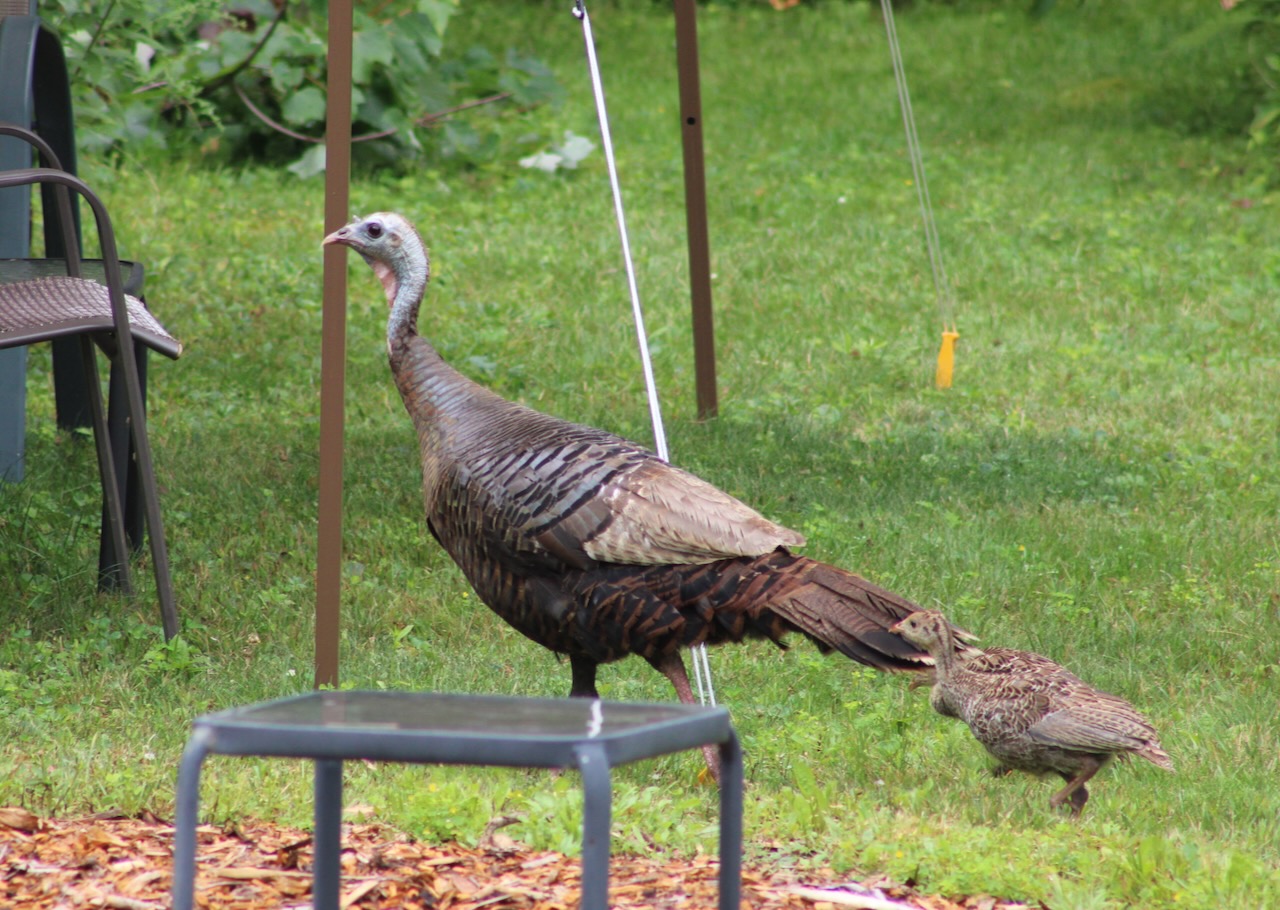
But in the midst of this discouragement, the caterpillars showed up on their own. And meanwhile, a turkey mom and her three babies have wandered through the yard a few times. Here we see them scooting under our canopy where we sit outside in some shade.
Meanwhile, the front raised bed that we didn’t plant decided to grow evening primrose on its own, and today I saw a gold finch happily checking out the yellow flowers. He was too quick to get into the photo. So I guess as a wildlife habitat, we are doing okay!
Then I saw this quote on Facebook this morning, posted by a colleague, and it was a good reminder that it isn’t really about how well we can garden. Something more magical is going on, and I must remember that.
“There was one thing I suddenly knew with absolute certainty: magic is not just something you do or make, it is something the universe does with you. It is our relationship to the Divine. There is nothing more magical than the presence of the sacred in one’s life. It changes everything. … It isn’t something one does to the universe; it’s what a living universe does with us once we have awakened to its Divinity.” Phyllis Curott in Book of Shadows
And maybe, it’s what the garden does with us once we have awakened to its Divinity.
Yesterday, I went over to the pond in the morning, and saw nine or ten dragonfly nymphs who had climbed up onto leaves. I didn’t see them climbing, but they were holding on to the leaves, and slowly emerging from the husk of their nymph bodies. They were on the sweet flag, the blue flag iris, and the arrowhead plants. They say that nymphs live for two years in the water, so perhaps these were deposited as eggs in the pond two years ago and survived over winters, and now were coming of age all together. Sometimes, the leaf stalks they were clinging to would shake a little, not from the wind, but from the effort of their struggle. Is the photo from later exactly the same, or did it progress a little bit more? Truthfully, I can’t tell.
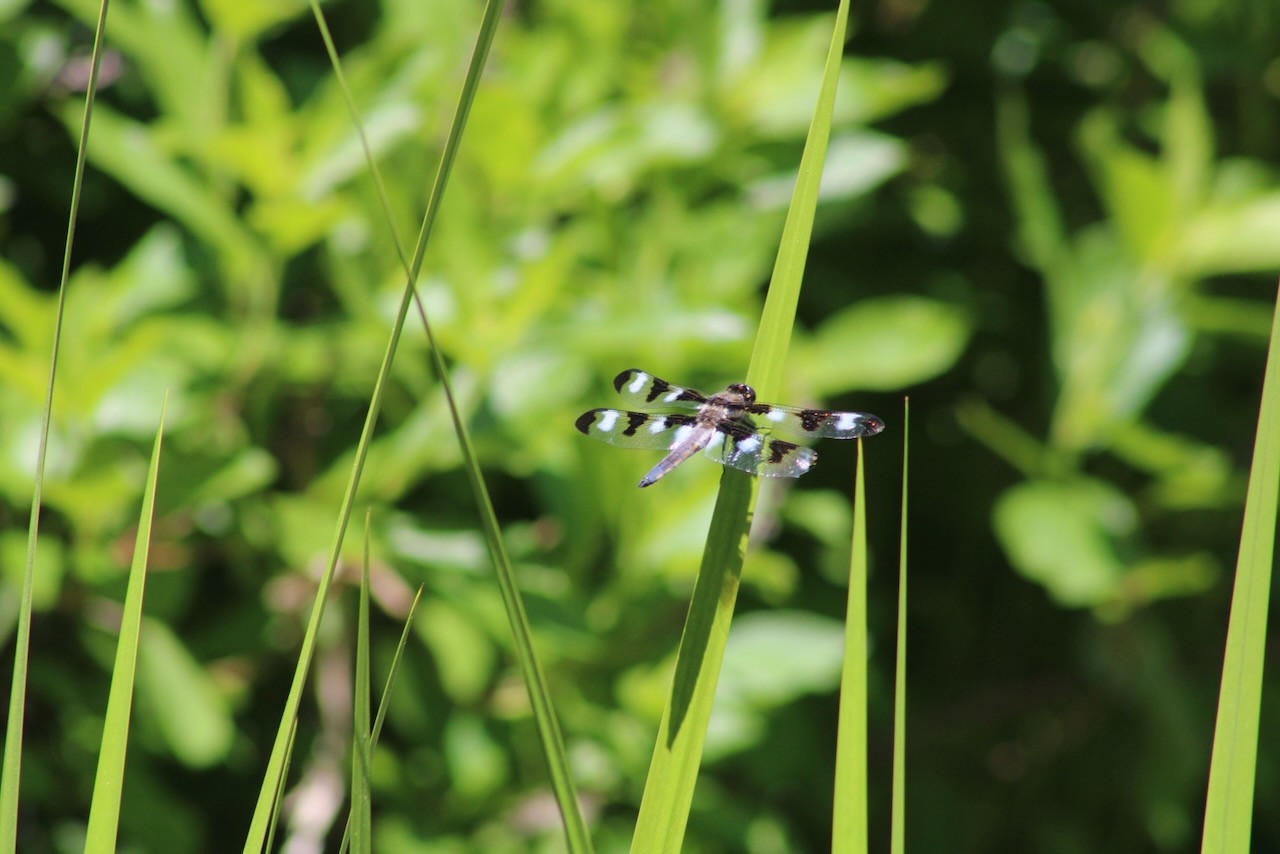
There was an adult dragonfly hovering around close by, it could have been the same one I had seen earlier in the summer. I wondered if it was watching over the nymphs protectively, or perhaps threatened by them, or interested in mating with them? It did stay close. A beautiful creature with black and white spots on its wings and a mostly gray body with black eyes.
I wasn’t able to watch all day, and then we had some rain in the evening. This morning, when I went back, it seemed like all of the creatures on the leaves were just husks of nymph bodies, and there was a new dragonfly at the pond. Turquoise eyes, mostly clear wings, white tail with a black end.
All of it felt quite magical, and also mysterious. An accident that I saw it at all, and yet amazing that I saw some of the process. In Passamaquoddy, the word for dragonfly is “apuciqaha.” According to my teacher, “apuci” means inside out, and “iqaha” refers to the way they fly in any direction. Seeing the adults emerge from inside of the bodies of the nymphs gave me a new sense of the meaning of “inside out.”
Once again, I see how the pond is home to all sorts of life that lives by its own rhythms, and what a privilege to witness some small aspect of that ongoing life.
I’ve seen dragonflies flying around the pond, mating above the pond, and dipping their tales into the water to lay eggs. I’ve seen dragonfly larvae in the pond swimming around. But until this week, I never knew if any of the larvae had lived long enough to transform into adult dragonflies. During the last few days I saw what I thought might be some sort of insect perched near the bottom of an iris stalk. But with a little research, I now realize that it is an empty husk from which a dragonfly larva has molted.
The pond never ceases to delight with the cycles of life of so many creatures. This month also saw these toads clasped in their mating posture, the male on the back of the larger female. I don’t know if any of the tadpoles from before have survived–just because I don’t see them doesn’t mean that they aren’t hiding somewhere. But they are low on the food chain, eaten by frogs, and also by dragonfly larvae. However, with more eggs in long strings, maybe more tadpoles are on the way.
The heavy rains of the last several days have delighted the tree frogs who are singing in the night. I haven’t seen any of them in the pond this year. Each year it seems that different species choose to inhabit this little pool of water. Thankfully, even on days when I don’t have the energy to tend to the many plants in the garden that would love some attention, I can sit by the pond and appreciate all that it holds.
They call it “upcycling” now, but I always think of it as the remnant of my time as a Catholic Worker when we always made practical use of whatever was on hand for what was needed. So this week, I upcycled an old screen tent to make a covering for this raised bed. I almost didn’t plant anything this summer, I’ve been so tired. But I happened to stop by the Portland Food Coop and they had organic kale seedlings for sale, and I got drawn in. I added compost and seaweed and turned over the soil in the bed.
This bed has often in past years been visited by critters such as groundhogs who love to chomp on greens, so I knew I had to protect it. (It has chicken wire underneath so that protects it as well.) The groundhog has always been easily put off by some sort of covering over the top. Many years ago I had purchased metal framing that I had repurposed for this bed. I had some netting that I covered it in years past (see a photo here), but I couldn’t find it. I did find the old screen tent in the garage–no longer usable because it had no frame anymore. So then I wondered–maybe this would be better than the netting, which had never kept out cabbage moths that liked to lay their eggs on the kale. Maybe the screen would keep out those pests as well?
So I took a scissors to the old tent, and cobbled it back together in a new shape, using a little superglue and paperclips. I tried to minimize any fabric that would block the sun. On the south end, is the zipper opening, and on the north end I folded over the larger remnants of screening.
To anchor the bottom, I placed some logs that we’d cut from fallen branches of our pitch pine. Once everything was in place, I planted my kale seedlings and watered everything well.
The experiment asks whether they’ll get enough sun through the screen, which does shade them a little, and whether they’ll be protected from cabbage moths? I hope it turns out well!
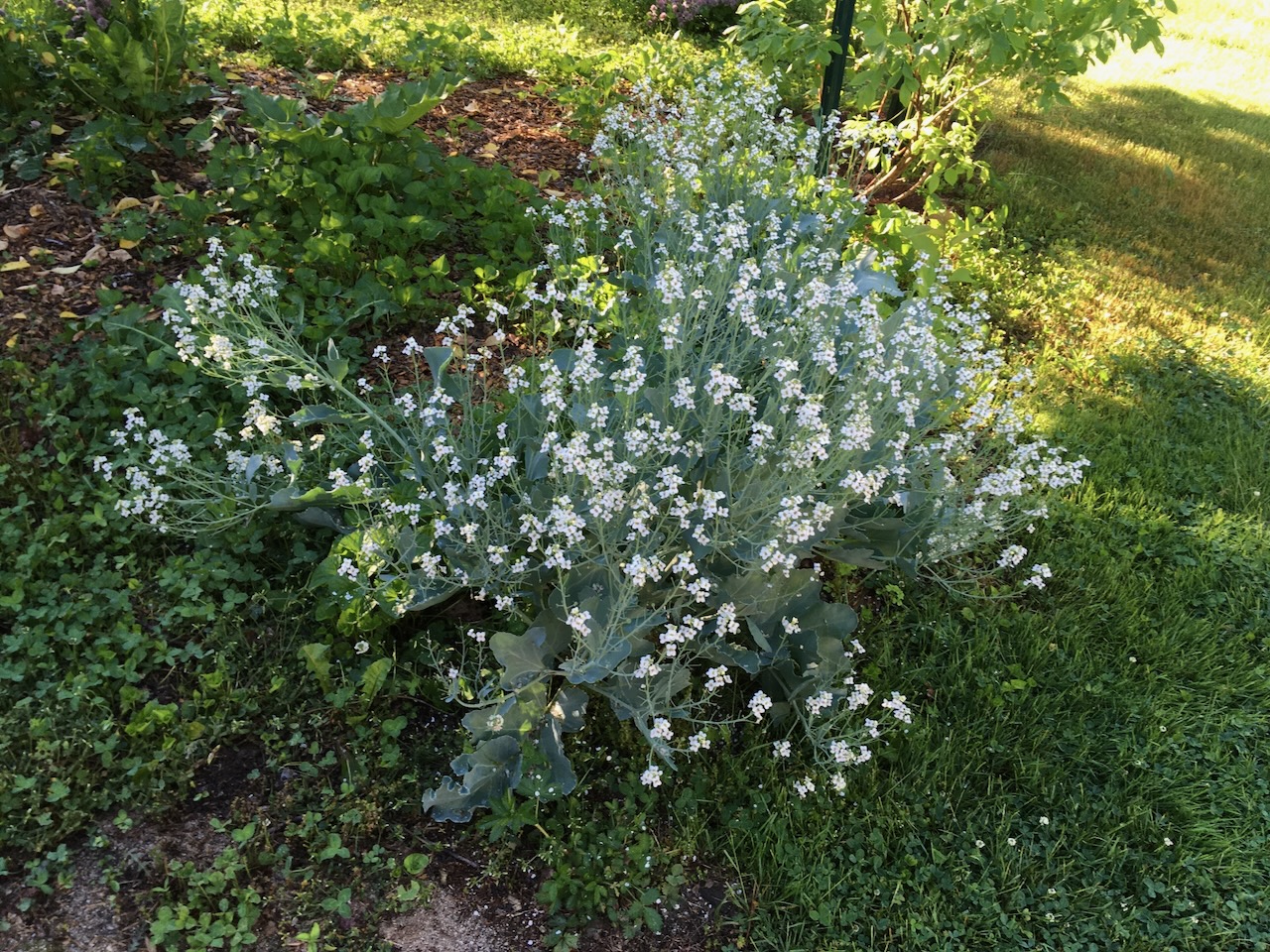
In the meantime, here is a picture of our perennial sea kale, from which we ate several small leaves and buds before it quickly turned to flowering. I love its honey smell.
Life continues to be abundant in the yard. We’ve had visits by a duck couple, who land on the pond, sometimes walk around the yard looking for food, and then take off again. When I was cleaning up old plants from the pond, I discovered strings of toad spawn, and now we have toad tadpoles swimming around.
I am suspicious that the three bullfrogs who’ve taken up residence might be eating them sometimes, but so far the tadpoles continue to survive. We’ll see.
I don’t seem to have much energy this year, so projects in the yard are moving slow. We finished stacking our firewood, and I cleaned up weeds and refreshed the wood chips around the fire circle. I resonated with something that was mentioned on television at the Chelsea flower show in Britain–gardening is often a lesson in failures. The cherry tree has some problem that causes spots on the leaves and cherries and I don’t think we’ll get any cherries despite our earlier blossoms. Probably the black cherry aphids, but I don’t have the energy to sort it out. So I am appreciating the plants that seem to take care of themselves.
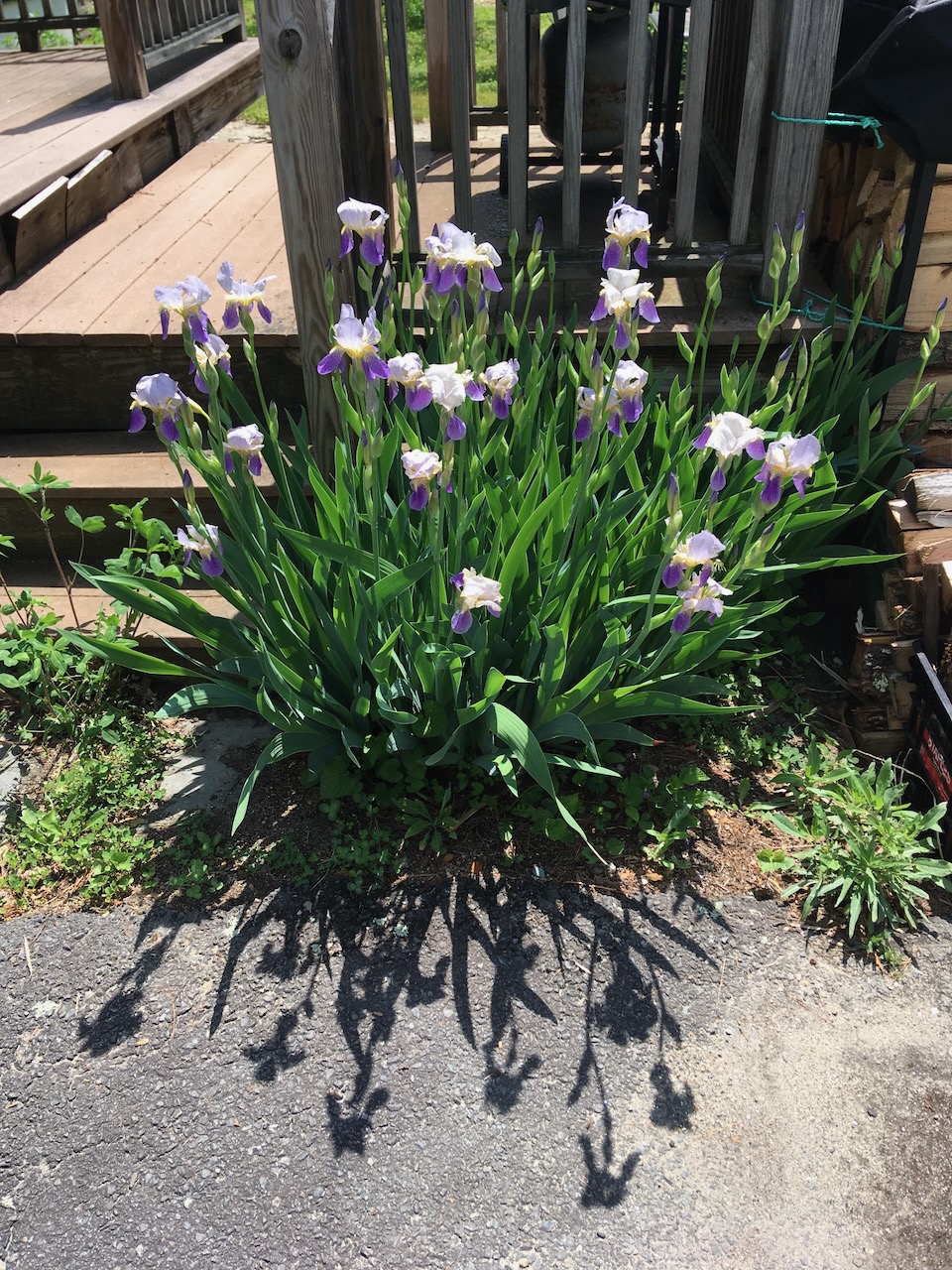
The irises by our deck are thriving this year, so happy and abundant. That sort of makes up for the lack of blue Siberian irises in our front patch–hardly any at all this year. The plants seem to move around, and I am not sure why the blue ones are not doing well. Happily, our neighbor’s are doing great, and I see them out our kitchen window.
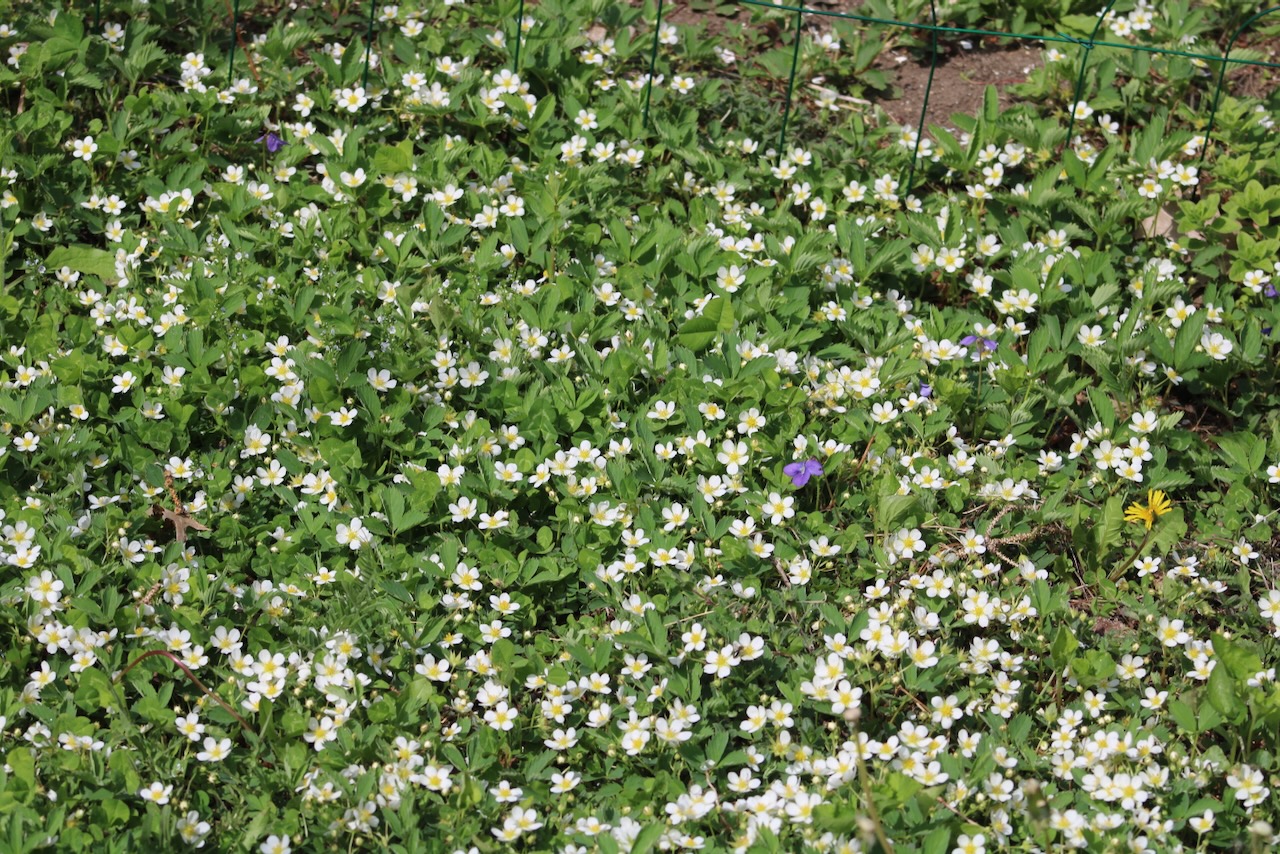
Meanwhile, the wild strawberries were blossoming and spreading everywhere, which is great–good food for birds and bugs. It is an excellent native ground cover. That makes me happy.
There is so much beauty in the spring, but it all seems to be moving so fast. I can’t keep up. Mayday has come and gone. Already this season is half over. After two months of physical therapy for my hip and lower back, I am able to walk fifteen minutes and more again. The other day I walked to Capisic brook and onto the path nearby, and saw the trout lilies that usually grow there, a lovely spring ephemeral. American Heritage Dictionary defines ephemeral:
Lasting for a markedly brief time.
Having a short lifespan or a short annual period of aboveground growth. Used especially of plants.
Spring itself and all its beauty feels markedly brief. Is my love of photos a way of trying to hold on to all that is ephemeral? Is my need to write an attempt to halt the relentless flow of time?
I have been drawn outside more and more each day, excited to see daffodils and violets and green shoots coming up everywhere. And, happily, the peach tree is now covered with pink blossoms, and the cherry trees have many blossoms too. Last year, because of the weather, there were none–so these beauties seem fragile and extra special because of that vulnerability.
Peach blossoms on a foggy day.
There are many projects in the yard to attend to. Many branches fell from trees in the storms of winter and early spring. Margy has been cutting them up and hauling them around. Some of these we’re using to make a brush pile in the back corner for wildlife habitat. The other day, I cleared that space of invasive plants. I also set up our eight rain barrels again. We are going to get an new order of firewood, after using up our last old logs in the storms. So we are working on the space for the firewood, and purchased a rack to keep them off the ground.
Yesterday, I added two more pond lilies to the plants in the little pond, and as I was tidying up old dead shoots from other plants, I found strings of toad eggs attached to the old ferns. (So of course I left those.) We haven’t had toad eggs in the pond before. But there are a few frogs beginning to make an appearance–shy ones who have been diving under when they hear me approach.
The robins did not come back to the nest on our back porch that they had used for two years. Maybe that pair are no longer living. I read that their average life span in the wild may be just two years. I also read that they often don’t reuse nest sites–so we were lucky to have them in that spot for two years. Another ephemeral.
Then we discovered a nest in the yew bush near our front door–able to be partly seen from our living room window. So new robins are raising young nearby again. Maybe one of them fledged from the back porch.
Blue robins egg barely visible behind branches.
Is my love of photos a way of trying to hold on to all that is ephemeral? Is my need to write an attempt to halt the relentless flow of time?
I was cuddling with my cat Billie on the couch and suddenly felt a deep sense of our own impermanence. She is 13, I am 70. Senior cat, senior human. How much more time do we have? Someday, I won’t be able to feel her warm little body, with its soft fur and sweet smell, curling up on the pillow near my face. Someday, she will be gone; someday, I will be gone. We too are ephemeral. I want to hold on, but life seems to be about movement, about letting go into the next moment.
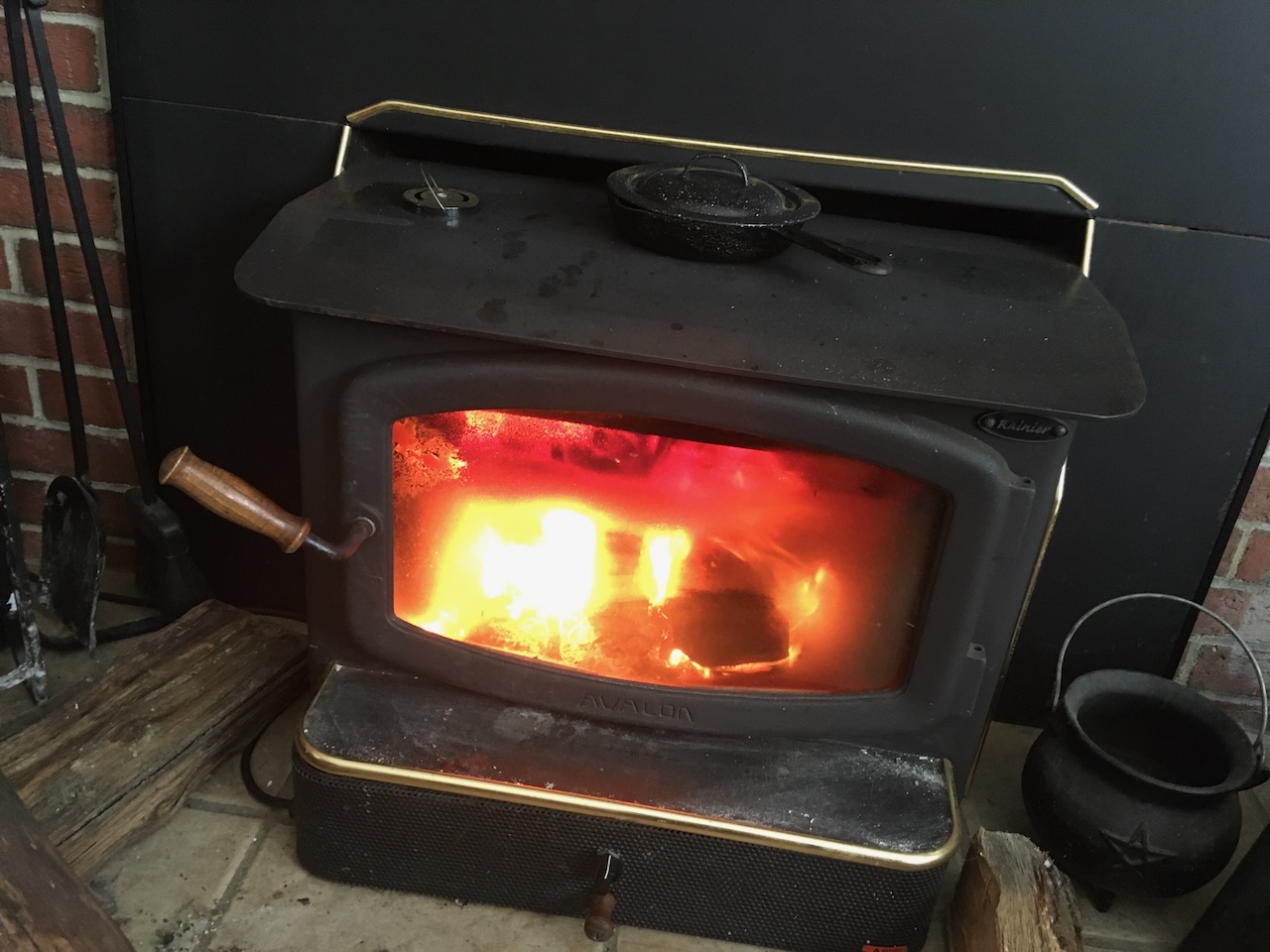
In the midst of a 55-hour power outage, before I knew how long it would actually be, I was sitting in front of the wood stove which had kept us warm for the last couple days. I was thinking about how fire is one of the sacred elements, and yet, I hadn’t been close to a fire recently except during our prior power outage and this one. (Yes, we have now had two power outages in the last two weeks! The first lasted 40 hours.) These power outages are exhausting for us, with our chronic fatigue anyway. But we are so lucky to have the wood stove which heats our house well, and on which we can even cook food, with our tiny cast iron pan or hot water kettle.
Tending the stove is a constant process, kindling a fire in the morning, adding wood, adjusting the flue, adding another log each hour or so. We were running out of wood, except for some poorly seasoned crabapple wood from when our tree fell during a storm last year. But our neighbor kindly said we could have some of his. I am grateful for our neighbors. That was a gift from this storm. The April nor’easter covered all the trees and branches with heavy wet snow that apparently caused over 300,000 outages across Maine, which is why it took so long for power to be restored. Still, it was beautiful outside.
We were without electricity, television, internet, all the usual ways we connect with the world. My phone has limited data (all used up) so I couldn’t use it to connect except for texts and phone calls. We have an old landline phone that we pull out to use because it doesn’t need electricity like our regular landline phone. I even had a great conversation with an old friend on that landline phone. But I realized how much I rely on the internet for connecting with people, for seeing news, for entertainment. Being without power was tiring, just to keep ourselves warm and fed, but being without the internet was so boring.
As I was sitting in front of the fire, on the third morning, I tried to be present to the day, to stop wishing for the power to come back, to accept the day on its own terms. It was then that I thought about fire, about the fires I had sat around, and even danced around in prior times. I thought about the rituals we had done in our own back yard around our own fire circle. Neglected fire circle now. We didn’t light it all last summer. The weeds have grown up around it. It takes some energy to light and tend a fire. I know I haven’t had much energy during the past years. But now I was, by necessity, tending a fire, and by gratitude and intention, remembering that fire is sacred, is beautiful.
When I consider it, it seems like electricity has taken the place of fire in my everyday life. I imagine that electricity might also be considered sacred, although it is more invisible. It heats our home, cooks our food, keeps our food preserved, washes our clothing, heats our water. It also enables these far away connections for which I have much gratitude. It brings stories and news and laughter. I was relieved and happy when the electricity came back on.
But I am also grateful for the quiet days of the storm that brought me back to appreciating sacred fire.
The chipmunks woke up from their hibernation earlier this week. Peeking out from their warrens beneath the garage. It’s a good thing we don’t have bears. My friend who lives in the woods had a bear arrive in the night to break apart their bird feeders this past week. Our chipmunks merely climb the pole and share in the bounty. The wake-up seems early this year, and probably is. The winter was too warm and too short. But here we are, in a climate changed world, loving the earth as well as we can.
Today is the Spring Equinox! Equal parts night and day. I want to take a moment, in the midst of the vast troubles of the world, to express delight at the turning of the seasons. Small bits of green emerging from the perennial plants. And I am grateful that after five sessions of physical therapy I am beginning to get some relief from my hip pain. My PT person uses Integrative Manual Therapy, and it is a miracle worker. There are still many sessions to go, and I am hopeful that healing will happen. I took a very short walk each of the last three days–my five minute walk to the end of the block–which actually takes ten minutes with my current walking status. It feels good to be outside.
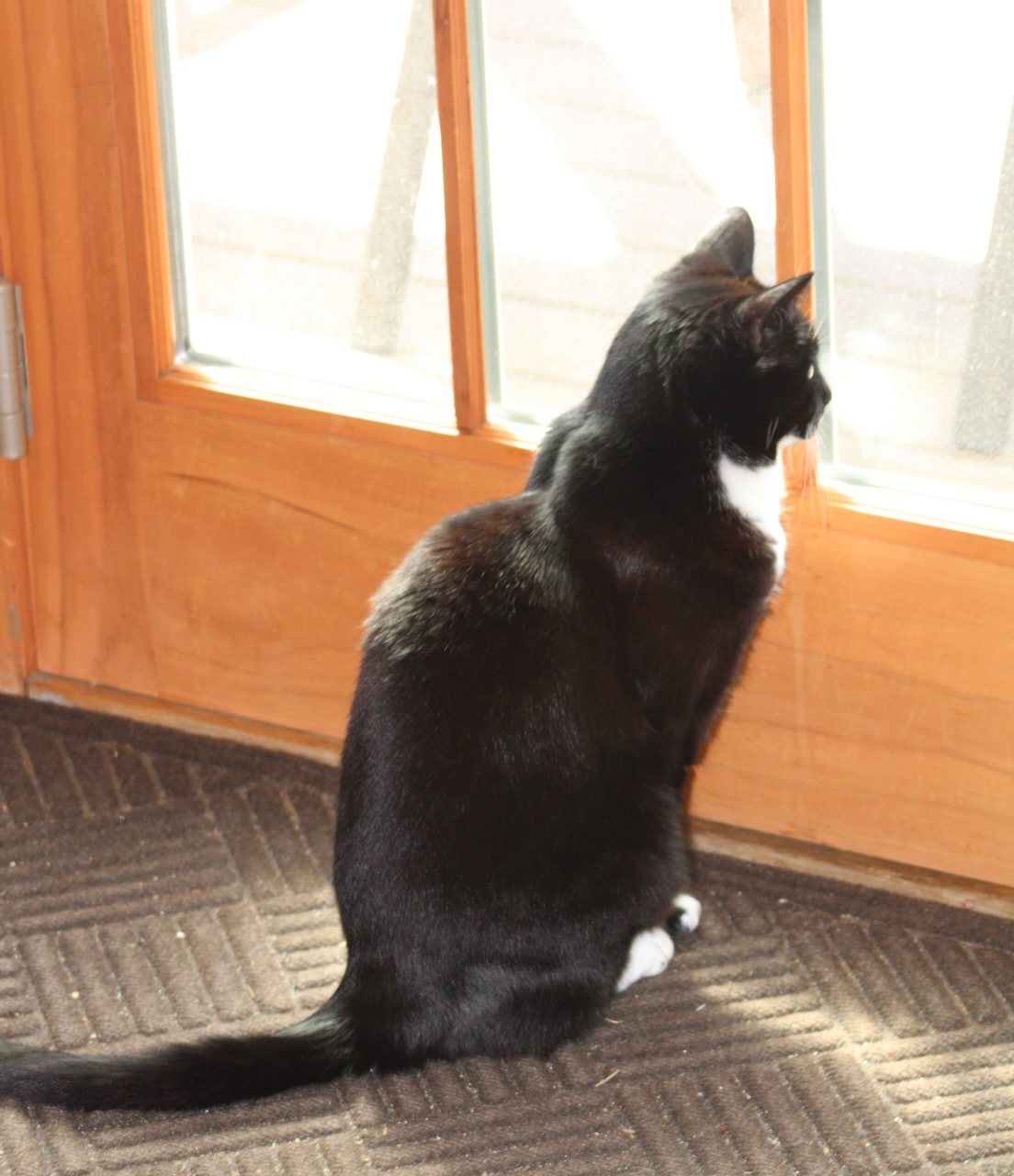
Meanwhile, the cats have new critters to watch through the windows. (They are indoor cats only.) Here is Billie looking out the back door.
I think about vulnerability. What it means for me to be 70 years old. I didn’t hurt my hip by falling or anything like that. I woke up one morning and there it was. It is a reminder to me to cherish the joys of each day. Who knows what tomorrow will bring? I can be prone to anxiety, and feel deeply the troubles of the world. I will keep bearing witness. But I will also find joy in these simple moments, these earth awakenings.
The last few weeks, I have been dealing with severe pain in my hip, such that it makes it difficult for me to walk or sleep. I am grateful that I now have physical therapy which is slowly helping. But as I was lying on the table getting treatment today, I kept thinking about people in Gaza, right now, who also were dealing with hip pain, or chronic illness, or who were giving birth–any of the myriad kinds of human conditions that render us deeply vulnerable, even in the best of situations.
And instead of finding help or treatment, those human beings are being forced out of their homes, bombed, shot, starved. How would I evacuate when I can barely walk? How would I sleep on the ground with no pillows to ease the pain? How would I manage my illness with no medicines? How would I give birth with no clean water? It is not as if those human frailties cease to exist because of war. Underneath the other horrors, the deaths, the woundings, the destruction of homes, schools, libraries, hospitals, there is each human story.
I find in my body a small metaphor for this hurting world. I find in my body a deep scream of pain for this hurting world. They say the hips are the foundation for the balance of the body. And the earth is out of balance in so many ways. We see it in the chaotic weather, we see it in wildfires, we see it in an ocean warming faster than expected, we see it in cruelty toward children who are “different,” we see it in pandemics, we see it in politics of fear and hate. Who knows what the future will bring, with such a painful present.
I found encouragement in these words of Elie Wiesel, who survived the holocaust and wrestled with its meanings and repercussions for the rest of his life:
“There may be times when we are powerless to prevent injustice, but there must never be a time when we fail to protest.”
I found this image and quote posted by a friend on Facebook–the image is the Ukraine sunflower, and Ukraine is another country full of people in pain that linger in my own heart. But the flower feels full of beauty and hope. [Update Note: I later heard from the creator of this poster. It can be found at https://www.redbubble.com/i/poster/Ukraine-sunflower-by-NestPaintbrush/103305139.LVTDI ]
Wiesel goes on to say:
“The Talmud tells us that by saving a single human being, man can save the world. We may be powerless to open all the jails and free all the prisoners, but by declaring our solidarity with one prisoner, we indict all jailers. None of us is in a position to eliminate war, but it is our obligation to denounce it and expose it in all its hideousness. War leaves no victors, only victims.”













 Finding Our Way Home