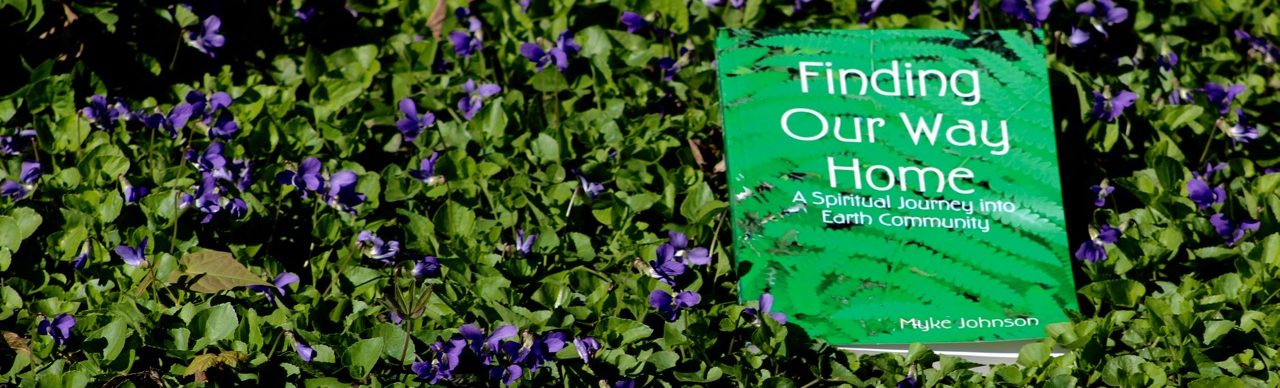
The E-book of Finding Our Way Home is now available! You can get an EPUB version at lulu.com for $9.97. (The link should take you directly to the book, or you can search by author and title.) In 3-5 weeks there will also be versions on Amazon, Barnes & Noble, Kobo, and other ebook stores. EPUB is readable on Apple Books as well as Nook, Kobo and other readers.
In 2016, when I first published Finding Our Way Home: A Spiritual Journey into Earth Community, I was happy to use an ecologically oriented print-on-demand source for a paperback format. That is still available for $17.99 plus shipping. I have been told it is the kind of book that does well with slow reading, a chapter at a time, with spiritual practices offered at the end of each chapter. Personally, I enjoyed doing the layout and choosing the typeface, and creating all the formatting. I assumed I would also do an e-book at some point, but with chronic illness and not very much energy, it took longer than I expected.
For some mysterious reason, during the last few weeks, I was inspired to get back to it. The first step was reading “how-to guides” at lulu.com. I had to create a new document and undo all the formatting I had previous used, substituting standard formats. I checked all the internet links that showed up in the notes, to make sure they were still functioning. I also updated the author page, but did not change anything else in the content.
My hope is that this new format will make the book more accessible to more readers, both financially and visibly. I especially want to thank my friend Diane K. for her cheerleading and enthusiastic support. Just a little note to mention that when you purchase directly from the publisher more of your payment goes to me as the author. But another way you can help, if the message appeals to you, would be to leave a review wherever you purchased the book. In the end, most of all, in my small way I want to keep fostering a spiritual journey of waking up to interconnection—to the earth, to each other, and to the Mystery within and between all.
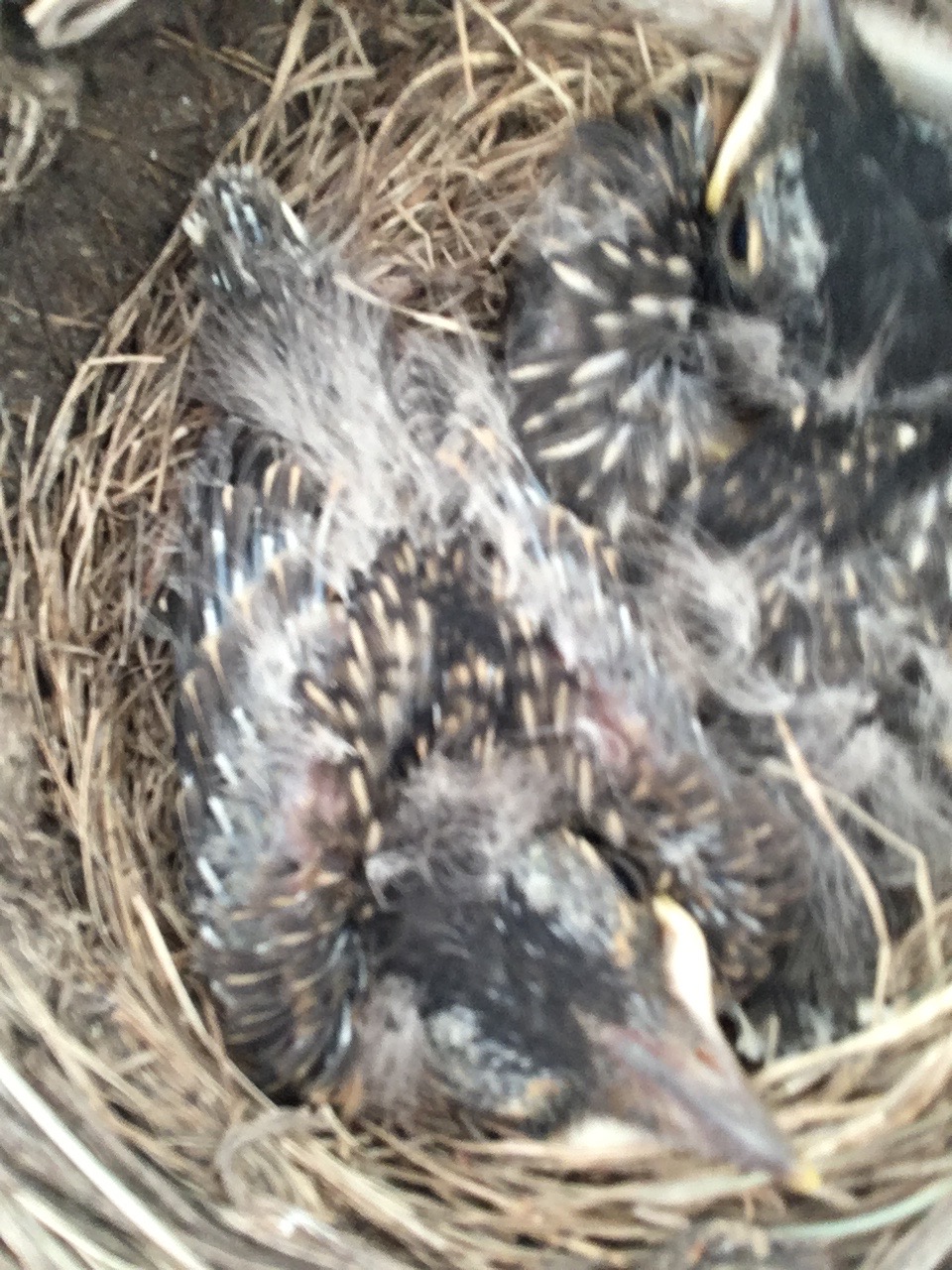
Two baby robins with open mouths waiting on parent.
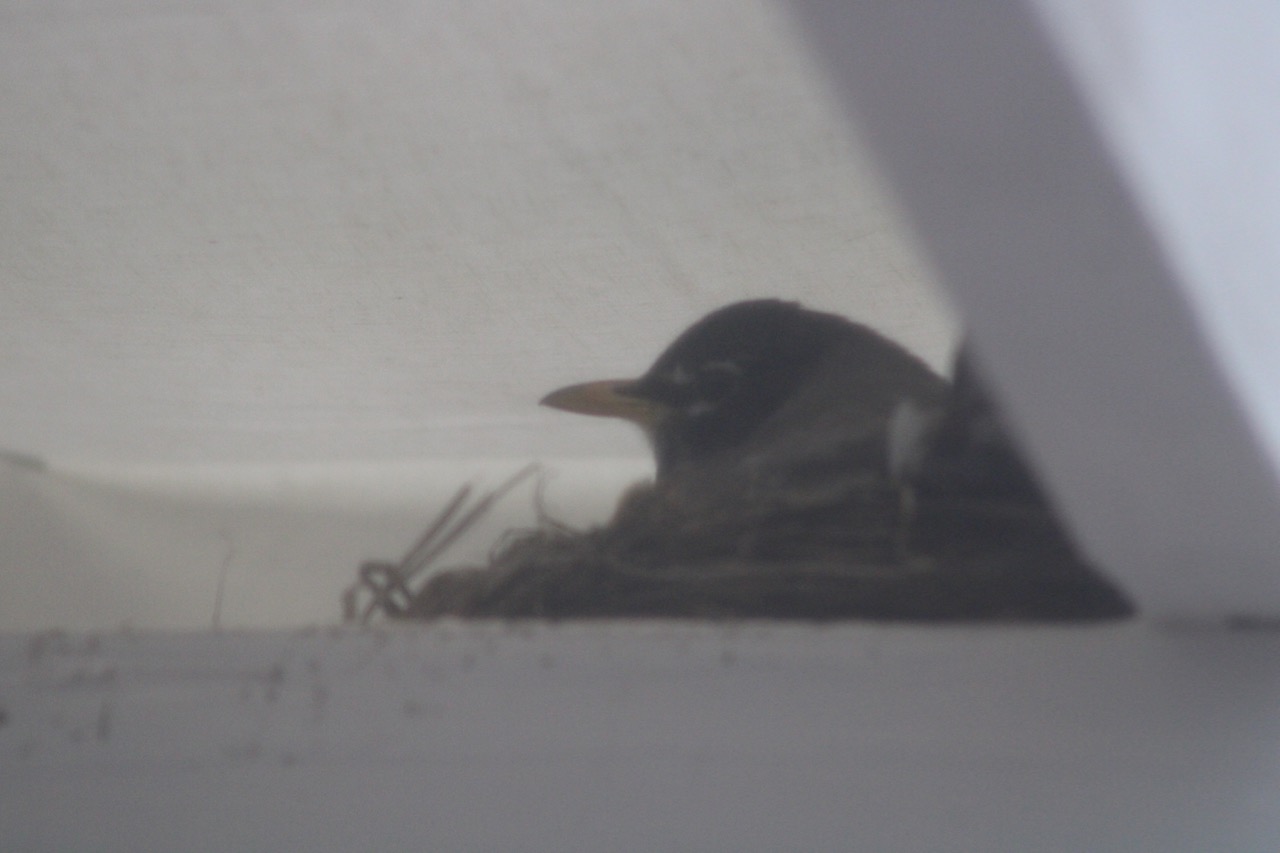
I’ve waited to post about the baby robins because I didn’t want to presume anything or jinx it. But it seems after the mama robin laid three eggs in the nest on our back porch beam, we now have two babies who have feathers and are poking their heads up to be fed. They don’t make a sound, and most of the time they are hiding deep in the nest while the mom and dad go about getting food, or just sitting on top of them resting. When the parents were gone for a bit today, I snatched this “selfie” with my phone over the nest. We mostly try to leave them be and not make a lot of noise on the porch.
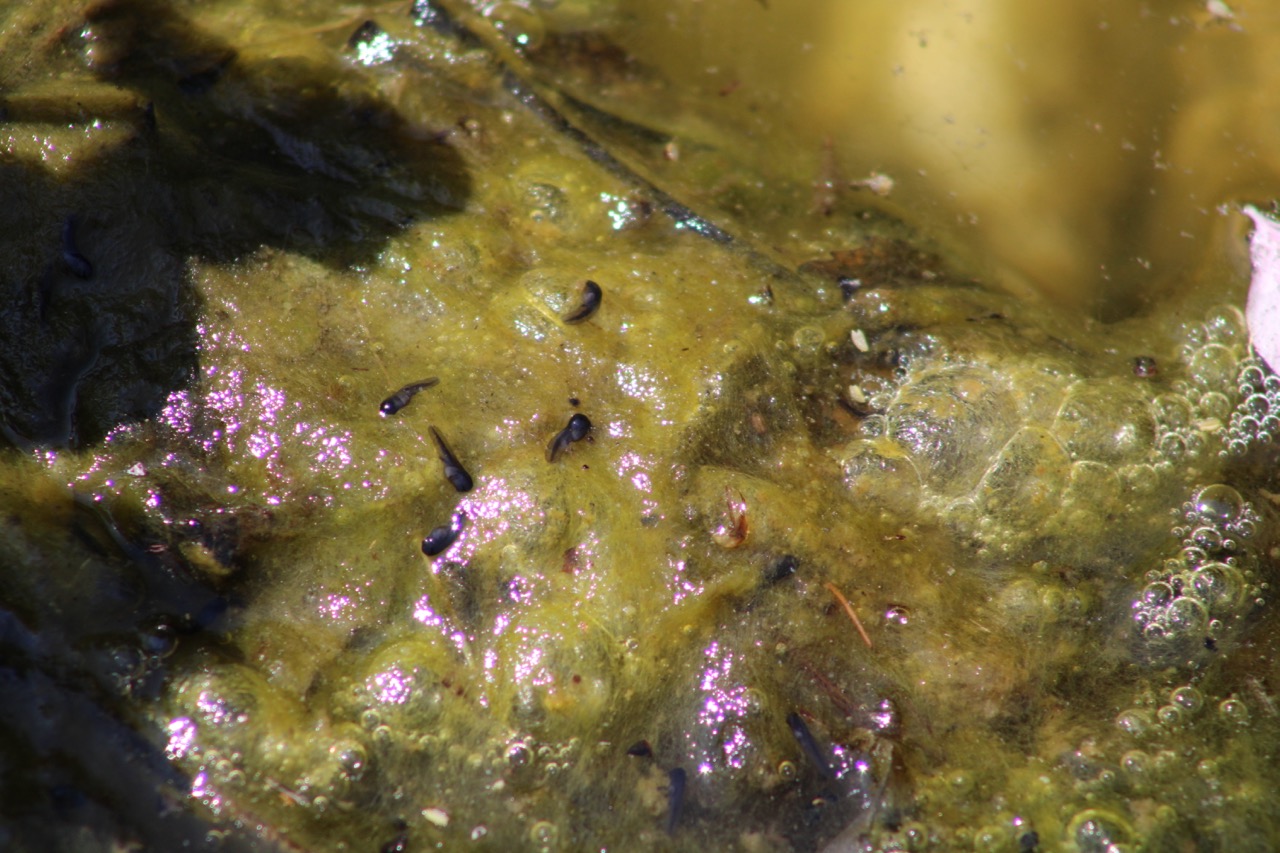
While not as photogenic, I also discovered we have tiny tiny tadpoles in the pond. I was lifting some algae with my net, and uncovered a whole group of them. Here is a close-up, but just imagine them about 1/4 inch from head to tail. Apparently they eat algae, so they must be happy where they are. Hurray! I would guess they are tree frog tadpoles, since the tree frogs have been singing, but I couldn’t find any confirmation of that in online searching–we’ll have to wait until they get a bit bigger.
Tiny black tadpoles in algae in the pond.
Finally, I planted some kale and lettuce and broccoli seedlings this morning, after adding more compost to raised bed, then using chopped leaves as a mulch. I put netting over them to deter animal neighbors–it doesn’t keep away cabbage moths, but seems to work for groundhogs and squirrels and such. Plant babies finally in the ground!
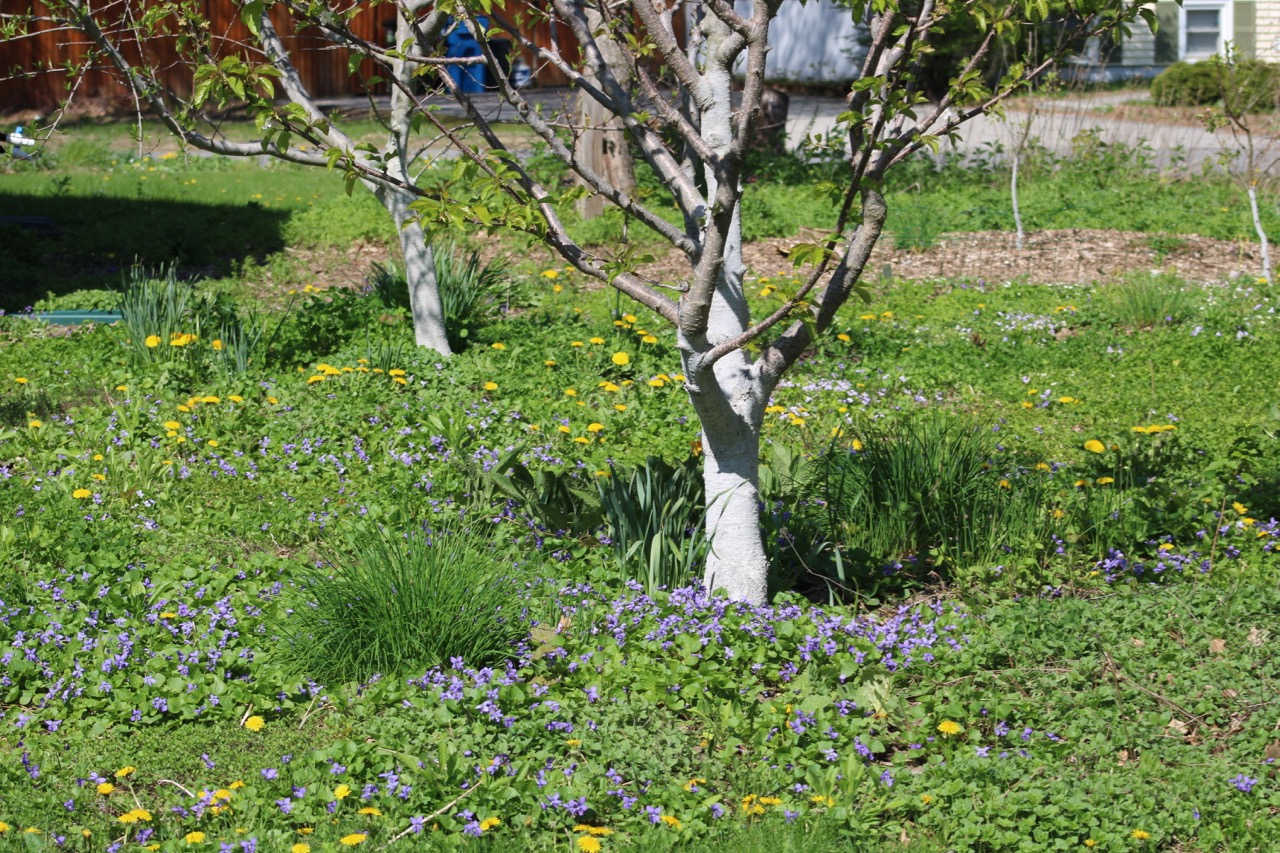
I walk through the orchard and marvel at the beauty of violets which have naturalized all over the ground. Dandelions offer a scatter of yellow along with a few daffodils, and clover has spread over the beds and paths in a swath of green. Chives and oregano and thyme are coming up in their clumps. I can’t capture it in a photo, but perhaps the one above hints at how lovely it has grown, mostly all on its own.
The cherry trees actually now have a few blossoms–maybe a dozen new buds have opened after initially all of the buds were empty. Not enough really for a fruit crop, but I wanted to note it. However, our Honeycrisp apple tree is covered with buds, for the first time. Maybe this will be the year of our first apple harvest?
I haven’t tried to do any veggie planting yet. Mostly I just walk around enjoying how the wild flowers shine in the sun. Yesterday I lay in the hammock reading for a while, and we had a lovely visit with a friend by the pond. We haven’t seen any tree frog eggs there, despite the repeated singing in the night. It is all a process of discovery–will they choose our pond or not? Meanwhile, the marsh marigolds have bloomed! My favorite flower colors are yellow, blue, and violet, so right now I am in paradise!
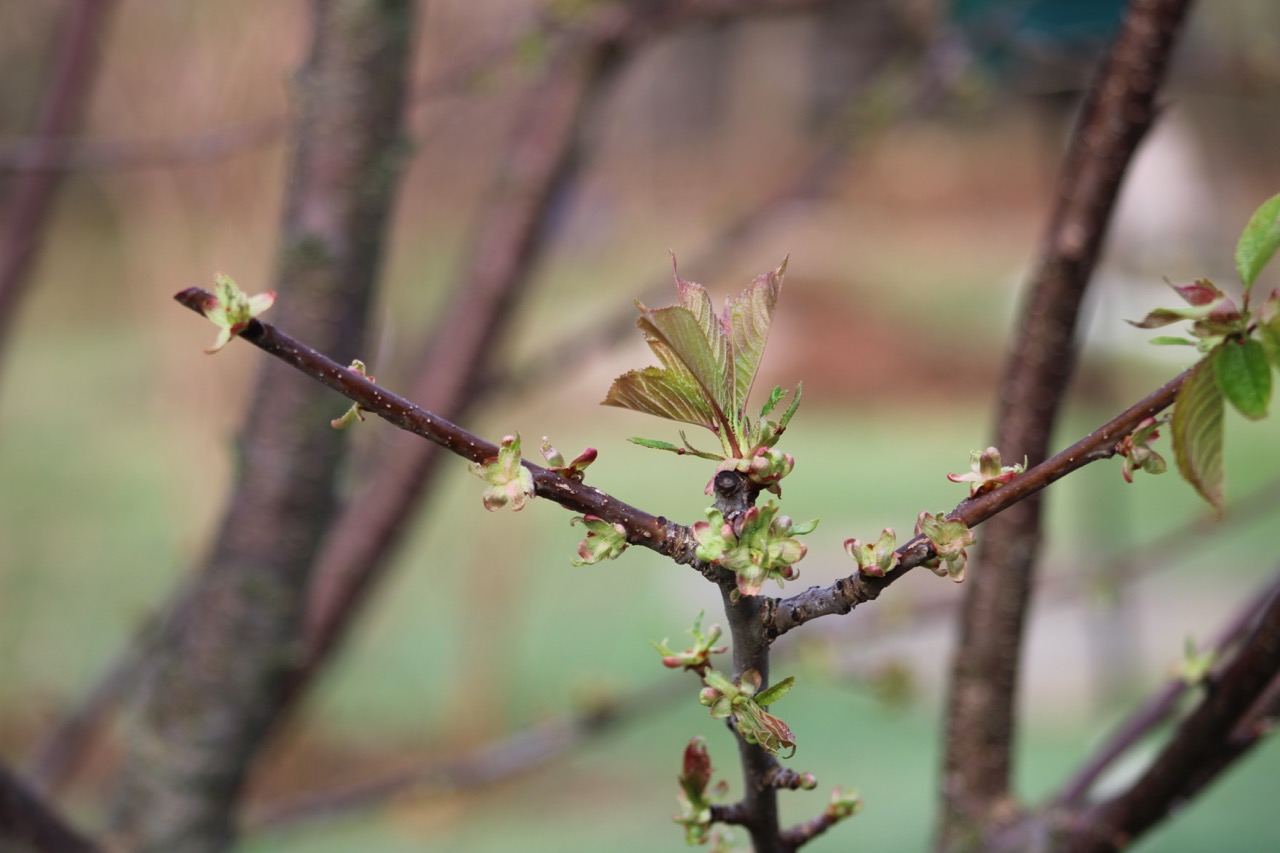
The cherry trees and peach tree have no blossoms on them at all. The cherry trees had the buds that should open into blossoms, but when they opened, they were empty. At first I worried that I’d done something wrong. But on connecting with other gardeners in Maine I learned that many people are facing this problem with all their stone fruits. Apparently, the most likely cause is the weird weather over the winter, with mild times alternating with a deep freeze. They didn’t stand a chance.
I feel sad about it–there were really so many buds on the cherry trees this year. In prior years we just had a very few blossoms, and I was hopeful that this year we’d see our first real fruiting. I also feel glad that the leaves are opening–I heard that some people’s trees actually died. I am glad ours are alive. But this is a lesson about climate change. Global warming increases the unpredictability of the weather, and the temperature swings are part of that. What food we can grow becomes more unpredictable.
We don’t rely on our little garden for our food–we are really just learners in this process. When we get a harvest, it is exciting–and thankfully, we still have peaches from last year’s abundance in our freezer. It looks like the blueberries and raspberries will be fine. I’ve already eaten sea kale and some asparagus. But I can feel the vulnerability of what it means to face a shifting climate, even in these small ways. How many larger ways are unfolding all over our planet? Severe heat and drought in many places, floods in other regions. For too many people actual starvation is real. I feel so powerless in the face of these huge problems.
When we first moved to this place, our hope was to form a deeper connection to the earth and all her creatures, through our connection to this small piece of land. I have to say it isn’t easy. We know so little, and we are surrounded by challenges larger than we are. For just one example, Margy spends hours pulling and cutting invasive plants around the borders of our land–Asian bittersweet, multiflora rose, Norway maples. The way it is with invasives, that job will never be over. Plants have their own personalities, and some are very aggressive even if they are native plants or desired plants, so there is the endless pulling and pruning to keep things in some sort of balance. (Oregano and wood anemone, I’m looking at you! Everywhere!)
But maybe these are the lessons we are learning about making a deeper connection to the earth. Plant by plant is the only way we get to know them. Whole Indigenous communities were needed to foster the balance of all beings, and we are just two old non-Indigenous humans. Some of our neighbors seem to be in a similar venture to ours, and others seem just the opposite.
Still, I have to hope that the love we offer to this place can be a small seed of healing, maybe even its own “aggressive” form of healing, spreading into the broken places. I draw hope from the birds who seem to multiply and who enjoy the yard so much. I draw hope from the violets blooming everywhere they want to bloom. I draw hope from the turkey who visited the other day and made a dust bath in the patchy lawn. There is something so wonderful about a community of creatures who share one place.
It was a quiet week, the robins had finished the nest, but were elsewhere in the yard. But this morning, one of them has come into the nest and has been sitting there a long time. I took a lovely little walk around the yard, just to look at things. There was a sparrow taking a bath in the shallow beach of the pond. The spice bushes were covered with tiny yellow blooms. I greeted the old pine, and the cedar tree, and the pitch pine. The sea kale has emerged, along with rhubarb leaves. The daffodils were blooming.
After breakfast, I went back outside–it is cold and gray today, with rain expected later, but I thought I might just do a few things. After reading some more information on pruning, I finally tackled that aspect of tending to the little apple trees, as well as I was able. Then I transplanted some chives and thyme to keep the baby trees company in their circles–companion plants.
After I came in, I saw the robin wasn’t in the nest, so I went out to check, and was delighted to find this: one blue egg. She came back a short time later, and is sitting there now. After last summer’s disappointments, I know there are no guarantees, but today is a day for hope. May the robin family be blessed with young!
Tree frog male, getting ready to sing his mating trill
Our first frog sighting in the pond yesterday, April 15! Much earlier than the last two years, when the first frogs came in June or July. It turned out to be a tree frog, rather than the green frogs that we’ve seen in prior years. We figured it out because in the afternoon, when my friend Francesca and I were sitting by the pond for a visit, suddenly, he sang the most amazing trilling sound, his white throat patch blowing out and in. And I remembered that Margy had heard that sound earlier in the day. Then, yesterday evening after dark, the night air was awash in these trilling calls, from all directions. A little internet searching identified those calls as tree frog mating calls.
Tree frogs live in trees, like their name suggests, and hunt on land most of the year, but they breed in water, in ponds and vernal pools. So maybe, just maybe, we’ll have some tadpoles to grow in our pond this spring. I learned that they eat algae, so that is another good, because our pond has got a bit too much algae in it. So exciting!
The other adventure of breeding is that of our robin pair. Even after three failed attempts to rear live young from eggs in a nest on the beam under the clear roof of our back porch, they were at it again, bringing nesting material to the same spot. That spot was just too hot in summer. It was so sad. So, first I tried telling them to go somewhere more suitable! Then I tried taking out the grasses to discourage them that way. But they kept at it. So then, I had a totally alternative idea. What about making something to shade that corner of the clear plastic roof? So it wouldn’t be so hot. This morning, I searched around and found some old cream-colored sturdy curtain material, and cut it to fit. Then I got up on a ladder and stapled it tightly to the wooden crossbeams.
I have already seen the robins return with more nesting material, so maybe they’ll put up with the changes to their location. After all, I had also painted the beams last fall. Now I am hoping that it will be enough–that the shade will keep the spot from getting too hot, that the robins can finally have a little family, in their chosen spot. And can I say that my heart is filled with joy after this little project? Some kind of ecstasy to help a fellow inhabitant of this place, to live together in mutual reciprocity.
Four years ago I attended an apple grafting workshop, and created four grafted plants to bring home. I planted them in a “nursery” bed in the orchard, a Black Oxford variety in the center to remain there, and the others to later transplant. The root stock was called M111, a semi-dwarf variety. But I wasn’t sure where to put them, so it has taken until now before I transplanted any. Two didn’t survive, but today I move this Blue Pearmain variety about 12 feet over to a new bed.
Both of these are heirloom varieties for New England. According to Fedco, Blue Pearmain is a fall/winter apple, “our favorite for baked apples—it was made to be stuffed. Moderately juicy flesh, firm, dense and slightly crisp, sweet with a bit of a tart background flavor. Incredibly beautiful medium to very large fruit is streaked and splashed with purplish red, mottled with russet and covered with a distinct dusty blue bloom. In a pie, it has just enough firmness and a good balance of sweet and tart with hints of pear. Tart coarse yellow sauce cooks up in a couple minutes. Tasty eaten out of hand. One of New England’s most famous varieties. Mentioned by Henry David Thoreau as a favorite in his wonderful essay “Wild Apples.” Grown throughout much of Maine for well over 200 years. Massive trees still found here and there. Keeps in the root cellar until midwinter. Blooms midseason.”
Black Oxford was created from Hunt Russet x Blue Pearmain, in Paris, Oxford County, Maine, about 1790. A winter apple, “this outstanding apple, a favorite long ago around much of Maine, has made a huge comeback. Medium-sized round fruit, deep purple with a blackish bloom. From a distance you might think you’d discovered a huge plum tree. Excellent pies, superb late cider. Leave the skins on for a delightful pink sauce. Best eating late December to March, but we’ve eaten them in July and they were still quite firm and tasty. They get sweeter and sweeter as the months go by. Good cooking until early summer. Some insect and disease resistance. Unusual light pink blooms early to midseason.”
According to the Holistic Orchard, Black Oxford is “A rare treat reminiscent of an exotic tropical fruit; exceptional sauce apple, stunning drying apple.” It is slow to come into bearing, but resistant to insect problems. It can tend toward biennial bearing. Ripens in late October into November.
Even though they are four years old from grafting, they still seem like baby trees to me. I still need to do some pruning to help them find good shapes. But I am excited that I was able to get the Blue Pearmain to a spot it can remain. This past winter, one of our old ornamental crabapples fell in a storm. The one that is left leans heavily toward the road, and we’re imagining that it might not survive for long either. So this Blue Pearmain is positioned about half way between the Black Oxford and the crabapple. As it gets larger, eventually the crabapple might not be there. But in the meantime, it won’t cast any shade and they should both do fine. I still need to do some weeding and probably use cardboard to keep unwanted plants from growing too close to the tree. It had been on the edge of our friend’s herb bed that she is not using so much anymore.
It feels so good to be outside, to be tending to plants, to be celebrating the spring!
Before: Black Oxford (left) and Blue Pearmain where they were growing close together before I transplanted the Blue Pearmain. There is a Honeycrisp tree exactly behind the Black Oxford, a little bigger.
Two people have reached out to me in the last few weeks to ask about the origins of the name of our little Capisic brook. They accurately assumed that it was a Wabanaki name, as are many waterways in what is now Maine, and wondered about its original meaning. I have wondered that too, though when I asked Wabanaki friends, no one was quite sure. So recently I began some research about it.
Capisic Brook has several branches winding through our neighborhood, with three headwaters: the north branch starts east of Forest Avenue near the intersection with Allen Avenue, the main stem in a wooded area within Evergreen Cemetery, and the west branch just east of I-95 near the intersection with Warren Avenue. Sadly, it receives run-off from development and roadways, and its water quality is significantly impaired. After these feeder branches join together it crosses under Brighton Avenue, flowing into Capisic Pond, which was originally created in the 1600s by a dam for a grist mill. Eventually Capisic Brook feeds into the Fore River. [I want to note here that the Fore River was called Casco by the Wabanaki people who lived here.]
All of this land is Wabanaki land. I wrote about its history in a previous post, noting that it was the chief Skitterygusset who first made an agreement for a settler to live near Capisic Brook and its uplands. While the settlers thought of these agreements as deeds of sale, a Wabanaki interpretation was something more like a treaty: an agreement to co-exist, and to render offerings each year for the use of the land and water. Unfortunately, the settlers kept taking more and more of the land and waterways. That is the painful legacy of colonization. Any story must include this legacy.
For those of us who live here now, if we are paying attention, the presence of the brook is everywhere in the neighborhood, showing up in the patterns of the roads, and the deep ravines with trees and brush. It most likely contributes to the wildlife that still frequents our yards. When I go for a walk, I seem to find myself heading to places where I can see the brook, in one segment or another. Despite the pollution and development, the brook has its own powerful presence in this place, that cannot be denied.
So what about the name? I have been privileged to study a Wabanaki language, Passamaquoddy/Wolostoqey, for the last five years with Roger Paul. One thing I learned is that the languages are polysynthetic–words are formed from the combination of smaller syllables, with root segments, prefixes, and suffixes, that combine to form new meanings. The word “Capisic,” as such, is not in the online Passamaquoddy/Wolastoqey dictionary. So I began to look at its parts. First of all, early spellings by settlers were not consistent or necessarily accurate to the actual Wabanaki words. It is likely that it has changed over the years. But I listened to how it sounded, and converted it as well as I could to the spelling system which has been used for the last 40 years–and is used in the online dictionary: ‘Kahpisik.
Now, it is more likely that the dialect here was Abenaki, and their recent spelling system is different, but I was working with what I knew best, and all of the Wabanaki languages are intelligible to each other, so that seemed not unreasonable. Here is what I was able to find: first of all, the final two letters “ik” are most likely a “locative” signifying that the word is a location. So then I looked at Kahpis. Sometimes, an “is” signifies something small, though that is less certain in this case. “Pis” can also mean “in” or “into.” I found the syllable “Kahp” in the prefix “kahpota” meaning to climb down or disembark, and also the verb “kahpotassu,” used in the context of transportation, meaning she or he gets off, gets out, disembarks, steps down. I couldn’t find other uses for “kahp.”
Many Wabanaki location words are the descriptions of what might take place there. Because of the physical characteristics of the brook, I am wondering if Kahpisik might refer to “the [small] place where we disembark [from our canoes].” The brook was unlikely to be a navigable stream, so people traveling on the Casco (Fore) River, coming to this brook, would have to disembark. So maybe that is what the name refers to.
I want to acknowledge that I am not an expert in the language, and merely hope to be a respectful and curious student. I checked in with Roger and he thought it was possible that this meaning might be on the right track. If others can tell me a more accurate meaning, or source for a meaning, I will update this post.
But in the meantime, it is helpful to think about this place in relation to its own history, to the people who lived here, live here still, and love this land and water. I imagine it used to be great drinking water, filtered as it was through gently sloping forest. Animals and birds still drink from it today, polluted though it is. I am grateful to be able to walk to the brook, to see the water and the plants, and sometimes birds and animals who visit. I am glad to see awakening environmental consciousness that seeks to purify its waters again, or at least mitigate its pollution. We belong to our watershed, and when we can imagine ourselves located in such a way, we are more likely to care for our home.
Yesterday I finally got outside and pruned one of the cherry trees in our little orchard. Pruning has always baffled me. My trees never look like the trees in the pruning guides, and though they are dwarf trees, they grow quickly long and gangly. I wish I didn’t have to prune, but experts say it is part of the work of caring for fruit trees. There are differences of opinion about the best time to prune, but for me it was partly based on actually being able to get close to the tree–the snow cover has kept me away before now.
But this post is not a how-to guide, nor meant to offer any wisdom about pruning. It is about risk and relationship. Sometimes we have to risk doing it all wrong, to do anything at all. Yesterday I took that risk, and in doing so, I realized that pruning is also about relationship. I had to get up close to the tree, stand on a ladder and notice all of its branches, all of its patterns, all of the pre-buds starting to form. I talked to the tree while I worked, asking for advice or forgiveness or something like that. I had to acknowledge that I am not the wisest or best caregiver for the tree, but here I am–I am your person and you are my tree. We are here on this land together. In the task of pruning, I become closer to the tree.
Pruning is odd to me, yet it is a welcome phenomenon for many plants. They thrive with cutting back, they are energized by it, it sets their hormones racing and can spark new growth. There are many principles which vary between species, and which are hard for me to translate into action for particular trees. But I think the only way I can really learn is by doing it, taking the risk with these trees, and doing the best I can. Letting the tree be imperfect, and letting myself be imperfect in my relationship to the tree.
I guess my winter project has been a sort of pruning too, going through old papers and recycling a bunch of them, organizing the rest. I had to get close to those papers too, sifting through each document in each file folder. I had hoped to be further along with it all, as we’ve turned the corner on Spring, and the sun and warmth begin to call me outside. I am mostly all done with papers from before I moved to Maine in 2005. But I am just beginning to sort through my work in ministry at the Allen Avenue Unitarian Universalist Church and in Portland. More of these “papers” are actually documents on my laptop, rather than in boxes in the basement. (I guess I could sit outside with my laptop for that kind of pruning!) I wonder. By pruning away these “branches” from the past, might I find more energy for living in these days and moments of the present? Do I need the pruning as much as the trees do?
We are halfway to Spring! So many cultures celebrate this day, or this change of season. For just a few examples: Imbolc or Brigid’s Day for Celtic people, Apuknajit (the winter spirit) for Mi’kmaq people, Candlemas in Catholic liturgy, Groundhog Day in secular America. They hearken to the coming Spring, and offer courage for getting through the rest of the winter. Here at our home in Maine, I can feel the change in the quality and angle of the sunlight. My heart is lifted by its brightness.
We’ve recently had a triple set of snowstorms, so the ground is finally covered in snow after nothing much in December. It too adds to the brightness. I love how it also reveals the creatures who live here with us. I’ve seen deer tracks going through the orchard all the way back across the frozen pond and into the hedgerow. You can see their traces in the photo above. I was also delighted to find these distinct squirrel prints after a rain on top of the snow a week ago. Like little hands.
Squirrel prints
I’ve been continuing my winter project of sorting, organizing and winnowing old papers in the basement. I had started with my years in Boston 1986-1999, then moved backwards in time. I am now finished with the very earliest files-hurray! So then I moved forward from 1999. I’ve begun to sort through papers from my years on Cape Cod, 1999-2005. That has meant that I’ve also started to incorporate the winnowing of digital files on my laptop for the same years. Some of it is plodding work, comparing documents to put duplicates in the trash, renaming documents so they are easier to organize, stuff like that. But some of it includes moments of sweetness, like finding a letter from a young queer person whose life was helped along by a sermon I preached called “Believing in Fairies.” [A version of which found its way into my book, Finding Our Way Home, and was excerpted in the post The Mystery Seed.]
It does my heart good to think of those seeds of blessing planted in the hearts of people I met along the way. Sometimes we hear about it afterwards, and sometimes we may never know. When the interactions were not so blessed–since I had my share of conflict and trouble along the way–it does my heart good to shred the remnants of those interactions, and let go. Lighten the load.
Imbolc is a time for setting intentions, for shaping our hopes for the future. It is kind of like looking through seed catalogues imagining what we will plant when the next season turns. I’m not ready yet for seed catalogues and intentions. But it is good to remember that the sorting and winnowing of my past life will not go on forever. I don’t know what sort of seed I want to plant for the future. That is still a mystery to me. But I am good with a mystery seed.
I saw a funny story on Facebook about a child who thought that bird seed grew birds. They showed their parents the proof–they planted a big pile of bird seed outside, and the following day, there was a whole flock of birds gathered round the spot. Maybe that is what I will plant today–filling the bird feeder with seed so that they will have nourishment for the deep freeze we are expecting in a couple days. I understand that Mi’kmaq people put out food for Apuknajit so that the winter spirit will be remembered and be kind. Maybe that is part of feeding the birds too–to remember our fellow creatures during these cold winter times, so that all of us might make it through to the spring.







 Finding Our Way Home