In the midst of cruelty and oppression, where does hope emerge? For me, it was seeing the protesters in Portland, Oregon dress in inflatable frog costumes, exposing the lie that Portland was a war zone, or that protesters were violent. In the face of armed and masked ICE agents, people responded with this creative and playful spontaneity. First there was one frog, and then it expanded to many frogs, and other silly costumed beings. Then someone else remembered this quote from Exodus about the plague of frogs. Perfect.
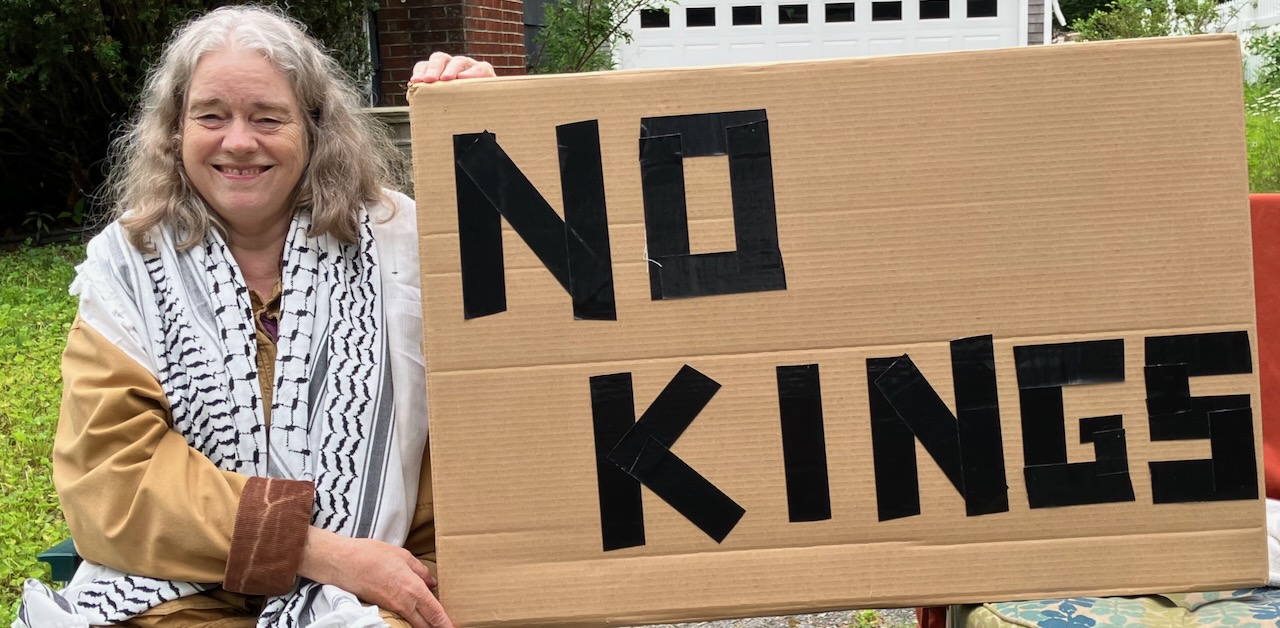
October 18th is NO KINGS day, and thousands of peaceful protests are planned for across the country. I can’t go out to one, but I can voice my support here. Support for democracy, support for the beautiful diversity that can make our communities full and alive, support for immigrants, support for trans siblings, and all queer people, support for disabled people and black people and indigenous people, Asian and Latino/a/x people. We need to keep expressing our vision of a multi-cultural country bound together by equality, justice, and full participation.
May the frogs multiply and spread the good word. Keep hope alive!
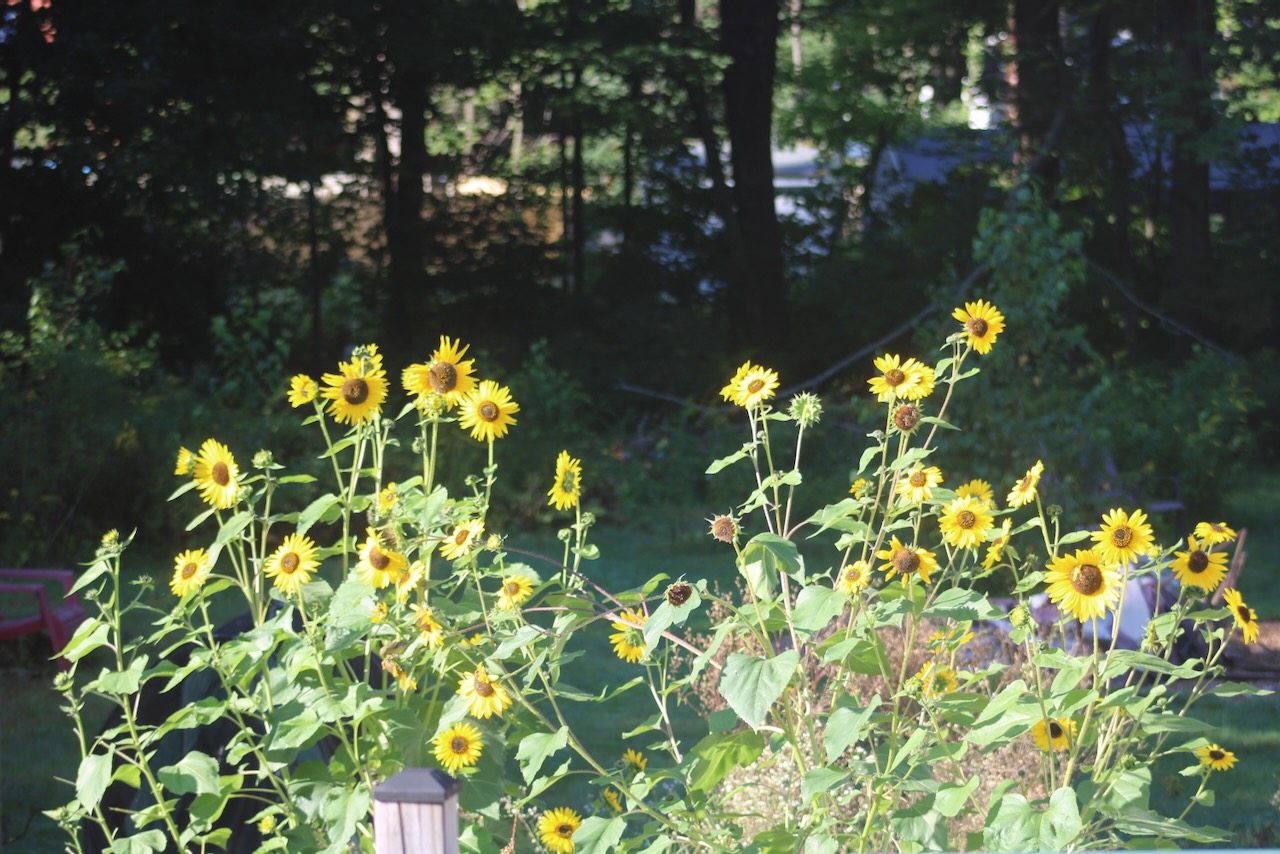
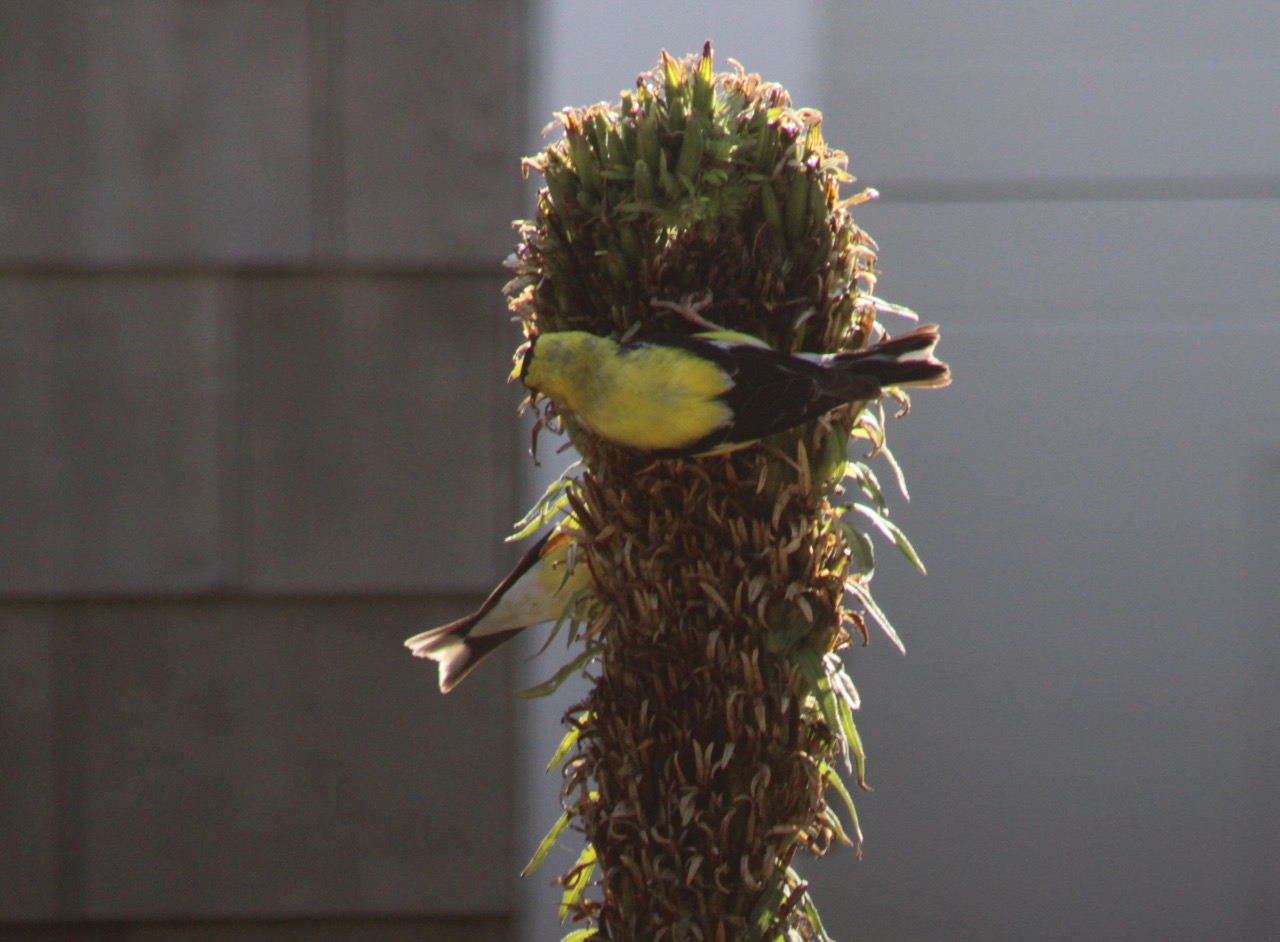
This is the view outside our back windows. We didn’t plant these sunflowers, they came up on their own, with help from squirrels and the bird feeder. These are the ones that goldfinches and bees love so much. Even a photo can’t capture the brightness of the flowers. They glow! They make me so happy each time I see them. I also always think of a dear friend who loves sunflowers, and that makes me happy too.
Another source of joy are the pond lilies, that have also multiplied. In other years, we’ve had many one bloom the whole summer, or maybe one bloom at a time. So in the morning, I see these sunflowers out my window. Then I take a little walk back to the pond, and see the blooms, and the little frogs. I hope they will bring a smile to you as well.
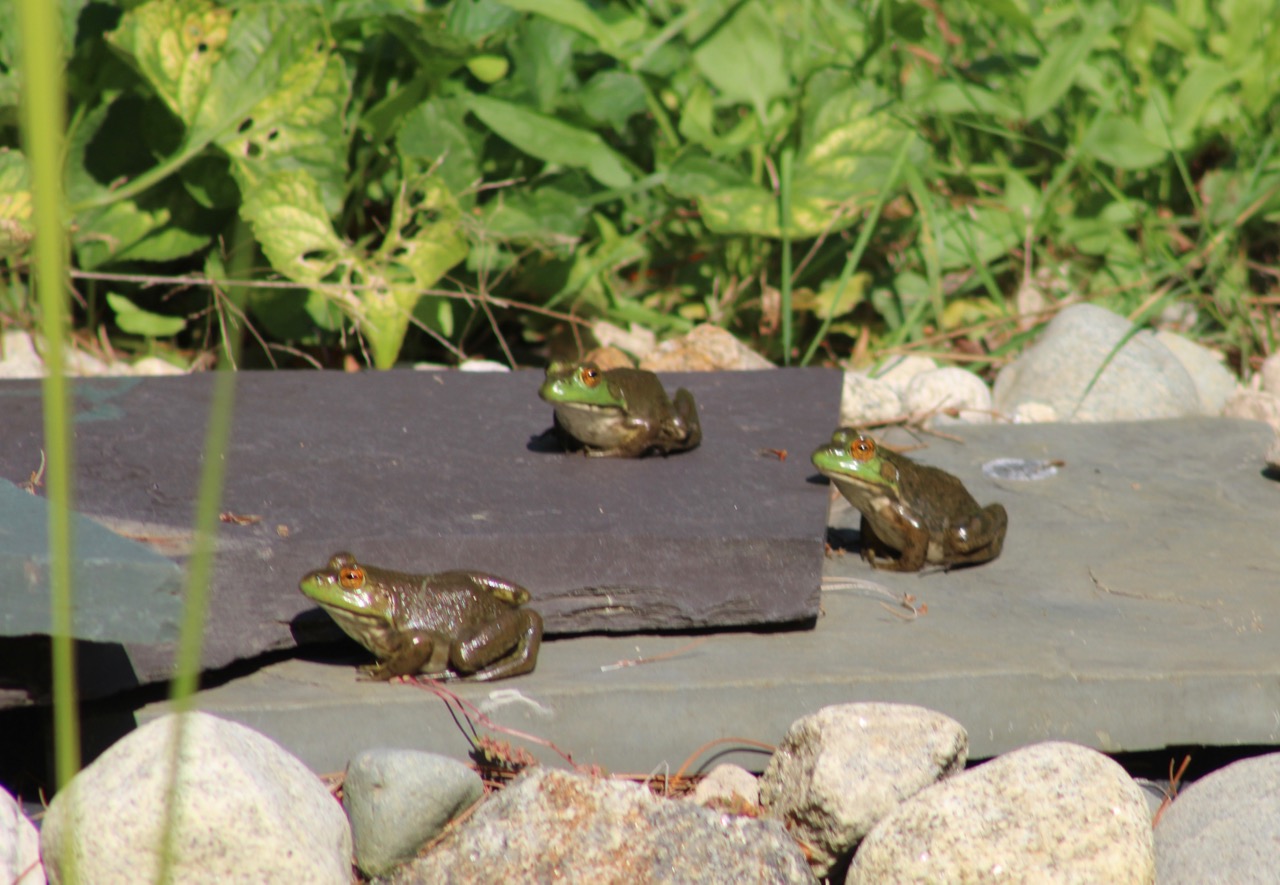
Since beginning to blog, I have loved taking photos of creatures and plants. It is like a third eye that helps me to see the beauty all around me. Sometimes it helps me to look more closely, later. Like with the frogs in our pond–I think these three might be bullfrogs, because of the ridge that goes behind their tympanum (their external ear drum for hearing), but not down their backs. I tried comparing them with images online, which helped, but then I noticed how often frogs have actually been misidentified in photos on the web. So I am not sure. They are bigger than some of the frogs that have been in the pond.
But when I look back to earlier photos of frogs that I identified as green frogs, I am confused. I knew those were green frogs because they were very small, and their little squeak as they dove into the water was distinctive. But they also seemed to have the ridge behind their ears and not always down their backs. Photos enable me to keep looking and wondering. I’ll have to wait and hear what these frogs sound like. They were out on those same rocks today.
Pink cosmos blooms
Sometimes, photos help me see beauty that is ephemeral yet durable. This cosmos was a volunteer by the side of the road, and started tall, with just one blossom. In the winds of last weekend, it fell over, but it keeps blossoming, and the bees keep coming by for nectar. It just keeps on blooming. It makes me smile.
Then, the other morning these turkeys wandered into the orchard, the sun making a little halo around their funny heads and big bodies. I was sitting in my chair and saw them outside the window. So I jumped up to go outside to take photos. The camera motivates me to watch them on their travels through the back yard. Then I can enjoy them once again in the photos.
It’s official. We’ve been designated by the National Wildlife Federation as a Certified Wildlife Habitat. This means that our garden “provides natural sources of food, water, cover, and places to raise young, and is maintained in a sustainable way that incorporates native plants, conserves water and doesn’t rely on pesticides.” We posted our sign in our front yard. We are one of over 227,000 such gardens in the United States, and they are hoping to reach 300,000 this year.
In order to be certified, you fill out a form at https://www.nwf.org/CertifiedWildlifeHabitat and give a donation to the organization. It’s on the honor system–you tell them the sources of habitat in your yard, in several categories. For food in our yard we have native plants, berry bushes, and fruit trees, as well as our bird feeder, and the pond. One of my favorites is evening primrose that grows wild. We keep several, only cutting in places that don’t work to have a tall plant–last year there were goldfinches all over this plant, and hopefully more this year.
We provide water especially with the pond. The pond serves so many purposes–food, water, a place to raise young (the tadpoles!), cover for frogs. When I walk in the morning, I see birds bathing, bees taking a drink, frogs sunning and snatching flies. But any kind of water brings wildlife to a yard–small or large. We also have a bird bath near our patio, and see birds and squirrels getting drinks there.
Cover is used to protect from bad weather, hide from predators, or hunt prey. Around the edges of our yard there are trees and bushes, and piles of branches that provide cover for small critters, and places to raise young. Ever since the orchard trees and hazelnut bushes have grown up, birds are always perching there, sometimes on their way to the bird feeder, sometimes eating insects. I’ve posted about the robins raising young in a nest on our back porch. But we’ve also seen young squirrels in trees, and chipmunks coming from underground.
As for sustainable practices, we never use pesticides, and we compost our food waste and leaves. We conserve water with our rain barrels, and if the pond needs topping up, that comes from the rain barrels too. We try to incorporate native plants wherever we can–mostly by not pulling the weeds that emerge on their own: violets, pansies, daisies, wild strawberry, goldenrod among many others. I use an app to identify plants that come up. We do also have invasive plants that we are trying to get rid of.
The official designation and sign were a gift to ourselves, and to make our intentions more visible in the neighborhood. Most of the actual habitat is in the back and side yards. Have any of you participated in this program? Maybe you might like to check it out. There are little things that each of us can do to care for the earth community, and foster habitat for wildlife.
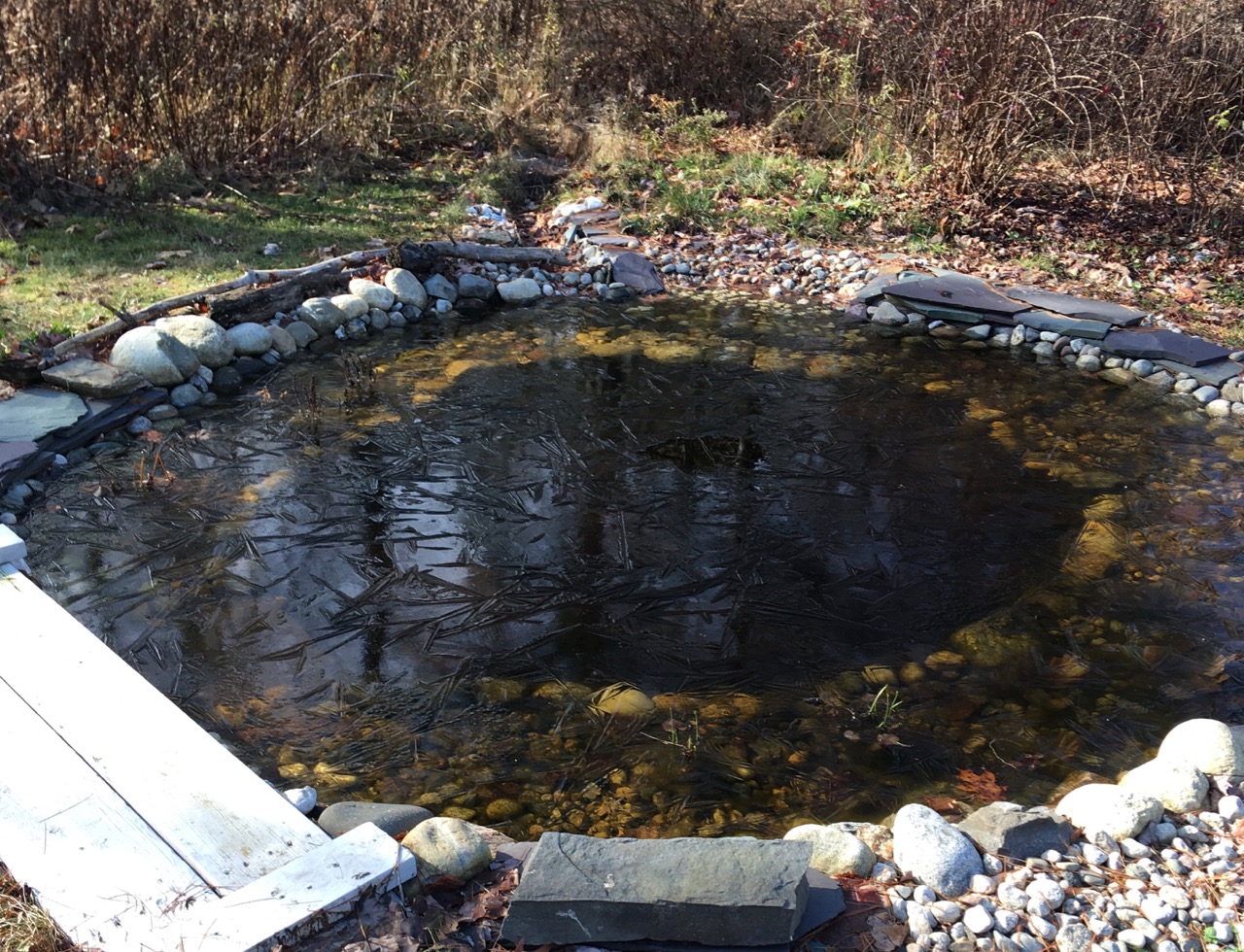
Ice was forming on the surface of the pond yesterday.
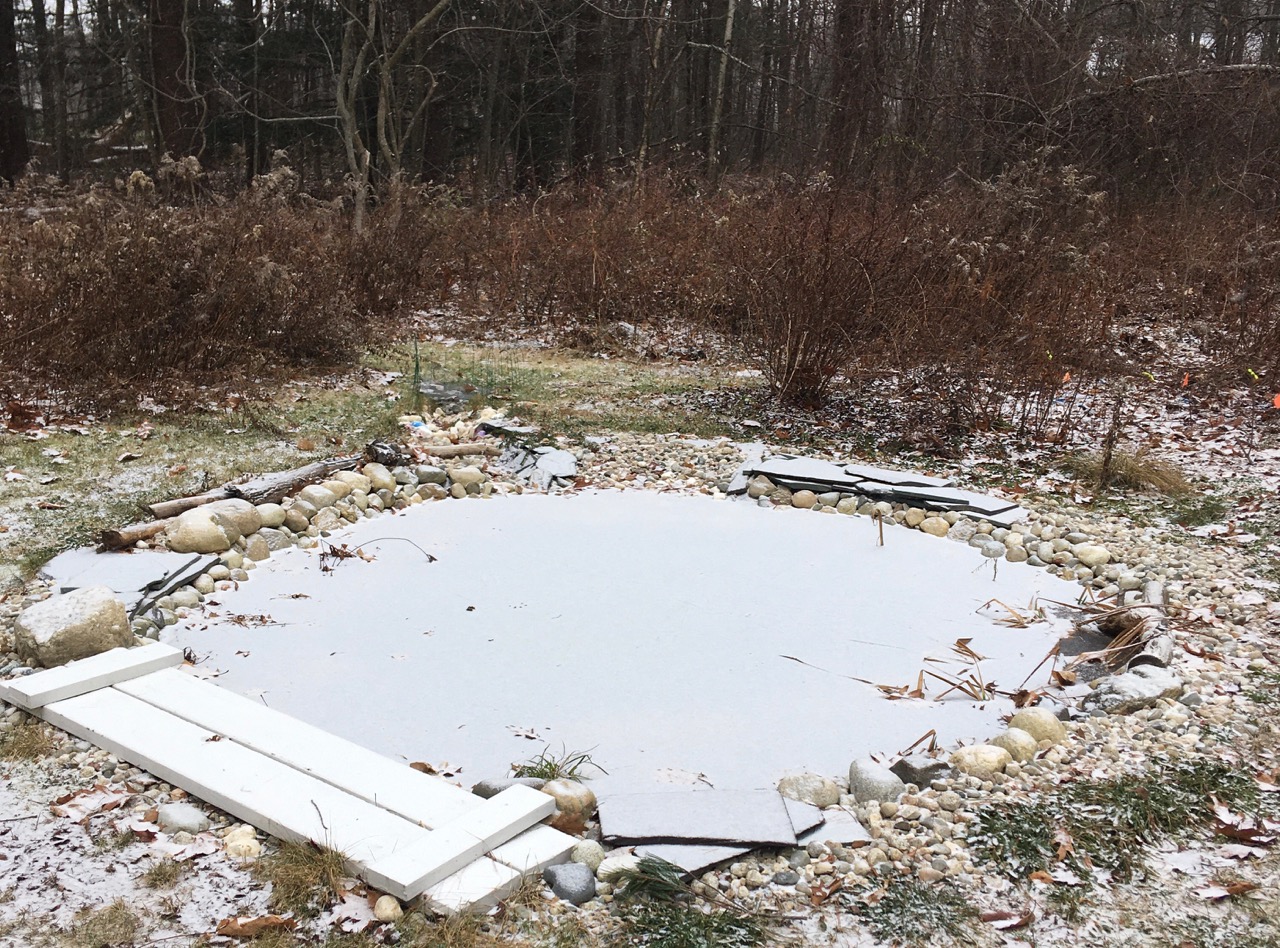
Yesterday felt like the true turning of the seasons, from warm autumn 70 degree days to a chilly, almost winter, high of 40 degrees. We had a freeze overnight and the pond surface was wrinkled with ice forming. I went around the yard putting away the last garden hose, the five-gallon buckets, the little tables we use in the back next to chairs. I turned over the wheelbarrows behind the garage. I covered our patio table and chairs with a tarp, and I plugged in the bird bath so it will keep water thawed during frozen weather. I got out the snow shovel and sand mixture to put on the back porch. I left 4 chairs around the fire circle–maybe we’ll get outside around a fire–it could happen!
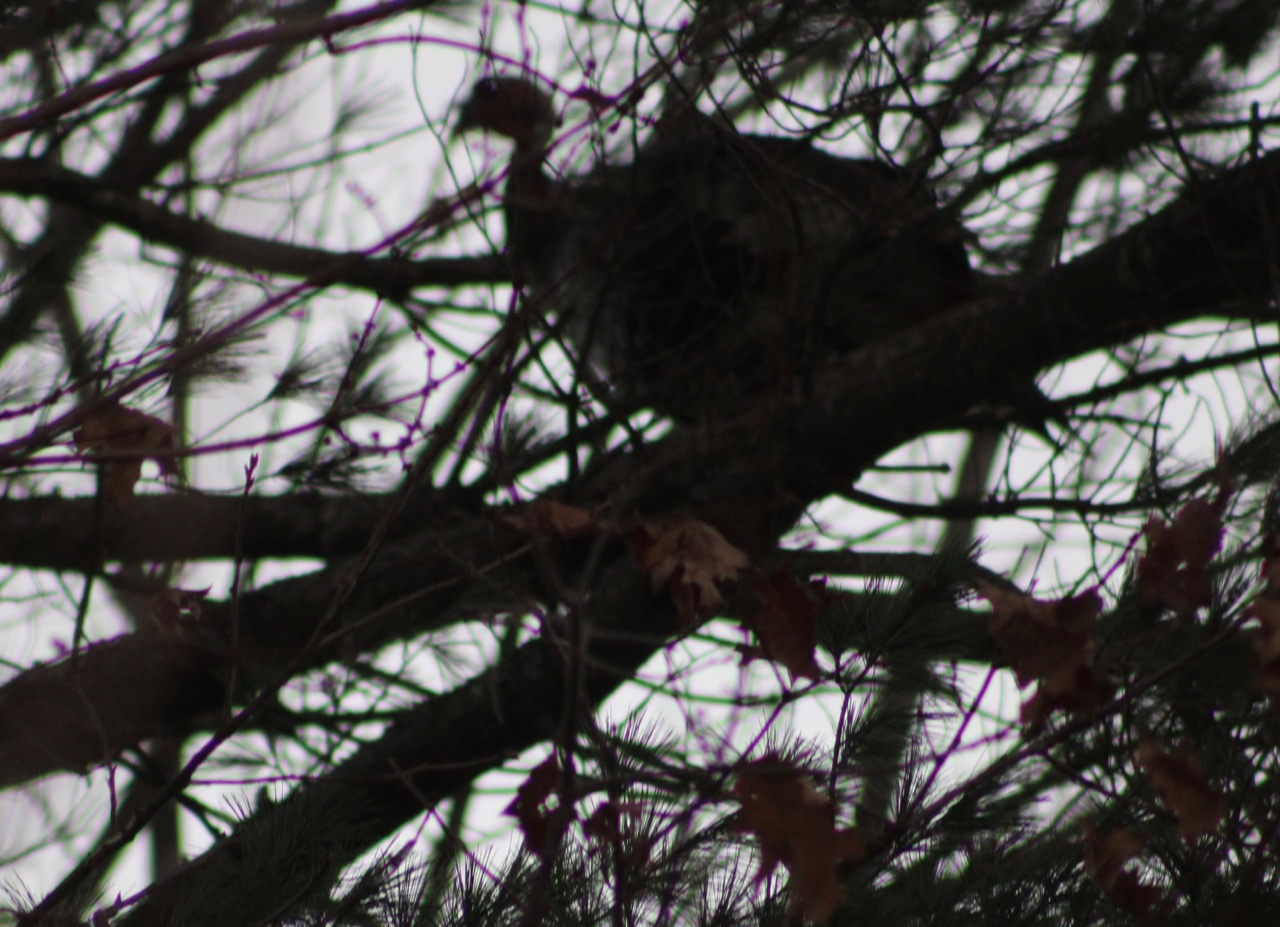
Last Thursday was my last time lying in the hammock for the season. I could see two frogs still hanging out in the pond, the color of mud, not the green of summer. While I was lying there, suddenly I saw a huge bird flying nearby, up to the pine trees at the back near our yard. Looking closer, I recognized the characteristic shape of a turkey! It was dusk and the light was turning all black and white and shades of gray. We’ve had a little trio wandering in the yard during the last few weeks, so I am guessing this was one of them. I had to put the hammock away the next day.
Turkey in a pine tree at dusk
This morning, we had a bit of snow, mixed with rain, so here we are. The gardening work, whether fully complete or not, is done for the season. And I was inspired to get back to my winter project–going through boxes of old papers in the basement. I am proud of myself for diving into it today!
Last winter, I went through 11 boxesfrom my years in Boston, organized, winnowed, and reduced them to four. I had just started on some boxes from the time before I moved there. This winter, I will go through papers from my time at the Women’s Peace Camp, and in Chicago, and in Grand Rapids. I went to Chicago from Grand Rapids in 1983 to attend Chicago Theological Seminary, from which I graduated in 1986. I visited the Peace Camp in the summer of 1983, and then lived there in the summer of 1985, and winter/summer 1986. These places were the scenes of my coming out as a lesbian, and my trying to figure out what ministry might look like for someone like me. At the time I had left the Catholic church, and was part of the emerging feminist spirituality movement. I experienced so much transformation during those years, and I am fascinated to read what I wrote about it. It was a season of profound personal change.
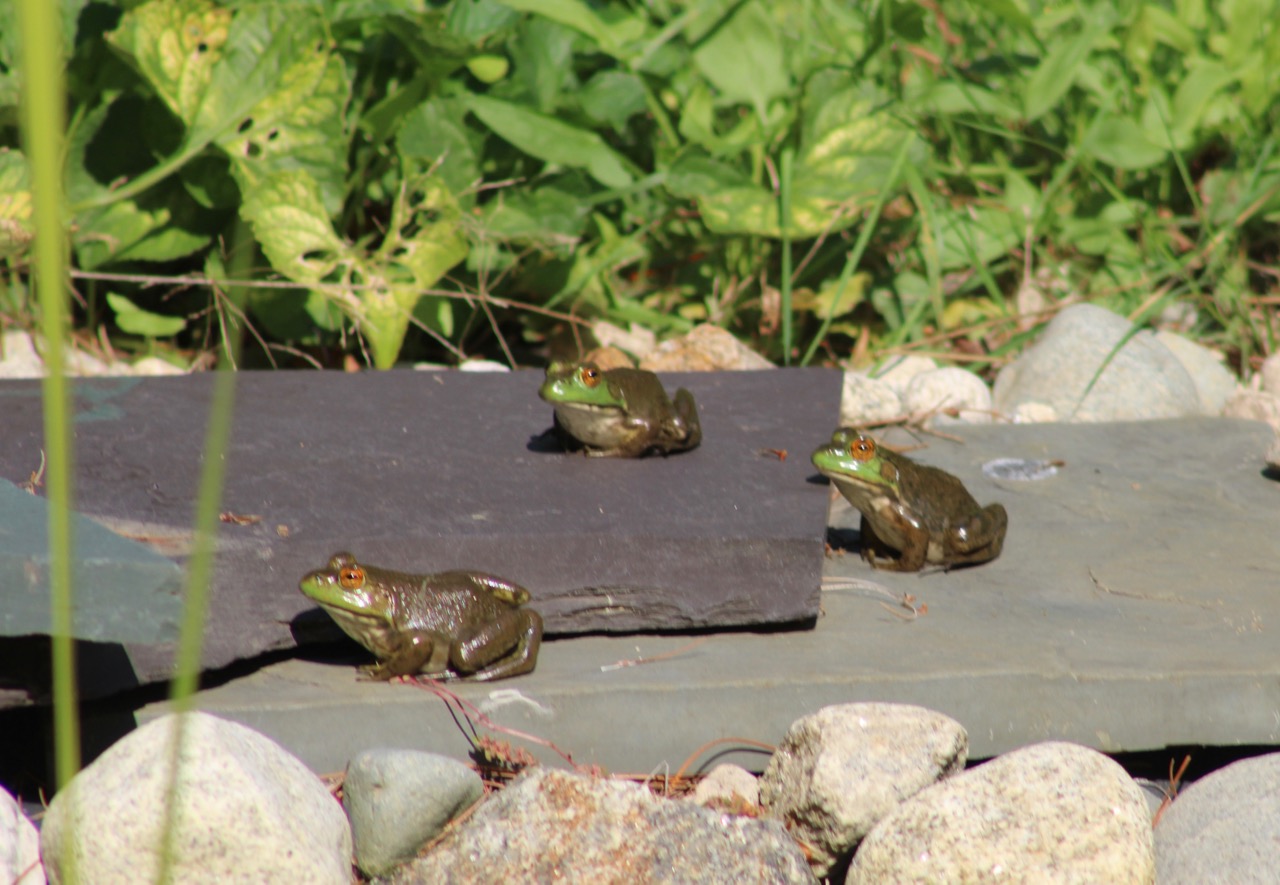
Three small frogs perched on rocks next to the pond in morning sun.
Lately, my life is small, as if I am looking on to life happening nearby, just like these frogs looking out over the edge of the pond. So many big things going on in the world, much frightening, some inspiring, but all of it feels somehow at a distance. I haven’t had a lot of words the past couple weeks.
But there was something I learned about that I wanted to mention here. It relates to my essay, on this site, called “Wanting to Be Indian.” I first wrote and published it back in 1995. I’ve learned a lot since then, and adapted the essay as I did. When I first wrote it, I described the history of my ancestry using the word “Metis.” I had no understanding of what that word meant in a Canadian context. I just had seen it in a French book about my ancestors, meaning of mixed ancestry, white and Innu. I thought maybe it might apply to me. But as I began to learn more, I stopped using that word, because historically it refers to the people in western Canada who have been a distinct Metis community for a long time. So I thought perhaps that was that. (Now I describe myself as white, with a distant Innu ancestor, my third great grandmother Marie Madeleine.)
But more recently, in the last year and especially this past week, I’ve been doing a lot more reading about the current situation in Quebec and the Maritime provinces. I have been horrified to learn about white people there claiming a “Metis” identity, in order to fight against the indigenous rights of Innu and other Native peoples. I found a website called Race Shifting, a “resource for people who are concerned with or want to find out more about the rise of the so-called “Eastern Metis” in the eastern provinces (Ontario, Québec, New Brunswick, and Nova Scotia) and in New England (Vermont, New Hampshire, Maine).”
Many of these so-called “Metis” organizations in Quebec have roots in white supremacist organizations, trying to impede the work that the government of Canada and Quebec were doing with Innu communities to negotiate agreements for their government-to-government relationships. (Some resources are in French, like the article about these negotiations toward Innu agreements. But I was able to read it with the help of Google translate.) The Innu never signed a treaty or ceded their land in the days of early colonization up through the end of the 20th century. Just after the turn of the century, when they were beginning to set parameters for these agreement, in public hearings there was resistance from some white people, especially those living near Saguenay and Sept-Iles. And then the tactics of those white people changed: they created “Metis” organizations, based sometimes on a very distant Indigenous ancestor (17th century), and often none at all. They tried to claim their own “Indigenous rights.”
I’ve written briefly about this issue before, but this time I saw that one of the Saguenay historians who is supporting this effort is someone who had done research on one of my ancestors, whose article I had requested and received in an email. That felt creepy. It made me wonder if probably a lot of these people are distant relatives of mine–I mean, that is sort of true for all French Canadians–we really are all related. But Saguenay is the region my great grandmother came from. Sometimes I hate being white. And certainly it was from my own experience that I wrote about the problems of white people wanting to be Indian. But this is something even deeper and more sinister–to claim Indigeneity to fight against Indigenous communities?
It’s hard to understand all these phenomena from outside of Quebec, from outside of Canada. And I don’t have a voice in that setting–I don’t even speak the language. Yet I understand enough to feel so sad. And even here in New England, I am looking on from the sidelines. I certainly have no role in identity policing. But it seems somehow important to try to understand it all, and important to support, in whatever small ways I can, the sovereignty struggles of Wabanaki peoples in Maine. This is where I am.
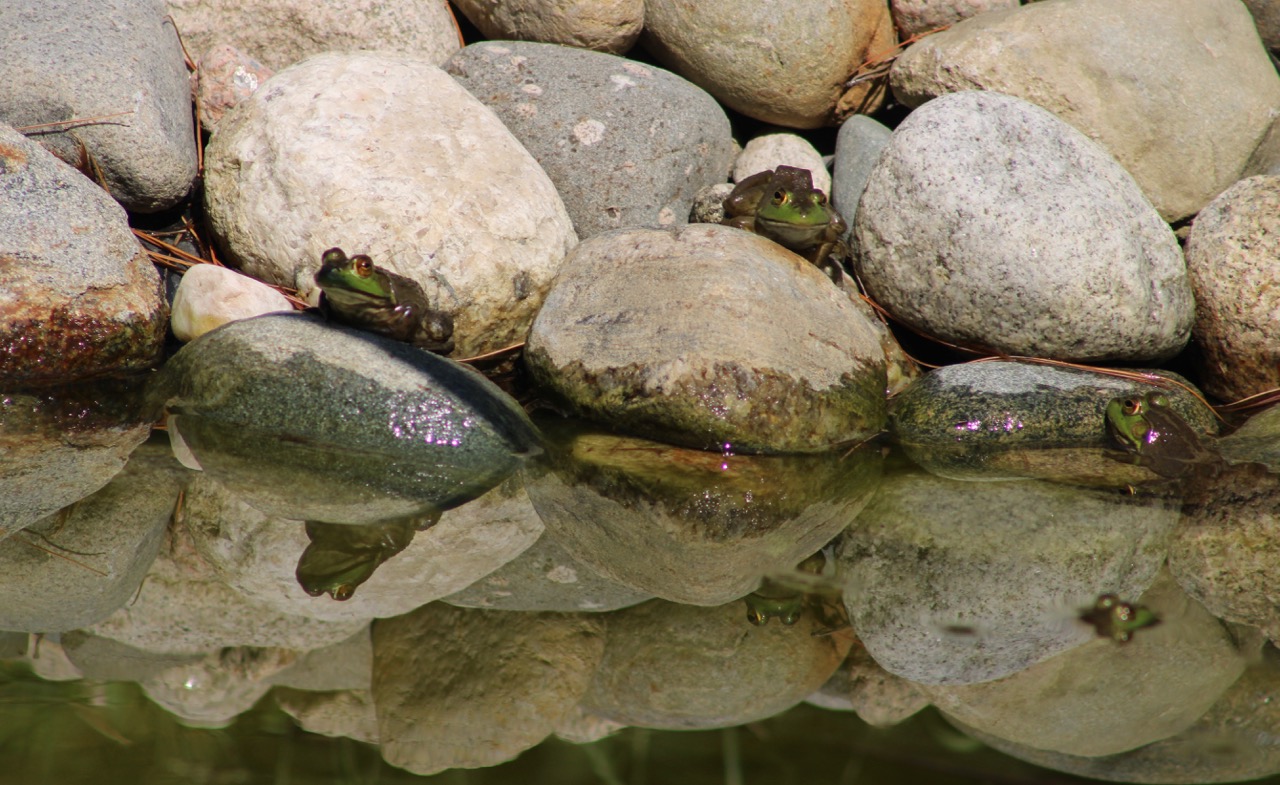
And now, for just a little beauty to counter the ugliness of racism, here are three more green frogs from our pond. (And the irony is not lost on me–frogs were used prejudicially against the French, and more recently a cartoon frog has been co-opted by white supremacists.) But these frogs are simply themselves.
Three frogs on rocks, and their reflections in the water of the pond.
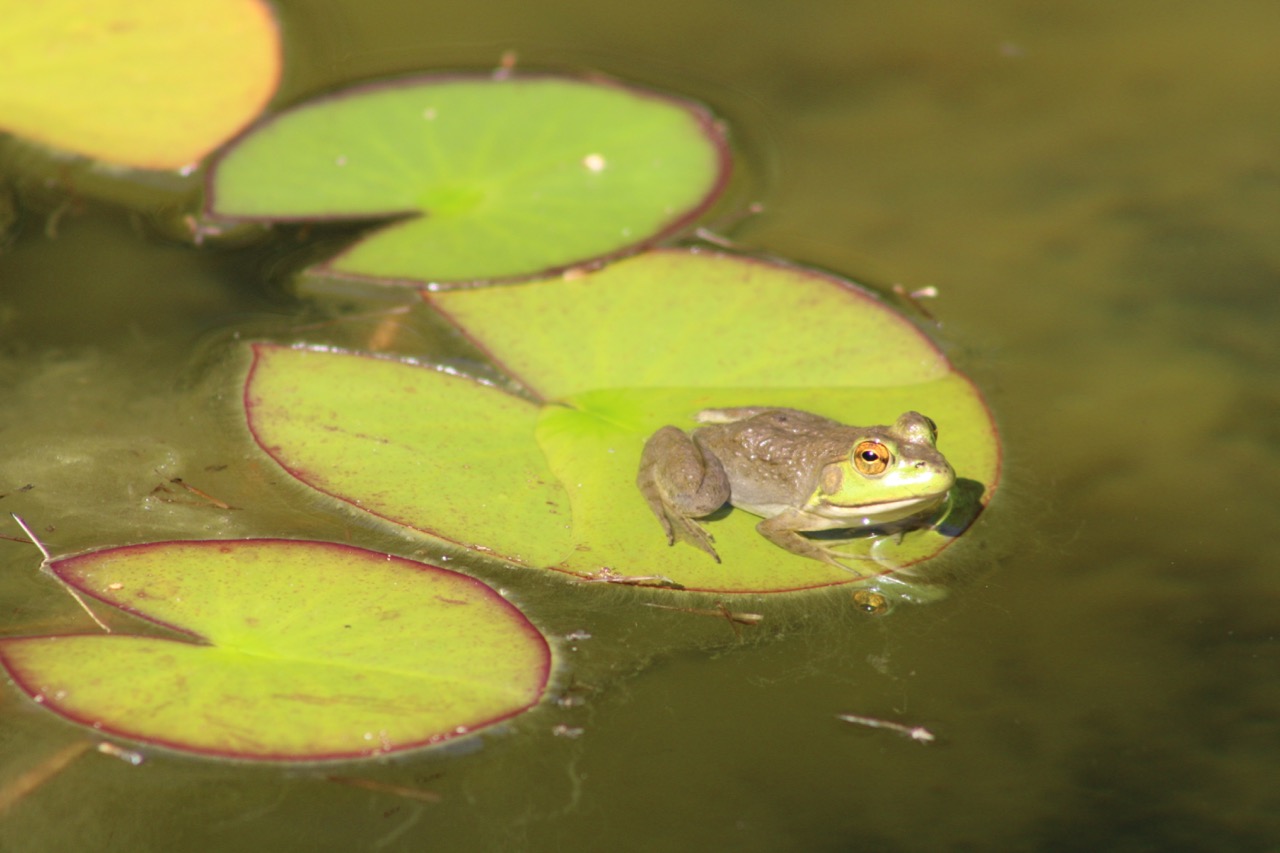
We finally got two solid rain storms this past week after a long drought. What a relief! And now four very tiny frogs have appeared in the pond. (I don’t know what happened to the one we had before that was a little bigger.) A few days ago, this new water lily flower started blooming, and today when I went out to see it, it had disappeared. But I found three of the tiny frogs perched on lily pads! The fourth was on the other side of the pond on a rock. I didn’t look too closely under the water to investigate the missing flower, so as not to scare the frogs.
But slowly I sat down near the edge of the pond and watched for a while. A dragonfly came and perched on blue flag iris leaves. The frogs stayed on their pads.
Tiny frog on a lily pad
Second tiny frog on another lily pad
Taking close-up photos makes the frogs appear larger than they really are. They are only about an inch long nose to backside. I wonder if maybe it was the rain that enabled these small frogs to travel from some other place to our little pond? I feel refreshed by the rain too. Cool nights with windows open, listening to the dark sounds. Lovely.
Catbird in the mulberry tree-a dark silhouette amid green leaves and berries
Two weeks ago, I had terrible cramping in my lower abdomen. Over a few days, it gradually localized to the lower left of my abdomen, particularly when I had to poop. My medical practitioner did some blood tests, and found high inflammation, but not infection, and scheduled a CT scan. They determined that I was having a bout of diverticulitis, which, even as it was diagnosed, thankfully began to ease up. It was scary and discouraging to have yet another illness keep me down for over a week, and add to the complications I already have with eating food. A little research showed that 50% of people over 60 in the US deal with this disease. We must have a cultural taboo against talking about it, because I was very surprised to realize it was that common.
After all that, I explored some herbal options for healing, and discovered that licorice root is one of the recommended herbs–which I have already been using for energy issues. This spring I harvested and dried some from the plant in our yard that I had planted a few years ago. (I use much more than that in a year, but it is exciting to be starting to harvest it here.) I have been drinking tea made by boiling a couple tablespoons of the root in a quart of water.
Dried licorice root-first harvest
Because of all this, I was feeling discouraged, and then I remembered the challenging wise words of Indigenous writer Paula Gunn Allen, in an excerpt from “The Woman I Love Is a Planet; The Planet I Love Is a Tree,” from her book, Off the Reservation.
“Our physicality—which always and everywhere includes our spirituality, mentality, emotionality, social institutions, and processes—is a microform of all physicality. Each of us reflects, in our attitudes toward our body and the bodies of other planetary creatures and plants, our inner attitude toward the planet. And, as we believe, so we are. A society that believes that the body is somehow diseased, painful, sinful, or wrong, a people that spends its time trying to deny the body’s needs, aims, goals, and processes—whether these be called health or disease—is going to misunderstand the nature of its existence and of the planet’s and is going to create social institutions out of those body-denying attitudes that wreak destruction not only on human, plant, and other creaturely bodies but on the body of the Earth herself….
“Being good, holy, and/or politically responsible means being able to accept whatever life brings—and that includes just about everything you usually think of as unacceptable, like disease, death, and violence. Walking in balance, in harmony, and in a sacred manner requires staying in your body, accepting its discomforts, decayings, witherings, and blossomings and respecting them. Your body is also a planet, replete with creatures that live in and on it. Walking in balance requires knowing that living and dying are two beings, gifts of our mother, the Earth, and honoring her ways does not mean cheating her of your flesh, your pain, your joy, your sensuality, your desires, your frustrations, your unmet and met needs, your emotions, your life.”
Paula Gunn Allen
It is so easy to identify events in the yard, or in my body, as beautiful or ugly, gifts or challenges, positives or negatives. But coming into a harmonious relationship with all beings of this earth requires letting go of that polarity–not denying the difficulties or pains, but going deeper with my responses. How can I embrace all that life offers, in the yard, and in my body?
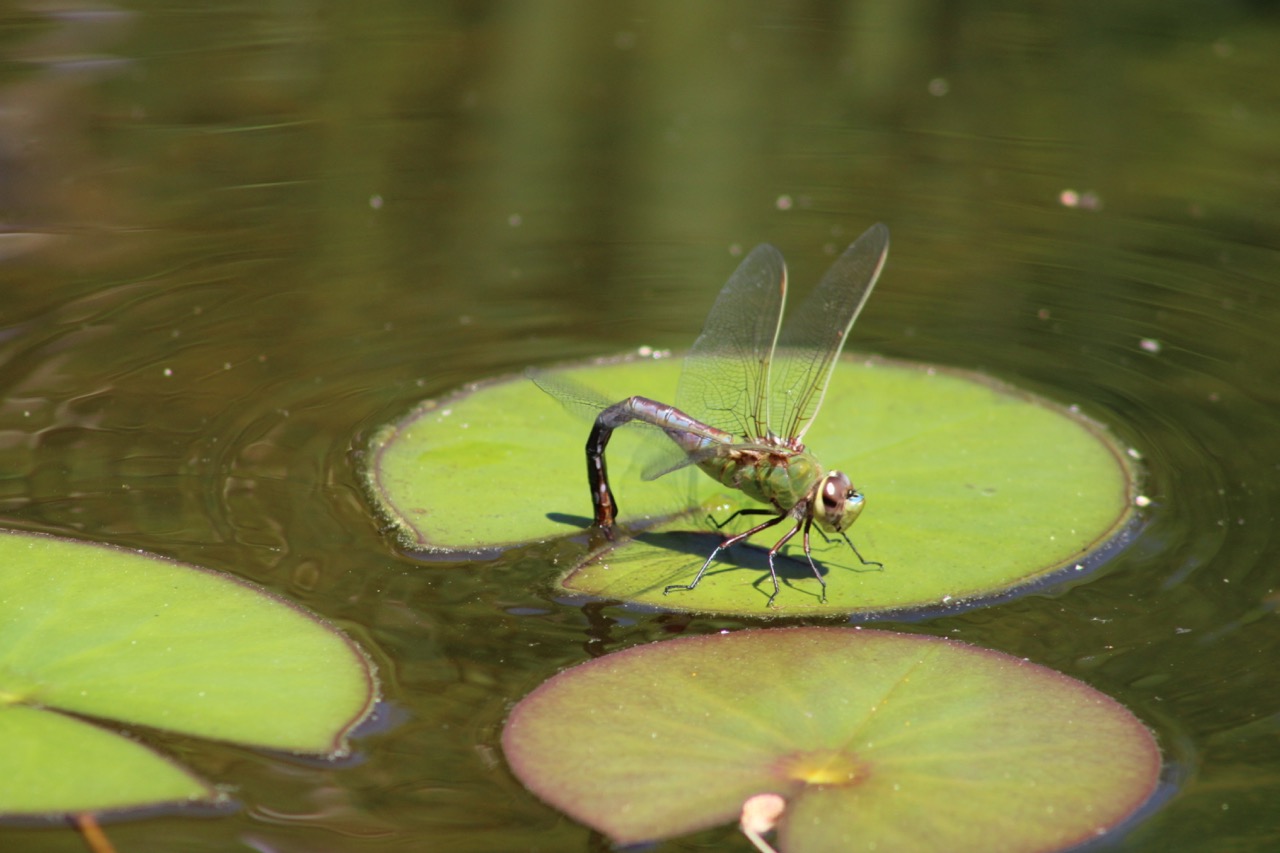
We have seen two frogs in the pond, one bold and the other cautious. Yesterday a neighborhood cat was stalking the pond. Today, I only saw the cautious one. Is the bold one gone? The cherries that appeared green in the trees are getting brown spots on them. The cardinal couple seems now to frequent the feeder every day. The robin that abandoned her nest, is back in the nest trying again with new eggs. Today I saw her partner bring her a bite to eat. A dragonfly was dipping her tail in the water, while perched on a lily pad–laying her eggs in the pond. Something took a few leaves off two of my kale plants, but did not destroy the whole plants. Can I begin to see all of it as wholeness, as beauty?
Dragonfly on a lily pad in the pond, dipping her tail in the water.
The last couple weeks have been focused on healing in our household. My partner Margy had knee replacement surgery, and came home to recuperate after a couple days in the hospital. Then, one of our cats, Billie, perhaps from the stress, stopped eating, and had something going on with her liver. So the vet came with some medicines to help her start eating again. I have been the tender of these loved ones, and both are doing well for the moment, but the healing will take some time. I haven’t been able to post on the site lately, being fully occupied with my nurse duties, but today is a quiet day, and I have these few moments to write and share photos.
Billie eating some food!
In the meantime, the yard is unfolding on its own, mostly with our neglect, except for occasional bits of tending, and I have been appreciating its springtime beauty and vitality.
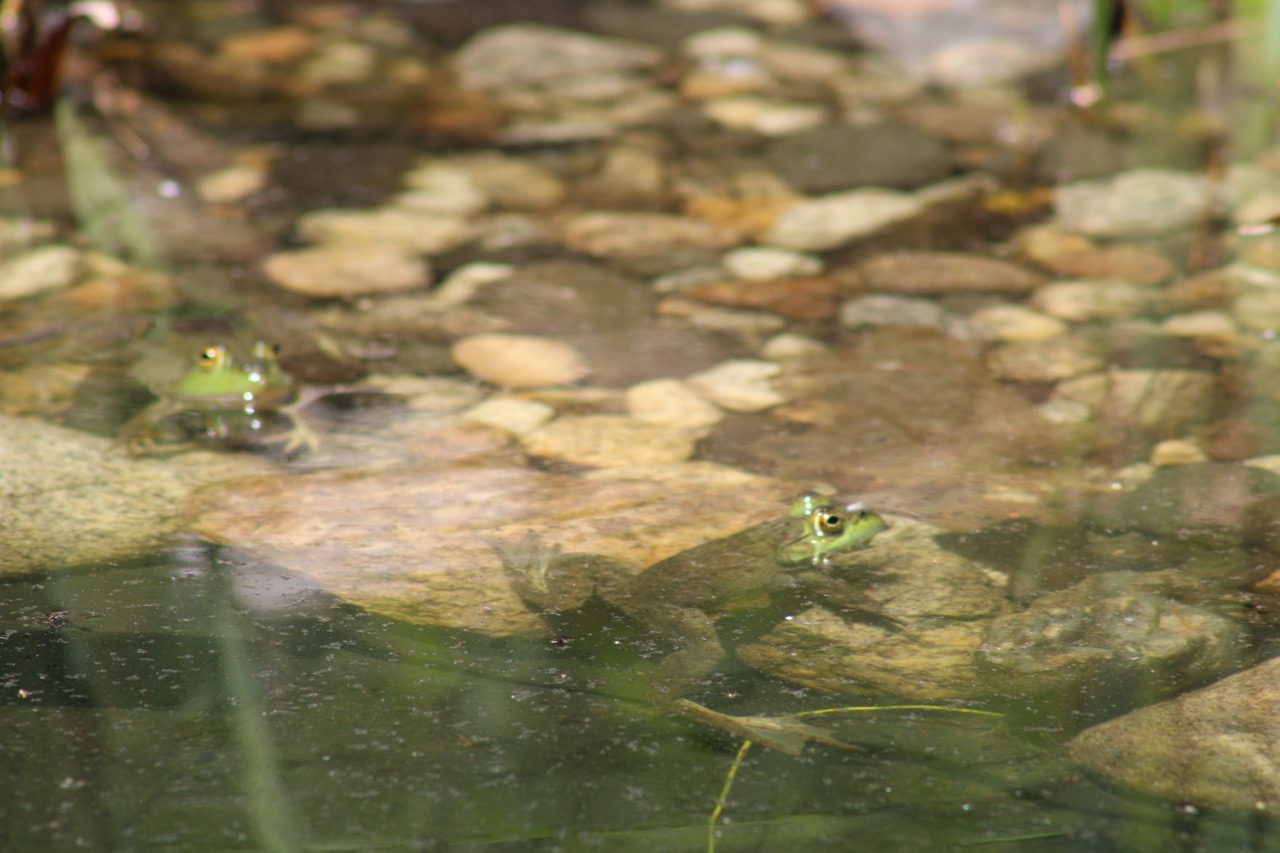
There are two frogs in the pond now, and one day, as I sat watching, one of them was chasing the other one, though not all the way out of the pond. The chased one is more timid, and dove into the bottom. They were both females I believe, so I am not sure what it was all about. But fascinating to watch, and listen to her calls.
Two frogs in the pond, just before the one on the left leapt over, and the one on the right dove under.
Sadly, the robin who has been sitting on the nest on our back porch, finally abandoned the eggs two days ago. She had been on the nest quite a bit, though not always, but they never hatched. I wonder if maybe the location was actually too warm for the eggs. Again, we don’t really know, but it is amazing to observe. We will miss her quiet presence, though I have also seen her in the orchard since then.
Yesterday, a lone turkey came into the orchard on her way to somewhere else. She very politely didn’t eat the broccoli and kale seedlings I just planted this week, but seemed to enjoy the clover.
Turkey in the garden with dandelion seed puffs behind.
I wonder if we might be able to create enough food in our garden, for the people and the animals? (Instead of battling with squirrels and other critters) Today, in a webinar, Letecia Layson described doing that, when creating a garden in a nature reserve. “Plant enough food for the animals and for you.” What a wonderful model for interconnection. There is so much wild plant beauty and food already out there too. For example, wild strawberries have spread over vast areas in the orchard and in the further back yard. We don’t usually eat these strawberries, but leave them for the birds.
Wild strawberry flowers
Way in the back, in the hedgerow which has now filled out in its summer foliage, there is a clump of jack-in-the-pulpit that Margy discovered last year. Since she can’t get back there right now, I looked out for it and was delighted to see that it has returned. I brought her a photo. We also have bleeding hearts, golden seal, and many many ferns along the edge of the “forested” area.
Jack-in-the-pulpit
Margy taught me how to use our battery-powered lawn mower, and I have been able to make some paths at least through the growing-taller grass. Mowing is usually her job. We figured we’d go along with No Mow May, but between ticks and invasive bittersweet, we actually do better to do some mowing. But we always steer around the ferns and other interesting wild plants that come up.
All of this has been a lesson in listening to the land, to the plants, to the animals. I have focused on quiet attention rather than doing projects. There will always be projects to do out there, but this year I am learning to be slow.
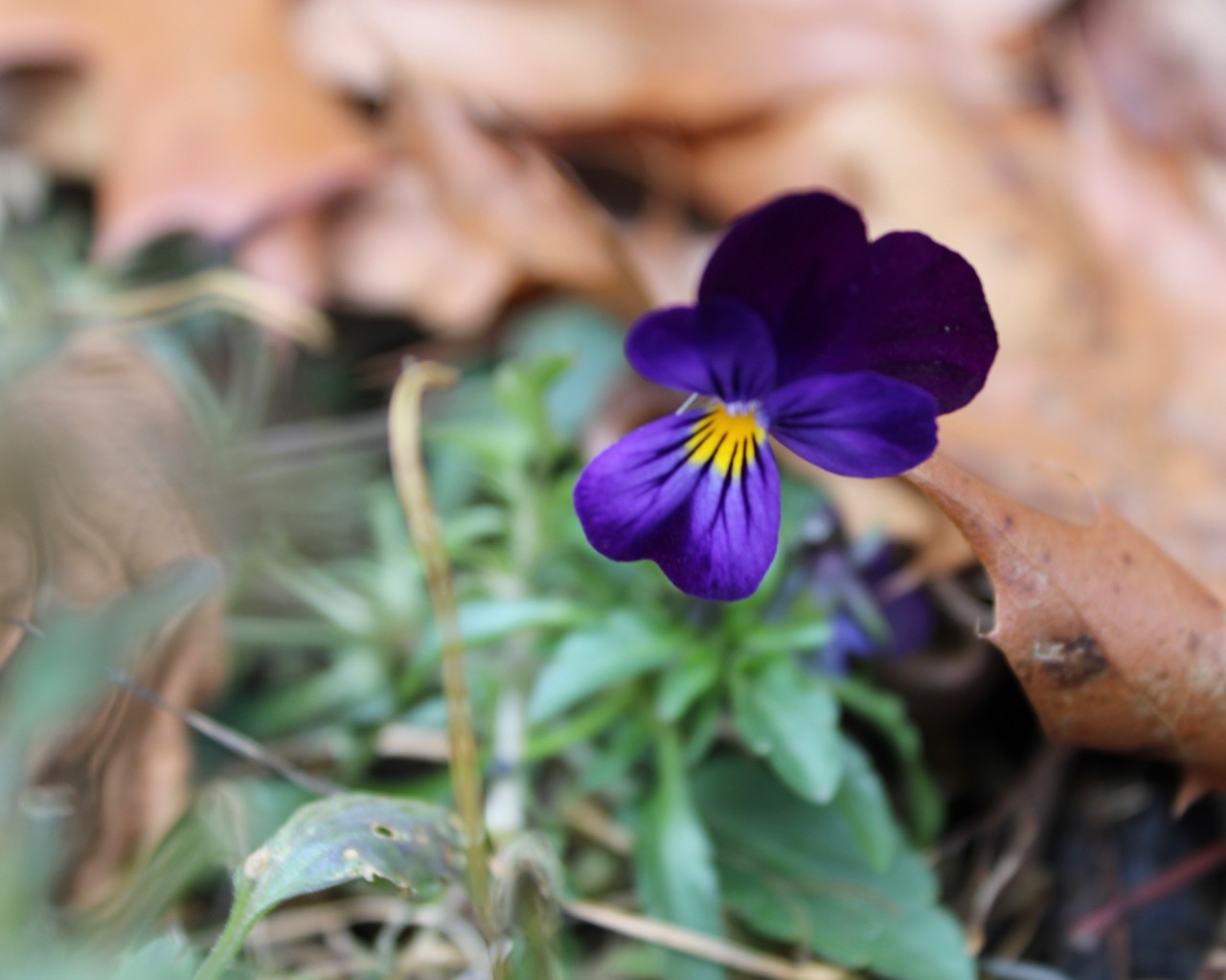
Wild pansy purple and yellow, blooming in December
A climate catastrophe sometimes shows up as the fragile beauty of a wild pansy blooming in mid-December in Maine. I took a photo this morning, before the snow arrived this afternoon, our likely first plowable snow of the season. Very late for us. The unseasonably warm days feel bright and pleasant, nothing dangerous. But I am thinking of the deadly storms that blasted through the midwest last week, tornadoes killing dozens of people in an unprecedented long trail of destruction. I am thinking of giant raging wildfires in the west, and monster hurricanes in the Atlantic. Sometimes the change feels like nothing much at all, unless I stretch my eyes to take in the bigger picture.
We arrived at our current house and yard six years ago after a 4 month search to find greener housing. We were able to downsize, to add insulation, to cover the south facing roof with solar panels, to install energy efficient heat pumps, to create a garden. Our actions fit the best choices we could make at that time, to align with our love for the earth and all her creatures. In that, they were like a prayer, like a magical spell to further the possibilities of earth community based in mutual respect. On a spiritual level, I have to hope that our small choices can ripple out for good.
But these individual actions don’t make a dent in the greater physical scheme of things. The giant polluters of greenhouse gases continue to ignore the limits of earth to push for expanding profits. We, as a planet, have already exceeded the hopeful atmospheric carbon dioxide goals of environmental organizations like 350.org. Now we’re at 415 parts per million. We’re on the way to unmitigated disasters that we can no longer walk our way back from. Scientists can make some predictions, but no one really knows how the increase in global temperature will play out in the next years and decades.
From where I sit, I can feel overwhelmed and helpless. I don’t have the energy to be out in the streets anymore, an activist like in my younger days. I don’t have the money to donate to activist organizations like I used to when I was working. Many activists I respect talk about the coming collapse of economies and civilizations, even within the next decade. I don’t imagine that I have the physical capacity to survive such a collapse, given my age and health. So what is there to do?
What helps is to recognize my limitations, to take in the very smallness of my being. What helps is to see young activists in the street, sharing their anger and love with loud voices. What helps is to remember that Indigenous people the world over have already experienced the collapse of their economies and civilizations. Pay attention to their advice. What helps is to recognize the smallness of my being, and yet remember how I am interwoven with the ancestors and all the interrelated beings of earth. What helps is to keep on loving the trees and birds and frogs and even the squirrels of this small place we are lucky to share with them. What helps is to offer bird seed as a prayer in the morning. What helps is to imagine the unimaginable largeness of the Earth, our mother, and her mysterious powers that we cannot measure or predict.












 Finding Our Way Home