The Seed of God

The German mystic, Meister Eckhart, wrote,

The seed of God exists in us…
Pear seed grows up into pear tree.
Nut seed grows up into nut tree—
God seed into God.

What might we do together if we remembered that each of us has the seed of God inside? Antoine de St. Exupery, in The Little Prince, tells us “it is only with the heart that one can see rightly; what is essential is invisible to the eye.”

Each one of us is like Jack and the Beanstalk. Each one of us has within us this spark of divinity, like a Mystery Seed, a seed of what we might become, fully alive. And we also have some husk that tries to keep it contained and hidden. We have to plant those seeds, let them break apart, tend them, and help them to grow. If we let those Mystery Seeds grow, like Jack with his beanstalk, we will become much more than we ever imagined.

I can’t help but think of one of the elders I knew in the congregation in which I served on Cape Cod in Massachusetts. Her name was Ellie. Ellie died at the age of ninety-four. She had always suffered from a stutter. As a child, she was sent to all the specialists that her prominent father could afford, and nothing cured the stutter. But in the midst of this, Ellie was able to find her voice.

She became a writer, both in her career, and in her passion for politics and social justice. She was a speechwriter for several political campaigns and an active member of the League of Women Voters. She was also active in the nuclear freeze movement. Somehow, she didn’t need to get rid of her stutter to bring forth her voice. It was almost as if her stutter helped her to find her voice. It was like an old husk, long ago cracked open, lying almost unnoticed around the bright flower of a plant that had grown from her heart. She had brought forth her latent divinity.Violets in Tree MJ DSC05246

Quote from Meister Eckhart (1260-1328), from “The Nobleman” in Meister Eckhart, From Whom God Hid Nothing: Sermons, Writings and Sayings

Growing a Soul

Fiddlehead New DSC00242Unitarian minister A. Powell Davies said “Life is just a chance to grow a soul.” He was known for standing up against injustice, and working on behalf of freedom, democracy and equality. For Davies, being fully alive meant living according to these values, and shaping the future toward a vision of connection and community. He spoke of the inner life at the heart of his actions:

“There is no mystery greater than our own mystery. We are, to ourselves, unknown. And yet we do know. The thought we cannot quite think is nevertheless somehow a thought, and it lives in us without our being able to think it. We are a mystery, but we are a living mystery… Fern Grow DSC03761_2In the mind’s dimness a light will shine; in the spirit’s stillness it will be as though a voice had spoken; the heart that was lonely will know who it was it yearned for, and the life of the soul will be one with the life that is God.”

For Davies, growing the soul means attuning ourselves to this inner light, becoming one with the life that is God.

The soul is not a passive object of salvation or protection, but a living capacity within all of us for a deepening awareness of connection and mystery. The Mystery Seed is another name for the soul. A seed is meant to be planted and to grow. To grow our souls means to foster our inner awareness of the connections between all beings, our inner awareness of the Mystery that is within us and within all.

Quotes from Davies from an article by Manish Mishra

Waking Up to Joy

I realize not everyone is attuned to rise at dawn. We each have our own circadian rhythms. Scientists have found that individual rhythms have a genetic basis and are incredibly difficult to change. Some people naturally rise early, they call them the larks, while others are tuned to a later cycle, they call them the owls.

So I am not suggesting that everyone should start rising at dawn. I am still not even sure if I can shape my life in that way. But what I notice is that whenever I take some small step toward attuning myself with the larger earth, I feel blessed by it—I feel more beauty and joy.

And yet, for each small step, I also feel challenged—aware of how broken off I am. Aware of how broken off we are as a people from this earth that is our whole life. I have to believe that awakening to this beauty and brokenness is the essence of the spiritual journey. We cannot have one without the other. My greatest hopes trigger my greatest fears. My greatest fears call forth my greatest hopes. I believe that when we enter that place between our greatest fears and our greatest hopes—when we encounter our own vulnerability, and call out for help, something can rise in us like the dawn… and this is the place where God lives.

I am still on this journey. When the days are shorter, the dawn comes later. But then it is too cold to go sit outside like I sat outside during the summer. So I am not sure how it will unfold. Sometimes I sit by the window and watch the sunrise from the comfy chair in my room, a tiny black cat curled up in my lap. But I remember the message of the cardinal singing at dawn: Come outside! May sadness be dispelled, may joy and beauty be awakened in us.Snowy Sunrise

A Finger Pointing to the Moon

Moon in branches DSC02496The Zen Buddhists tell this story:

The nun Wu Jincang said to the Sixth Patriarch Huineng, “I have studied the Mahapari-nirvana sutra for many years, yet there are many areas I do not quite understand. Please enlighten me.”

The patriarch responded, “I am illiterate. Please read out the characters to me and perhaps I will be able to explain the meaning.”

Said the nun, “You cannot even recognize the characters. How are you able then to understand the meaning?”

“Truth has nothing to do with words. Truth can be likened to the bright moon in the sky. Words, in this case, can be likened to a finger. The finger can point to the moon’s location. However, the finger is not the moon. To look at the moon, it is necessary to gaze beyond the finger…”

I want to call us to a deeper appreciation of truth—that we not be attached to any ideology in a way that becomes a kind of idolatry of the mind. Words and ideas about spirituality are not meant to be literal. They are like the finger pointing to the moon. If we spend a lot of energy debating the nature of the finger—what good will that do for us? If we defend the finger, or try to ridicule the finger, or argue about the finger—we’re missing the point. The point is that the finger is pointing to the moon. I hope that we might learn to shift our gaze, and discover that beauty and mystery!

Beyond Language

If God is God, if that concept is to have any meaning for me, then I need to go back to the language of mythos—the language that leads us through language into that which lies beyond language.

Karen Armstrong describes a ritual that used language in this way, during the tenth century BCE in India. The Indians of that time gave the name Brahman to the unseen principle beyond the gods, the sacred energy that held all the world together, and in fact was the all of reality. The Brahmin priests developed the Brahmodya competition.

The contestants began by going on a retreat in the forest where they performed spiritual exercises, such as fasting and breath control, that concentrated their minds and induced a different type of consciousness. [The] goal [of the contest] was to find a verbal formula to define the Brahman, [but then it went beyond that.] The challenger asked an enigmatic question, and his opponent had to reply in a way that was apt but equally inscrutable. The winner was the contestant who reduced his opponents to silence–and in that moment of silence, when language revealed its inadequacy, the Brahman was present; it became manifest only in the stunning realization of the impotence of speech.

How often do we carry language to the very limits of language, and enter that kind of silence?Sunlight in Water

I remember something I learned when I was an undergraduate student at Aquinas College. The very wordy Catholic theologian Thomas Aquinas had said, at the end of his days, that all of his work was like grass, and should be burned in the fire. There was no way to put the true reality into words. I was lucky enough to grow up reading the words of the Christian mystics like John of the Cross and Teresa of Avila, who moved beyond the dogmatic Catholicism of their time and my time, into a relationship with the divine that was beyond all dogma, beyond all images.

One of those mystics was a Dominican preacher, Meister Eckart. In the pre-modern 13th century he wrote:

For if you love God as he is God, as he is spirit, as he is person, and as he is image–all this must go! Then how should I love him? You should love him as he is nonGod, a nonspirit, a nonperson, a nonimage, but as he is–pure, unmixed, bright “One” separated from all duality; and in that One we should sink eternally down, out of “something” into “nothing.”

I think my experience was rather unusual for kids my age. But it reminds me that even in the most dogmatic of situations, that element of mythos is not totally lost from our world. Even among the fundamentalists, I know that there are people who move beyond narrow literal images into something beyond—something more silent and mysterious and expansive. So when I criticize that system, I do not mean to imply that there can be no authentic spirituality among them. I do mean to challenge the solidification of those images of God into an idol, and into a weapon to condemn those of us who choose a different path.

Quotes cited in Karen Armstrong, A Case for God

Trying to Define the Undefinable

I want to delve deeper into the discussion from Karen Armstrong about logos and mythos. Modern religion has taken the language of reason, and attempted to apply it to the realm of mythos. Whereas, prior to the modern era, the word faith meant trust, commitment, and dedication, in the modern era, faith came to mean an intellectual affirmation of unprovable facts about a divine being. When reason was beginning its ascent, many Christian religionists fell into the trap of shifting to the language of reason to try to defend and define the undefinable. They drew further away from the mystical and miraculous elements of the faith stories. The Deists, for example, saw God as an unseen clockmaker, who had set the world in motion like a well-oiled machine.

But as Newtonian science began to explain more and more of origins, there was less and less need for this rational God, and eventually God became superfluous to the scientific endeavor. In the meantime, the logos way of looking at things had become the norm. So when religionists fought back in defense of God, some did so in a literalistic and idea-based mode—they claimed that truth could be found in the literal words of the bible, and that faith required that one believe every word of this literal bible as historic and scientific fact. Of course, some words were emphasized more than others, and this approach to truth fostered intolerance of anyone who held differing interpretations.

We have been so thoroughly immersed in the modern era, that it is difficult to imagine the realm of mythos. If our only option for understanding God is that big guy in the sky, no wonder that another phenomenon of the modern age has been the rise of atheism. Atheism affirms the methods of science and the language of logos as the only reliable path to truth, and concludes that it is impossible to find evidence to prove that God exists. Fair enough! But the only God some atheists are now choosing to debunk turns out to be the God of the fundamentalists—that big guy in the sky.

One of the criticisms of the work of contemporary atheist writers such as Richard Dawkins, Christopher Hitchens, and Sam Harris is that they refuse to debate with theologians who have more nuanced and expansive understandings of religion or divinity. They too can be intolerant of any who disagree. Barred GateBoth fundamentalists and these atheists are relating to a God in a box—a God that is defined and described as if it were possible to say exactly what God is.

There are many attributes of their God that I find good reason to debate—I don’t believe in a God who is male but not female. I don’t believe in a God who is squeamish about sex. I don’t believe in a God who would send His children to the eternal torment described as Hell. I don’t believe in a God who would arrange for his son to be killed, to satisfy his anger at the mistakes of human beings. I don’t believe in a God who would cavalierly destroy this earth, and bring up a few obedient followers to some new place, to gloat over the suffering in triumph. 

But deeper than any of these particular attributes is the fact that I don’t believe in a God that can be defined by human logic. The word define means to place limits around. That God is too small for me. 

Words about God: Reason vs. Myth

People have been searching for God, and making idols about God for a very long time. But we have some particular ways of doing it in the modern era. I believe one such phenomenon that has become an idolatry of our time is Biblical literalism. Fundamentalists claim to be bringing back the fundamentals of ancient Christianity, but in fact, their version of Christianity has not existed anywhere prior to the last one hundred years or so. They claim that every word in the Bible is the literal and factual truth. But scholar of religion Karen Armstrong reminds us that literalism is a very modern way to read the Bible, a way that was unheard of prior to this era. In A Case for God, she talks about the historical context for our modern idols.

After the destruction by the Romans of the Jewish Temple in Jerusalem, during the first century of what we call the Christian Era, there were various groups of Jews wrestling with their new religious predicament—much of the Hebrew Scriptures were centered around the temple, and the rites and rituals of the temple, but now there was no temple.

One group of rabbis began to re-work their faith into a guide for living as if the temple was everywhere, and how they lived should reflect the priestly status of all the Jewish people. They began to develop new practices for living, and created the beginnings of classical Judaism. They felt perfectly free to re-arrange the Biblical texts, or draw new meaning out of them, use them metaphorically, or even disagree with them. Eventually, a body of literature grew up around this effort, that we now call the Talmud.

There was also another group of Jews making new meaning out of the old scriptures. They were re-interpreting the old texts around the person of their teacher Jesus, whom they saw as the Messiah, who had been crucified by the Romans. They too re-arranged texts, interpreted them metaphorically, and added new writings and practices. They too were grappling as Jews with a temple-less Jewish faith, though now we call them the early Christians. But neither these early Christians, nor the rabbis who shaped the faith of Judaism, were biblical literalists.

Karen Armstrong writes that before the modern era, which was beginning about the time that Columbus set sail for America,

“religious discourse was not intended to be understood literally because [they believed] it was only possible to speak about a reality that transcended language in symbolic terms.”

Armstrong talks about how in premodern cultures there were two recognized ways of acquiring knowledge. Logos, or reason, “was the pragmatic mode of thought that enabled people to function effectively in the world.” Mythos, or myth, “focused on the more elusive, puzzling, and tragic aspects of the human predicament that lay outside of the remit of logos.” The modern world is a world devoted to scientific reason, and has lost track of the meaning of myth—in fact, myth is now defined as something that is not true. But in pre-modern times, myth was the common language of religion, and helped people to wrestle with the challenges that were not so easily solved by reason. Mythic words were meant to be a doorway into that which was beyond words.

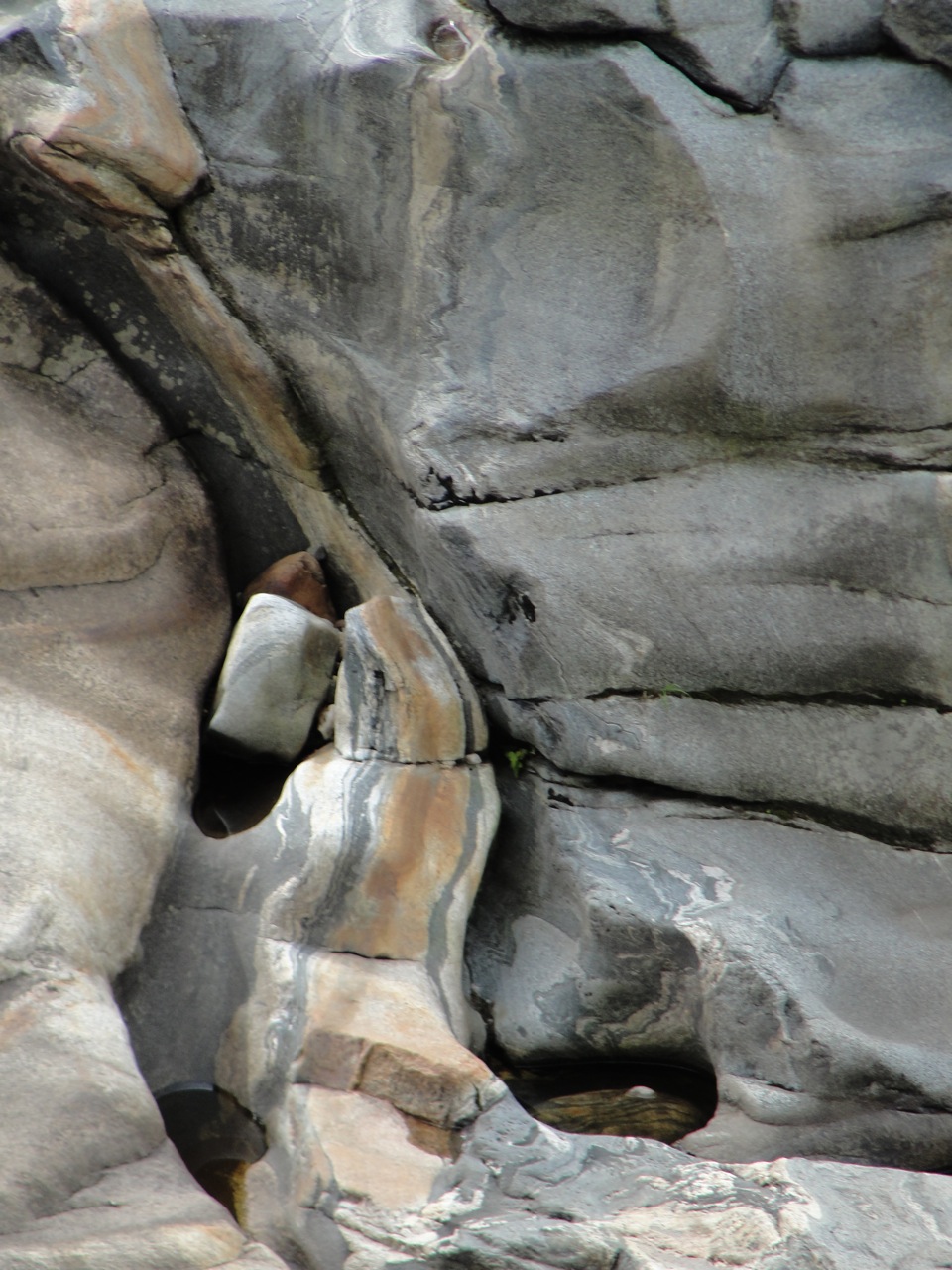
The language of myth was linked to the practice of ritual, in which people entered into a communal experience of story in a way that transcended logical thought or emotion. They were brought to the limits of their rational understanding, into the presence of the mysterious and ineffable, and emerged with a new capacity for living within the tragedy and bliss of this world. Religion was not something that people thought, but something that they did. People who put in the hard work and perseverance it required “discovered a transcendent dimension of life” that was also “identical with the deepest levels of their being.” Potholes flow DSC00653

Exchanging God for an Idol?

Stone TowerIn the story of Exodus, we read that Moses led the Hebrew people out of their slavery in Egypt, with the help of great miracles performed by their God. As they traveled through the desert, they survived with the help of more miracles. They made an agreement with God—he would continue to protect and lead them and they would serve him forever. Then Moses went up the mountain to talk to God, to receive the law.

But after forty days and nights, the people grew restless, and asked Moses’ brother Aaron to build them another God to worship, saying “we don’t know what has happened to this Moses.” Aaron asked for all their gold earrings, melted them down, and formed them into the shape of a golden calf. Then the people brought sacrifices and burnt offerings, and began to create a great celebration for this calf God.

Well, the story goes on to tell us that God was angry, and Moses was angry, and many lives were lost, before the people repented and reconciled. But that is not what is most interesting to me about this story. What I find most curious is that even though this group of people had been up close and personal with God, even though God freed them, and did miracles to feed them—they still forgot all about that after only forty days. They wanted something solid that they could worship—and so they exchanged their God for an idol.

It is an old story, but it still rings true today. Human beings have a perennial problem. We are very quick to turn any idea or experience of God into an idol—something solidified, defined, predictable, and under control.

Think about the image of God that many of us absorbed as children from our American culture. This God is an old white man with a beard and a long white robe who sits on a golden throne in heaven. Remember him? He is supposed to control things on earth and grant favors to the good people who pray to him, while punishing the people who do bad things. There are plenty of preachers who will tell you that if you are good and give your life to Jesus and your money to them, that God will make you prosperous and successful and healthy.

And if you don’t follow their prescriptions, well, you’d better beware. A certain televangelist I won’t name blamed a number of disasters on pagans, feminists, and gays and lesbians. After the devastating 2010 earthquake in Haiti, he claimed that the Haitian people had been cursed by God, because they had made a deal with the devil during their 19th century liberation struggle.

I don’t believe in that God. Maybe that televangelist doesn’t want to see it, but I have noticed that goodness can go hand in hand with poverty, illness and misfortune, and those who are wealthy can more than occasionally be selfish, greedy, and downright mean. I don’t believe in a God who blesses the prosperous people and curses the misfortunate people. I think that particular God is a kind of idol, a golden calf, created by people to prop up their own prejudice or insecurity, and apparently, to put other people down.

Imagination as a Tool

Imagination can play an important role in shifting our attention. If we want to find that which is larger than words, that which we cannot define or explain by words, we need to access the playfulness of the non-verbal mind. Images are one way that we can experience the non-verbal realms. Carl Jung taught us about the power of dream images to express realities which could not be expressed in words. In my dreams, I have experienced the power to fly, to light candles from across the room, to heal with fire in my hands. Our dreams can be a pathway into a different consciousness.

Candle flameSometimes, people shift their attention by calling upon an image of the larger reality. Some people call upon God to hear them and to speak to them. Others invite the goddess to enter the circle. Or we might say, Infinite Light, be here now, and light a candle. These invitations are also called invocations. It might feel silly to us to call out to someone or something that we don’t even know is there. But any time we invite the larger reality into the room, what we are really doing is inviting our hearts to shift their attention. We are re-tuning our hearts to notice the light that is already there.

The images are meant not to be objects to grasp in our minds, but tools for the imagination to awaken the mysteries of connection within us. So, if I say, “Spirit of Life, please open my heart to the wonders of your world,” I create an intention, a form that can hold the energies in a certain rhythm or shape. I open a window in my consciousness, to see what my literal eyes cannot. When we open the door, there is something that wakes up, something beyond what we can expect or explain. If we don’t open the door, we will never know what is out there, or in here.

Beginning a Spiritual Journey

A spiritual journey is our path of waking up our awareness to the larger reality of which we are a part. It is simpler than we think. It is so simple, that if we don’t pay attention, we can miss it entirely. I invite you to experiment with me:

Start by noticing the energy level wherever you are at this moment, both around you and within you. Are you alert? Restless? Calm or anxious? Tense or relaxed?

Now, sit up as erect as you can without straining. Notice how the energy level changes.

Now I invite you to breathe deeply, breathe all the way down into your belly. As you breathe in and out, let go of whatever might be on your mind, and let yourself relax and recharge. Just pay attention to your breathing in and out, as you sit quietly for a minute in the silence.

Now pay attention to the energy around you and within you. Do you notice any changes?

The very beginnings of a spiritual journey are in the practice of paying attention to the energy of the present moment. When we are first born, we see and hear everything around us without definition or understanding. Gradually, we come to assign meaning to shapes and colors and sounds. We say mama, or daddy, or ball, or doggie. We separate the world into smaller objects that we can name and grasp. Perhaps we learn about God as a kind of separate object that we might name and grasp.

But once we assign such names, once we divide the world into objects, we sometimes forget to see what is actually before us. When I was in high school, I took several drawing classes. Our first lesson was to stop drawing objects, and to start sketching out shadows and light. In order to draw, we have to see at a different level from the level of objects. To pay attention, spiritually, is like that. We are shifting our consciousness from small separate objects to larger connecting energies.

Shadow & Light

Photo by Margy Dowzer

I learned the awareness meditation from Starhawk, in her book, The Spiral Dance: A Rebirth of the Ancient Religion of the Great Goddess.