Pond, Water!

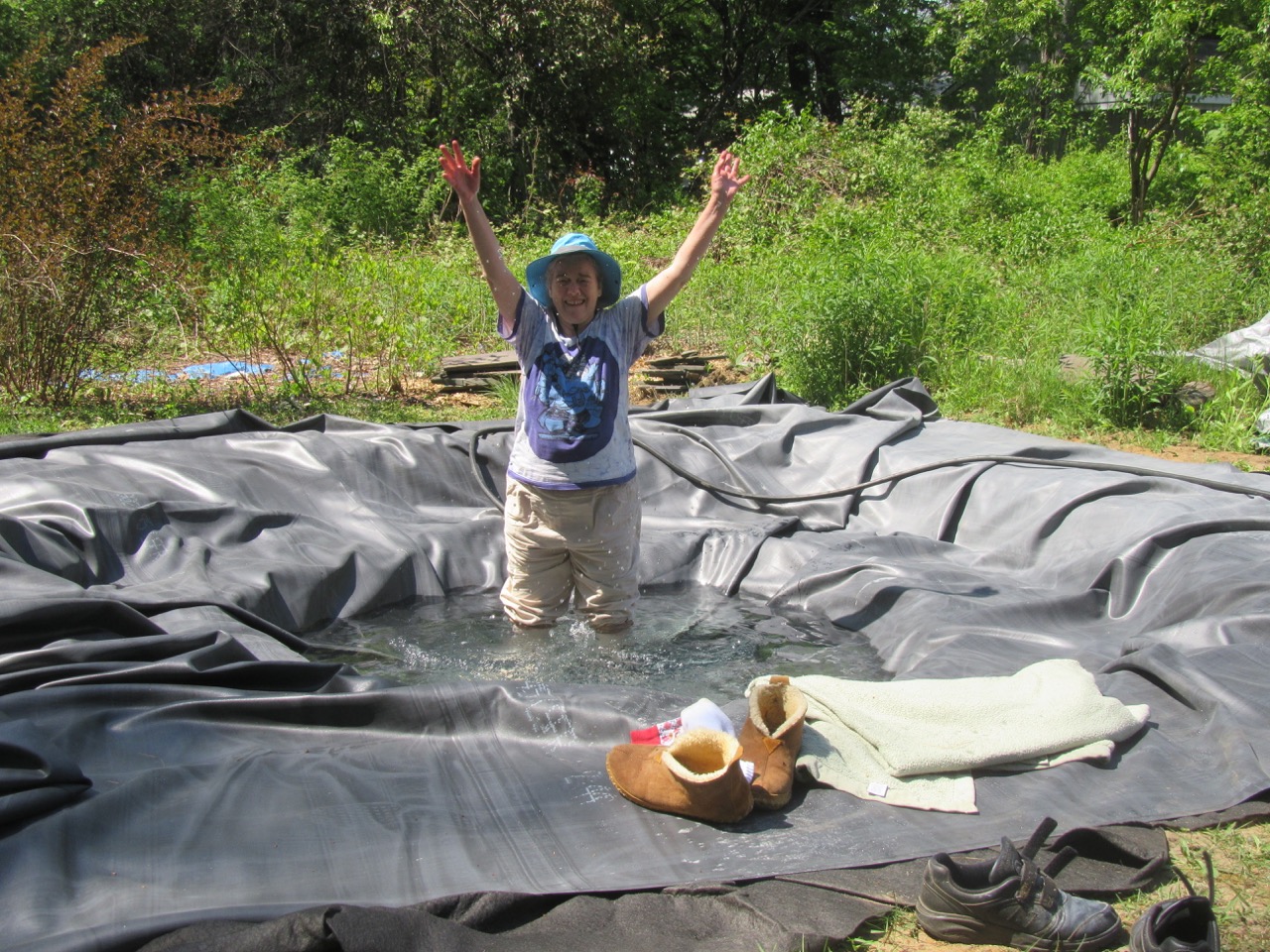
Photo by Margy Dowzer: I am in the water as we fill the pond!

Such an exciting moment when we began to put water in the pond yesterday! It was a sunny hot day, so being in the cold water was great. I found I had to get right into it to do the folds of the pond liner which are necessary when you take a square liner and put it into a round hole. We filled it up to just under the level of the planting shelf.
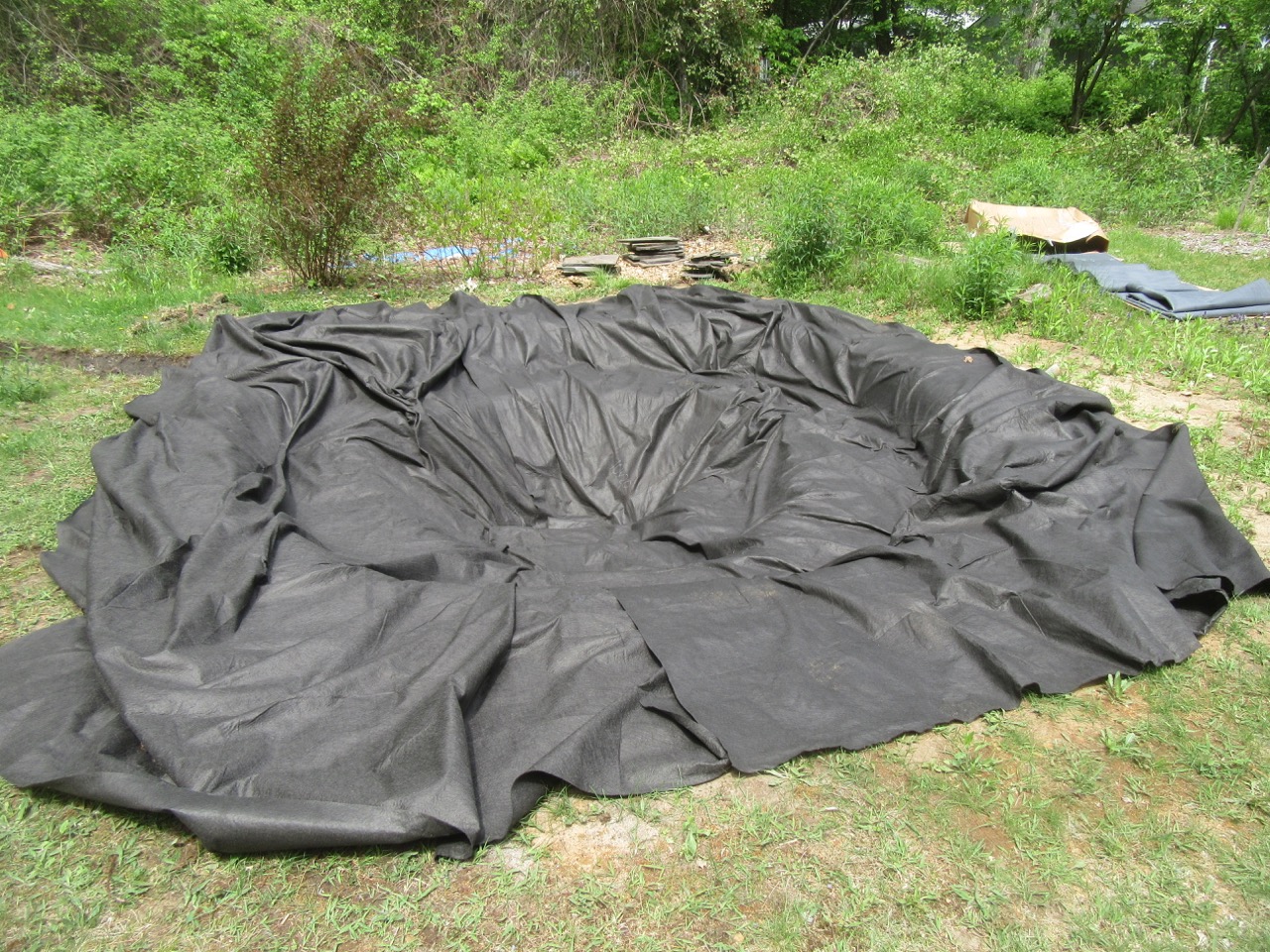
Photo: black cloth underlayment

But back to the earlier parts of the process–the first thing I did yesterday was install the pond liner underlayment–a very light felty fabric thing that protects the pond liner. We might not have needed it, because of the carpet strips, but the pond liner is guaranteed for life if you use the underlayment. I had purchased a 20 by 20 foot 45 mil EPDM liner, and the underlayment came in two pieces of 10 by 20. I overlapped them about 3 feet. After that, I also dug further and deeper on the overflow channel, and made sure it sloped away from the pond. You can see it in the left on the photo.

Then, midday, our neighbors came by to help with installing the pond liner itself–the liner is very heavy, but with the three of us (plus a kid!), it wasn’t hard to position it over the hole. So grateful for helping hands! Because the pond wasn’t quite as deep as planned, I knew we’d have extra liner on the sides, so we didn’t have to worry about getting everything exactly centered.
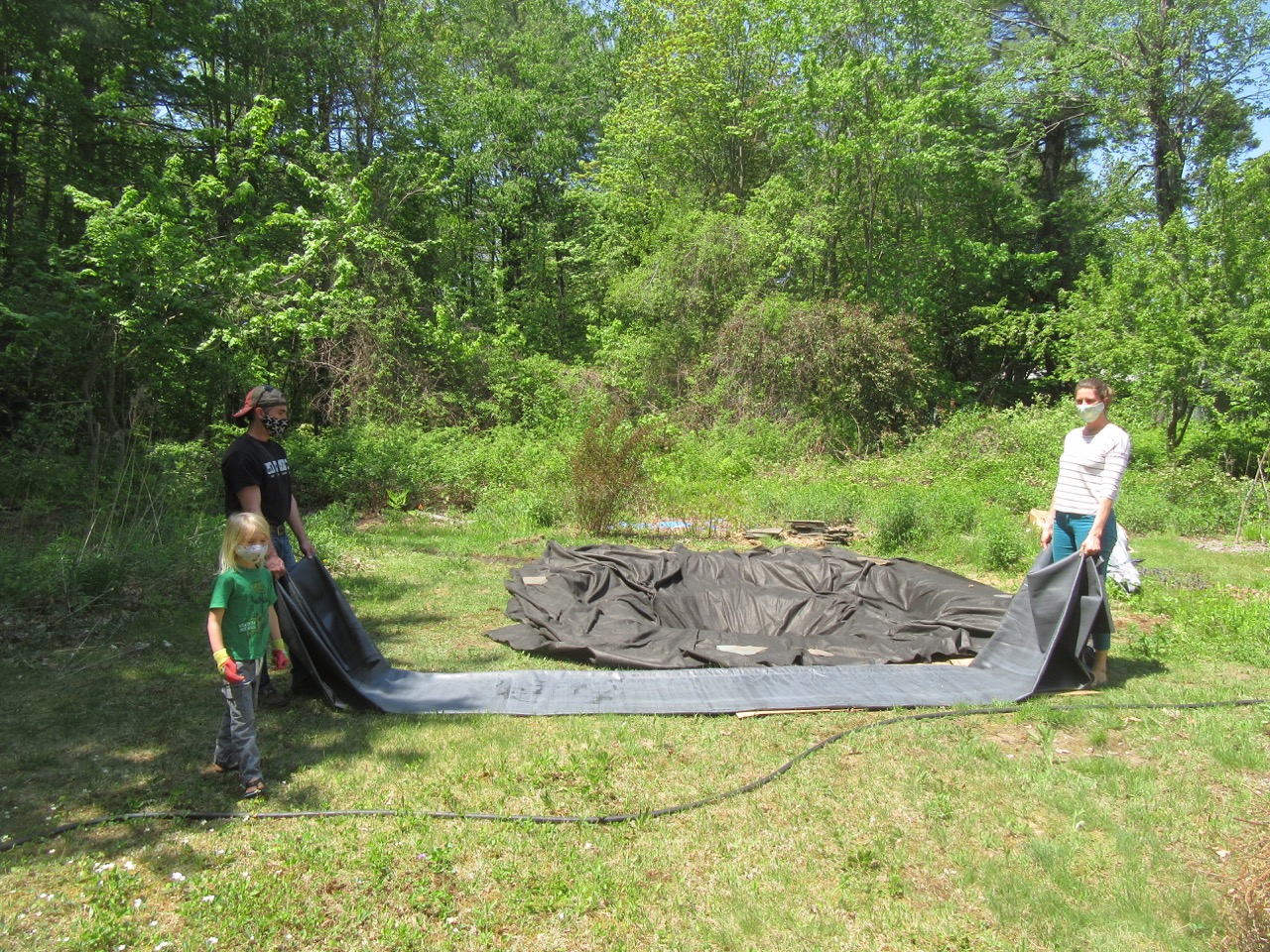
Photo: getting in position to install the liner.

As it turns out, black rubber gets very hot in the sun, so we all wore gloves, along with our masks for COVID.

After the liner was roughly in place, the neighbors went home. I got into the hole and adjusted everything so it was flush with all the surfaces underneath, creating folds where needed. It was recommended by my Building Natural Ponds book to not step on it with shoes, but socks weren’t enough to protect my feet from the heat–so I pulled out my fuzzy slippers and a blanket.

Photo by Margy Dowzer: Taking a moment to rest while shaping the liner to the hole.

After a short break, we started filling the pond with our garden hose. Water from the house has chlorine in it, but the chlorine will evaporate quickly and so this water is fine to use especially before we have any life in the pond. Eventually, we’ll use water from the rain barrels you can see in the back of the photo, but we’ve had no significant rain for a while. While the hose was running, Margy and I wandered around the back of the yard looking at plants, and then finally pulled up chairs to watch the water fill. And I got in a few times to keep adjusting the liner–glad to have an excuse!

It isn’t the end of the process by any means. I have been doing this step by step, not knowing how long each step would take. The next thing to do, and why we only filled up to the planting shelf, is to cover the planting shelf with stones and pebbles. I’ve collected lots of rocks from around the yard, but will definitely need to purchase more. And that is a bit more complicated than I realized, likely involving borrowing or renting a pickup truck. But in the meantime, I went online and ordered 5 native pond plants that will arrive in about 10 days. It is really happening! And there is water in the pond!
Pond, next steps

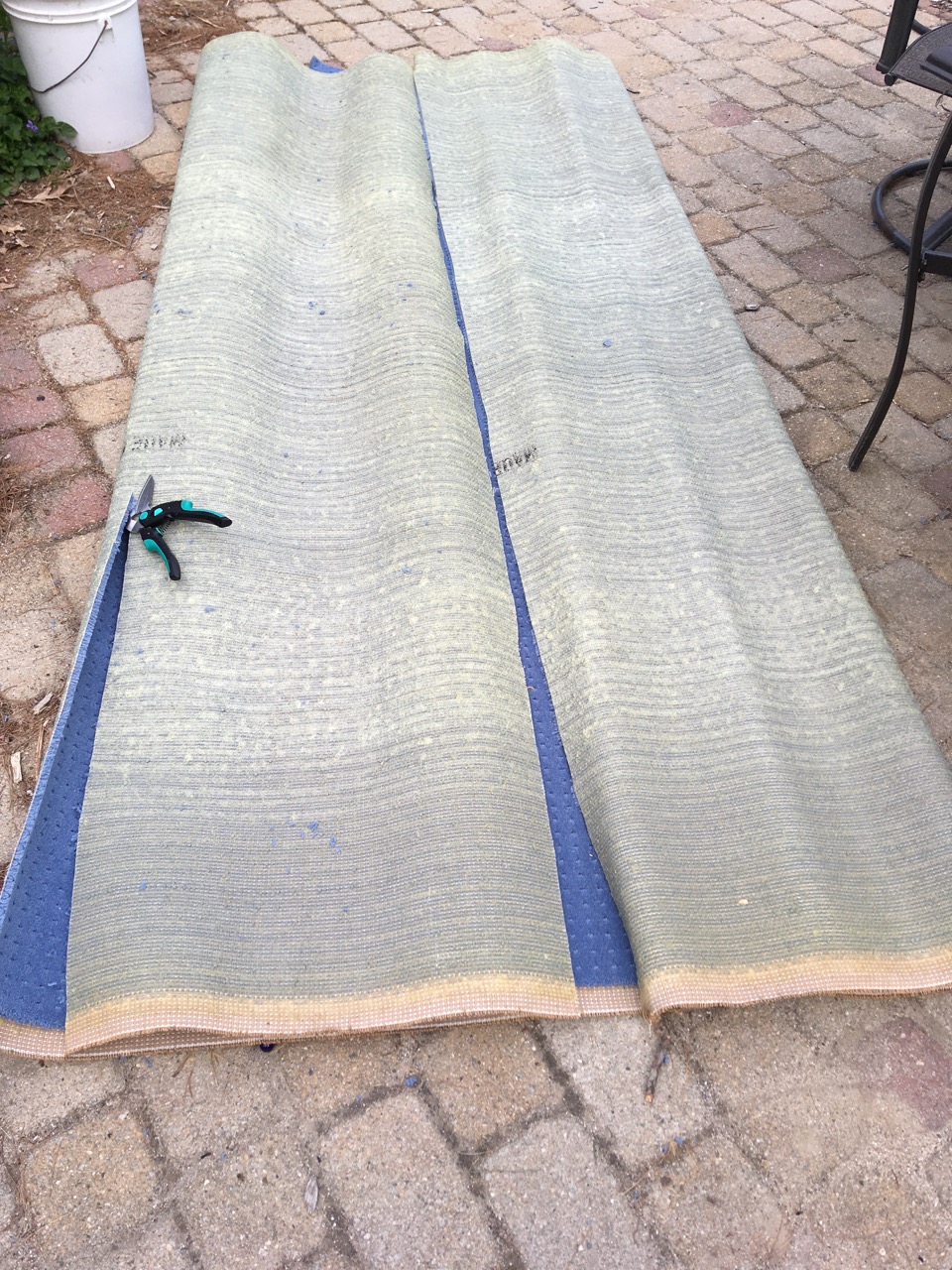
Photo: Cutting old donated carpet in 2 feet+ strips

I had a slow start today. I haven’t talked much lately about living with chronic illness, but for some reason I’ve been feeling much better energy than usual this spring. Still, I have a method for energy use: First of all, I rest when I need to. But what seems to work with garden projects is that I exert myself for a short while–say 10 minutes, or one wheelbarrow load. And then I sit and rest for 10 minutes. I don’t time myself, that is just a guess. I stop when I need to and rest until I can start again. While resting, I drink some iced licorice-root tea–that is a big help. I make a big batch of the tea (boiling licorice root for 15 minutes), and cool it to keep in jars in the fridge. Then I put together a big plastic glass (with a cover to take outside) adding ice and some lemon juice. Licorice root is said to be good for adrenal glands, so maybe this is why it has been so good for my energy.

But for example, this afternoon about 3 p.m., after my slow start, I was able to make my way outside. I started on the next step for the pond–cutting the old carpet (that I collected for free) into strips about 2 feet wide. I started with the biggest carpet piece I had received. Margy bought me a really good pair of carpet cutting scissors. Oh my gosh–they are so sharp and nice and easy to use. So I cut one 8 foot (?) strip, and then I rested. Then I cut another one. It went like that. After I had finished cutting that carpet piece into about 8 strips, I decided to see how it might lay on the pond surface.

But then I had another thought while experimenting. Since the pond is no longer going to be 3 feet deep, but rather about 2 1/2 feet, and since I have a pond liner that is 20 by 20, why not make it a bit wider at the top. (Since the equation for the pond liner size takes into account depth and width and length.) So instead of 11 by 11 1/2, just add a bit more on the half that has a one foot planting shelf, let the pond be closer to 12 by 12, and the planting shelf be a bit wider too. So I started digging again around the top edge. And then I remembered the advice to make a sloping “beach” edge for small critters to be able to get in. So I did some of that. Again, bit by bit.

While doing this further digging, I again saw more bright orange bittersweet roots. This is the biggest reason why we are using carpet strips as an underlayment. Some folks like sand better, but we need something that can stop the roots from puncturing the pond liner.

So the next photo is what it looked like when I called it a day. I was lying in the hammock a bit, resting, and then when I got up I could barely move. That is the other part of this process. I get really exhausted and sore all over. So I came in and took a hot shower, and then took two aspirin, which lately always seems to help. I’ll be down for the evening, but tomorrow, probably ready to start again. Unless I am not. I am sharing all these details to say that I am so grateful I am able to do this outside work, in this rhythm of work and rest. And also, maybe it might be a helpful suggestion for others who don’t have stamina for whatever reason. Work and rest, work and rest, in little segments. It has been a good day.

Photo: the pond, which is wider now (on the left and foreground), with blue carpet strips covering the “beach” area, and going down to the bottom.

Prayer for Pollinators

Peach and two cherry trees

If you’ve been following my work on digging the pond, I will mention that I took a little break, first to find out what to do about the water that has seeped into the bottom, and then because I twisted my ankle on Friday while I was digging. So annoying! My ankle is not so bad–after a couple days of rest, I can hobble around now, and I will be digging again soon.

In the meantime I wanted to share this photo of the flowering peach and cherry trees in our food forest. They flowered a bit earlier this year than last. In the photo, the peach blossoms are pink, and it is hard to see the white cherry blossoms amid their green leaves in the photo. But they are so beautiful! There are more cherry blossoms this year than last, when we got just a few.

However, I’ve been concerned about pollination. Our neighbor keeps honey bee hives, and usually we have lots of her bees visiting over here, drinking nectar and drinking water from our bird baths. But this year, it has been very sparse for bees. I found out that our neighbor’s hives died in a cold snap earlier in the spring and she hasn’t replenished them yet with new bees.

One day, I did see bees of all sizes in the Lapins cherry tree (on the right in the photo), but I didn’t see them in the peach tree. (Not that I sit and stare all day.) But I’ve been doing so much TLC with the trees this year, with Kaolin clay, and holistic foliar sprays. It would be a shame if we didn’t get fruit because of pollination problems. It is too late now to try to hand-pollinate. The other potential glitch is that while the Lapins cherry is self-fertile, the Black Tartarian cherry needs the Lapins to cross-pollinate. They are both sort of blooming now, but the Lapins had peak blooms earlier, and the Black Tartarian has new blooms that just came out yesterday. So we wait and see.

It reminds me of the sad danger to pollinators everywhere because of climate change, environmental pollutants, pesticides, and development. All of our human food is dependent on these little creatures who pollinate the plants. If the bees die, so do the humans.

Today I pray for the pollinators, with gratitude and humility. Part of this prayer is offering to the bees so many other plants in our food forest: daffodils, dandelions, and violets are blooming now; soon we will also have chives, oregano, clover, thyme, and many more. All of us can do more to provide food for bees and other pollinators throughout the season. Only then can they also provide food for us. May this circle of life be blessed.

Pesto

This past week’s big garden project was making pesto. I’m not an expert on preserving food from the garden, but discovered that while oregano and thyme were easy to dry, things like chives and basil didn’t work for me to dry. But making pesto and freezing it has been great. We just finished using the last of our pesto from last summer, and it was time to make it again.

So here is my very loose recipe for anyone who might want to try it. First of all, cut big bunches of stalks of basil, parsley, and chives from your garden. And really, any combination of these will work, though I think of basil as the primary ingredient of pesto.

Basil & chives

Basil & Chives & Olive oil

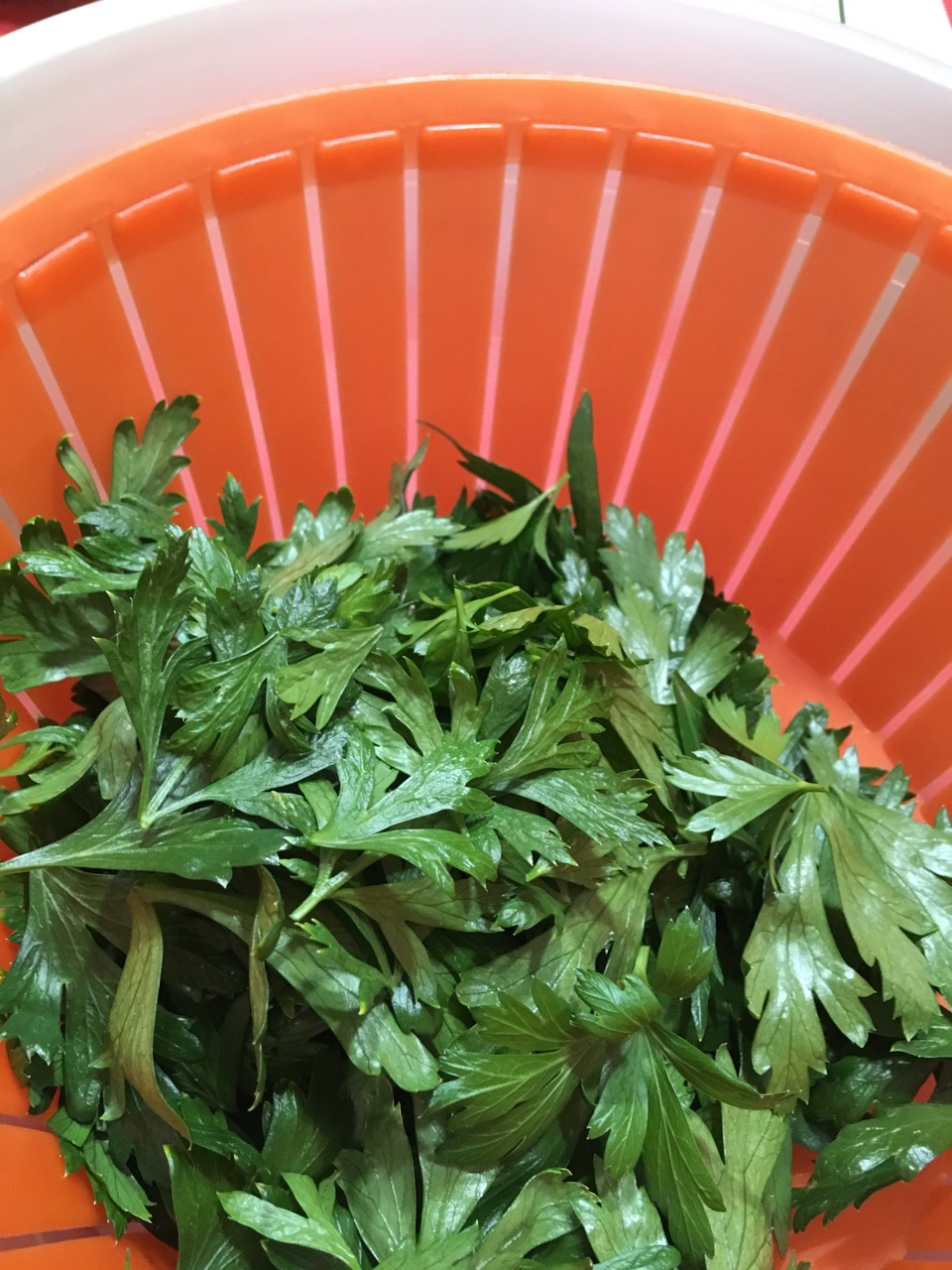
Pinch the basil leaves off the stalks and place in a salad spinner–you can wash and dry them in the spinner. Do the same for parsley–I just cut the leafy parts off the stalks. Our garden is organic, but rinsing deals with any random bugs or dry leaves or other impurities that might be attached.

Parsley

Parsley in the salad spinner.

Chives can be rinsed briefly, and cut with a knife into couple inch lengths. Once these are ready, start with a blender. First, put in 1 cup of olive oil, and then reserve 1/2 cup for use as needed to keep the blender stirring easily. Add the basil and blend, add the parsley and blend, add the chives and blend. Or do this in any order you like. I also added 4 Tablespoons of lemon juice, salt and peper, 1 clove garlic, and some garlic scapes. I don’t do well with too much garlic, but you might want to add more if you like it.

Finally, I added one cup of raw hazelnuts. Traditionally, people use pine nuts, but they are more expensive and since we have hazelnut bushes, it seemed fitting, though our bushes haven’t produced any nuts yet. Later, when we use the pesto, we will add parmesan cheese.

Finally, I line a baking pan with wax paper, and put the pesto mixture on this paper in small lumps–like cookies. Place the whole pan in the freezer until the mixtures have frozen, and then I fold them up in the wax paper and store in freezer bags.

Pesto "cookies"

Pesto “cookies”

Through the winter, we take out the pesto cookies and use as many as we need with baked chicken, with zucchini noodles, with anything that could use a bit of bright flavor. I ended up needing to make two batches because I had so much basil. And the basil plants will grow back again, so we could make more later on. So much fun.

Where are the birds?

Bird Feeder no birds

We have always had birds in our back yard in the winter, coming to our feeder, or rooting around on the ground. But this year, we’ve seen almost none at all. We didn’t fill the feeder over the summer–but many birds visited during that time, in the orchard and in the nearby trees and all over the place. So we expected that filling it up again would bring the usual winter birds. But I can count on one hand the birds I’ve seen. And no cardinals.

In trying to comprehend this, I noticed that only one other thing has changed. The lot behind our neighbor’s house–not visible in this photo–had been overgrown with bittersweet, and then the vines took down part of a big maple tree. Plus Margy had been cutting a lot of the invasive bittersweet.  So that field has less tree and vine cover, which some birds may have preferred.  More ominously, I’ve read that in North America the total number of birds has declined by 25% in the last fifty years.  Is it finally affecting our own yard?

I have seen a few birds here and there on my walk in the neighborhood, and there have been a few in the crabapples in the front yard. But despite our full feeder, plus a thistle feeder, and even a suet cake, no one is around.  It seems so strange and empty.  Have you noticed fewer birds where you live?

All of this got me thinking sadly about extinction, and I happened to see a documentary about the early Neanderthal humans, who lived in Europe and Asia for several hundred thousand years, before becoming extinct about 40,000 years ago. According to the DNA testing company “23 and Me”, all modern humans, except for those from sub-Saharan Africa, have between 1 and 4 % Neanderthal DNA, from interbreeding of the two related species. So the Neanderthals can be counted among my ancestors too. By the way, they were much smarter and more cultured than the myths that were taught about them early on.

There are a lot of theories about why they went extinct. But this particular documentary, Neanderthal Apocalypse, made the hypothesis that one factor was the eruption of a super-volcano near present day Naples 39,000 years ago. However that might have effected the Neanderthals, I found myself more focused on what it might do to us today. If a super-volcano were to erupt in our time, ash and debris would cover miles and miles of land, and kill all vegetation, crops, and the animals who rely on them (including us.)  Ashes and toxic gases would rise up into the upper atmosphere and block out sunlight, plunging a large portion of the earth into a volcanic winter. Civilization over.

Now this might be a depressing thing to think about, but for some reason, I didn’t feel depressed. Instead, I was reminded of how very powerful the Earth really is.  We are so small, and so reliant on all of the Earth’s interwoven life.  So, in a funny way, I felt less afraid. We humans know some things, and the activity of our species is causing damage to the climate, and wreaking havoc everywhere. But so much is beyond our control and even our understanding. It is profoundly humbling and reminds me to be grateful for how the earth provides everything we need.

So I come round to this Winter Solstice holiday, today, and say thanks to the Earth for birthing us, for feeding us, for fire that warms us in winter, for so much beauty that inspires our lives.  And I say a prayer for the birds: please come back to once again feast with us in this little patch of land we call home.


Gifts

During the spring, Margy was talking about wanting to plant sunflowers this year. But as it happened, she was busy with too many other garden projects to actually do it.  So imagine our delight when the garden planted its own sunflowers! They came up under the bird feeder, now sitting empty for the summer, but where sunflower seeds were the food we offered to the birds (and squirrels) all winter.

Gift sunflowers

Lately, the garden plants have felt mostly like children who need our care and attention. With the dry hot weather, they’ve needed a lot of watering. Yesterday, I did another foliar spray for the fruit trees, to help them ward off Japanese beetles, which I also have been picking off every day and dropping in soapy water. And there have also been lovely raspberries to harvest each day, and snap peas (almost gone now) and kale and basil to gather and preserve.

So this gift of flowers emerging without any effort on our part–perhaps the land is reminding us that she loves us as we love her?

It has been one year since my retirement began. One of its themes has been to find connection with this small portion of the Mother Earth, this land we are so lucky to call our home. As non-Indigenous people, we are trying to heal a long wounded history of our people’s disconnection from land.  Our ancestors left their home places generations ago.  If our society had an understanding of earth connection, it could not destroy earth life as it destroys, with such thoughtlessness–pollution, clearcutting of forests, poisoning of soil with pesticides, trash dumping, mining, fracking… the long list of ecological destructions that are endangering us all.

So in our small corner of the world, we are trying to reweave those threads of interconnection, reawaken the truth–long dormant in our bodies–that we are not separate from the earth–we are the earth.  As we tend the land, as we care for the plants, as we pay attention each day, we hope that a shifting occurs–that we move from domination patterns to partnership patterns in our relationship to Earth. We know how small we are–yet hope that if we can shift our own patterns, it might in some way ripple out to the larger patterns. Because we are interconnected. Because that is the magic.

The gift sunflowers remind me that the land herself is eager to be in partnership with her human children. She loves us and wants wholeness for all.

sunflower with bees

Every sunflower has its bees.


Deer Neighbors

Deer near our yard

The phone rang this morning about 8 a.m., and it was our neighbor Mary, calling my attention to a deer in the wild brush behind her yard. I came outside and walked behind our garage, to the edge of our yard, near where Margy had cleared bittersweet from all over the crabapple trees in the wild area. Mary had said it was a small deer, so I was surprised to see what seemed to me a rather large animal with antlers. He didn’t startle, but calmly looked at me, as I took photos from several yards away.  After a few minutes,  he slowly turned and disappeared into the bushes.

So beautiful! I had once seen a deer the first year we moved here, and that winter we also noticed some tracks in the snow, but we hadn’t seen any in our yard since then.  (However, Margy mentioned she has seen some deep in the undeveloped wild areas.) Of course, it has stirred up mixed feelings to see or not see them. We love our wildlife neighbors, but have also been concerned about our fruit trees.  The year we planted our first trees, I put up a fine fishing line thread between metal poles, at the back and side of the orchard, because I read that deer don’t like barriers that they can’t see clearly. So it was meant to be a gentle deterrent, and I haven’t taken it down, though this summer the line had sagged to about a foot above the ground.

And perhaps, this clears up a mystery that developed several days ago.  Earlier last week, I noticed that the ends of some branches on one of our cherry trees seemed to have been bitten off–just four branches in one area of one tree with their tips clean gone.  You might notice it in the center of the photo below. I also noticed the top bitten off of a raspberry shoot that had sprouted near our wood chip pile. I’ve been trying to figure out what might have done it, and I think maybe we have our culprit. Thankfully, he didn’t eat any more of anything. I’ve re-stretched the fishing line “fence” to see if that helps.

Cherry branches bitten off

We never know what adventures we’ll find in our backyard.  The other evening, during dusk, Margy saw a beautiful skunk wandering across the back of the yard.  I’ve seen a few holes in the garden where it came digging for grubs in the night.  Mostly, these days, we have scores of small birds who love to perch on branches and even tall flower stalks in the orchard, and peck for bugs in the mulch.

And can I say, finally, that I love that we have a dear neighbor who calls us to report a deer sighting!

Breathe Beauty

This spring, I go from “hard work in the garden” days, to “collapse on the couch” days. With so little sun and so much rain, I feel an urgency on those good days to do as much as possible.  Monday, for example, I was able to inoculate the orchard with Wine Cap mushroom spawn.  That involved shoveling and hauling lots of wood chips from the pile, via a wheelbarrow, over to the trees, laying layers of wood chips in patches near each of the four trees, then spreading the spawn, then more wood chips on top.  (This is on top of old wood chips that are already around the trees.) I also put some compost in patches that I had missed last week.  I also planted chamomile and sunchokes that I had received in trade at the Plant Swap on Saturday.

Then, after, while I am taking a hot Epson salt bath for my aching muscles, I imagine that I will blog about it the next day–but I just haven’t have the energy for much more than Netflix for two days after any garden work days.  So I haven’t blogged about the Fedco tree sale, or about repurposing the garden bed behind the garage for three new blueberry plants, or about spreading seaweed mulch near the trees, or adding compost, or planting kale and more peas.  I haven’t blogged about any of it.

Meanwhile, between the work and the collapse, it is easy to miss the ephemeral beauty of it all.  The other day, I noticed I was missing something. I stopped to sit on the deck, and then walked around the yard, not working. I just looked at bushes and flowers and ferns, paying attention to what was there, appreciating the miracle of plants and their growth.

Violets

These violets came up on their own in a crack in the pavement near the bulkhead.

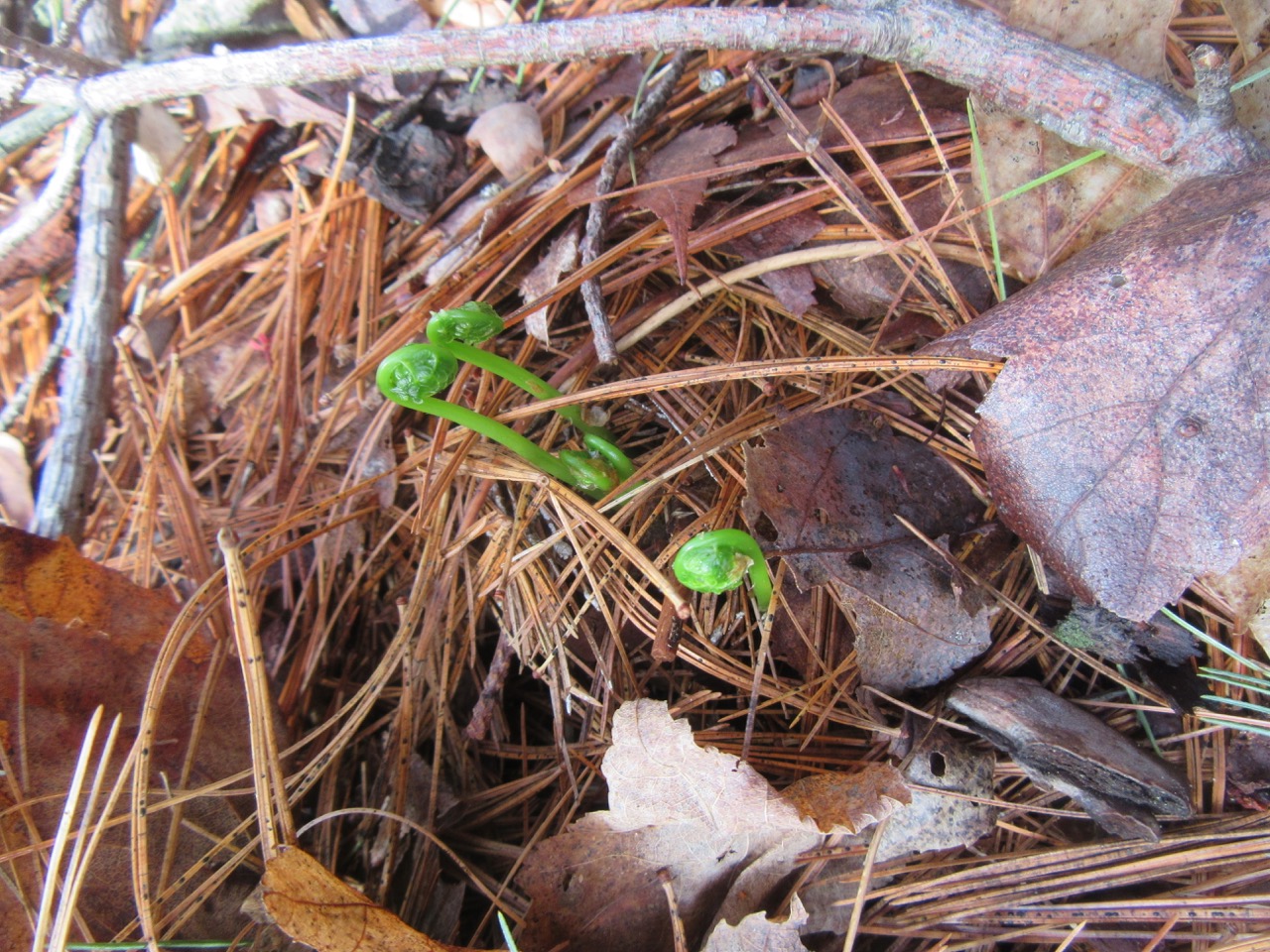
Fiddleheads coming back!

I thought the fiddlehead fern I planted last year had died, but here they are coming up again near the big old pine tree.

Golden Seal coming up

And here is the golden seal that I planted last year, also coming back after seeming death!

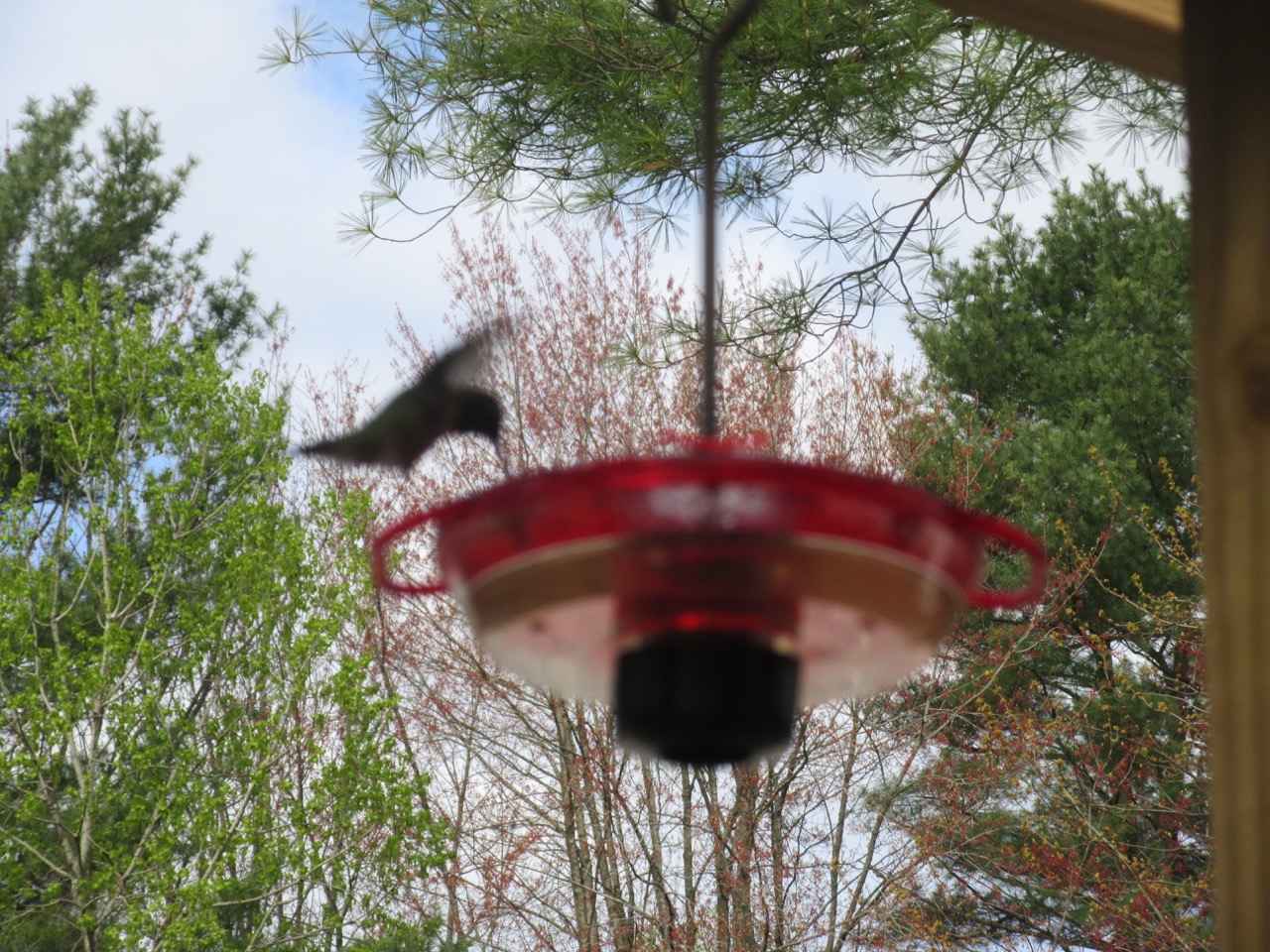
I finally sat down again on the deck, and after I had been there awhile, the hummingbirds boldly flew in to drink from our feeders.

It is hard for me to have so little energy this spring.  I wish I could do much more in the garden, and not be so exhausted every time afterwards.  I guess this is my new reality, this balancing act. But I am reminding myself to appreciate the beauty around me, to notice the color purple on the patio (as Alice Walker might say), to be grateful, and quiet enough for the birds to fly around taking no notice of my presence. To breathe slowly enough for shadows of joy to sneak in.

Hummer shadow

Wolasuweltom

“When you think in Passamaquoddy, your whole life revolves around being thankful for everything that’s around you,” says Roger Paul, our Wabanaki Languages teacher.  “Everything about what you look at, or what somebody tells you, you think gratitude.” The root verb for giving thanks is wolasuweltom (he or she gives thanks, is grateful). To say “thank you” to someone you say “Woliwon.”  

He went on to comment, “…in other cultures I’ve noticed it’s about, ‘What am I to gain from this?’, …or ‘What’s my goal?'”  He told a story about a woman he met in Washington, DC, who wondered why Indigenous people didn’t come to testify in Congress about why they needed certain funding–they might send lawyers or other non-Native employees to explain–but she had never seen an actual Indigenous person explain why they needed this funding.

Roger said, “It took me a while, but I figured it out. …The reason, I told her, was because we’re not about going to demand what we deserve. We’re about being thankful for what we already have… So… we’re not good at going up to say, ‘Hey, we deserve this–we have an entitlement to this–you owe us this.’ …We’re more at, ‘Oh, this is all we get? But, you know what, I can use this. Thank you.'”  He said, “It’s that attitude, that almost every word in our language surrounds that concept of gratitude.”

All this was during a conversation among a few of us before class last month.  Ironically, earlier that morning I had been thinking about my final presentation, in which we were supposed to introduce ourselves in the language.  I had thought to myself that perhaps I should try to say something about why, as a non-Wabanaki person, I wanted to learn to speak Passamaquoddy.  What was my purpose or goal in doing this?  In English, I have said, I wanted to “decolonize my mind and learn to think in a new way.”  But I couldn’t figure out how to express what I meant in the language, even with the help of the online dictionary.

So when Roger spoke of how the language itself was not so much about expressing goals, as it was about giving thanks, I was struck by the irony of it all.  Here I was, even in my attempts to speak the language, thinking exactly like a white person.  And maybe, the goals and purposes didn’t matter as much as I thought they did.  Maybe I should try to say, instead, what I am thankful for.

Later, I asked Roger if it would be okay to quote him for the blog, and he gave me a generous yes.  I am thankful for all of these conversations, more than I can say.  These days, I am less and less sure of the purpose of anything I am doing.  I am less and less sure of my goals.  But I am reminded, each morning, to give thanks for everything around me.

Ducks in Spring

Disruptions of Spring

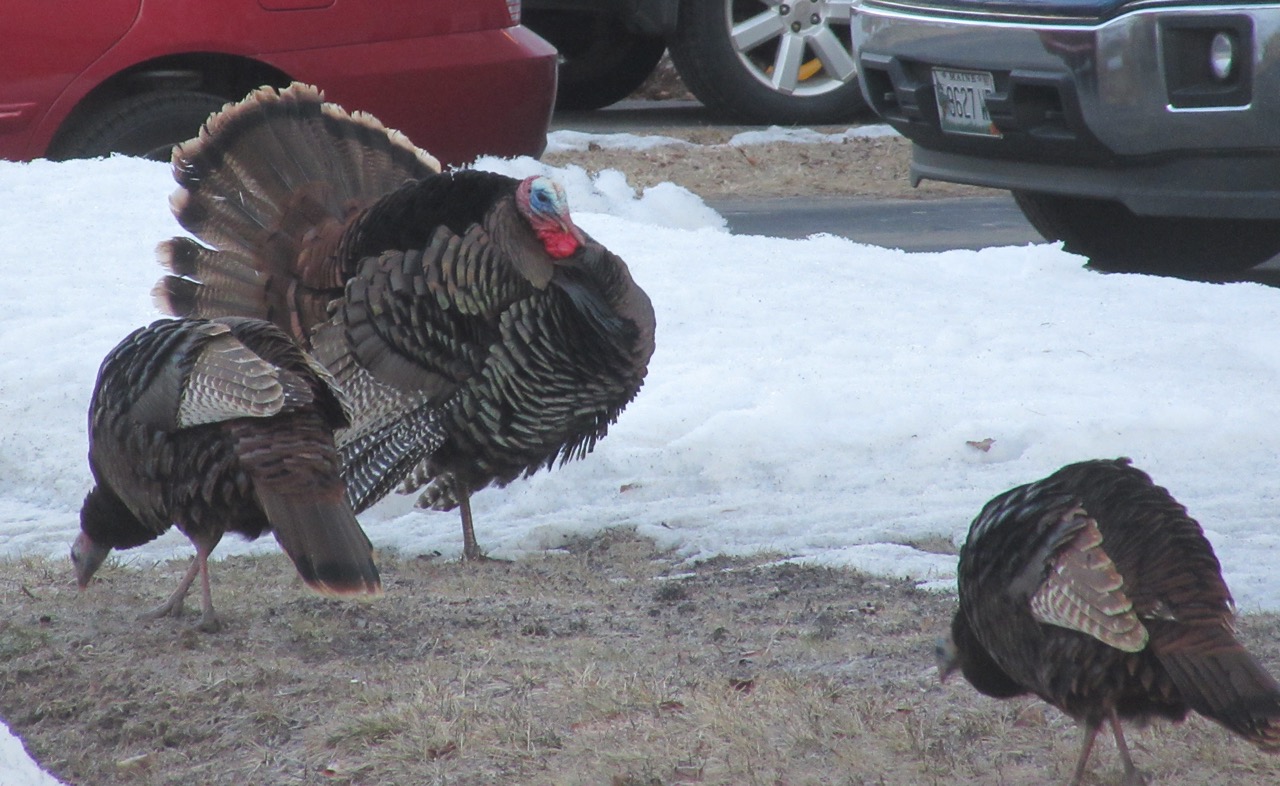
Turkey Tom display

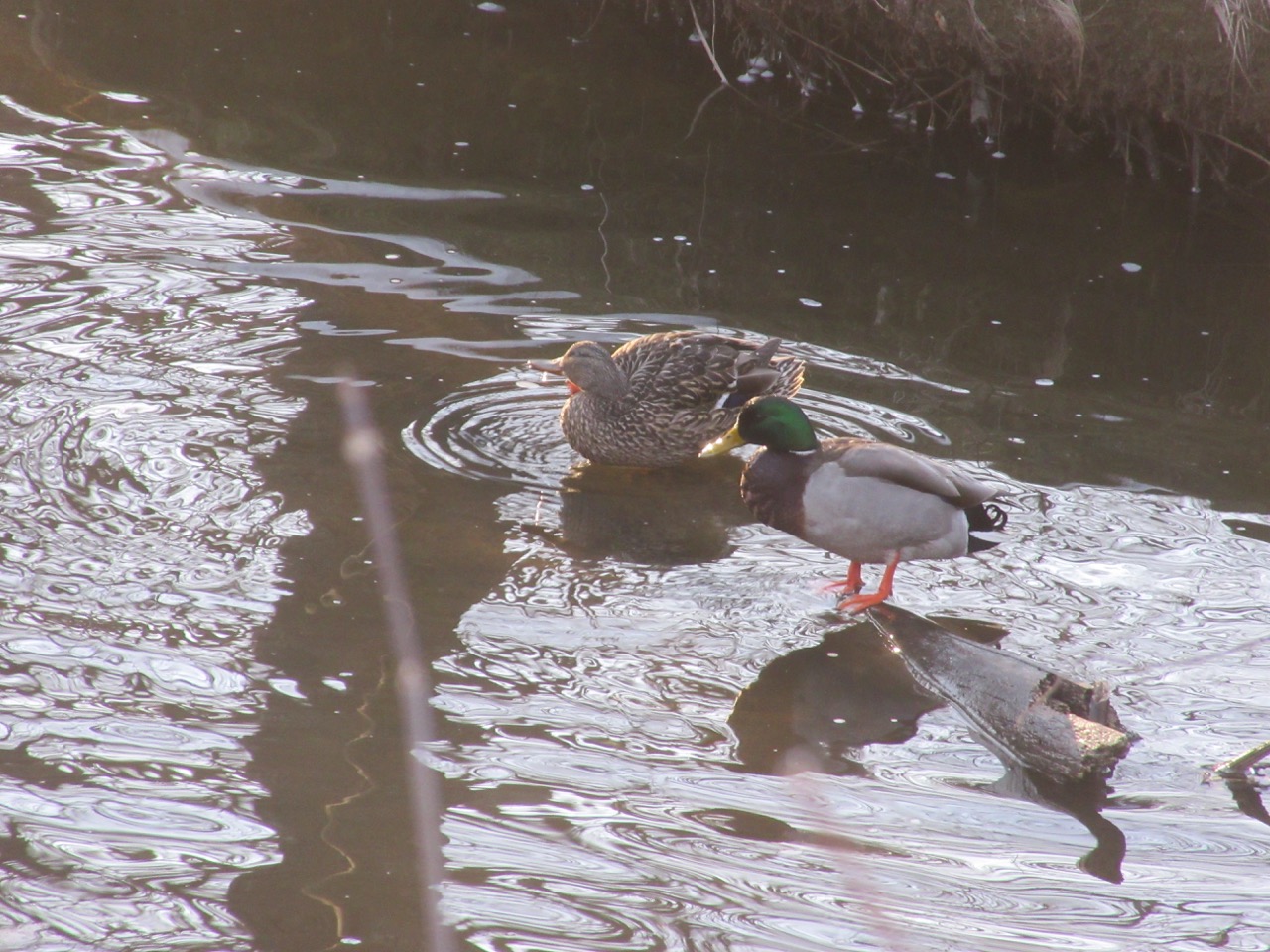
Spring is here in its northern way, with unexpected delights and disruptions–the wild turkey toms proudly displaying in the midst of old snow and random automobiles–a flock of starlings taking over the trees in our yard—two ducks hanging out in the brook. A small group of us celebrated with ritual on the Equinox to welcome these disruptive forces into our lives, to undo the stuck places we’ve found ourselves, and make room for new growth, new movement. We used a frozen bowl of ice, in which we placed candles, to symbolize the thawing times.

We do still have snow or ice over most of the yard, but each day another small patch of brown grass appears; our neighbor was already out raking in her snow-free yard.  In the middle of this, two days ago, my car was rear-ended as I was driving the on-ramp toward the highway after grocery shopping in town. No one was hurt, thankfully, though my car is now in the shop waiting for the insurance bureaucracy to authorize repairs. I was able to drive it home from the scene, and take out the groceries, being careful to go through and watch for broken glass in the bags.

Still, it shook me up with the vulnerability that is life.  We never know which day might be the last.  And meanwhile I’ve been watching a show on Netflix called “Last Chance to See” which follows Stephen Fry and Mark Carwardine as they make a journey in 2009 to visit endangered animals that were first documented twenty years earlier by Mark and Douglas Adams (author of the Hitchhiker’s Guide to the Galaxy). Stephen Fry brings a comedic voice to their adventures as the urban klutz who doesn’t usually traipse about in nature. (I recognized his voice from the movie version of Hitchhiker’s Guide.)

But underneath that veneer of comedy is wonder and grief.  The final episode was originally going to be about the Yangtze river dolphin, but the dolphins were declared extinct in 2007.  So instead, they search for blue whales.  Mark tells Stephen that blue whales, the largest animals ever on the planet, have been here for forty million years.  Forty million years. And now they are endangered, along with so many others.

I was caught up in the awe Stephen and Mark experienced in getting up close to these majestic beings.  I was filled with amazement at the beauty of this complex interwoven planet that we have been blessed to inhabit.  And I tapped into the grief that has been haunting so many of us these days.  Grief for the demise of so many beings.  Grief for the losses that are being propelled by human activity.

I feel so powerless to stop this roaring train that “western civilization” has become.  Perhaps there is nothing we can do to save all that is dying.  All I could think to do was to let myself choose conscious gratitude and love–gratitude and love for the utter wonder of life on our planet.  Gratitude and love for the animals and plants that are our elders and companions.  Gratitude and love in the midst of grief.

Flock of Starlings

Starlings in the trees.