Feeding Each Other

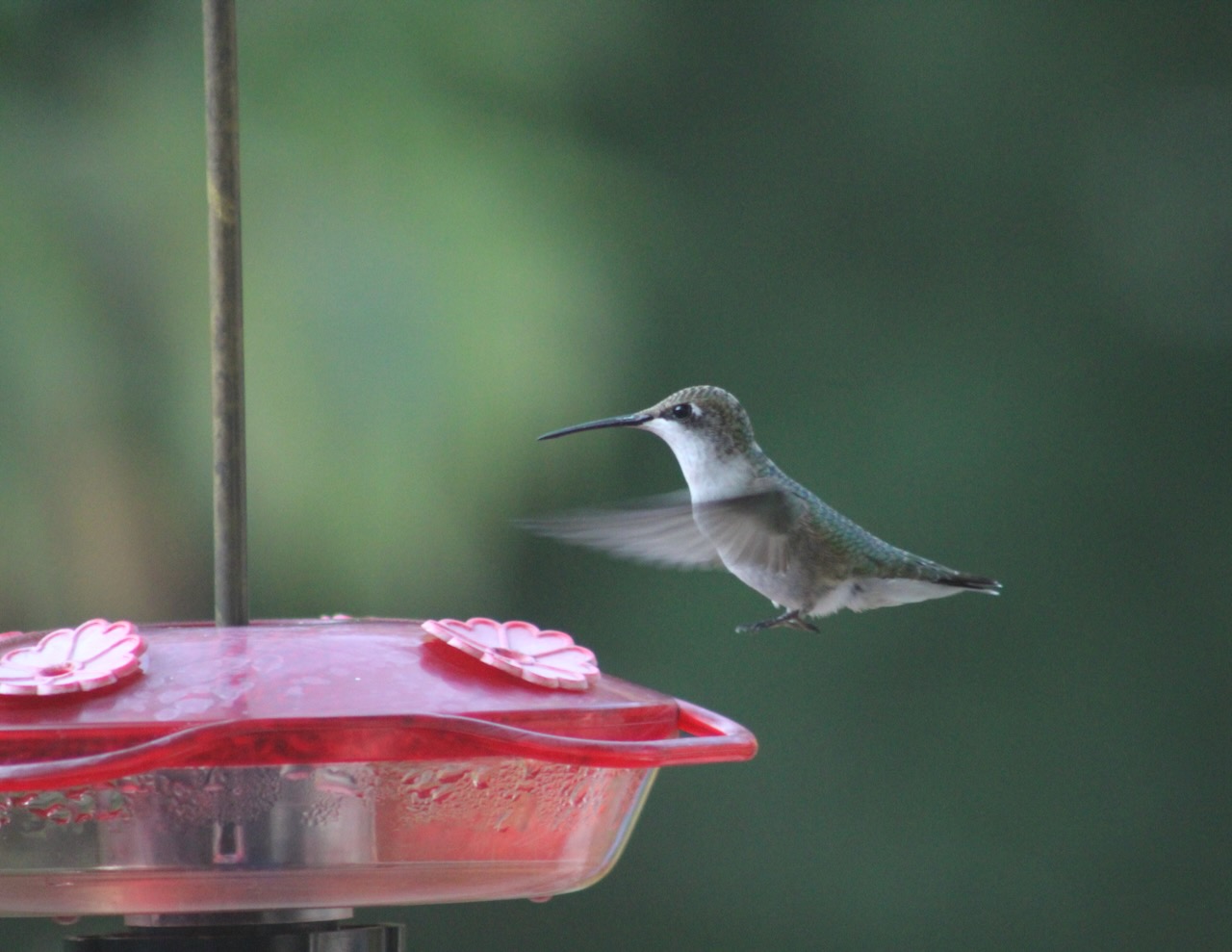
female hummingbird flying near red feeder

This summer, we’ve been blessed to feed hummingbirds in our yard, both through flowers like bee balm, and also through our little red hummingbird feeder that we fill with a sugar solution. Earth creatures feed each other. Everyone needs to eat. This happens through the incredible natural chain of life, some animals eating plants, other animals eating animals. But the deepest natural order is that all animals must eat. The interconnected circle of life. We participate in this circle, by what we eat, and by how we feed others.

Perhaps this is why forced starvation is such a horrific crime. To cut off a people from food is a crime against humanity, and also a crime against the natural order of life. I have been daily bearing witness to the forced starvation of people in Gaza by the Israeli government. There is food aid literally waiting at the border being denied entry. My heart is breaking every day. As the starvation goes on, it becomes impossible for people to heal from the damage it does to their bodies, even if they survive. Every day more people are dying and more people are reaching a point of no return. One action that is being organized is to pressure mainstream media to cover the fact that Israel is starving Gazans, which should be headline news everywhere in the world. You can find a template to flood media inboxes at https://writersagainstthewarongaza.com/action.

I also want to bear witness to the starvation happening in Sudan. I am not seeing so much about it in the news. When the current regime in Washington closed the doors on USAID, the situation there became dire. According to an article today in Closer to the Edge:

“The U.S. was once Sudan’s largest humanitarian donor. USAID funded almost half the international aid reaching the country. Then, with the flick of a legislative pen and the grinning cruelty of budget hawks who will never see a famine up close, that support was ripped away. Community kitchens—lifelines for displaced families—shut down. Nutrition programs vanished… The numbers are so obscene they should scream off the page: 25 million people acutely food insecure, over 770,000 children under five on track to suffer severe acute malnutrition this year, and nearly 100,000 cholera cases since last summer. ” 

We are all connected. I am remembering that the very first moral imperative according to the parables of Jesus, was simply this: “I was hungry and you fed me. I was thirsty and you gave me drink.”

Native wild flowers

glowing yellow goldenrod flowers on tall stalks, with dark green background
Goldenrod flowers are in bloom.

We have now lived in our home in Portland for 7 years, and are gradually getting to know the plants around us. We have our share of invasive plants, but today I want to highlight a few of the beautiful native wildflowers that are blooming right now in our yard. They come up on their own, and Margy has encouraged them by pulling invasive species, and leaving certain areas alone as she mows paths around the back yard.

I believe our goldenrod might possibly be the solidago sempervirens, or seaside goldenrod, native to eastern North America. This identification fits with our sandy pine forest soil, and photos online look similar. But it is very difficult to distinguish between species of solidago. Solidago is considered a keystone species, and has been called the single most important plant for North American pollinator biodiversity. They are very loved by many bee and butterfly and moth species. We love them too.

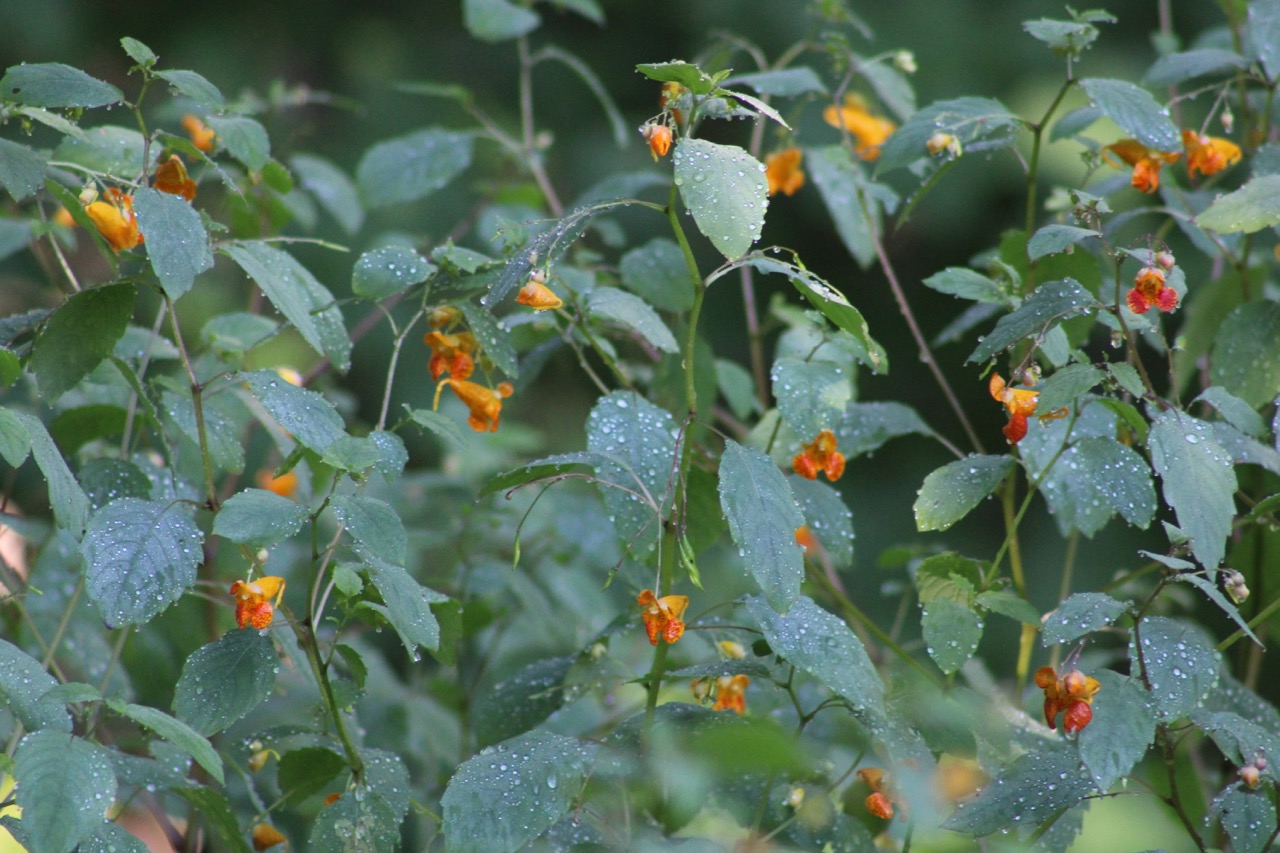
Tiny orange flowers on thin stems with oval serated leaves, droplets of water on the leaves.
Jewelweed after a rain.

Jewelweed grows profusely at the back and sides of our yard. Impatiens capensis is also called touch-me-not, because of the way the ripe seeds pop open when touched. It often grows near poison ivy (which we don’t have) and has traditionally been used as a remedy to prevent the rash caused by exposure to poison ivy. This year it has gone a little crazy all around our old white pine, and in Margy’s mound bed nearby. Hummingbirds and bumble bees are their major pollinators.

tall stems with small yellow flowers at the tips, many plants in 1/2 wine cask planter, on patio near deck railing.
Evening primrose in an old half wine cask container.

I got to know evening primrose last year, when it was the favorite plant for goldfinches after it had gone to seed. This year, it has self-propagated into two containers, as well as all around the patio and orchard. Oenothera biennis is a biennial plant, forming a small rosette the first year, and then in the second year shooting up to great height before blooming. It is native to eastern and central North America. Evening primrose oil is considered medicinal for a variety of conditions, though we haven’t tried harvesting it for such.

evening primrose closer
Evening primrose, closer look at the blooms.

What I love about these three species is that they grew on their own. We didn’t plant them, we just began to notice them and appreciate their presence. True gifts from the earth. There are many others we have begun to notice as well. It takes a while to learn about them and to identify them. It feels like such an important part of finding our way into earth community.

First Frog! and other firsts

First frog in the pond sighted today!

I saw the first frog in the pond this morning! I came to sit quietly earlier, saw nothing, and then when I came back a while later, there she was, sunning herself on a stone. I almost missed seeing her. She’s a darker color than the ones from last year, but still in the green frog species. Later, I saw her in the water, with her eyes just above the surface, sitting still, as they do. Welcome little frog!

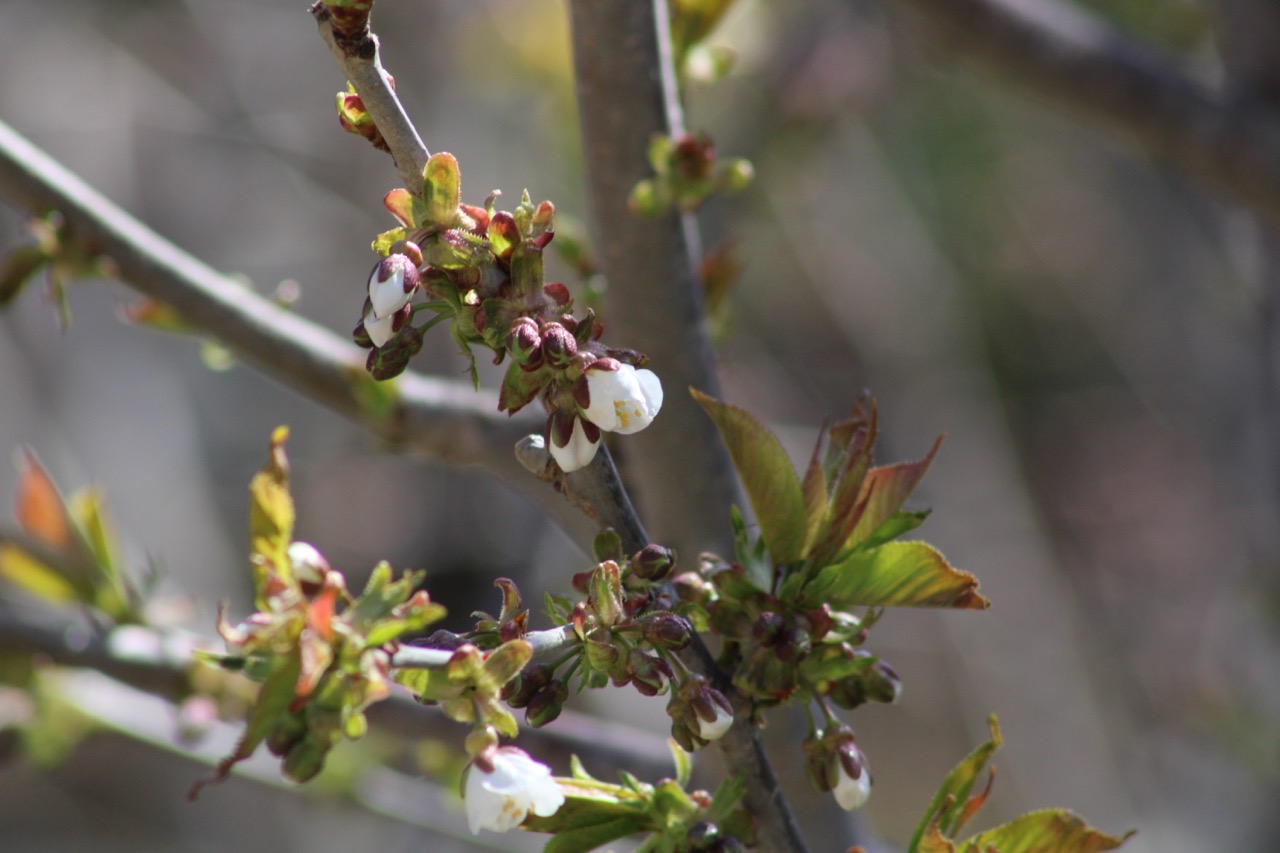
It was a day of firsts. The first cherry blossom opened on our Lapins sweet cherry.

White cherry blossom with maroon leaf edges.

As we sat at the patio table, Margy saw the first hummingbird–darting to where the feeder used to be–(there is a hanging folded paper peace dove there now). It was too quick for us to get a picture. But after lunch, I put out the feeder–not there, but on the other side of the deck, so as not to disturb the robin, who is nesting again. Yesterday morning, she was sitting with her beak open, and she kept it open for quite a long time. We wondered if by any chance that meant she was laying an egg. (It reminded me of women in labor, taking shallow breaths as they prepared to birth the baby.) They say she will lay one egg per day until she has her brood of 3 or 4. If all goes well, she will incubate them for 2 weeks, and feed babies for 2 weeks. She still comes and goes during the day. I hope she tolerates our presence. We’re trying to be quiet as we go in and out.

It feels like, with the arrival of May, all the creatures are joining us in our wonderful little back yard. My heart is smiling.

Robin with beak parted, on nest in beam.

Beauty and Trauma

Juvenile female cardinal near Joe Pye Weed and flea-bane

I have been at a loss for words these past few weeks. But sitting quietly in the back yard–often next to the frog pond–has enabled me to see some beautiful birds. I’ll start with this cardinal, cardinals being for a long time my favorite bird. I saw this rather scraggly (like all juveniles) female while I was lying in the hammock reading. I love their little chirps.

I saw the cardinal just as I started reading a new book, Carnival Lights, by Chris Stark. It has taken me several weeks to finish because it was so painful. I had to stop and start, stop and start. This novel should have all the trigger warnings. It brings to life the theme of missing and murdered Indigenous women, and it also weaves the past into the near present (1969) with the long history of land theft, murder, and oppression. I grew to love cousins Sher and Kris, two teenage Ojibwe girls, running away in Minnesota. But I am not even sure to whom I might recommend the book? I felt like I was plunged into vicarious trauma as a reader, and I wouldn’t want to re-trigger that kind of trauma for my Native friends, one of whom already mentioned that, yeah, she’d never be able to read it.

Yet there were also threads of beauty and resilience interwoven into the tapestry of the story that fed my spirit too. Such powerful gorgeous writing, such depth of expression, such love. It is a brilliant book. I first found it because it was recommended by a Native author I love–Mona Susan Power. So perhaps for some Native women, the trauma is well known and understood, and the beauty and love in this story is a healing balm.

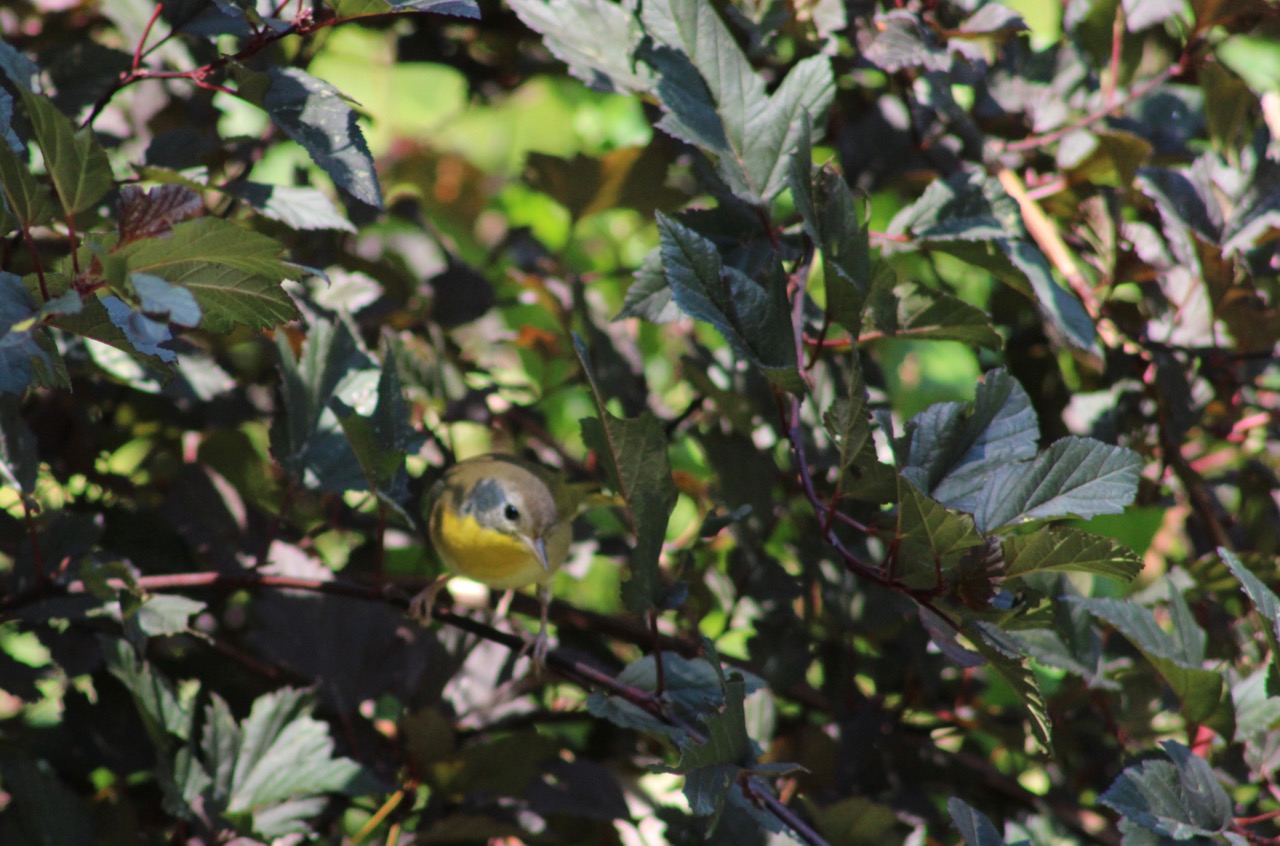
For me, in between reading, I had to go to my own backyard to find the grounding and fortitude to be able to continue. I was sitting near the pond watching the frogs when two yellow warblers (I think that’s who they are) started flitting about in the bushes, trying to attract my attention–perhaps away from something else? It seems too late for there to be a nest, but who knows? It must be almost time for their migration south. They were definitely letting me see them, and then flying to another bush close by. I saw them on two or three separate days, and caught these photos.

I think this is a yellow warbler in the nine-bark bush near the pond.
I think this is a yellow warbler female, seen on a different day in the same nine-bark bush, with a summer sweet bush in the background.

What do we do with the obscene brutality and violence that our whole society is built upon? What do we do with the exquisite beauty of a bird on a summer day?

A hummingbird hovering while drinking at the feeder

Hugelkultur 5 & Peach Blossoms

Wow, it has been a month since Hugelkultur 4 when I last devoted a post to progress on our hugelkultur garden bed. I am happy to say that yesterday I planted the first seeds! It has been a slow process of adding more soil and compost, a little bit each day, plus another layer of seaweed to help keep some of it in place. I also added soil and compost to the area between the mound and the logs marking the path, so there is a lower level on that side as well as a higher level. That in turn provided support for something like a slope of soil on that side. We planted lettuce and broccoli and spinach in that lower area, which will get a little more shade than other parts of the mound. It is a bit late in the season for all of those, so we’ll have to see how they do.

Hugelkultur done for now

I finally decided that it wasn’t really possible to get enough soil to stick to the other side to use that as a planting surface, at least for this year. I’m calling it done for now! But as the mound ages and settles year to year, I think it will continue to evolve and we can keep shaping it and adding to it. For now, I intend to plant zucchini and bush beans and maybe some cucumber and kale on the top of the mound, and the zucchini and cukes can cascade down the sides. Our last average frost date in Portland is May 24, so those will get planted soon.

Hugelkultur May

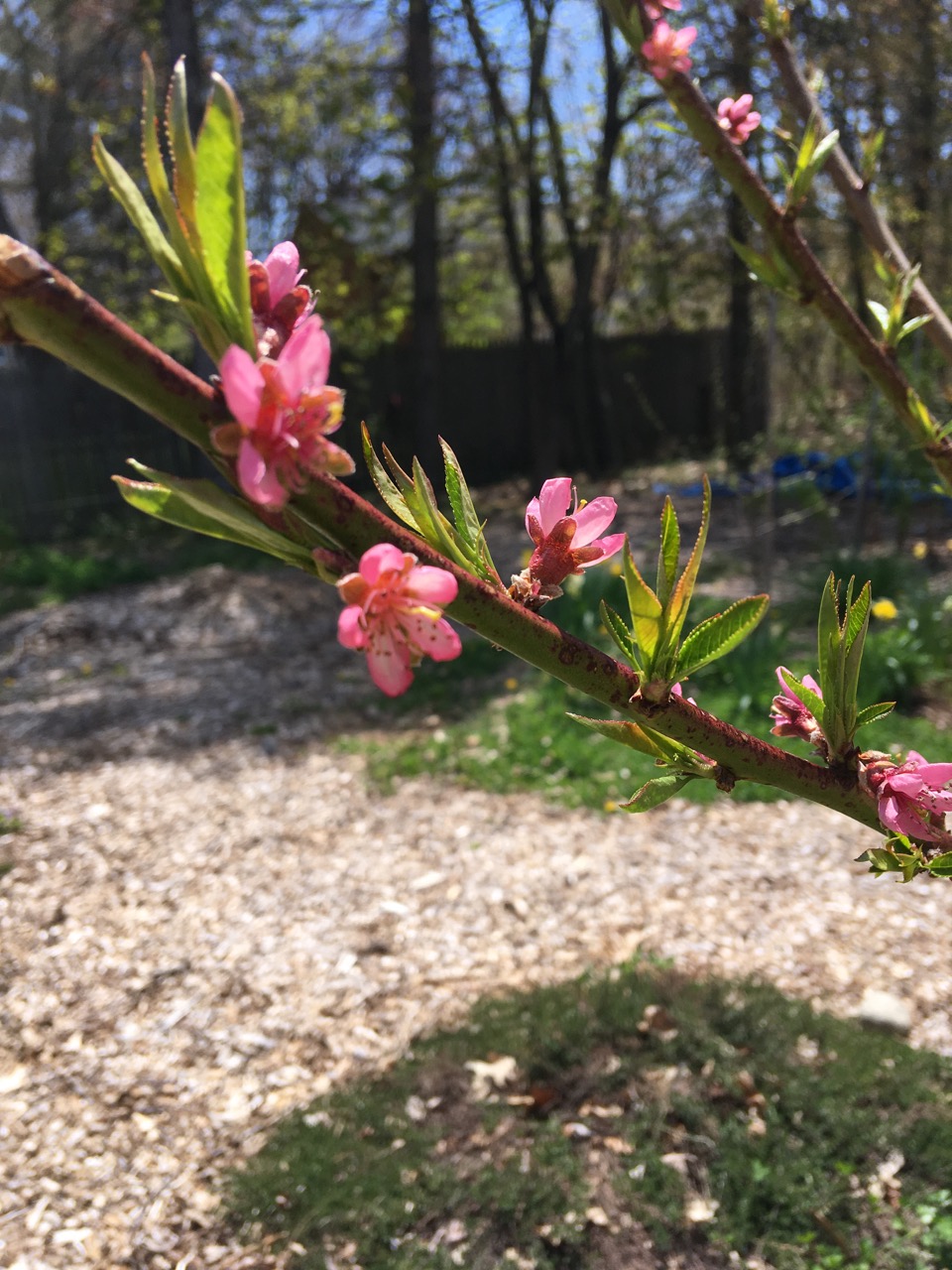
Meanwhile, speaking of frost, we had three freeze-warning nights this past week, and we covered our blooming peach tree with a tarp each night. But yesterday, I witnessed the best thing ever. I was sitting in my chair and saw a flash of something out the window, so I looked up. There was a tiny hummingbird, the first of the season, visiting each of the peach blossoms looking for nectar. I can’t explain why it moved me so.  All of the care given to the tree, all of the natural beauty of the tiny hummer. No way to capture it in a photo, but here is the peach tree in bloom.

Peach tree in bloom

I mentioned in an earlier post that an annual activity in the spring is pruning the cherry and peach  trees–each year relearning it all over again and steeling myself to the task which seems so harsh. The peach had produced an abundance of branches, but I took out all of the ones growing toward the center, and those that were smaller than pencil size, in order to preserve a vase shape and to build a strong scaffold for future years. I was happy that I was able to leave some branches that were budding, and if all goes well we might get our first peaches this year.

Peach blossoms

Breathe Beauty

This spring, I go from “hard work in the garden” days, to “collapse on the couch” days. With so little sun and so much rain, I feel an urgency on those good days to do as much as possible.  Monday, for example, I was able to inoculate the orchard with Wine Cap mushroom spawn.  That involved shoveling and hauling lots of wood chips from the pile, via a wheelbarrow, over to the trees, laying layers of wood chips in patches near each of the four trees, then spreading the spawn, then more wood chips on top.  (This is on top of old wood chips that are already around the trees.) I also put some compost in patches that I had missed last week.  I also planted chamomile and sunchokes that I had received in trade at the Plant Swap on Saturday.

Then, after, while I am taking a hot Epson salt bath for my aching muscles, I imagine that I will blog about it the next day–but I just haven’t have the energy for much more than Netflix for two days after any garden work days.  So I haven’t blogged about the Fedco tree sale, or about repurposing the garden bed behind the garage for three new blueberry plants, or about spreading seaweed mulch near the trees, or adding compost, or planting kale and more peas.  I haven’t blogged about any of it.

Meanwhile, between the work and the collapse, it is easy to miss the ephemeral beauty of it all.  The other day, I noticed I was missing something. I stopped to sit on the deck, and then walked around the yard, not working. I just looked at bushes and flowers and ferns, paying attention to what was there, appreciating the miracle of plants and their growth.

Violets

These violets came up on their own in a crack in the pavement near the bulkhead.

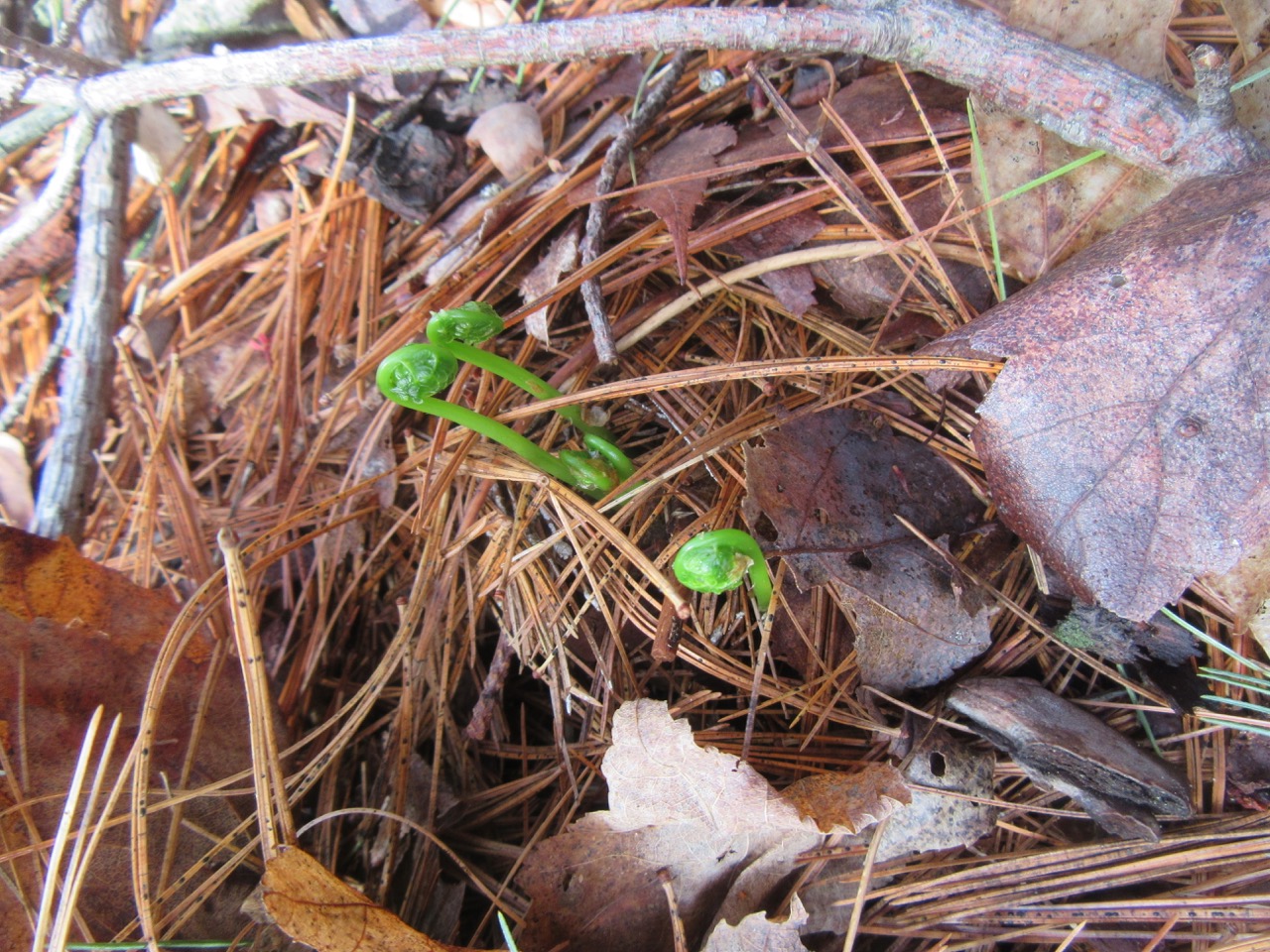
Fiddleheads coming back!

I thought the fiddlehead fern I planted last year had died, but here they are coming up again near the big old pine tree.

Golden Seal coming up

And here is the golden seal that I planted last year, also coming back after seeming death!

I finally sat down again on the deck, and after I had been there awhile, the hummingbirds boldly flew in to drink from our feeders.

It is hard for me to have so little energy this spring.  I wish I could do much more in the garden, and not be so exhausted every time afterwards.  I guess this is my new reality, this balancing act. But I am reminding myself to appreciate the beauty around me, to notice the color purple on the patio (as Alice Walker might say), to be grateful, and quiet enough for the birds to fly around taking no notice of my presence. To breathe slowly enough for shadows of joy to sneak in.

Hummer shadow

Yes They Did Come!

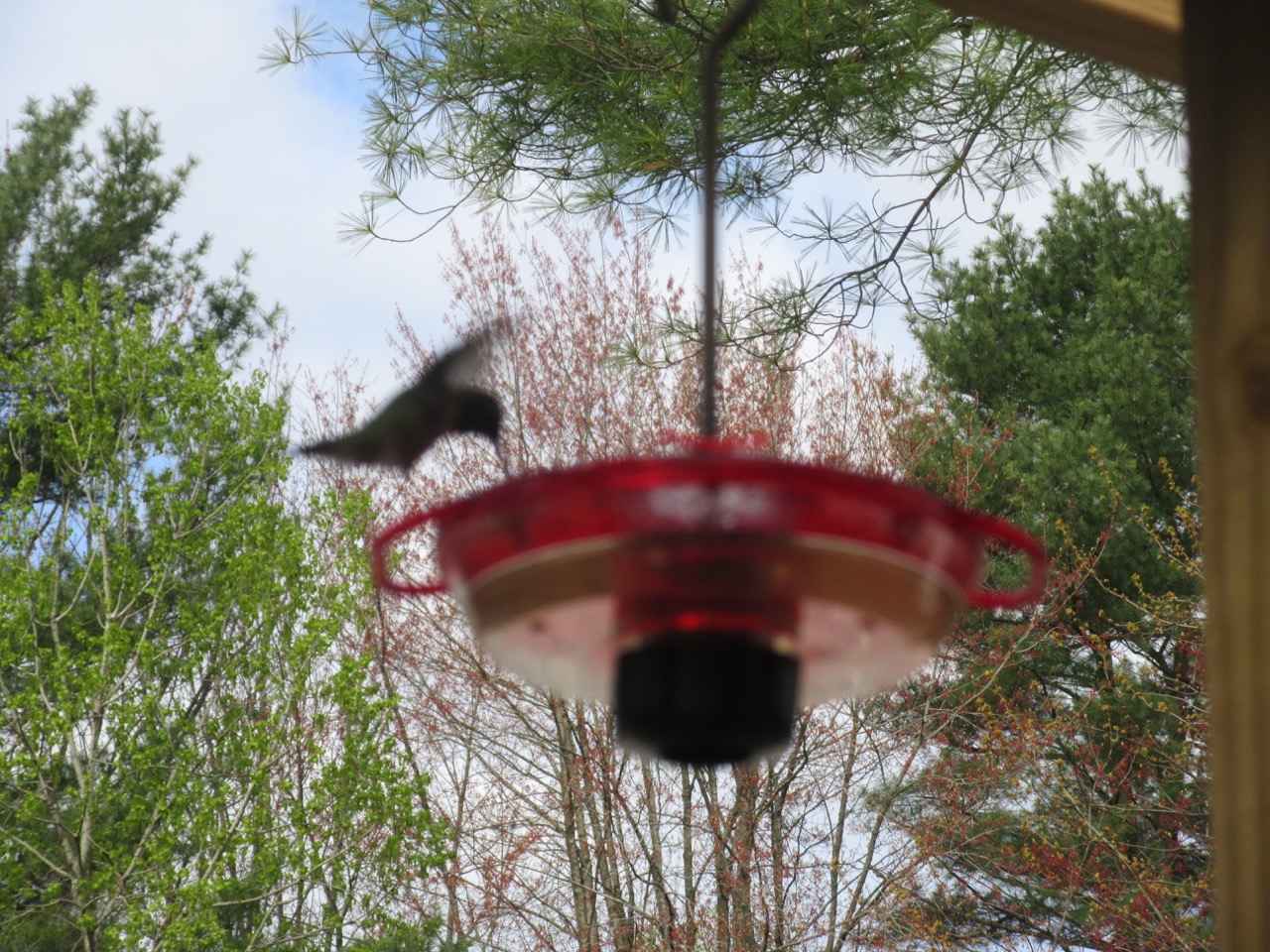
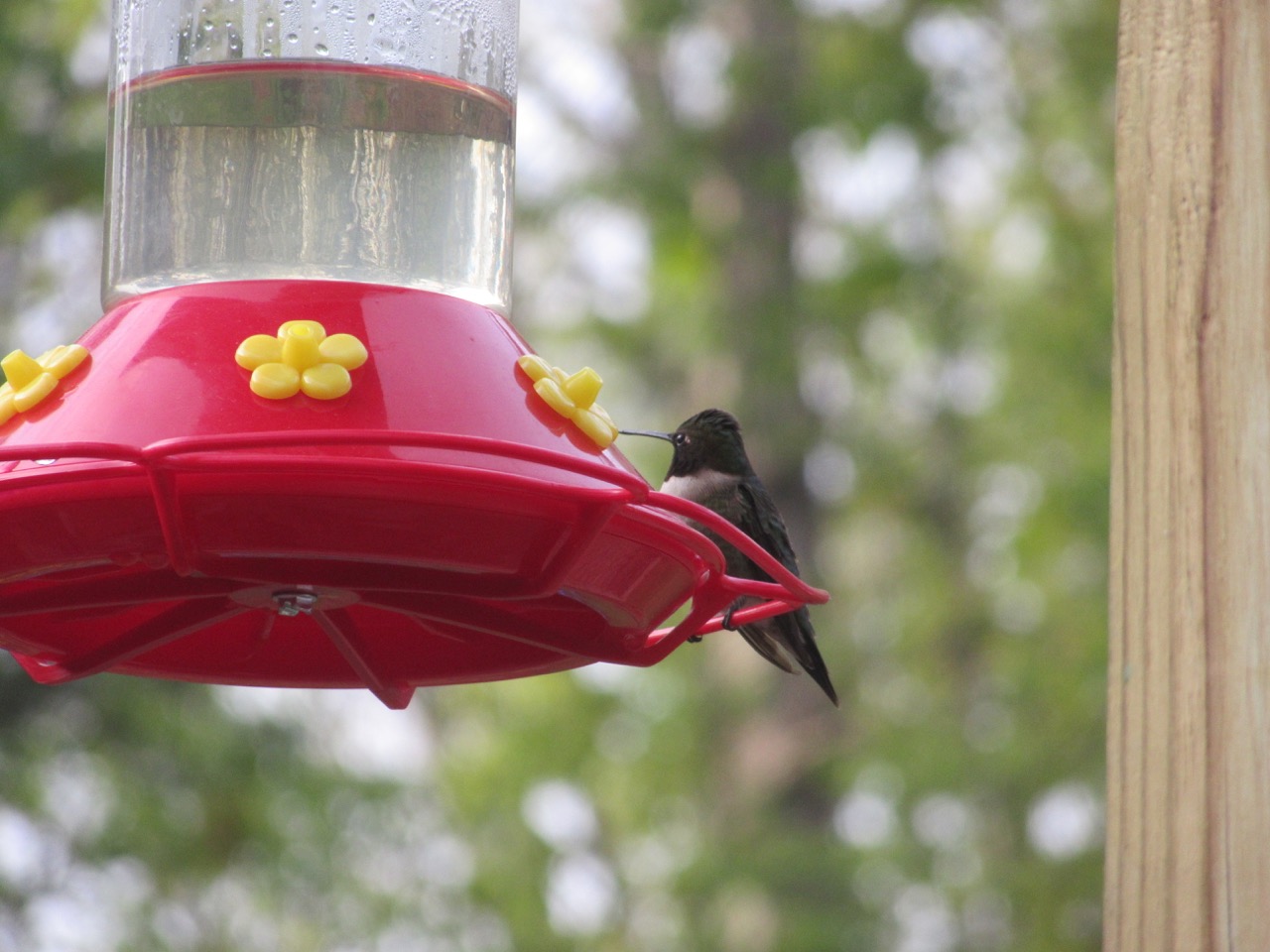
HummingbirdWe put up the hummingbird feeders five days ago, and the hummingbirds showed up within a couple days.  Today I got some photos, while sitting on the deck a few feet away. This is a male ruby-throated hummingbird, and a female came around as well.  It is rather marvelous that they can find these feeders, considering the length of their travels.

Hummingbirds migrate to and from central America where they spend the winter, usually in the same place that their ancestors did.  They fly alone, not in flocks, and instinctively know where to go.  Isn’t that incredible?  Hummingbirds have an average life span of 3-5 years, so maybe these are the same hummingbirds as those who found the feeder we put up last year, before we had the roof on the deck.  Or maybe they are descendants.  Now we have two feeders, and they’ve already used both.  Hummingbirds are very territorial, so I wonder if we’ll see others, or these two will claim it all for themselves.

Hummingbirds?

Hummingbird Feeder

Margy got a new hummingbird feeder for us!  I put it up today, plus our old one too, attached to opposite sides of the beams on our new roof on the deck.  I hope we aren’t too late to catch the migration–we used to put out the feeders when the viburnum near our door (in North Yarmouth) started blossoming, the first week of May.  We’re still figuring out the best timing for here in Portland.  I’ll let you know when we see any.

In the meantime, lots of watering to do, and I also divided some comfrey and some oregano to take to the Plant Swap tomorrow at the Resilience Hub.  Last year we got all of the companion plants we needed for our cherry trees.  The comfrey and oregano seem like basically fool-proof plants, and grew abundantly in the food forest.  So I was confident enough to take some out to share.  This year, I hope to find some kale seedlings, perhaps, and just see what might be there.  Maybe elderberry starts?  It has been a beautiful day in the garden.

Hummingbird Feeder small