The Lost Words

I haven’t had many words this autumn. Now, here we are in mid October. Leaves changing color, lovely cool days and cooler nights.

On the autumn equinox, we had a ritual with a few friends around our fire outside. I had gathered some acorns and we passed around a basket of them and each took out one acorn to express our thanks for some aspect of our lives, and then one for a wish or intention that we wanted for the next darker season. My intention was to bring back more music into my life. For whatever reason, I hadn’t been singing or playing my guitar for ages–I mean, years. So I put on new strings, and tuned the guitar, and then started singing a song here and there.

I found this hauntingly lovely song, Lost Words Blessing, originally shared by a colleague in a worship ritual. The song was inspired by a book The Lost Words created by by Robert Macfarlane and Jackie Morris. “The book began as a response to the removal of everyday nature words – among them “acorn”, “bluebell”, “kingfisher” and “wren” – from a widely used children’s dictionary, because those words were not being used enough by children to merit inclusion. But The Lost Words then grew to become a much broader protest at the loss of the natural world around us, as well as a celebration of the creatures and plants with which we share our lives, in all their wonderful, characterful glory.” [You can find out more about it on their website, and order books and albums there as well.]

One of my favorite things to do with songs is to figure out how I can sing and play them, and so I did with this one. And then, I found myself thinking about Passamaquoddy/Wolastoqey words, and how the language is in a fragile place, with original speakers growing older, and newer speakers trying to find their way into the language after long years thinking in English. How many of those words have been lost, or almost lost?

It has been a powerful gift for me to be learning the language with Roger Paul, via the University of Southern Maine during the last six years. Roger told us that the elders had given permission to share the language with outsiders, so that others might wake up to the world view hidden within. But I am always conscious that the language is filled with triggers of pain for all that was lost and taken by the violence of colonization.

There was something about the language that resonated for me with the song “The Lost Words Blessing.” So I decided to try to translate the song into Passamaquoddy–which I quickly found out isn’t really possible. It isn’t possible in part because the structure of English poetry is based on filling the lines with many words to evoke an experience, while the structure of Passamaquoddy, as well as I can understand it, is to use words that themselves are full of descriptive action. I learned a lot about how different the two languages are, by trying to create a version of the song in Passamaquoddy.

Still, I kept at it, not “translating” but pulling out words and sentences that created a similar experience in me, and also fit the phrasing of the music. While I am only an intermediate learner, I have learned how to research using the pmportal.org, to try to identify patterns and options and vocabulary. I couldn’t do it without that aid, and likely I made mistakes. I still don’t know if or when it might be respectful for me to sing this song. Can I, as a white woman, bring the language into this particular experience? When might it be appropriate to enter deeply into the language such that I can create a song with it? But to learn the language is, in a way, to fall in love with it. I want to honor Roger’s teaching by speaking as well as I can. Whether I ever sing the song for anyone but myself, I have learned so much by trying to create it.

Here is a sample, the first verse, with the original English, the Passamaquoddy, and then a more literal rendering of the Passamaquoddy into English. [Note: edited Dec 2024 with updated draft]

  • Enter the wild with care, my love
  • Kuli-nutahan elomahkiwik
  • In a good way, go out to the wilderness
  • And speak the things you see
  • on ktitomon keq nemihtuwon
  • and say what you see
  • Let new names take and root and thrive and grow
  • Piliwihtomun on kminuwiwihtomon
  • Name it/them newly and name it/them repeatedly
  • And even as you travel far from heather, crag and river  
  • Peci-te pihcehkomon nit sip weceyawiyin
  • Even when you go far from the river where you are from
  • May you like the little fisher, set the stream alight with glitter
  • Ansa pokomkehsis sipuhsis seskahtuweht
  • Like the little fisher make the stream sparkle brightly
  • May you enter now as otter without falter into water
  • Ansa kiwonik cupotomhat, kini-cupotomha
  • Like the otter slides into water, boldly slide into water

Learning Passamaquoddy as a Non-Native

Photo: Snow covered tree at dawn.

What a beautiful dawn the other day, all the branches coated with light snowy adornment! I’ve been feeling grateful these days. In particular, I’ve been thinking about how lucky I have been to study the Passamaquoddy language with Roger Paul during the last 3 1/2 years. I recently saw an article published a few years ago, by Taté Walker, “3 Questions to Ask Yourself Before Learning an Indigenous Language as a Non-Native.” It got me reflecting about the questions, some of which I had already considered when I began. #1 Why am I learning this language? #2 How will I center tribal perspectives as I learn this language? #3 How will I handle criticism from Indigenous people? Today, I also have a fourth question which I will explore.

I looked back to my earlier posts to remember my thoughts about why I was learning this language. I had asked permission from the teacher, and also from my Wabanaki friend who was going to take the class, and both had been very welcoming. Roger has talked about how his elders had decided it was time to share the language with others beyond the community. On a very practical level, it was hoped that by increasing the number of registrations, the class was more likely to be offered at USM, so more available to Wabanaki students who wanted to learn.

On a deeper level, I wrote that it was a way to begin to decolonize my mind, “I want to think differently”–Nkoti piluwitahas. I also had the thought that, ideally, any of us who came to live in Wabanaki territory should learn the original language of this land, as respectful visitors. Also, years ago, an Indigenous woman had said, “If you really want to understand our spirituality, you must learn our language.” It stayed in my mind though I can’t remember now who it was who said it. (This was during the time I was working on the issue of cultural appropriation by white people of Indigenous spiritualities.)

Today, thinking about it again, I know I had the privilege of retiring from work right at the time the class began, and there was a program for seniors to enroll in university classes for free. Everything came together so easily. My heart led me into it and the door opened. I think perhaps, too, though I didn’t realize it at the time, it was a way to connect to my own Innu ancestors.

During the process of taking these classes, I have learned so much about the perspectives and history of Wabanaki people. I have learned how few people are now fluent in the language, because of forced assimilation, and because of the terror of the boarding schools and day schools, where children were punished for speaking their language. I have learned that for me to learn the language is a privilege that many Wabanaki people do not have, if only because they are busy trying to survive in the English-speaking world. I understand that if I were to speak the language in most contexts, it might be a painful trigger for Native people who carry so much trauma about the loss of their language. So mostly, I haven’t tried to speak it except in our class contexts. And though I am beginning to understand more than I could have imagined, I am humbled too by how difficult it is for me to speak any of it, except for carefully constructed dialogues. I am truly still a beginner.

But the question closest to my heart these days is this: Since I have been granted this gift of learning the Passamaquoddy language, how can I give back? From this course, I’ve learned gratitude and the importance of reciprocity: so what is my responsibility now, as the recipient of such a gift of knowledge? Bearing in mind that I’m not training to be a professional teacher, and I have so little energy anyway because of chronic illness. I have done some activities in solidarity to Wabanaki concerns–but these are not related to language. I don’t have an answer right now. But I am holding this question closely. How can I give back? What is my responsibility in light of the gift of this knowledge? It may be that by holding the question, an answer will be revealed.

Ancestor Yearnings

My great grandmother Claudia Tremblay

Today, September 29, is my great grandmother Claudia’s birthday–she was born in 1865. I never got to meet her, but I was named for her (my middle name) and so I have felt a connection to her for quite a while. This week I was once again caught in the throes of this strange yearning obsession to try to understand the lives of my matrilineal forbears. I happened to be looking at a document about Claudia that I compiled a few years ago, and it mentioned a resource–the “General Catalogue of the Entire Montagnais Nation.” [Except the title was in Latin and the book was in French. Denis Brassard, Catalogus generalis totius Montanensium Gentis of Father Jean-Joseph Roy, 1785-1795 ]

It was a record of baptisms and other religious rites at the King’s Posts (Postes du Roi) in the Saguenay River area and North Shore of the St. Lawrence River of Quebec, in the 18th century. The Postes du Roi were the site of trading between the Innu/Montagnais and the French/British. They were also the site of missionary priests coming round to offer religious instruction and ceremonies to the Innu people. (The French called the Indigenous people of this region Montagnais, but since then, the people have reclaimed their own word, Innu.)

Claudia’s mother was Angele McLeod, and her mother was Marie-Madeleine, who was identified as “Montagnaise” in any records I had been able to find. But I had been unable to go any further back in her family, and only had estimates of her birth to be about 1789, perhaps linked to a Post du Roi. So I went looking for that book, which was available in a digital format for not so much expense. And it had a built-in translation function, which helped a lot since my French is shaky. The first half of the book was a description of how things were at the Postes du Roi. The Innu generally spent fall/winter/spring in the inland forests, hunting and gathering, and then came to the shores of the Saguenay or St. Lawrence in the summer, to fish and gather with each other. The Posts were built at these established summer gathering places to foster the fur trade, and the conversion of Innu people to Catholicism by the priests.

By searching record by record through the hundreds in the chart, I was able to find two Marie-Madeleines (Maria Magdalena) whose births were within 10 years of 1789: 1795, 1797. The Innu people did not use surnames, but rather single descriptive names, so each record included a Christian name (in Latin) and a personal name for the child in the Innu language. I found Marie Madeleine Katshisheiskueit (record #1065), and Marie Madeleine Manitukueu (record #1079). I don’t know that I will ever be able to establish a definite link between one of them and my Marie Madeleine, but one of them could be related to me. My Marie Madeleine eventually was married to Peter McLeod who worked for the King’s Posts in many places. And she was identified as Catholic, so it would be likely for her to be in these records.

Finding these names is touching a deep place in my spirit. I can’t even describe it. And deeper still, was searching out the meanings of the Innu names in the language. I was able to determine that Katshisheiskueit likely means “Hard-working/female” and her parents’ names were Antonius/ Tshinusheu which means “Northern Pike”, and Anna/ Kukuminau, which means “old woman” or “wife.” (Now the parents were only about 16 then, so likely it was an endearment, or Tshinusheu just said–“that’s my wife.”)

Manitukueu has something to do with Spirit–Manitu is the Innu word for Spirit. But I couldn’t find an exact reference. Manitushiu means someone who uses spiritual or mental power. “kueu” seems to be a common verb ending signifying something being or having. It is like detective work–and I wouldn’t be able to do any of it if I hadn’t been studying Passamaquoddy, which is related to the Innu language. Words are formed polysynthetically, with smaller parts joined together to create long descriptive concepts in one word. So I search the online Innu dictionary, with my framework of Passamaquoddy, and try to recreate what they might mean.

Manitukueu’s parent’s names were also challenging. Her father was Simeon Tshinapesuan, and the closest word I could find was something meaning “slips on a rock”, or “slippery.” Her mother was Marie Madeleine Tshuamiskuskueu, part of which meant “finding it by detecting it with body or feet.” But then I lucked out because her own birth record called it Iskamiskuskueu–which means “from Jeremy Islets,” and she was from Jeremy Islets. According to another source, this Innu name of that place meant “where you can see polar bears.” (Where you can find polar bears?) I guess I was rather far off.

So, it’s hard to trace “family trees” without surnames, but each child was listed with their parents, and by going through again searching for the parents’ names, I could find their parents too. And in fact, there were a few generations in each of their families to be found in the charts, with a lot of holding a magnifying glass over my computer screen so I could read the small letters in the charts. Much more still to do.

It is a whole world uncovered to me. And whether or not one of these women is my actual relation, this is the world she lived in, the world she came out from to enter a path that eventually would lead her daughters and granddaughters into other worlds. I never imagined that I might learn the Innu name of my great, great, great grandmother… and now there are all these names dancing in my mind, trying to form in my mouth, bringing much depth to my heart. I feel such gratitude and curiosity.

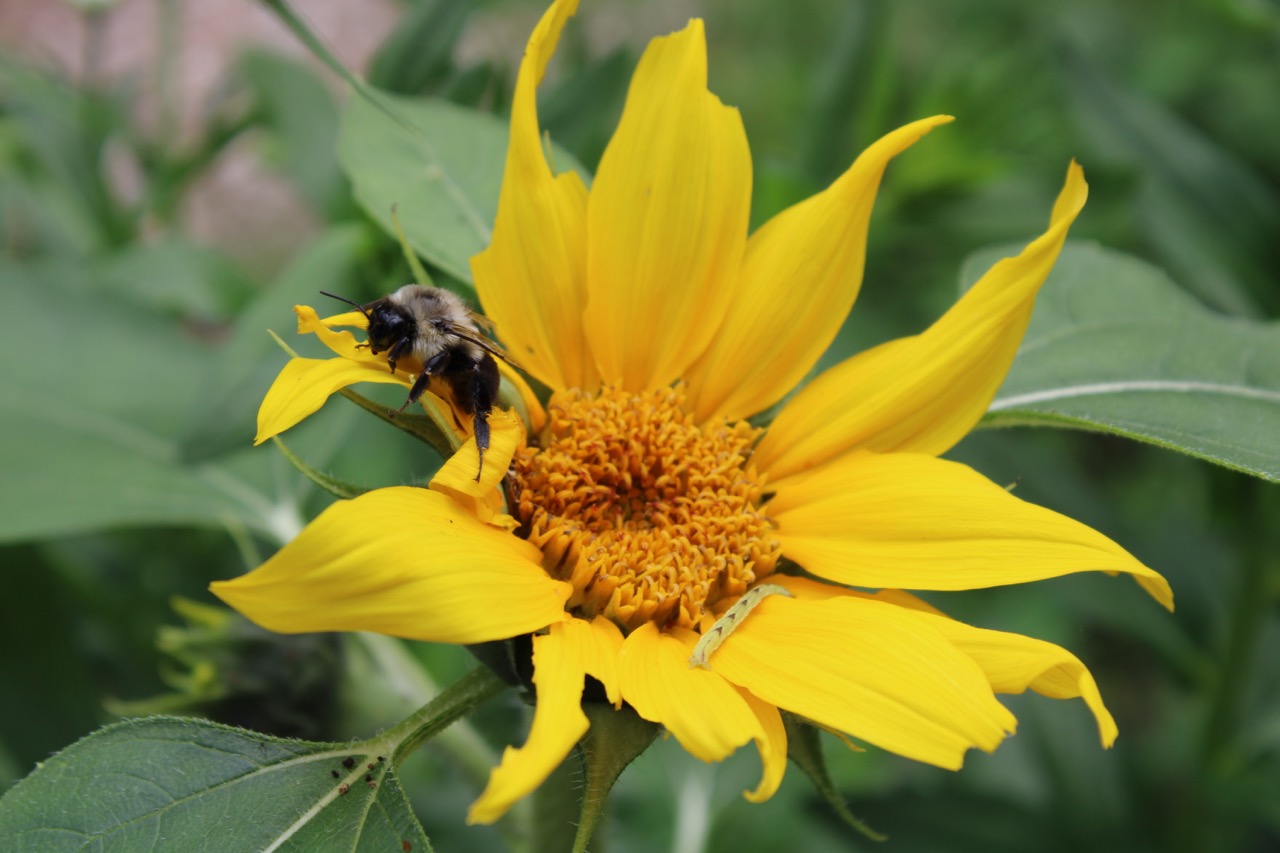
Yellow sunflower planted by squirrels, with a bee inside.

Kci Woliwon/Thank you very much

I feel such gratitude that I was able to participate in the 4th gathering for Healing Turtle Island, this year held online via Zoom and Facebook Live. Healing Turtle Island is a 21-year ceremony, born through a vision of Penobscot Sherri Mitchell, bringing together Indigenous spiritual leaders from around this land and around the world, to share teachings and ceremony for the healing we need for our times. I am grateful that those of us descended from colonizers have also been welcomed into the circle, that we too might listen and participate in this healing.

I was present for the first year’s ceremonies in 2017 at Nibezun in Passadumkeag, and though I have held its intentions close to my heart, my health has prevented me from attending the last two years. Being online this year, while a disappointment in some ways, enabled me and thousands of other people to participate from all over the world. (You can participate too, by viewing the recordings made of most of the sessions on Sherri’s Facebook page.)

Healing Turtle Island 2020

Poster announcing the schedule, from Healing Turtle Island page.

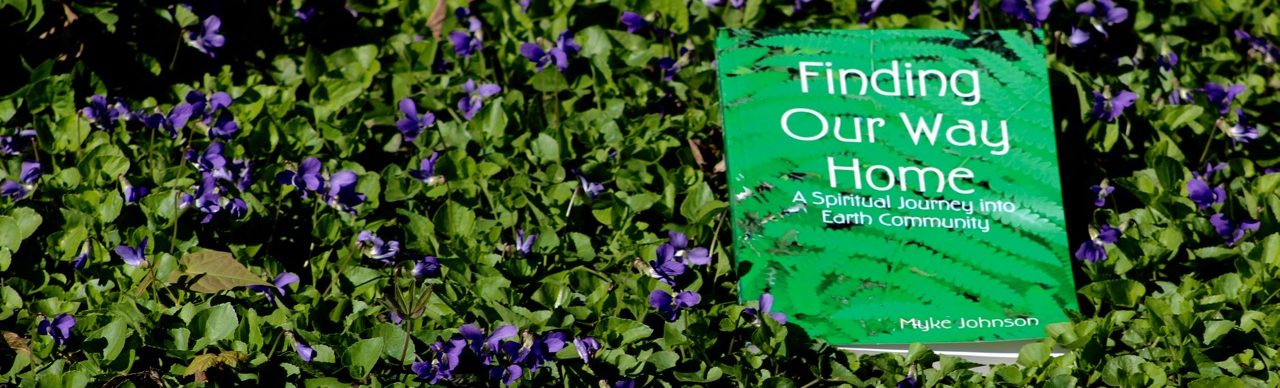
I am sitting in the silence now, after the closing ceremonies from this morning, thinking about what I have learned, what I carry with me going forward. First of all, it was grounding to hear so many people talk about the need to restore our connection with the land, with the spirit, with each other. It helps me to remember that that has been a guiding principle for me for the last several years, (as well as the theme of this blog and of my book .) By seeing this expressed so passionately by so many people, I felt renewed in my own spiritual journey into earth community.

Secondly, I was struck by how many people spoke of the importance of Indigenous languages for the healing and decolonization of the land and the peoples of the land. Over and over people reminded us that the spirituality and guiding principles of Indigenous peoples are found in their languages. Many people spoke in their native languages, offered prayers, offered songs, and then sharing partial translations, acknowledging that so much cannot be translated into the violence of the colonizer languages. They also spoke of how colonization disrupted the languages, how a whole generation of children were punished for speaking their languages, how difficult it is to bring back the languages, decolonize the languages, but how utterly necessary.

This touched me deeply, especially now that I have been studying a Wabanaki language for the past two years. On the one hand, I was so happy to understand a modest percentage of what Passamaquoddy and Wolostaqi elders were sharing in their language, especially in the prayers and songs and personal introductions. On the other hand, it has sometimes been bewildering to me that I find myself on the path of learning this language. A door opened so fortuitously just after I retired, and I walked through it into Roger Paul’s class at USM. I often ask myself, what is this about?

I feel glad that I helped to increase the numbers to enable the class to continue for its mostly Wabanaki participants through four semesters. I am glad that Roger got permission from his elders to share the language beyond the community. I have said that I want to decolonize my mind, I want to think differently: nkoti-piluwitahas. During the weekend another thought came to me, that any of us who come to live in Wabanaki land should learn the original language of this land. It is only appropriate as respectful visitors. And I remember someone saying, years ago, if you really want to understand our spirituality, you must learn our language.

But I still wonder what my responsibility might be, as a white person learning to speak a Wabanaki language. I am very sensitive to how much pain there is, in the loss of the language, and the slow revitalization that is happening now. Who am I to be learning, while so many Wabanaki people have not been able to do so? So I go forward with carefulness and respect and humility.

One other thing that was shared over the weekend lit a spark in me: that we all, colonizers included, should be seeking to uncover our own distant Indigenous languages. I had this idea to learn to introduce myself in the Innu language, the language of my matrilineal ancestors, and then a few lines in the language of my French and Scottish colonizer ancestors, and then a few lines in the language of my Germanic-speaking immigrant ancestors who came later, but who form the largest part of my inheritance.

The thing is, the Innu language is in the same family as Wabanaki languages, and structured in the same ways, so I feel like I am learning so much about those Innu ancestors by this process. That has been one of the very great personal gifts for me of learning a Wabanaki language. So I say kci-woliwon, thank you very much, for the blessings of this Healing Turtle Island gathering, and to all the language teachers, and especially to the Spirits of my ancestors who lead me into paths I could not have foreseen or chosen on my own.