Gardening Gifts & Challenges

Cluster of many asters with pink centers and white petals.
Asters are blooming!

My favorite part of gardening is when native plants show up and bloom all on their own! Asters are all around the edges of our yard, and in so many other Maine yards in our neighborhood right now. Different varieties, all beloved by pollinators, tiny beautiful blossoms when you look closely.

My least favorite part of gardening is wrestling with the invasive species that show up on their own. For the last three weeks I’ve been pulling buttercup plants that spread all over under the honeycrisp apple tree, and were also just starting to infiltrate the raspberry patch. So first I pulled up all the plants I could, in sections, then I set down cardboard over the area, watered it, and spread a thick layer of wood chips on the cardboard. Handily, the tree is right next to our pile of wood chips. The hope is that the cardboard and wood chips will smother the rest of the buttercup roots that I am not able to eradicate.

Small apple tree with wood chip pile to the left, half circle of cardboard on the ground almost covered in wood chips, and front right plants including buttercup plants.
Halfway done pulling buttercup plants and layering cardboard.

While I was at it, I also pulled up all the oregano under that tree–my other nemesis, though it has its uses as an herb. It was intermixed with the buttercup. I was sad that I had to cover other ground plants like wild strawberry, and I hope they will spread again over the wood chips once things settle down. But finally, it was finished. (For now–I imagine I will have to be on the lookout next season for sneaky little survivors.)
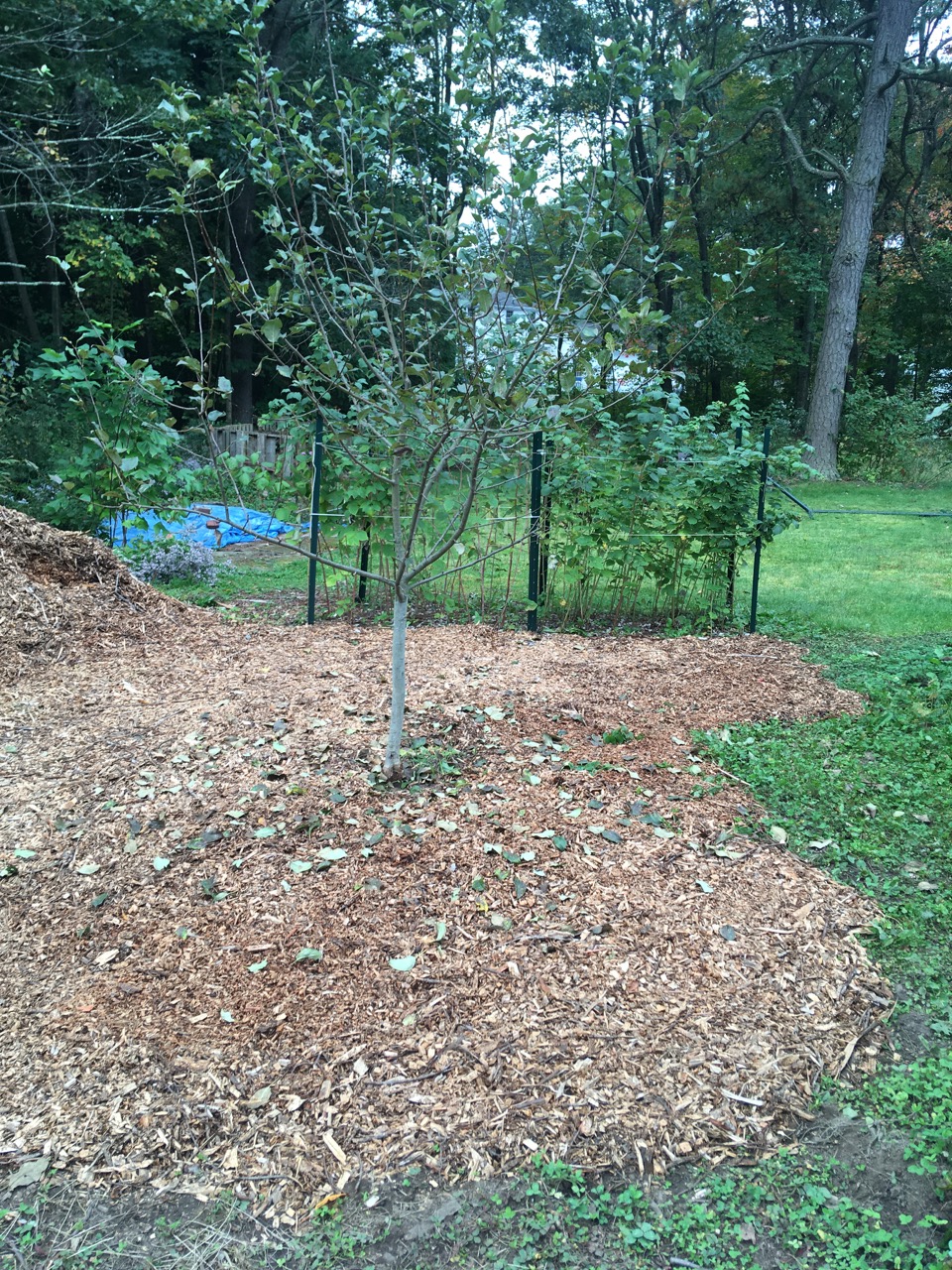
Small apple tree surrounded by wood chips in a big circle. A raspberry patch is visible behind it, and green lawn.
Completed!

Meanwhile, the other least favorite thing about gardening is watching how climate change is disrupting the patterns that nature usually unfolds in each season. Yesterday, I discovered that there were open blossoms on the cherry trees–just a few–but this is October in Maine! Last winter’s unseasonable warming and freezing killed all the blossoms that should have come out in the spring. We have yet to harvest any cherries from these trees beyond one or two. And now this. I have heard that other people are noticing weird blooming out of season on other plants too. I don’t know if the cherry trees will survive. I hope they will. I tend them as well as I can, but there are forces far beyond the little garden here in our yard.

white five petal cherry blosom on branch, with leaves in background.

Meanwhile, I try to be grateful for the gifts that still emerge, the asters and goldenrods, the frogs and birds, and that I am able to go outside to watch and learn.

Boundaries & Buttercups

Green buttercup leaves in a mat/
Buttercup leaves forming a mat.

Earlier this summer, I discovered a few lovely yellow buttercup flowers under the Honeycrisp apple tree. I didn’t think too much about it. They were so pretty. Later, when I was mowing the orchard undergrowth, I mowed those flowers along with everything else. But more recently, I realized that the buttercups had spread all over the ground near that tree, and were crowding out any other plants. So once again, I did some research and discovered that Ranunculus repens, creeping buttercup, is considered invasive in Maine.

I don’t know how it got here. And it is likely that I won’t be able to get rid of it entirely–each plant puts out horizontal stems that take root at its nodes and form new plants at each node. But I have to try. Further research suggested that using a garden fork to loosen the soil and lift up the plants was a good way to pull the plants with their roots. Also, it prefers acidic soil, so adding lime to make the soil less acidic can discourage them. I started pulling them yesterday, and did some more this morning before the rain came.

Small tree with a few apples on its branches, at the ground we see green  all over, except in one area where soil is visible, and a garden fork in the lower right.
Here you can see the section I pulled and the other huge section covered with buttercup plants.

I was complaining about all this to Margy, and she reminded me that a large part of our gardening is removing problematic plants in order to encourage beneficial plants. So while I delight in the violets that spread everywhere, and the wild strawberries–both native ground covers that have flourished in the orchard, I also have to reckon with these invaders that come in from who knows where.

Invasive plants don’t have good boundaries! Now, there are also some native plants that are quite aggressive growers too. One example is Canada anemone, or anemone canadensis, which Sylvia planted in the herb garden. The difference is that native plants have more benefits for the local ecosystem. But I pulled hundreds of these plants to make room for the littlest apple tree. I put down cardboard boundaries around the circle, and over the circle, then covered it with wood chips. I may also use that method for the buttercup areas to see if that helps.

Very small tree in a circle of wood chips, with lush green plants at the back of the circle.
Small Blue Pearmain apple tree, with a ring of Canada Anemone around the back.

So once again, lessons can be learned from plants and the process of tending them in the garden. Plants have many different relationships with each other. Can aggressive or invasive plants eventually find some sort of balance? Some non-native plants find a useful niche and honor the boundaries of plants around them. We might also ask ourselves, How are we in our own relationships with others? Are we aggressively pushing out others to claim all the space and goods for ourselves? Or are we good at sharing space and goods with our neighbors? Are we also careful with our own boundaries, not letting others treat us aggressively?

And I can’t even consider these questions without thinking about the early colonization of this continent by Europeans–they certainly fit the definition of an “invasive species,” destroying so much in their spread across the continent. Yet here we are now. Can we learn to live in harmony with all beings around us?

Humble

Red rain barrel in front of house, heat pump seen on upper right, behind oregano plants all over the place, green with white flowers
Overgrown oregano all around the rain barrels and heat pump.

I love sharing photos of beauty in the yard. But it is harder to know how to share the challenges and failures. I actually feel like a failed gardener right now. Yes, there are little harvests, yes there are elements of beauty. But there is so much that is overwhelming. I don’t enjoy “weeding” which seems to be what real gardeners often talk about enjoying. A weed is merely a wrong plant in the wrong place. We make further distinctions to talk about invasive plants that are harmful to the local ecosystem. And there are also native plants that are aggressive in the ecosystem.

One of my overwhelming senses of failure comes from the oregano that is spreading all over the orchard. When I originally planted some donated oregano as a companion plant to the orchard trees, I had no idea how it would take over. Oregano is a tasty herb, not native, but useful, and the bees love the flowers; I’ve dried some of the plant for seasoning. Last year as it spread, I thought, okay, just let it go where it wants. This year I tried taking out a tiny patch using a garden fork. Its roots form a thick mat under the soil. Even a tiny patch was challenging to remove. I’ve lately taken the mower through the orchard a few times. With the rain and heat inhibiting our outdoor time this summer, I can’t imagine how to get it under control. I hate the feeling of needing to get a plant under control.

Everything in the yard is ragged and overwhelming. For each native plant I newly discover and appreciate (like the evening primrose that the goldfinches adore), there is another tall unknown plant that I have no idea about. The orchard trees have to be pruned each year, and face challenges from mysterious pests and diseases. Will the Lapins cherry survive its challenges?

Perhaps in all of this, I discover that I don’t enjoy tending and caring for this patch of earth the way I thought I would? I am not good at gardening? I’ll never be good at harvesting much food? I want to give up sometimes, but how can I? Everything is right outside my door. I acknowledge that it is much more difficult for all gardeners because of the climate catastrophe of our times. I realize that I don’t have teachers to show me how–mostly just books really, and the internet. I don’t think gardening was meant to be so all alone.

But I have made this commitment to a spiritual journey into earth community. These overwhelming challenges are part of that journey too. So what can I do? This morning, I took myself out to our new screen tent, placed a blanket on the ground, and sat on the ground. It has been a while since I have done that. At our old yard, I used to sit on the ground in a screen tent almost every day. Lately, instead, I have been walking around looking at things that need tending. Today, I sat on the ground and let the ground tend to me. I turned to each of the four directions, to honor the powers of east, south, west, and north–and the powers of the earth below, the sky above, the spirit within.

The sun shining through in the eastern sky, from within the screen tent.

It reminds me that I am small, and these powers are large. Spirit is large. They are my teachers and carers. I hear the cardinal singing from the tall trees. Truthfully, I am not really the one who tends the earth, the earth is the one who tends to me.

I am remembering a chant song I learned from a friend in English, and then heard later in Wolastoqey; As far as I can discern, it originated from Wolastoq people, and has since been performed by other indigenous people as well. My friends and I sang it something like this, in several verses substituting the word “creator” with all manner of beings, such as trees, ancestors, water, stars, dragonflies, children–all the creatures around us.

We've got to humble ourselves in the eyes of the creator, we've got to bend down low.
We've got to humble ourselves in the eyes of the creator, we've got to know what they know.
We can raise each other up, higher and higher. We can raise each other up.

Perhaps the failures are also teachers, a reminder of our ultimate dependence, an opening into something more mysterious and powerful in whose eyes we are seen and held.

30 Years!

Margy & Myke selfies, two old white lesbians sitting close on a quilted background loveseat.
Margy & Myke cuddling on our new loveseat recliner 2023.

July 4th is the 30th anniversary of Margy and I being together as lovers! We have many different anniversaries actually–for example, it was six years before we moved into a household together, when we moved from Boston to Cape Cod in 1999. Perhaps that was our first truly big commitment, buying a house together in a new place. We never did the legal marriage thing, even as we fought for it to become available to same-sex couples, partly because Margy has been disabled since we’ve known each other, and she would have lost her health care coverage, and partly because legal marriage just didn’t matter to us personally, radical dykes that we were.

Our Love Is Holy poster carried by Margy and Myke at state house in Massachusetts surrounded by other rally goers.
Mar 11 2004 rally at the state house in Massachusetts, constitutional convention about equal marriage

We were something of a case of opposites attract, and we often found ourselves surprised to be together. Our values and commitments were solidly aligned, but our personalities and relationship styles were different. Still, we adapted to each other’s needs, we cared for each other, and we are still learning how to do that. I love Margy for her passion, for her humor, for her curiosity, for her tenderness. Also for being such a sweet butch. Music, dancing, activism, the ocean–they were all parts of our love story. These days, I love that she goes out beyond the yard to get rid of invasive plants; that when she mows, she mows around native plants like goldenrod and ferns so they can flourish.

Margy surrounded by green trees and vines, pulling on multiflora rose shoots.

I love that she encourages my pond building and orchard planting. I love that we both love critters like birds and frogs. That each of us cherishes solitude as well as togetherness. As we come into our elderhood, many things keep changing. We face new challenges, but our love is like the ground, a living foundation in which to keep planting and tending the seasons of our daily life. I am so grateful that we found each other, and that we have journeyed together for these thirty years!

White pond lily with yellow center, on greenish pond water, with reflection, and two leaves floating behind.
Pond lily blossoming!

Empty Buds

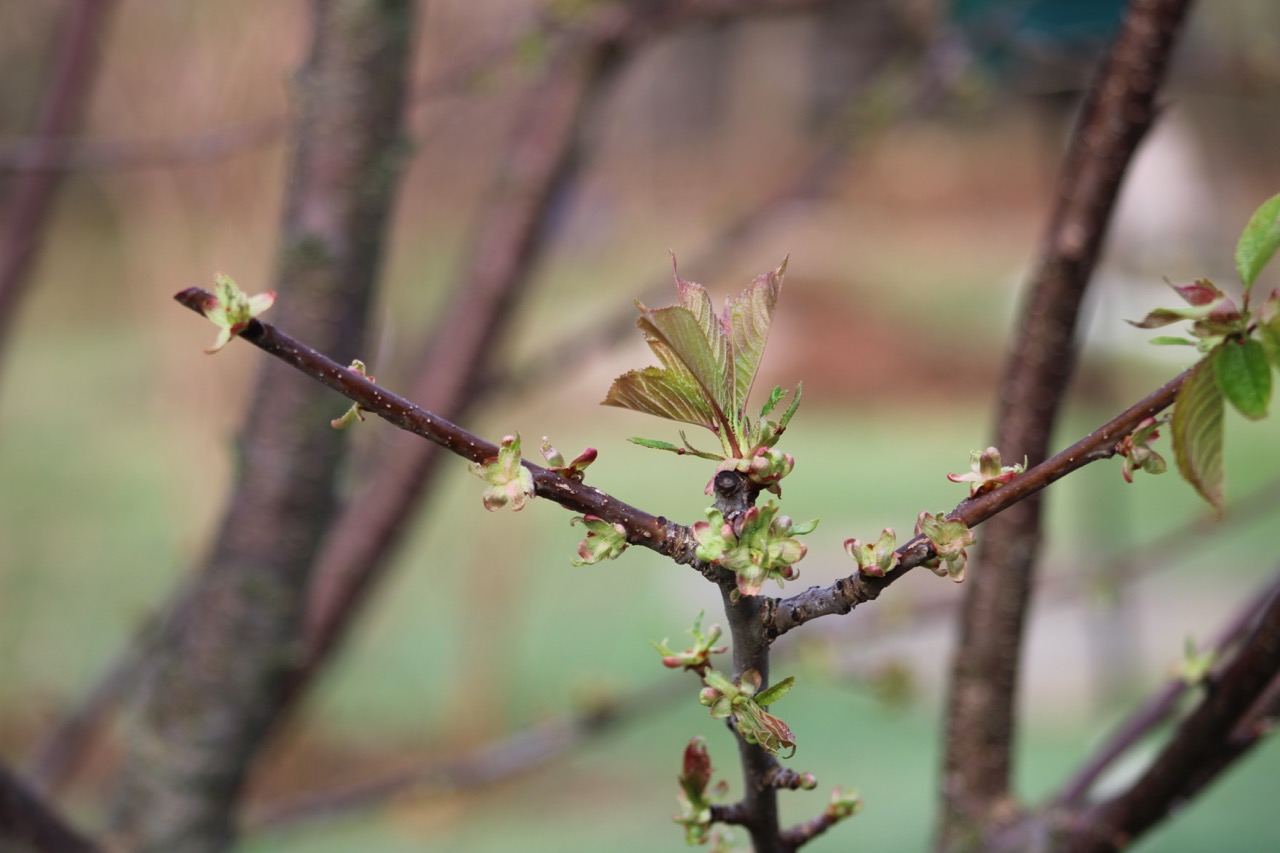
Branches against blurred green and brown background, with small leaves, and small empty buds opened.
Cherry tree open buds are empty.

The cherry trees and peach tree have no blossoms on them at all. The cherry trees had the buds that should open into blossoms, but when they opened, they were empty. At first I worried that I’d done something wrong. But on connecting with other gardeners in Maine I learned that many people are facing this problem with all their stone fruits. Apparently, the most likely cause is the weird weather over the winter, with mild times alternating with a deep freeze. They didn’t stand a chance.

I feel sad about it–there were really so many buds on the cherry trees this year. In prior years we just had a very few blossoms, and I was hopeful that this year we’d see our first real fruiting. I also feel glad that the leaves are opening–I heard that some people’s trees actually died. I am glad ours are alive. But this is a lesson about climate change. Global warming increases the unpredictability of the weather, and the temperature swings are part of that. What food we can grow becomes more unpredictable.

We don’t rely on our little garden for our food–we are really just learners in this process. When we get a harvest, it is exciting–and thankfully, we still have peaches from last year’s abundance in our freezer. It looks like the blueberries and raspberries will be fine. I’ve already eaten sea kale and some asparagus. But I can feel the vulnerability of what it means to face a shifting climate, even in these small ways. How many larger ways are unfolding all over our planet? Severe heat and drought in many places, floods in other regions. For too many people actual starvation is real. I feel so powerless in the face of these huge problems.

When we first moved to this place, our hope was to form a deeper connection to the earth and all her creatures, through our connection to this small piece of land. I have to say it isn’t easy. We know so little, and we are surrounded by challenges larger than we are. For just one example, Margy spends hours pulling and cutting invasive plants around the borders of our land–Asian bittersweet, multiflora rose, Norway maples. The way it is with invasives, that job will never be over. Plants have their own personalities, and some are very aggressive even if they are native plants or desired plants, so there is the endless pulling and pruning to keep things in some sort of balance. (Oregano and wood anemone, I’m looking at you! Everywhere!)

But maybe these are the lessons we are learning about making a deeper connection to the earth. Plant by plant is the only way we get to know them. Whole Indigenous communities were needed to foster the balance of all beings, and we are just two old non-Indigenous humans. Some of our neighbors seem to be in a similar venture to ours, and others seem just the opposite.

Still, I have to hope that the love we offer to this place can be a small seed of healing, maybe even its own “aggressive” form of healing, spreading into the broken places. I draw hope from the birds who seem to multiply and who enjoy the yard so much. I draw hope from the violets blooming everywhere they want to bloom. I draw hope from the turkey who visited the other day and made a dust bath in the patchy lawn. There is something so wonderful about a community of creatures who share one place.

Turkey sitting on patchy grass.

Spring Energy

The first dandelion of the season! We love dandelions and so do the bees.

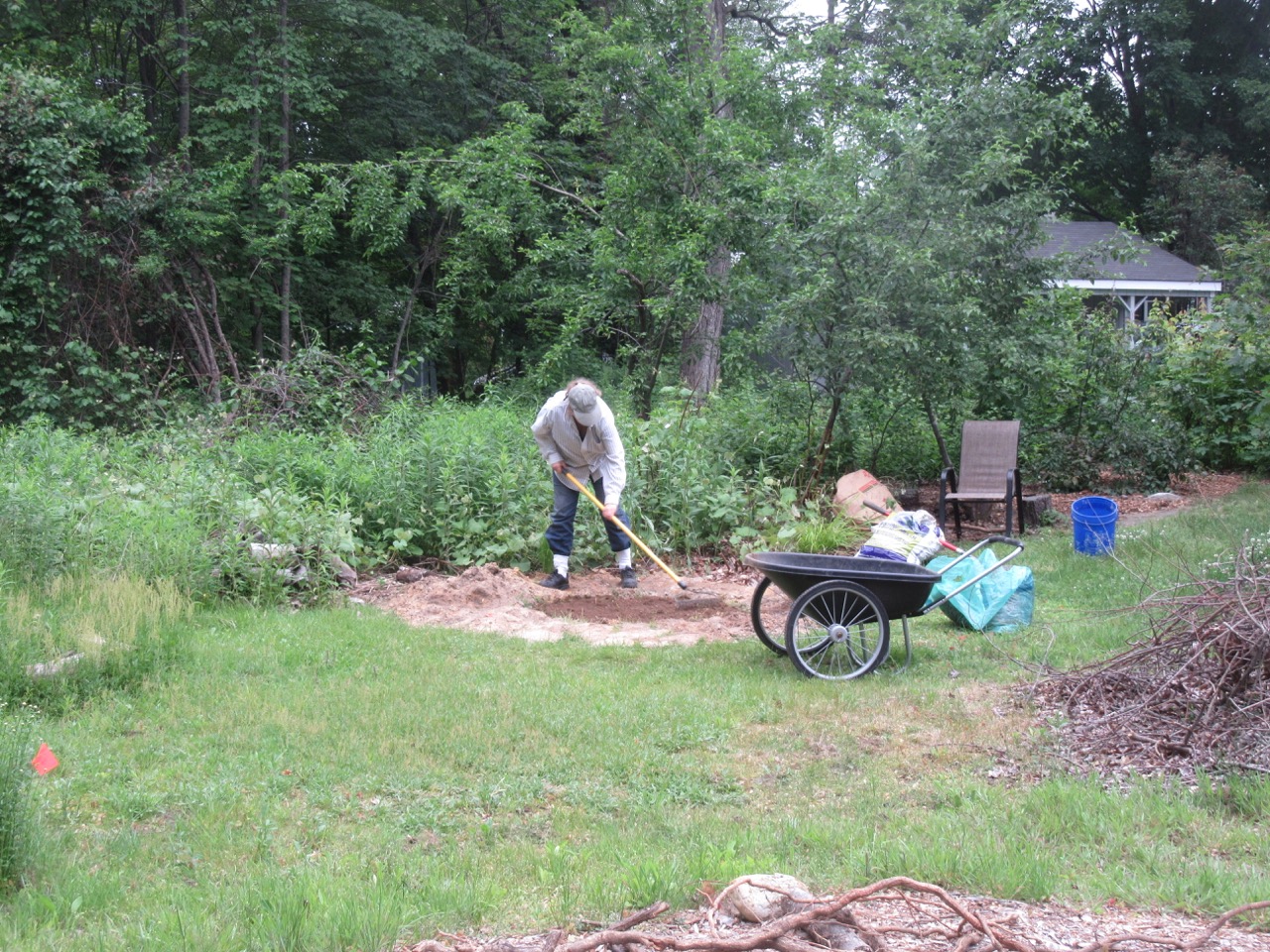
Wow! It feels like spring is finally here. Last week was a flurry of activity in our yard, and I had the energy to do it! And it was warm and sunny! We had a timeline. On Tuesday, all day I was sifting the remains of the old compost pile, and putting it everywhere–in the new raised bed, on the hugelkultur mound, the asparagus beds, under many of the fruit trees, the old potato patch, and an area near the baby apple trees in which I hope to plant zucchini this year. We have had to sift the compost because roots had worked their way into the pile from the edges, including invasive bittersweet which we do not want to spread around the garden.

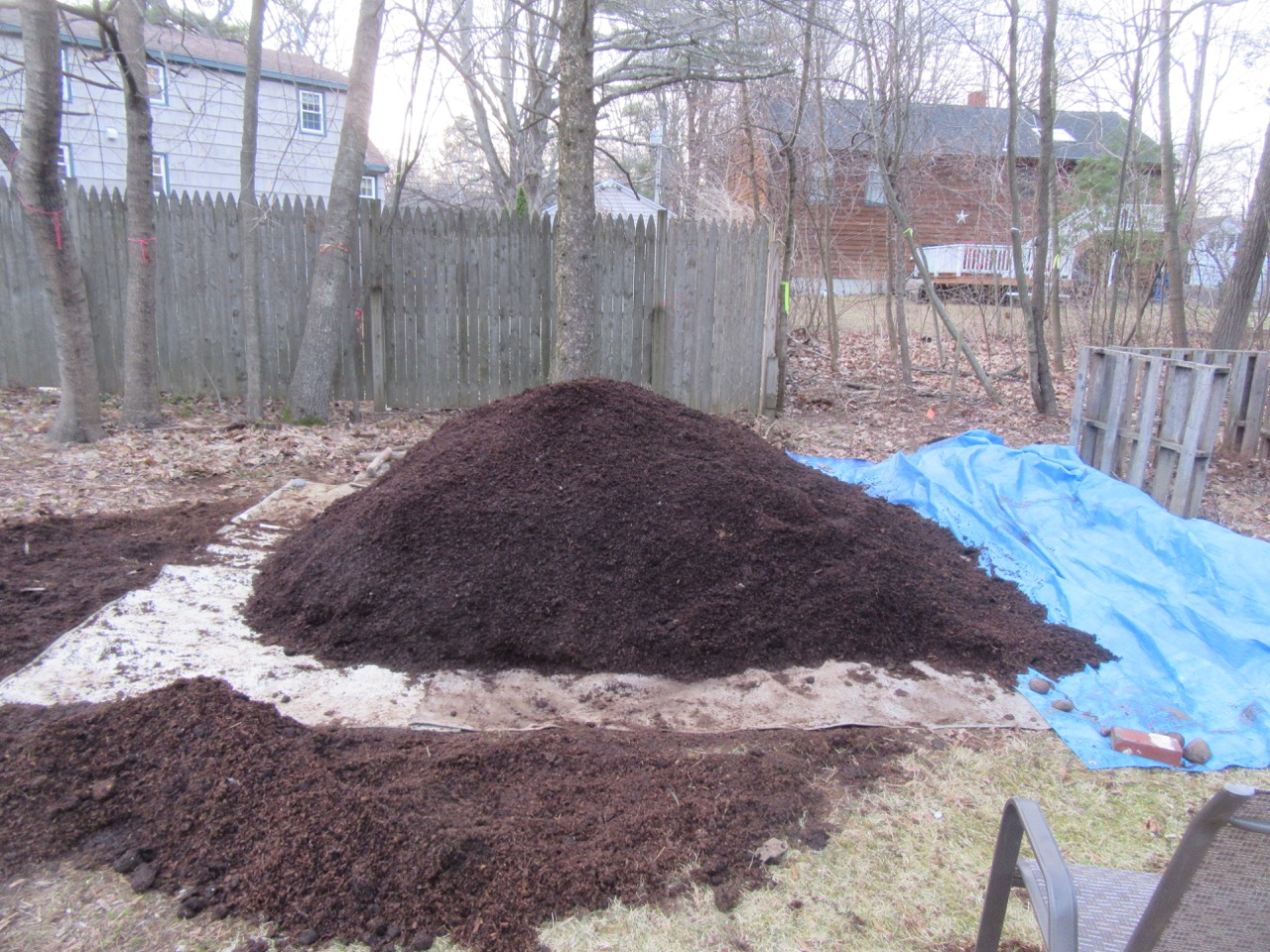
The goal was to completely empty the pile, because on Wednesday we were getting a new four cubic yards of composted manure from Wilshore farm. So I finished up Wednesday morning, and Wednesday afternoon we got our delivery. Then Margy and I were using shovels and rakes the rest of the day to slightly move that pile so it was all situated on top of old carpet, with at least a foot of clearance around the edges–so no more roots.

Composted manure on old carpet.

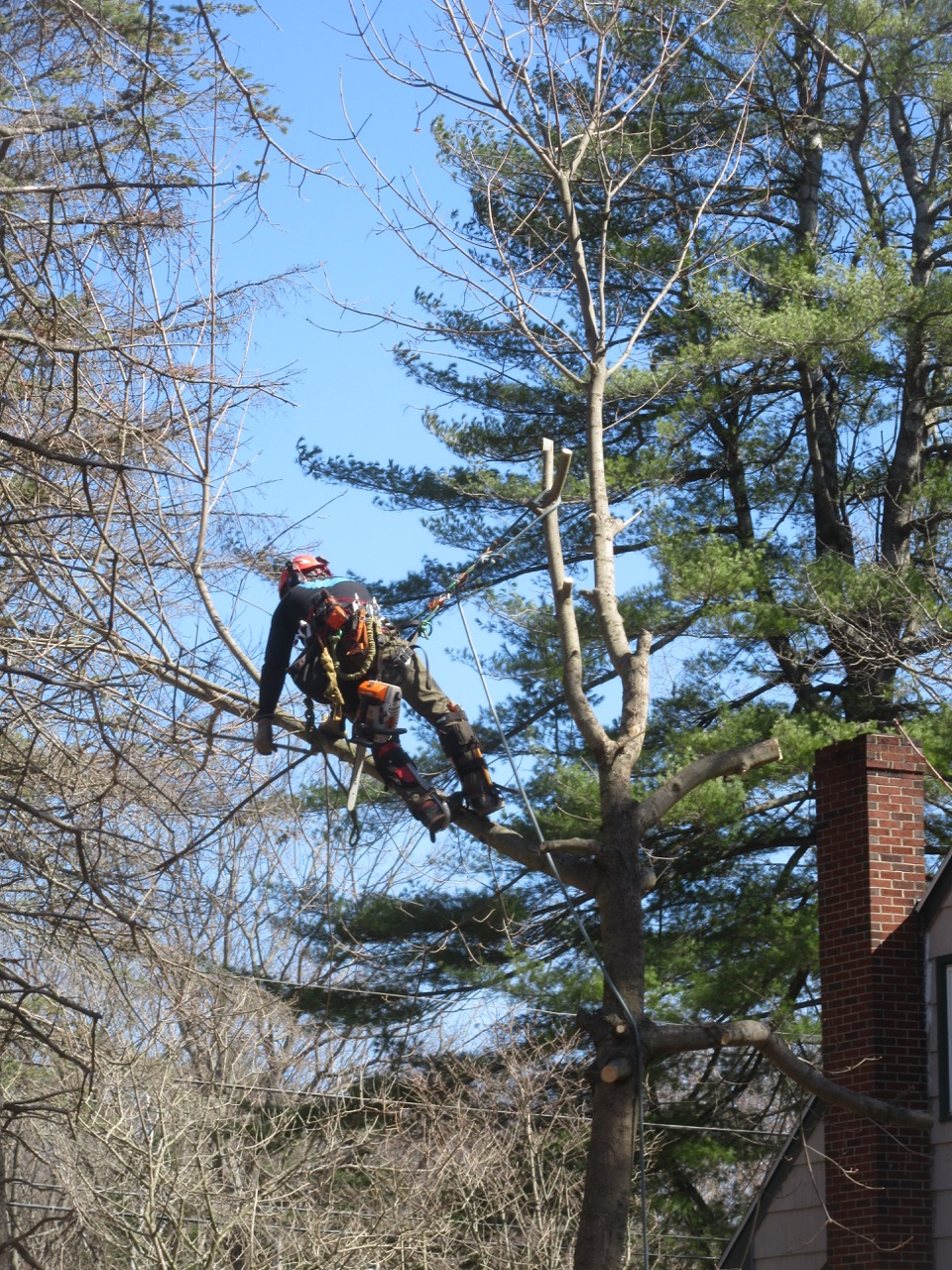
On Thursday morning, I finished up with what was on the edges, and spread the remains over the nearby grassy areas. On Thursday afternoon, Dan from Blue Ox Tree Service was coming to cut down three Norway maples along the fence between us and our neighbors. While we hate to cut down trees, we also have been trying to remove invasive plants, and Norway maples are invasive here. They grow like crazy and spread their seeds everywhere. Both Margy and I each had a moment with those trees earlier, to apologize for needing to cut them down, and thanking them for the shade they had given, and say goodbye. We let them know that their wood would stay in our yard to benefit the other trees in the garden.

Dan up in the Norway Maple

It was amazing to watch Dan climb the trees and with a system of ropes and pulleys balance himself on the tree, and cut it from within. We really like Dan, who has delivered free wood chips to our yard many times in past years. He is very tuned into permaculture, and told us he has an arrangement to deliver wood chips to Cultivating Community gardens this summer. In fact, our whole intense timeline of last week was based on the fact that he was going to leave us a pile of wood chips from the trees, and once that pile was there, a truck couldn’t get through to deliver compost where we needed it to be.

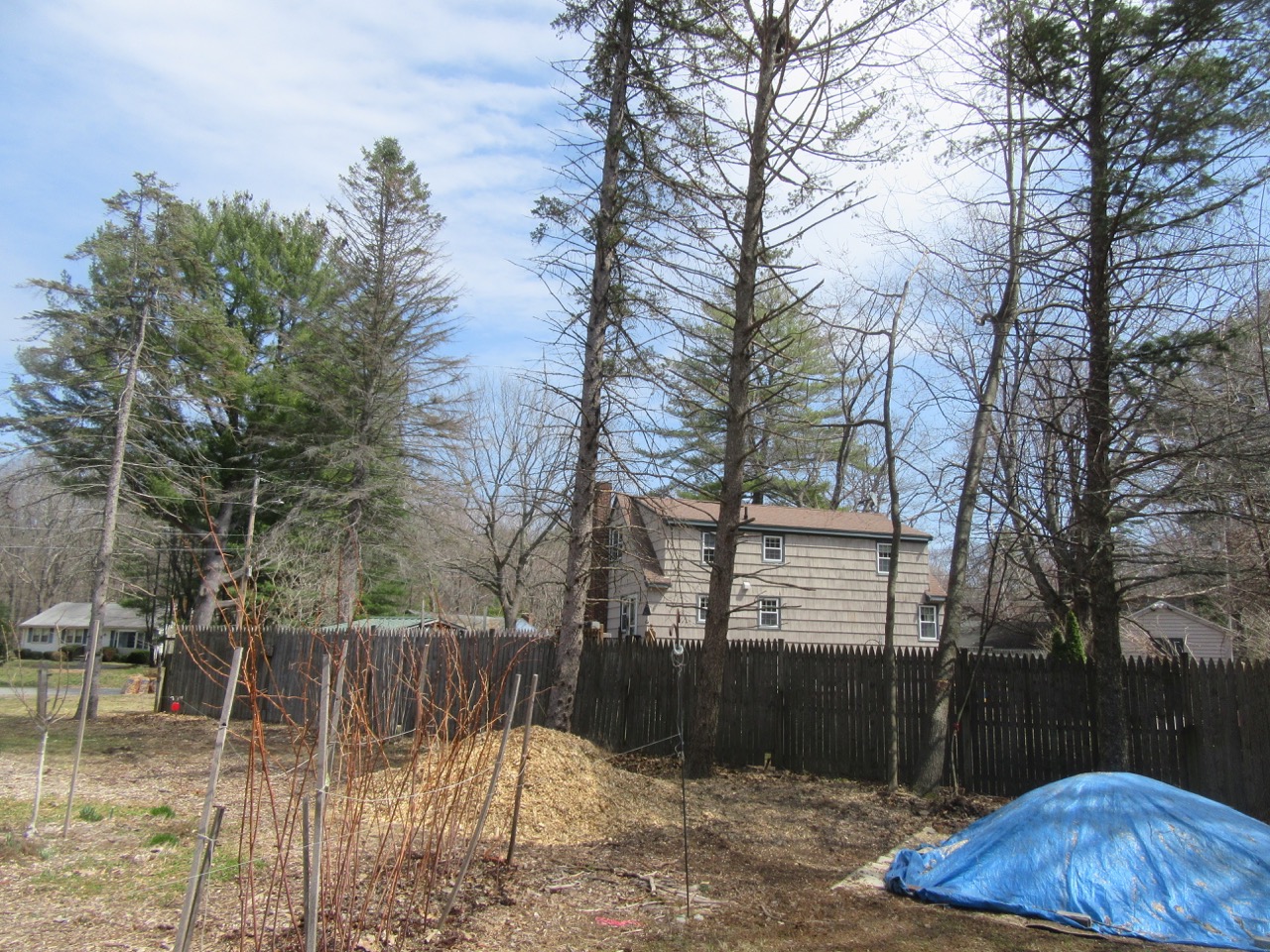
Wood chip pile on the left, compost pile on the right covered with blue tarp.

So here are our wood chip and compost piles, all set up for soil enhancement and mulching for the season. The area along the fence has opened up to offer more morning sun to the orchard–you can see four somewhat scraggy spruce trees remaining, plus a skinny red maple and oak near the right which will have more room to grow.

Now, the growing season is fully begun. I was amazed that I was able to put in so many hours of outside work each of those days–I am thinking it has something to do with the surging energy of the earth in spring, the warmth of the sun, and also with drinking iced licorice tea while I was working–a great herbal energy booster. I am remembering how exhausted I felt last fall, how much work the garden was during the long summer, and yet, spring brings new excitement and new energy, even to me with my chronic illnesses that can get in the way. May it be that way for you too!

Decolonization Lessons from Plants

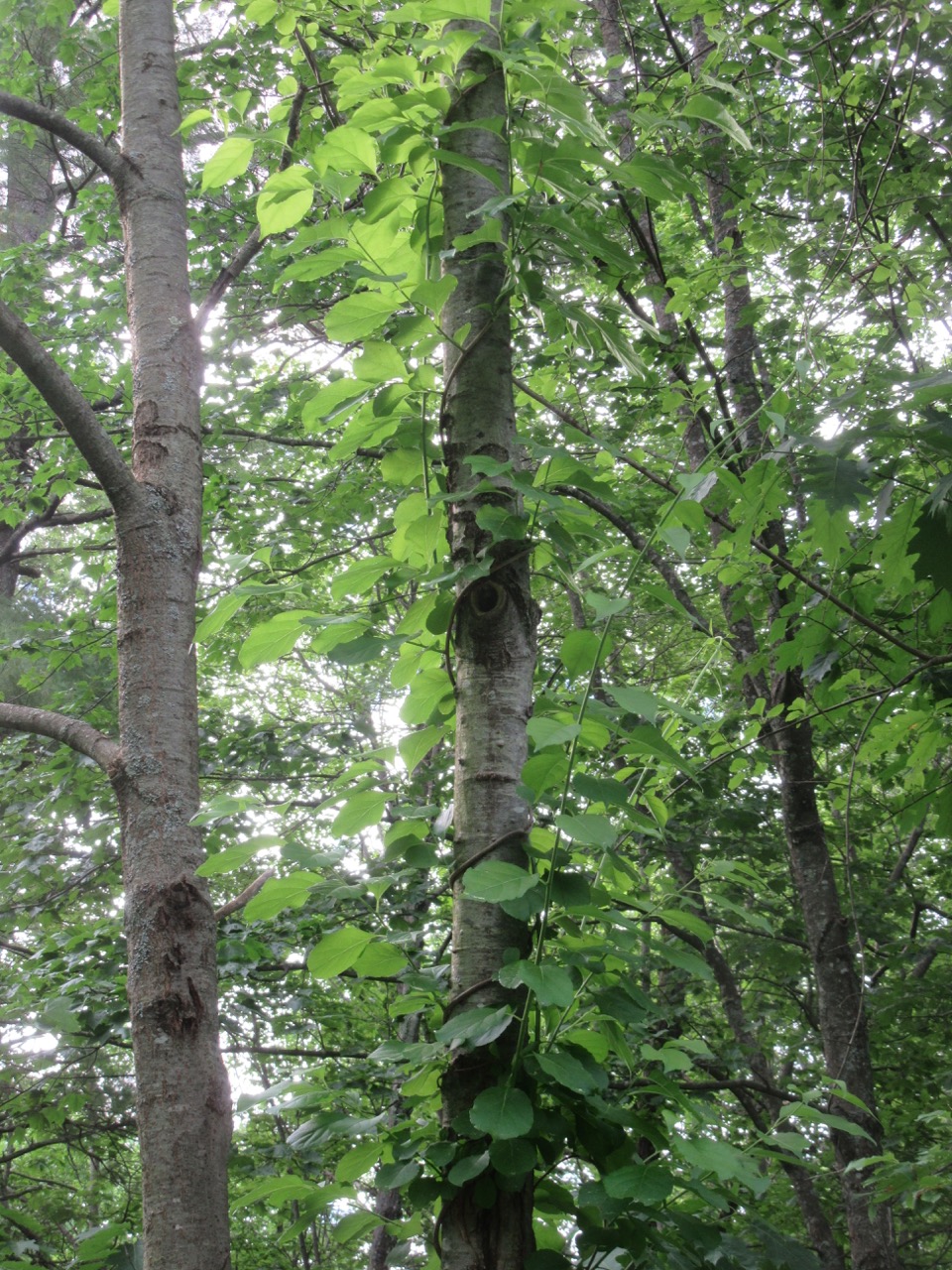
Bittersweet around a tree trunk

 Bittersweet vining around a tree trunk.

After spending a week going through soil to remove bittersweet roots, I have been thinking about invasive bittersweet as a visceral metaphor for colonization. Bittersweet comes into an area by seeds or roots, and then reaches for the sky. It vines around any support, living or dead, to keep climbing higher and higher. When its vines first wrap around a tree trunk, like in this photo, it may look green and healthy and beautiful. It may even seem to appreciate the tree on which is grows. But eventually, it can kill the tree, either by suffocating its trunk, or by the sheer weight of its leaves and branches.

Below is a photo, taken by my partner Margy Dowzer, of a huge bittersweet vine, 4-5 inches in diameter, tightly wrapped around the trunk of this tree.  It has been cut near the bottom, which is the way to stop it growing. But you can see how it has warped the trunk and become embedded in its flesh. A huge maple tree next door came crashing down after it was covered in bittersweet vines and flowers. Bittersweet will spread to a whole area, and kill other plants that are trying to grow. Bittersweet embedded in tree trunk

And this is like colonization. When Europeans first came to this land, they planted themselves in several locations and tried to grow as much as possible. They wiped out many Indigenous communities through disease and warfare. They used the lands cleared in this way to grow crops and build towns. They kept spreading out across the whole continent, bringing destruction to Native peoples and ecosystems as they took over. They imagined that their own growth and reaching for the sun was the only thing necessary and valuable, and took no notice of the harm they were causing.  And of course, it isn’t just past history, it keeps happening today. Our whole economic system is based on continual growth. “More and more and more!” might be the mantra of the colonizers and the bittersweet.

Might there be another option? There is a different sort of plant that was brought to this continent by colonizers. In fact, it was called “English-man’s foot” or “white-man’s footprint” by Indigenous peoples because it appeared wherever the settlers showed up. Its familiar name is broadleaf plantain (plantago major). It too spreads all over, and especially in disturbed soils. However, it is a humble plant, and a useful medicinal herb. Indigenous peoples soon discovered its healing properties and added it to their herbal pharmacies.

I was reminded of this a couple weeks ago when I had a bite from a black fly appear on my hand, itching like crazy. My friend Sylvia (who is an herbalist) suggested plantain. I made a poultice by chewing up some leaves and then putting that mash on the bite, letting it remain until it dried. It helped to ease the itching right away. Plantain is also good for all sorts of wound healing, stomach troubles, fevers, and is anti-inflammatory. You can eat young leaves in salads, and cook older leaves in stews. It is also useful for breaking up compacted soil, and combatting erosion.

So perhaps we who are not Indigenous to this land might learn from the plantain a new model of how to be here, in this place we now find ourselves. Perhaps we too might become humble and useful, growing only close to the ground, paying attention to healing and the easing of pain.

Plantain

Plantain

Transplanting the Mulberry Tree

One of the principles of permaculture is to observe, and then adapt.  So last year, we had planted a mulberry tree in a particular spot, but it was not doing very well, not getting enough sun. (I got fooled by the fact that it is called an understory tree–but our tall trees are at the south of our property, and this one was getting shaded by them.) So with some advice from Mihku, Margy and I found a new spot, on the other side of the back yard, and carefully measured the ten foot radius a mature tree might need. It feels like a great spot for the tree, especially since one of our goals for the tree is as a gift to the birds who might otherwise eat up our future cherries, blueberries, and peaches. This spot is next to the undeveloped land next to our yard.

Myke sorting through dirt

Sifting through soil. Photo by Margy Dowzer.

But the whole project has taken days to finish!  First, we had to deal with the ever present bittersweet whose roots run through our soil from the undeveloped edges all around.  Asian bittersweet is an incredibly invasive plant that can spread by any roots, or by its seeds.  At this time of year, there are hundreds of small plants popping up out of the grass.  Margy has been the primary bittersweet warrior for our land, going round the undeveloped edges and cutting vines and freeing trees that have been almost strangled by them.  (Some were already lost.) We don’t want to use any poison, so it’s a constant process of depriving the roots of active vines, and pulling up any new shoots. (Someday, I might reflect on the parallels between invasive plants and colonization. I certainly have been thinking about it this week.)

Bittersweet roots (tiny ones)

                                                  Bittersweet roots.

In any case, because of the bittersweet, we couldn’t just dig a hole and plant the tree–we had to dig a much bigger hole, and pull out several huge orange roots. Then we had to sift through all the soil that we’d taken from the hole, to remove any tiny orange roots. I have been doing this for so many hours that when I close my eyes I still see tiny orange bittersweet roots. I think I could identify them by feel in the dark as well. Here is what they look like when they are tiny:

For most of our yard, I’ve tried to use a no-till sheet mulching/lasagna gardening method. This is done by layering a mix of brown and green organic matter on top of the soil. So even though we had to dig a huge hole for the mulberry tree, I used the sheet mulching method as I began to fill it.  The soil was pretty barren and sandy below the top few inches, so adding organic matter would help to enrich it.  I used layers of soil, compost, dried grass, seaweed, coffee chaff, and included the broken up grasses from the sod I’d removed from the top.  Here is the hole after some layers had already been added.

Mulberry transplanting hole

The hole beginning to be filled with layers.

Myke layering the mulberry bed

Raking in another layer of soil. Photo by Margy Dowzer.

For the past week, I’ve put in a few hours each day alternately sifting soil from around the edges of the hole, adding the soil to the hole, or adding other layers of compost, dried grass, or seaweed. Margy took turns sifting soil as well. Some days it seemed like it would never be completed.

Finally, today, the last soil was sifted, and the hole was transformed into a mound. I dug a smaller hole in the center of it, and gently moved the small tree, still in dormancy from the winter.  (Last year it didn’t wake up until the end of June, so we were trying to finish before it woke up.) I tucked it in with water and more soil and more water.

Mulberry transplant

Mulberry tree transplanted!

To finish it off, I covered the mound with thick layers of newspaper (to prevent weed growth), and then wood chip mulch.  We were expecting rain in the afternoon today, and tomorrow.  It’s good weather for a big move. I offered a blessing to encourage the small tree to prosper in its new sunnier location, near the crabapple tree and the blueberry bushes. May it be so!

Myke adding wood chips to mulberry

Adding wood chips to mound. Photo by Margy Dowzer.

Bittersweet Basket Weaving

Bittersweet Ugly Basket

My first “ugly” bittersweet basket.

What does it mean to make a relationship with parts of the natural world that we ordinarily think of as trouble?  I am wrestling with this question as we wrestle with the bittersweet vines that surround our yard.  Asian Bittersweet is classified as an invasive species, because it takes over an area and can wipe out other species.  It is very hard to get rid of it.  This has provoked some places, including Falmouth, Maine, to plan to use horrible pesticides in its eradication–which seems to me an even worse problem–and a never ending one, because they admit that they won’t be able to ever completely eradicate it.

Some folks are taking a different approach however.  Yesterday, Margy and I attended a workshop led by Zack De La Rouda about weaving baskets with bittersweet vines.  I loved  Zack’s attitude–since we brought this plant here, then we need to find ways to deal with the consequences.  And with climate change and other pests threatening species like ash and willow, which have traditionally been used for baskets, we need to keep looking for options.  So he brought us into his experiments with making useful items with bittersweet. Which, as he said, is everywhere. The vines had been cut, dried, and then soaked in water for a couple days. I have to say it was not an easy material to work with–hard to bend and shape, at least for a beginner.  But Zack assured us that everyone has an ugly basket–when our first attempts to learn the skills result in less than usable outcomes.  So I took a pic of my ugly basket.

Another presentation in April got me started on this question.  Tao Orion, author of Beyond the War on Invasive Species: A Permaculture Approach to Ecosystem Restoration spoke at the Resilience Hub.  We might think of getting rid of invasives as important to promoting a balanced eco-system.  But what she discovered is that in the professional world of land management, what usually happens first is a complete destruction of the “invaded” area with powerful pesticides.  She helped us to look beyond “the war” and explore other options for dealing with invasives.  For example, we can look at the function invasive plants are playing in the ecosystem where they have taken root, and address imbalances in the soil and other factors that may need attention.

Bittersweet shoots

Bittersweet vine shoots.

Orion was from the west coast, and didn’t specifically address bittersweet.  Margy started cutting off huge vine stems that are surrounding other tree trunks, to try to save those trees from choking.  But the vines are so resilient.  Tiny shoots start coming up in the lawn, from root networks spread beneath the soil. Non-pesticide ways to deal with them include pulling out what you can, cutting off what you can, and ongoing cutting, to keep the roots from getting the nourishment they need.  (Even people who use pesticides have to do all that, by the way.) In the final analysis, there is no way to completely eradicate them, so you have to learn to manage them.

On the plus side, bittersweet is a remarkable example of resilience.  They propagate by seeds, by roots spreading through the soil, and can re-grow from small root segments. You’ve got to admire that multi-functionality. And birds love the seeds in winter.  There are dozens of birds who live in the uncultivated area just west of our yard–which is overrun with bittersweet, as well as raspberries and blackberries and grape vines growing wild.

But on the other hand, I can’t help but compare it in my mind with the European peoples who invaded this continent, including my own ancestors from France and Scotland in Quebec, and my Germanic ancestors who came later–as immigrants being used to settle the west. Just like an invasive plant, the European invaders took over the landscape, wiped out other communities of people, and destroyed the balance of the eco-system.  On an even wider scale, modern human beings as a whole species have overrun our planet and are destroying our ecosystem.

So perhaps the most important lesson bittersweet might teach us is to look in the mirror, at our own invasions, and together we might learn about how to live within respectful boundaries with all of our siblings on this planet.