Does prayer work?

First of all, what does it mean to ask if prayer works? Usually, by that we mean that our appeal for help is answered in a way that we get what we need or want. But sometimes, prayer works because it connects us to the larger Mystery, and we feel the deep peace of that connection. We feel seen and understood. When that happens the specifics may start to become unimportant.

However, sometimes prayer also works on a very practical level. To take away pain, to heal, to find something we need. Once, I placed my hands on the head of my friend, and her headache disappeared. I was curious. Why does that happen sometimes and not other times? Are there ways to pray that make prayer more likely to work?

When I look back at my experience, I see that there have been certain qualities that were often a part of such prayer with tangible results. The most powerful prayers in my life included the experience of becoming aware of the deep desires and yearnings in my heart. I would even say that desire or yearning or felt need are the root of the power in prayer, the source of its energy.

It may take a great deal of introspection to know what we truly desire. Some of us have learned to pay so much attention to the needs and desires of others, that we don’t know how to imagine our own. Or we have been misled by advertising, which manipulates our desires toward the pursuit of consumer products and stuff. Some of us may feel we don’t deserve what we desire. Others of us may have felt that religion asked us to give up our own desires. But I believe our deep desires come from a sacred place. We are all sacred beings and worthy of receiving good things from this world. In prayer, we must welcome our true desire, our yearning, our need.

Drawing by Benjamin Crowell, Creative Commons

Drawing by Benjamin Crowell, Creative Commons

And then, in these most powerful prayers, comes the experience of sending that yearning or that desire out into the universe. I imagine it like shooting an arrow from a bow. A big part of shooting an arrow is letting go of the arrow. Letting go of our desire does not mean abandoning it, or giving up on it. Letting go means not clinging to the need. An arrow can’t reach its mark if we hang on to it. We must trust that if we send out the arrow, it will have an effect.

Prayer is not the same thing as worry. Worry is a kind of hanging on, imagining the worst future, rather than being open to the possibility of something good. We are finding a balance between feeling our desire, and letting it go into the universe as it will. So we send it out and let go.

All desire, all need, all prayer, has a risk attached to it. If we let ourselves feel desire, we risk the pain of its not being fulfilled. That becomes easier when we understand that our desire is holy whether it is fulfilled or not. Desire is only unholy if it harms other people, or disregards their freedom. We must hold a deep respect for all beings. Prayer is not coercive. For example, if a person is romantically attracted to someone, they can honor that desire as holy. But they can’t force the other person to be attracted back. Letting go of the arrow honors the powers beyond us, as well as the powers within us. We are joining forces with the universe, not trying to force the universe to do our bidding.

Sending out the arrow is a symbol of asking for help from the larger reality. Here again, the arrow is just an image. There might be other images to help make it real. We can send forth our desire into the hands of God, or imagine it being received by an all-encompassing Love. We may imagine it entering like one small channel into a great river of life. We can also send forth our prayers into the care of our friends. We can tell other people what we desire and need. When we join our power with the power of others, it grows stronger.

New Ways to Think About Prayer

Larry Dossey is a physician who attempted to study prayer scientifically. He challenged the way we have been taught to think about prayer and God. He said people think of sending prayers “up there,” as if God were a spiritual communications satellite, granting or denying requests at whim. He felt the studies seem to point, not to the arbitrary power of that kind of God, but to some inherent power in the human being, something that linked us together beyond the limits of space and time.

That also helps with a problem raised by Episcopal Bishop John Spong. He asked, “Should prayer work?” When his wife had cancer, thousands of people prayed for her, since he was a well known bishop. She did live longer than expected, but he began to be troubled by the implications of it being due to all the prayers. Would this mean that God cared more to relieve the suffering of those who were lucky enough to be well connected? Suppose there were a poor sanitation worker, whose wife wasn’t high profile, or well-connected. Wouldn’t it be a capricious God who would treat her differently, according to worldly standards of human importance? It didn’t fit the kind of God in which he wanted to believe.

Perhaps we can let go of that idea of a God granting or denying requests at whim. If prayer is a way of opening up a connection to the larger whole, then it means that our energies are tuning in to larger energies, and we can be influenced by those energies, and also influence the energy of that whole, in subtle and significant ways. Rupert Sheldrake put it in terms of scientific field theory. Prayer could be understood as an activation of our energy within a larger field of energy, similar to how magnets exert an influence within a magnetic field.

Now, that is all very intellectually stated—but the experience is felt more in the heart. So it helps to be able to imagine the larger Mystery in some tangible form. We just need to be aware of the kind of image we choose. A capricious granter or denier of favors may leave us feeling betrayed and hurt. But other images feel more true to a transforming power of kindness.

We may imagine the Mystery as a God full of unconditional love, or imagine the power of the bountiful Earth. We might envision Jesus who fed the crowds, or a vast River of Life, or a great web of connection. Images are the best way to focus and direct energy. Our minds might be hesitant about such images, or think of them as childish. But I find I can understand with my mind that these images are images–symbols, metaphors–and yet assent with my heart to engage in a relationship to the Mystery through them. What images help you to engage in prayer?

Prayer is a kind of paying attention, a doorway, a silence. A recognition of smallness and largeness. Prayer creates a relationship between our individual self and the universe. Or rather, prayer creates an awareness of that relationship which already exists. Prayer opens up our experience of divine power manifesting within us. Right in the midst of our utter helplessness, we discover a limitless energy beyond our own personal effort.

Sunset Crescent MJ DSC09460

The thoughts from Bishop Spong were from an article in IONS (Institute of Noetic Sciences) #51 

Have We Known the Anguish of an Unanswered Prayer?

Perhaps we fell in love with the person of our dreams, but despite our yearnings and furtive requests to a higher power, our feelings remained unrequited. Perhaps we were watching the game of our favorite sports team—but they lost despite the collective energy of millions of fans. I know that may seem trivial, but a huge number of people pray for their teams to win. Perhaps we were confronted with the serious illness of a loved one, yet all our begging and bargains with God did not make them well. When I think about prayer it is hard not to remember that anguish.

And yet, for me, there are also other memories. There have been times when, to my surprise, strange and wonderful things happened after prayers. As if, despite my appeals, I never really expected a response.

Several years ago, my youngest brother in Michigan was getting married. I am the oldest of nine siblings, and we are scattered across the country. It is rare for my family to be gathered all together. At that time, our finances were very tight, but I really hoped that Margy and I could attend the wedding, since she hadn’t had a chance to meet most of my family yet. But then we found out that two tickets would cost $850. We knew we couldn’t afford that. So I prayed; and I also called my dad and asked him to pray. (No, he did not send us the tickets.) The very next morning, an email came, announcing special bargain fares from Southwest Airlines. The two of us could go for a total of $325.

Perhaps you may have had similar unexplainable experiences. A friend of mine just recently told me a story. She was having a particularly difficult night, with chronic pain that flared up keeping her from being able to sleep. She had never done this before, but for some reason, she reached out and prayed for help with the pain. And then, suddenly, all the pain went away. She was completely pain free for the first time in weeks. She was able to rest, and fell asleep in a deep peace. This prayer did not take away the pain for good. But it did remove it during several hours that night.

We pray when we face a challenge that feels bigger than we are. Praying is a way to appeal to the larger Mystery of the universe, the force for kindness or benevolence, to aid us in our smallness, our vulnerability.

All of this implies that there is something or someone to whom we are reaching out for help. Do we need to believe in God to pray? The answer is not as simple as yes or no.  I define spirituality as our experience of connection to the larger Mystery of which we are a part. We don’t have to understand God in a literal way. In fact it might be better understood metaphorically.

I am thinking of it like a flow of water. If we dive into and relax in a large body of water, we can float; we can also choose to draw water into our bodies by drinking, we can shape water, use it to cause change, create something with it. Prayer is like that. We connect to the larger reality through some kind of opening up or diving in. And if our connection to the larger reality is real, it is not merely an experience like going to the movies, where we can watch but not participate. Our connection creates transformation for our lives.

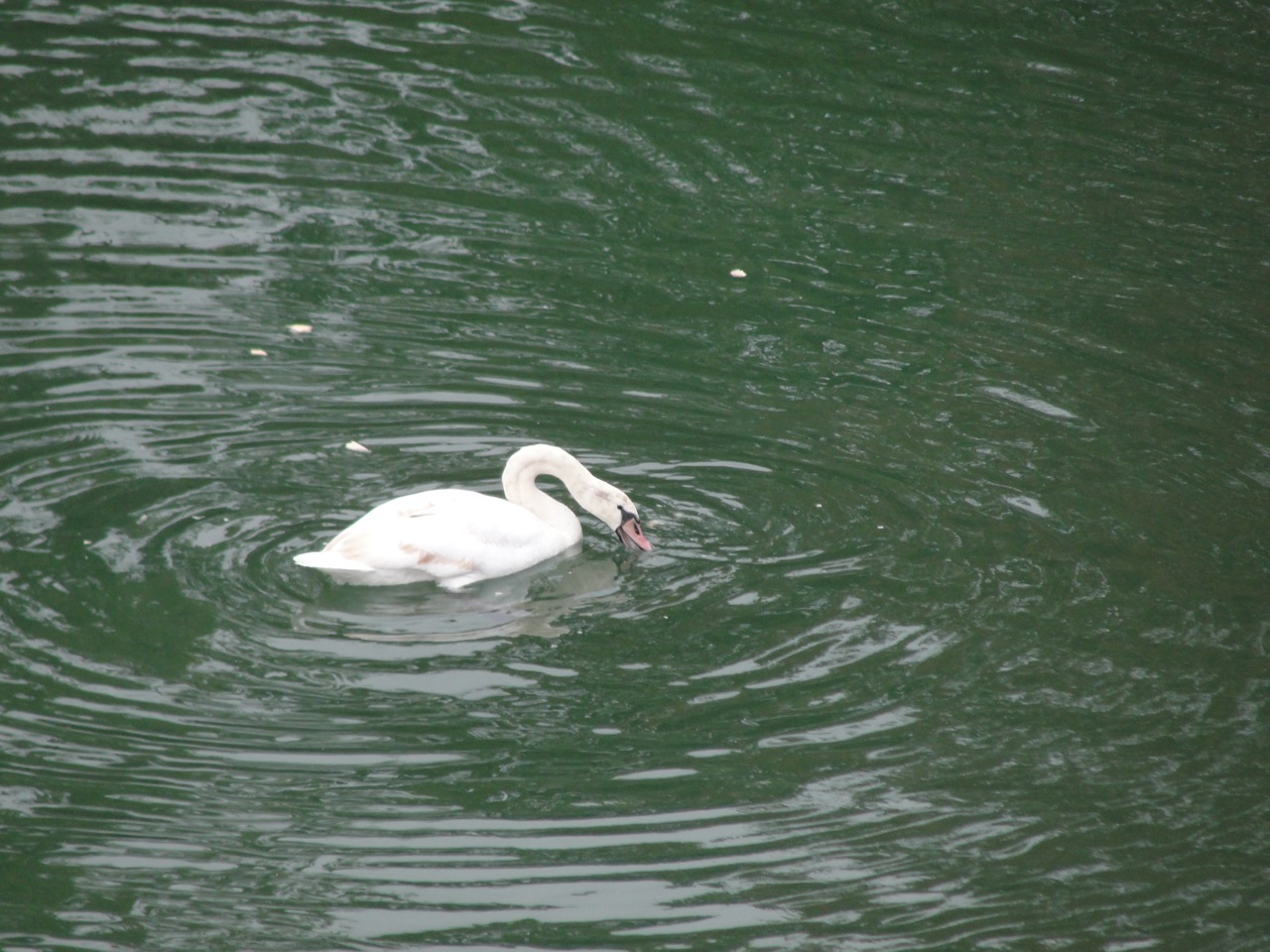
Swan in water MJ DSC09904

Prayer Links our Smallness to the Larger Kindness

You can only pray what’s in your heart
so if your heart is being ripped from your chest
pray the tearing
if your heart is full of bitterness
pray it to the last dreg…
pray your heart into the great quiet hands that can hold it
like the small bird it is.
                                          Elizabeth Cunningham

Photo by Margy Dowzer

Photo by Margy Dowzer

The spiritual journey brings us into experience of our connection to the larger Mystery of which we are a part. But spirituality is not only about something we experience, something we receive with awe and gratitude. Spirituality is also about the power we hold to shape, to create, to cause change in the larger whole. Sometimes this power has been called prayer. I have also heard it called magic. But we don’t usually think of prayer as a power we hold. We usually think of prayer when we feel powerless, when we feel our need.

Why do we pray when we are in need? During our day to day lives, many of us often feel a sense of control over our lives, a sense that we are making choices, and things can be expected to turn out based on our work and our effort. But when things go wrong—when someone we love is ill, or we lose a job, or we face death, or a child is in trouble—we are confronted with our limits as human beings, we are face to face with our utter vulnerability. Think about the saddest or scariest or most difficult moments of our lives. In those difficult moments, we feel our smallness in this world.

Prayer is an appeal to the kindness in the universe, to the mysterious power of goodness and blessing that some call God. Prayer is a reaching out from that place of smallness to the larger reality in which we find ourselves. When we were very small, when we were children, we needed the help of someone larger than us. We relied on our parents or other caregivers for everything—our food, our shelter, our learning, our basic needs. That may have been a blessed experience or a painful one. And growing up in any situation, we feel a pull to become independent, to be able to do things for our selves.

As adults we are working out a balance: between giving and receiving, between helping others and getting help when we need it. But for many of us asking for help is difficult. Probably because we don’t really like to experience our vulnerability, our smallness. Possibly because we’ve had the experience of asking for help and not receiving it. In some settings in our world, to show our weakness might mean to be taken advantage of.

Prayer has this baggage attached to it. It requires that we face our vulnerability, and be willing to ask for help. Prayer is like letting go into a kind of floating—a hope that if we are in over our heads, the ocean will hold us up, rather than swallow us. Prayer opens a link from our smallness to the larger kindness in the universe.  The Sufi poet Rumi said,

Don’t do daily prayers like a bird pecking,
moving its head up and down.
Prayer is an egg.
Hatch out the total helplessness inside.

Fractals Teach Us That We Matter

Oak MJ DSC03499There is another reason why fractals matter. Fractals teach us that we matter. By becoming aware of the fractal patterns throughout the natural world, we can see that all things are connected. The circulatory system of the human body branches out like the limbs on a tree. The patterns of waves on the shoreline are similar to the patterns of radio waves beaming through space. Even though we are infinitely small in comparison with the rest of the universe, what happens on a small scale reflects what is happening on a larger scale.

Some of these patterns may seem to be unchanging and eternal, but there is also unpredictability in the system. Scientists use the word chaos to describe this unpredictable behavior. Without chaos, there could be no creativity, because creativity means the emergence of something new and unpredicted.

Perhaps you may have heard of the “butterfly effect.” This phrase was used by Edward Lorenz to describe the impossibility of predicting the weather, despite creating complex computer models that looked at multiple variables. Lorenz found that a small change in the initial conditions would produce large changes when the patterned cycles repeated many times. It was expressed in metaphor as the butterfly effect: a butterfly flapping its wings in South America can change the weather in Maine.

We have creative power as human beings. That means that what we do within our patterns has an effect on the rest of the fractal network. We are part of an interdependent web of all that exists. If we change a pattern in our lives, it reverberates through the rest of the web; it ripples out like a stone thrown into a pond. We have the power to create more beauty, more love, more truth, and more goodness in the web. We never really know what greater effect we will have on the future of the universe. We cannot control the ripples that flow out. But human beings for centuries have observed that acts of kindness multiply into more kindness in the world.

There is a fable told by the ancient Greek storyteller Aesop:

A sleeping lion was awakened one morning by a mouse running over his face. The lion became so angry that he grabbed the little mouse in his paws and was about to eat him up. The terrified mouse begged for his life. “Please let me go,” he cried. “If you do, one day I will repay you for your kindness.” The idea of such an insignificant little creature ever being able to do anything for him amused the lion so much that he laughed out loud and good humouredly let the mouse go.

Then, one day the lion got caught in a snare set by a hunter and was unable to get himself free. The mouse heard and recognized the lion’s angry roars and ran to the spot where he was. He went right to work gnawing at the ropes with his teeth. Soon the lion was set free. “You laughed at me when I promised to repay you. But now you see that even a little mouse can help a lion.” So remember: no act of kindness, however small, is ever wasted.

What we do matters. No matter how small we are, we are intimately connected to the vast universe. We are part of its beauty and its creativity and its love. The patterns in the stars live in the patterns of our hearts. We do not walk alone. These are the lessons I learn from the beautiful geometry brought into the world by Benoit Mandelbrot. May these fractal mysteries teach us ever to be mindful of our power.

What If God Is a Fractal?

What if God is a fractal? What if God is a pattern that repeats itself from the infinitely large to the infinitely small, a pattern of life and love and creativity?

Human beings have always used images to help us understand the mysterious. Some images of God are like bigger versions of human beings—the Nicene Creed says “I believe in God, the father almighty.” God has often been seen as a father, a king, a ruler, a judge, or a lord.

But when our understanding of the universe grows more complex than these images, some have been tempted to give up on the idea of God. For many people, it doesn’t make any literal sense to imagine a huge king up in the sky somewhere. And if our experience of these authority figures has been difficult, their images are more likely to inspire fear and guilt rather than help us live our lives.

Ferns Full grown DSC05279If I imagine God as a fractal–a self-similar pattern both infinitely large and infinitely small–it helps me to be a whole person—to bring together my reasoning and my heart and my spirit.  It helps my mind to fathom the larger Mystery, as well as to understand the link to that Mystery I feel within my heart.

I am reminded that it is not a new thing to compare God to a geometric shape. The Christian tradition has used the triangle to describe God as trinity. But while the triangle is a static, simple, and smooth figure, a fractal has multiple dimensions, and infinitely complex variations and expressions. That fits my understanding of spirituality—I believe that there are infinite variations in the ways we can experience the holy. As the Sufi poet Rumi has said, “There are hundreds of ways to kneel and kiss the ground.”

There are other metaphors and images of fractal patterns that can expand our idea of God. For example, each cell of the human body contains the DNA pattern that shapes the whole body. If we use our imagination, we might say that human beings are like a single cell in the larger body of the universe and God is like the DNA within each cell, shaping it into its unique being.

Spirituality is a way of connecting our small selves to the mystery and grandeur of the larger whole of which we are a part.  If the larger whole is a fractal pattern, then in some deeply important way, we are already connected by the very pattern itself.

How Can a Mystery as Large as the Universe Connect to a Being Like Me?

Hubble Image of Spiral Galaxy

Hubble Image of Spiral Galaxy

Another reason that fractals matter, and why I want to explore them, has to do with a very old spiritual quandary. Human beings have long imagined the possibility of an infinite being, a divine being, who is creator and sustainer of the universe, commonly known in our culture as God. Not all human beings resonate with this idea, and the details vary as to what God might be like, but most peoples have some sort of divine being or beings as a part of the stories and values of their culture. I have spoken of God as the larger Mystery of which we are a part.

Many human beings have also imagined that they can have a personal relationship with this divine Mystery. Most cultures have forms of prayer to entreat help from God, and forms of prayer to thank God for help given. Many people also directly experience the presence of the divine in their hearts, the intimate presence of the Mystery.

I know that I have had moments in my life when I felt held in the arms of divine love, that I felt cared for by a Mystery greater than myself. Those feelings are so tangible, that they help me get through my most difficult days. When I feel afraid, I can trust that all will be well, because of that tangible presence of love. When I feel overwhelmed, I can keep on walking forward, held in the memory of that love. But if God is infinite, or if the Mystery is all that is, how can that be? How can a Mystery as large as the universe connect to a being like me, small as a speck of dust?

Fractals have given me a new way to think about this spiritual dilemma. A fractal is a pattern that repeats itself, from an infinitely large scale to an infinitely small scale. What if God is a fractal? What if God is a pattern that repeats itself from the infinitely large to the infinitely small.

Here is how I imagine it. The divine pattern is a pattern of life and love and creativity—it expresses itself in the creative unfolding of the universe. It repeats in the attractions of planets and stars, and in the evolution of life itself. Because fractals continue to repeat in self-similar ways at all scales of size, the same divine pattern emerges at the size of our own human consciousness. We can find that pattern in our hearts, the expression of life and love and creativity. Thus we can find the Mystery in our hearts, as well as in the larger whole.

In this way, fractals offer a solution to the old quandary of an infinite God relating to a tiny human being. By understanding fractals, my intellect can make sense of what my heart experiences of the Mystery. It helps me to make sense of the tender feelings I feel, and to welcome their help for the troubles that life brings. I feel less lonely, when I feel connected to the divine love. It becomes possible to believe that I matter, that I am not just a speck of dust in a vast uncaring universe. I have within me the fractal beauty of the infinite MysteryFerns More DSC03600

Fractals In the Forest

A fractal is a pattern that repeats itself, from an infinitely small scale to an infinitely large scale. We see in the patterns and shapes of nature that there is self-similarity at all levels.

This has both practical and mystical applications. I learned about one practical application from a documentary called Hunting the Hidden Dimension. A group of scientists concerned about global warming was trying to determine how much carbon dioxide was absorbed by trees in the rain forest. They could measure the carbon capture of a single leaf, but how could they count the number of leaves in the forest?

They had an idea. They started by measuring the circumference of all of the branches on a single tree. Because of the fractal nature of the tree, the branches form a regular pattern, dividing at certain intervals into smaller and smaller branches. By measuring every branch, they could determine the ratio between branch sizes. Then they took it one step further. They measured the trunks of all of the trees within a given area.

Imagine it with me if you will. If we walk through a forest we see trees of all sizes—small saplings, huge old giants—there is an endless variety of sizes all around us, seemingly in a random pattern.

Trees MJ DSC03686But it turns out it is not so random. The ratio of tree sizes in an area of forest is approximately the same as the ratio of branch sizes on a single tree. There is a pattern to it. And by learning the patterns, the scientists could compute how many leaves were in the forest, and how much carbon dioxide they would absorb.

Now when I walk through the forest near my home, I remember this experiment, and look with wonder at the trees around me. What seemed chaotic and random before, is now bursting with new meaning, full of patterns that start to reveal themselves to me, as I gaze with deeper insight. My experience of the trees’ beauty expands, and I feel a growing sense of awe.

I find myself looking for fractal patterns everywhere. This new understanding has changed the way I see the world. And it is not only visual. I can feel the patterns in bark with my fingertips, and I start to listen for patterns in the sounds I hear as well. Next time you look at a spider’s web, or gaze into the clouds in the sky, watch for the fractal patterns.

Our ability to measure fractal patterns in the natural world has also given us the ability to create digital worlds that remind us of our own. Fractal formulas are used to generate computer graphics that look realistically like mountain ranges, and rivers, and forests, and clouds. That wasn’t possible just a few decades ago.

Fractals have been used to design antennas in greatly reduced sizes, which enabled the creation of the next generation of cell phones and other electronic communicators. Fractal geometry is enlarging our ability to create new devices that work better, because they follow patterns that resonate with the natural patterns around us.

Why Fractals Matter-Reading the Book of the Universe

Why should fractal geometry matter to those of us who are not mathematicians? First of all, fractals give human beings a new way to look at the universe. When we can describe something, we can see it better than if we cannot describe it. Because we are better able to see the natural world, fractals enable us to have a deeper relationship to the natural world.

It reminds me of learning to read a book. In order to read, we need to understand the patterns of squiggly lines that form the letters of the alphabet. And then we need to understand how those squiggly lines are combined in multiple ways to form words, and then sentences, and so on. A person who cannot read may look at a book, and it might seem beautiful, or there might be pictures in it to be curious about, but that person cannot understand what it means. When we learn to read the patterns of squiggly lines, the book becomes a doorway into a whole story, and suddenly we have access to a wealth of ideas and thoughts and understandings.

The natural world is like a sacred book; it is the place where we search for truth and beauty and goodness. We might say that the universe itself is our bible. We don’t have to understand the world to appreciate its beauty. Even a baby can laugh with delight at the bright colors of flowers, or try to catch a butterfly. But the more we understand the natural world, the deeper can be our appreciation, and the more its mystery opens up to us. Fractals help us to read the book of the universe.

Fractals give us a way to measure and describe the complex patterns in the natural world. Fractal geometry, in fact, reveals to us the inherent patterning that permeates the universe. A fractal is a pattern that repeats itself, from an infinitely small scale to an infinitely large scale. Complex entities are created from simple designs extended out to many dimensions. We see in the patterns and shapes of nature that there is self-similarity at all levels. Ferns DSC05288

Fractal Spirituality-The Infinite Within Our Souls

Every
Child
Has known God,
the God who knows only four words.
And keeps repeating them, saying:
Come Dance with Me.”
Come
Dance.
                                                     Hafiz

How can a Mystery as large as the Universe find expression within the smallness of our souls? How can we tiny beings experience the Infinite? I found a new way to think about this question when I learned about fractal geometry. Fractals are never ending patterns, with self-similarity at all sizes.

Benoit Mandelbrot was the mathematician who first coined the word fractal, and brought to our attention the possibility of exploring the geometry of the natural world. Fractal comes from the word for broken, and Mandelbrot wanted to explore the rough shapes of nature. Traditional Euclidean geometry could not describe these shapes. Mandelbrot wrote: “Clouds are not spheres, mountains are not cones, coastlines are not circles, and bark is not smooth, nor does lightning travel in straight lines.” Fractal geometry enables scientists to describe the world through complex mathematical formulas.

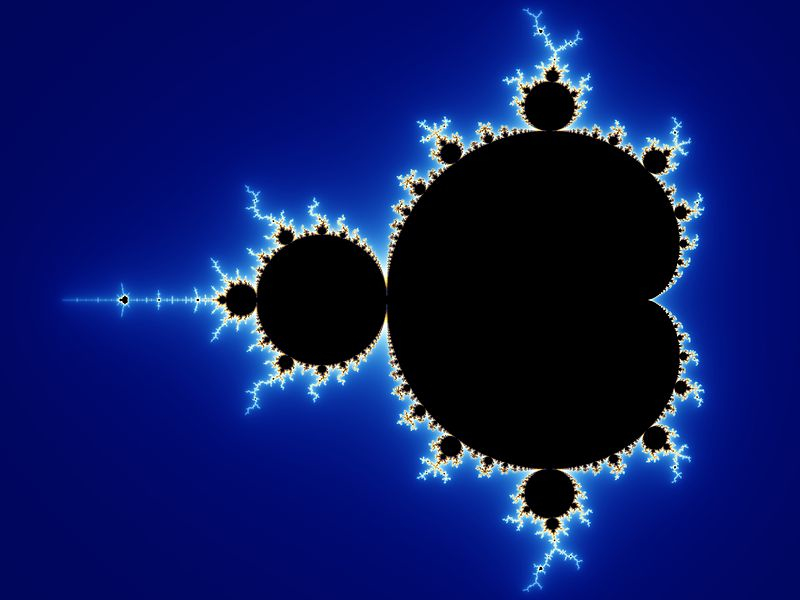
Mandelbrot Set by Wolfgang Beyer, Wikimedia Commons

Mandelbrot Set by Wolfgang Beyer, Wikimedia Commons

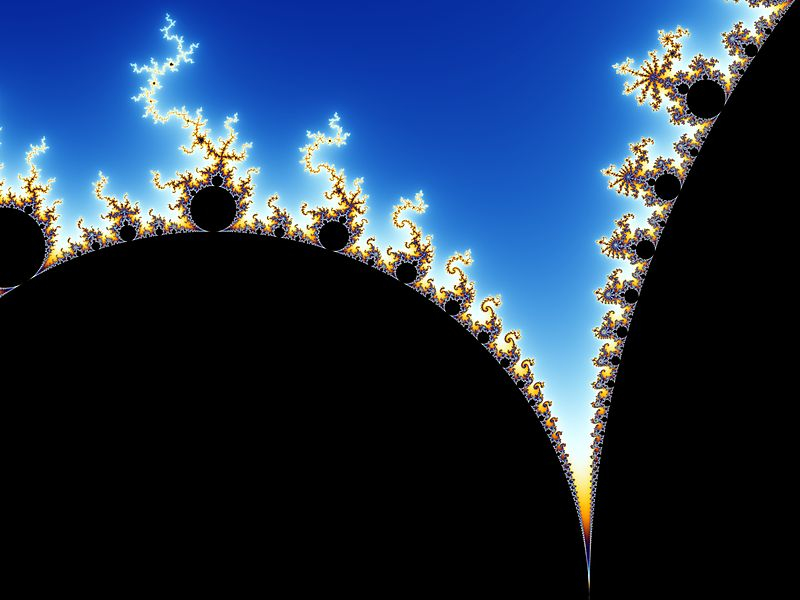
I am not a mathematician, but I was curious to see if I could make sense of the math. Perhaps you have heard of the most famous image associated with fractal geometry, what is called the Mandelbrot Set. It has a dark area that looks a bit like the shape of a bug, with a large round spot, and a small attached round spot. But the edge is what makes it fascinating. It is filled with beautiful complex curlicues that continue to be complex curlicues no matter how much the set is magnified. In fact, it continues through infinite magnification.  (For more images of magnification, see here.)

Mandelbrot Set Magnification by Wolfgang Beyer, Wikimedia Commons

Mandelbrot Set Magnification by Wolfgang Beyer, Wikimedia Commons

But “What is it?” I wondered.

If you have math anxieties, I promise you, I am only going to give a simple explanation with ten sentences. You are also welcome to skip the next paragraph.

A Mandelbrot Set is a diagram of a mathematical equation. The equation is: Z = Z2 + C. You insert a number into the equation, and the equation computes it to a new number. Then you start the equation all over again with the new number. Now here’s the interesting part—we don’t care about the answer. We care about how many times you can repeat the equation, with the number you started with. If you can repeat it only a limited amount of times, that number is part of the Mandelbrot set—and it becomes a black dot on your diagram, part of the black spot. If you could repeat it an infinite amount of times, that number is outside the Mandelbrot set. Depending on how quickly it gets to be infinite, it can be given a different color. Only computers can actually do all of these calculations, but they do them very well, and so we can see the images formed by the equation.

Okay, I’m done with the math part now. (I didn’t go into complex numbers or imaginary numbers, so my apologies to anyone who really knows about all of this. But for the rest of us, it is probably more than enough anyway.) The thing is, when Mandelbrot computed his formula, it created a picture filled with beautiful complex curlicues. And no matter how many times you magnify the picture, you will continue to see similar complex curlicues.

More tomorrow…


For those who would like more detail about the Mandelbrot Set, see the website Introduction to the Mandelbrot Set: A guide for people with little math experience by David Dewey.