“Friends of the Indian”

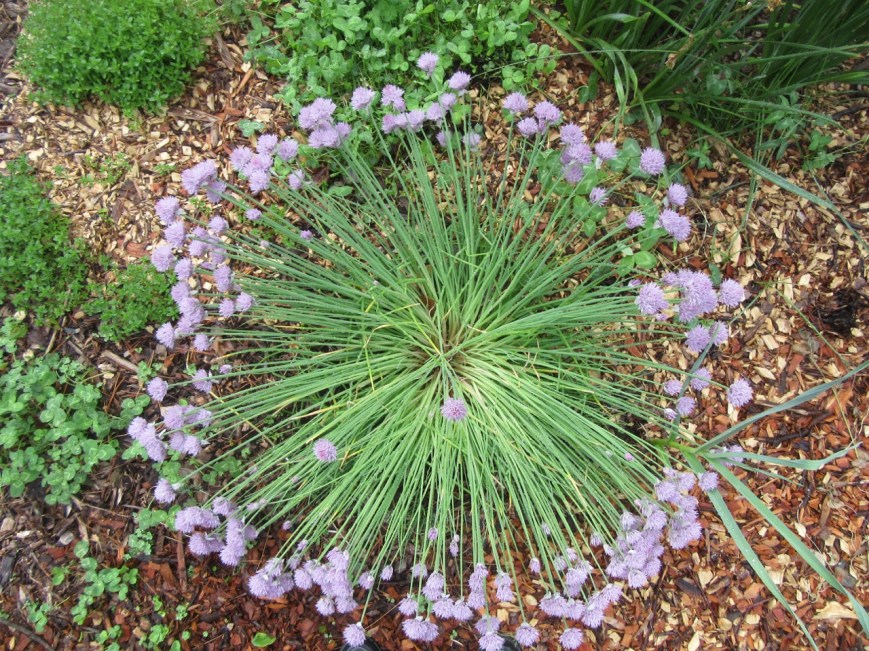
Chives after rain

Chives after the rain

Permaculture teaches us to observe the patterns in nature, and I thought of patterns when I saw this circle of chives after the last rain storm. Plants are so beautiful, especially when they bloom. Especially when they form a circle after rain.

Everything is green now. I go outside and do what I can in the garden. Inside, I finished watching the Ken Burns series The West. One of its stories has really stayed on my mind–the story of a well-meaning white woman who tried to help, but ended up causing harm to Native peoples. I think about how often that pattern has repeated itself in the last 150 years. And I wonder, how do we keep from repeating it again?

Alice Fletcher was a white upper-class feminist, one of those women that we lesbians of my generation have been so thrilled to discover–because she lived and worked with her romantic companion, Jane Gay.  Born in 1838, she went to “the best schools” and was active in the feminist and suffrage groups of New York city. Eventually she found a mentor, the director of the Peabody Museum, to study anthropology and archeology.  In 1881 she lived with and studied the Omaha Indians of Nebraska. She appreciated the culture and became close to many people there, even adopting a son, Francis La Flesche, who himself became a professional ethnologist.  She and he published a multitude of articles and books about Indigenous culture and music.

But she also came to the conclusion that Indian people needed to be brought into the mainstream life of America culture. According to PBS,

Containment had been the goal of federal Indian policy throughout much of the nineteenth century, but in 1883 a group of white church leaders, social reformers and government officials met at Mohonk Lake, New York, to chart a new, more humane course of action. Calling themselves “Friends of the Indian,” they proposed to remold Native Americans into mainstream citizens and to begin this process by re-educating the youngest generation at special Indian schools.

Alice Fletcher devoted herself to pressuring the government for the allotment policy: the breakup of tribal landholdings into individual holdings. “Friends of the Indians” thought it would be good for Native peoples to become more like their white neighbors, to farm, to own their own land individually, rather than collectively.

In 1882, the Bureau of Indian Affairs hired her to make a survey of all Indian lands for their suitability for allotment. The same year she was hired to manage the allotment of the Omahas’ lands. After the passage of the Dawes Act in 1887, which provided for the eventual breakup of all Indian reservations, she managed the allotment of the Nez Percé’s remaining lands.

But allotment failed drastically in so many ways.  First of all, it failed to honor the choices of Indigenous peoples–most of them did not want allotments but were forced into it. And ultimately, it robbed Native nations of millions of acres of their land, and undermined their cultural sovereignty as nations.

Between the passage of the Dawes Act in 1887 and its repeal under the New Deal in 1934, allotment continually deprived Indians of many of their remaining lands. The outright sale of “surplus” lands — parts of reservations left over after allotments had been assigned — and the subsequent sale of allotted lands themselves shrunk the Indian estate from about 150 million acres before the Dawes Act to 104 million acres by 1890, to 77 million by 1900, and to 48 million by 1934. By the time of its repeal, according to one study, two-thirds of the Indian population was “either completely landless or did not own enough land to make a subsistence living.”

Alice Fletcher thought she was a friend, helping, doing something good for Native peoples.  But her help caused harm.  No wonder Indigenous people are cautious about those of us who might show up eager to “help.”  Patterns.  And how do we know that what we think of as help might later be revealed to have caused harm?  Let’s ponder that question for a while.

Sea Kale blooming

The perennial sea kale in bloom smells like honey.
Pruning

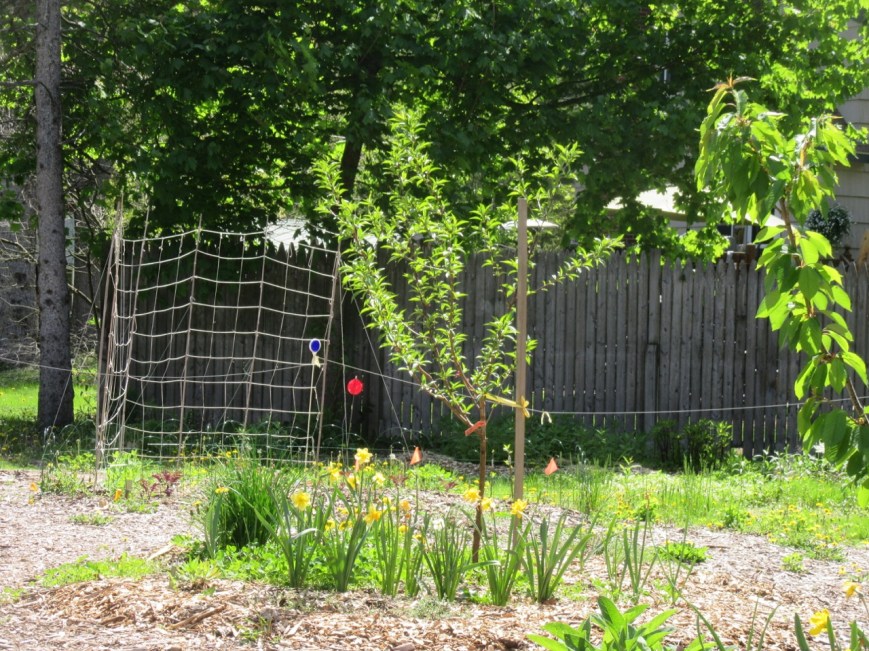
Our friend, Mihku, who is a master gardener, gave me more advice about pruning last Sunday.  We looked at all the orchard trees, and she reminded me that these first few years are all about creating a good shape for the tree, thickening up the trunk, and creating strong scaffold branches, while not letting them get too leggy or long.

So for example, here is the peach tree before pruning (on May 27th).  It looked bright and happy, and even had a few flowers, (which you can see if you zoom in). But the branches were quite long, and the tree is too young to give energy to making fruit this year.  On the right foreground of this photo, you might also notice a very leggy branch from one of our cherry trees, dividing into new shoots at its tip.

Peach tree before pruning

Peach Tree before pruning

The next day, I went back to my Holistic Orchard book to read what Michael Phillips had to say about pruning, too.  It seems I need to read it at least once a year, because in between, I forget.  There are different methods for different fruits.  Apples and cherries prefer a central leader, with several scaffold layers of branches nicely spaced out as you go up the trunk.  Peaches prefer an open vase style, in which there is no central leader, but the center is opened up to give good sunlight to the flowers and fruit.  But it is far beyond the power of any book to give what a wise friend can give–especially for gathering the courage to actually do it.  (It seems counterintuitive to do all that cutting of new branches.)

This kind of pruning at this season of the year is meant to encourage growth in the right form and direction.  Mihku suggested cutting about 1/3 off from the long branches, and once again staking the cherry branches to make a better “crotch angle” (where the branch angles from the trunk.)  They tend to grow almost straight up, and should be reaching out to form a 45-60 degree angle.  Flat cuts at the end of branches will also help them to thicken up. Header cuts on the central leader, will encourage lower branches to grow–which was especially important for the Lapins cherry, which had a big gap between lower branches and higher shoots. I was excited to see that there were some new branches starting to form at a better height.

After I did the cherries, I went to the peach, picked off the blossoms, and cut away branches that were growing inward, to favor those that were growing outward. And those that I wanted to keep got about 1/3 headed off to help them become stronger, choosing a spot just above an outward facing bud.

Peach Tree after pruning

Peach after pruning

Finally, I checked our semi-dwarf apple tree, which is still quite small, and found that there were three branch shoots reaching upward at the central leader–just like Michael Phillips suggested there would be, and I chose the strongest to be the leader, and snipped off the other two.

Pruning accomplished for the season! Thanks Mihku!

Myke & Mihku in the garden

Photo by Margy Dowzer


Splendid Strip in Progress

Last year, in an attempt to outcompete the crabgrass on the strip between the sidewalk and the street, I transplanted two dozen hardy perennials that were given to us for the digging.  (See the prior post for more details on that, and some great “before” pictures.) This spring, most of the transplants were re-emerging with abundance!  I love hardy perennials!  Time for step two.Strip 2019 1

I went back over my plant list to see what survived: Day lilies (yellow), Allium (lavender-colored), Goat’s Beard (leafy), Siberian Iris (blue), Turkish Rocket (yellow), Blue Cornflower, Heliopsis (yellow), Anise Hyssop (purple), White Ruffled Iris, Spiderwort (blue), Lady’s Mantle (yellow-green) and Astilbe (purple-pink).  The color theme as you may have noticed is blue/violet & yellow, with a few others mixed in, (and several repeated). I still hope to add even more Siberian Irises.

But in the meantime, I filled in a couple empty spots with mystery pots (Siberian Iris and/or Day Lilies), two patches of Thyme taken from an overabundant patch in the orchard, and some Lemon Balm for the tough spot closest to the driveway, still leaving room for our trash and recycling bins.  And then, I started laying down cardboard and/or folded newspaper between all the plants, and covering that with wood chips.  I’ve just made a small start at one end, but the project can keep going bit by bit.  All that hauling of wood chips takes it out of me.

I also made a small bed to try and grow a dozen Lupine flowers from seed.  I know–that wasn’t the original plan–to go to all the effort to grow seeds.  But when I was down east last weekend, they were selling the seed packets in a little cafe, and it was an impulse buy.  Lupines are the queen of Maine wildflowers. So I soaked them overnight (well, two nights actually).  I made a little soil bed between some of the other plants: first laying down a very light double layer of newspaper, then some sifted out compost from our pile, mixed with soil.  After I planted the seeds, I used straw as a light mulch over the seeds, and filled in the edges with the wood chips.  I also put a little fence around it, to protect it from unsuspecting dogs and children who might happen to wander down the sidewalk.  I feel happy to look at it.  More later.Strip 2019 Lupine bed


Resilience in Portland

Cherry Tree and companion July

[Photo of our cherry tree with its companion plants.]

I really believe that permaculture offers a way to live in this time of ecological crisis. In Portland, we have a wonderful resource for learning permaculture skills, and offering mutual aid as we learn. The Resilience Hub helps people to regenerate the land, grow healthy food, and build community.  In that way, it also cultivates hope. In June of 2017, the Resilience Hub was the sponsor of our Permablitz when over 20 people came to help us establish our garden.

Over the last ten years, the Resilience Hub has become a thriving community organization. This past summer, its founder, Lisa Fernandes, moved on into new, but related work. Lisa’s departure prompted a series of community conversations about the future of the Hub: its assets and challenges, its goals and visions. Margy and I attended many of those meetings, and I was so committed to continue this important work that I volunteered to be on the new Board of Directors. We now have new part-time staff, Kate Wallace as Executive and Programming Director and Benjamin Roehrl as Operations Director. See more about our plans going forward at the website.

BUT–the Hub is at a critical point and needs all of us who care about permaculture in Maine to show up with financial help and renewed involvement. To that end, we created a Go Fund Me campaign, and we are trying to reach our goal in the next few days.  I’ve shared it via Facebook, but thought I would add my blog “audience” to this appeal as well.  Please check out our page, and donate what you can!  And if you are local to southern Maine, sign up to be on our active members list!

We are celebrating with a potluck and party this Thursday, January 17, from 6-9 p.m. at the Hub at 224 Anderson Street in Portland. See more about the party at https://www.meetup.com/maine-permaculture/events/257165312/

One of my favorite definitions of permaculture is “revolution disguised as gardening.”  Charles Eisenstein says, (in his recent book, Climate: A New Story,) in this time of ecological degradation, perhaps the most important work we can do is to care for and regenerate the places we live in, the places we love. (More on that later!) That’s what the Resilience Hub is all about. Thank you for helping us to keep it thriving!

Innu Tea Doll

Innu Tea Doll Angela Andrew – Version 2

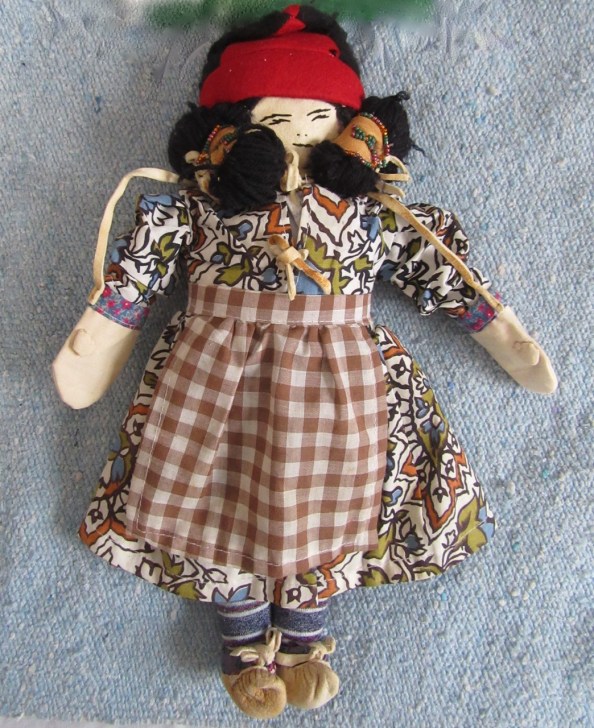
My friend Wells Staley-Mays gave me this Innu Tea Doll, knowing of my love for my distant Innu ancestors.  The story is this–when the Innu would travel to the interior of Nitassinan during winter, to hunt the caribou, they had to carry whatever they needed for the journey.  Children carried their share by bringing along a doll that was stuffed with tea leaves.  When the other stores of tea were depleted, a cut was made in the seam of the doll to remove and use the tea leaves.  The doll could be restuffed with grasses or leaves and resown.

I am reminded that the principles we find in permaculture are not new–but were often embedded in the lifeways of Indigenous peoples around the world. One such principle is “stacking functions”–creating elements of our garden (or our lives) that can fulfill more than one function at a time.  So the tea doll was both a storage container for tea, and also a toy to delight a child.  It also has had a further function more recently, to keep alive traditions of the Innu and serve as a source of income for those who sew them.

Innu Doll DetailThis doll was created by Angela Andrew, an Innu elder from the Innu Nation in what is now called Labrador. It is hard to show in photos, but the doll is made of cloth, except her face and moccasins are smoke-tanned caribou skin.  Each layer of clothing is distinct and can be taken off and on.  She has a flannel shift and long pants, with knitted socks, underneath the broadcloth dress and apron.  Her hair is black yarn, and fastened in place with beaded leather ties.  Her hat is a traditional Innu head covering. The clothes are tied with little strips of leather, and her mittens are held in place by a long leather string going behind her neck. Does anyone else remember when our mittens were held in place with a long string like that as children?

Wells and I originally met when we were working against hydrodams being built on Cree, Inuit, and Innu territorial rivers. He had the chance to travel into the bush with the Innu on a trip to Canada many years ago. So this doll is full of those memories and good feelings from our work together. Thank you Wells!

Hell Strip to Esplanade

Planting the roadside strip

Lisa & Myke at work, photo by Margy Dowzer

Last month, Margy and I were talking about the crabgrass that has overrun the lawn in so many places, including the strip between the sidewalk and the street. This strip seems to be referred to by many names–from “hell strip” to “esplanade.”  She is working on other strategies for other places, but I had the idea (after some internet research and an appreciation of what someone in our neighborhood had done to theirs) to see if hardy perennials might eventually outcompete the crabgrass and solve the problem. Then it truly would be shifting from a hell strip to an esplanade!

I started off by moving some turkish rocket from our backyard garden to the front. Turkish rocket is a fast growing perennial vegetable with beautiful yellow flowers. I had planted some last year, excited to try it, but this spring discovered that I didn’t really like the taste of the greens–they were too sharp and bitter for me.  But the flowers were amazing.  So I decided that I’d move it from the food forest to the strip.  Another friend came by and transplanted some yellow day lilies and blue cornflower that needed a new home!

I put out a call on our permaculture meet-up, and was gratified when another member, Sandi, responded by saying she had a lot of perennials that needed dividing and we could have them. That’s the thing–so many wonderful perennial flowers multiply of their own accord and expand out of the area they are originally planted.  So why not use that spreading habit to achieve a better use of the roadside space–for pollinators and for beauty. So I went out to her house and we dug up a whole bunch of plants.

That weekend, our friend Lisa was visiting, and she jumped in to help me with the transplanting effort.  And it was a big effort!  In the end, we had 24 new plants along the strip, mostly with blue or yellow flowers, which we tended to alternate.  Several patches of Siberian iris and several patches of allium; anise hyssop, heliopsis, calendula, white ruffled iris, goats beard, astilbe, mallow, and lady’s mantle.  The other day, I added some catnip–another plant that can spread, but hey, maybe it will outcompete the crabgrass, and we’ll also have catnip for the cats.  The whole thing doesn’t look like much yet–a bunch of scraggly transplants, only a few with any flowers right now–but we’ll see how it goes next summer.  If we can get a load of wood chips, we may put down some cardboard and wood chips between the plants.  But that can happen later too.  I will let you know how it goes.

IMG_7917

Opossum sighting

Opossum

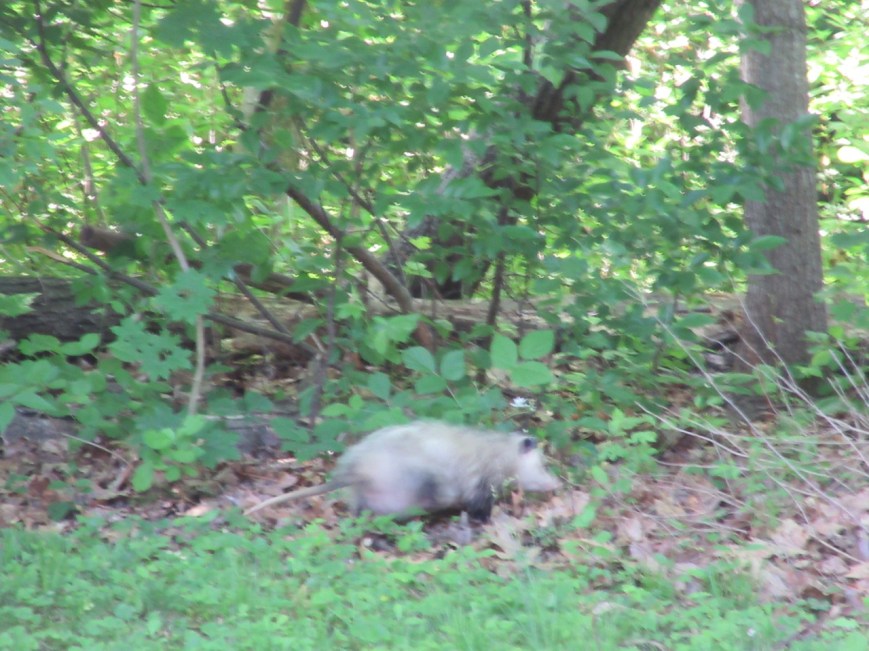
The photo came out a little blurry, but I was delighted to catch a glimpse of this little opossum neighbor, while I was sitting in the screen tent a few mornings ago. When it saw me, it speeded up its walk near the underbrush at the back corner of our yard. I understand that opossums eat ticks, among many other things, so I was glad to see it our neighborhood.

Reading more about them, I learned that they can also eat food from bird feeders and fruit trees.  They are nocturnal.  It will be an interesting balancing act–we intend to grow food for ourselves, yet we also love the critters that show up in this space we share. But perhaps that is the heart of the question–how do we live as neighbors in this land, rather than colonizers/occupiers/dominators?  How do we care for our own needs, while also caring for the needs of other beings on this earth?

Hummingbirds?

Hummingbird Feeder

Margy got a new hummingbird feeder for us!  I put it up today, plus our old one too, attached to opposite sides of the beams on our new roof on the deck.  I hope we aren’t too late to catch the migration–we used to put out the feeders when the viburnum near our door (in North Yarmouth) started blossoming, the first week of May.  We’re still figuring out the best timing for here in Portland.  I’ll let you know when we see any.

In the meantime, lots of watering to do, and I also divided some comfrey and some oregano to take to the Plant Swap tomorrow at the Resilience Hub.  Last year we got all of the companion plants we needed for our cherry trees.  The comfrey and oregano seem like basically fool-proof plants, and grew abundantly in the food forest.  So I was confident enough to take some out to share.  This year, I hope to find some kale seedlings, perhaps, and just see what might be there.  Maybe elderberry starts?  It has been a beautiful day in the garden.

Hummingbird Feeder small

Pruning

Cherry Tree prunedFriday and Saturday I pruned and trained our young fruit trees.  I did a lot of research beforehand, because it seemed so sad to actually cut them at all.  But the Holistic Orchard book, and most other resources suggest that pruning helps them to grow into a shape that gives them enough support and sunlight for fruit.
Of course, after the research, I realized it might have been better to prune the cherries more drastically last summer, when we first planted them.  But all we have is now.  Here is a photo of the Black Tartarian Cherry with its central leader cut at the top–to promote another tier of scaffolding (outward facing) branches.  The small bud near the top should grow into another central leader.   If I didn’t cut the top, the next outward facing branches would have grown too high up on the leader.

Next, I cut the ends of the first tier of scaffold branches, because they were too long and leggy and uneven.  On this cherry, they are also rather low to the ground, but the only way to remedy that would be to cut them all off, and I couldn’t do that.  I tied them back to encourage them to grow at a better angle to the central leader.  I did this for both cherry trees.  (We had also done this last summer, and took off the ties for the winter)

I also pruned our new young apple tree by making a heading cut on its central leader to promote scaffold branch growth.  For the peach, I did a more drastic cut on the central leader, to create a “vase” shape, where there is no central leader, but four or five main branches, which is the form most recommended for peaches.  Some sources recommend that for cherries too, but we had started with a central leader form last year.  After I was done with all this cutting, I said a prayer to the trees–I am so new at this, that I barely know what I am doing–so please forgive me for that, and grow and thrive anyway!

Funny to think that plants can thrive by being cut back so drastically.  Is there a message in that for humans too?  That the most difficult experiences of our life can shape us for greater beauty and fruitfulness to come?

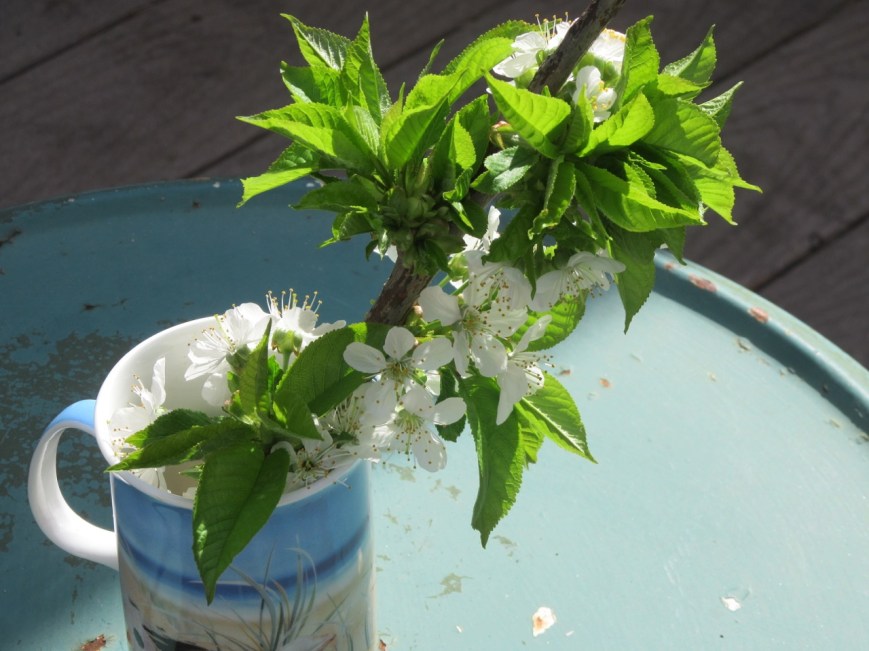
I took a cut branch with cherry blossoms from the Lapins Cherry, and put it in a cup of water on our deck.  Maybe the bees will still want to visit them.  For now, it is a sign of the years to come, when we can let the flowers bloom and hope for fruit.Cherry Blossoms

The (Future) Pond

the future pond after rain

With all the excitement about the rain barrels toppling, I didn’t get a chance to share this other effect of the big rain storm:  our future pond actually looked like a pond (with a little island) on Tuesday.  I only had time last summer to dig up the grass and top soil for most of its surface, meanwhile using that soil in our new annual veggie bed.  This is the slow project–bit by bit digging and removing soil (and putting it someplace else) until the pond is as deep as it needs to be–a few feet in the center, with a foot deep shelf at the edges for plants.  Eventually, we’ll use a pond liner.  The water was gone by the next day.