Balance in the Garden

Raised bed with wooden sides, on left are pea plants on string and bamboo, middle is broccoli seedlings surrounded by pine cones, wire fencing around edge.

This earth love is a balancing act. We love critters in the yard, after all, they live here too, and have the right to be here. They bring so much joy to us. But we want to grow food too. The last time we bought organic broccoli at Hannafords, it was $8 for one crown. These twelve broccoli plants in this raised bed will be very valuable food for us. I’ve also planted cucumber seeds here. So we try to use gentle methods to discourage the critters from eating the plants we want for our food.

Margy saw a groundhog poke its head up out of a hole in the grass, over near the fence. There was a burrow underneath where a spruce tree fell before, and after it was removed there was still a mound of old roots and dirt. Groundhogs can be the worst for eating garden food, despite how cute they are. At times, we’ve used human pee to mark a line around the beds. Last year, we covered that bed with an old screen tent to protect the kale–and it did. All of it is a kind of communication, with respect.

This year, I am trying out a new method for deterring critters from the garden bed–putting pine cones in between the plants as mulch. (I saw it on Facebook.) Apparently many critters do not like the prickly feel of the pine cones under their feet–and these pine cones are very prickly. They come from our pitch pine, and we have tons of them everywhere. Margy had a bag full of them in the garage, so I used those first, and then started twisting them off fallen branches under the pitch pine. I had to wear gloves to do it, that’s how prickly they are. I’m putting them in the hugel mound as well.

We’ll see how it works.

In the meantime, in critter news, a few days ago we saw a mother turkey walk through the yard with about ten baby turkeys. Ducks stop in to take a dip in the pond. The frogs hang out there, and the tadpoles are getting big. They like to linger under the lily pads. The robin has four new eggs she is incubating. The chipmunks fill up on sunflower seeds at the bird feeder, but are also eating the maple seeds that blew all over the yard.

And sometimes, beauty emerges in unlikely ways–this is a dandelion after the rain washed away all the fluffy seeds. A perfect star.
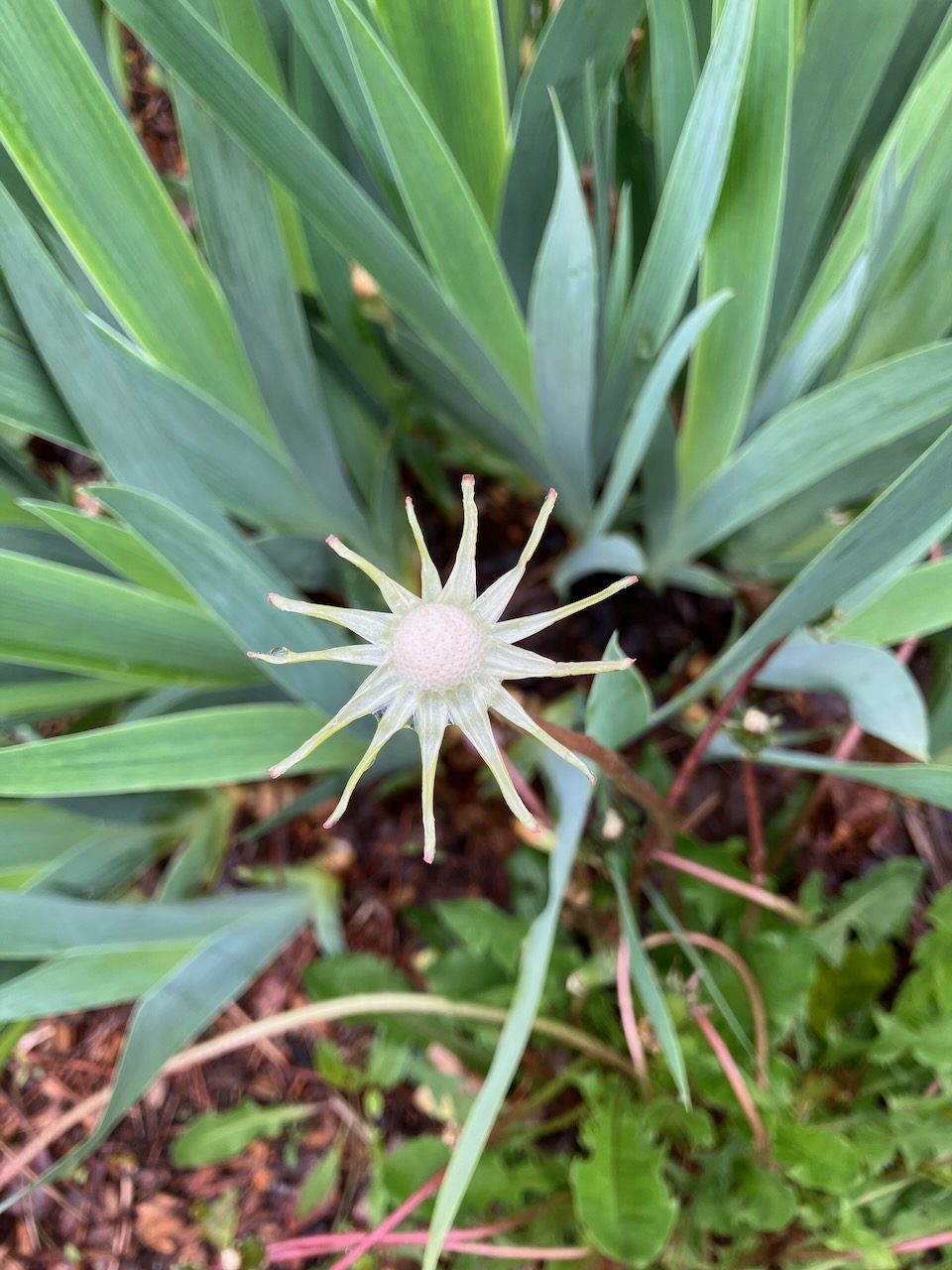
a white star shape of a dandelion plant, surround by angular green iris leaves.

May Day the old way

May Day treeYesterday evening, eight of us danced around the pitch pine in our yard, dressing it up with rainbow ribbons for May Day.  Did you know that the original Maypoles were not cut wooden poles, but live trees?  It makes sense to me, coming from people who worshiped among the trees, who honored and revered the trees. And so what better way to celebrate the full arrival of spring, the arrival of the May, than to celebrate the tree with an ancient dance?
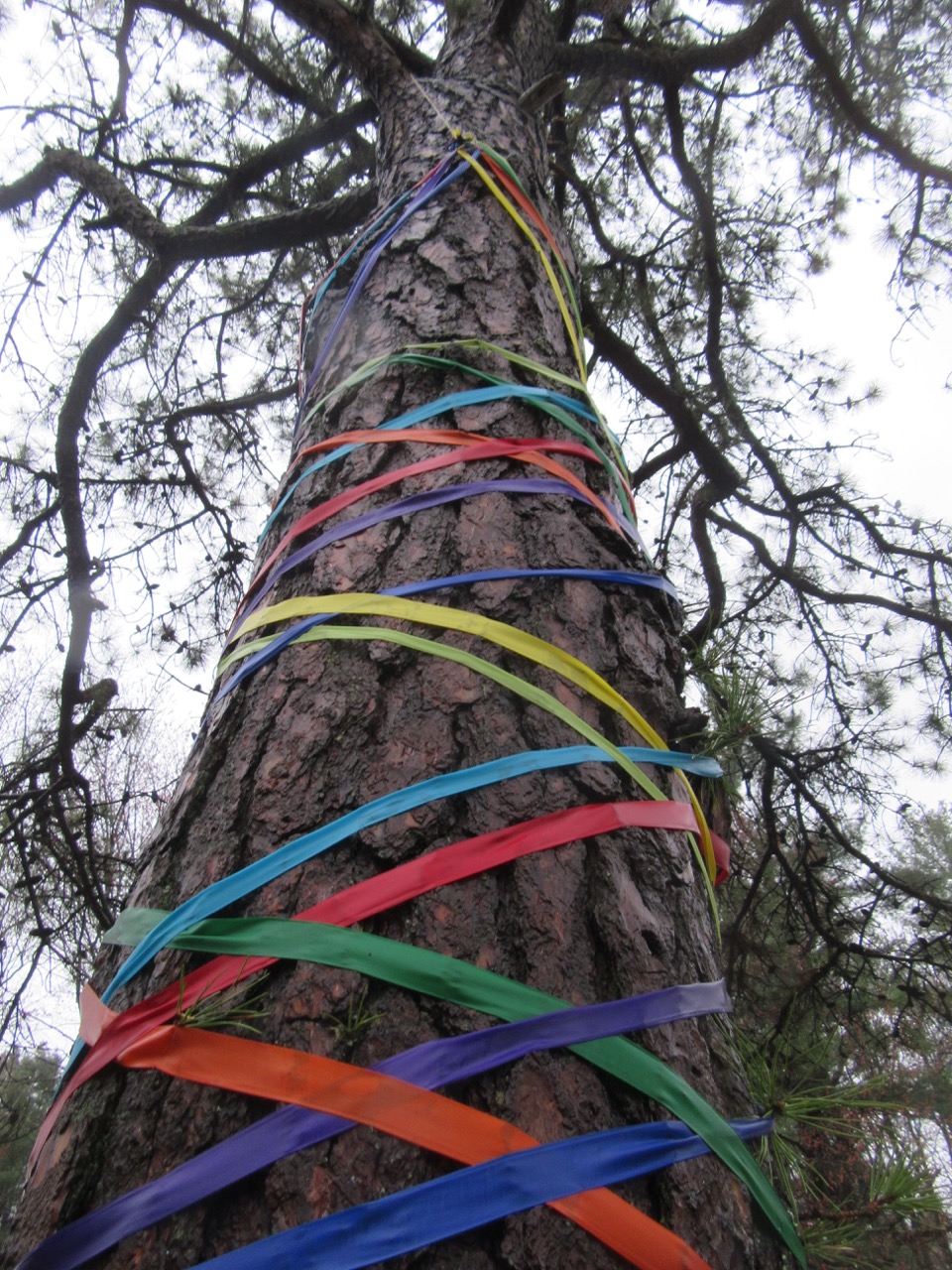
Earlier, I had attached eight ribbons to a small metal ring, and then Sylvia tossed a rock-tied string over a branch so we could lift the ribbons to a good height for dancing. Margy went to a field close to where we used to live to pick forsythia branches to decorate the bottom of the tree. In this time of the earth awakening, we joined our life energy to that of the earth, that we might all be full of life and regeneration.  It was a magical moment to be weaving in and out between each other, with our bright colors, dancing on the earth, and finally surrounding the tree, hands joined in a circle.

After a rain-filled night, I took photos this morning. We keep hoping for more warmth…it is only in the 40s today.  But we’ve finally finished planting all the bushes. I set up the rain barrels (by putting in their spigots and re-attaching their overflow hoses), and yesterday I found smaller containers for storing a big bag of Kaolin clay (an organic product used for certain orchard pests). Tending and planting and tending.

When I pay attention to what is happening to our planet, I feel so much despair, I feel overwhelmed. I know it is better to plant trees, than to cut them down.  I know it is a good thing to tend this small plot of land.  But even with many of us planting trees, or protesting, or changing our lives, do we have the power to stop the destruction?  No, I think not.  But what came to me the other day was this.  If we are out there, planting a tree, putting our hands in the soil, watering a seed, dancing on the ground, or even lying in a hammock under a pitch pine, perhaps we can learn to hear the voice of the earth.  Perhaps she will see us there, and take pity on us.  Perhaps she will open our ears and hearts and guide us into regeneration and healing. This is my hope.May Day Pitch Pine

Turkeys Visiting

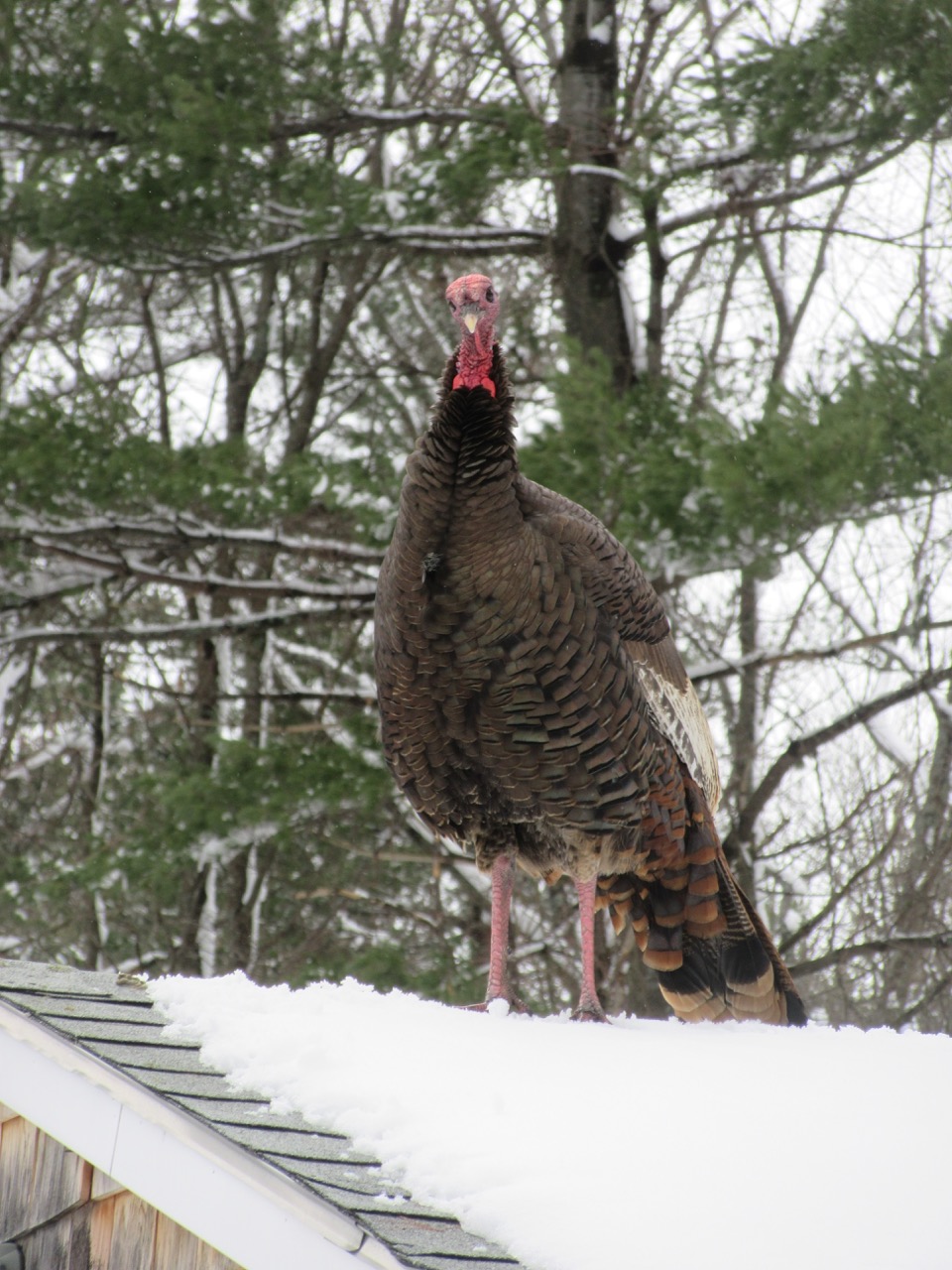
Turkey on Garage Roof

Yesterday, I looked out a window and saw a turkey in the driveway.  When I went on the deck to get a closer look, it flew up to the maple tree in our neighbors yard.  But then I looked up and discovered two turkeys on the garage roof, another roosting in the pitch pine, more in the spruce and small maple on the other side of the house–we were surrounded!

The one on the roof seemed to enjoy our conversation–it was looking at me so intently as I spoke.  I wonder if this is the same family that visited often during the summer and played in the dirt in and near our future pond?  They were younger then, of course.  But maybe? If you look closely you can see two of them in the photo below, from their visit in September. This morning on my walk, they were out walking too.  Perhaps the deep snow has disrupted wherever they were hanging out during the winter.  But they look very fat and healthy.  A visit from wild neighbors always makes my day!

Turkeys in dirt

The Importance of Naming

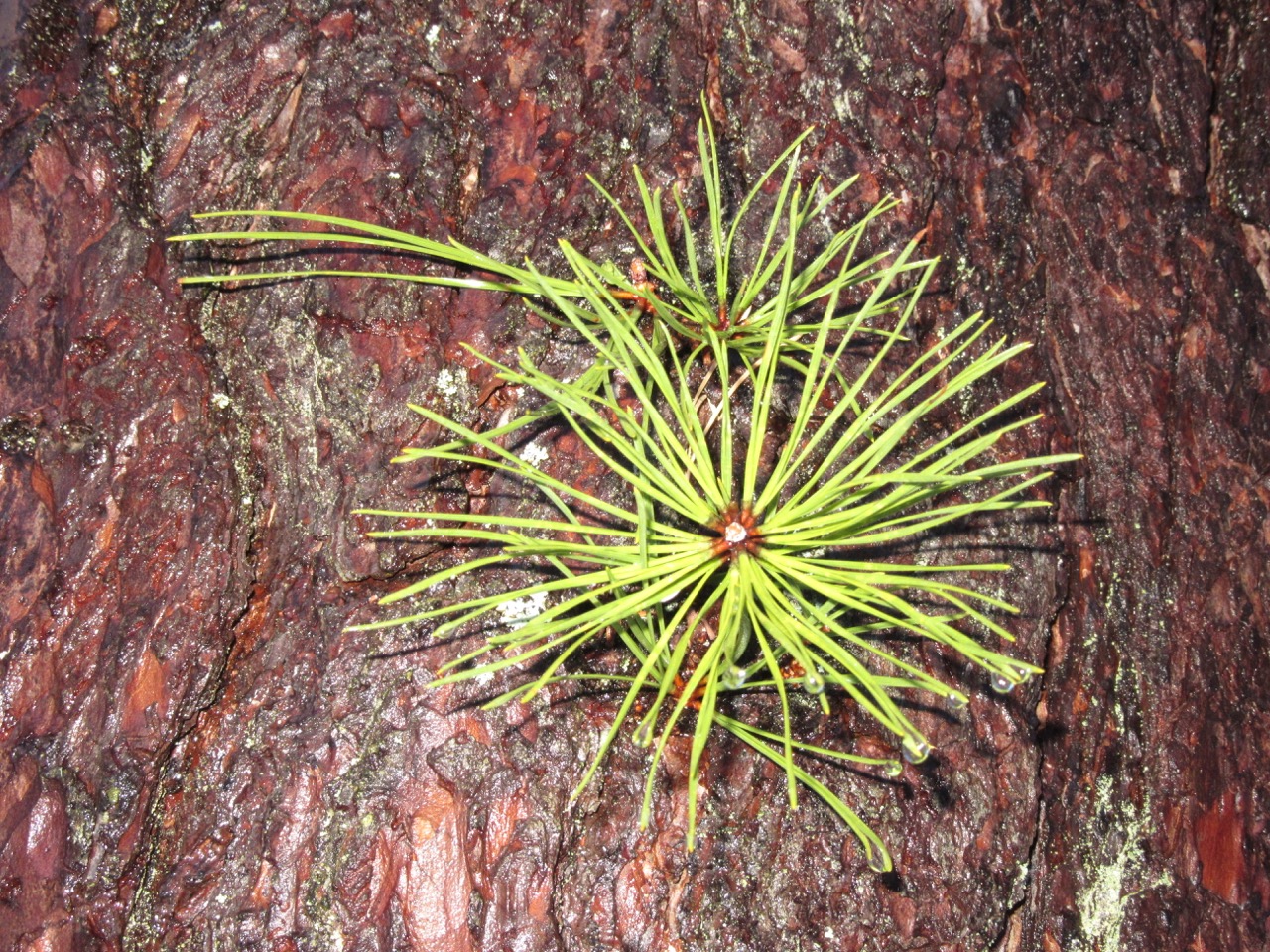
Pitch Pine needlesIn my attempts to get closer to the pine in our yard, I made an important discovery today.  It is not a red pine, it is a pitch pine. I discovered that its needles come in groups of three–and the red pine comes in groups of two.  So then I went searching for a resource I remembered from a couple years ago–an identification guide of the pines of Maine, and confirmed everything.

It is a funny thing.  I had used that resource earlier to identify the tree as a pitch pine, especially because of its habit of small patches of needles coming out of the trunk–as in the picture above.  But then the arborist said no, it was a red pine, and so I deferred to their judgment. Perhaps that is one of the lessons for me to learn–arborists don’t necessarily have intimate knowledge of all tree species. Sometimes it takes detective work, which is easier with the many resources that are available online.

So this naming is making a big difference in my relationship with the pine.  Now I understand the prickly feeling–according the guide, “Pitch pine cones have a sharp prickle at the end of each scale.”  They are prickly!  It also says, “Branches are horizontal, rigid, contorted and form an open crown.”  That describes so perfectly the irregular beauty of its shape.  “Pitch pine attains a diameter of 1–2 feet, and a height of only 30–40 feet.”  These height numbers relieve the anxiety I had about the tree possibly growing to shade our solar panels–it is likely fully mature at its current height.

What else?  It is native to eastern North America. It can live to be 200 years old. It tends to grow in acidic, sandy, and low-nutrient soils. It is a “pioneer species” and is often the first tree to vegetate a site after it has been cleared. So perhaps it speaks to the history of this land–that this land was cleared, that it was depleted. The tree can also regenerate itself–if the main trunk is cut or damaged by fire it can re-sprout using epicormic shoots, which is unusual for a conifer.  (This might make it a candidate for coppicing or pollarding–the practice of cutting a tree to use the wood, after which the tree regrows.)

According to Wikipedia, “Pitch pine provides a habitat and offers food for many wildlife species. They are used as cover and nesting for birds such as the pine warbler, wild turkey, blue jays, black-capped chickadees, black-and-white warblers, and chestnut-sided warblers. Small mammals and birds eat the seeds.”

I feel like the tree and I are starting all over again with getting to know each other–now that I know the tree’s actual family and species–now that I know its family name.