Walking in Storms

Early morning at Capisic Brook Jan 8

A little magic has emerged in my life. For a long time, I didn’t have the energy to go on walks, except for a minimal 5-minute walk to the end of our street. But somehow my energy has lifted a little, and for the last several days I have been able to walk to Capisic Brook, where it goes under the walkway to the elementary school, about 15 minutes total. It started January 2nd when, as I entered my driveway, I felt the presence of the Marie Madeleines, my ancestors from Îlets-Jérémie. “We are still with you.” They would have spent so much time walking in their lives. So I felt them walking with me in the early morning, greeting the dawn.

I heard the message from these ancestors: “You need new boots. Walking will be needed.” It was true that my boots were quite old and my feet were feeling it. So when I got back home, I did some online research, and then called a local store. After arranging it, I went in with a mask on, tried them on and bought myself some new boots. (The ones I wanted were on sale!) When I am lucky enough to hear a clear directive, I find it is so beneficial to follow it. And so I have kept walking almost every morning before breakfast. Even in the snowstorm, even in the first rainstorm. Yesterday I couldn’t get myself out there, but today the sun helped.

All these storms have been a challenge. We expect snow in winter in Maine. I like snow. But we’ve only had one snowstorm. There have been at least three huge rain and wind storms–first, when the spruce tree fell into the orchard, another January 9th into the 10th, and then yesterday which mostly caused damage at the shore during high tide. I took this photo of the brook at flood level on the 10th–because the branches of Capisic Brook flow through deep ravines, it doesn’t come onto roads in our neighborhood.

After the rainstorm, January 10

I can’t help but wonder what these weather changes mean for the future. Will rain and wind be the new winter, alternating with snow and cold? Someone posted (on Facebook-but no attribution) this little diagram that showed how climate warming destabilizes the polar vortex causing the extreme colds and unusual warms we are seeing right now. My sister in Montana reported -34 degrees, and Texas at 40 degrees, while we were up to 50 degrees.

While often I am most inclined to grieve or be afraid of all of this, I am also hearing the message that we must find a way to keep loving our changing earth mother, keep loving through the ups and downs. Perhaps it is also about the magic of walking–keep walking through the storms. I don’t know the answers but I am so grateful for the moments of connection and care.

Fallen Spruce

It is raining here in the northeast and the wind is blowing mightily, with gusts past 50 miles per hour. This healthy spruce tree suddenly fell down from its very roots. I was inside and heard something, but didn’t realize what had happened until I poked my nose out the door. Thankfully, it just missed our deck! And our house! 

I found this little squirrel within the branches, perched on a cherry tree branch, probably wondering what the heck just happened! And also eating a seed. The spruces are like squirrel highways over here.

I went fully outside into the rain to survey the damage and was amazed by how we lucked out. The spruce landed in the orchard, tucked neatly between the trees. Some orchard tree branches are bent or broken, but not the trunks. Also, it could have hit our house if it had fallen in a different direction, but it did not.

Earlier, I had been worrying about an entirely different spruce–a dead one with a squirrels nest. That one is still standing so far, but this one took me by surprise. The whole root ball had come out of the ground. This photo is from that root, from the bottom of the tree, looking to the top, where you can see how it landed between the white painted trunks of apple and peach. The patterns of the branches are so beautiful, even in its dying.

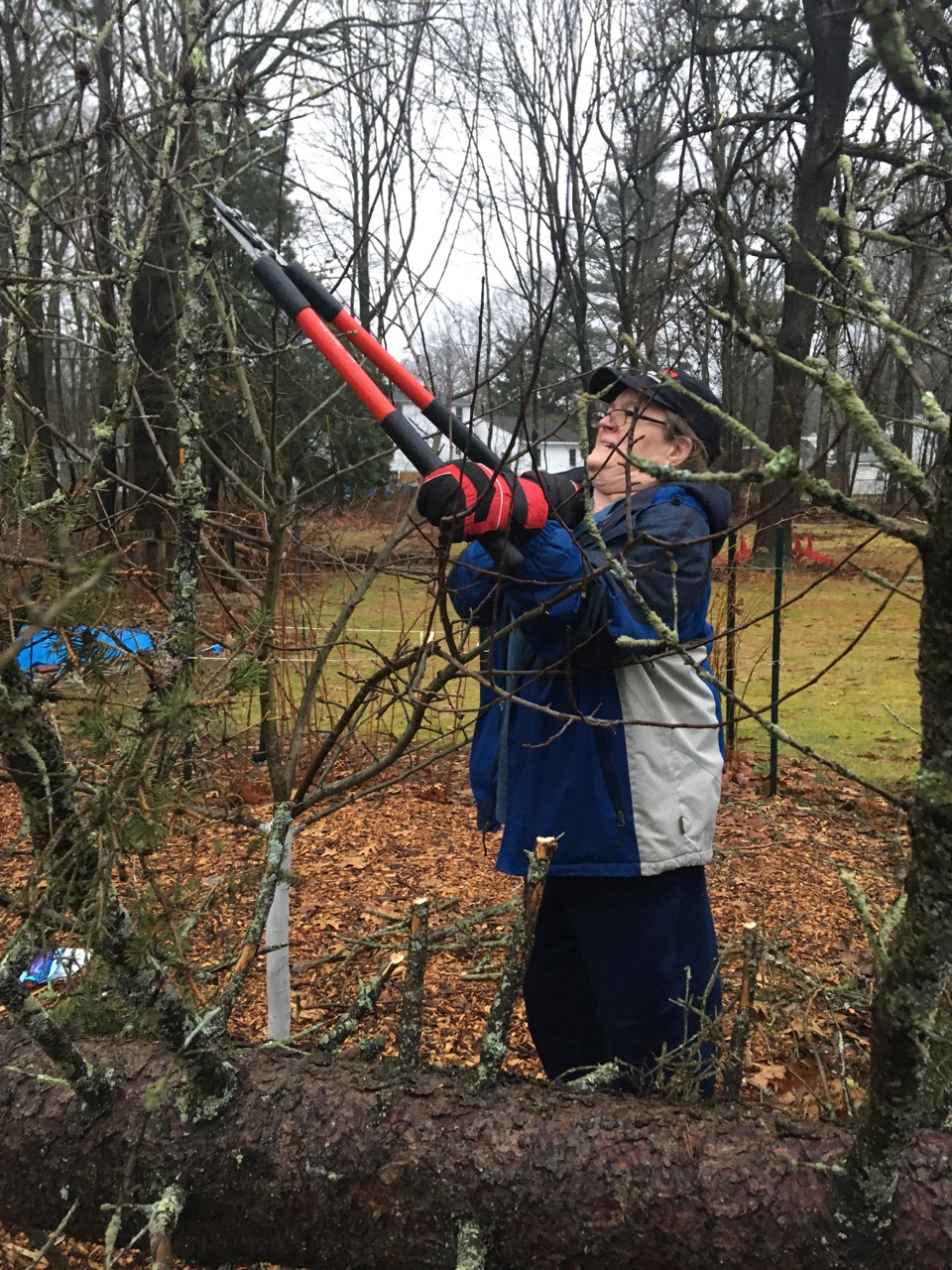
I don’t know how much damage the orchard trees suffered. When Margy got home from an appointment, she went out in the rain immediately to begin cutting spruce branches that were interfering with orchard tree branches. I guess that is something else that I love about her. Going outside in all sorts of weather, and caring about trees. I think if the branches can be freed from where they are bent, they might have a better chance of recovering.

Meanwhile, I am inside thinking about how vulnerable we all are to the wind and weather. How even with so much care put into this orchard, it could be wiped out with a storm. Or a tree could fall on our house. I tend to worry, to imagining worst case scenarios. Yet, I have been so blessed in so many ways, protected from harm by what magic? I can’t put it on “being blessed,” because I don’t think people who face tragedy or catastrophe do so because of not “being blessed.” (I don’t think people being killed in Gaza are outside of the view of that Mystery who blesses all, and who is especially with those who are suffering.)

Luck? Fate? I am reminded of the Chinese story about a farmer whose horse escaped into the hills. When his neighbors came by to sympathize with the old man over his bad luck, the farmer replied, “Bad luck? Good luck? Who knows?” The next day, the horse returned with a beautiful wild stallion. This time the neighbors congratulated the farmer on his good luck. His reply was, “Good luck? Bad luck? Who knows?” Then, when the farmer’s son was attempting to tame the stallion, he fell off its back and broke his leg. Everyone thought this very bad luck. But the farmer again replied, “Bad luck? Good luck? Who knows?”

Some weeks later, the army marched into the village and conscripted every able-bodied youth they found there. When they saw the farmer’s son with his broken leg, they let him off. Now was that good luck or bad luck? Who knows?

When a tree falls I am reminded that the world we live in is much bigger than we can understand or imagine. 

Weather Report

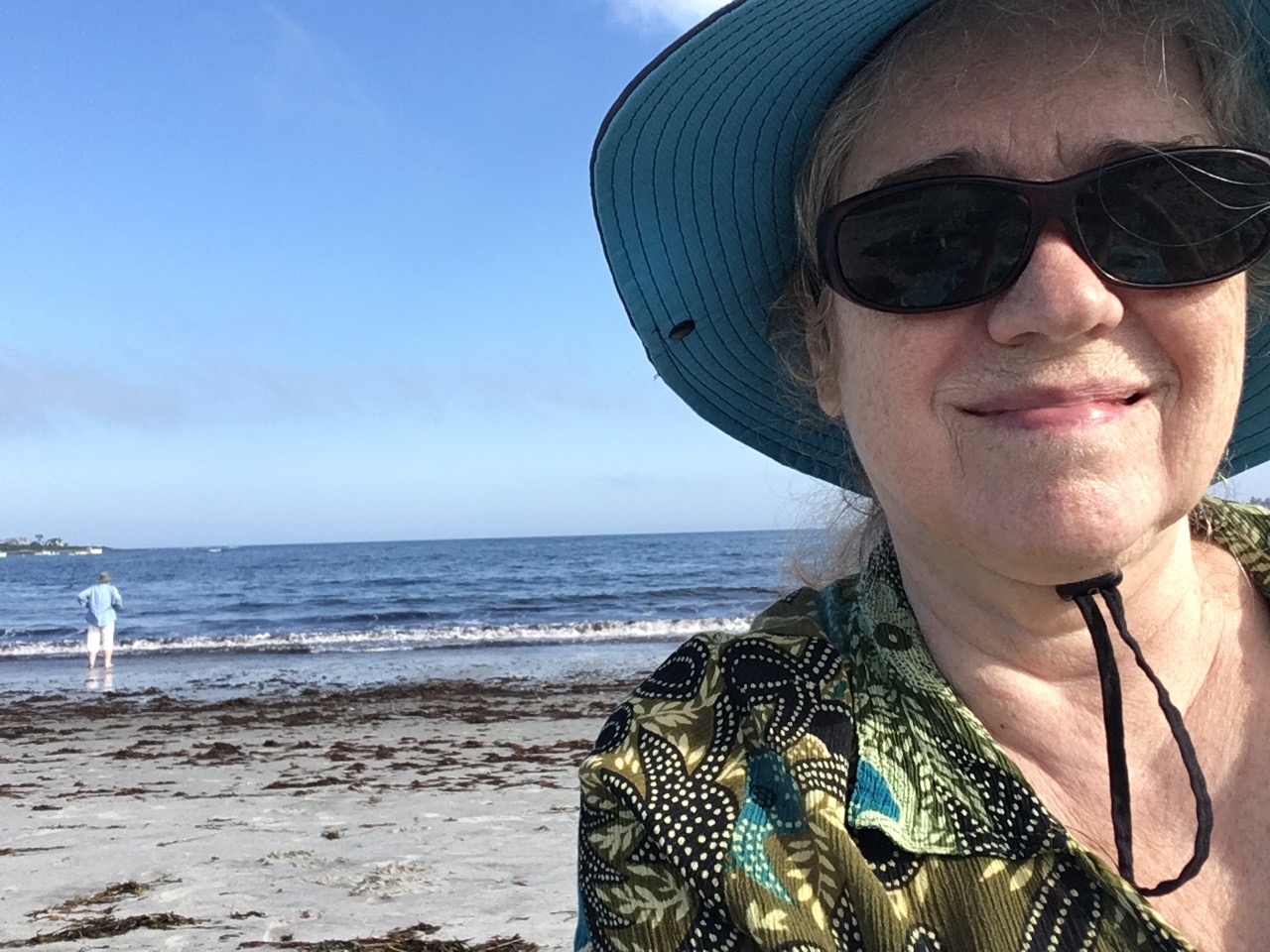
Close-up of white woman smiling into camera, with blue sun hat, sun glasses, and backdrop of ocean beach, with small figure looking out to sea.
Crescent Beach, Myke, with Margy in background.

A week ago we finally made it to the beach. We’ve had so many rainy days this summer, alternating with a few very hot muggy days. That day was hot and muggy, but less so at Crescent Beach, so we got ourselves over there. The water was totally full of seaweed, and somehow that dampened my enthusiasm for swimming, but the wading was lovely, and lying on a blanket in the sand. I’m smiling in the selfie, but this post is more about the challenges of this summer.

It feels like a summer in which it is very hard to love the earth, or to feel loved by the earth. It is hard to even go outside! According to the weather report for Maine, June had only 7 days without rain. And July the rainy patterns have continued. But what makes it worse is that the days without rain have gone to the opposite extreme of muggy and hot. I don’t think we’ve had even one dry, sunny, moderately warm day. The other challenge has been air quality–many days of smoke particles making their way from Canada–not to an extreme, but enough to bump the meter from “good” to “moderate”.

And I have to acknowledge that we’ve been lucky here. No flash flooding of town centers, like in Vermont this week. No over-100-degree heat for days on end like in Arizona. No forest fires on our doorstep. But still…

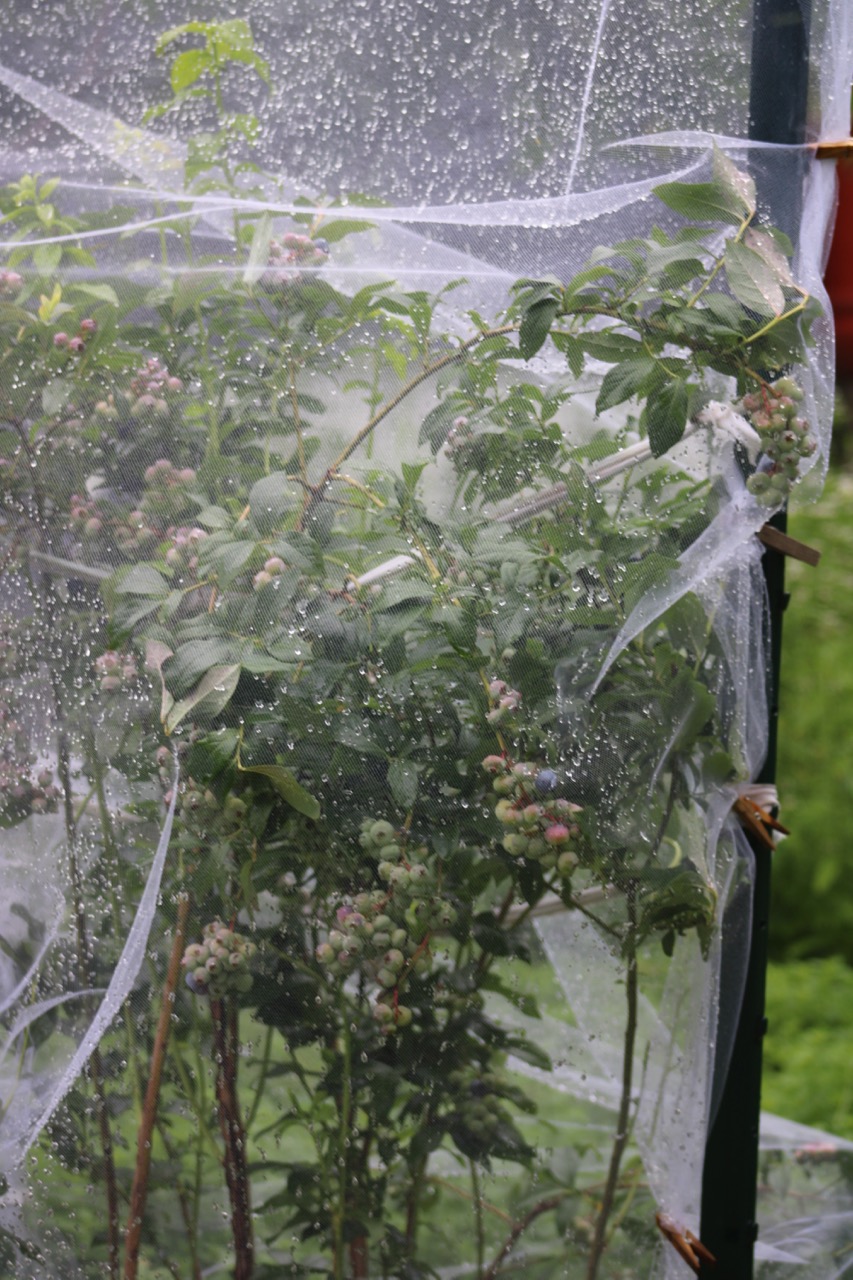
I’ve been feeling like a failure in my deep intention to build relationship with the earth. It’s not that the garden is doing so badly (except for maybe the cherry tree). It is just that I feel unable to tend to it, unable to even sit outside and appreciate it. (The cherry tree needs some attention because of, perhaps, black cherry aphids and sooty mold.) If I manage to do one small garden thing in a day, I count that as gain. For example, the other day, I put some tulle netting over the ripening blueberry plants.

Tulle fabric spread over blueberry bush, with raindrops, berries starting to ripen.

I do try to walk around for ten minutes in the morning if I can. But none of it feels like the nurture that the garden had been for me during the last several years. Instead I feel a vague sense of overwhelm, I feel uncomfortable in my body, I feel grief and deep weariness.

And the truth is, because of climate change, because of the destructiveness of our larger society, we are all facing unimaginable loss, we are all facing a time of unknowable earth transformation that may lead to our doom. With this looming around us, no wonder these small weather challenges feel so overwhelming.

So today I am making space for that overwhelm, for grief, for rest. But even in the midst of those feelings, there are parts of the garden that still seemed determined to bring beauty to my eyes. I look out the front window, and the roadside garden is now awash in yellow heliopsis flowers and day lilies. They brighten even a gray day.

Yellow heliopsis flowers all over the roadside garden.

No smoke here right now…

purple and pale lavender spiderwort blossoms in spiky green leaves, with rain drops clinging to leaves
Spiderwort blossoms after rain

We’ve had two weeks of very cool rainy weather, and that counter-clockwise low pressure weather system has kept away the wildfire smoke from Canada, while folks to our south are facing orange skies and unsafe air. Still, we’ve paid attention, following the news, and thinking about what might happen if it does come our way. It is easy enough for Margy and I to stay inside, or wear our N95 masks outside.

But now that we are deeper in relationship with our land, I am anxious about how such bad air might affect the robins and frogs and squirrels and other critters who live here with us. They don’t have masks and can’t get inside. I wonder if the babies of these critters wouldn’t make it, so vulnerable in those first weeks of life. My heart is wide open to our little microcosm of earth life.

And yet it is the macrocosm that emerges most in this story, because the smoke is coming from far away in Quebec, from wildfires made more destructive by climate change. We aren’t alone in our microcosm, we are all connected by the winds that blow across the globe, undeterred by artificial boundaries. I have been somewhat removed from wildfire problems. I have seen them on the news in California, Alberta, Australia. This is the first time they have come close to where I live. But truly we are all more and more vulnerable. And of course, some much more vulnerable than others. I worry about people without houses, struggling just to survive, in a tent or with a tarp. They can’t get out of the bad air.

There is so little I can personally do about these large issues at this time in my life. That is some of my motivation for trying to tend our little garden–to love this small place of earth in hopes that more and more people can learn to love the larger earth, our great mother. To share the beauty of this earth in writings and photos on this blog, that beauty might inspire love. But love includes grief, and the more we love the earth, the more we grieve for the destruction that human beings are perpetrating.

Irises in bloom, purple, with hints of paler purple and yellow.
Irises in bloom

Roadside Garden Flowers

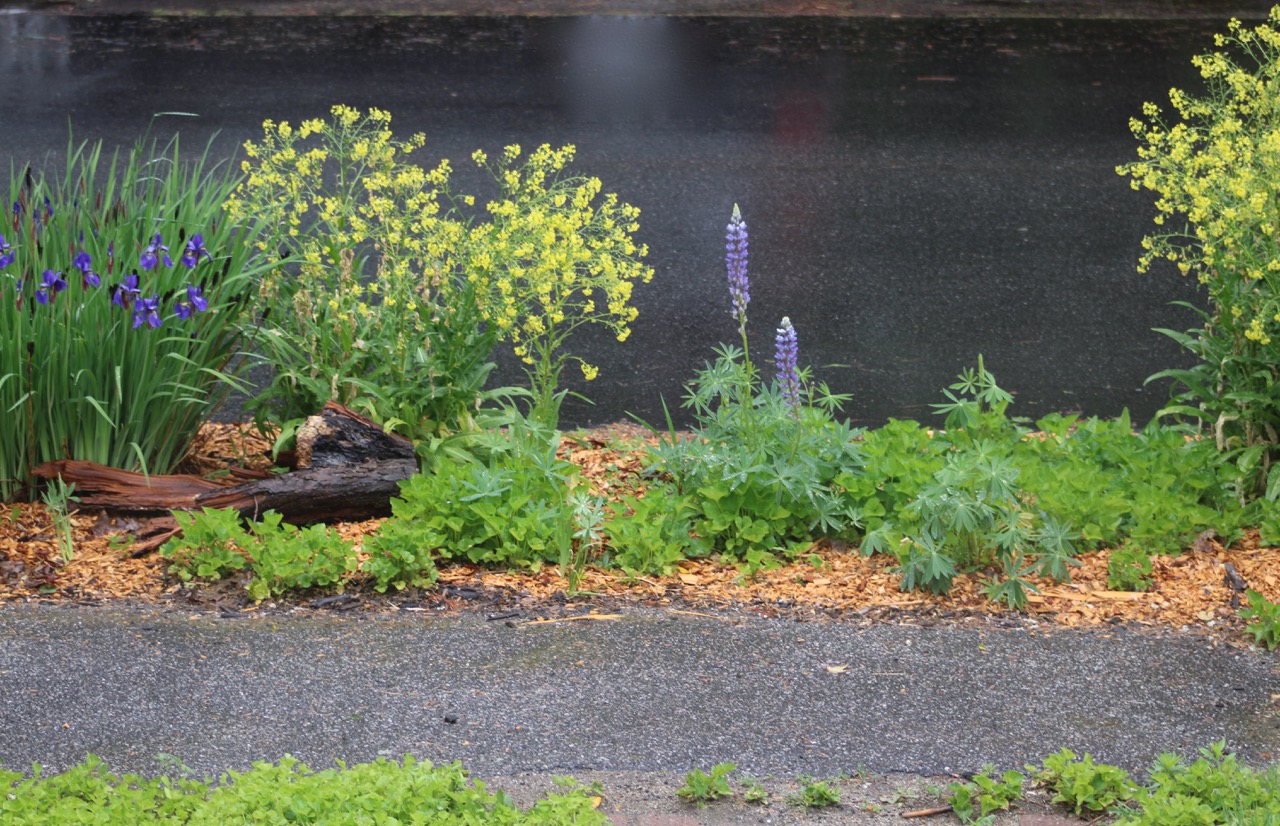
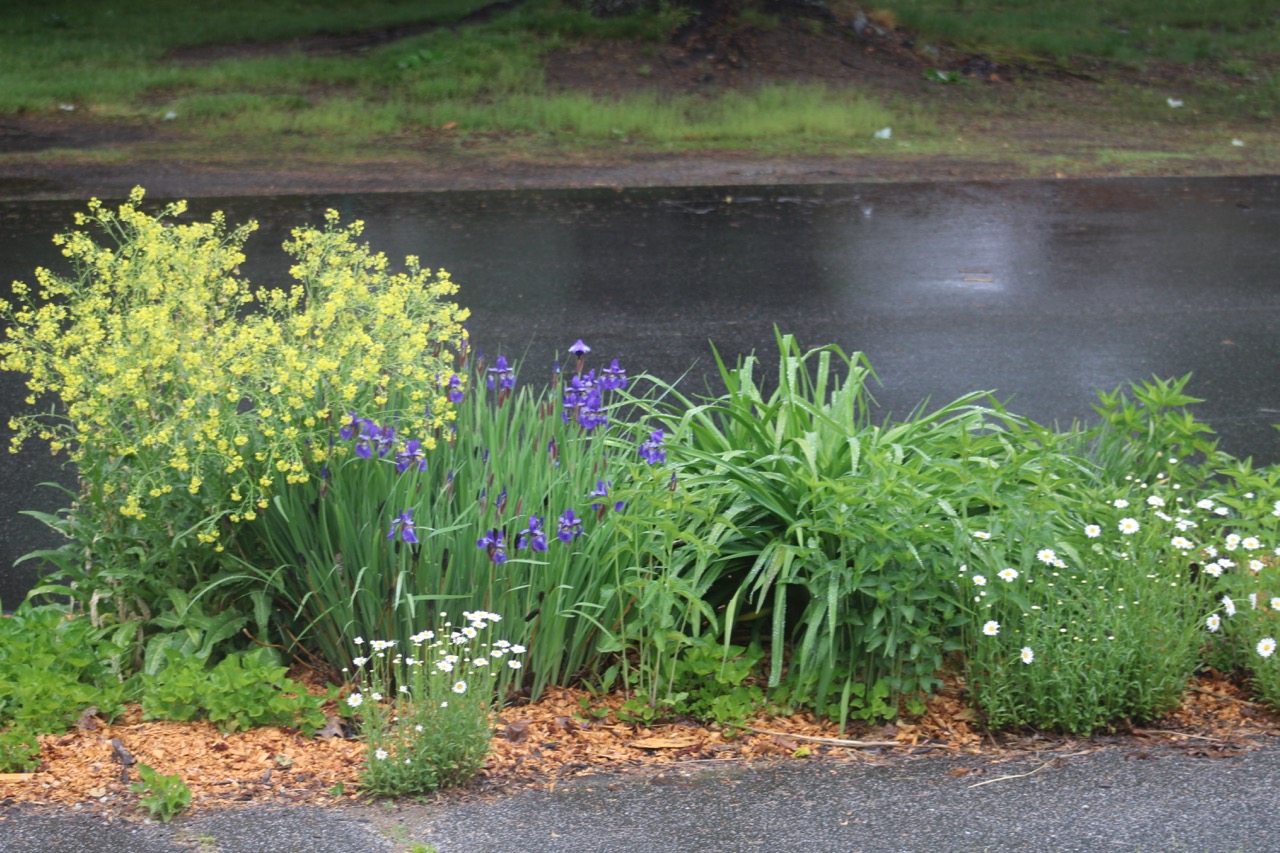
Roadside garden with siberian iris purple flowers, turkish rocket yellow flowers, lupine purple flowers.
Siberian iris, turkish rocket, lupines in bloom.

This is my favorite time of year for the roadside garden. The flowers are in contrasting colors of bright yellow, purple/blue, and white, with lovely green leaves of all shapes and sizes. Despite the cold and rain of the past week, it seems to send off a glow into the gloom. It was a garden formed originally from gifted hardy perennials, and others have naturalized to find their own places, like the white daisies.

Yellow flowers of turkish rocket, purple Siberian irises, daisies, in front of rain slicked pavement road.
Turkish rocket, Siberian iris, wild daisies in bloom.

Before the rain, we planted random and unknown flower seeds in one of the garden beds in the front, and carrot seeds in the other (next to broccoli seedlings). I had also planted zucchini and cucumber seeds in the hugelkultur mound. I hope the rain waters them gently and they sprout. Most of our seeds are from prior years, so it is a gamble. But it did seem like good timing.

And for those who have been following this blog, you might be delighted to learn that after the robins fledged, the parents are now starting a second batch of eggs. Once again, she laid one egg per day, but this time, there are four!

Four blue robin's eggs in nest

Humbling

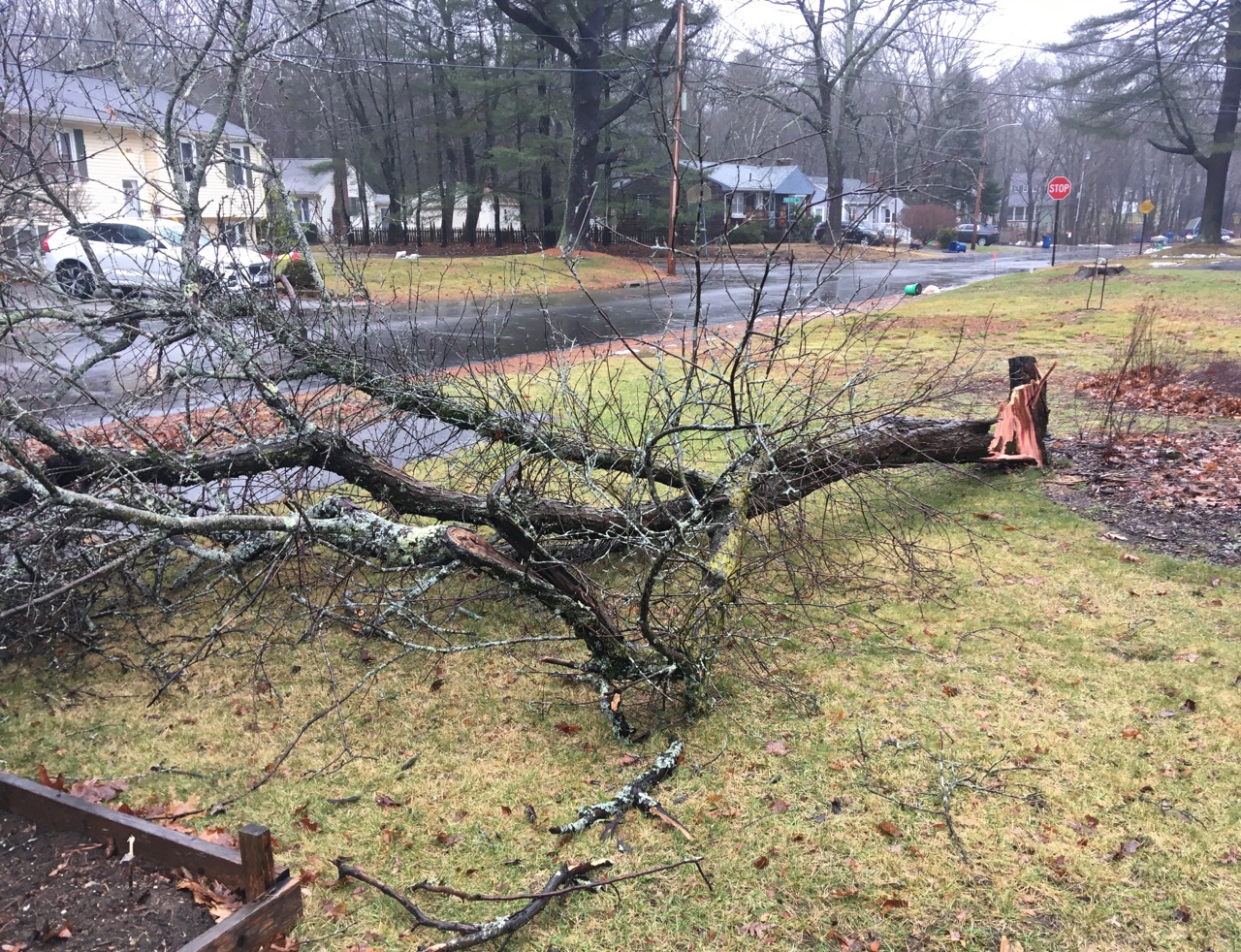
Crabapple tree broken at trunk and lying on the faded green of winter lawn, with street behind, houses visible on other side.
Fallen crabapple tree

On December 23rd, a severe rain and wind storm passed through Maine, after also creating havoc with storms and snow in other states. In the early afternoon, I was sitting in the living room, and suddenly heard some sort of clattering outside. I had previously gone out in the rain to right overturned trash barrels, and so I went out again to look around. At that moment, Margy was driving into the driveway from an appointment, and she asked me–did you see the crabapple tree? Going round the side of the house, this is what came into view: one of the ornamental crabapple trees in our front yard had suddenly cracked through its trunk and fell over. It didn’t land on anything or damage anything, which was a relief, but the tree was dead.

A couple hours later, our electric power went out, along with many other thousands in Maine–though only a segment of the people on our street. The thing with power outages is–you never know if it is going to be a brief interlude, a few hours, or a few days. You enter this limbo time of unknown duration. We waited until dark, and then lit our wood stove–thank goodness our house had this wood stove when we purchased it. It is a very fine wood stove, and it will heat the entire house when needed. We don’t usually use it except for emergencies. But in fact we had used it just a week ago when our heat pumps were being repaired. We have a few flashlights and candles, so we lit those too. And I could connect to the world via my cell phone, and Facebook.

However, I have to acknowledge that it felt very dark, the sun setting at 4 p.m., and not rising until about 7 a.m. Keeping up with wood in the stove was exhausting. It was hard to just relax with the uncertainty of it all. After a Friday of warm and windy rain, the temperature dropped on Saturday to a frigid 12 degrees. I was worried about our refrigerator food, and the freezer in our basement. I covered the freezer with a few blankets. I put the food from the fridge freezer into rubber tubs, and put them out on the back deck. Then, an unexpected grace–our neighbor Brian came by, and offered to run an extension cord from their house to ours–they had not lost power. So by this gift, we were able to plug in our refrigerator.

Before the storm, we’d purchased a round shrimp plate for a holiday treat–so Friday dinner was shrimp and cheese and crackers and cucumber and carrots. A little picnic. Margy had also boiled some eggs before the storm, and we had some sliced ham, so those were other meals that didn’t need cooking. On Saturday early evening, I got a text that the power should come back at 7 p.m., but then it did not. I felt such disappointment then, and crankiness, and boredom. Later, we tried to work on a puzzle, but without a good light source, it was mostly frustrating.

It is humbling to realize how difficult I found this time without electricity. I felt disconnected, restless, and bereft. I tried reading the book I had started a little while ago, but it was a heavy subject, and I couldn’t manage it in the midst of everything else. I missed the entertainment and mental stimulation of television or streaming channels like Britbox and Prime. I missed connecting to Christmas Eve services through Zoom. I felt at a total loss. I had imagined that as I grew older, I would become more resilient with age. But I see that I am perhaps less resilient after all, that I am vulnerable and dependent in many ways. When I went to bed, I felt defeated.

For whatever reason, I woke at 3 a.m. on Christmas, and couldn’t get back to sleep. I added a log to the fire, and wrote in my journal. I think then that I surrendered to the situation I was in–that here we were, in the dark, and we didn’t know for how long–and yet, we were warm, and we had food, and kind neighbors, and offers of support via Facebook. We were not alone. I thought about the people in Ukraine right now, also facing the loss of electricity in winter, and maybe no heat or water, along with the devastation of war and bombs–so much loss and uncertainty. I found myself praying for those folks who were facing so much greater hardships. I acknowledged my vulnerability and exhaustion.

By the time the sun rose, I felt peaceful sitting near the fire, drinking some tea after I’d managed to heat water on the narrow five-inch ridge on the top of the wood stove. I was still exhausted, still humbled by the difficulty of my managing in these circumstances, but somehow at peace with all of that. It would be a lie to say that I was not relieved when our power came back on at 10 a.m. But I am glad I came to some peace within my spirit before the end of our 44 hours without power.

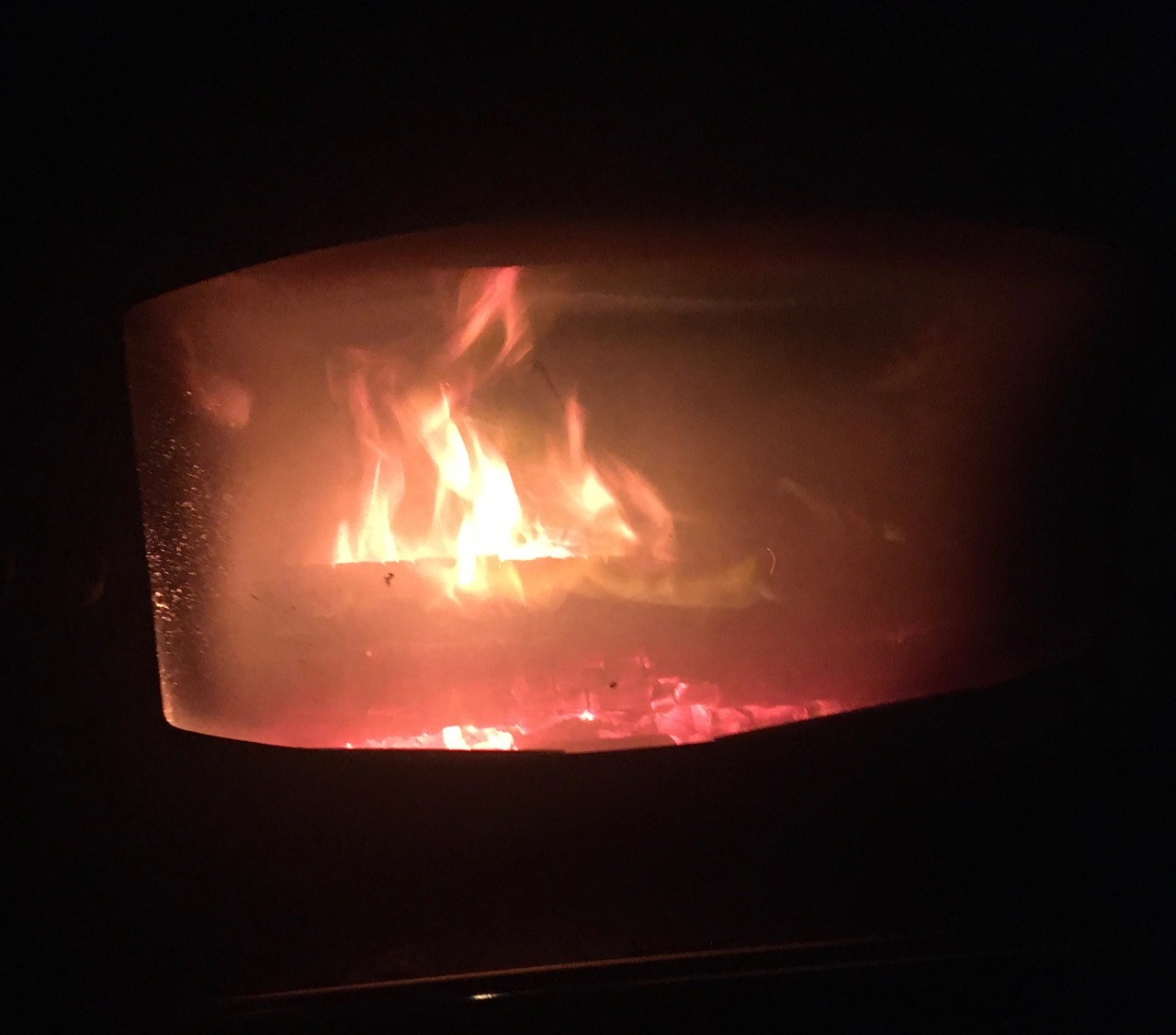
Fire burning in the wood stove.

Rain, lilies, and tiny frogs

White water lily blooming in pond.

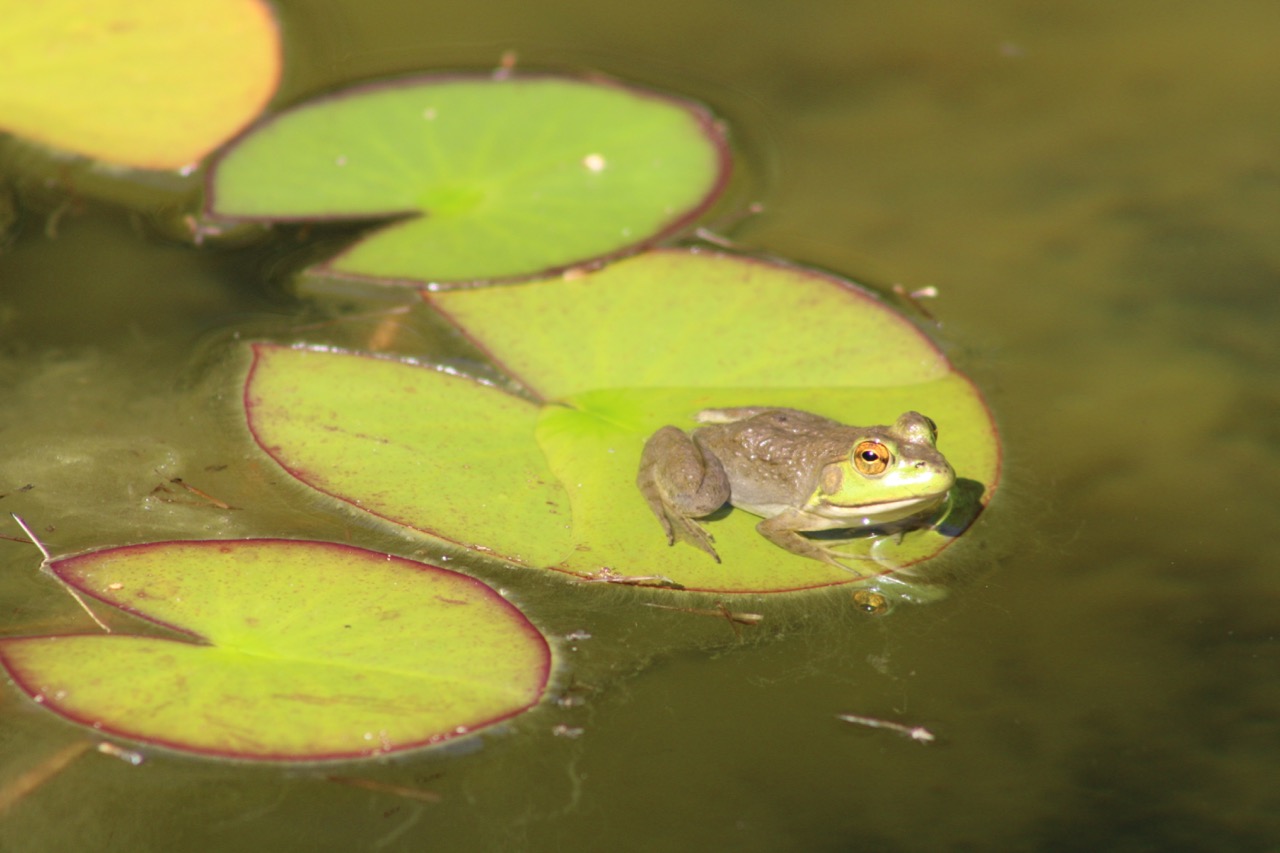
We finally got two solid rain storms this past week after a long drought. What a relief! And now four very tiny frogs have appeared in the pond. (I don’t know what happened to the one we had before that was a little bigger.) A few days ago, this new water lily flower started blooming, and today when I went out to see it, it had disappeared. But I found three of the tiny frogs perched on lily pads! The fourth was on the other side of the pond on a rock. I didn’t look too closely under the water to investigate the missing flower, so as not to scare the frogs.

But slowly I sat down near the edge of the pond and watched for a while. A dragonfly came and perched on blue flag iris leaves. The frogs stayed on their pads.

Tiny frog on a lily pad
Second tiny frog on another lily pad

Taking close-up photos makes the frogs appear larger than they really are. They are only about an inch long nose to backside. I wonder if maybe it was the rain that enabled these small frogs to travel from some other place to our little pond? I feel refreshed by the rain too. Cool nights with windows open, listening to the dark sounds. Lovely.

Pond: a little frog

Photo: The pond sides are now covered with stones.

This morning, when I approached the pond, I heard a distinctive plop! And later, approaching again, I saw a tiny frog leap quickly from the beach rocks into the water. Another plop! It is our first frog. (Or maybe it is a toad–still not sure). No chance to catch it in a photo. But I am sure it was the best sound all day! And in more good news, most other pond projects are now complete.

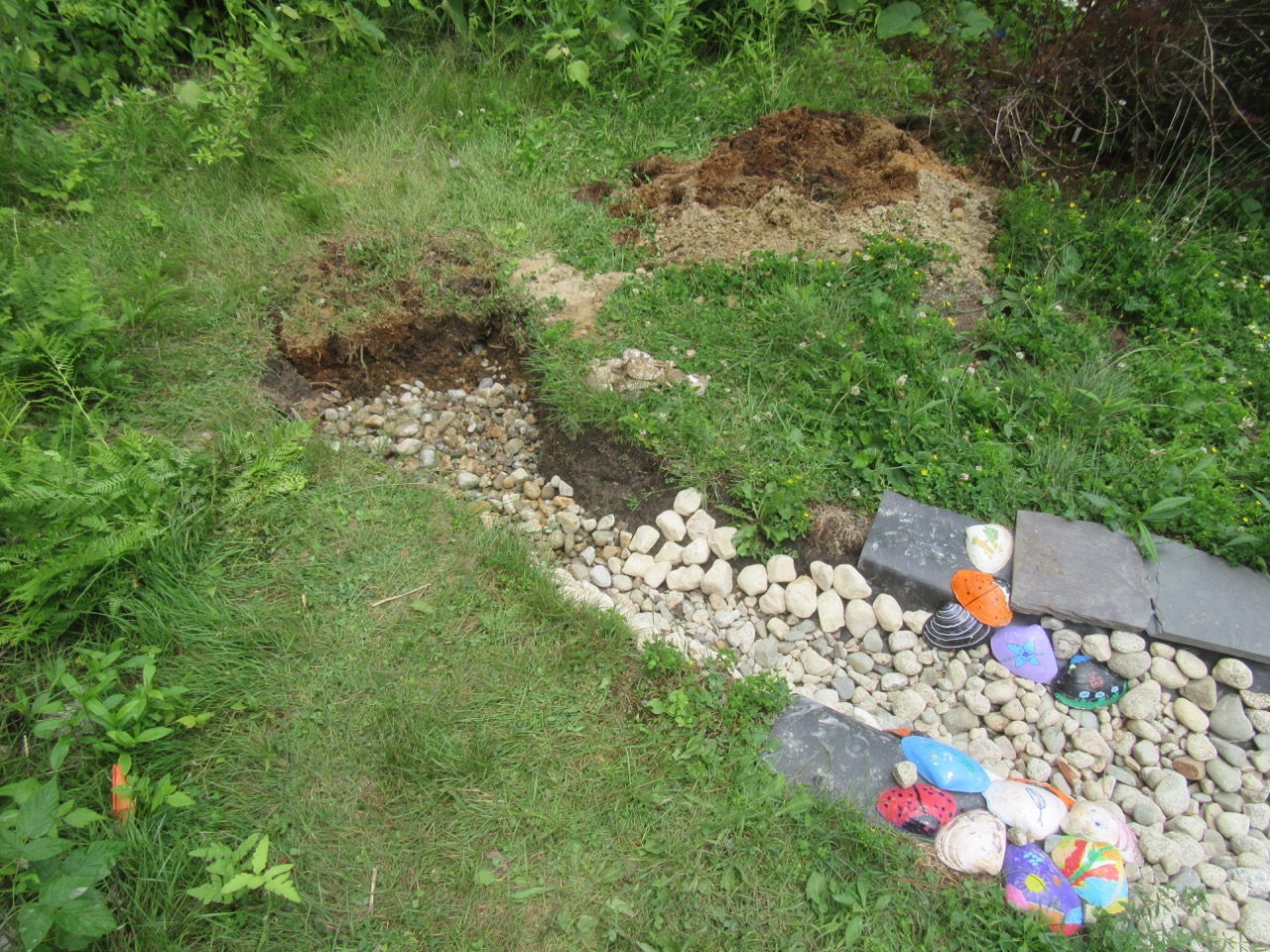
The other day I used up the rest of the half-yard of stones I had gotten delivered early in the process–I added more to the planting ledge so that the plants were better anchored, and then I planned to use the rest of the stones in an upgraded overflow channel spill hole.

We had two inches of rain from tropical storm Elsa, and I was out there in my raincoat in the rain with a shovel, digging the spill hole bigger so muddy water wouldn’t flow back into the pond. Yesterday, I took a leaky five gallon bucket and drilled lots of holes all over it, so water would flow through it easily, but it could hold stones. Then I dug the spill hole deep enough to put the bucket down below the level of the spillway. I filled the bucket with small stones, and also put stones underneath and around the outside of it, finishing up with it today. Another rain is coming tomorrow so I will see if it works.

Photo: white plastic bucket, after drilling holes in the sides and bottom
It is hard to show the slope, which goes down from the spillway on the right gently down to the hole on the left. The bucket is completely buried with more stones on top. I also repurposed some painted shells that had been made for me by the kids in my old church when I retired.

I have gone on many adventures looking for stones on the side of country roads, but I finally succumbed to the temptation to buy a few more bags of stones at the big box store. (I had tried that once before but the quality was terrible.) I needed more small stones to fill up the spill hole, and I needed larger ones for one small section of pond siding under the little deck. The small ones enabled me to complete the spill hole. The larger ones were a weird cream color, that left a creamy residue when washed. I don’t know what they do to them. But I put them in place, along with a few bricks, under the little deck, and now it is complete.

Since my last posting, I was also delighted to receive some blue flag iris from our friend Lisa Fernandes, who gleaned it from her pond. They are already growing new shoots! You can see them in the upper photo, the largest plants on the other side of the pond. I also transplanted my little pond lily tubers into a larger basket filled with stones, and placed them on the lower shelf.

It is so lovely to sit by the side of the pond and watch the reflections on the water… may you have such loveliness in your life.

Planting and grafting and rain

Winterberry bushNewly planted baby bushes are not as photogenic as old trees, but this week I’ve been excited to be planting bushes that have been waiting for two weeks for the ground to thaw. We’ve had so much rain, that on the few non-rain days this last week, Margy and I would be outside for as long as our energy would allow.  So far I’ve planted four witch hazel bushes and two winterberries (that is one in the photo, with a mulch from its shredded paper packing material) and three of the spice bushes.  Two more of those to go.  Margy has been planting clover in the front yard where she did a major crab-grass clearing last summer and fall.

I also took down the winter protection circular “cages” for the orchard trees, and did their first seasonal nutritional spray–a concoction I had learned about from the Holistic Orchard book. (It includes Neem Oil, Karanja Oil, a bit of dish soap, molasses, Fish Hydrolysate, Liquid Kelp, EM-1 microbes, and water, and helps to strengthen the trees own disease prevention and growth.)  The orchard trees have their green tips poking out! I am also seeing new shoots of asparagus, sea kale, licorice, rhubarb, elderberry, and lots of chives.

I haven’t had a chance to mention the apple tree grafting workshop I attended at the Resilience Hub on April 7th.  I won a ticket to the workshop in a raffle the day before at another event, along with a grafting knife.  So, do you remember learning the story of Johnny Appleseed, when you were young?  He went across the land, supposedly, planting apple trees in every town and countryside?  It was news to me to learn that the apples we eat don’t come from trees that grow from seeds.  Rather, they are created from branches-“scions”-of particular varieties grafted onto various root stock.

I did feel pretty clear on the concept of apple tree grafting before I actually went to the workshop–mostly from ordering our apple tree last year from Fedco.  But it was harder than it seemed it would be–the actual cutting of scions and root stock, I mean.  The basic idea was to form a diagonal cut on the root stock, and a matching cut on the scion of the variety we wanted, and then to form a smaller v-shape cut on each of those bare wood parts to help wed them together.  We practiced on spare wood for at least 30 minutes before we started on the root stock and scions.  When the cuts matched (the green edges of the bark needed to meet each other), we’d put them together, tape them with grafting tape, and then cut the scion wood to leave just two buds to grow.  I am summarizing a bit here.

In the end, I brought home four apple trees that I had grafted, albeit poorly. My chosen root stock was M-111, a semi-dwarf variety, and my scions were Black Oxford and Blue Pearmain. I also learned that they could be grown in a kind of nursery bed, and transplanted to a permanent location next year.  So this week, I dug them into our newly designated nursery bed, the one unused circular bed in the orchard, in which I am also growing peas, kale and lettuce (in the photo, the bamboo and string framework are there on the left to support snap peas, and the four apple trees will go in the area to the right.) Now we wait and see if any of them grow!  And just for fun, I brought home some more scion wood, to try and graft it onto our ornamental crab apple trees–sometimes that works, and you can get edible fruit from the new branches. Now if it would just stop raining every day.Pea supports


The (Future) Pond

the future pond after rain

With all the excitement about the rain barrels toppling, I didn’t get a chance to share this other effect of the big rain storm:  our future pond actually looked like a pond (with a little island) on Tuesday.  I only had time last summer to dig up the grass and top soil for most of its surface, meanwhile using that soil in our new annual veggie bed.  This is the slow project–bit by bit digging and removing soil (and putting it someplace else) until the pond is as deep as it needs to be–a few feet in the center, with a foot deep shelf at the edges for plants.  Eventually, we’ll use a pond liner.  The water was gone by the next day.