Swabian Roots

I have been delving into the stories of my ancestors again, and the last few days I was researching my great-great-great grandparents, Johann Nepomuk Heisler (b. 1781 in Westerstetten) and Barbara (Zeller) Heisler (b. 1788 in Tomerdingen). They lived in the small town of Westerstetten, in the Swabian Alb, now a part of Germany. 

Johann was a shoemaker and farmer. They were married in 1805, when he was 24 and she was 17, and moved into their house at Haupstrasse 19 in 1806. [The house was built in 1757 and was still there at the turn of this century.] The first of their children was born in 1806, when Barbara was 18. They had 14 children, but several died in childhood, and Barbara herself died at the age of 37 in October of 1825, one week after the birth of her last child. I would say it is likely that she died of childbirth related issues. At that time, only eight children were still living.

Four years later, in 1829, when Johann married his second wife, Magdalena Rimmele, who was 45, only six of the children remained: Jacob was 20, Martha was 13 (and died 5 years later), Nikolas was 11, Johann was 9, Augustin was 8 and Anton was 4. The youngest four boys would eventually emigrate to the United States—but I will talk more about that in separate stories. [One of which can be found here.]

It is uncertain how long the family ancestors had lived in Westerstetten. Their parents are just identified as “German,” in the records I have. But we might conclude that they were from the area of the Swabian Alb, because Johann Nepomuk Heisler’s grandfather Johann Leonhard Heisler is listed as born in Essingen in the north part of the Swabian Alb. His great-great-grandfather is also listed as born in Essingen, and that one’s wife was born in Westerstetten. So the family were most likely of Swabian heritage.

That whole region was part of the Swabian Alb, centered in the city of Ulm, but including both Westerstetten, and Tomerdingen which were each perhaps 15-17 kilometers north of Ulm. Their small town at that time however was on the edge of rival political entities, and they would have experienced many transitions in the early 1800s.

From 1414 to 1803, Westerstetten, and Tomerdingen as well, were part of the territory of Elchingen Abbey, a Benedictine monastery. For much of its history, Elchingen was one of the 40-odd self-ruling imperial abbeys of the Holy Roman Empire and, as such, was a virtually independent state that contained several villages aside from the monastery itself. This meant it was independent of the jurisdiction of any lord, and answered directly to the Holy Roman Emperor. Perhaps the devout Catholicism of the Heislers is related to their connection to the Abbey. 

Like all the imperial abbeys, Elchingen lost its independence in the course of the German Mediatisation in 1803 (a secularisation and land redistribution process put in place by the French conquests of Napolean) and the monastery was dissolved. When this happened, the village of Westerstetten was given to the “Elector (and then Kingdom) of Bavaria” along with Elchingen, and the city of Ulm. Seven years later, in 1810, the border between Bavaria and Württemberg was re-negotiated and Westerstetten and Ulm both became part of the “Kingdom of Württemberg.”

The Heislers were most likely struggling villagers during all of this. According to one Wikipedia entry, life was extremely hard in the Swabian Alb. There was a lack of water and the soil was poor in quality. For many villages fetching water required a long journey by horse. Since water often needed to be stored over a long time, it became stagnant. Thus disinfection via alcohol was very popular: “Most” (cider) was mixed with water and even given to babies.

I wonder how much the decision to send four sons to the United States was influenced by these difficult conditions, and by the tumultuous political landscape. As it turned out, only one son remained behind, of all of the 14 children. In 1978, my grandmother Lucille Heisler Johnson wrote to her sister, “I remember Papa (Thomas Heisler) telling us about his father and two brothers coming over from Germany. They all had to be under twenty-one because they left Germany to avoid military service.” The last brother came later on his own. I am beginning to imagine these ancestors.

Abbey of Elchingen

Map of Württemberg before the French Revolutionary Wars, showing the Free Imperial City of Ulm, separating the two parts of the Imperial Abbey of Elchingen, with the Danube shown running through the centre of the image. Cropped from German States Before and since the French Revolution: II. Wurtemberg, from The Historical Atlas by William R. Shepherd, 1923, from the Perry-Castañeda map collection. Public Domain 
 

The Power of Memory

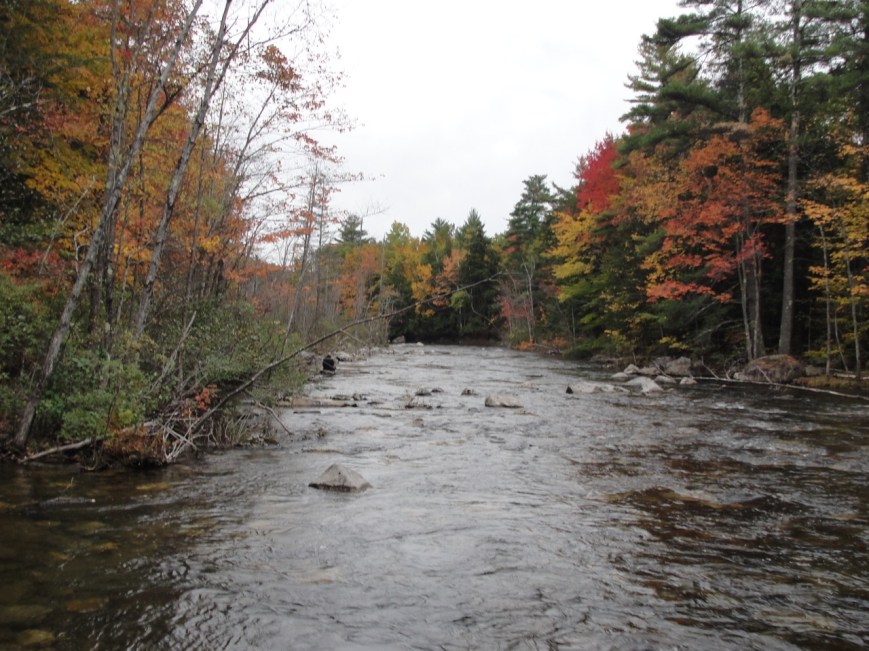
Presumpscott River

I just finished reading Ta-Nehisi Coates’ The Water Dancer, a powerful novel set in the days of slavery and the underground railroad, told through the voice of one young man who is among “the tasked.” There is so much I could say about this story.  Starting with this word, “tasked.” Coates never has his characters who are in bondage call themselves “slaves,” but rather, “the tasked.” And this subtle shift of language helps to transport us beyond the familiar words (of the masters) that have been written as history, into the direct perspective of those who were counted as property.

Even though I learned about slavery from my early days in school, it was easy to discount (even by benign repetition) the pervasive way this institution shaped the whole of our nation from its beginnings, it was easy to mask its reach and extent and corruption.  I grew up in the north, and it was easy to think of it as something far away, other.  But in recounting exploits of folks in the underground railroad, Coates makes clear that people in the north weren’t safe from slavery, or immune to its power. Any person of African descent could be captured off the streets of Philadelphia and transported away into bondage. A person of European descent who devoted themselves to ending slavery risked being murdered.  It was everywhere in this country.

It is not that the novel opened my eyes to some new knowledge, but that it helped me remember what I have already known, and bring it alive in a vivid way.  The whole practice and institution of slavery makes a lie of any notion of “greatest country” or “good old days” or “American dream.”  From the earliest settler invasions in 1619, through the creation of the “United States,” through the Civil War, up to 1865–246 years–the country was bound up in these practices of forced labor, torture, separation of families, sexual abuse. We are part of a horrible legacy that still shapes everything about our country, even though there are strong incentives for us to “forget.”

In The Water Dancer, the central character, Hiram Walker, has a magical gift that is tied to the power of memory.  He was a precocious child with a photographic memory of everything, except for the memory of his mother, who was sold away from him when he was only a young boy.  That trauma erased all memories of her from his consciousness. But later, crossing a bridge over the river Goose, the bridge where so many people had been lost into the deeper south, he sees a vision of his mother dancing with a water jar on her head.

The story begins here.  On the first page he says,

“knowing now the awesome power of memory, how it can open a blue door from one world to another, how it can move us from mountains to meadows, from green woods to fields caked in snow, knowing now that memory can fold the land like cloth, and knowing, too, how I had pushed my memory of her into the “down there” of my mind, how I forgot, but did not forget, I know now that this story, this Conduction, had to begin there on that fantastic bridge between the land of the living and the land of the lost.”

He doesn’t come into the power of his own magical gifts until he can awaken the full memory of all that he has lost, and the painfulness of that loss. And perhaps we too will never find healing for all that we face in our world today, until we open our minds to the painfulness of what we call the “past,” (because it is never “past”), until we are willing to face it as it lives within the “down there” of this land we call home.

The Water Dancer creates that kind of magic, conjures the power of memory to transform all that we are.

Ancestor Wounds and Healing

I’m on my way to the Wild Maine Witch Camp!  My friend Sylvia and I are leading one of the morning workshop series (called a Path), on the topic of Ancestor Wounds and Healing. 

Our intention in this path, is to open our lives to the blessings of our ancestors and to healing the wounds we carry from them. This work, for us, is rooted in our understanding that our path as witches is tied up with collective liberation from colonization and oppression, from patriarchy and racism. Connecting with our ancestors is a way to wrestle with our collective history and all that it includes, in order to bring healing and liberation in our times.

I have been blogging about this process with my own ancestors for the last several months, discovering more about the experience of my German and East Frisian immigrant ancestors, and the Quebec story of my French, Innu and Scottish ancestors. I’ve been asking questions about how the stories of my ancestors fit into the larger story of colonization, of relationship to the land, of migration, and belonging. Perhaps I have also been wrestling with the question of whether my European ancestors might have any blessings to offer me. That story is so tangled and broken.

I am looking forward to sharing this work with a group of people in the context of our lives as witches. Our tools will include experiential magical practice, music and chanting, personal sharing, guided meditation and trance work, sacred herbs, and the wisdom of each person in the circle. We will draw on Joanna Macy’s Work that Reconnects which is based on a cycle of four movements that we will use through our four days together. We will begin with gratitude, then move into honoring our pain, then seeing our connections with new eyes, and finally, going forth.

Perhaps I am hoping to discover if this message from Linda Hogan, Chickasaw writer, also might apply to me:

Walking. I am listening to a deeper way.

Suddenly all my ancestors are behind me.

Be still, they say. Watch and listen.

You are the result of the love of thousands.

Biddeford Pool beach

Meanwhile in the Garden

Winecap MushroomsA few fun surprises this week in the garden. Way back in May, I had inoculated the wood chips near the fruit trees with Wine Cap mushroom spores.  Then nothing happened all summer, so I figured maybe it wasn’t moist enough and didn’t take.  But this week suddenly, beautiful big mushrooms started sprouting with a reddish tint to their caps. Being cautious, I checked the package again, and also researched Wine Caps on the internet–I was relieved to discover there are no poisonous look-alikes. First Mushrooms
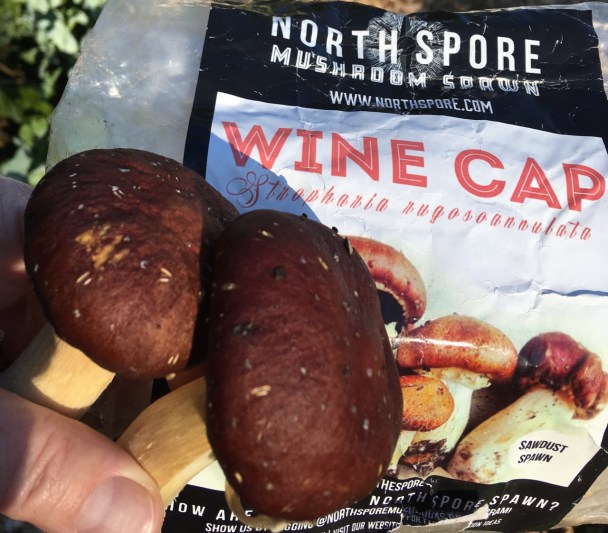
Since then we’ve had fresh mushrooms in our eggs and in a batch of spaghetti sauce. The mushrooms keep popping up all over the orchard. They should come back again each year now.  What a marvelous thing to get food right from the ground!

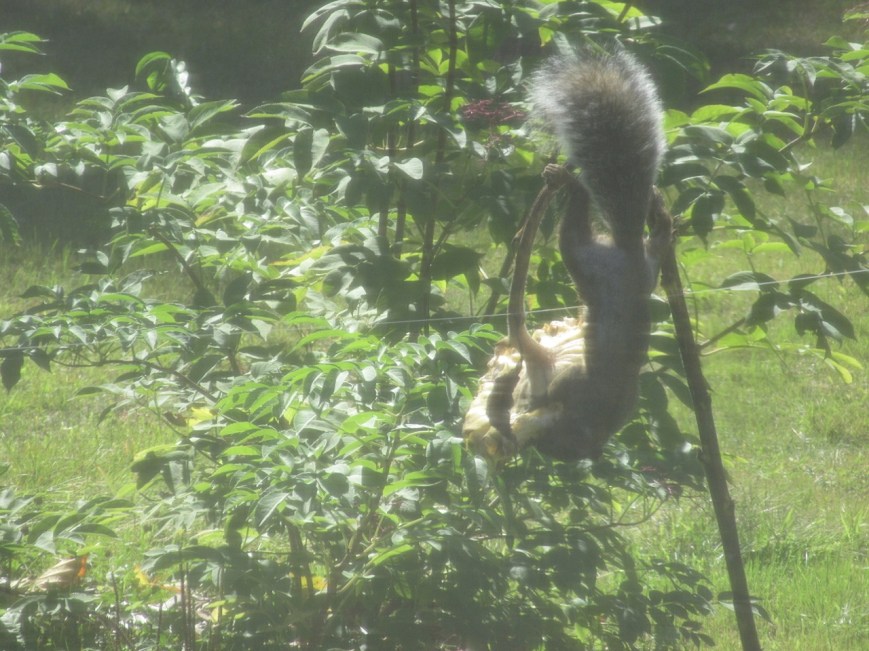
Speaking of food from the ground, the squirrel was excited to discover that one of our volunteer sunflowers had seeds on it. Just like she would do on our bird feeder in the winter, she hung upside down to get to the meaty morsels.Squirrel on Sunflower

Were they really there? Later, I checked for myself. Certainly enough for a little snack. I think this is the same squirrel that decided she should build a nest this week under our solar panels, in a spot behind a cross board that supports our deck roof.  Not good!  (Squirrels can chew the wiring and mess up the solar panel system, we discovered.) Each morning and evening Margy or I would climb on a ladder to pull out small branches and leaves and grass to undo what she had built. We’ve got a plan to cut off some branches on our ornamental crabapple that form a super-highway from the materials to the roof.

But one day, while I was on the ladder pulling out stuff, she came running down the gutter and stopped short when she saw me. I said to her, “You can’t build a nest here! This is our house. Go find a nice tree.”

I don’t know if it was my stern suggestion, or the pile of “stolen” nesting material that was scattered on the deck beneath the ladder, or sheer discouragement from all her work being undone each day, but the last two days she has not replenished her spot. (We’re still going to prune the tree though!) Maybe the sunflower seeds were a little something to sweeten the agreement. We try to find a balance with our plant and animal neighbors in this place. Giving and receiving in gratitude.

Sunflower Seeds

Garden Updates

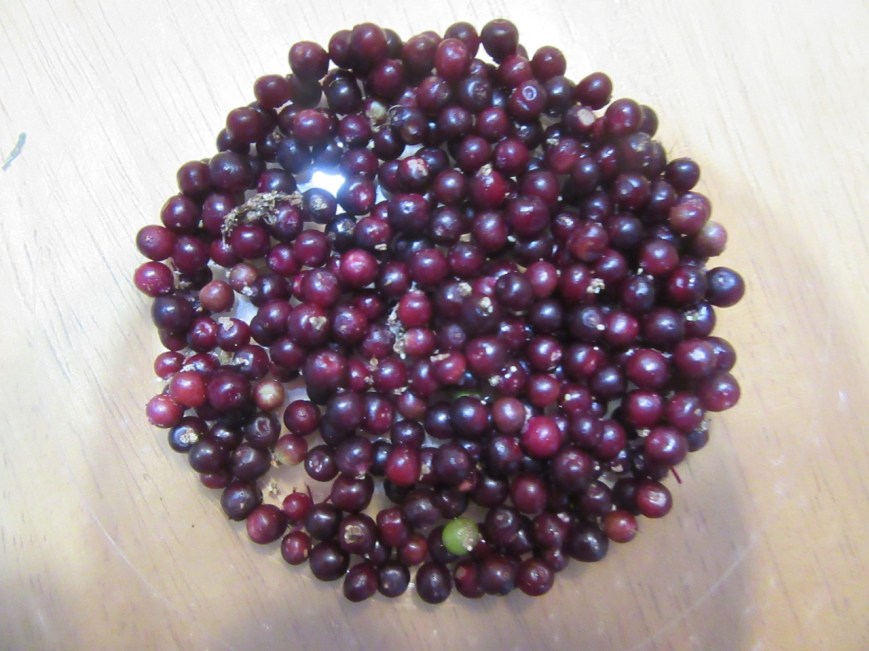
Elderberries ripeThis week there were a few exciting new developments in the garden. We harvested our very first elderberries—maybe a whole half cup of them! Earlier in the summer, I was worried about whether something was wrong with the elder flowers, and perhaps there was, but eventually they created a spotty bunch of green berries. I must admit, I hadn’t gone by the bush for several days, but when I went out the other day, they were purple. I ate one that was quite sweet, but Margy tasted a sour one, not as ripe. Elderberry harvest 2019Not enough to make elderberry syrup, or really much of anything, but enough to be enthused about future possibilities. Margy and I will have to celebrate with a berry eating ritual.
Another new development: I saw a few catkins on our hazelnut bushes! I hadn’t known to expect them, but when I  looked it up, I learned that these are the male part of the plant’s reproductive system. They will stay on the plant through the fall and winter, and then in very early spring they start lengthening and unfurling.  When the female flowers open at the tips of branches, they pollenate. Hazelnut catkinsThere are only a few catkins right now, but they are a harbinger of future crops of hazelnuts. In my last batch of pesto, I used hazelnuts from the Food Coop to add to basil, parsley, chives and garlic from the garden, plus olive oil and lemon of course. So we can’t quite do it only from our garden, but maybe more and more.
I also processed oregano and thyme that had been drying in the basement herb dryer for longer than they needed to be, and did another batch of frozen chives, and frozen kale for the winter. Our harvest is limited more by my own energy than by the earth energy.

If anyone local would like oregano or thyme or chives, please let me know—they are flourishing in the garden still, and I’d be happy to share—also lemon balm, comfrey, and dill. They have all been very enthusiastic.

Miracle of Ocean

Crescent Beach September

Yesterday late afternoon, with the weather up to 80 degrees, I went to Crescent Beach. Would it be the last day warm enough for me to go in the water? Maybe, maybe not. But without expectations, I set up my chair on the sand, and walked down to the edge of the water to feel the cold splashing on my feet. Its temperature was mildly cold not frigid, much warmer than early summer. There were a few more waves than usual. Only a small group of children were in the water, jumping into the waves as they broke on the shore.

I have become a bit timid about waves, as I have gotten older. The tide was low, and there were lots of round stones to walk over, so I came back to my chair and put on some swim shoes, so I’d have better balance. Then I walked back out and stepped right in. I moved quickly through the breaking waves and past them to about my waist level. The rhythms of the water rose up to my shoulders, and then back down, lifted me up and down, too, but gently. I dove into one wave to cover my head, but then I just stood facing the sea, watching the waves come in, letting them carry me up and down.

Here’s the amazing thing: after being in the water, the waves, for a long time, and then staying longer still, I began to be washed in a sense of joy and happiness. It felt miraculous because this whole past week, I had been feeling exhausted and achy–a classic flare up of the auto-immune conditions I struggle with. But somehow the water washed all of that away, and I was filled with a physical sense of well-being and playfulness.

When I go into the water, I usually pray to the Mother Ocean, I give her my worries and struggles. She is one kind of divine presence, larger than I can ever be, and the source of all life. But it wasn’t my small prayer that shifted me–it was the very energy and power of her presence all around me, it was the waves dancing with me, it was my body responding to the waves. It was unexpected.

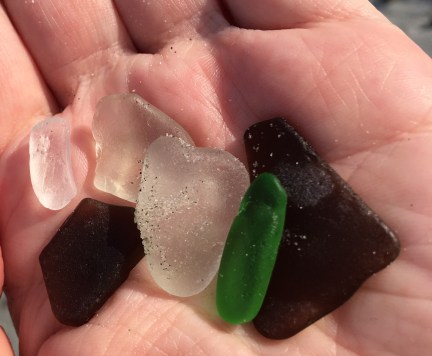
Filled with this lovely happiness, when I came out of the water, I walked along the shore looking at stones and shells, and I found several pieces of sea glass. I love that the ocean can transform these broken bits of human invention into tokens of beauty. Since I have been thinking lately about the ancestors, it came to me that sea glass is a kind of gift from people who came before. I’ve read that it can take 20-40 years in the waves, sometimes longer, for glass to be tumbled to create this patina. So someone a long or short time ago made the glass, touched it, discarded it.  I am holding this connection, broken yet made whole again, and so I prayed for friends and family who needed healing.Seaglass

After my walk, I sat in my chair and ate some yogurt mixed with cocoa, honey, cacao nibs, and blueberries. I started reading the novel Barkskins by Annie Proulx, which begins with French settlers in Quebec taking down the forest. (Another way to try to understand colonization.)  Isn’t it a picture of happiness, to read in a chair on the beach, sun on my shoulders?

monarch catepillarOn my walk back to the car, one more fun surprise. This colorful monarch caterpillar on a milkweed plant just past the beach roses.
I wish I could share with you the happiness of being in the ocean, of walking on the shore finding sea glass, of reading on the beach on a September evening, of finding a monarch on a milkweed.

But the happiness was triggered by actually being in the ocean with its waves dancing me up and down. So if you are feeling timid about walking into the waves, whether literal or metaphorical, please know that on the other side little miracles might happen. Joy might find you.


Conflicting Survival Strategies in early Quebec

(More reflections on colonization in Quebec, jumping off from the book Helene’s World.)  Author Susan McNelley writes:

Summer days for the French settlers were long and filled with hard work. This was not the case for the indigenous people. Life was much less demanding in the summer. Fish, fowl, and small game were readily available in the river and nearby forest. The indigenous peoples along the St. Lawrence didn’t worry about storing food to last the winter. To the consternation of their French neighbors, the natives spent much of their time sleeping and socializing with their friends. There were games, story-telling, feasting and opportunities for young people to meet and court.  Summer was a time of replenishment and fortification for the rigors of winter.

A common factor for both Montagnais/Innu people and French settlers in early Quebec was surviving the long hard winter.  But they had quite different strategies for doing that. The French worked very hard in the summer to clear fields, and plant and harvest crops. Bread was their primary food. They were agricultural people, and in the early years were also reliant on ships arriving in summer with new supplies, to replenish their stores of wine and oil and spices and grains. They preserved food and stored it for surviving the long winter. Winter included much less activity, so in some ways it was an easier time, but they were on their own, and their strategy for survival was to carefully ration what food they had among the people in their families.

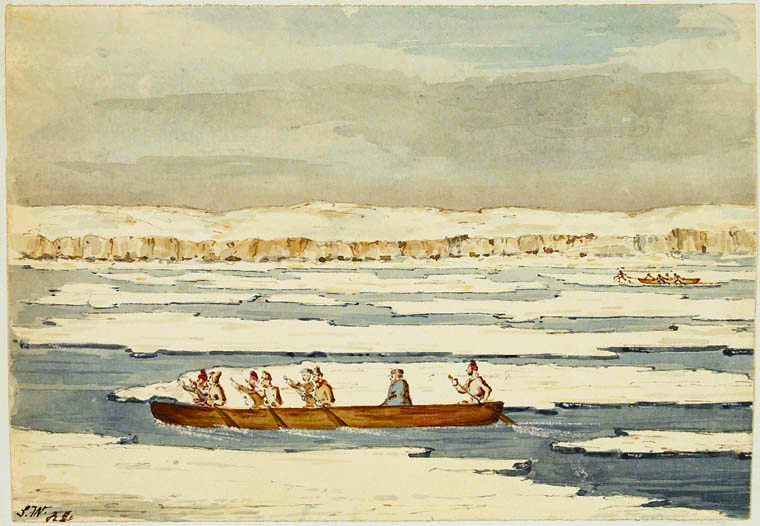
For the Montagnais, on the other hand, summer was the easy time–they camped by the river, fished & hunted, gathered fruits and nuts, feasted and celebrated with each other, and generally felt a sense of abundance in all sorts of food. As the fall came, they caught and dried eel, and then they left the summer encampment and began to hunt small game in the nearby woods. In winter, they traveled in small family groups into the interior, where they relied on heavy snow cover to slow down the big game: moose, caribou, deer, and bear. When they were successful in the hunt, they shared their feast with nearby families.

hiver_transports_11

Susan McNelley describes a winter incident recounted by Champlain when some of the Montagnais/Innu came to the early French settlement, because they were starving, and asked for food.

Although the French did try to be generous, they rationed the distribution of provisions to the aborigines out of necessity. Otherwise, the food would not have lasted a month.

The French believed that the Innu were irresponsible because they didn’t store food, and because when they acquired food in the hunt, they ate all of it, or shared with their neighbors.  But if you are traveling to follow big game, it wouldn’t be practical to carry large quantities of preserved food.  It would be practical to share the abundance that came sporadically depending on who had a good hunt.  Reading between the lines of this incident, I could imagine the Innu noticing that the French had food while they had none, and expecting, according to their own values, that of course the French would be willing to share with them. Their strategy for survival was sharing what became available, as it became available. The French strategy was about storing up and rationing.

And isn’t that just like capitalism, really, and how our modern mainstream society works.  “Save what you don’t need now, to use later. Try to accumulate as much as possible. That is the definition of wealth.”  (But perhaps rampant consumerism and planned obsolescence have superseded that model too.  Some things to think about.)

I feel the pressure of this time of year to preserve what we can from our garden, small as it is–making pesto from basil and chives and parsley, freezing kale, drying herbs–in our own way getting ready for the long Maine winters. We certainly wouldn’t know how to survive on our own, without being able to go to the Food Coop or grocery store. So perhaps both the French settlers and the Innu had better survival skills than we have now.Kale


French and Innu in Early Quebec

Samuel de Champlain map of Quebec

1612 Map of New France by Samuel de Champlain

Some thoughts on early French and Innu ancestors, on reading Helene’s World: Helene Desportes of Seventeenth-Century Quebec, by Susan McNelley.

I was surprised to learn that the primary Indigenous nation at the Quebec settlement in 1620 (later, Quebec City) were the Montagnais (Innu.) I had thought they had been mostly living further downriver and inland. But the Quebec settlement was one of the summer dwelling places in their vast territory along the St. Lawrence, where they fished, gathered herbs and berries, and traded with their neighbors for corn and tobacco.

In the early days of the settlement, the Innu, along with the Huron (Wendat) from further west, and other Algonquin tribes, were the main trading partners of the French.  Beaver pelts were the primary export from the colony.  Interestingly, the French especially valued the used pelts–those having been worn for a few years–after the longer hairs had worn off, because the French used the shorter hairs to felt for popular hats back in Europe. So what a great opportunity!  The Innu could trade the pelts they were about to discard, for copper kettles, metal tools, firearms, blankets, and food.

In the early days of the settlement, hundreds of canoes would arrive each summer, bringing furs for the annual trade. The French settlers had become part of earlier trading patterns. (The French made the choice to ally with the Huron and Montagnais against the Iroquois, and those earlier rivalries were exacerbated by competition to control the beaver trade. The Iroquois had allied with the English and the Dutch.)

But beginning in the 1630s, as in so many other places on this continent, diseases from the Europeans proved decimating for the Native peoples who had no natural immunity to them. Measles, smallpox, plague. The Huron/Wendat lost 50% of their people, and losses were said to be similar among the Montagnais/Innu. That, combined with increasing hostilities with the Iroquois, caused the remaining Innu eventually to go further downstream or inland.

French colonization took a different shape from English colonization.  There was more interaction with–and valuing of–Indigenous peoples as trading partners and allies. But an underlying driving force of this colonization was the desire of French Catholics to convert the Indigenous people to Christianity, to “save their souls,” which for them was inextricably linked with their also adopting French customs and lifestyles.  The Jesuit priests and Ursuline nuns settled in Quebec with a special call to this mission.

Native people were seen as “savages” who must be “civilized.” The French colonizers would send a few people to live among the tribes to learn their languages and customs. They invited Native people to send their children to be educated, and a few did send their children to the Ursuline school. There were many positive connections between the two groups. The Indigenous people were interested in the French, they shared a love of pageantry and celebration, they valued the trade, but ultimately and unsurprisingly, most were unlikely to give up their own ways for the ways of the French during these years.

More later on their different cultural strategies to survive the hard winters…

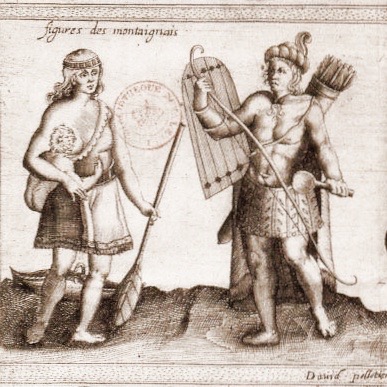
Montagnais as seen by Champlain detail

Detail from the map–Champlain’s drawing of Montagnais/Innu people.


The Flowing

Orchard August 2019

The other morning I woke from a dream, in which I was thinking about Wabanaki languages. Wabanaki languages are a flowing. Everything is moving. Verbs are central. Verbs change shape to fit who is acting, who is moving, how many, and who or what their object might be. For example, Wiku is a verb for identifying where someone dwells. (The k is pronounced like g.) As in, Wiku Portland, meaning, “He/or/she lives in Portland.” But to say, “I live in Portland,” would be Nwik Portland.  “Where do you live?”  Tama kwik?

Even many nouns are flowing, changing, shapeshifting. Like the word for home. The noun, Wik, means a home. But “my home” is nik. “At our home” is nikonuk. “At your home” is kikonuk. The words flow depending on who lives there, or if you are going there. And the words for “mother” are related to the words for home. Wikuwossol, nikuwoss, kikuwoss. “His/or/her mother, my mother, your mother.” Flowing. Shapeshifting. Full of relationship.

English, on the other hand, is filled with many more nouns than verbs. Since contact with the colonizers, Wabanaki languages have had to add more nouns to the lexicon, to translate from English or French. Some of these nouns were created from verbs by adding an ending that, by itself, means “bait.” For example, koselomol, means “I love you.”  But to turn the verb “love” into a noun, you must say kseltomuwakon. Wakon means “bait.” So perhaps to make these nouns we must capture the verb, trap it with our bait, to stop its movement for a moment.

We colonizers live in solid houses with lots of things/nouns in them. The Indigenous peoples of northern places used to live in easily movable homes, with fewer things, to follow the hunt in winter, to fish the shores in summer. Everything was a movement, a dance, a shape-shifting. (Of course, many southern Indigenous peoples were/are farmers, stayed in one place. I don’t have any exposure to how their languages work.) But I notice the tendency in me to look for solid things, to struggle with the endless flow.  To try to put things in their places, get organized.  Make vocabulary flash cards to capture the words into my brain. (Even though the Wabanaki Languages class I am taking is on summer break, I have been listening to the recordings from the class, and continuing to study.)

Still, the garden in this place, at our home, nikonuk, also tries to teach me about flow, if I can be open to it. Every week is filled with different patterns and growing and shapeshifting. This week, no more snap peas or raspberries. But the basil has come back again after I harvested most of its leaves a while ago. The young fruit trees are wild and leafy. The bee balm is dying, and prone to powdery mildew. My nephew and his girlfriend helped me put wood chips on the paths during their visit a couple weeks ago. It rained during the night last night. Every day is different. There is no way to get the garden in shape, in form, once and for all. It demands relationship, interaction, flowing, it demands the verb “gardening.”

In Passamaquoddy, kihke means “He/she gardens or plants,” and kihkan is a garden. It is also another form of the verb.


Gifts

During the spring, Margy was talking about wanting to plant sunflowers this year. But as it happened, she was busy with too many other garden projects to actually do it.  So imagine our delight when the garden planted its own sunflowers! They came up under the bird feeder, now sitting empty for the summer, but where sunflower seeds were the food we offered to the birds (and squirrels) all winter.

Gift sunflowers

Lately, the garden plants have felt mostly like children who need our care and attention. With the dry hot weather, they’ve needed a lot of watering. Yesterday, I did another foliar spray for the fruit trees, to help them ward off Japanese beetles, which I also have been picking off every day and dropping in soapy water. And there have also been lovely raspberries to harvest each day, and snap peas (almost gone now) and kale and basil to gather and preserve.

So this gift of flowers emerging without any effort on our part–perhaps the land is reminding us that she loves us as we love her?

It has been one year since my retirement began. One of its themes has been to find connection with this small portion of the Mother Earth, this land we are so lucky to call our home. As non-Indigenous people, we are trying to heal a long wounded history of our people’s disconnection from land.  Our ancestors left their home places generations ago.  If our society had an understanding of earth connection, it could not destroy earth life as it destroys, with such thoughtlessness–pollution, clearcutting of forests, poisoning of soil with pesticides, trash dumping, mining, fracking… the long list of ecological destructions that are endangering us all.

So in our small corner of the world, we are trying to reweave those threads of interconnection, reawaken the truth–long dormant in our bodies–that we are not separate from the earth–we are the earth.  As we tend the land, as we care for the plants, as we pay attention each day, we hope that a shifting occurs–that we move from domination patterns to partnership patterns in our relationship to Earth. We know how small we are–yet hope that if we can shift our own patterns, it might in some way ripple out to the larger patterns. Because we are interconnected. Because that is the magic.

The gift sunflowers remind me that the land herself is eager to be in partnership with her human children. She loves us and wants wholeness for all.

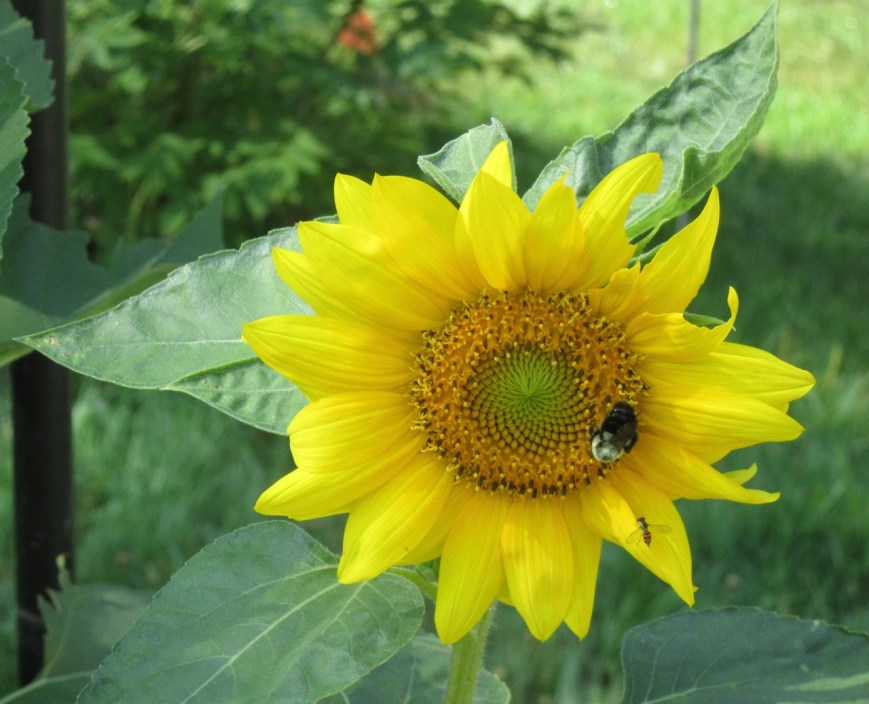
sunflower with bees

Every sunflower has its bees.