As I move toward retirement, I have been bringing back old favorite sermons to preach again. This one, called Patience and Poetry, reminded me of the poetry that preaching itself can be. It feels like poetry when I am able to weave together certain images, vivid metaphors, weave together the words of others with my own, creating some sort of whole from these previously unrelated parts. So in this sermon, the image of the grasshopper became a central thread, and perhaps also the grass below our feet. I will miss this form of poetic endeavor, so different from other forms of writing, (though I will not miss the suffering that each sermon required to create.) I don’t often share sermons on the blog–too long–but here it is for today.

[Photo by Margy Dowzer]
The poetry of earth is never dead:
When all the birds are faint with the hot sun,
And hide in cooling trees, a voice will run
From hedge to hedge about the new-mown mead;
That is the Grasshopper’s—he takes the lead
In summer luxury,—he has never done
With his delights; for when tired out with fun
He rests at ease beneath some pleasant weed.
The poetry of earth is ceasing never:
On a lone winter evening, when the frost
Has wrought a silence, from the stove there shrills
The Cricket’s song, in warmth increasing ever,
And seems to one in drowsiness half lost,
The Grasshopper’s among some grassy hills.
What is patience? The dictionary describes it as the bearing of provocation, annoyance, misfortune, or pain, without complaint, loss of temper, irritation or the like; or, an ability or willingness to suppress restlessness or annoyance when confronted with delay; or, quiet steady perseverance, diligence, and care. Its root is in the Latin, pati, which means to undergo or suffer, connoting the bearing of an action caused by another or beyond our own control.
What is poetry? The dictionary says it is the art of rhythmical composition, written or spoken, for exciting pleasure by beautiful, imaginative, or elevated thoughts; or, lofty thought or impassioned feeling expressed in imaginative words. The word comes from poet which derives from the Greek poiein, which means to make, plus tes, which connotes an agent.
At their roots then, these words patience and poetry are almost opposites—one implying quiet acceptance of what comes our way, and the other pointing to active creation. And yet, I think perhaps that any poet would say: no word is merely fashioned simply and easily on the page, child of the act of writing. Rather there is some mysterious deeper quality of waiting, or receptivity, even suffering, to bring it forth. And in the midst of bearing the most tumultuous of storms, when life overthrows our well-imagined plans, we can discover moments of pure creativity—songs we choose to carry us through the night.
Poet Adrienne Rich wrote:
“A wild patience has taken me this far
as if I had to bring to shore
a boat with a spasmodic outboard motor
old sweaters, nets, spray-mottled books
tossed in the prow
some kind of sun burning my shoulder-blades.
Splashing the oarlocks. Burning through.”
And then later,
“After so long, this answer.
As if I had always known
I steer the boat in, simply.
The motor dying on the pebbles
cicadas taking up the hum
dropped in the silence.”
The thing is, she isn’t really talking about a boat; she is talking about life. And that is how poetry is. Poetry connects one thing to another, and by those connections seeks to understand something of the imponderable questions that are stirred up in our souls by all that is beyond our control.
Life is both a suffering of what happens to us, and a sometimes heroic story told by ourselves as we make of our lives something beautiful. That is the real poetry—the whole wide range of creativity that human beings bring forth from our messy, muddled, magical lives.
Where does creativity come from? The writer looks out the window and sees the sunlight melting ice from the trees, with a sound like rain strangely falling on the dazzling bright snow. The gold finch’s olive drab feathers are turning yellow at the feeder. A rhythmic beat, a moment of beauty. But something more. In March, already the buds are forming on the tips of tree branches. Already the seeds are stirring. Then the ice comes with bracing wind. There is a struggle between winter and spring, shifting alliances moving back and forth each morning. But the sun is patient, each day bringing a few more minutes of light.
Some things can be rushed. Phone calls made, shopping done, bills paid, floors swept, dishes washed. But some things can only be brought forth in their own good time. A wild patience is needed for creativity. Patience like the patience of the sun in March. Life carries the original rhythms.
In Elizabeth Barrett Browning’s poem, entitled: “Patience Taught By Nature”, she wrote:
‘O dreary life,’ we cry, ‘ O dreary life ! ‘
And still the generations of the birds
Sing through our sighing, and the flocks and herds
Serenely live while we are keeping strife
…Meek leaves drop yearly from the forest-trees
To show, above, the unwasted stars that pass
In their old glory: O thou God of old,
Grant me some smaller grace than comes to these !–
But so much patience as a blade of grass
Grows by, contented through the heat and cold.
Jeffrey Lockwood is an entomologist who studies grasshoppers. During his first summer of research, he spent hours and days and weeks in a field, observing and videotaping. He wrote:
The greatest virtue of my summer’s work would be patience. …I didn’t analyze the ten-foot shelf of videotapes until later that fall, but even in the summer I knew full well what grasshoppers did most of the time: nothing. Absolutely nothing. Despite my focus on the times when the grasshoppers were “doing” something, for forty-three minutes of every hour they were not doing anything.
Mary Oliver wrote:
Who made the world?
Who made the swan, and the black bear?
Who made the grasshopper?
This grasshopper, I mean-
the one who has flung herself out of the grass,
the one who is eating sugar out of my hand,
who is moving her jaws back and forth instead of up and down-
who is gazing around with her enormous and complicated eyes.
Now she lifts her pale forearms and thoroughly washes her face.
Now she snaps her wings open, and floats away.
I don’t know exactly what a prayer is.
I do know how to pay attention, how to fall down
into the grass, how to kneel down in the grass,
how to be idle and blessed, how to stroll through the fields,
which is what I have been doing all day.
Tell me, what else should I have done?
Doesn’t everything die at last, and too soon?
Tell me, what is it you plan to do
with your one wild and precious life?
There is a creativity that can only come to us through quiet waiting. Through doing absolutely nothing. Through paying attention. That is one kind of patience. Robert Epstein, a professor in human behavioral studies and one-time editor in chief of Psychology Today, wrote, “In my laboratory research, I’ve learned about the enormous benefits waiting has for creativity. When people are struggling to solve a problem, the more time they have, the more creative they become. Even long periods of inactivity are eventually followed by breakthroughs. The main challenge is to teach people to relax while ‘nothing’ seems to be happening.”
Entomologist Lockwood writes, “Our struggle to understand the languor [of the grasshopper] arises from our approaching these creatures with the same question with which we approach each other: ‘What do you do?’ It is as if we can define all worth in terms of what someone or something does.” He goes on to say,
If we seek to reveal the inherent worth and dignity of life—…then it is not surprising that a grasshopper might spend a couple of hours just sitting. I am reminded that Thich Nhat Hanh, the Buddhist priest, suggested that when people are hurrying about and shouting, “Don’t just sit there, do something!” the crisis might be more effectively addressed if a quiet voice admonished us, “Don’t do something, just sit there.” Maybe grasshoppers would make good Buddhists.”
In one of my idle moments, I googled the words patience and grasshopper, and discovered that there are T-shirts that say “Patience Grasshopper” on them. Actually, they say “Patience,” with a picture of a grasshopper. What is this about? I wondered. Through much more googling, I finally found a reference to the old television series, Kung Fu. Master Po, apparently, was always saying to Kwai-Chang Kane, “Patience, Grasshopper, Patience.” Kane wasn’t patient. That is why the Master gave him the name, Grasshopper—because he wasn’t quiet enough—he wasn’t paying attention enough—to notice the sound of a grasshopper near his feet.
Going back to the work of Jeffrey Lockwood, who pays attention to grasshoppers—the irony is that his job is to kill them. He works for cattle ranchers in Wyoming, and grasshoppers can wipe out the fields that cattle need to graze on. He is an ecologist, and has helped to figure out how to kill grasshoppers with fewer pesticides, and less overall harm to the environment. But the role of respectful observer doesn’t sit easily with the role of careful executioner. He writes:
At the beginning and end of each summer, I sneak away from my field assistants… to be alone, to pray. This is a time when I experience the fullness of the prairie, when I seek what lies at the core of my intentions as a scientist, and when I release the guilt and shame. The thought-words are different each time, but the question I ask myself persists: Why do I continue to develop the means of killing these creatures?
I justify killing grasshoppers because my intentions are purified by love for them. I am soothed by the notion that I mean well, that I foster a world in which there is less killing, and fewer misunderstandings between species. I tell myself that intentions are all that we really control; outcomes are evasive and uncertain. But spraying thousands of acres with insecticides, regardless of intentions, is going to do a lot of harm.”
Life is always messy and our choices are complicated. Lockwood compares his work with that of his father, a nuclear weapons researcher who believed that what he was doing would prevent war with the Soviet Union. How do we create change in the world? How is peace brought forth? Can we find the patience to wait until we have clarity about what we should do? Or must we have patience with our own imperfect attempts, as we dirty our hands and muddy our feet seeking to create the path forward?
After all, nature itself is not merely sparkling sun and singing birds. Lockwood talks of walking along a barbwire fence, on which every forth or fifth barb held a grasshopper. This was the doing of the shrike, a bird that impales its prey for safe storage, and barbed wire was an alternative to its standard thornbush. He comments that brutality was not the exclusive purview of humans. Grasshoppers, too, are cannibals, and will quickly eat their dead companions.
Mary Oliver, in “A Dream of Trees,” wrote:
There is a thing in me that dreamed of trees,
A quiet house, some green and modest acres
A little way from every troubling town,
A little way from factories, schools, laments.
I would have time, I thought, and time to spare,
With only streams and birds for company.
To build out of my life a few wild stanzas.
And then it came to me, that so was death,
A little way away from everywhere.
There is a thing in me still dreams of trees,
But let it go. Homesick for moderation,
Half the world’s artists shrink or fall away.
If any find solution, let him tell it.
Meanwhile I bend my heart toward lamentation
Where, as the times implore our true involvement,
The blades of every crisis point the way.
I would it were not so, but so it is.
Who ever made music of a mild day?
Creativity emerges in the heat of crisis. Patience is forged in the fiery struggle to sort out impossible choices. When I first planted a garden I was surprised—most of the work was about killing things—pulling weeds, drowning slugs in stale beer, thinning seedlings, by which it is meant, throwing away some perfectly fine little carrots so that the others can grow larger roots. Patience is a forgiveness for the tragedy of this world—that nothing is quite what we might like to imagine or dream, that everything is tinged with lamentation. Can we still embrace the stained and messy whole of it? Can we shape the clay of each day into a vessel that might hold a flower?
In the ancient Celtic world, Brigit, the Goddess of poetry was also the goddess of healing and of smithcraft—she shaped the broken things of the world through fire, into beauty and usefulness.
Mary Oliver wrote, in a poem entitled “Where Does the Temple Begin, Where Does It End”:
There are things you can’t reach. But
you can reach out to them, and all day long.
The wind, the bird flying away. The idea of God.
And it can keep you as busy as anything else, and happier.
The snake slides away; the fish jumps, like a little lily,
out of the water and back in; the goldfinches sing
from the unreachable top of the tree.
I look; morning to night I am never done with looking.
Looking I mean not just standing around, but standing around
as though with your arms open.
And thinking: maybe something will come, some
shining coil of wind,
or a few leaves from any old tree –
they are all in this too.
And now I will tell you the truth.
Everything in the world
comes.
At least, closer.
And, cordially.
Like the nibbling, tinsel-eyed fish; the unlooping snake.
Like goldfinches, little dolls of gold
fluttering around the corner of the sky
of God, the blue air.
Creativity comes to those who wait, “as though with your arms open.” And maybe that is also the definition of prayer. A kind of active waiting. A wild patience in the middle of the muddiness. Whatever the grasshopper is doing, before it leaps into the air.
CLOSING WORDS
As those who are struggling will say, each day,
God grant us the patience to accept the things we cannot change,
the courage to change the things we can,
and the wisdom to know the difference.
Citations, where known:
From the poem “Integrity,” by Adrienne Rich.
Jeffrey Lockwood, Grasshopper Dreaming (Skinner House Books, 2002) pp. 5-6.
Mary Oliver, “The Summer Day,” in New and Selected Poems, p. 94.
Robert Epstein, Psychology Today, 9/01/2001, at https://www.psychologytoday.com/articles/200109/waiting?collection=10059
New and Selected Poems, p. 247.
“Where Does the Temple Begin, Where Does It End” in Why I Wake Early, p. 8-9.

 I was excited to hear Lisa Brooks speak at the Maine Historical Society last night. Lisa is the author of
 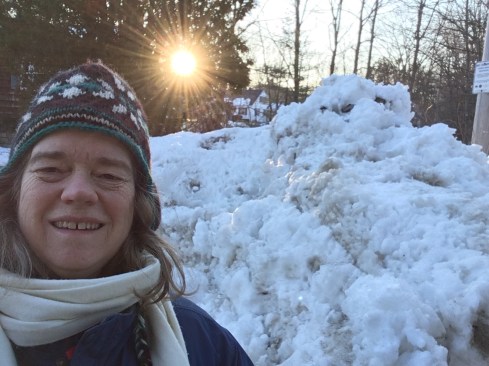 Today is the first day of spring everywhere in the Northern Hemisphere. What it looks like in my neighborhood is huge piles of snow and a really cold morning, but with a bright sun leading us into a clear day.
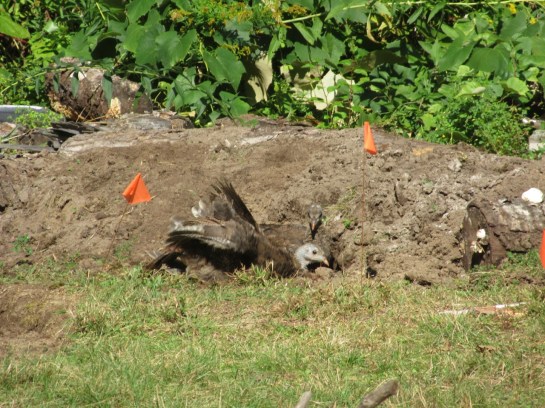

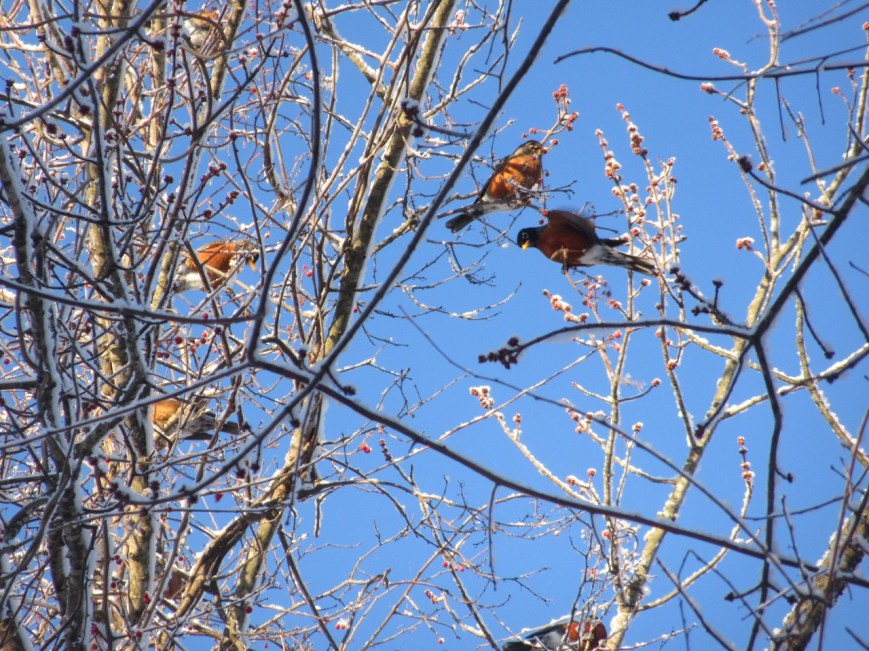

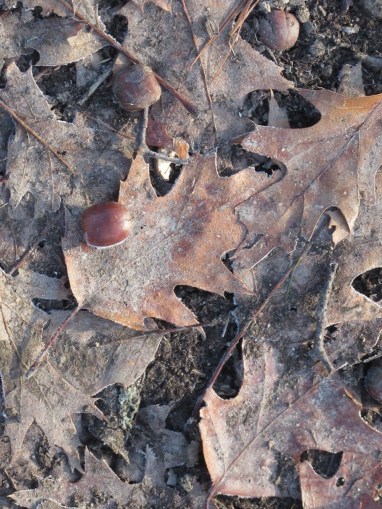 The mild weather has revealed old oak leaves and acorns all over the ground on the trail by the brook, as well as the back of our yard. The trees in our yard are young, but there are many old ones in the neighborhood. In the fall there were literally thousands of acorns underfoot all along the streets and the trail. It got me thinking about acorns as a food source–roasted and ground into flour.
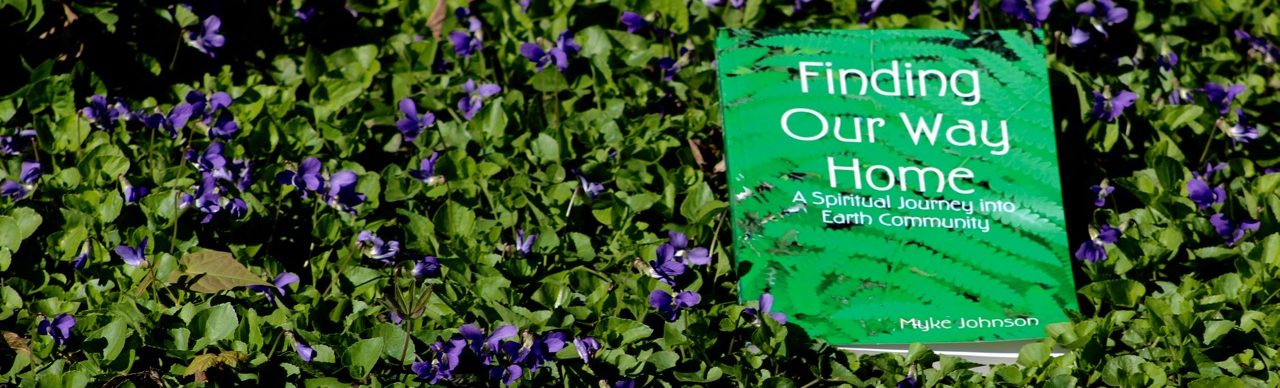
 Finding Our Way Home