Dawn Rhythms

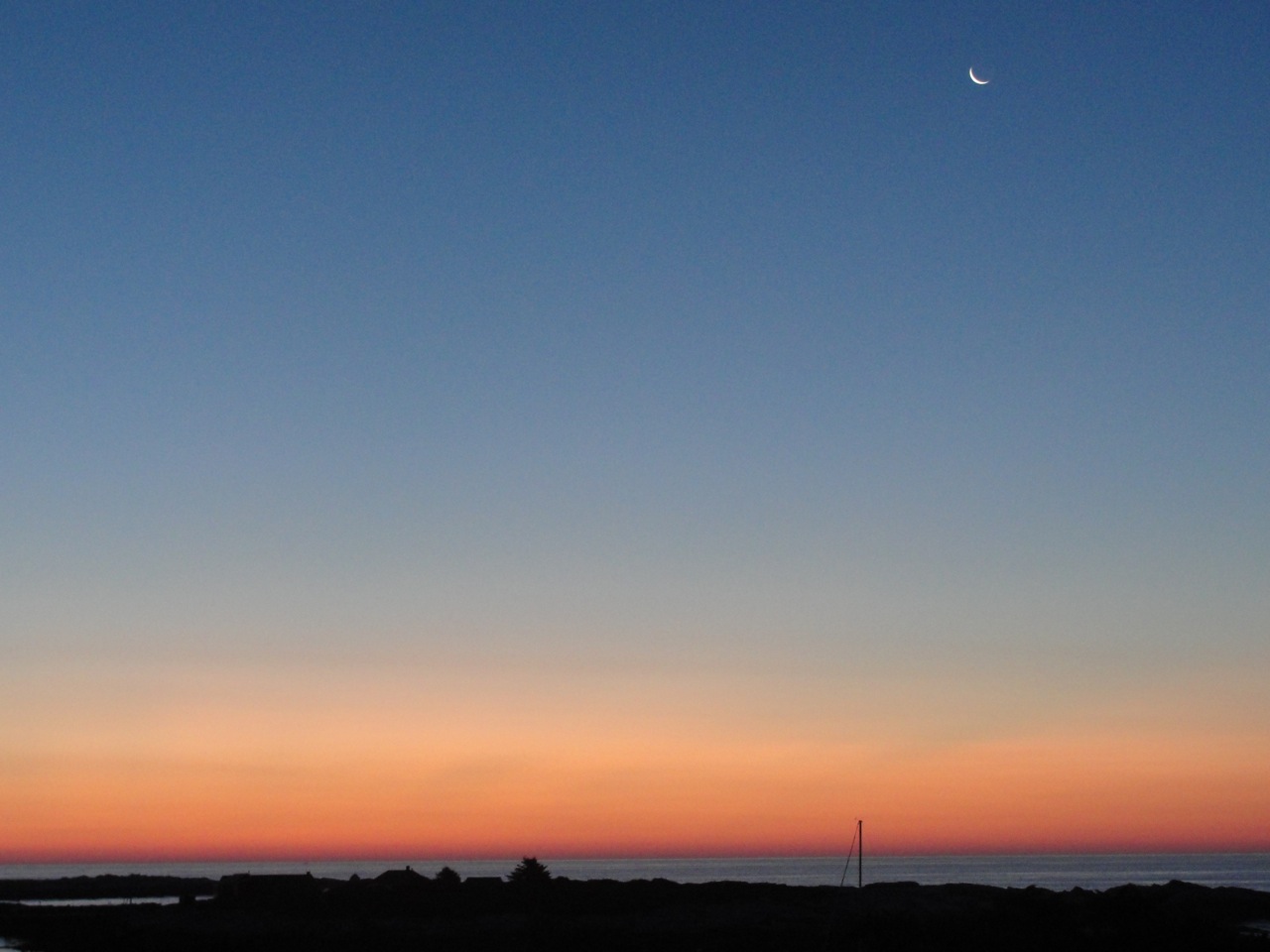
Crescent Moon at DawnOne morning on Star Island, I heard the cardinal at 4 a.m. Closer to first light. The waning crescent moon was hung over a deep pink rainbow of a skyline. I began to wonder why we don’t always get up with the light. It is actually quite bright in the hour between dawn and sunrise.

Before that summer, I had used the words dawn and sunrise interchangeably, but I learned that dawn refers to the first light that comes before sunrise. There is so much of it. Enough to read and write in my journal. We could save a lot of electricity if we got up at first light, and went to bed earlier. Of course, that is the logic behind daylight savings time, where we set the clock ahead so that we wake up an hour earlier during the longer days.

But what would it be like if our world was oriented to the rising and setting of the sun? Then every day we’d rise a little later or earlier than the day before. Because the sunrise changes every day. We’d have long days in the summer, and short days in the winter. The earliest sunrise in Maine comes in mid June, just before 5 a.m. daylight savings time. (That would be 4 a.m. Eastern Standard Time.) The latest sunrise comes about 7:15 at the end of December, except, because of time changes, it actually gets to 7:22 in early November, before we fall back with the changing of the clocks.

So, people might say that it wouldn’t be practical, in our world, to plan our day according to the sun. We plan our lives according to the clock. But what do we lose by that? While I was trying to discover the natural rhythm of dawn, I could feel how disconnected I was from all natural rhythms. Rising at dawn is a way to deepen my relationship with the seasons of the earth, and to the sun, and to the birds. But it makes me wonder, “Why do we try to shape the earth to our demands? Why don’t we try to shape ourselves to the rhythms of the earth?” And what might happen if we changed that pattern?

Cultures and religions the world over have honored the sacredness of dawn, the sacredness of the sun. Our word “sun” comes from the Old English, “sunne,” which was related to the Germanic sun goddess, “Sunna.” It shows up in our everyday language—the day of our worship is called Sunday. Christian monks, and Hindu priests rise at dawn; Muslims during Ramadan, as well as Indigenous peoples across many cultures. There is something in our human life that wants to be attuned to the life of the earth, which looks for beauty and joy in these simple rhythms.

Moving Toward East

I feel awe and wonder when I watch the sun come up in the morning and also when it goes down in the evening. Its beauty and grandeur can be breathtaking. It gives me even greater awe and wonder to realize that it is actually we on the earth who are moving, turning toward or away from our view of the sun. Science has taught us that. The earth spins on its axis once every twenty four hours, and this spinning creates our day and night. I may know all this intellectually, but I must use my imagination to experience it: see if you can, too. You can try this anytime, but it is most vivid at a sunrise or sunset.

Face the east just before sunrise.
Imagine yourself riding on the surface of the round earth sphere,
almost like riding in a car, looking out the front window.
We are speeding forward further and further until suddenly the sun comes into view. Feel yourself moving!

Later, just before sunset, face the west.
Again imagine yourself on the surface of this huge globe.
This time, like a child looking out the rear window of a car,
see that we are speeding away from everything until the sun slips from our sight.
We’re always moving toward the east!

It would make us dizzy to be aware of this motion all the time. But for a moment, we can be dizzy with the wonder of it all. Scientific knowledge can bring us to an awareness of reality beyond what we can see with our own eyes. Spirituality is when that awareness moves from the dry realm of intellect into the visceral experience of awe and wonder. The natural world is the original holy book, the original sacred text: the earliest forms of religion were responses to the mysteries of the earth and sky. As our ability to read this book of the universe grows, our spiritual practices are trying to catch up.

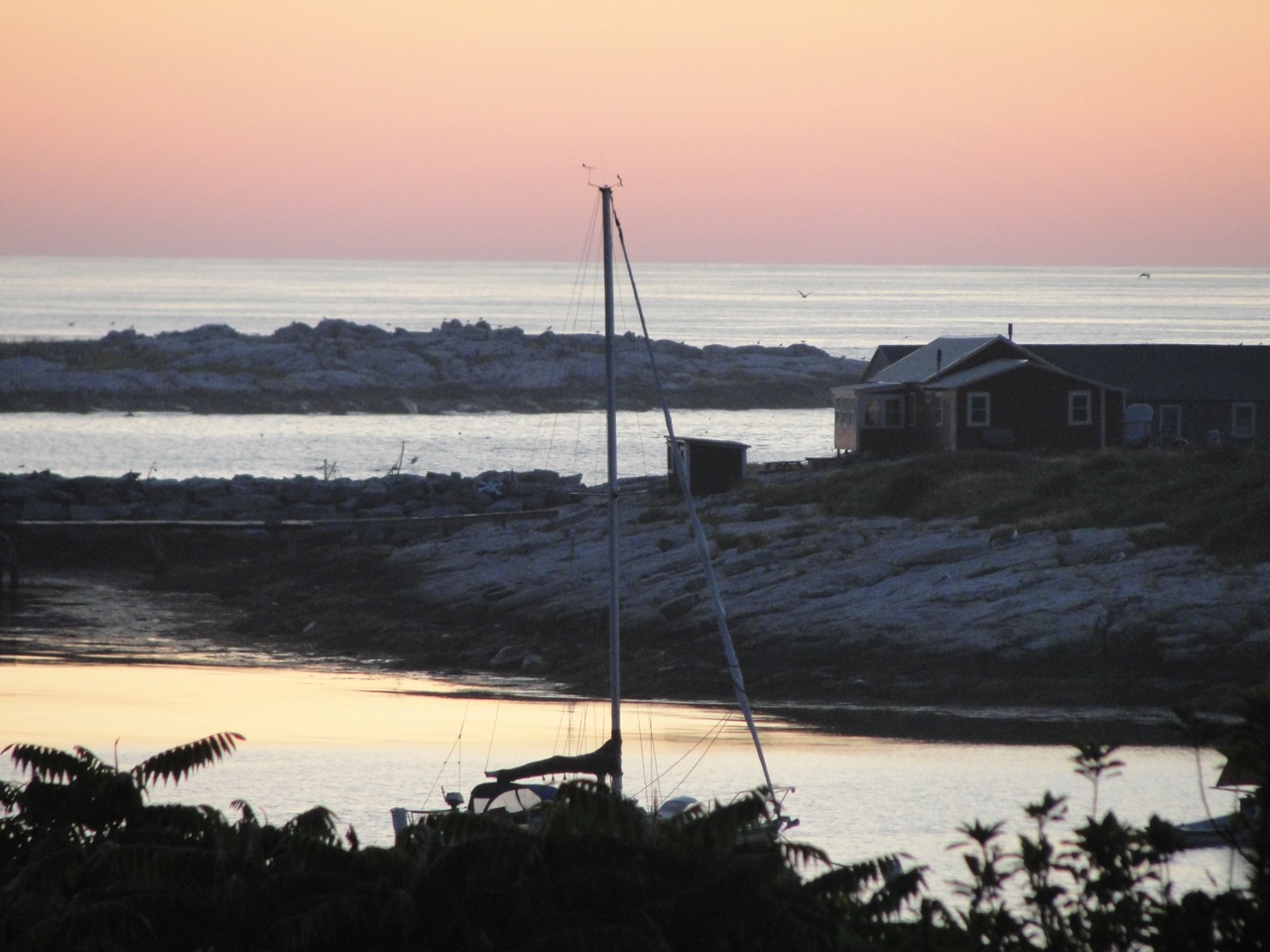
Dawn at Star IslandMargy and I traveled to Star Island, a conference center that is an island off the coast of New Hampshire. It is a rather small island—you can see the water from almost every place on it. It turned out that the windows in our tiny room faced the east. The next morning, through my open window, of course I heard a cardinal singing before sunrise. “Come outside!” it seemed to say, once again.

Right beyond the door of our room was a porch facing east, with rocking chairs on it. I could crawl out of bed wrapped in a blanket, and sit in a rocking chair to watch the sun rise over the ocean. That day, the clouds formed variegated patterns of pink and orange, blazing up through the whole eastern sky. The cardinals jumped from bush to bush close to where I was rocking in my chair.Rocking Chairs

Watching the beauty of the sunrise during the next several days, I was again thinking about how the sun generates its own energy, how all the stars do that. We on earth are more like children, we are utterly dependent on this light-being for all our needs. All of the energy human beings generate and use all over the earth relies on the sun as its ultimate source. The whole sphere of life on earth is a child of the sun. Yet the sun is so personal too. We can feel its touch on our faces—it is as personal as the vitamin D that it creates through our skin.

The poet Hafiz said,

Even
After
All this time
The sun never says to earth,
You owe
Me.”
Look
What happens
With a love like that.
It lights the
Whole
Sky.

 Poem from The Gift: Poems by Hafiz, The Great Sufi Master, translations by Daniel Ladinsky 

Sunrise Blessings

Mona Polacca, an indigenous elder of the Hopi and Havasupai people, spoke at my church one summer. She talked about how we come into relationship with all the elements of the earth, with water, and air, and fire and earth. She blessed us with the feather of a water bird. Someone at the talk asked Mona what gave her hope. She said, hope comes with each new dawn.

Feeling blessed by her words, the next day, I woke up at 5 a.m. and went outside a few minutes later. It was already so light! The sunrise was to be about 5:18. The birds were all singing their morning songs. I could see the red orange sphere through the branches of the spruce tree.Spruce Sunrise DSC03603 I felt anew the amazing power of the sun. All plants convert sunlight to energy, and animals eat the plants, and we eat the plants and animals and our bodies are formed of this. We are the sun. Every fiber of our being is created of sunlight. All the earth sings to this light, this star from which we are created.

And we can see the sun. We have been fashioned in such a way that we can recognize this parent—all the creatures of the surface of the earth feel and see the sunlight. I felt joined together with that song of the earth, a prayer of thanksgiving to the sun. Thanks for life! I chimed in. Thanks for vision to experience the life all around me of which I am a part, and for hearing and smelling and tasting and touching.

After such a magical moment, you might think that I would be awake every morning after that. But it wasn’t so easy for me to actually get up at dawn. To sustain it I would have to go to bed much earlier than I was used to. The very next morning I had planned to sleep in, because I was up late the night before. But in the middle of my sleeping, I heard a banging sound.

I stirred, and realized that one of our kittens was inside the closet, pushing against the sliding doors. I grumbled, but the clock said 5:15 a.m., exactly five minutes before sunrise. Feeling duly summoned by forces greater than myself, I crawled out from under the sheets, pulled on my shoes, and went outside once more, while the red ball was just appearing in the east.

The Magic of Dawn

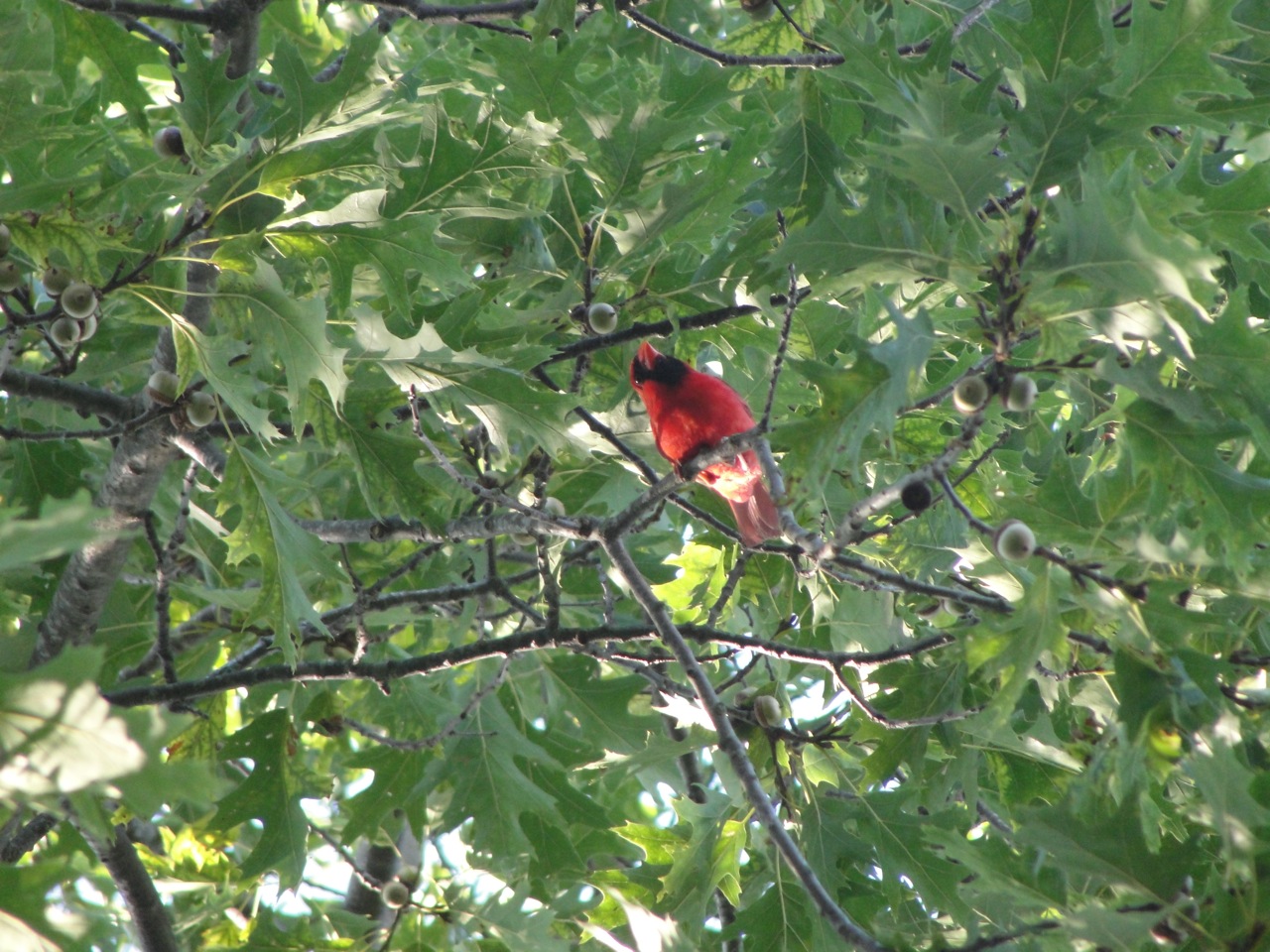
CardinalI was sitting on a blanket in a screen tent in the back yard, honoring the earth and all her creatures, when during my prayers, a cardinal started singing, and came to perch on the ground right near the tent. I felt so thankful for that visit.

I was pondering the big questions of my heart. I was asking, What is my greatest hope? And my heart answered, I hope that we find a way to live in harmony with all life on the earth, that our spirits wake up to experience the unity of all life, that we might join in that beautiful dance. But I also asked, What is my greatest fear? My heart answered, I am afraid that the greedy and powerful will kill all the trees, pollute the oceans, and destroy the animals and the people. I am afraid that humankind is broken beyond restoration, so cut off that we cannot find our way back to the unity.

And so my prayer was a prayer to find wholeness, to find joy. When the cardinal started to sing so close by, it reminded me of the magic of being outside, the place where my hope is restored. It also reminded me of the magic of waking up at dawn, the time when the cardinal and a host of other birds sing their most beautiful songs. They create together a dawn chorus.

I first learned about the magic of dawn from my Wampanoag friend gkisedtanamoogk. He had told me that the eastern peoples, called the Wabanaki, believed that dawn was the most sacred time of the day—the name Wabanaki means people of the first light, the first light of the sky before the sun rises over the horizon. This time was considered the best time to pray, to commune with the earth and the spirits within the earth.

A few days later, I woke early, and heard a cardinal singing outside my window, and that called me outside again. So I went out and sat on my blanket and tried again to open my heart to the world all around me. When I look at any writing in English, even the tag on the edge of the screen tent, I cannot help but read the writing there. Yet when I look at the plants or the mushrooms in our yard, I realize I do not know how to read the earth. I don’t know the names of many plants or their characteristics. Our species has become so isolated, so alone in our own thoughts and works. I wish I had a guide to teach me how to read the earth.

Slug in grassI saw a small slug moving slowly through the grass. As I was watching it, I wondered what it was reading about the earth, what chemical messages it found in the small trails through the grass. It was on its way toward a mushroom. I took photos of its small golden body, tried to pay attention to its slowness and intention as it climbed the mushroom stem. Even a slug can be a teacher.Slug on Mushroom

Listening to the cardinal singing, these words came into my heart: Whatever you do there is beauty in it: the work, the rest, the prayer, the play, the listening. Awaken to beauty, be present to it, the hidden beauty of the ordinary is like the muted beauty of the female cardinal. Dispel sadness, awaken to beauty and joy.

Lessons from a Small Bird

Cardinal

Photo by Margy Dowzer

The cardinal has been the species that has most taught me connection to the earth. It began unexpectedly in the winter of 1985, when I was going through a difficult transition. My marriage had ended at the close of 1984, and I was deep in grief about that loss. One winter afternoon, sunk in sadness, I heard a curious sound outside my window. When I looked out to investigate, I saw the bright red plumage of a male cardinal. Its song was distinctive and joyful, and its color shown brilliant against the gray Chicago snow. My heart was lifted by its melody.

Ever since that moment, the cardinal has signaled for me beauty and hope in the midst of suffering. So you can imagine my chagrin when, early in the summer of 2011, my partner Margy found a dead cardinal beneath one of the windows of our house. We always feel sad when a bird flies into a window—but this was a young female cardinal, and Margy knew I’d be very downhearted about it. I wondered what sort of message it was bringing, or even what bad omen it might portend. I know that sounds superstitious, but after we have associated one of our fellow creatures with a sense of blessing, it is unnerving when something like this happens.

A friend reminded me that death is a part of life. She said, pay attention for the blessing here. So I blessed the cardinal’s small body with incense, and buried it in the composting leaves at the back of our yard. I thanked the cardinal for the joy her species had brought into my life, and wished her well in the great cycle of life. I decided to put hanging streamers around our windows, to help deter future bird accidents.

During this time, I had begun reading Leslie Marmon Silko’s book, The Turquoise Ledge. It was a memoir of her days walking the arroyos near her home in Arizona. I found it a strangely quiet book. She writes about going for walks, and the creatures around her house. She talks about making peace with the creatures who live in the same place she lives—in her case, that included rattlesnakes and grasshoppers. Sometimes creatures died near her house, too, and she felt sad about it, like I felt about the cardinal. In our yard, we have chipmunks and birds and squirrels and toads. Sometimes deer or turkeys wander through, and neighbor cats. One has to slow down and be quiet to notice the creatures of the earth.

It seemed to me that the dead cardinal might be saying: Stop! Stop pushing, stop trying, stop doing, let go. Be still. Be outside. Listen. Everything is a blessing. Everyday you can go out among the trees right here. Stopping is a way to pray.

A Finger Pointing to the Moon

Moon in branches DSC02496The Zen Buddhists tell this story:

The nun Wu Jincang said to the Sixth Patriarch Huineng, “I have studied the Mahapari-nirvana sutra for many years, yet there are many areas I do not quite understand. Please enlighten me.”

The patriarch responded, “I am illiterate. Please read out the characters to me and perhaps I will be able to explain the meaning.”

Said the nun, “You cannot even recognize the characters. How are you able then to understand the meaning?”

“Truth has nothing to do with words. Truth can be likened to the bright moon in the sky. Words, in this case, can be likened to a finger. The finger can point to the moon’s location. However, the finger is not the moon. To look at the moon, it is necessary to gaze beyond the finger…”

I want to call us to a deeper appreciation of truth—that we not be attached to any ideology in a way that becomes a kind of idolatry of the mind. Words and ideas about spirituality are not meant to be literal. They are like the finger pointing to the moon. If we spend a lot of energy debating the nature of the finger—what good will that do for us? If we defend the finger, or try to ridicule the finger, or argue about the finger—we’re missing the point. The point is that the finger is pointing to the moon. I hope that we might learn to shift our gaze, and discover that beauty and mystery!

Reality is a Dance

Kayaker Reality is a dance between making plans, and responding to small and large disruptions. So to embark on a spiritual journey is to grow our capacity to practice, to plan, to wait outside, and then to embrace all that reality offers.

A spiritual practice is meant to help us develop the skill of embracing what comes to us as an opportunity to wake up. A spiritual practice helps us to be fully present and to pay attention. If we have not been practicing, we can get thrown off by life’s disruptions, become grumpy and anxious, shut down or reactive. In fact, that can happen even when we have been practicing. Kayak Tipped OverBut I know from long experience that the more I practice this embrace of reality, the easier it becomes to shift from resistance to curiosity, from crankiness to compassion.

The spiritual journey is our search for an immediate, personal experience of the larger reality, our connection to the earth, to each other, and to the Mystery that connects and upholds life. Let us go back for a moment to an experiment.

Notice the energy in your heart right now.
If you wish, create an invitation in your heart, open your heart to experience the larger Mystery that connects and upholds all life.

As feelings come up, imagine your breath filling and embracing those feelings. Be present to what emerges in your heart. If you feel emptiness, breathe into the emptiness. If you feel joy, breathe into the joy. If you feel confused, breathe into the confusion.

The beginning and the ending of spiritual practice are in paying attention to the energy of the present moment.

After the wondrous, after the experience of Mystery, we must always come back to the everyday. In pagan rituals, they say we must “ground the energy.” We remember to eat food or have a drink of water. In Buddhism, there is a saying, “after the ecstasy, the laundry.” Sanity is being able to switch our consciousness from the mysterious to the ordinary. Life is not static, it keeps moving. We are not meant to remain in emptiness or in ecstatic feelings. We are meant to be fully involved in all that life is about. Says one Western lama, “What became clear is that spiritual practice is only what you’re doing now. Anything else is a fantasy.”

The most important grounding is how our spiritual experience affects the rest of our living. In the end, we may ask, What is spirituality for? I would answer that our experience of the Mystery that connects and upholds life is meant to bring greater power and resources into growing in community with all that lives. Authentic spiritual practice will energize us for greater kindness, compassion, peace, and humility. May it be so.

In the waterQuote from Jack Kornfield, After the Ecstasy the Laundry, (New York: Bantam, 2000). p. 126

Emptiness

What comes next? If we wait in the darkness, if we succeed in opening our heart to awareness of the present moment, we may discover within us certain empty feelings, a kind of spiritual hunger. That does not mean we have failed in our search. Rather, it means we have found the next step. An experience of yearning may feel like a hole deep in our being. Hole in RocksWe may be tempted to try to fill it quickly with some new type of ritual or escape into some other sensation. It may feel painful and lonely, like an absence of something we need. But this emptiness is itself a kind of window or doorway.

The Buddhist teacher Kinrei Bassis says:

“the deepest form of prayer is really just the willingness to be still and let the longing in your heart go out without defining or understanding where it is going. Meditation is the willingness to let go and learn to trust so that we may enter into this seeming darkness.”

The emptiness itself, if we embrace it fully, can become the doorway into the larger reality. The practice of paying attention to the present moment helps us to cultivate the capacity to remain present to our feelings. We grow more at ease with anger, fear, sadness, and longing. We are able to breathe into these feelings, rather than run away from them.

If we breathe into the longing, breathe into the emptiness, there comes a time when it may open up into an experience of communion, an experience of our connection with the earth, with each other, with the Mystery within all reality. It may feel something like dissolving into Mystery. This experience goes beyond the capacity of words to describe. We may feel deep joy, even ecstasy, an intense awareness of being one with Love. An old hymn described it as “Leaning on the Everlasting Arms.”

Sometimes, that feeling may come unexpectedly, without any spiritual practice at all. The Mystery is funny like that. It surprises us. Sometimes it comes when trouble or grief has opened a chasm in our hearts and the pain of yearning fills our being to the core. It has been in the lowest moments of my life, that I most experienced the presence of the Mystery, holding me in love and connection and carrying me through.

Quote from “The Buddha Calling the Buddha,” by Kinrei Bassis, in Parabola, Summer 2006.

No One Way

If some of this talk about spirituality doesn’t make sense for you, remember that we bring our diverse personalities to our experience of spirituality. We will not all resonate with every approach to spirituality. My colleague, Rev. Peter Richardson, outlined four possible approaches to spirituality corresponding to traits from the Myers Briggs personality inventory.  His framework is just one example of how our spiritual experience might be diverse. We all have natural inclinations to tune into different frequencies.

He suggests that those of a more intellectual bent may be primarily drawn to the search for great truths. Einstein is one such mystic of the scientific realms. He felt awe and wonder at the mysteries of life revealed through science. A first step for an intellectual might be to appreciate the intricacy and beauty of the natural world, to pay attention to those moments of wonder.

Those of a more practical bent may be drawn to the works of goodness. They might find inspiration in the path that Gandhi shaped, to live out the connectedness of life by organizing for justice on behalf of the oppressed. A first step might be to volunteer for a soup kitchen, to pay attention to the larger reality in the gift of soup that connects us to someone who is hungry.

Those of an emotional bent are more likely to be drawn by love and devotion to divine or spiritual beings. The Sufi poet Rumi wrote thousands of love poems to the divine Friend, whom he felt most closely through his relationship with his human friend Shams. These are the folk who might especially benefit by reading the poems of the mystics, by music and incense and sacred ritual.

Finally, there are those of an intuitive bent, who may be drawn to the unfolding and transformation of the self into the larger self. The writings of Ralph Waldo Emerson might be a guide for those in this visionary orientation. These folk may be drawn to a diversity of practices and rituals, and may find their spiritual experience changing greatly over time.

There is no one way to practice spirituality. We begin by being aware of the present moment, by inviting our hearts to pay attention. We can notice those activities that help us to feel a sense of connection and wonder and gratitude, that help our hearts to feel most alive. We can invite the larger reality into our lives, by choosing to bring more of these activities into our daily lives.

Path

Photo by Margy Dowzer

Peter Richardson, Four Spiritualities, (1996.) Find it here.

Imagination as a Tool

Imagination can play an important role in shifting our attention. If we want to find that which is larger than words, that which we cannot define or explain by words, we need to access the playfulness of the non-verbal mind. Images are one way that we can experience the non-verbal realms. Carl Jung taught us about the power of dream images to express realities which could not be expressed in words. In my dreams, I have experienced the power to fly, to light candles from across the room, to heal with fire in my hands. Our dreams can be a pathway into a different consciousness.

Candle flameSometimes, people shift their attention by calling upon an image of the larger reality. Some people call upon God to hear them and to speak to them. Others invite the goddess to enter the circle. Or we might say, Infinite Light, be here now, and light a candle. These invitations are also called invocations. It might feel silly to us to call out to someone or something that we don’t even know is there. But any time we invite the larger reality into the room, what we are really doing is inviting our hearts to shift their attention. We are re-tuning our hearts to notice the light that is already there.

The images are meant not to be objects to grasp in our minds, but tools for the imagination to awaken the mysteries of connection within us. So, if I say, “Spirit of Life, please open my heart to the wonders of your world,” I create an intention, a form that can hold the energies in a certain rhythm or shape. I open a window in my consciousness, to see what my literal eyes cannot. When we open the door, there is something that wakes up, something beyond what we can expect or explain. If we don’t open the door, we will never know what is out there, or in here.