Living lying down

mussed up light blue sheet with two cat paws peeking out, black and white fur

I’ve been trying to figure out what it all means. I mean my life these days. What does it mean to be ill, to be mostly fatigued, to be compelled to rest most of the hours of my days? I wasn’t sure what photo could go with this question, and then I happened to see this photo of Billie from five years ago, her body hidden under a sheet on the bed, just her little paws sticking out. Somehow that fits. These days I am mostly hidden, lying down somewhere, sometimes under a sheet, and just a tiny part of me emerging into the world now and then.

I used to admire the elders who were out on the picket lines into their eighties and nineties. It makes me sad, but I don’t think that can be me. I still care about the things I used to care about. I hunger for justice, for human rights, for kindness, for peace. I still rage against cruelty, oppression, violence, and genocide. I scroll on Facebook and try to bear witness to all that is happening out there. I share posts that document the atrocities, in the hope that bearing witness is better than silence. I share posts that document the resistance, in order to foster hope in the face of so much despair. But is that diminished activism what my life now is meant to be about? Is it what it means?

Spoon theory is a method of managing energy for many people with disabilities and/or chronic illness–if we only have so many spoonfuls of energy, we have to ration our activities to match the spoons we have. Lately I am always running out of spoons before I can finish the tasks of daily living. I am lucky if I can keep up with the dishes in the kitchen sink, keep up with cleaning out the litter box for the cats, keep up with watering the vegetables I was so bold to plant. Are these tasks of daily living what my life means now? Do I need to cultivate that Zen approach to being fully present in each moment, however mundane?

Meanwhile, I spend many hours lying on the couch watching tv shows on Roku. Sometimes I have to manage my energy for that too. I can’t handle too much drama. British mysteries are about right, especially if I have seen them before and they are well done. Nature shows are usually okay, unless there is too much about how we are destroying it. Sometimes I nap during the shows. Lately, I’ve been watching “Would I lie to you?” on Britbox for laughs. It all feels rather pathetic actually, but this is the unvarnished truth.

I don’t have the answers to my questions. I don’t know what it all means. But I feel like I have to wrestle with this reality I am living in, wrestle with the meaning, because that is also still who I am, a wrestler-with-meaning. I can look out on the world, but I must also look into this intimate space under the covers. I believe that each human being has inherent dignity, each life has ultimate value. I believe that we are all connected. So how do I find the ultimate value in this life of mine, right now, not based on what I have done or who I have been, but right now. Still able to write sometimes, but about to lie down for the rest of the day.
Even the Humblest of Beings

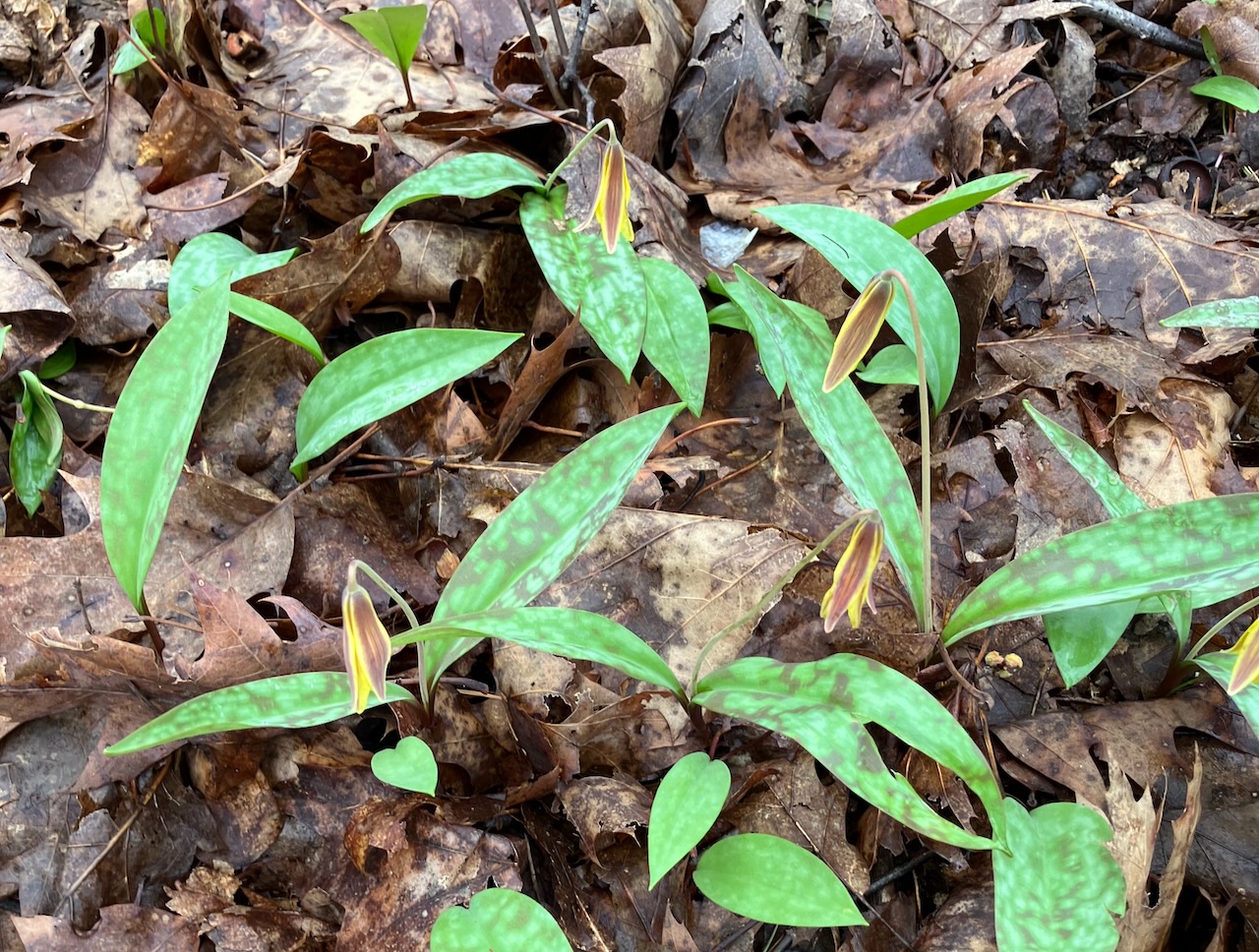
trout lilies in old leaves, with mottled green leaves, and yellow and brown blooms

The trout lilies bloomed last week before several days of rain. This photo was from May 5th. Today the blooms are already fading or gone. The trout lilies live near a path by the Capisic Brook that I visit most mornings, though I don’t always make it as far as that path. I was glad to walk a little further to see these lovely small beauties.

I want to continue to post from the Universal Declaration of Human Rights, which I started a couple weeks ago. It is such a good reminder that every person, no matter how humble, or seemingly insignificant, is worthy of dignity. (In this quote of the declaration from 1948, for simplicity, I am using the original language, in which the pronouns he/his/him were understood to refer to all people).

Article 12: No one shall be subjected to arbitrary interference with his privacy, family, home, or correspondence, nor to attacks upon his honor and reputation. Everyone has the right to the protection of the law against such interference or attacks.

Article 13: (1) Everyone has the right to freedom of movement and residence within the borders of each state. (2) Everyone has the right to leave any country, including his own, and to return to his country.

Article 14: (1) Everyone has the right to seek and to enjoy in other countries asylum from persecution. (2) This right may not be invoked in the case of prosecutions genuinely arising from nonpolitical crimes or from acts contrary to the purposes and principles of the United Nations.

Article 15: (1) Everyone has the right to a nationality. (2) No one shall be arbitrarily deprived of his nationality nor denied the right to change his nationality.

Can you read them again? So important in the light of what is happening to migrants today in our country. Everyone has the right to seek asylum. Every one has the right to a country, or to leave a country. Everyone has the right of return. And yet so many are denied that right. We have to keep speaking up for what we know is right, even if our societies have never fully lived up to these values.

There are things we cannot control

Green shoots emerging in brown leaves and old stems
Going through old files, I found this reflection poem from 2014. It feels even more fitting for today, especially living as I do in the "realm" of chronic illness. I cannot control how much energy I will have each day, and rarely can I take action that might have an influence in the world outside our home. But this morning I was reminded that I can still choose to love in all of my hours, and be grateful.

There are things we cannot control.
It is a long list.  The weather, the seasons, 
the coming of day and night.
Another person's joy and sorrow, or love and grief.
We cannot control anything 
	about another person, most of the time.
The things we cannot control 
       are more numerous than the things we can.
The economy.  The price of milk.  
The coming of storms or the blooming 
       of lady slippers.
The return of the hummingbirds,
       or the death of poets.
If you are like me, you sometimes imagine 
you have more power than you really have.  
You try to control what you can, 
and even what you cannot.  You worry.
You want your children to be happy and fulfilled.
You want your parents to be healthy and content.
You want your partner to be a good match, and loving.
You may want the members of your community
	to be enthusiastic and generous,
and your staff to be talented and never to move away.
Big things or small things, no matter.
There are long lists of things we cannot control.
We want for all children to be safe, and girls who are lost to come home again.
We want angry young men to work out at the gym 
        and never to buy large amounts of guns and ammunition. 
We want politicians to be dedicated to the common good,
        and news media to the truth.
We cannot control anything about another person,
        most of the time.
We cannot control another person's joy and sorrow, loss and grief.
We cannot control the ways that joy and sorrow come into our own life.

But there are a few things we can control.
We can choose the values we want to follow in our own lives.
We can choose to speak up and act 
	in ways that share our values with the world.
We can choose to greet a stranger
	and listen to a friend.
We can choose kindness. No matter what.
We can choose to love.
	(and love ourselves too)
May you find the places of choice in your life, 
      and be at peace about all that is out of our control.

Conflicting Survival Strategies in early Quebec

(More reflections on colonization in Quebec, jumping off from the book Helene’s World.)  Author Susan McNelley writes:

Summer days for the French settlers were long and filled with hard work. This was not the case for the indigenous people. Life was much less demanding in the summer. Fish, fowl, and small game were readily available in the river and nearby forest. The indigenous peoples along the St. Lawrence didn’t worry about storing food to last the winter. To the consternation of their French neighbors, the natives spent much of their time sleeping and socializing with their friends. There were games, story-telling, feasting and opportunities for young people to meet and court.  Summer was a time of replenishment and fortification for the rigors of winter.

A common factor for both Montagnais/Innu people and French settlers in early Quebec was surviving the long hard winter.  But they had quite different strategies for doing that. The French worked very hard in the summer to clear fields, and plant and harvest crops. Bread was their primary food. They were agricultural people, and in the early years were also reliant on ships arriving in summer with new supplies, to replenish their stores of wine and oil and spices and grains. They preserved food and stored it for surviving the long winter. Winter included much less activity, so in some ways it was an easier time, but they were on their own, and their strategy for survival was to carefully ration what food they had among the people in their families.

For the Montagnais, on the other hand, summer was the easy time–they camped by the river, fished & hunted, gathered fruits and nuts, feasted and celebrated with each other, and generally felt a sense of abundance in all sorts of food. As the fall came, they caught and dried eel, and then they left the summer encampment and began to hunt small game in the nearby woods. In winter, they traveled in small family groups into the interior, where they relied on heavy snow cover to slow down the big game: moose, caribou, deer, and bear. When they were successful in the hunt, they shared their feast with nearby families.

hiver_transports_11

Susan McNelley describes a winter incident recounted by Champlain when some of the Montagnais/Innu came to the early French settlement, because they were starving, and asked for food.

Although the French did try to be generous, they rationed the distribution of provisions to the aborigines out of necessity. Otherwise, the food would not have lasted a month.

The French believed that the Innu were irresponsible because they didn’t store food, and because when they acquired food in the hunt, they ate all of it, or shared with their neighbors.  But if you are traveling to follow big game, it wouldn’t be practical to carry large quantities of preserved food.  It would be practical to share the abundance that came sporadically depending on who had a good hunt.  Reading between the lines of this incident, I could imagine the Innu noticing that the French had food while they had none, and expecting, according to their own values, that of course the French would be willing to share with them. Their strategy for survival was sharing what became available, as it became available. The French strategy was about storing up and rationing.

And isn’t that just like capitalism, really, and how our modern mainstream society works.  “Save what you don’t need now, to use later. Try to accumulate as much as possible. That is the definition of wealth.”  (But perhaps rampant consumerism and planned obsolescence have superseded that model too.  Some things to think about.)

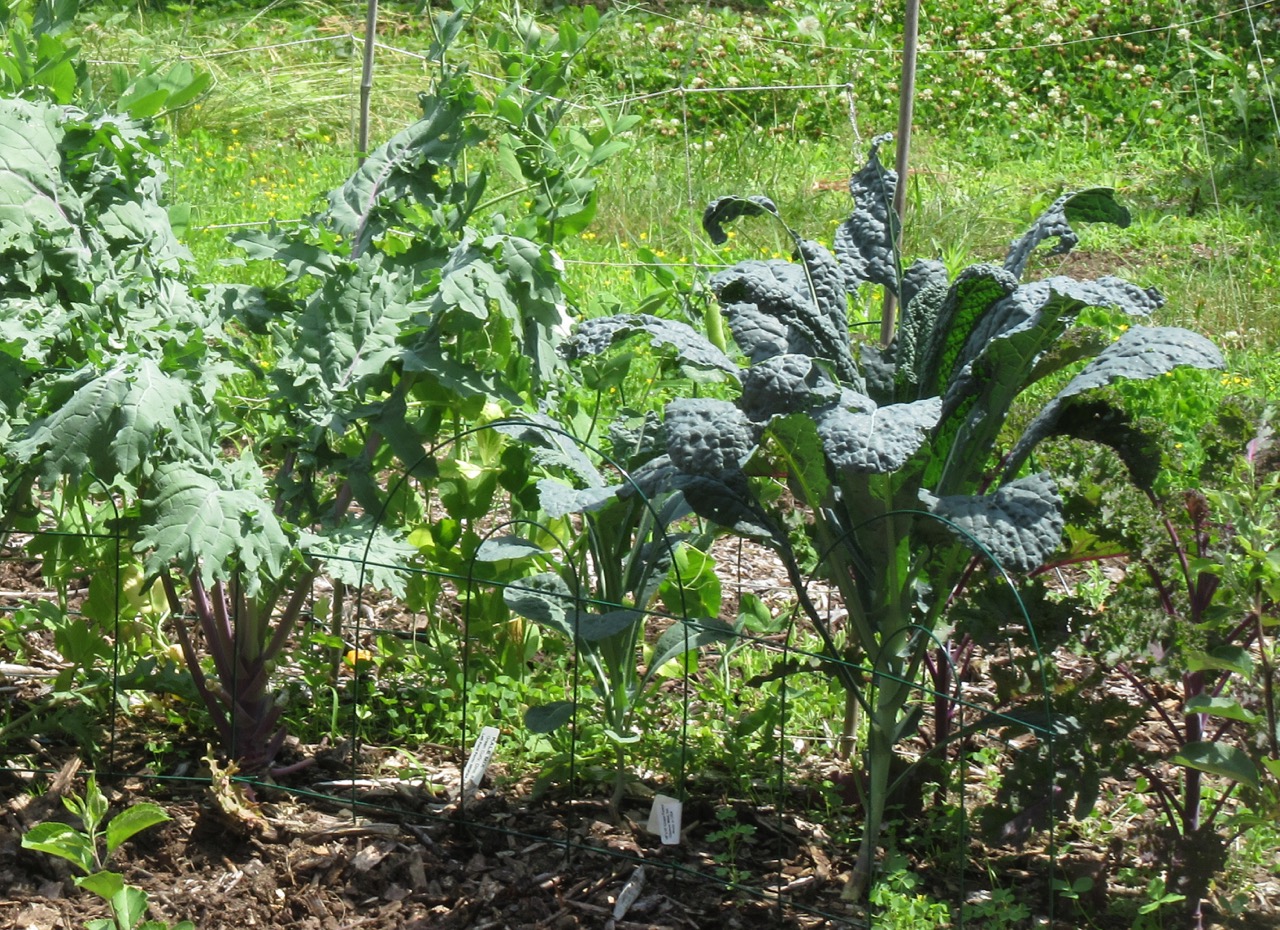
I feel the pressure of this time of year to preserve what we can from our garden, small as it is–making pesto from basil and chives and parsley, freezing kale, drying herbs–in our own way getting ready for the long Maine winters. We certainly wouldn’t know how to survive on our own, without being able to go to the Food Coop or grocery store. So perhaps both the French settlers and the Innu had better survival skills than we have now.Kale


Questions to Ask Ourselves

img_0448I have been asking myself and others, what does the change in our country mean for our personal activities and commitments?  Every day I receive dozens of emails asking me to sign this petition or donate to that organization working on behalf of immigrants, or women’s reproductive health care, or the environment, and on and on. Invitations to March on Washington, or Boston, or Augusta. Invitations to lobby my senator or call my congressperson. I can feel overwhelmed by trying to make decisions on what to choose, what to ignore, what to do with the same amount of time in each day, in each week as I have always had.

How are we meant to respond to the current challenges in our world, to the pain and suffering we see? On the one hand, we can say simply—follow our values, care for the vulnerable, fight for justice. But Quaker educator Parker Palmer, in his book, Let Your Life Speak, asks us to take a step back, to look more deeply at what we are being called to do. Palmer says, “Our deepest calling is to grow into our own authentic selfhood, whether or not it conforms to some image of who we ought to be… True vocation joins self and service, as Frederick Beuchner asserts when he defines vocation as ‘the place where your deep gladness meets the world’s deep need.’”

So one question we might be asking ourselves is, What is our own deep gladness? What sparks in us a sense of joy, because it taps into the very essence of our gift, our personality, our being? Another way to think of this might be, What are we good at doing? The influential African-American theologian, Howard Thurman, puts it, “Don’t ask what the world needs. Ask what makes you come alive, and go do it. Because what the world needs is people who have come alive.”

But is it really okay to pay attention to our own hearts, to our own deep gladness, to what makes us come alive? Shouldn’t we be mobilizing, organizing and lobbying every day to support our values in a society where they are under attack? I think what Palmer and Beuchner and Thurman are reminding us is that we can’t give what we don’t have. Not that we can’t learn new skills and rise to challenging occasions—but we can’t sustain a commitment if it goes counter to our nature.

For example, some people might be very at home with organizing a protest rally—making phone calls, posting on social media, renting sound equipment, contacting the right speakers, giving a stirring speech, and so forth. Some one else might be very good at going door to door, talking to neighbors and strangers of all political persuasions, making a connection and bridging the divide. Someone else might be good at strategizing behind the scenes, mapping out goals and objectives, and a course of action to take to get there. Someone else might be very good at bringing coffee and cookies to the meeting, and making sure that each new person is welcomed and brought into the conversation, and leaves feeling a sense of connection and involvement. Even in organizing and mobilizing, we each bring our particular gifts to the table.

And by that same token, we each have limits. Parker Palmer points out that he learned as much about understanding his calling from his limits as from his talents and gifts. He said, “Lacking insight into my own limits and potentials, I had allowed ego and ethics to lead me into a situation that my soul could not abide.”

He isn’t referring to the external limits that society places on people because of our gender, or the color of our skin, or the country of our origin. Rather, he means the limits that arise from our personalities, from our natural way of being in the world, from who we are at our core. We are encouraged to be tender with our natural way of being in the world, and not ask our souls to bear what they cannot abide.

For example, if someone is a complete introvert, they would not best serve their soul by forcing themselves to go to a march or a meeting. Rather, they might be happier to write letters to the editor or to their congressperson. Another person might not be able to go door to door, talking to neighbors, but they are really good at tutoring asylum seekers one-on-one to help them learn to speak English more quickly and feel at home in this country. Our limits and our strengths are mirrors to each other. We need to ask ourselves about our gifts and our limits.

I want to mention something about external limits. Parker Palmer admits that he holds a lot of privilege as an educated white male. Even to ask ourselves about “our soul’s calling” assumes that we have the privilege to ponder the question. Many people work overtime in jobs that do nothing to provide gladness, and barely enough to support a home and food. Another important question to ask ourselves is about our areas of privilege or areas of marginalization. What we can offer the community is dependent upon our social location—and that goes both ways. As a woman, I would not be welcome to share a gift for leading worship in the Catholic community. This is an area of marginalization for me. On the other hand, as someone currently with a steady income, it would be inappropriate for me to try to teach people in poverty how to save their money. It would be intrusive and disrespectful.

We must understand our position in a social fabric, the powers we hold and the challenges we face just by who our people are, where we live, the color of our skin. I am reminded of the advice given to budding writers—write what you know.

So we must ask, What are our gifts, what gives us joy, what are our limits, what is our location? Palmer says, “Is the life I am living, the same as the life that wants to live in me?” It is from this place of understanding our own essence that we can best respond to the great needs of our world.