Decolonization Lessons from Plants

Bittersweet around a tree trunk

 Bittersweet vining around a tree trunk.

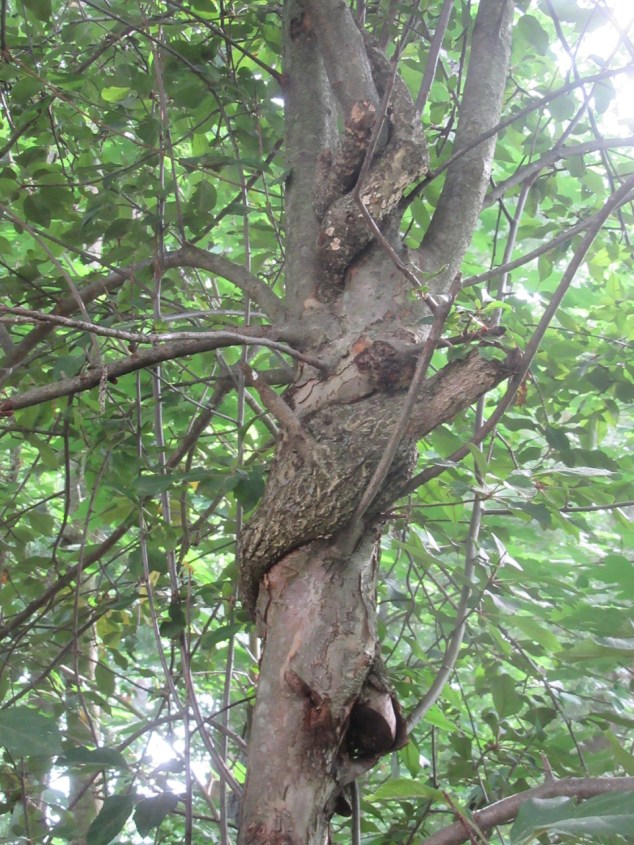
After spending a week going through soil to remove bittersweet roots, I have been thinking about invasive bittersweet as a visceral metaphor for colonization. Bittersweet comes into an area by seeds or roots, and then reaches for the sky. It vines around any support, living or dead, to keep climbing higher and higher. When its vines first wrap around a tree trunk, like in this photo, it may look green and healthy and beautiful. It may even seem to appreciate the tree on which is grows. But eventually, it can kill the tree, either by suffocating its trunk, or by the sheer weight of its leaves and branches.

Below is a photo, taken by my partner Margy Dowzer, of a huge bittersweet vine, 4-5 inches in diameter, tightly wrapped around the trunk of this tree.  It has been cut near the bottom, which is the way to stop it growing. But you can see how it has warped the trunk and become embedded in its flesh. A huge maple tree next door came crashing down after it was covered in bittersweet vines and flowers. Bittersweet will spread to a whole area, and kill other plants that are trying to grow. Bittersweet embedded in tree trunk
And this is like colonization. When Europeans first came to this land, they planted themselves in several locations and tried to grow as much as possible. They wiped out many Indigenous communities through disease and warfare. They used the lands cleared in this way to grow crops and build towns. They kept spreading out across the whole continent, bringing destruction to Native peoples and ecosystems as they took over. They imagined that their own growth and reaching for the sun was the only thing necessary and valuable, and took no notice of the harm they were causing.  And of course, it isn’t just past history, it keeps happening today. Our whole economic system is based on continual growth. “More and more and more!” might be the mantra of the colonizers and the bittersweet.

Might there be another option? There is a different sort of plant that was brought to this continent by colonizers. In fact, it was called “English-man’s foot” or “white-man’s footprint” by Indigenous peoples because it appeared wherever the settlers showed up. Its familiar name is broadleaf plantain (plantago major). It too spreads all over, and especially in disturbed soils. However, it is a humble plant, and a useful medicinal herb. Indigenous peoples soon discovered its healing properties and added it to their herbal pharmacies.

I was reminded of this a couple weeks ago when I had a bite from a black fly appear on my hand, itching like crazy. My friend Sylvia (who is an herbalist) suggested plantain. I made a poultice by chewing up some leaves and then putting that mash on the bite, letting it remain until it dried. It helped to ease the itching right away. Plantain is also good for all sorts of wound healing, stomach troubles, fevers, and is anti-inflammatory. You can eat young leaves in salads, and cook older leaves in stews. It is also useful for breaking up compacted soil, and combatting erosion.

So perhaps we who are not Indigenous to this land might learn from the plantain a new model of how to be here, in this place we now find ourselves. Perhaps we too might become humble and useful, growing only close to the ground, paying attention to healing and the easing of pain.

Plantain
Plantain

“Friends of the Indian”

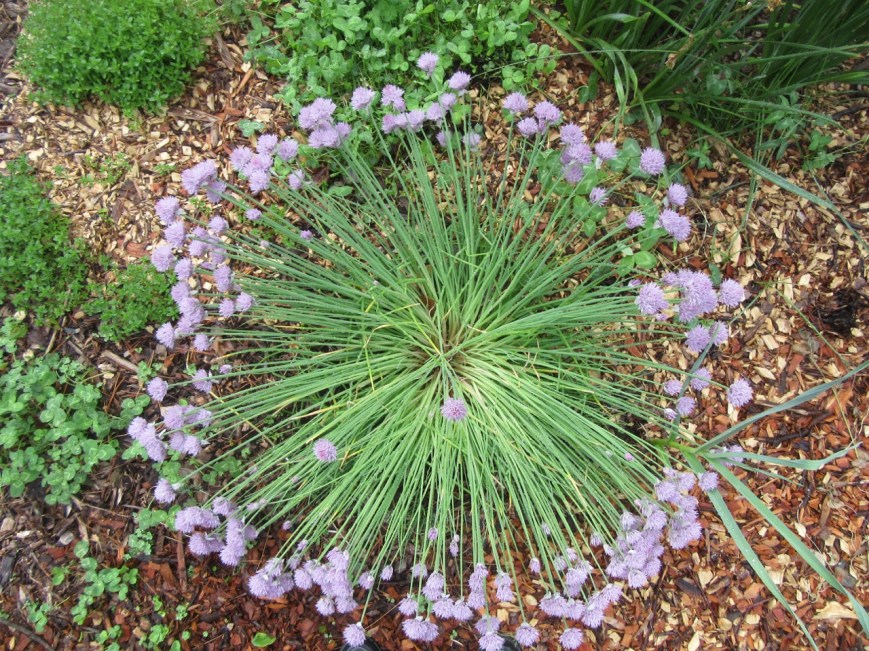
Chives after rain

Chives after the rain

Permaculture teaches us to observe the patterns in nature, and I thought of patterns when I saw this circle of chives after the last rain storm. Plants are so beautiful, especially when they bloom. Especially when they form a circle after rain.

Everything is green now. I go outside and do what I can in the garden. Inside, I finished watching the Ken Burns series The West. One of its stories has really stayed on my mind–the story of a well-meaning white woman who tried to help, but ended up causing harm to Native peoples. I think about how often that pattern has repeated itself in the last 150 years. And I wonder, how do we keep from repeating it again?

Alice Fletcher was a white upper-class feminist, one of those women that we lesbians of my generation have been so thrilled to discover–because she lived and worked with her romantic companion, Jane Gay.  Born in 1838, she went to “the best schools” and was active in the feminist and suffrage groups of New York city. Eventually she found a mentor, the director of the Peabody Museum, to study anthropology and archeology.  In 1881 she lived with and studied the Omaha Indians of Nebraska. She appreciated the culture and became close to many people there, even adopting a son, Francis La Flesche, who himself became a professional ethnologist.  She and he published a multitude of articles and books about Indigenous culture and music.

But she also came to the conclusion that Indian people needed to be brought into the mainstream life of America culture. According to PBS,

Containment had been the goal of federal Indian policy throughout much of the nineteenth century, but in 1883 a group of white church leaders, social reformers and government officials met at Mohonk Lake, New York, to chart a new, more humane course of action. Calling themselves “Friends of the Indian,” they proposed to remold Native Americans into mainstream citizens and to begin this process by re-educating the youngest generation at special Indian schools.

Alice Fletcher devoted herself to pressuring the government for the allotment policy: the breakup of tribal landholdings into individual holdings. “Friends of the Indians” thought it would be good for Native peoples to become more like their white neighbors, to farm, to own their own land individually, rather than collectively.

In 1882, the Bureau of Indian Affairs hired her to make a survey of all Indian lands for their suitability for allotment. The same year she was hired to manage the allotment of the Omahas’ lands. After the passage of the Dawes Act in 1887, which provided for the eventual breakup of all Indian reservations, she managed the allotment of the Nez Percé’s remaining lands.

But allotment failed drastically in so many ways.  First of all, it failed to honor the choices of Indigenous peoples–most of them did not want allotments but were forced into it. And ultimately, it robbed Native nations of millions of acres of their land, and undermined their cultural sovereignty as nations.

Between the passage of the Dawes Act in 1887 and its repeal under the New Deal in 1934, allotment continually deprived Indians of many of their remaining lands. The outright sale of “surplus” lands — parts of reservations left over after allotments had been assigned — and the subsequent sale of allotted lands themselves shrunk the Indian estate from about 150 million acres before the Dawes Act to 104 million acres by 1890, to 77 million by 1900, and to 48 million by 1934. By the time of its repeal, according to one study, two-thirds of the Indian population was “either completely landless or did not own enough land to make a subsistence living.”

Alice Fletcher thought she was a friend, helping, doing something good for Native peoples.  But her help caused harm.  No wonder Indigenous people are cautious about those of us who might show up eager to “help.”  Patterns.  And how do we know that what we think of as help might later be revealed to have caused harm?  Let’s ponder that question for a while.

Sea Kale blooming

The perennial sea kale in bloom smells like honey.

Civil War Addendum

I want to add this update to my earlier post about my German Missouri immigrant ancestors connection to the Civil War.  In checking out my notes from another family source, I see that my great-great grandfather, Johann Heisler came to Cole County, Missouri, via New Orleans, arriving in New Orleans on January 13, 1840, ten years earlier than another source had suggested.  His three brothers came to this country in 1850.  One of them, his brother Anton, served in the Union Army during the Civil War.

He enlisted in October 1862 and served as a private in Company D, 42nd Regiment, Missouri Infantry.  He was discharged in December, 1864.  While he was on duty in October 1864, six miles from Jefferson City, he was captured by General Sterling Price’s command and held prisoner by the Confederates at Fort Scott, Kansas, until December of 1864.  He came back to St. Thomas, Missouri in much weakened health, and later applied for a pension related to that health condition, but was denied it.

Missouri Germans in the Civil War

I felt an odd sense of relief and satisfaction to learn that my German Missouri ancestors were on the Union side of the Civil War.  While recovering from my latest gardening exploits, I was watching episodes of the Ken Burns documentary “The West.”  I was surprised by the series’ level of truth-telling in stories about colonization, about racism, about the violence endemic to the history of the United States. It has been quite an eye-opener about the “settlement” of the West, and I recommend it to all students of decolonization.

In the episode about the lead-up to the Civil War, I learned that Missouri and Kansas were the site of the heaviest civilian conflict and bloodshed before and during the war.  Earlier, in 1820, Missouri was admitted to the Union as a slave state, in conjunction with Maine being admitted as a free state, in the compromise to keep a balance between the free and slave states.  When the Kansas territory was “opened for settlement” in the 1850s it was decided to let the residents vote on whether they would be a slave state or free state.

[“Opened for settlement,” of course, meant the removal and theft of the land from the Arapaho, Comanche, Osage, Kansa, Kiowa, Missouri, Otoe, and Pawnee peoples, plus a dozen more eastern tribes who had been relocated to Kansas/Oklahoma in what was to be their land forever. But moving on for now to the slavery question…]

This new Kansas territory turned into a tinderbox of the national tensions between slavery vs. freedom for African-Americans–white Abolitionists from New England, and white pro-slavery Missourians (with their enslaved people with them) were among those who rushed to live in Kansas to influence the direction it would go.  Eventually, after much bloodshed, burning, looting, and turmoil, Kansas joined the Union in 1861 as a free state.

But my own curiosity shifted from Kansas over to what happened in Missouri, where my Heisler/Gerling ancestors had settled in the 1850s. I had thought they were on the side of the Union, so what were they doing in a slave state?  Ken Burns didn’t tell their story, but I went hunting on the internet to sort it out.  There I found the rather satisfying news that the German emigrants in Missouri were in fact opposed to slavery, and avid supporters of the Union.  They had emigrated after a failed revolution for democracy in 1848 in the German lands, and held dear the ideals of freedom and equality.  According to Patrick Young, in an article that was part of a series, The Immigrants’ Civil War,

[German Americans] saw parallels in the military coups in the German states in 1848 that ended the democratic dream in Europe. One of the exiled revolutionaries, August Willich, wrote after the attack on Fort Sumter that Germans needed to “protect their new republican homeland against the aristocracy of the South.”

Their influence was part of what kept Missouri in the Union.  According to another article by Patrick Young,

Missouri was a border state. That meant that it was a slave state lying between the Confederacy and the free states of the North. In the 1850s, Missouri had been the staging ground for pro-slavery terror raids against free soil towns in Kansas, but by 1861, the state’s wealthy slaveholding class was being challenged for power from an unlikely quarter.

German immigrants had moved into the state in large numbers in the 1850s. Most crowded into the fast growing industrial metropolis of St. Louis. Others started small German-speaking rural communities, [Note–that would include my ancestors] where they found themselves expected to defer to nearby slaveholders who expressed their worth in the number of humans they owned. The Germans had come to America for freedom, and they resented both slavery and the power it gave slaveholders over Missouri politics. When the Germans became citizens, they quickly formed the state’s most consistently anti-slavery electorate.

Thomas HeislerWhen I look at the lists of Union and Confederate soldiers from Missouri, none of my direct ancestors are included, though there were two Heisler men listed as Union soldiers. It’s possible that my great-great grandfather, Johann Heisler, was too old to enlist–he would have been 40 years old in 1860, with young children. My great grandfather, Thomas Heisler was born in 1857–only a toddler when the war began. Maybe they just tried to farm their land, and keep the peace with their neighbors.  One family story says the four Heisler brothers had left Germany to avoid being drafted into the military there. [Note: see addendum about another brother’s service in the Union Army.]
But it sounds like the war came to everyone’s land.  From the same article:

Even before the war, pro-slavery raiders had tried to drive German farmers out of rural Missouri. Now bringing about the submission or eradication of the Unionist German community became an imperative for Confederates.

Historian Ella Lonn wrote that after the Germans foiled the takeover [by the Missouri Confederates] of the [St. Louis] arsenal and fired into the mob:

“The hatred that Missouri Confederates felt for the Germans was frightful…German farmers were shot down, their fields laid waste, and their houses burned.” 9

German immigrants responded by supplying nearly half the soldiers raised by Missouri for the Union cause over the next four years.9 In that state, the war would take on the vicious character of a guerrilla struggle between Germans trying to make a place in a free America, and native-born Confederates trying to drive them out.

The Germans refused to leave.

So, in the midst of so much that is soul crushing about the history of this country, that’s a satisfying story to learn! There were many other stories about the Germans in Missouri of that time–too numerous to include, but check out the series, The Immigrants’ Civil War. I am inspired in my own work against racism to know they were carrying those values of equality and freedom from their homeland.


Pruning

Our friend, Mihku, who is a master gardener, gave me more advice about pruning last Sunday.  We looked at all the orchard trees, and she reminded me that these first few years are all about creating a good shape for the tree, thickening up the trunk, and creating strong scaffold branches, while not letting them get too leggy or long.

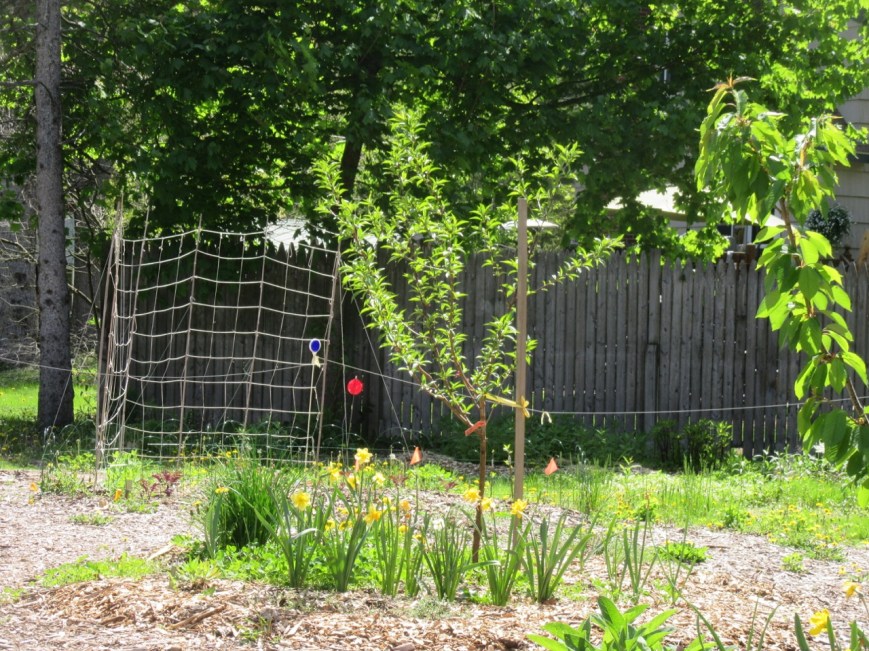
So for example, here is the peach tree before pruning (on May 27th).  It looked bright and happy, and even had a few flowers, (which you can see if you zoom in). But the branches were quite long, and the tree is too young to give energy to making fruit this year.  On the right foreground of this photo, you might also notice a very leggy branch from one of our cherry trees, dividing into new shoots at its tip.

Peach tree before pruning

Peach Tree before pruning

The next day, I went back to my Holistic Orchard book to read what Michael Phillips had to say about pruning, too.  It seems I need to read it at least once a year, because in between, I forget.  There are different methods for different fruits.  Apples and cherries prefer a central leader, with several scaffold layers of branches nicely spaced out as you go up the trunk.  Peaches prefer an open vase style, in which there is no central leader, but the center is opened up to give good sunlight to the flowers and fruit.  But it is far beyond the power of any book to give what a wise friend can give–especially for gathering the courage to actually do it.  (It seems counterintuitive to do all that cutting of new branches.)

This kind of pruning at this season of the year is meant to encourage growth in the right form and direction.  Mihku suggested cutting about 1/3 off from the long branches, and once again staking the cherry branches to make a better “crotch angle” (where the branch angles from the trunk.)  They tend to grow almost straight up, and should be reaching out to form a 45-60 degree angle.  Flat cuts at the end of branches will also help them to thicken up. Header cuts on the central leader, will encourage lower branches to grow–which was especially important for the Lapins cherry, which had a big gap between lower branches and higher shoots. I was excited to see that there were some new branches starting to form at a better height.

After I did the cherries, I went to the peach, picked off the blossoms, and cut away branches that were growing inward, to favor those that were growing outward. And those that I wanted to keep got about 1/3 headed off to help them become stronger, choosing a spot just above an outward facing bud.

Peach Tree after pruning

Peach after pruning

Finally, I checked our semi-dwarf apple tree, which is still quite small, and found that there were three branch shoots reaching upward at the central leader–just like Michael Phillips suggested there would be, and I chose the strongest to be the leader, and snipped off the other two.

Pruning accomplished for the season! Thanks Mihku!

Myke & Mihku in the garden

Photo by Margy Dowzer


East Frisian Teetied (Teatime)

The most identifiable tradition of my East Frisian ancestors is a tea ceremony.  In fact, East Friesland is the tea drinking capital of the world.  Since I am a tea drinker this delights me.  I don’t know if my great grandfather’s family brought this tradition with them to Illinois–it never made it into our family lore–but as I seek to reconnect with my East Frisian ancestors, the tea ceremony feels just right.

Tea first came to East Friesland from Asia in the 17th century, via the Dutch East India Company.  Many Frisians were sailors on those trading (and colonization) journeys.  Tea began to compete with beer as a beverage of choice.  By the 18th century, when most of the Dutch and Germans were choosing coffee, the East Frisians continued with tea. It was drunk a few times a day, morning, afternoon, and evening, and helped to warm you up in the cold rainy weathers of this land near the North Sea, as well as make a break in the working day.

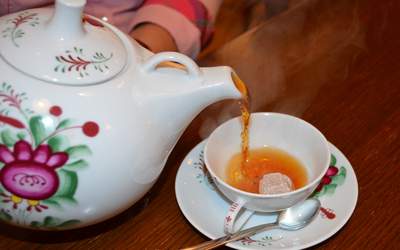
There is a very specific way to make and serve East Frisian tea.  You start with the soft water of the area, and then a blend of particular dark tea leaves, mostly Assam, with several others blended in.  There are traditional porcelain pots and cups.  You heat the pot with hot water, then empty it, and put in one spoon of loose tea per cup, plus one for the pot. Then you pour water that has just boiled, but is not boiling, over the leaves, to let it steep for 3-5 minutes.  Then it is strained, and poured into cups into which a piece of kluntje, or rock sugar has already been placed.  Then, a small amount of heavy cream is gently poured into the sides of the cup, without stirring, and it forms a small cloud floating in the tea.

It is a communal event, a daily ceremony.  Someone pours the tea for everyone.  When drinking, the idea is to taste each layer separately–the creamy layer, the clear tea layer, and the sweetness of the final layer.  One site said that the creamy layer represents the (cloudy) sky, the clear tea represents the water, and the sugar represents the land.  It is customary to have (at least) three cups of tea, and you place your spoon into the cup to signify when you have had enough.

There is an East Frisian saying, “Opwachten un Tee drinken.” “Wait and see and drink some tea.”  I was able to find an East Frisian tea blend to buy online, and also some fairly similar kluntje–though not quite the same.  But when these arrive, I will have to try it myself, in honor of my great-grandfather and his family.  One last thought–I am curious that there is also a connection to tea on the other side of my ancestral tree–the tea doll of the Innu people.  Somewhere in the middle, I am sitting here right now with a mug of black tea.  I find myself wondering how all these peoples have come together in me, and whether I might learn from their wisdom and bring some healing to their brokenness.

“Remain in the land and nourish it”

One of my hopes in exploring the stories of my ancestors is to see what cultural wisdom I might reclaim from everything that got lost in translation, especially regarding their relationship to land.  Today I was diving deep into internet stories about East Friesland, the ancestral land of my great grandfather Henry Johnson. His parents and grandparents had traveled from East Friesland to Illinois via New Orleans in the 1850s.

His father, Heye Broer Janssen traveled to the U.S. on the ship “Fannie” with 16 total family members including his parents Broer Janssen Martens and Geske Alber Schoen, arriving in New Orleans October 28, 1851. (The name Martens was dropped in the U.S. and they were called Janssen and then Johnson. Previously in East Friesland, people took the first name of their father as their last name.)  Henry’s mother, Helena Hinrich Janssen arrived in New Orleans on November 8, 1854 with her parents Heinrich Johann H. Janssen and Esse Classen Beckman. Her parents died a few years later, and she and her brothers and sisters were cared for by relatives and neighbors. Heye and Helena (Lena) married in 1862, and Henry was born in 1865, the second of ten children.

I must offer thanks again to my cousin Jim Pattyn for all his work in exploring the genealogy of our common ancestors.  In my search for their relationship to their land, I found myself recording all the towns in which they had lived in East Friesland, in fact for many generations prior: Firrel, Grossoldendorf, Kleinsander, Kleinoldendorf, Hesel, Moordorf, Schwerindorf, Strackholt, Remel.  These small towns are all within about 30 miles of each other in the center of East Friesland, somewhat near the larger town of Aurich.

625px-Ostfriesland_Verkehr-de.svg

East Friesland Map: Photo by NordNordWest – own work, using Ostfriesland de.svg by Enricopedia., CC BY-SA 2.5, https://commons.wikimedia.org/w/index.php?curid=5273792

In a letter dated April 16, 1846, from Alton, Illinois, one of my distant relatives (Heie Keiser) encouraged his family back in East Friesland to come join him. He praised the opportunities in his new home.  I was struck by one of his closing statements. He wrote:

And also think not as the old wives used to say, “Remain in the land and nourish it.” We agree much more with the poet, when he says, “Hail to you Columbus, glory be to you, be highly honored forever.’ You have shown us the way out of hard servitude.”

The East Frisians had a deep love of independence and freedom, and they resonated with the “American dream.”  I appreciate their love of freedom, but in my study of the process of colonization, I cringe at their praise of Columbus–one can see that they jumped at the chance to be part of the settling of this land that was new to them. They were able to work hard and acquire their own land to farm and to cherish.

But as a feminist scholar, I also like to notice wisdom that is hidden by being contradicted.  I wonder, who were the “old wives” who had offered this different sort of wisdom that was being rejected:  “Remain in the land and nourish it.”  That is a heritage I want to claim today, the heritage of the old wives, the ones who stayed.  (I think it also filtered into the ones who came to the U.S., because from what I can gather, the East Frisians were careful farmers who took care of their land so that it might continue productive for long years.)

I also heard about another custom of German immigrants (not sure from which parts of Germany) who carried in their pockets across the ocean some of the soil from their homes, so that at least they might be buried with some of the soil of their own land.  In this exploration of the ancestors and their relationship to land, there is something to grieve and also something to be thankful for.  I think that what Margy and I are trying to do with our land here in Portland might fit into that old wives’ wisdom–remain in the land and nourish it.


Osage River Bend

Thomas & Theresa Heisler wedding

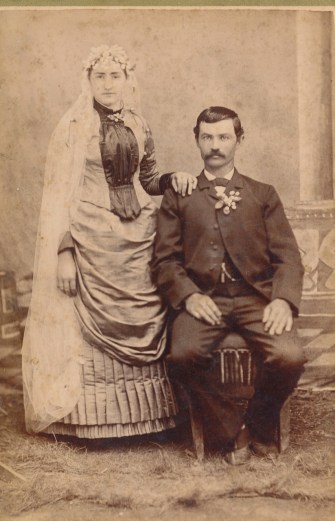
[Thomas Heisler and Maria Theresia (Theresa) Gerling at their wedding 2/16/1886]

I am continuing my exploration of my own ancestors settling in America, and how they may have participated in the colonization of this land.  My dad’s mother, born Lucille Mary Heisler in 1897, was the daughter of Thomas and Theresa (Gerling) Heisler, originally of St. Thomas, in Cole County, Missouri.  Thomas’s father (and my great-great-grandfather) was Johann Heisler, who came to Missouri about 1850, where he lived in St. Thomas with his wife Elizabeth (Koetzner) and was a farmer. They became a “well-known” Cole County family.

The first post office in St. Thomas was dated 1855.  It was a small German Catholic farming community, named for St. Thomas the Apostle, which is also the name of their church.  It was one of several Catholic communities founded by the Belgian Jesuit priest, Ferdinand Helias, who was known as the father of mid-Missouri German Catholics.

According to Russel Gerlach, in “The German Presence in the Ozarks,”

Some Germans were attracted to the Ozarks seeking religious freedom. Osage County attracted several thousand German Catholics whose principal reason for emigrating from Germany was religious. Their spiritual leader, Father Helias, established a parish in Westphalia in 1834, and in subsequent years seventeen settlements, composed primarily of Rhinelanders, were established in Osage, Cole, Miller and Maries counties.

I read that because the immigrants from various regions in Germany carried those tensions with them to these lands, he helped to settle them in communities which were ethnically differentiated. By the way, it was eye-opening for me to learn that in the German ancestry of my dad’s family, at least four different cultural and linguistic communities were represented–the East Frisians, the Rhinelanders, the Swabians, and the Westphalians.  The Heislers were from the Swabian culture. (But more on that in another post.)

What about the Indigenous peoples who had lived in Cole County before?  Well, their name remains in the river that winds through the area–the Osage River.  St. Thomas was formed in a fertile bend of the Osage River.  It was Osage Nation land before the settlers came. According to the website of St. Thomas the Apostle church:

The Indian Territorial Government established Cole County in 1821, paving the way for eager settlers to purchase this fertile land.  Perched above the river bottom and close to today’s parish cemetery, German immigrants built a small log church for the families that lived in the area.  Fr. Ferdinand Helias, S.J. began ministering to the needs of Catholics in this area in the early part of the 19th century.  A larger frame church was built to support the Indian Bottom Settlement.  As the city of St. Thomas took shape further east of the river, Father Peter Eysvogles, S.J. persuaded the families of Indian Bottom to move the church to this growing community.

I was struck by how the names “Indian Bottom” and “Osage River” spoke to the history of the land, even after its people had been removed. My own ancestors came a full generation after that removal, but definitely were among the settlers eager to purchase this newly “available” land.  The Osage Indians had a wide ranging territory that included land now in the five U.S. states of Missouri, Illinois, Arkansas, Kansas, and Oklahoma.   The first Europeans to meet them were the French explorers Joliet and Marquette in 1673.Osage Ancestral TerritoryIn 1803, when the United States made the Louisiana Purchase agreement with France, they claimed ownership of Osage territory. According to educational materials of the Osage Culture Traveling Trunk,
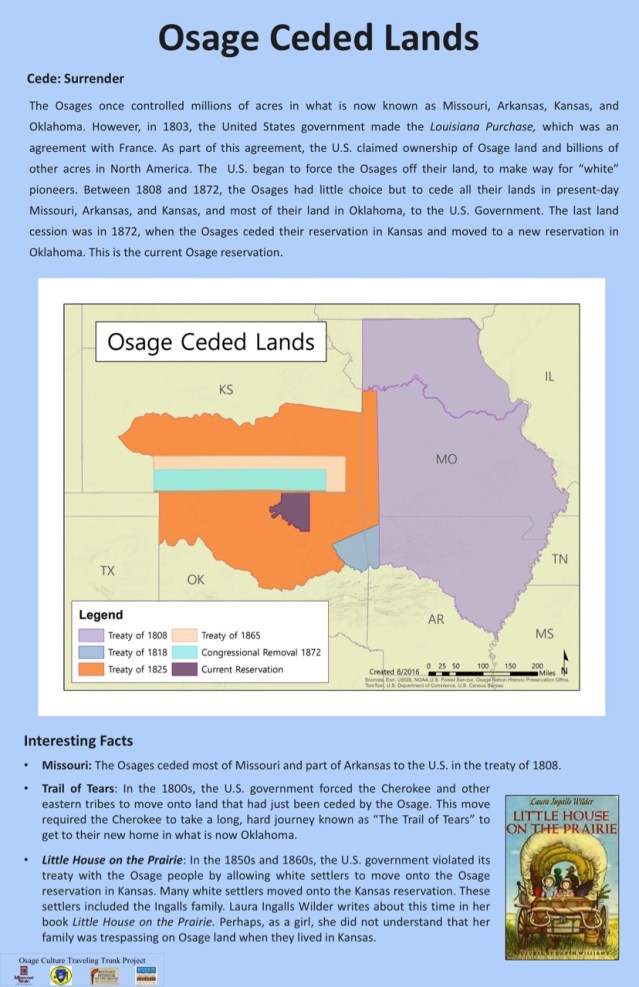
Between 1808 and 1872, the Osages had little choice but to cede all their lands in present-day Missouri, Arkansas, and Kansas, and most of their land in Oklahoma, to the U.S. Government. The last land cession was in 1872, when the Osages ceded their reservation in Kansas and moved to a new reservation in Oklahoma. This is the current Osage reservation.

You can find out much more information about the Osage on that website, which is dedicated to educating children in Missouri.  I want to include one more map from that program to emphasize the extent of these ceded lands. osage_ceded_lands_poster

Special thanks to my cousin Jim Pattyn for sharing his genealogical research into our Johnson family.


Plants and their wisdom

Sea Kale emerging

Sea Kale emerging in my garden, April 3rd.

This morning, I have been reading Farming While Black, by Leah Penniman. It is a marvelous book on so many levels–history lesson, gardening guide, liberation manual–and it feels a privilege to learn so much from a work that is actually focused toward Black farmers and gardeners. I knew so little about the skills of enslaved Africans who brought with them to these lands African plants and knowledge of growing them.  I knew so little about the work of George Washington Carver who was one of the first to study and promote regenerative land practices.  I know so little about multiple plants and their habits and their gifts for us.  Get this book!  

But then, after reveling in reading all morning, I find myself opening to multiple layers of deep grief underneath the joy of reading the book.  Grief for the African peoples who were stolen from their land and enslaved.  Grief for these Turtle Island lands, whose balanced ecosystems and soils were so depleted by the cutting of forests, and the plowing under of the soil, as well as by the war waged on their people.  And grief for myself and my communities–that we have lost our connection to the ecosystems, we have lost our connection to the wisdoms, we have lost our connection to the plants.

I get overwhelmed with the abundant knowledge in the book, and I remember this feeling in other wonderful books I have read, the feeling that I have no hope of learning everything I need to learn, in the limited years left to me on this planet.  I get the feeling that I have no hope of regaining access to the collective wisdom that has been cut off in so many ways.  And I realize that this too is part of colonization.

My East Frisian ancestors were some of those who plowed over the fertile prairies back in the 19th century.  Grief.  But at least they knew how to grow their own food, and provide for their families from their land.  I read online recently that in the last two generations, most Americans have lost the capacity to do that.  More grief.  I don’t know how to do that.  And I can’t envision getting to that ability before I die.  Plus, it is not really something we can learn from books.

In Farming While Black, I was reading about herbs and their healing properties, and there were too many to take in–even though it was a limited list of the herbs they grow and find to use in their community.  I feel lucky if I can learn about two or three herbs in a season.  All of us should have been learning the herbs since the early days of childhood wandering in the woods.  The plants are our elders, our guides, the wise beings who know how to feed us and heal us and care for us.  This separation from the plants is also a part of colonization.

One answer to my dilemma is about community.  No one is meant to have all the knowledge on their own.  It is okay that I can’t learn it all on my own.  But I feel grief too for the fragmentation of communities that has kept us from sharing this learning and wisdom with each other.  And I feel grateful for each person who has shared their knowledge of plants with me.  I feel grateful for organizations like the Resilience Hub, who bring people together to share so much wisdom of soil and plants and ecosystems.

But for this moment, I want to honor the pain of colonization, honor the pain of what has been lost, honor the pain of so many threads of connection that were torn apart and destroyed, never to be rewoven.  It is a long journey to healing.

Wolasuweltom

“When you think in Passamaquoddy, your whole life revolves around being thankful for everything that’s around you,” says Roger Paul, our Wabanaki Languages teacher.  “Everything about what you look at, or what somebody tells you, you think gratitude.” The root verb for giving thanks is wolasuweltom (he or she gives thanks, is grateful). To say “thank you” to someone you say “Woliwon.”  

He went on to comment, “…in other cultures I’ve noticed it’s about, ‘What am I to gain from this?’, …or ‘What’s my goal?'”  He told a story about a woman he met in Washington, DC, who wondered why Indigenous people didn’t come to testify in Congress about why they needed certain funding–they might send lawyers or other non-Native employees to explain–but she had never seen an actual Indigenous person explain why they needed this funding.

Roger said, “It took me a while, but I figured it out. …The reason, I told her, was because we’re not about going to demand what we deserve. We’re about being thankful for what we already have… So… we’re not good at going up to say, ‘Hey, we deserve this–we have an entitlement to this–you owe us this.’ …We’re more at, ‘Oh, this is all we get? But, you know what, I can use this. Thank you.'”  He said, “It’s that attitude, that almost every word in our language surrounds that concept of gratitude.”

All this was during a conversation among a few of us before class last month.  Ironically, earlier that morning I had been thinking about my final presentation, in which we were supposed to introduce ourselves in the language.  I had thought to myself that perhaps I should try to say something about why, as a non-Wabanaki person, I wanted to learn to speak Passamaquoddy.  What was my purpose or goal in doing this?  In English, I have said, I wanted to “decolonize my mind and learn to think in a new way.”  But I couldn’t figure out how to express what I meant in the language, even with the help of the online dictionary.

So when Roger spoke of how the language itself was not so much about expressing goals, as it was about giving thanks, I was struck by the irony of it all.  Here I was, even in my attempts to speak the language, thinking exactly like a white person.  And maybe, the goals and purposes didn’t matter as much as I thought they did.  Maybe I should try to say, instead, what I am thankful for.

Later, I asked Roger if it would be okay to quote him for the blog, and he gave me a generous yes.  I am thankful for all of these conversations, more than I can say.  These days, I am less and less sure of the purpose of anything I am doing.  I am less and less sure of my goals.  But I am reminded, each morning, to give thanks for everything around me.

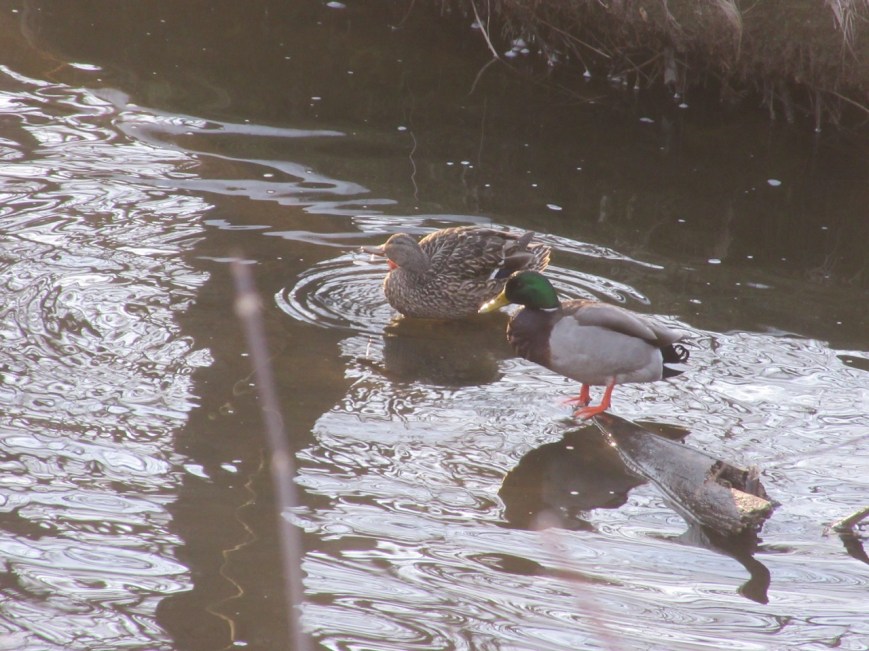
Ducks in Spring