They fixed it.

DSC03011

After my complaints about the poor job on the doorway flooring, the lead carpenter came out yesterday morning and re-did the doorway… looks good this time.  We decided not to sand and refinish all the floors so we’ll have to wait for the natural colors to catch up with each other, but the floor boards flow from one room to the other as they should.

Hurray for speaking up.  (And thanks for all the moral support from commenters!)

Cranky

I am feeling cranky today.  After some good beginnings with our carpenter and his crew, yesterday we went to the house, and were shocked by some very poor work on the wood floor being done to fill in where the doors were enlarged.  Cracks, a big cut joint between several boards right in the middle of the door.  I didn’t take a picture of that.  But the other day I had taken a picture of a few other un-finishings. Like this mark over the windows that were installed–a deep scratched groove in the drywall.  There are three such marks below and two above.
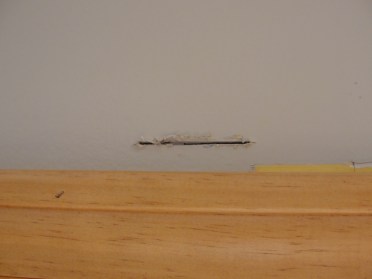
Scratch DSC02947We don’t have any touch up paint for this room’s color (the sellers left some paint cans from other rooms in the basement.)  So does this mean, really, that we’ll have to repaint the entire room?

There was also a mistake in the placement of a grab bar in the bathroom, and while it can be moved, the place from which it will be removed will now be marred, and the bathroom wall is either wallpaper or a sponge-spackled paint finish that we don’t have the ability to duplicate.

When I contract with someone to do work that we cannot do ourselves, it creates in me a sense of vulnerability.  When things come up, I ask myself all sorts of self-doubting questions: Am I being too picky?  Should I have said more? What can we reasonably expect? Can we assume they’ll finish up the work nicely, or do we have to raise the issues as we notice them? Should I have held up our second payment check to make sure these issues were dealt with? (We are doing the work in three stages, so it didn’t seem unreasonable to make a second installment before everything was totally done on this stage–But?)

I did call the carpenter shortly after we noticed the poor job on the flooring–this was being done by a member of his crew–and he interrupted the work and has said he will fix the issues we raised.

I hate to be in the mode of criticizing other people’s work. But I do expect people to do a good job. This is only a small “easy” job for them apparently, but it is the home we hope to live in for a very long time. I want to look at the improvements we made, and feel happy about how beautiful they look.

I was thinking about all of this this morning, and trying to figure out how to get into a better mood.  I remembered some advice that Sarah Susanka wrote:  “Every situation contains within it the food and fertilizer for our flourishing, but the only way we can find this out is by being obedient to each set of circumstances that present themselves–to fully engage whatever arises to the best of our ability and to process any reactions and judgments as they come up, without editing or suppressing anything.”

She went on to describe her discomfort with situations of confrontation, how she hesitated to share her direct feelings for fear of angering someone else.  How important it was for her to begin to notice that pattern and uncover what came up in her, so she could learn to be direct–to deal with the difficult and uncomfortable as it arose.  Yep.  That resonates.

So I blog to notice what comes up for me, to give it some attention–to be able to say, I am afraid to demand of others the level of perfection that I demand for myself. And I am afraid to confront others about their mistakes.  I don’t want to make anyone angry or uncomfortable.  But I do have it within me to confront–if I can get through the resistance to having to do it, the wish to avoid it. It wasn’t what I wanted to have on my plate yesterday or today, but there it was. Here it is.
Twelve Days of Climate Prayer

Reflected Sky

Today the climate talks begin in Paris, and I am joining with many others to pray, to meditate, to pay attention, to lend our individual energies to this most important project of humankind. Can we act together to shift our way of life from planet destruction to planet healing?

On each of the twelve days of the talks, I intend to pray at sunrise, to ask for help from all of our siblings on this planet–the animals, the trees, the birds, the plants, the winds, the moon.  Help us to learn to live in mutually beneficial ways with all life on Earth!

I don’t put my hope in the goals or plans of the participants in the climate talks.  I have heard that the goals are so modest, they won’t create enough change to save us from devastating global warming.  But I do feel inspired by the ordinary people around the world who have more ambitious goals. We want a planet that is full of life for human beings and all other beings!

I am hopeful because there are so many others who are praying, meditating, paying attention, protesting, changing our own habits, changing our investments, changing what we buy, changing what we grow, changing how we think and how we live.

What do you love about this Earth? Please join in a twelve-day global focus on transformation! If you pray, pray for this. If you don’t pray, take some other action each day on behalf of the Earth. Find hope in the energies of hundreds, thousands, millions, billions who love the Earth, and love life, who are joining in this powerful intention.

Projections from the Shadow Side of History

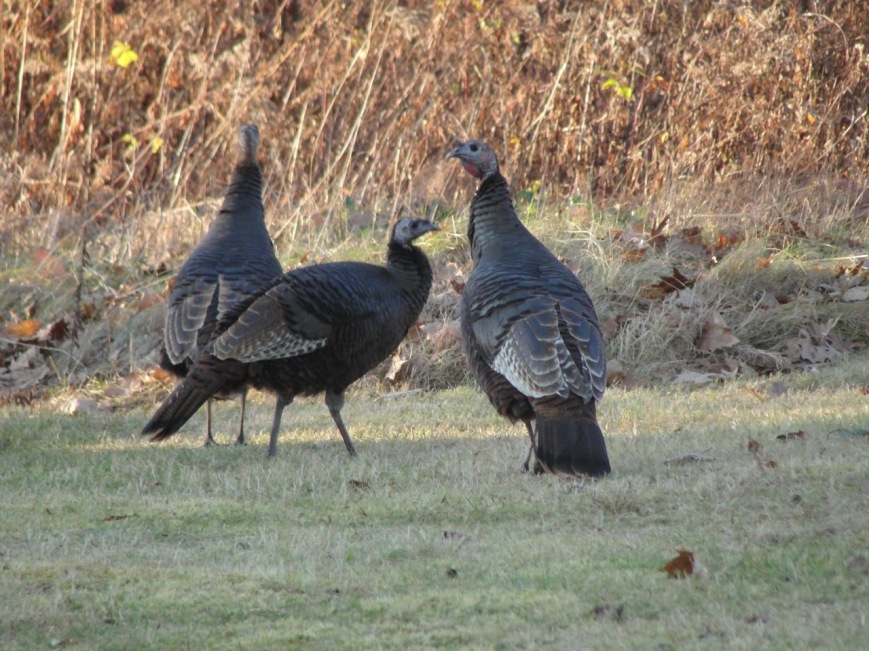
Turkeys DSC02379Thanksgiving is a holiday that always fills me with mixed feelings. Gratitude is wonderful, and getting together with family and friends can be a blessing. But I know that the stories we celebrate are white-washed versions of a history that has brought devastation to so many. I always remember that many Indigenous people call this the Day of Mourning.

The only time that foreign immigrants actually brought disease and destruction to this continent was when the English, Spanish, and French came to settle on its shores. Millions of Indigenous peoples died from diseases to which they had no resistance, or were killed in ongoing campaigns by the newcomers to destroy them and their way of life.

So while I give many thanks for my life, it feels sacrilegious to give thanks for prosperity that was built on the suffering and death of so many others. But it does illuminate for me, in a social psychological way, the possible roots of our American fear and hatred of foreign immigrants. I wonder if perhaps these feelings are a form of projection from this unacknowledged shadow side of American history. People imagine that new immigrants will bring destruction because the first settlers were the immigrants who did bring destruction.

This fear of the foreigner never proved realistic with later immigrants—with the Irish, the Italian, the Chinese, the German, the Jewish, the Puerto Rican, and so many others. Despite being hated and derided, they eventually became a part of the fabric of American life. Perhaps there is a link between facing more honestly our own shadowed and genocidal history, and letting go of our fear of the other.

Hard thoughts for a quiet holiday at home. But so many are cold and hungry and desperately seeking a safe harbor. And the tide of xenophobia and racism in our country seems to be rising out of control. Let’s help our friends and neighbors to keep their heads about them. I believe that when we are lucky enough to have shelter and food and clothing and safety, we are responsible for sharing what we can with those who are in need. To me, that is what thanksgiving should be all about.

Called to be Better: In Light of the Attacks on Paris

Heart Candle Flame DSC01573

How tragically ironic, as we approach the season of Christmas, (which celebrates a Middle Eastern refugee family seeking shelter), that so many in the Christian world are now, in response to the attacks in Paris, calling for shutting their boundaries to refugees from Syria. Haven’t people heard that these refugees are fleeing from the same terrorists who killed in Paris? I understand that people are afraid. That is the purpose and consequence of terrorist acts. But to extend that fear to all refugees, to all Muslims, to all Syrians is one of the worst forms of human cowardice.

We are called to be better than that. I am not saying it is easy. But I was inspired when I heard about Antoine Leiris, whose wife was shot in Paris. He posted this message to those responsible:

On Friday night you stole away the life of an exceptional being, the love of my life, the mother of my son, but you will not have my hatred. I do not know who you are and I don’t want to know, you are dead souls. If the God for whom you kill so blindly made us in His image, each bullet in my wife’s body would have been a wound in His heart.

Therefore I will not give you the gift of hating you. You have obviously sought it but responding to hatred with anger would be to give in to the same ignorance that that has made you what you are. You want me to be afraid, to cast a mistrustful eye on my fellow citizens, to sacrifice my freedom for security. Lost. Same player, same game.

We are only two, my son and I, but we are more powerful than all the world’s armies. In any case, I have no more time to waste on you, I need to get back to Melvil who is waking up from his afternoon nap. He’s just 17 months old; he’ll eat his snack like every day, and then we’re going to play like we do every day; and every day of his life this little boy will insult you with his happiness and freedom. Because you don’t have his hatred either.”

His is a beautiful example of what heroism looks like. Most of us are not being asked to be that heroic right now.  But are we perhaps being called to take a few small step of heroism ourselves?  A few small acts that ask only a small amount of bravery come to my mind. We could contact our governors and our Congressional delegations to let them know we don’t agree with those who want to refuse refugees. We could contact the President and encourage him to hold strong, and in fact to increase the numbers of people we welcome from Syria.  

On a more involved level, we might take it upon ourselves to learn more about the roots of the Middle East conflicts, and how U.S. foreign policy is linked to all of this. Some articles that I have found helpful include several interviews on Democracy Now that can be found on their website: www.democracynow.org. And perhaps, we could be active in welcoming those refugees who do arrive, helping them to get settled in a new and unfamiliar place.  Let us open our minds and hearts to the deeper realities of our world, and become our best selves—let us move beyond fear and hatred into compassion and hospitality toward those who are suffering.

Bittersweet

Some hard realities are emerging in our pursuit of the house with the beautiful back yard. It has been a whirlwind of activity for acting on due diligence for the purchase and sale. We’ve had a home inspection, and a solar evaluation. We’ve discovered a few moderate-sized challenges–we’ll have to replace the roof before we can install solar panels.  We’ll have to prune a large tree whose branches hang over the roof.

But perhaps the worst came yesterday, when our realtor called to say that in looking closer at the deed and the page on which it was registered, it appeared that not all the land that seemed to belong to this property actually belongs to it.  There is a Portland Water District parcel that runs next to the land, and it takes up part of the space that was being occupied by the current owners.

We feel angry and betrayed that the sellers never disclosed this information.  In the listing photos and in the placement of some children’s playground equipment, we were led to believe that this property went up to the neighbor’s fence.  But in reality the larger part of the side yard belongs to the PWD.  I remembered that there had been the remnants of a little fence from the front corner of the house over to the neighbor’s fence that had been removed except for the posts.  We are guessing that the realtor suggested they take down the fence because it wasn’t legal, but who knows?

We went to the property today to do some of our own measurements, to see where the boundaries really are, and to try to decide if, with this new information, we still want to choose this property.  We really don’t like the underhanded aspects of real estate–the attempts get the best deal you can, even if you play dirty.  Our own values say, be honest, let it be fair to all involved. We are so glad our realtor shares those values, and also that he is so conscientious and went the extra mile to discover these discrepancies.

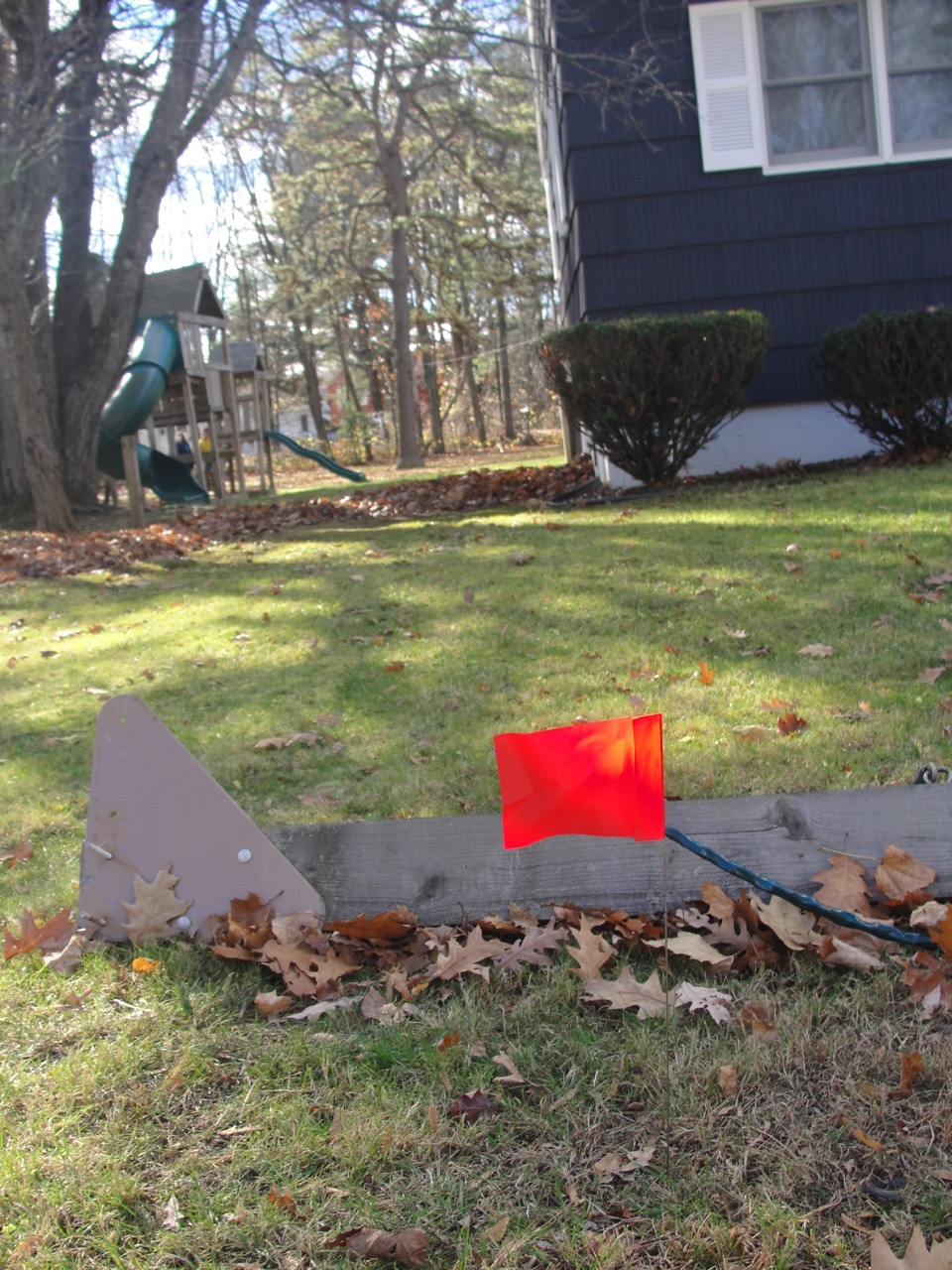
Red boundary flag, photo by Margy Dowzer

Our red boundary flag

When we did the rough measurements we discovered that the actual front boundary of the property stops about even with the side of the house, and then slants back to the left, away from the house, directly through the play equipment. The big tree, and the neighbors fence too, by the way, are all on PWD land.  We spent a long time in the yard, trying to sort out our feelings about it all.  We still need some more information from the water district. It seems that all the neighborhood properties are currently encroaching on their land.  There is a 20-inch, 101-year-old water main that runs on their land, fortunately toward the other side of it. But will they be tearing it all up to replace or repair in the next twenty or thirty years?

What we’ve learned in this process is that the privacy of this back yard is vulnerable. Along with this water district land, there is a paper road that is undeveloped at the back of the land, that may never be developed, or will it?  On the plus side, all of it expands the sense of space that one feels there.  But on the other hand, will there be future changes over which we have no control? We’ll try to get more information on Monday. We have until Tuesday to withdraw.  But for now, we are still feeling a connection to the land, even tender toward its neglected needs.  In the undeveloped areas off the back edges, there are invasive vines and bittersweet.  One of the values of permaculture is to bring healing to the land. We feel good about that. Please send us prayers for clarity, and the revealing of important truths.

All this is PWD owned land.

All this is PWD owned land.  Photos by Margy Dowzer.

Step by Step

I am writing this morning with a small black cat purring on my lap.  Yesterday was the new moon, and on each new moon I read my journal from the past 28 or 29 days back to the last new moon. I notice how busy I have been, leading worship again, and with the life of my congregation in full force.

This past Sunday, I preached about Sandra Bland, #BlackLivesMatter, and Ta-Nehisi Coates’ book, Between the World and Me.  The title of the sermon was “Changing Lanes Without Signaling.” (Text of my sermons can be found on our church website a few days after the services.) I love that my congregation welcomes these tough issues and appreciates that I bring them sermons exploring the painful realities of our world. I feel truly lucky to be serving as their minister.

There have been a few more houses we’ve looked at in our search for greener housing, but nothing that resonated, until recently we began exploring a different kind of option. Our realtor knew someone who was planning to sell their house, but it was not yet on the market. He thought of us because the owner had done many green upgrades, including solar panels, and a permaculture garden. We’ve had a chance to look at the house and yard, and like it a lot. But it will need many other kinds of renovations, including an addition of a bedroom, in order to work for all of our needs.

So we are exploring the world of renovation-land. Asking ourselves, could we live in the midst of noise and workers and a good bit of chaos for several months? And more seriously, could we get all the needed permits, and afford the work that would be done? Right now we are waiting on some estimates from a green-savvy general contractor we are getting to know. Stay tuned.

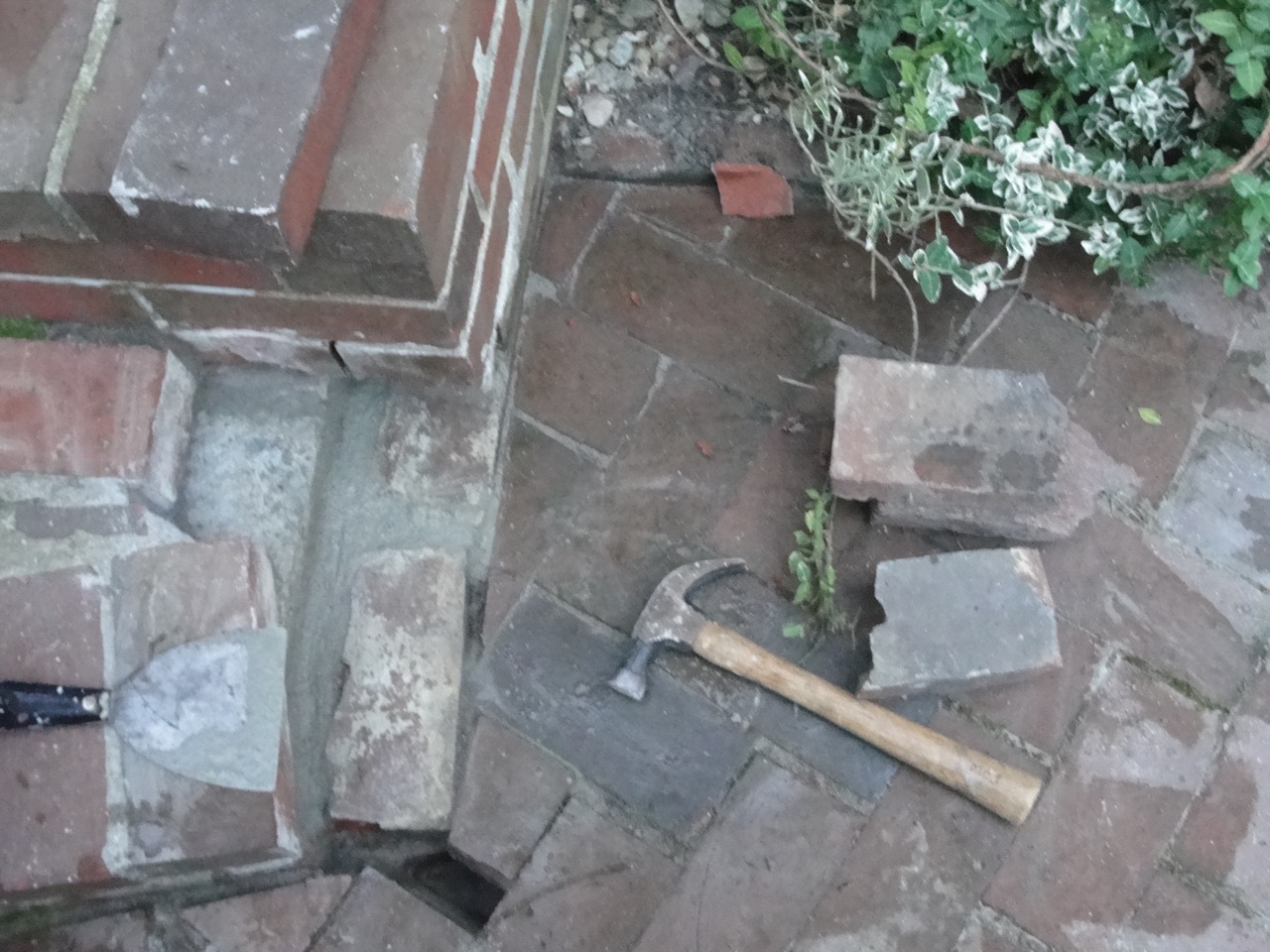
Meanwhile, Margy has been doing some small jobs on our own house: this week she is repairing some loose bricks on a corner of our entry steps, trying to get it finished before the weather turns too cold. I love my butch partner! I love how we are caring for each other, and staying tuned in to each other during this challenging journey. It draws us even closer together.

Photo by Margy Dowzer

Photo by Margy Dowzer

Returning To the Present Moment

Our search for greener housing has brought me an intense focus on a worthy project and a burning desire to bring it to completion. But one of the side effects of this project has been that I easily lose track of my attention to this present moment. It is as if I am hovering between the present and the future, and my feet can’t find the ground.

I took a walk this morning in my neighborhood. A short way down the road, I found a frog that had been killed by a passing car. As I moved its body into the grass, I was reminded that we never know when we will meet our own end. It won’t wait for us to finish all our projects. This moment is all that we have for sure. How can I live in this moment, even when I am involved in working on a goal?

One of the best ways I know to return to the present moment is to enter through the door of gratitude. I am grateful for the full moon that was golden in the trees as it was rising last night. I am grateful for cuddling with my love after watching a movie together on the couch. I am grateful for diving into the ocean yesterday after time setting up rain barrels at a Permablitz in South Portland. I am grateful for people who care about the earth and each other enough to gather together to help new friends fulfill a permaculture design for their garden.

I am grateful for local sausage fried with green kale at breakfast. I am grateful for the sun shining through the clouds during my walk. I am grateful for the turkey who crossed the road in front of me. I am grateful for the chirping of the chipmunk who greeted me on my return, and then hid in the rain downspout extension. I am grateful for one more day to be alive in this beautiful earth.Chipmunk DSC00392

Shredding and Thoughts on an Anxious System

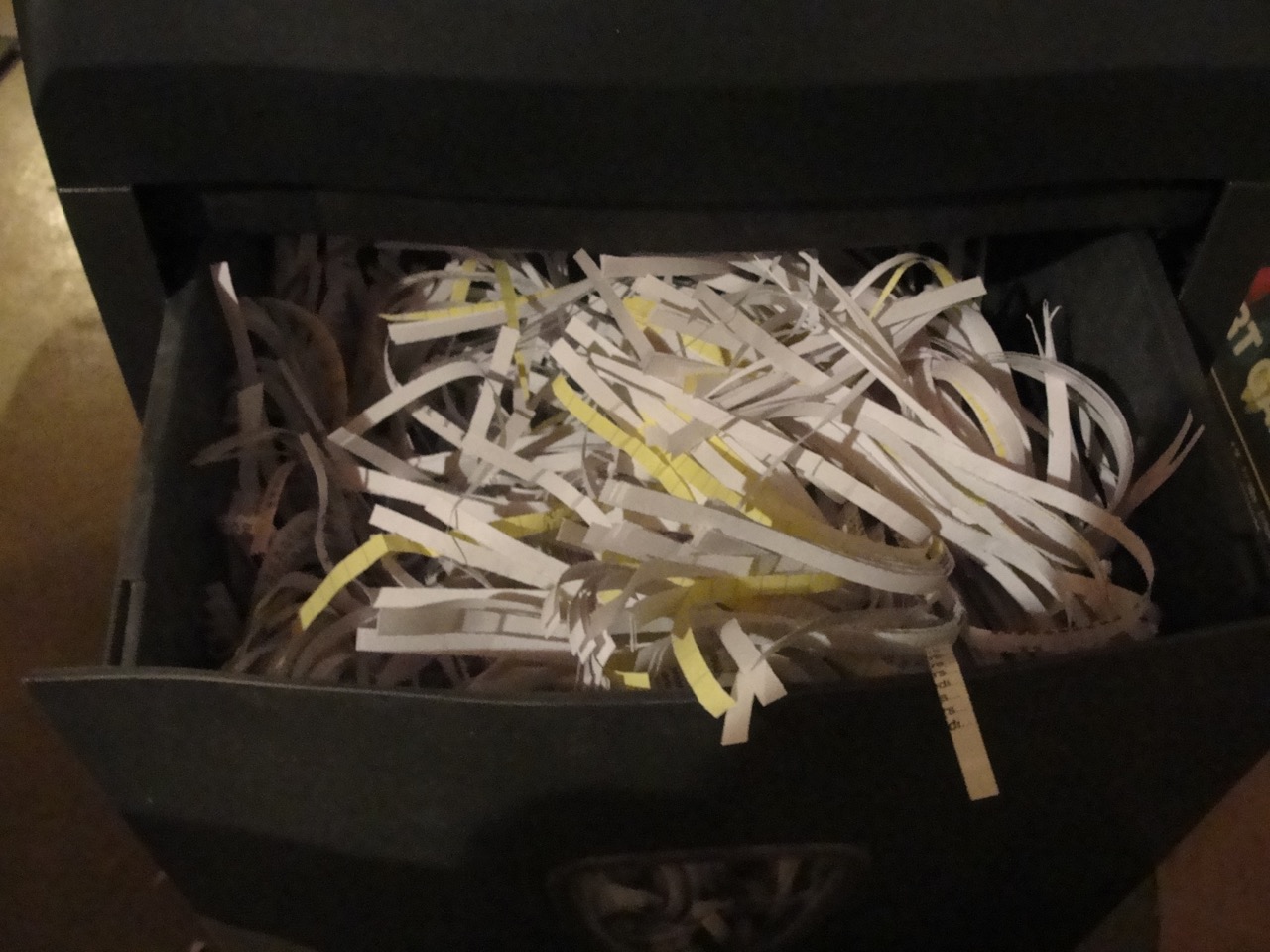
Shredding DSC00379As part of our downsizing, simplifying, and search for a greener home, I have been cleaning up old financial records that I had basically just boxed up and kept forever. I checked online sources to figure out which records I actually needed to keep and which ones I could throw away and recycle.

I found out that the IRS has three years from your income tax filing to audit your tax return for miscellaneous errors, and six years if they suspect you of underreporting income, so they suggest you keep all your returns and documentation for seven years. As a minister, this means I must also keep the documentation for all housing expenses, since our housing allowance is treated differently for taxes than regular salary. I have also read that I should keep anything related to purchase or sale of a house, and permanent improvements to the house. (If you think you might want to do some shredding, please do your own research on this, because I am not an accountant or tax expert.)

I have been doing this process for an hour or two at a time, because the shredder gets tired after a bit of time, and I do too. I’ve fed it thousands of old receipts, old bills, old bank statements, old tax returns. I have filled up four huge trash containers with paper for recycling. I am just getting up to the seven-year mark in my papers–starting from many years ago I’m finished up to 2007. What am I learning? It takes almost as much work to eliminate old papers as it did to acquire them. Finances have gotten so complicated that they take more time and energy than I want to give to them. In the financial world “green” does not refer to environmentally sustainable.

It makes me realize that the structure of our society’s economic system is based on fear and anxiety. The IRS is the adversary who might bang at our door and discover we threw away the letter acknowledging a donation. I am not against the idea of taxes or contributions to social security. (I don’t appreciate that so much of the money goes to weapons and war.) Ideally, taxes are the way we support the Common Good, the way we recognize and contribute to shared resources like roads and firefighters and schools and libraries and care for our elders. I wish healthcare for everyone was also included among those shared resources. I deeply value giving energy to the Common Good.

And I wish there were a way to approach it all beyond anxiety and the complicated accumulation of records. I am curious if others have found a way to truly simplify the financial processes in our lives?

Respite for Mother Earth

Today I am participating in a non-action, non-event. It is being sponsored by Dawnland Environmental Defense, an alliance of Native and non-Native peoples united in the protection of the Dawnland with particular focus on the sacredness of Water. The “Dawnland” is the land of the indigenous Wabanaki, this place where dawn first comes to our country. Everyone is invited to participate in a RESPITE for Mother Earth ~ “stay home, do little, pollute little, buy nothing (especially gas!), explore ways to lower your carbon footprint, regroup, relax, and give your Mother a break!” (It actually covers Aug 13-15 but today is the day I am able to participate.)

In our search for greener housing, there are times when it seems important to stop looking, stop driving around, stop even thinking about projects and buildings, and remember the ground underneath our feet, the root of life, the Earth who is Mother of all. I was able to go outside this morning and listen to the crows and chipmunks sounding an alarm–I think I may have seen a small hawk in the neighborhood. I washed out our bird feeder, and filled it with fresh seed. I read somewhere that bird calls wake up the plants each day, and can wake up our hearts as well.

There is one task I am doing–writing and emailing a letter about a mega-dump that is threatening the Penobscot River. If anyone is willing to help, especially Maine residents, you might use this information to create your own letter, or look at the Dawnland Environmental Defense page for further information.

Michael T. Parker, Maine Department of Environmental Protection, Solid Waste Program, 17 State House Station, Augusta, ME 0333-0017

michael.t.parker@maine.gov

Application #: DEP # S-20700-WD-B1-N

I am writing to request a public hearing on the expansion of Juniper Ridge Landfill, which is located just upstream from Indian Island. It is already a threat for the future viability of the river, and doubling the size (as is now being proposed) will allows a larger mountain of toxic trash to be placed on sensitive wetlands. This will have a detrimental affect on Penobscot people as well as all people who love the Penobscot River.

It is important that affected citizens have a voice in this proposal that threatens their water, the wetland ecology, and the air. It is important that hearings be held in a location convenient for those who will be most affected, such as in Old Town, Orono, Alton, or the Penobscot Nation area. Please inform me of further details on such a hearing.

Sincerely,

The Rev. Dr. Myke Johnson

Ma'skwasi Sipo (Birch Stream), traditional Penobscot hunting, fishing, and gathering territory, is located in close proximity to the mega-dump, Juniper Ridge Landfill.

Ma’skwasi Sipo (Birch Stream), traditional Penobscot hunting, fishing, and gathering territory, is located in close proximity to the mega-dump, Juniper Ridge Landfill. Photo from Dawnland Environmental Defense Facebook page.