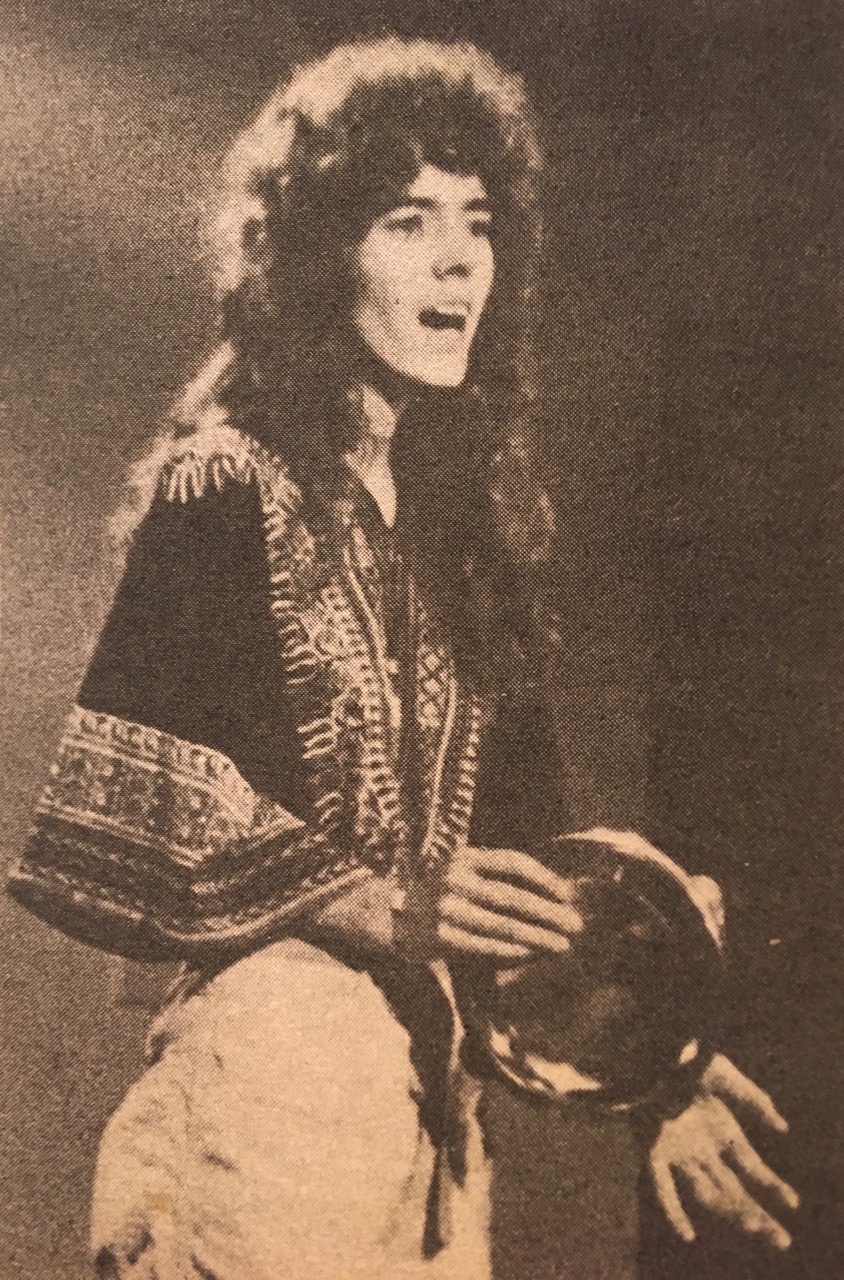
I’ve been going through old boxes from my past, and am currently working on the time I lived in Grand Rapids, Michigan, from 1979 to 1983. It was such a different time–not many photos, for example. But I found this one in a clipping from a women’s periodical, attached to an article I wrote about how women’s history is not just reading about women from the past, but an imperative for us to make history in the present–herstory. I still believe that!
My partner at the time, Gary, and I were trying to make history/herstory through non-violent activism, and through running a Catholic Worker hospitality house. We called it Grimke Community, named after Angelina and Sarah Grimke, white southern women who worked for the abolition of slavery in the early 1800s. We opened our house to a person or family in need of emergency shelter, often in cooperation with the local battered women’s organization. The house was in a kind of land trust, and we lived there rent-free. We could pay the bills if one of us had some sort of half-time job at minimum wage.
I held various jobs during those years, from being a maternity aide for a home-birth midwifery group, to visiting women in the local jail, to cleaning houses, to being a library “page.” I was also doing a lot of music those days, and performing in any local venue I could arrange, from nursing homes to social justice rallies. It is funny to look back at my big naturally-curly hair, my extremely thin torso, and my wide-open mouth. I was learning to use my voice!
In early 1983, when this picture was taken, I was trying to make sense of how to follow my calling. It was something like a call to ministry, but still being Catholic, and being a woman, I felt like I had to invent something totally new. Eventually, I was able to take the next steps by going to Chicago to attend the Chicago Theological Seminary, where I was lucky to receive a full fellowship. Gary and I moved to Chicago to take over also, serendipitously, the leadership of St. Elizabeth Catholic Worker House. Those were years of profound transformations. And after seminary, I did invent something new for myself–a ministry which was a combination of activism, offering feminist therapy for women, and leading feminist ritual and community education. (This was years before I eventually was ordained as a Unitarian Universalist minister.)
Now, looking back at my own herstory, I can feel the continuity between the me of now and the me of back then. But I feel some sadness that the changes for which I struggled, while meeting some success, have also faced incredible backlash and new challenges. Still, I don’t regret any of it.
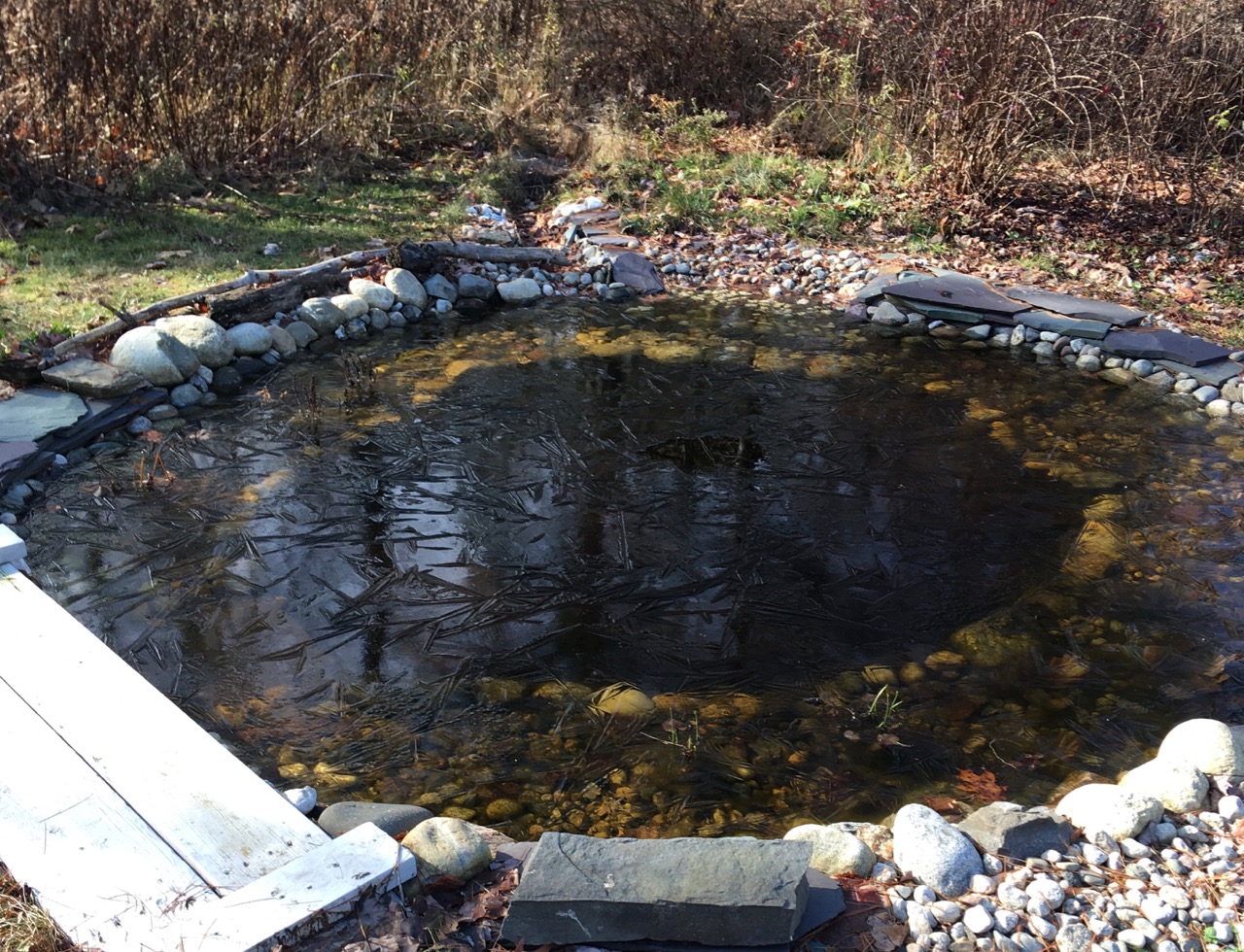
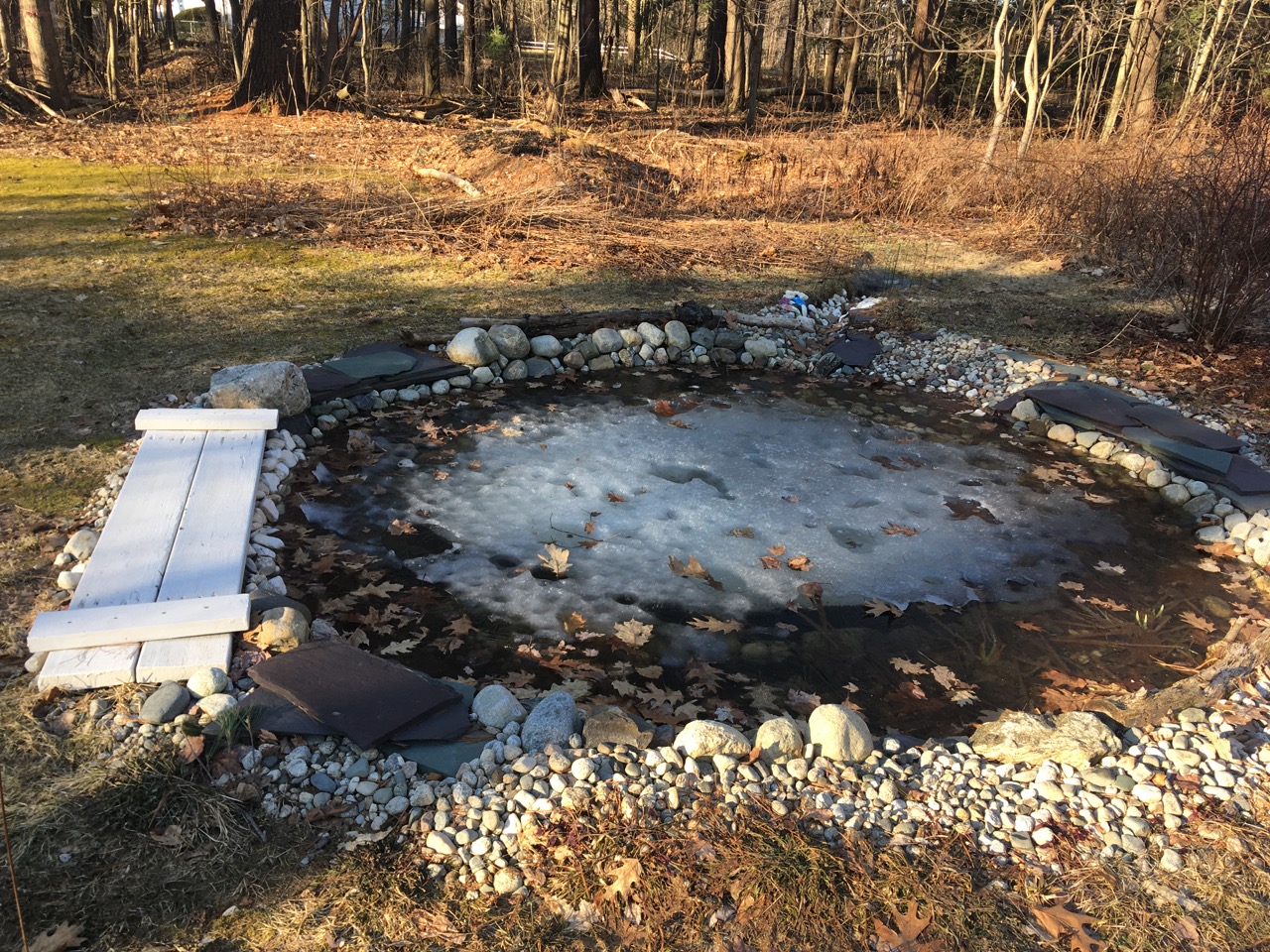
Ice was forming on the surface of the pond yesterday.
Yesterday felt like the true turning of the seasons, from warm autumn 70 degree days to a chilly, almost winter, high of 40 degrees. We had a freeze overnight and the pond surface was wrinkled with ice forming. I went around the yard putting away the last garden hose, the five-gallon buckets, the little tables we use in the back next to chairs. I turned over the wheelbarrows behind the garage. I covered our patio table and chairs with a tarp, and I plugged in the bird bath so it will keep water thawed during frozen weather. I got out the snow shovel and sand mixture to put on the back porch. I left 4 chairs around the fire circle–maybe we’ll get outside around a fire–it could happen!
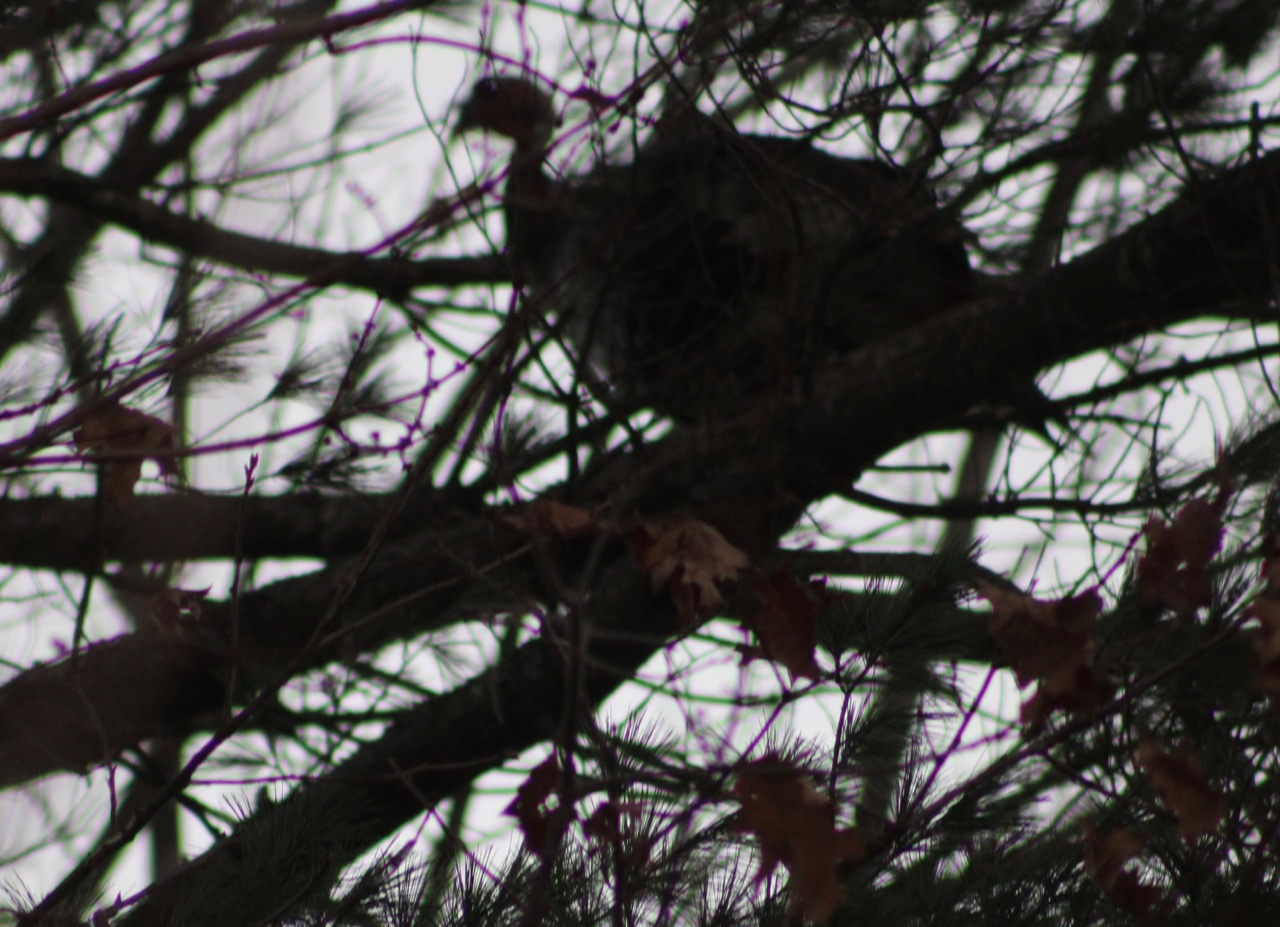
Last Thursday was my last time lying in the hammock for the season. I could see two frogs still hanging out in the pond, the color of mud, not the green of summer. While I was lying there, suddenly I saw a huge bird flying nearby, up to the pine trees at the back near our yard. Looking closer, I recognized the characteristic shape of a turkey! It was dusk and the light was turning all black and white and shades of gray. We’ve had a little trio wandering in the yard during the last few weeks, so I am guessing this was one of them. I had to put the hammock away the next day.
Turkey in a pine tree at dusk
This morning, we had a bit of snow, mixed with rain, so here we are. The gardening work, whether fully complete or not, is done for the season. And I was inspired to get back to my winter project–going through boxes of old papers in the basement. I am proud of myself for diving into it today!
Last winter, I went through 11 boxesfrom my years in Boston, organized, winnowed, and reduced them to four. I had just started on some boxes from the time before I moved there. This winter, I will go through papers from my time at the Women’s Peace Camp, and in Chicago, and in Grand Rapids. I went to Chicago from Grand Rapids in 1983 to attend Chicago Theological Seminary, from which I graduated in 1986. I visited the Peace Camp in the summer of 1983, and then lived there in the summer of 1985, and winter/summer 1986. These places were the scenes of my coming out as a lesbian, and my trying to figure out what ministry might look like for someone like me. At the time I had left the Catholic church, and was part of the emerging feminist spirituality movement. I experienced so much transformation during those years, and I am fascinated to read what I wrote about it. It was a season of profound personal change.
The last few weeks have been full of ordinary tasks around the house and yard. Sometimes we forget to be grateful for these very ordinary things. I think about people whose lives have been disrupted by war, by floods, by fire, by despots. Margy and I are able to do our ordinary tasks and ordinary meals and ordinary rest, undisrupted, and for that I am grateful.
A couple weeks ago, I painted the trunks of the orchard trees, to protect against winter sunburn and insects. This time I used a half and half mix of white milk paint and “Surround”–both powders that are mixed in water. I don’t know if it is really necessary–certainly I see fruit trees around the neighborhood without anything on them. But one morning, I had the energy and decided to try out the mixture. Surround is a kind of porcelain clay organic product that can disrupt certain insects. Last summer, I sprayed the fruit trees with it, and they remained light colored all winter. This summer I didn’t do any sprays like that, but why not try it as a winter paint? So that was one little project.
Peach tree with white paint on trunk.
I’ve been using the skimmer to clear leaves off the pond, and then I also have been cutting off the dead stalks of pond plants. I got into the pond one day, placing my feet very carefully down to the second step in, and lifted the pond lily pot, then dropped it down to the deepest part of the pond. The deepest part is 2 1/2 feet, so I am hoping that the hardy lily might survive the winter this way. And maybe in the spring it will need to be lifted back out, or maybe it will just reach its leaves up to the surface from there. I asked Margy to watch with me, just in case I slipped. But I didn’t! A few frogs are still hanging out, since the weather has been unseasonably warm still.
Since we had an extra weekend of warm weather, I finally painted the upper beam of the roof on our deck. Some of the wood had been left bare when a friend put in the roof, a few years ago, so protecting it has been on the long-term to-do list. Happily, there was some primer in our basement that I could use, leftover from the prior owners. It took three days, and each day after working on it for only a couple hours I was dead exhausted. But it is done today!
Deck beam half painted and half still undone bare wood.
Meanwhile, we’ve been filling in our absentee ballots, and researching the details of 13 referenda questions for our city of Portland, as well as the candidates running for office. I am grateful for democracy, as flawed as it might be practiced, and pray that we’ll still be able to have a democracy going forward. Rising fascism in our country has been alarming and discouraging, as well as the attack on the bodily autonomy of women, and the threats to such importance common goods as Social Security and Medicare. So much of my life’s work has been about expanding the benefits of democracy to those who have been excluded, fighting for equality and justice and liberation for myself as well as others. My work has included criticism of the way that our democracy has been incomplete, flawed, and unjust. But I think of voting as harm reduction–I may criticize candidates and policies, but I will vote for those who will do the least damage. Right now, with the Republican party being taken over by fascists, that means voting for Democrats across the board. So I am extra appreciative these days of the ordinary benefits we can take for granted, and pray that many many people will be moved to vote to keep those benefits.
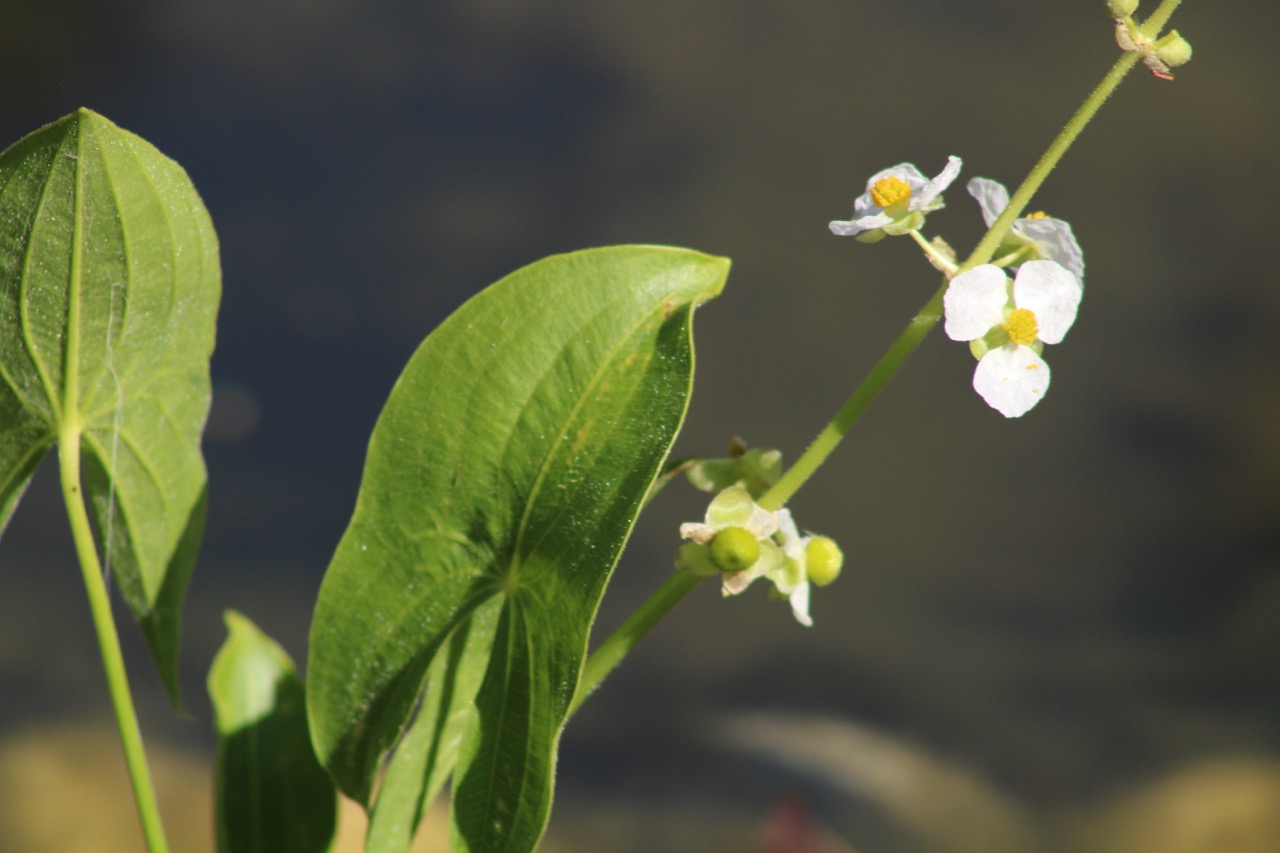
Arrowhead flowers and leaves and seeds, a pond plant
I am happy to be starting a new experimental adventure. After four years away following my retirement, I am venturing back into involvement with my former congregation, Allen Avenue Unitarian Universalist Church. In our faith community, a retiring minister traditionally stays away for a few years, to make room for a new minister to bond with the congregation, and to make real the fact that I am no longer their minister. If or when we return, we create a covenant with the current minister to clarify our relationship and offer our mutual support. I have done that with Rev. Tara Humphries who is now serving the congregation.
But it is still a delicate balance to negotiate. When I go back, I am not their minister, but I am also not just any other member of the church. I am still their Minister Emerita, an honorary designation expressing our mutual affection and connection. But with or without that designation, I still carry those thirteen years of affection and connection, and it gives me an influence different from other members. So for me, the experiment is measuring whether and how I might be a member of this community in that in-between zone. I am drawn back by a desire for the kind of community that church offers, I am drawn to that little village of care and support. Is it possible? Will it work for me, and for them?
Some parts of this feel very clear-cut. Dealing with chronic illness has made it impossible for me to carry out many ministry functions, like weddings, memorials, and leading worship, so I won’t even be tempted to be doing any of those. Another aspect clarified in our covenant recognizes that “since my position still carries some weight, I will decline to participate in the governance of the congregation, or take sides on any issue.” And both Tara and I will “decline to participate in, and will remove ourselves from, any conversations with church constituents which might try to evaluate each other’s ministries or contributions to church life.” All of that feels very down-to-earth and solid.
But more experimental are the personal interactions and connections. The first event I attended was an in-person, outdoor celebration of our 200th anniversary on September 10th. I am still being super cautious about COVID, so I wore a mask even though we were outside, though most others did not. This was the largest event to which I have gone at all since COVID. I would have loved to hug everyone, but I did air-hugs instead. It was wonderful to see people I knew, and meet a few I did not know. Heart-warming. It was also rather exhausting, and I had to rest afterward. Is that my chronic illness, or introversion, or somehow feeling once again all those threads of connection?
Worship services are now hybrid on Sundays–some people attend in person and others on Zoom, so I have attended a couple via Zoom, but I haven’t yet stayed for “zoom coffee-time.”
I went to the monthly “Elder Salon” and that felt really good. The structure made it easy for me to participate as others did, with a few minutes of check-in for each person, and a discussion following that. I like the reciprocity I felt in that group. The topics of concern to elders match many of the topics of concern in my own life right now. So it feels like I can join in as any other member might join in, and benefit from the collective wisdom in the group. I guess I am learning to be an elder. I like it.
All in all, I am taking it slow, and observing what comes up for me.
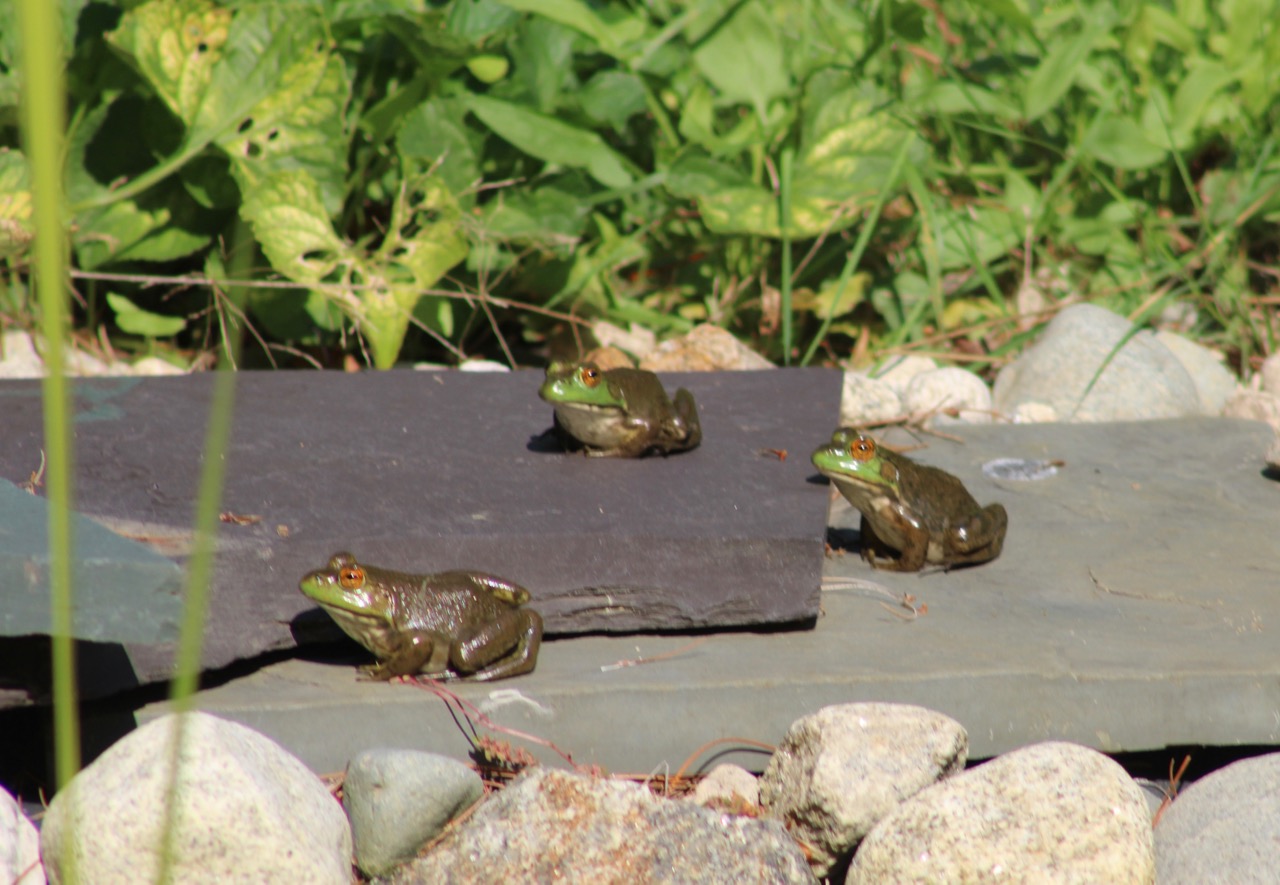
Three small frogs perched on rocks next to the pond in morning sun.
Lately, my life is small, as if I am looking on to life happening nearby, just like these frogs looking out over the edge of the pond. So many big things going on in the world, much frightening, some inspiring, but all of it feels somehow at a distance. I haven’t had a lot of words the past couple weeks.
But there was something I learned about that I wanted to mention here. It relates to my essay, on this site, called “Wanting to Be Indian.” I first wrote and published it back in 1995. I’ve learned a lot since then, and adapted the essay as I did. When I first wrote it, I described the history of my ancestry using the word “Metis.” I had no understanding of what that word meant in a Canadian context. I just had seen it in a French book about my ancestors, meaning of mixed ancestry, white and Innu. I thought maybe it might apply to me. But as I began to learn more, I stopped using that word, because historically it refers to the people in western Canada who have been a distinct Metis community for a long time. So I thought perhaps that was that. (Now I describe myself as white, with a distant Innu ancestor, my third great grandmother Marie Madeleine.)
But more recently, in the last year and especially this past week, I’ve been doing a lot more reading about the current situation in Quebec and the Maritime provinces. I have been horrified to learn about white people there claiming a “Metis” identity, in order to fight against the indigenous rights of Innu and other Native peoples. I found a website called Race Shifting, a “resource for people who are concerned with or want to find out more about the rise of the so-called “Eastern Metis” in the eastern provinces (Ontario, Québec, New Brunswick, and Nova Scotia) and in New England (Vermont, New Hampshire, Maine).”
Many of these so-called “Metis” organizations in Quebec have roots in white supremacist organizations, trying to impede the work that the government of Canada and Quebec were doing with Innu communities to negotiate agreements for their government-to-government relationships. (Some resources are in French, like the article about these negotiations toward Innu agreements. But I was able to read it with the help of Google translate.) The Innu never signed a treaty or ceded their land in the days of early colonization up through the end of the 20th century. Just after the turn of the century, when they were beginning to set parameters for these agreement, in public hearings there was resistance from some white people, especially those living near Saguenay and Sept-Iles. And then the tactics of those white people changed: they created “Metis” organizations, based sometimes on a very distant Indigenous ancestor (17th century), and often none at all. They tried to claim their own “Indigenous rights.”
I’ve written briefly about this issue before, but this time I saw that one of the Saguenay historians who is supporting this effort is someone who had done research on one of my ancestors, whose article I had requested and received in an email. That felt creepy. It made me wonder if probably a lot of these people are distant relatives of mine–I mean, that is sort of true for all French Canadians–we really are all related. But Saguenay is the region my great grandmother came from. Sometimes I hate being white. And certainly it was from my own experience that I wrote about the problems of white people wanting to be Indian. But this is something even deeper and more sinister–to claim Indigeneity to fight against Indigenous communities?
It’s hard to understand all these phenomena from outside of Quebec, from outside of Canada. And I don’t have a voice in that setting–I don’t even speak the language. Yet I understand enough to feel so sad. And even here in New England, I am looking on from the sidelines. I certainly have no role in identity policing. But it seems somehow important to try to understand it all, and important to support, in whatever small ways I can, the sovereignty struggles of Wabanaki peoples in Maine. This is where I am.
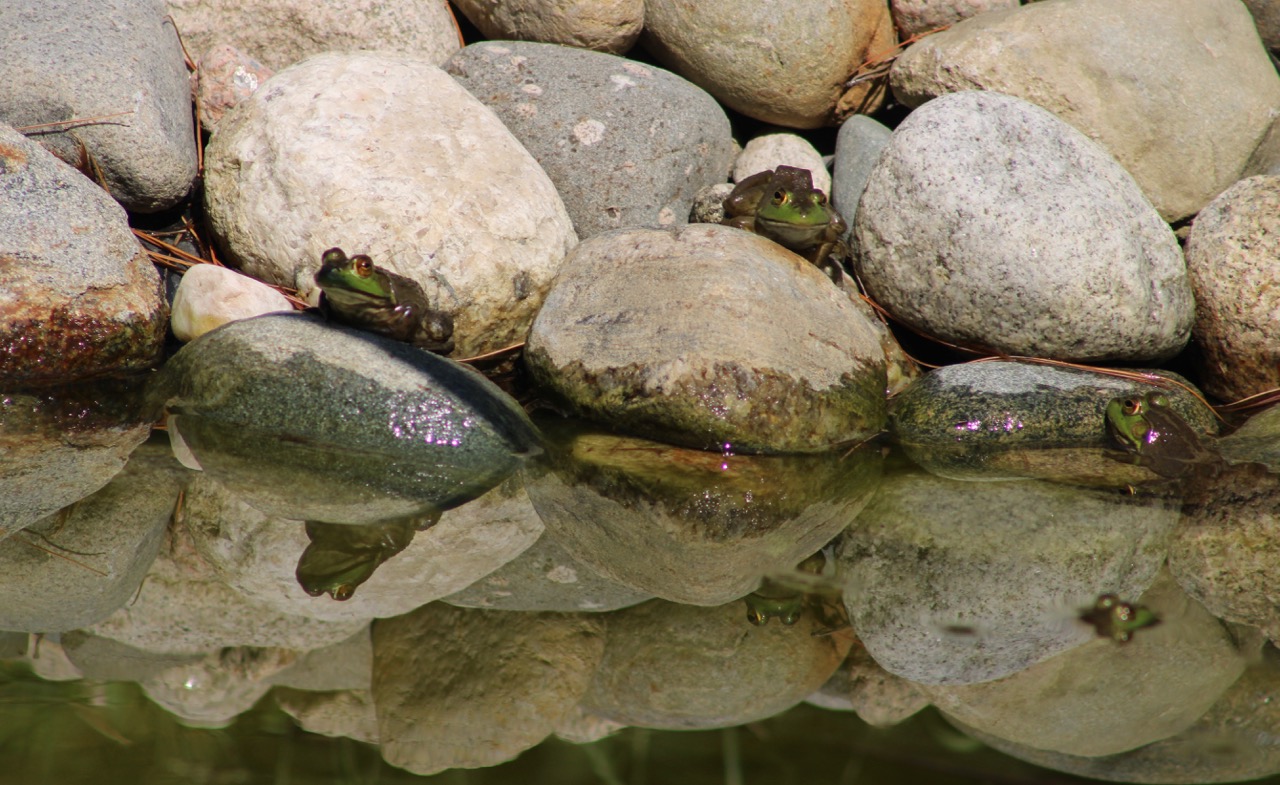
And now, for just a little beauty to counter the ugliness of racism, here are three more green frogs from our pond. (And the irony is not lost on me–frogs were used prejudicially against the French, and more recently a cartoon frog has been co-opted by white supremacists.) But these frogs are simply themselves.
Three frogs on rocks, and their reflections in the water of the pond.
Turkey mother and two babies behind plants in the yard
How does the Spirit move? How does the Spirit guide us? Is it like the wind blowing this morning, shifting the trees every which way? Might it come disguised as a turkey mother, with two babies always following nearby, meandering through the yard? Might it be in the doors that close, as well as the doors that open? Might it be in a conversation with a friend, sparking new ideas?
These last few weeks have been hard in our nation. Human rights have been undermined by the supreme court, and the attempted overthrow of democracy has been detailed in congressional hearings; gun violence continues, and police violence against black men does not abate. Heat waves remind us of the continued crisis of our planet, and despite many people acting as if the pandemic is over, the latest variant is more contagious and more severe.
I have felt at a loss for words about the big issues of the nation. I turned 69 last month, and after working for justice all of my adult life, I feel discouraged about the horrible backlash which seems to have taken power. Not surprised really. With the long history of this nation rooted in genocide, enslavement, and violence, it is amazing that we have made any progress at all. But for much of my life, it felt as if things were moving in a better direction. Now it feels like the same issues have to be fought all over again. I feel discouraged personally because I no longer have the physical energy to go to protests or marches, to be out there in the streets making a big noise. And because of that, I feel cut off from the community of resistance, which gives one hope and resilience.
So I listen for the Spirit, try to find guidance for my own little life. I look for signs in the wind and in the creatures who visit. The little turkey babies stay close to their mother, even as they wander through the tall grasses and wildflowers. Am I like that baby turkey? When it gets tired or scared, it jumps right up on the back of its mother. Or am I like the turkey mother, and someone needs to jump up on my back? How important it is that we help each other, and recognize the help that comes our way.
Baby turkey on its mother’s back.
How does the Spirit guide us? At times I am at a loss about what I can do, what I should do. This next chapter of my life is new territory. I don’t always understand when one door closes, but can I trust that the Spirit is still guiding me? Can I keep hold of a “yes” in my heart to the next open door? Can I recognize the sound of the Spirit in all of its guises? I am listening.
The last couple weeks have been focused on healing in our household. My partner Margy had knee replacement surgery, and came home to recuperate after a couple days in the hospital. Then, one of our cats, Billie, perhaps from the stress, stopped eating, and had something going on with her liver. So the vet came with some medicines to help her start eating again. I have been the tender of these loved ones, and both are doing well for the moment, but the healing will take some time. I haven’t been able to post on the site lately, being fully occupied with my nurse duties, but today is a quiet day, and I have these few moments to write and share photos.
Billie eating some food!
In the meantime, the yard is unfolding on its own, mostly with our neglect, except for occasional bits of tending, and I have been appreciating its springtime beauty and vitality.
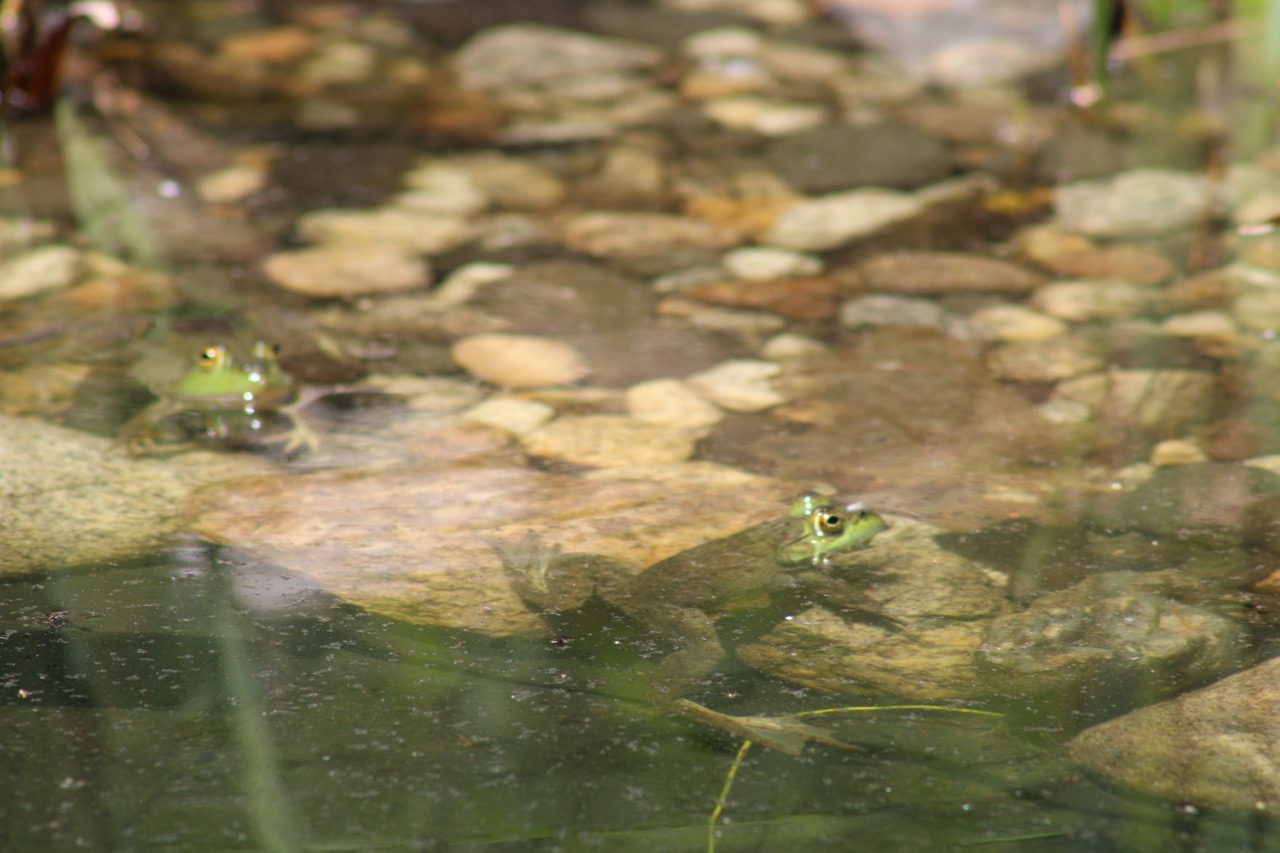
There are two frogs in the pond now, and one day, as I sat watching, one of them was chasing the other one, though not all the way out of the pond. The chased one is more timid, and dove into the bottom. They were both females I believe, so I am not sure what it was all about. But fascinating to watch, and listen to her calls.
Two frogs in the pond, just before the one on the left leapt over, and the one on the right dove under.
Sadly, the robin who has been sitting on the nest on our back porch, finally abandoned the eggs two days ago. She had been on the nest quite a bit, though not always, but they never hatched. I wonder if maybe the location was actually too warm for the eggs. Again, we don’t really know, but it is amazing to observe. We will miss her quiet presence, though I have also seen her in the orchard since then.
Yesterday, a lone turkey came into the orchard on her way to somewhere else. She very politely didn’t eat the broccoli and kale seedlings I just planted this week, but seemed to enjoy the clover.
Turkey in the garden with dandelion seed puffs behind.
I wonder if we might be able to create enough food in our garden, for the people and the animals? (Instead of battling with squirrels and other critters) Today, in a webinar, Letecia Layson described doing that, when creating a garden in a nature reserve. “Plant enough food for the animals and for you.” What a wonderful model for interconnection. There is so much wild plant beauty and food already out there too. For example, wild strawberries have spread over vast areas in the orchard and in the further back yard. We don’t usually eat these strawberries, but leave them for the birds.
Wild strawberry flowers
Way in the back, in the hedgerow which has now filled out in its summer foliage, there is a clump of jack-in-the-pulpit that Margy discovered last year. Since she can’t get back there right now, I looked out for it and was delighted to see that it has returned. I brought her a photo. We also have bleeding hearts, golden seal, and many many ferns along the edge of the “forested” area.
Jack-in-the-pulpit
Margy taught me how to use our battery-powered lawn mower, and I have been able to make some paths at least through the growing-taller grass. Mowing is usually her job. We figured we’d go along with No Mow May, but between ticks and invasive bittersweet, we actually do better to do some mowing. But we always steer around the ferns and other interesting wild plants that come up.
All of this has been a lesson in listening to the land, to the plants, to the animals. I have focused on quiet attention rather than doing projects. There will always be projects to do out there, but this year I am learning to be slow.
I recently read Sarah Ramey’s memoir, The Lady’s Handbook for Her Mysterious Illness. Published just last year, it is described this way:
“In her harrowing, darkly funny, and unforgettable memoir, Sarah Ramey recounts the decade-long saga of how a seemingly minor illness in her senior year of college turned into a prolonged and elusive condition that destroyed her health but that doctors couldn’t diagnose or treat. Worse, as they failed to cure her, they hinted that her devastating symptoms were psychological. …Ramey’s pursuit of a diagnosis and cure for her own mysterious illness becomes a page-turning medical mystery that reveals a new understanding of today’s chronic illnesses as ecological in nature, driven by modern changes to the basic foundations of health, from the quality of our sleep, diet, and social connections to the state of our microbiomes.”
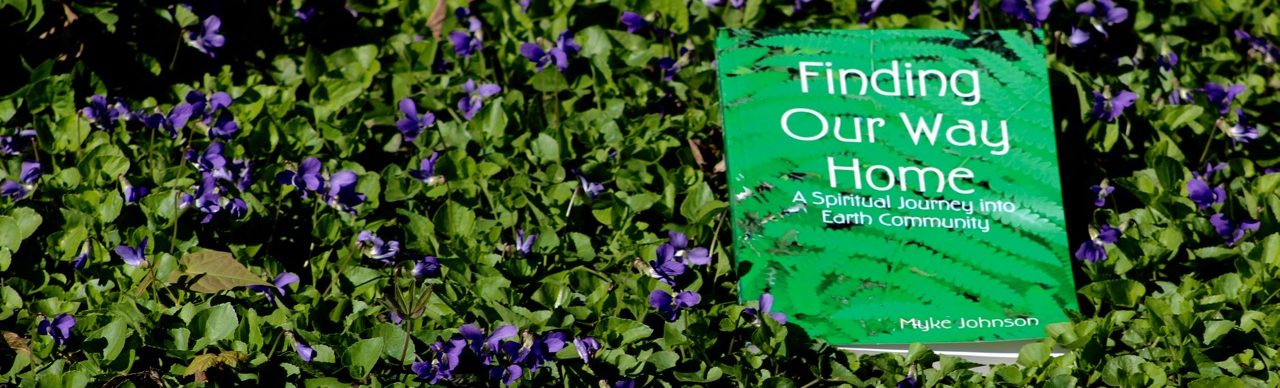
Book Jacket Cover
I haven’t experienced the horrifying stories she recounts with medical personnel, but I know others who have. I think it helped that I was usually drawn to alternative practitioners, though Sarah had her own horror stories with alternative practitioners. She finally found help with practitioners of Functional Medicine, and my own primary care nurse practitioner is aligned with that field. For that I am grateful.
I identified with the mysterious nature of auto-immune chronic conditions–when I reflected on it, I realized that they have been a part of my life for many years–most recently, Hashimoto’s thyroid disease, SIBO, adrenal fatigue, and borderline diabetes, but earlier in my life there was endometriosis, polycystic ovary syndrome, and gradually developing multiple chemical sensitivities, and multiple food sensitivities. For most of my life, I managed to work and keep my balance, but it became more and more difficult. Finally, when I turned 65, and could access Social Security and Medicare, I retired from my work as a full-time minister.
I wondered at the time if being released from the stress of full-time work might bring me relief from the illnesses, but that was not to be the case. Instead, I was better able to manage living with the illnesses. But it is a delicate balance. If I eat well (for me that means no refined sugar, no gluten, low carb, lots of vegetables, and meat, while avoiding the list of specific foods that give me problems), if I rest when I am weary (which is spending some variable part of every day lying on the couch), if I take certain natural supplements (for example, I take Berberine, which has been shown to be as effective as Metformin for helping blood sugar balance), and if I don’t overdo it anywhere, well then, I have some energy to do things I love, to write, to garden a bit, to learn new things, even the miracle of building our little pond last year.
Sometimes, I can forget that I have these illnesses. Some days I wake in the morning rested and glad to greet a new day. I might have several hours to work on projects. I tend to get more weary and achy as the day goes by. And during these two years so far of COVID, I have been glad for the many opportunities that the world on Zoom provided. But then, something happens that upsets the balance, and I am sunk into a lower level of functioning, just barely able to cook my meals and take care of the basics. Most recently, I think that my body might have reacted badly to my second Shingrix vaccine. The last four weeks have been mostly couch weeks: reading books and watching British mysteries on Roku. I hope that I am emerging from that now. It is not easy to know what upsets the balance–all I can do is respond to it.
Because I am always asking questions about meaning, I appreciated the connection that Sarah Ramey made between our chronically ill bodies, and the larger ecology of the earth. I think about that too. I wonder if my own body is mirroring the afflictions of the earth I love, is somehow sensitive to the larger web–global warming, the prevalence of forever poisons, the loss of communal connections, the ecological balance which human beings have undermined. If that is the case, can I love my body as I love the earth? Can I grant her that self-care that has been neglected for too long?
One aspect that Sarah Ramey sees as critical is our need for human connection. I was reflecting on how for much of my life I made connection through activism, through shared work. I still feel the impulse to act for justice, in small ways, but there are less opportunities now for the connection that used to be a part of it. I have also felt more isolated since retiring, and, of course, since COVID. Maybe I need to learn something new–to nurture connection that is not at all about work or social justice, but about something more elementary. Can I be cherished, not for what I do, but for my being? Can I cherish others in this way? Can I also cherish myself in just this way? Perhaps it will require a kind of spring melting of some other kind of hidden ice. May it be so.
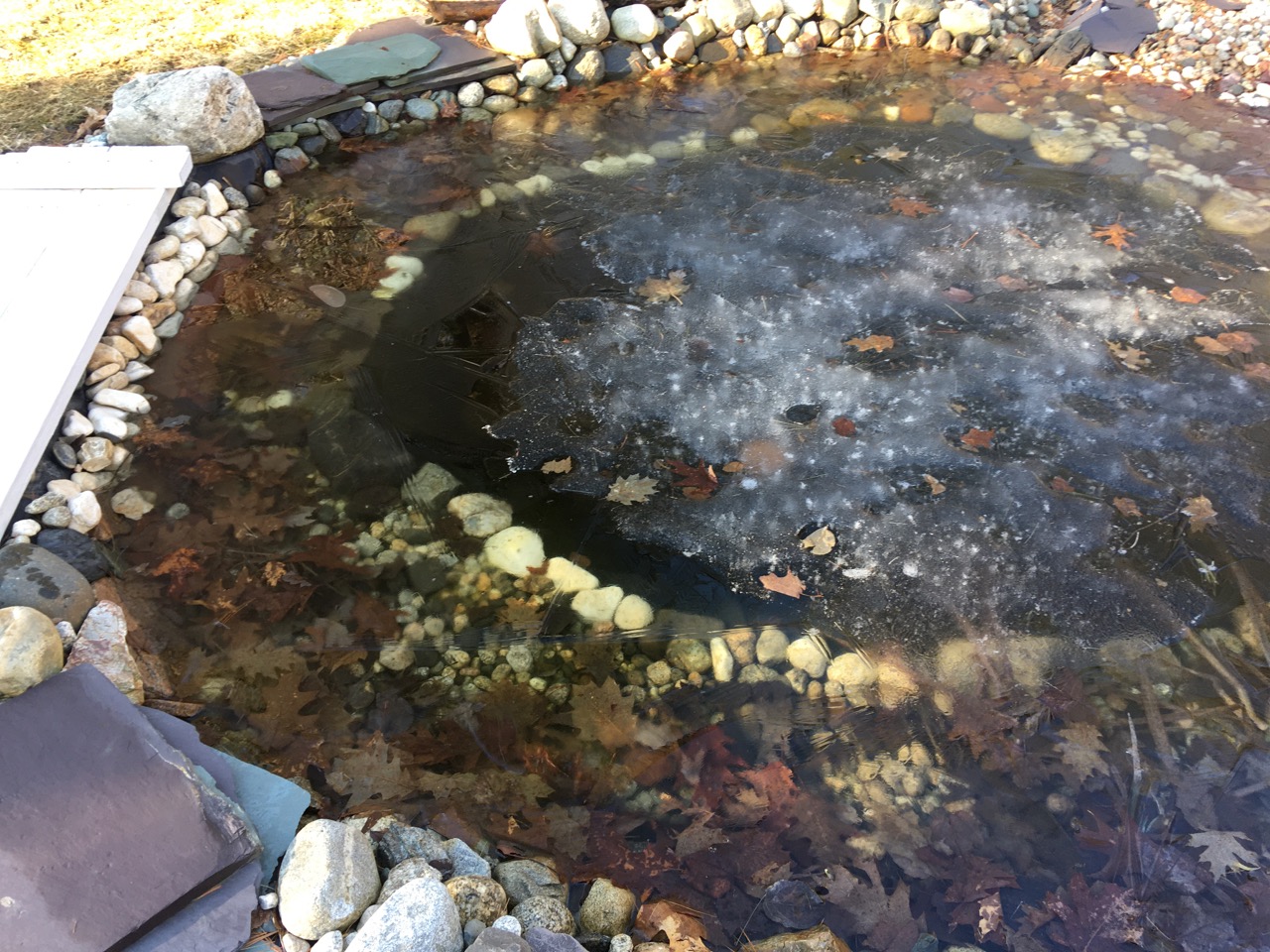
Hard to see, but there is a thin clear layer of ice on the surface of the pond this morning, but more of the winter ice is melting each day. March 26, 2022
On March 14th, at 1 p.m. Queer Spirit will broadcast an interview with me, done by Revs. Marvin Ellison and Tamara Torres McGovern. Queer Spirit is a regular feature of OUT Cast, a forum for LGBTQ+ issues broadcast on community radio every Monday. WMPG 90.9 FM from 1:00 – 1:30 p.m. (Livestream: WMPG.org) One of the questions they asked: “What do you think has been your generation’s unique struggle with sexuality and spiritualty – and what would you say is your generation’s contribution to these matters?” I thought about what I had written in my book, Finding Our Way Home, in a chapter called “The Mystery Seed.” I want to share an excerpt with you today.
Bean seeds
Do you remember the fairy tale of Jack and the Beanstalk? When he and his mother are in desperate straits, Jack trades their cow for some magical bean seeds. The bean seeds grow overnight into a vine that reaches up to the sky. He climbs the vine and encounters an evil giant, who eats human beings, but Jack is able to escape with a magical hen that lays golden eggs, and a golden harp that plays by itself. He learns from a fairy that the giant’s castle is actually his very own—he is really a prince whose father was killed by the giant. In the end, he kills the giant, and recovers his hidden inheritance.
So what does this have to do with us? The bean seeds enable Jack to connect with who he truly is, and with a larger reality beyond the small cabin he shares with his mother. Within each one of us is something like those magical bean seeds. We are so much more than we can imagine. We might say inside each of us is a Mystery seed, a seed of what we might become. This Mystery seed is our potential to connect with the larger Mystery of which we are a part; it is the Divine within us that connects to the Divine beyond us, it is the fractal pattern of life and love and creativity. This seed is not only in some of us, not only in fairy tales or kings or saints, but in every one of us.
What evidence do I have for this seed of divinity within each human being? How have I personally experienced this might be so? Ironically, it has been illuminated when I faced situations where people were treated as if they had no dignity or value at all. But something within and between people transpired to bring forth a light that could not be extinguished.
When I went to college, one of my best friends slowly revealed to a few of us that he was homosexual. This was a great torment for him and for all of us who loved him, because we were very devoted Catholics. According to Catholic teaching, homosexuality was against the laws of nature. Tom would try hard to live celibately, and then crash, and go out and “get debauched.” He was depressed and often despaired of his life. I felt a painful contradiction in all of this—I knew he was a deeply spiritual person, so why should he suffer in this way? But I didn’t have an answer at that time.
Before I met Tom, in the reality of my youth, it was as if gay people did not exist. When I was growing up, during the 1950s and 60s, I never even heard the word lesbian, and gay only meant happy. I never saw gay people on TV, read about them in a book or newspaper, or learned about them in school. As a girl in a Catholic family there were two possibilities for my life path: I could become a wife and mother, or I could become a nun. I never even imagined the possibility of lesbian.
Tom’s dilemma introduced to me a whole category of people who were considered unworthy of sacredness. Gay people were not supposed to exist. And if they did exist, they were identified as unnatural, disordered, a mistake, a problem. African American lesbian poet Audre Lorde writes, “We were never meant to survive.”[i]
At that time it never even occurred to me I might have something in common with that group of people. I didn’t come out as a lesbian until years later, at the age of thirty-one, after a five-year process of struggle and transformation… Gays and lesbians have often been excluded or disparaged even by those who are closest to us. After I came out, one of my sisters refused to let me stay in her home because she didn’t want her children to know about gay people. I received a letter from another sister. She wrote, “I pray for you night after night… Homosexuality is wrong! And as your sister I don’t want to lose you to the devil.” Her words were those many of us have heard from parents or siblings, or from the institutions of our society.
How much guilt, despair, and shame have gay people carried in our hearts because we were not welcome in the reality defined by our culture and religion? Because we could not see the sacredness within? How many gay people have killed themselves in the pain of that reality? How many gay people have been killed, through the violence and hate of a society that has refused to include us in their definition of reality?
But so much has changed. Now it is hard to imagine I didn’t know about the existence of lesbians or gay men. Now gay people are in prime-time television. There are supportive high school groups for Gay, Lesbian, Bisexual, Transgender, Questioning, and Straight youth. My friend Tom eventually was able to embrace his sexuality, and share his life with a long-time partner. In 2004, Massachusetts became the first state in the U.S. to allow same sex couples to be legally married, and in the years since, marriage has been won throughout the whole country.
Even language became transformed. Words like lesbian, or queer—once painful putdowns—were reclaimed as words of honor. I remember we young activists marching and shouting, “We’re here, we’re queer, get used to it.”
So much has changed. For me, it seems like a miracle—in fact, two miracles. First, I still can be amazed I exist as a lesbian at all. How did I cross over into a whole new reality? It is as fantastical as Jack climbing a bean stalk into a castle in the sky. Second, it is remarkable that we who are queer can celebrate being queer. How did we go from being outcasts, to celebrating and believing in ourselves? How did we go from being outcasts, to demanding that reality make a place for us? To celebrate ourselves as queer we often have had to risk every other valuable thing in our lives. We’ve risked family, friends, jobs, safety. Yet this thing which was considered a problem became the “pearl of great price,”[ii] as the gospel says. This heavy burden became the hen that laid golden eggs. And it has been incredible to see!
What happens within people that they can claim the power to celebrate themselves? …What happens inside people when they refuse the rejection of society, and claim the right to name themselves valuable. When people who have been told all their lives “You are no good,” find within themselves a different voice that says, “You are sacred.” To me, this is powerful evidence of the divinity within us. And this is the premise of the work of those of us who call ourselves Liberation Theologians: the Divine is revealed in the struggle of oppressed people for liberation.[iii] It is the Mystery seed within us growing like a vine into the sky.
…That is what happened for me, too. Within a community of women, I experienced a new reality coming into being. With women who were celebrating lesbian existence, I encountered the Divine in a new way. Sometimes we called it the Goddess. Sometimes we had no name to describe it. But we felt a sacred and holy power when we seized the courage to embrace the body of another woman. Everything shifted. It no longer mattered whether we were welcome at the table of the society that excluded us. We were in a new reality and could no longer be denied.
Me and Rev. Marvin Ellison, back in 2009, as co-leaders of the Religious Coalition for the Freedom to Marry, getting ready for the public hearing.
[i] Audre Lorde, “A Litany for Survival,” The Black Unicorn: Poems (New York: W. W. Norton, 1978), 31.
[iii] Liberation Theology was first articulated in 1971 by the Catholic Peruvian priest Gustavo Gutierrez, in his book, A Theology of Liberation: History, Politics, Salvation (1971 in Spanish, English edition Maryknoll, NY: Orbis Books, 1973).
What a beautiful dawn the other day, all the branches coated with light snowy adornment! I’ve been feeling grateful these days. In particular, I’ve been thinking about how lucky I have been to study the Passamaquoddy language with Roger Paul during the last 3 1/2 years. I recently saw an article published a few years ago, by Taté Walker, “3 Questions to Ask Yourself Before Learning an Indigenous Language as a Non-Native.” It got me reflecting about the questions, some of which I had already considered when I began. #1 Why am I learning this language? #2 How will I center tribal perspectives as I learn this language? #3 How will I handle criticism from Indigenous people? Today, I also have a fourth question which I will explore.
I looked back to my earlier posts to remember my thoughts about why I was learning this language. I had asked permission from the teacher, and also from my Wabanaki friend who was going to take the class, and both had been very welcoming. Roger has talked about how his elders had decided it was time to share the language with others beyond the community. On a very practical level, it was hoped that by increasing the number of registrations, the class was more likely to be offered at USM, so more available to Wabanaki students who wanted to learn.
On a deeper level, I wrote that it was a way to begin to decolonize my mind, “I want to think differently”–Nkoti piluwitahas. I also had the thought that, ideally, any of us who came to live in Wabanaki territory should learn the original language of this land, as respectful visitors. Also, years ago, an Indigenous woman had said, “If you really want to understand our spirituality, you must learn our language.” It stayed in my mind though I can’t remember now who it was who said it. (This was during the time I was working on the issue of cultural appropriation by white people of Indigenous spiritualities.)
Today, thinking about it again, I know I had the privilege of retiring from work right at the time the class began, and there was a program for seniors to enroll in university classes for free. Everything came together so easily. My heart led me into it and the door opened. I think perhaps, too, though I didn’t realize it at the time, it was a way to connect to my own Innu ancestors.
During the process of taking these classes, I have learned so much about the perspectives and history of Wabanaki people. I have learned how few people are now fluent in the language, because of forced assimilation, and because of the terror of the boarding schools and day schools, where children were punished for speaking their language. I have learned that for me to learn the language is a privilege that many Wabanaki people do not have, if only because they are busy trying to survive in the English-speaking world. I understand that if I were to speak the language in most contexts, it might be a painful trigger for Native people who carry so much trauma about the loss of their language. So mostly, I haven’t tried to speak it except in our class contexts. And though I am beginning to understand more than I could have imagined, I am humbled too by how difficult it is for me to speak any of it, except for carefully constructed dialogues. I am truly still a beginner.
But the question closest to my heart these days is this: Since I have been granted this gift of learning the Passamaquoddy language, how can I give back? From this course, I’ve learned gratitude and the importance of reciprocity: so what is my responsibility now, as the recipient of such a gift of knowledge? Bearing in mind that I’m not training to be a professional teacher, and I have so little energy anyway because of chronic illness. I have done some activities in solidarity to Wabanaki concerns–but these are not related to language. I don’t have an answer right now. But I am holding this question closely. How can I give back? What is my responsibility in light of the gift of this knowledge? It may be that by holding the question, an answer will be revealed.








 Finding Our Way Home