Miracle of Ocean

Crescent Beach September

Yesterday late afternoon, with the weather up to 80 degrees, I went to Crescent Beach. Would it be the last day warm enough for me to go in the water? Maybe, maybe not. But without expectations, I set up my chair on the sand, and walked down to the edge of the water to feel the cold splashing on my feet. Its temperature was mildly cold not frigid, much warmer than early summer. There were a few more waves than usual. Only a small group of children were in the water, jumping into the waves as they broke on the shore.

I have become a bit timid about waves, as I have gotten older. The tide was low, and there were lots of round stones to walk over, so I came back to my chair and put on some swim shoes, so I’d have better balance. Then I walked back out and stepped right in. I moved quickly through the breaking waves and past them to about my waist level. The rhythms of the water rose up to my shoulders, and then back down, lifted me up and down, too, but gently. I dove into one wave to cover my head, but then I just stood facing the sea, watching the waves come in, letting them carry me up and down.

Here’s the amazing thing: after being in the water, the waves, for a long time, and then staying longer still, I began to be washed in a sense of joy and happiness. It felt miraculous because this whole past week, I had been feeling exhausted and achy–a classic flare up of the auto-immune conditions I struggle with. But somehow the water washed all of that away, and I was filled with a physical sense of well-being and playfulness.

When I go into the water, I usually pray to the Mother Ocean, I give her my worries and struggles. She is one kind of divine presence, larger than I can ever be, and the source of all life. But it wasn’t my small prayer that shifted me–it was the very energy and power of her presence all around me, it was the waves dancing with me, it was my body responding to the waves. It was unexpected.

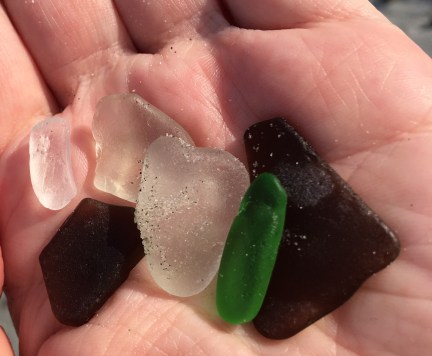
Filled with this lovely happiness, when I came out of the water, I walked along the shore looking at stones and shells, and I found several pieces of sea glass. I love that the ocean can transform these broken bits of human invention into tokens of beauty. Since I have been thinking lately about the ancestors, it came to me that sea glass is a kind of gift from people who came before. I’ve read that it can take 20-40 years in the waves, sometimes longer, for glass to be tumbled to create this patina. So someone a long or short time ago made the glass, touched it, discarded it.  I am holding this connection, broken yet made whole again, and so I prayed for friends and family who needed healing.Seaglass

After my walk, I sat in my chair and ate some yogurt mixed with cocoa, honey, cacao nibs, and blueberries. I started reading the novel Barkskins by Annie Proulx, which begins with French settlers in Quebec taking down the forest. (Another way to try to understand colonization.)  Isn’t it a picture of happiness, to read in a chair on the beach, sun on my shoulders?

monarch catepillarOn my walk back to the car, one more fun surprise. This colorful monarch caterpillar on a milkweed plant just past the beach roses.

I wish I could share with you the happiness of being in the ocean, of walking on the shore finding sea glass, of reading on the beach on a September evening, of finding a monarch on a milkweed.

But the happiness was triggered by actually being in the ocean with its waves dancing me up and down. So if you are feeling timid about walking into the waves, whether literal or metaphorical, please know that on the other side little miracles might happen. Joy might find you.


The Flowing

Orchard August 2019

The other morning I woke from a dream, in which I was thinking about Wabanaki languages. Wabanaki languages are a flowing. Everything is moving. Verbs are central. Verbs change shape to fit who is acting, who is moving, how many, and who or what their object might be. For example, Wiku is a verb for identifying where someone dwells. (The k is pronounced like g.) As in, Wiku Portland, meaning, “He/or/she lives in Portland.” But to say, “I live in Portland,” would be Nwik Portland.  “Where do you live?”  Tama kwik?

Even many nouns are flowing, changing, shapeshifting. Like the word for home. The noun, Wik, means a home. But “my home” is nik. “At our home” is nikonuk. “At your home” is kikonuk. The words flow depending on who lives there, or if you are going there. And the words for “mother” are related to the words for home. Wikuwossol, nikuwoss, kikuwoss. “His/or/her mother, my mother, your mother.” Flowing. Shapeshifting. Full of relationship.

English, on the other hand, is filled with many more nouns than verbs. Since contact with the colonizers, Wabanaki languages have had to add more nouns to the lexicon, to translate from English or French. Some of these nouns were created from verbs by adding an ending that, by itself, means “bait.” For example, koselomol, means “I love you.”  But to turn the verb “love” into a noun, you must say kseltomuwakon. Wakon means “bait.” So perhaps to make these nouns we must capture the verb, trap it with our bait, to stop its movement for a moment.

We colonizers live in solid houses with lots of things/nouns in them. The Indigenous peoples of northern places used to live in easily movable homes, with fewer things, to follow the hunt in winter, to fish the shores in summer. Everything was a movement, a dance, a shape-shifting. (Of course, many southern Indigenous peoples were/are farmers, stayed in one place. I don’t have any exposure to how their languages work.) But I notice the tendency in me to look for solid things, to struggle with the endless flow.  To try to put things in their places, get organized.  Make vocabulary flash cards to capture the words into my brain. (Even though the Wabanaki Languages class I am taking is on summer break, I have been listening to the recordings from the class, and continuing to study.)

Still, the garden in this place, at our home, nikonuk, also tries to teach me about flow, if I can be open to it. Every week is filled with different patterns and growing and shapeshifting. This week, no more snap peas or raspberries. But the basil has come back again after I harvested most of its leaves a while ago. The young fruit trees are wild and leafy. The bee balm is dying, and prone to powdery mildew. My nephew and his girlfriend helped me put wood chips on the paths during their visit a couple weeks ago. It rained during the night last night. Every day is different. There is no way to get the garden in shape, in form, once and for all. It demands relationship, interaction, flowing, it demands the verb “gardening.”

In Passamaquoddy, kihke means “He/she gardens or plants,” and kihkan is a garden. It is also another form of the verb.


Gifts

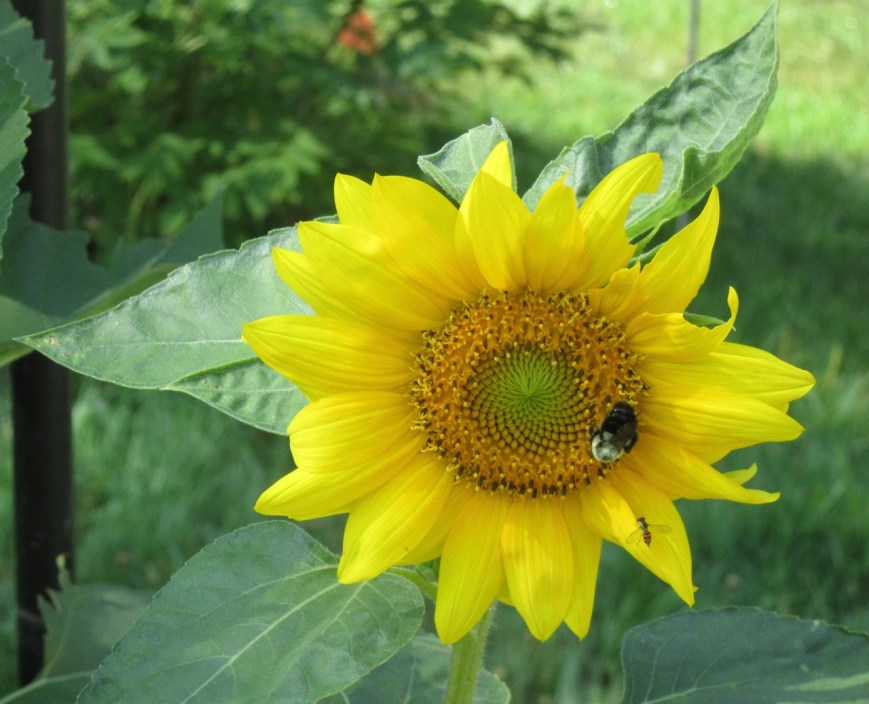
During the spring, Margy was talking about wanting to plant sunflowers this year. But as it happened, she was busy with too many other garden projects to actually do it.  So imagine our delight when the garden planted its own sunflowers! They came up under the bird feeder, now sitting empty for the summer, but where sunflower seeds were the food we offered to the birds (and squirrels) all winter.

Gift sunflowers

Lately, the garden plants have felt mostly like children who need our care and attention. With the dry hot weather, they’ve needed a lot of watering. Yesterday, I did another foliar spray for the fruit trees, to help them ward off Japanese beetles, which I also have been picking off every day and dropping in soapy water. And there have also been lovely raspberries to harvest each day, and snap peas (almost gone now) and kale and basil to gather and preserve.

So this gift of flowers emerging without any effort on our part–perhaps the land is reminding us that she loves us as we love her?

It has been one year since my retirement began. One of its themes has been to find connection with this small portion of the Mother Earth, this land we are so lucky to call our home. As non-Indigenous people, we are trying to heal a long wounded history of our people’s disconnection from land.  Our ancestors left their home places generations ago.  If our society had an understanding of earth connection, it could not destroy earth life as it destroys, with such thoughtlessness–pollution, clearcutting of forests, poisoning of soil with pesticides, trash dumping, mining, fracking… the long list of ecological destructions that are endangering us all.

So in our small corner of the world, we are trying to reweave those threads of interconnection, reawaken the truth–long dormant in our bodies–that we are not separate from the earth–we are the earth.  As we tend the land, as we care for the plants, as we pay attention each day, we hope that a shifting occurs–that we move from domination patterns to partnership patterns in our relationship to Earth. We know how small we are–yet hope that if we can shift our own patterns, it might in some way ripple out to the larger patterns. Because we are interconnected. Because that is the magic.

The gift sunflowers remind me that the land herself is eager to be in partnership with her human children. She loves us and wants wholeness for all.

sunflower with bees

Every sunflower has its bees.


Deer Neighbors

Deer near our yard

The phone rang this morning about 8 a.m., and it was our neighbor Mary, calling my attention to a deer in the wild brush behind her yard. I came outside and walked behind our garage, to the edge of our yard, near where Margy had cleared bittersweet from all over the crabapple trees in the wild area. Mary had said it was a small deer, so I was surprised to see what seemed to me a rather large animal with antlers. He didn’t startle, but calmly looked at me, as I took photos from several yards away.  After a few minutes,  he slowly turned and disappeared into the bushes.

So beautiful! I had once seen a deer the first year we moved here, and that winter we also noticed some tracks in the snow, but we hadn’t seen any in our yard since then.  (However, Margy mentioned she has seen some deep in the undeveloped wild areas.) Of course, it has stirred up mixed feelings to see or not see them. We love our wildlife neighbors, but have also been concerned about our fruit trees.  The year we planted our first trees, I put up a fine fishing line thread between metal poles, at the back and side of the orchard, because I read that deer don’t like barriers that they can’t see clearly. So it was meant to be a gentle deterrent, and I haven’t taken it down, though this summer the line had sagged to about a foot above the ground.

And perhaps, this clears up a mystery that developed several days ago.  Earlier last week, I noticed that the ends of some branches on one of our cherry trees seemed to have been bitten off–just four branches in one area of one tree with their tips clean gone.  You might notice it in the center of the photo below. I also noticed the top bitten off of a raspberry shoot that had sprouted near our wood chip pile. I’ve been trying to figure out what might have done it, and I think maybe we have our culprit. Thankfully, he didn’t eat any more of anything. I’ve re-stretched the fishing line “fence” to see if that helps.

Cherry branches bitten off

We never know what adventures we’ll find in our backyard.  The other evening, during dusk, Margy saw a beautiful skunk wandering across the back of the yard.  I’ve seen a few holes in the garden where it came digging for grubs in the night.  Mostly, these days, we have scores of small birds who love to perch on branches and even tall flower stalks in the orchard, and peck for bugs in the mulch.

And can I say, finally, that I love that we have a dear neighbor who calls us to report a deer sighting!

Plants are amazing

Comfrey

Comfrey Plant in our Orchard

Last night, I watched (again) the documentary, What Plants Talk About. Did you know that plants change their chemistry based on the environmental stressors they experience? So, for example, if a certain caterpillar is munching on their leaves, they can release chemicals into the air, scents, that attract the insect predator of that caterpillar.  Or they might offer nectars that shift the scent of the bug itself, and that scent attracts predators. They also share nutrients with their child plants and other tree species in a forest.

This got me thinking about our human use of plants for healing. We benefit from their chemical wizardry and can use their medicines for our own challenges. Over thousands of years of human “prehistory” and “history,” we learned the benefits of so many various plants in our environment. A body of knowledge has accumulated for the medicinal use of herbs.

Plant medicines can also be used to help other plants. Michael Phillips, in the book Holistic Orchard, recommends making fermented teas of comfrey, horsetail, stinging nettles, and/or garlic scapes to use as a foliar spray to help orchard trees during the summer.  Comfrey provides large amounts of calcium. Horsetail has natural silica which helps the plant cuticle defense against certain summer fungi.  Nettles are a tonic of overall nutrition with trace minerals, vitamins, nitrogen, calcium, and potassium. They also have silica, with levels skyrocketing when seeds formation is just beginning, so that is a great time to use it. Garlic helps to carry other nutrients.

It just so happens that I was in the orchard last week, thinking I needed to trim back the comfrey because it was getting too big.  Then I noticed that the nettles in Sylvia’s herb garden were flowering, maybe starting to form seeds. (We’d rather that they didn’t spread nettles everywhere.) And lo and behold, the garlic plants had formed scapes. So maybe it was time to make some herbal tea. (We don’t have any horsetail, sadly.)

Comfrey Nettles Garlic brewTo make the fermented tea, you use a five-gallon bucket.  Cut plant leaves into the bucket and loosely pack them in.  Then, pour a kettle of boiling water over the leaves to get things started, and add unchlorinated water to fill it to the top. I used water from our rain barrels. Then “let sit for seven to ten days somewhere outside, loosely covered to prevent significant evaporation. This fermentation period makes the constituents that much more bioavailable for foliar absorption.” It gets pretty smelly with sulfur compounds–that’s how it is supposed to smell. You strain it when you use it. Once brewed, you dilute it, using about a cup of the tea per gallon of spray.

So I made the tea on July 6. It is likely ready to use about now, though I went ahead and added two cups to the spray formula I did on July 9th.  Having such a small orchard, I might not be able to use all of the tea in a timely way, so I figured that partially brewed tea would add something beneficial in any case. I will add whatever I don’t use to the compost pile.

A few other thoughts were brewing in my mind after watching What Plants Talk About. If you think about how plants change their chemicals to fit their environmental stressors, you have to conclude that the medicines in the plants might be changing day by day, hour by hour. So when you harvest that plant, and in what condition you harvest it, might make all the difference in the world about whether that plant has the medicine you need. And perhaps that is the source of the “old wives’ tales” about when and how to pick various medicinal herbs. When the moon is full, or first thing in the morning? (By the way, I think that old wives’ tales are often the source of much hidden wisdom.)

If I were a young person just starting out as a scientist herbalist, I would want to ponder how we might experiment and cooperate with plants to create particular medicines that we need. We’d have to start by understanding and measuring the differences in their chemical composition under various conditions. Try to better understand why the old herbalists knew the best times for picking. That might take a while. But then, once we better understood these marvelous beings, maybe we could learn to communicate back and forth with them, and then, perhaps we could invite them to create new medicines for the diseases we face in these times. What a line of research that would be!

Stinging Nettles

Stinging Nettles 

A Little Beauty

EsplanadeThe esplanade, the former hell strip, is now a thing of beauty, and this small beauty is good for my soul. I finally finished mulching between all of these hardy perennial plants with cardboard and wood chips. The plants are thriving. The tall Heliopsis is in bright yellow full bloom right now, and the purple hued Spiderwort flowers open each morning. (The Siberian Irises have already completed their flowering.)Esplanada flowers

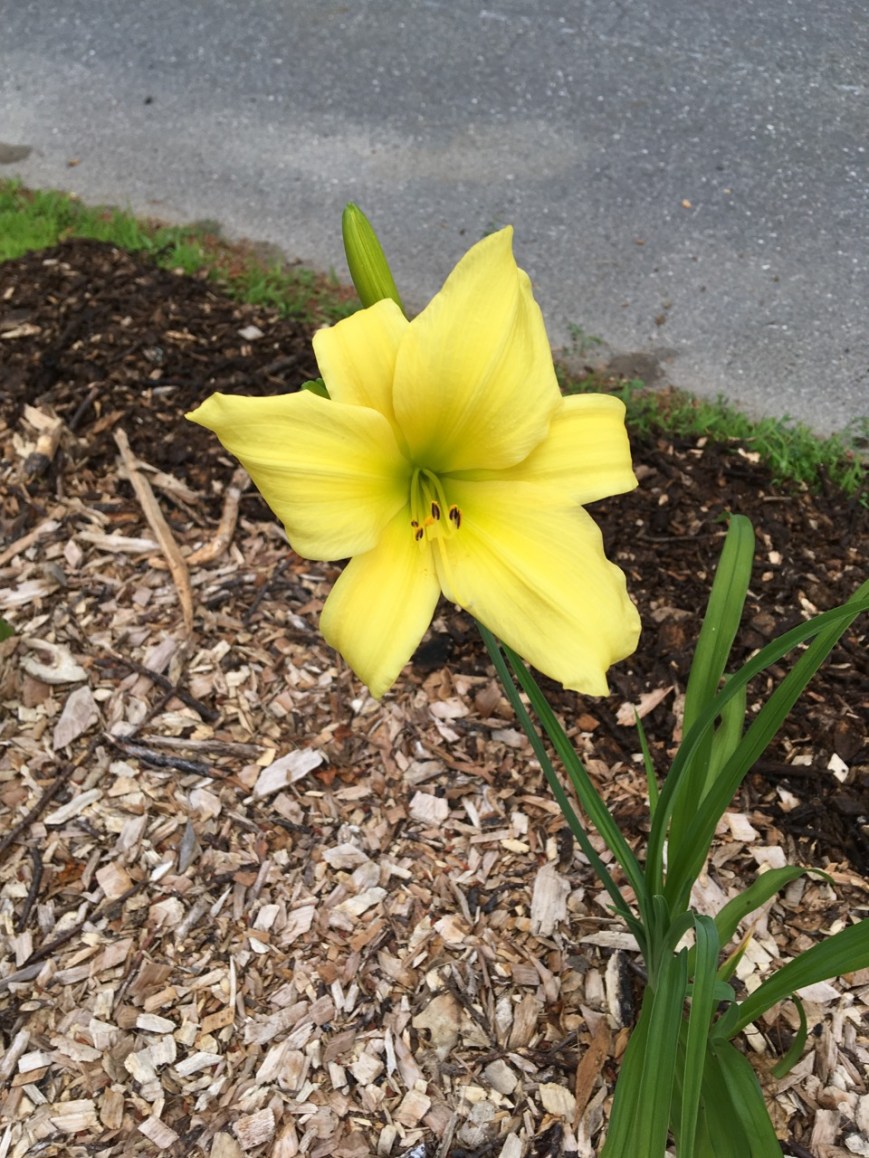
Thursday, our first daylily blossomed, and there are more to come. In these days of cruelty to children and destruction of so much that we hold dear, I believe it helps to refresh our spirits with the beauty of the earth. Beauty is strength for the struggle.Daylily #1

Decolonization Lessons from Plants

Bittersweet around a tree trunk

 Bittersweet vining around a tree trunk.

After spending a week going through soil to remove bittersweet roots, I have been thinking about invasive bittersweet as a visceral metaphor for colonization. Bittersweet comes into an area by seeds or roots, and then reaches for the sky. It vines around any support, living or dead, to keep climbing higher and higher. When its vines first wrap around a tree trunk, like in this photo, it may look green and healthy and beautiful. It may even seem to appreciate the tree on which is grows. But eventually, it can kill the tree, either by suffocating its trunk, or by the sheer weight of its leaves and branches.

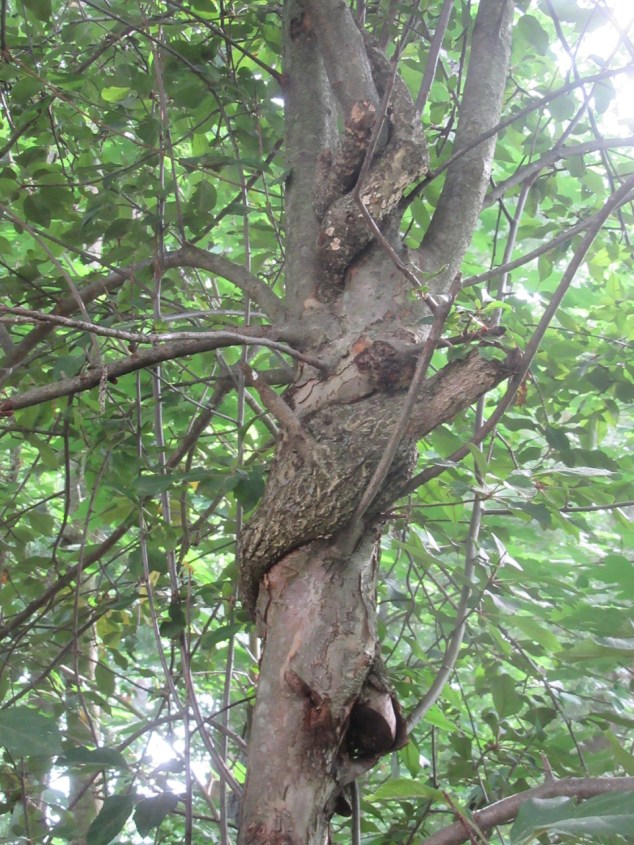
Below is a photo, taken by my partner Margy Dowzer, of a huge bittersweet vine, 4-5 inches in diameter, tightly wrapped around the trunk of this tree.  It has been cut near the bottom, which is the way to stop it growing. But you can see how it has warped the trunk and become embedded in its flesh. A huge maple tree next door came crashing down after it was covered in bittersweet vines and flowers. Bittersweet will spread to a whole area, and kill other plants that are trying to grow. Bittersweet embedded in tree trunk

And this is like colonization. When Europeans first came to this land, they planted themselves in several locations and tried to grow as much as possible. They wiped out many Indigenous communities through disease and warfare. They used the lands cleared in this way to grow crops and build towns. They kept spreading out across the whole continent, bringing destruction to Native peoples and ecosystems as they took over. They imagined that their own growth and reaching for the sun was the only thing necessary and valuable, and took no notice of the harm they were causing.  And of course, it isn’t just past history, it keeps happening today. Our whole economic system is based on continual growth. “More and more and more!” might be the mantra of the colonizers and the bittersweet.

Might there be another option? There is a different sort of plant that was brought to this continent by colonizers. In fact, it was called “English-man’s foot” or “white-man’s footprint” by Indigenous peoples because it appeared wherever the settlers showed up. Its familiar name is broadleaf plantain (plantago major). It too spreads all over, and especially in disturbed soils. However, it is a humble plant, and a useful medicinal herb. Indigenous peoples soon discovered its healing properties and added it to their herbal pharmacies.

I was reminded of this a couple weeks ago when I had a bite from a black fly appear on my hand, itching like crazy. My friend Sylvia (who is an herbalist) suggested plantain. I made a poultice by chewing up some leaves and then putting that mash on the bite, letting it remain until it dried. It helped to ease the itching right away. Plantain is also good for all sorts of wound healing, stomach troubles, fevers, and is anti-inflammatory. You can eat young leaves in salads, and cook older leaves in stews. It is also useful for breaking up compacted soil, and combatting erosion.

So perhaps we who are not Indigenous to this land might learn from the plantain a new model of how to be here, in this place we now find ourselves. Perhaps we too might become humble and useful, growing only close to the ground, paying attention to healing and the easing of pain.

Plantain

Plantain

Transplanting the Mulberry Tree

One of the principles of permaculture is to observe, and then adapt.  So last year, we had planted a mulberry tree in a particular spot, but it was not doing very well, not getting enough sun. (I got fooled by the fact that it is called an understory tree–but our tall trees are at the south of our property, and this one was getting shaded by them.) So with some advice from Mihku, Margy and I found a new spot, on the other side of the back yard, and carefully measured the ten foot radius a mature tree might need. It feels like a great spot for the tree, especially since one of our goals for the tree is as a gift to the birds who might otherwise eat up our future cherries, blueberries, and peaches. This spot is next to the undeveloped land next to our yard.

Myke sorting through dirt

Sifting through soil. Photo by Margy Dowzer.

But the whole project has taken days to finish!  First, we had to deal with the ever present bittersweet whose roots run through our soil from the undeveloped edges all around.  Asian bittersweet is an incredibly invasive plant that can spread by any roots, or by its seeds.  At this time of year, there are hundreds of small plants popping up out of the grass.  Margy has been the primary bittersweet warrior for our land, going round the undeveloped edges and cutting vines and freeing trees that have been almost strangled by them.  (Some were already lost.) We don’t want to use any poison, so it’s a constant process of depriving the roots of active vines, and pulling up any new shoots. (Someday, I might reflect on the parallels between invasive plants and colonization. I certainly have been thinking about it this week.)

Bittersweet roots (tiny ones)

                                                  Bittersweet roots.

In any case, because of the bittersweet, we couldn’t just dig a hole and plant the tree–we had to dig a much bigger hole, and pull out several huge orange roots. Then we had to sift through all the soil that we’d taken from the hole, to remove any tiny orange roots. I have been doing this for so many hours that when I close my eyes I still see tiny orange bittersweet roots. I think I could identify them by feel in the dark as well. Here is what they look like when they are tiny:

For most of our yard, I’ve tried to use a no-till sheet mulching/lasagna gardening method. This is done by layering a mix of brown and green organic matter on top of the soil. So even though we had to dig a huge hole for the mulberry tree, I used the sheet mulching method as I began to fill it.  The soil was pretty barren and sandy below the top few inches, so adding organic matter would help to enrich it.  I used layers of soil, compost, dried grass, seaweed, coffee chaff, and included the broken up grasses from the sod I’d removed from the top.  Here is the hole after some layers had already been added.

Mulberry transplanting hole

The hole beginning to be filled with layers.

Myke layering the mulberry bed

Raking in another layer of soil. Photo by Margy Dowzer.

For the past week, I’ve put in a few hours each day alternately sifting soil from around the edges of the hole, adding the soil to the hole, or adding other layers of compost, dried grass, or seaweed. Margy took turns sifting soil as well. Some days it seemed like it would never be completed.

Finally, today, the last soil was sifted, and the hole was transformed into a mound. I dug a smaller hole in the center of it, and gently moved the small tree, still in dormancy from the winter.  (Last year it didn’t wake up until the end of June, so we were trying to finish before it woke up.) I tucked it in with water and more soil and more water.

Mulberry transplant

Mulberry tree transplanted!

To finish it off, I covered the mound with thick layers of newspaper (to prevent weed growth), and then wood chip mulch.  We were expecting rain in the afternoon today, and tomorrow.  It’s good weather for a big move. I offered a blessing to encourage the small tree to prosper in its new sunnier location, near the crabapple tree and the blueberry bushes. May it be so!

Myke adding wood chips to mulberry

Adding wood chips to mound. Photo by Margy Dowzer.

Pruning

Our friend, Mihku, who is a master gardener, gave me more advice about pruning last Sunday.  We looked at all the orchard trees, and she reminded me that these first few years are all about creating a good shape for the tree, thickening up the trunk, and creating strong scaffold branches, while not letting them get too leggy or long.

So for example, here is the peach tree before pruning (on May 27th).  It looked bright and happy, and even had a few flowers, (which you can see if you zoom in). But the branches were quite long, and the tree is too young to give energy to making fruit this year.  On the right foreground of this photo, you might also notice a very leggy branch from one of our cherry trees, dividing into new shoots at its tip.

Peach tree before pruning

Peach Tree before pruning

The next day, I went back to my Holistic Orchard book to read what Michael Phillips had to say about pruning, too.  It seems I need to read it at least once a year, because in between, I forget.  There are different methods for different fruits.  Apples and cherries prefer a central leader, with several scaffold layers of branches nicely spaced out as you go up the trunk.  Peaches prefer an open vase style, in which there is no central leader, but the center is opened up to give good sunlight to the flowers and fruit.  But it is far beyond the power of any book to give what a wise friend can give–especially for gathering the courage to actually do it.  (It seems counterintuitive to do all that cutting of new branches.)

This kind of pruning at this season of the year is meant to encourage growth in the right form and direction.  Mihku suggested cutting about 1/3 off from the long branches, and once again staking the cherry branches to make a better “crotch angle” (where the branch angles from the trunk.)  They tend to grow almost straight up, and should be reaching out to form a 45-60 degree angle.  Flat cuts at the end of branches will also help them to thicken up. Header cuts on the central leader, will encourage lower branches to grow–which was especially important for the Lapins cherry, which had a big gap between lower branches and higher shoots. I was excited to see that there were some new branches starting to form at a better height.

After I did the cherries, I went to the peach, picked off the blossoms, and cut away branches that were growing inward, to favor those that were growing outward. And those that I wanted to keep got about 1/3 headed off to help them become stronger, choosing a spot just above an outward facing bud.

Peach Tree after pruning

Peach after pruning

Finally, I checked our semi-dwarf apple tree, which is still quite small, and found that there were three branch shoots reaching upward at the central leader–just like Michael Phillips suggested there would be, and I chose the strongest to be the leader, and snipped off the other two.

Pruning accomplished for the season! Thanks Mihku!

Myke & Mihku in the garden

Photo by Margy Dowzer


Raccoon/Espons

One of the great things about our cats is how they alert us to visitors in the yard.  This morning, Billie suddenly leaned over into the bedroom window, all focused attention, and then she hurried off to the kitchen.  I looked out the window, and then I too ran to the kitchen–to look out the French door windows to the back.  We had both seen a raccoon, walking right onto our deck, checking things out.Raccoon on the deck

Sadly, this was not a great nature photo–I didn’t capture the raccoon’s adorable face.  And when they saw us at the window, they decided to move along, leaving only small wet footprints behind. I barely caught their distinctive striped tail as they hurried past on their way toward the steps to the driveway.  Raccoon tail

Compost barrel holeThe Passamaquoddy word for raccoon is Espons, and it means the one who leaves a mess. I pulled on my boots to go outside to see if Espons had left any messes anywhere in our garden–but the only thing I found was a tiny hole dug into the side of our compost barrel.  It looks like that compost is ready.

I think this is the first time I’ve seen a raccoon in the yard, though I saw one in a tree down by the brook a while back. As much as Margy and I love to play in the soil, plant trees and bushes, and tend to the growing plant life all around us, the most thrilling part of connecting to this land is when the critters visit us.

Many small birds and squirrels live here all the time, but we’ve also seen turkeys, a very occasional deer (and not in the last year), the skunk, the groundhog, a few chipmunks, the fox, the hawks, the turkeys (they visit a lot–though not this spring–they must be raising young somewhere else right now), not to mention tiny toads and salamanders. I call them visitors, but really, we share this urban environment. They live here as much as we do–but not usually on the deck!  We try to find a balance between welcoming them, and reserving certain garden foods as our own “territory.”  (Since we don’t yet have much food in the perennial food forest we’ve been slowly creating, it hasn’t yet been a big issue.)

I am reminded somehow, by the joy of this unexpected visit, that my spiritual “marching orders” during this past cycle of seasons have been rather clear.  I was not to try to “make magic”–which I understand as to focus my intention and will to create something or to make change in this world.  Rather, I was to flow with the already flowing magic of the deeper River, to let the Earth move my feet, let the Wind guide my mind. I was to rest, and let the Fire of joy carry me through the days.  That joy has carried me into some marvelous learning–the Wabanaki language class comes to mind.  That joy has carried me out into the garden to plant and tend and haul wood chips around.  That joy has carried me to the pages of this blog site, to write and reflect.  But it isn’t really about creating a garden or a blog.

It is about observing, being quiet, listening to the trees, tuning in to the flow of interconnected life. It is about moving beyond doing into a different way of being.  A way that is alert to the many beings who visit us, whether we notice them or not. It is about noticing.

Margy's clover & daffodils

Margy’s clover & daffodil garden in the front yard.