River of Rock

river of rock

Yesterday, with the ice and snow thawing, I ventured all the way down the path by the brook and discovered that the way was blocked by this new river of rock. There used to be a small wooden bridge over a small drainage ditch that led down to the brook, but now there was this huge thing.  And an orange mesh barrier blocking the way on both sides.

Today I went back and discovered that someone (a dirt bike?) had pushed the mesh barrier down, so I stepped over the mesh too.  I walked across the rocks consciously imagining that the path will be restored with a new little bridge.  Don’t our feet have some sort of magic to trace the energy of our intentions, and create or preserve the trail we want to walk on?  As poet Antonio Machado wrote, “Traveler, there is no path. The path is made by walking.”

So perhaps all of us who walk or ride this small path are preserving it by our collective energy, by our love and attention, and by moving through barriers. Perhaps there is a lesson in this.  Thank you kindred travelers.

mesh down


Sky Portal

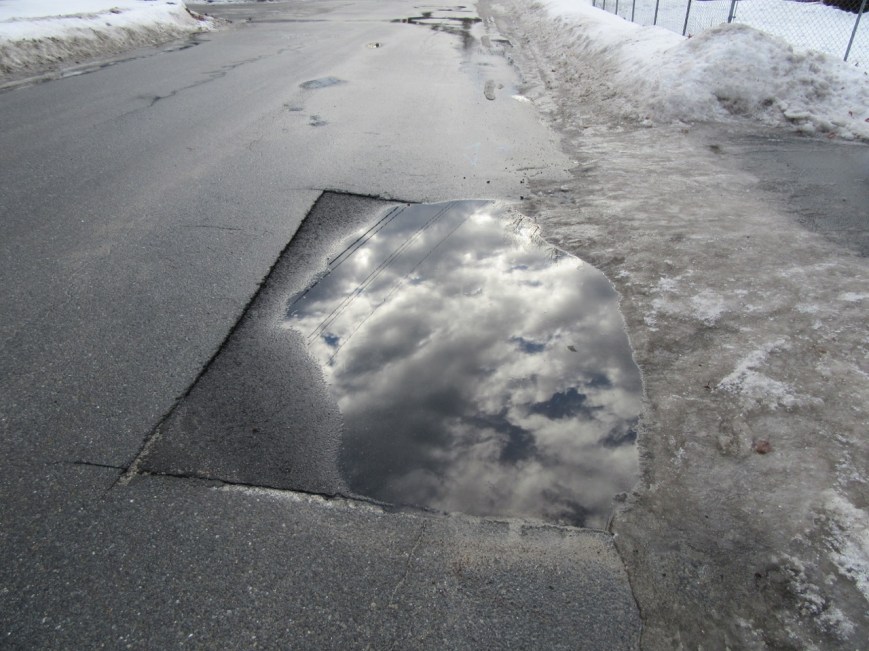
sky puddle

Doesn’t it look like if I were to step across that threshold I might fall into the sky? The thaw of last night has opened up all sorts of cracks in the fabric of space/time.  Meanwhile, I am walking in the morning, paying attention to beauty.  Our congregation is doing a February activity called Fun-a-Day, in which participants choose an activity to do each day that gives them joy. I think mine is this walking with a camera, noticing the beauty that I otherwise might miss. What would yours be?  Feel free to join in!

Finding Inner Wisdom

Woodstove Fire

Wood stove Fire-Photo by Margy Dowzer

During our ritual celebration yesterday evening for Imbolc/Groundhog Day, we scryed with the magic of the fire in our wood stove.  Scrying is a form of seeking wisdom, by gazing into some sort of medium–such as a crystal ball, tea leaves, a bowl of water, a candle flame.  It gets a bad rap on Wikipedia as “unscientific.”  But as one person mentioned last night, while meditation may sometimes be difficult, there is something about quietly staring into a fire with each other that brings one to a state of stillness within.

When we find that stillness, we have access to our own deeper wisdom, and the wisdom of the deeper mystery. Some people see images in the fire. Others notice whatever thoughts or feelings emerge in the stillness of gazing.

Here is what I noticed on the way to the wisdom in me:  First of all, a sense of deep weariness.  Then, a desire to stop doing so much out there in the world, to pay attention to what is happening within.  Then, a feeling of how difficult it is to say no to invitations to activism on issues that are important.  There is so much hard stuff in our world right now, and so many good people are responding.  How do I know when I should be taking action, and when I should be in stillness?

Then, a fear that if I choose to say no, I will disappoint people, lose their love and acceptance. Then, a realization that that motivation, that fear, is not a source of wisdom, but rather a wound that needs healing.  I sat with the fear for a while, gazing still into the fire, opening my heart to the healing energies of the mystery.  We were celebrating Brigid after all, who is a Celtic goddess of healing. We had brought into the circle a small bottle of water from one of Brigid’s wells in Ireland, and I anointed my forehead and heart and hands with some of that water.

Deeper still, I realized that I am in the midst of a profound change.  I am shifting from one identity, one chapter of my life–as the minister of the Allen Avenue Unitarian Universalist Church, to another identity, another chapter–as yet unknown.  What I most desire is something like a cocoon in which to make that transformation, just as the caterpillar encloses itself for its transition to the butterfly.

This “enclosing myself” is not the same as doing nothing at all.  There are activities that directly relate to this transition–processes of ending, closing down, completing the work. I notice how hard it is to turn my attention away from the usual activities of my current/former self, to pay attention to the transition.  And in understanding this, I realize that I have to be courageous enough to say no to some good and important activities and activism. I have to say no, so that I can be courageous enough to say yes to the transformation.
Groundhog Day

IMG_4560

We’ve made it half-way to the Spring Equinox–Groundhog Day, Candlemas, Imbolc according to the Celts… Whatever we call it, I have always liked this festival. Even the birds seem to know that something is up.  On my walks the last couple days, they have been singing so that I notice it.  The height of the sun? The change in the light?  Even though it’s been cold, and today snow was covering everything, they sing.

Today, in my neighborhood, the groundhog would not have seen his shadow–so that means that spring will come early.  But in fact, groundhogs are still in hibernation here, and since technically, it will still be six weeks until spring no matter what, I don’t actually count on the groundhog to confirm the weather.  But this day still awakens the hope that winter won’t last forever.

I was happy to learn that the Groundhog Day tradition comes from Americans with German ancestry–since that is part of my own heritage.  Back in German-speaking lands, it was instead a badger, and originally a bear, whose emergence would predict the weather on Candlemas Day.  Candlemas was a Catholic feast, but was retained even after Protestant Reforms, likely because it was an even earlier pagan feast that had been Christianized. There are sayings in English, French, and Latin as well that correspond to the myth: “If Candlemas is fair and clear, there’ll be two winters in the year.” This attests to its antiquity as a European tradition.

Imbolc is the feast of Brigid, the goddess of smithcraft, poetry, and healing.  When Margy and I visited Ireland, we visited more than one Brigid’s well where the waters are known for their healing properties.  But I also think of this festival as a celebration of fire–fire is the key component of welding and smithcraft, and it is also a symbol of creativity–the inner fire that inspires poetry and art and music.  It is the fire which inspires social change, transformation, and healing.

Years ago, this came together for me in the poem by Cherrie Moraga, “The Welder,” in the book, This Bridge Called My Back: Writings by Radical Women of Color.  It concludes with these lines:

I am now
coming up for air.
Yes, I am
picking up the torch.

I am the welder.
I understand the capacity of heat
to change the shape of things.
I am suited to work
within the realm of sparks
out of control.

I am the welder.
I am taking the power
into my own hands.

Thank you Cherrie Moraga!  And thank you to the singing birds!  Thank you dear neighborhood groundhog for not eating my kale last summer!  And to all of you reading this, may your day be filled with creativity and healing.

Changes

IMG_4095

This coming summer, I plan to retire from my ministry at the Allen Avenue Unitarian Universalist Church.  I have loved being a minister and have loved serving this congregation for 12 1/2 years.  I think the congregation would also say that it has been a good match.  But last summer, I began to think I might need a change.  I have been dealing with auto-immune health issues for some time, and just don’t have the energy I used to have. I will be turning 65 this coming summer, and that means I will be eligible for Medicare–which in turn makes it possible to consider this change.

Unlike when Margy and I were searching for greener housing, and had such a clear sense of intention guiding our efforts, this change is more mysterious.  It comes from a deep place of weariness in my body, and a deep hunger for spaciousness in my spirit.  I am not sure exactly what the future will hold.  One thing I do know is that I need to tend the garden in our yard.

We’ve already ordered a bunch of trees and other perennials that will arrive in the spring:  one “Honeycrisp” apple tree, one “Contender” peach tree, an “Illinois Everbearing” mulberry tree (that one is mostly for the birds), three hazelnut bushes, two blueberry bushes–Blue Ray & Jersey varieties, a licorice plant, twenty-five Asparagus plants, and three goldenseal plants.

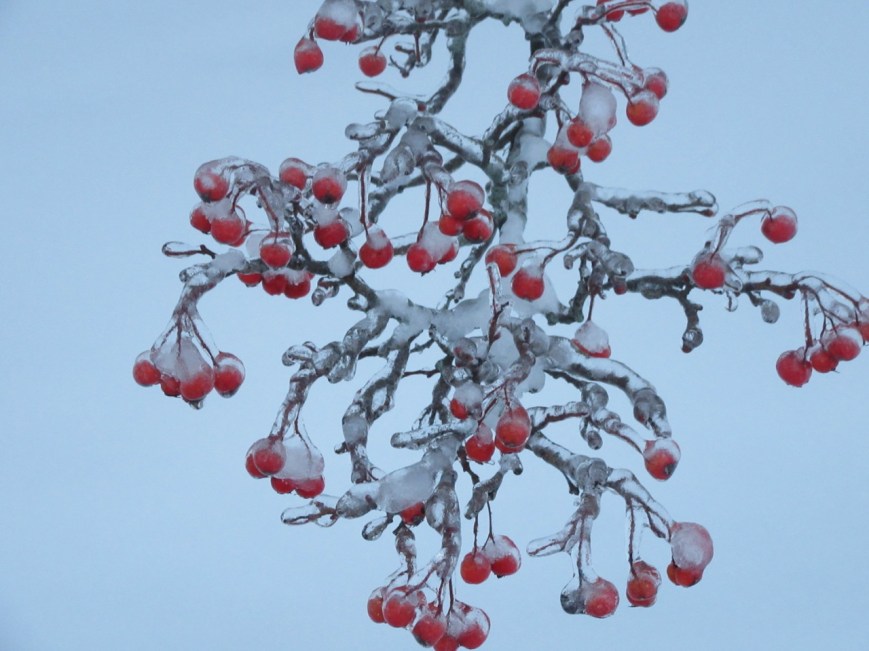
My spirit feels like the ground hidden under the snow, or the berries encased in ice.  I am trying to find quiet and solitude to listen to what it wants to tell me, to find out, as David Whyte says,

What shape waits in the seed of you to grow and spread its branches against a future sky?”


What We Are Here For

IMG_3796

“Life is the expression and fulfillment and celebration of beauty. This is what we are here for.  We’re not here to do anything else.” (Sarah Susanka in The Not So Big Life)

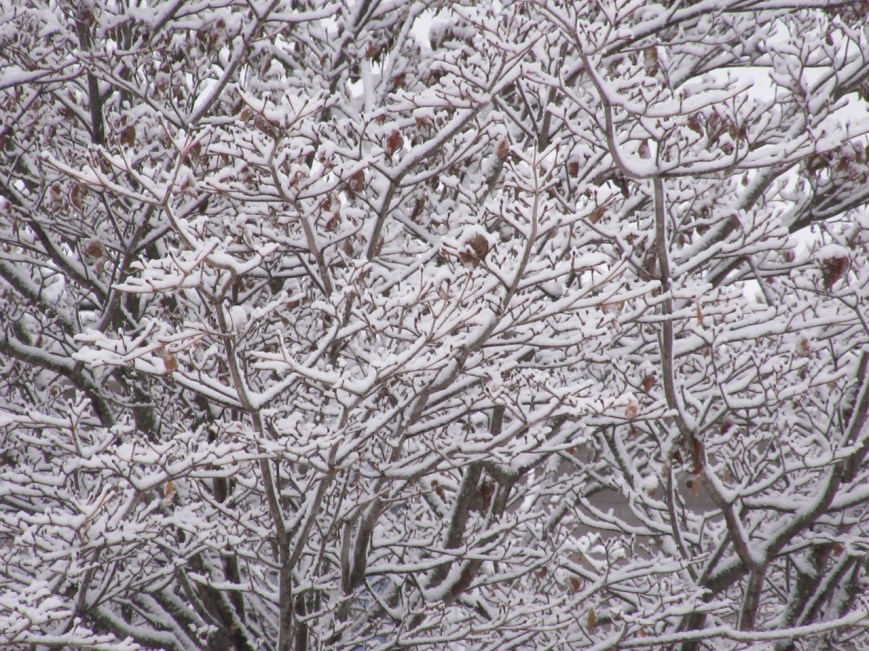
Perhaps this is an odd sentiment, when so much in our country is going wrong these days. Aren’t we also here for justice, for compassion, for interconnection?  But what is beauty anyway?  Is it the unexpected sighting of a wild raccoon near the brook during a morning walk?  Is it the fluid colors of the sky in the dawn?  Is it a coating of ice or snow on the branches of every tree and bush in the neighborhood?

Why do these things enliven our souls?  Perhaps beauty is the mark of an essential wholeness, a harmony we can recognize with our eyes, our ears, our hearts, our whole being.  If that is the case, then I believe beauty also includes justice, compassion, interconnection.  We recognize instinctively the wholeness within justice, within acts of kindness, the miracle of our interconnection.

Beauty has something to teach us about how to work for justice as well.  To express and celebrate beauty is to turn our attention away from the ugly hatefulness we deplore, toward acts of creating what we aspire to.  This is why I love permaculture and solar panels and work parties and gardens.  We are bringing into being the wholeness we hope for.  I am not saying that protests are not important as well.  On the contrary.

But as Rebecca Solnit promises, in her book Hope in the Dark,

…if you embody what you aspire to, you have already succeeded. That is to say, if your activism is already democratic, peaceful, creative, then in one small corner of the world these things have triumphed. Activism, in this model, is not only a toolbox to change things but a home in which to take up residence and live according to your beliefs, even if it’s a temporary and local place… Make yourself one small republic of unconquered spirit.

May you be a beacon of beauty today!

Into the Beauty

We never know when there might be magic and beauty right around the corner–if we only make a choice to look.  My day started a bit upside down and backwards–I woke before 4 a.m. with sinus pain, and never got back to sleep after I started up a vaporizer.  Finally I turned on the light, and slowly started my day in a rather bedraggled and sluggish way.  After a while, it occurred to me to just let go of the upside down feeling, and enter the day afresh.  I offered a prayer to the Mama to help me step into the flow of the River, let the magic guide me.

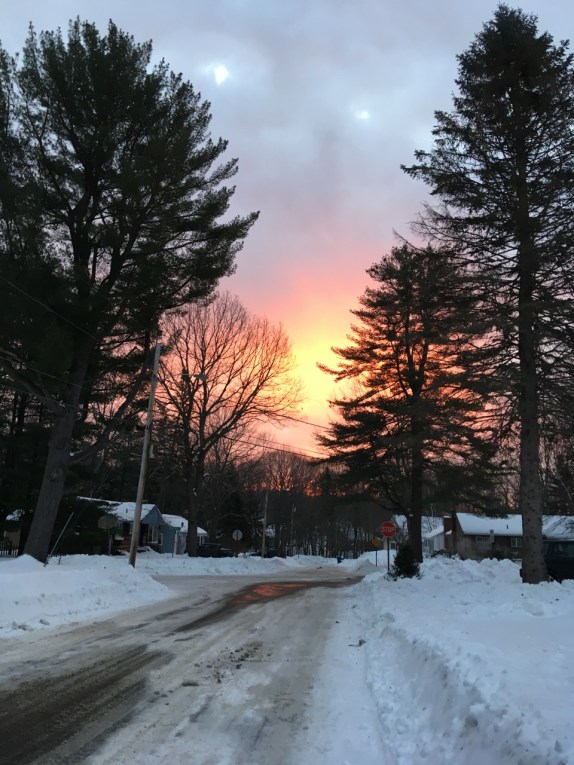
So in that spirit, I put on my coat and boots and went out for a walk about 7 a.m.  I went out the back door and walked around the west side of the house along the driveway to the front.  When I turned to go into the street, toward the east, there was suddenly this beauty of a pink and golden sky before me.  It felt like an affirmation of my prayer.   May you also find magic and beauty right around the corner today!
Sunrise surprise

“Part Indian”

Yvonne DSC01872I don’t know the whole story about Elizabeth Warren’s claim to have Native ancestry.  I have heard her mocked by being called “Pocahontas.”  That mockery is wrong on so many counts, not the least of which is the tragic story of the actual Pocahontas that has been obscured and romanticized by American culture and cinema.  But what I want to explore today is the sometimes confusing experience of those of us who are white but have some Native ancestry.
I know enough now to know that having Native ancestry does not make one a Native American.  But I didn’t know that when I was young.  It was through trying to understand what my Native ancestry meant that I grew to understand what it meant to be white.

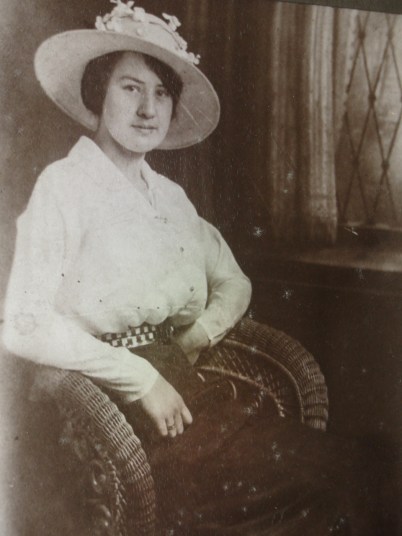
When my siblings and I were growing up, all we really knew was our family stories.  Our mom told us she was part Indian.  She didn’t know what tribe.  It was through her mother’s family, my grandmother Yvonne who came from Quebec to Detroit.  (That is Yvonne’s picture I have included above–taken on the day she crossed the border from Canada to her new life in America with my grandfather.) My mom was proud of being part Indian.  My dad had worked as a cowboy, so we used to joke about our parents being the cowboy and the Indian.

Our family stories opened in my heart a curiosity toward Indigenous peoples. As a young adult I learned more about American Indian political struggles, and began to take what action I could in solidarity.  But I also learned that white people who claimed to have Native ancestry were often joked about, considered Wannabes, and especially tasteless was to claim a great-grandmother who was a Cherokee Indian princess.

Perhaps that was why I was relieved to discover that we were not part Cherokee.  I was the one who researched our family history and learned that we were related to the Innu people, who are indigenous to the land now called Quebec and Labrador. The French settlers called them Montagnais. I learned that the Innu know their land as Nitasinnan, which means “our land.”  Later, in the midst of my activist work, I had a chance to meet Innu activists, working against the hydrodams that Quebec was trying to build on their rivers.

Gradually, I learned more about the Indigenous experience in America, and was able to better understand my own position as a white woman.  But in between my childhood and my better understanding, it was confusing to me.  There were a few occasions that I said I was Native American, many other occasions I kept silent.  My sister once took an art class that she got into because she was 1/16th Indian (we thought).  For a short while, I said I was Metis–mixed–because that was a word used in a book in French that spoke about some of my ancestors.  Not being in Canada, I didn’t know about the actual meaning of that word in English to describe another distinct group.  It took a long time to sort out that it was more accurate and respectful to say that I was white.

This is why I have some sympathy for Elizabeth Warren right now.  With only family stories to guide us, it is hard to sort out the dynamics of race and privilege from cherished ancestral connections.  And the stories of my grandmothers are also meaningful to me still.  I say grandmothers, because it was my matrilineal descent that originated in Nitasinnan.  My Innu great-great-great-grandmother was Marie-Madeleine, who married a Scottish trapper near Chicoutimi, Quebec.  Her daughter was Angele, whose daughter was Claudia, my great-grandmother, and Yvonne’s mother.  When we were kids, we thought we were 1/16 Indian, but it turned out to be 1/32.  Much later, a DNA test confirmed that matrilineal descent.

These grandmothers were gradually–or perhaps quickly–assimilated into the white community, first in Quebec, and then in the United States.  I learned that assimilation itself was part of the long campaign to divide Indigenous people from their land and their history.  When an Indian woman in Canada married a white man, she lost her legal status as an Indian.  So, on the census records for Angele, for example, she was referred to as Scottish like her father.  The mother disappears, through a combination of sexism and racism.  I don’t think the assimilation was without difficulty.  I don’t know the early stories, but my mom mentioned once that her mom and her aunts didn’t go in the sun, because they didn’t want their skin to darken and people to think that they were Indians.

Their lingering shame says something to me about the difficulties of the assimilation process.  And yet–they told the stories–they didn’t forget their ancestry.  And that means something to me as well.  The Innu word for “my grandmother” is Nukum.  Even though I am now very clear about being white, I pray to Nukum for guidance in my life, and she has helped me on my journey.

Celebrating Grains (as someone who doesn’t eat grains)

Today is the celebration of Lammas, the Grain Festival–or how I often have thought of it here in North America–the Corn Festival.  This is the time when local corn on the cob is finally ready!  In its European origins, “corn” meant wheat, and it was a celebration of the wheat harvest, complete with Lammas breads eaten during the rituals.  But lately, I have been following a mostly grain-free eating plan–no wheat, no gluten, and no corn.  So how might I celebrate Lammas?

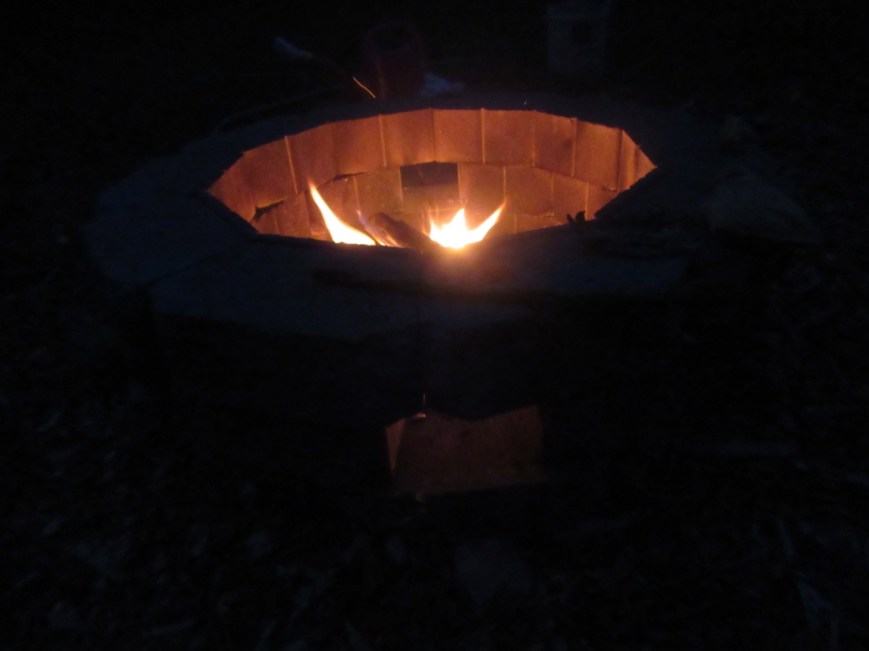
I am planning to go outside for a fire this evening.  We had our first fire in our fire circle on the new moon on July 23rd.  (the photo is from that fire)  A fire always feels like an invocation of the sacred.  Perhaps it would work also to celebrate with nuts and fruits, which are like grain in that they are the seeds of the plant.  They are freely gifted by the plants to human beings.  All cultivated plants co-evolved with human communities.  So perhaps tonight I will celebrate that partnership between human beings and plants!

First Fire

Wounds Remembered

View from our tent MD

[View from our tent Friday morning, photo by Margy Dowzer]

Healing the Wounds of Turtle Island was a powerful, moving, four-day gathering, with teachings and ceremonies led by Indigenous elders from near and far.  It included the stories of so many people, many of which are not mine to tell. But I want to share some of my own story at the gathering.

Wabanaki means people of the dawn, and there were ceremonies at sunrise each day led by Bobby Billie, a spiritual leader from the Seminole in Florida. I am also a person called to the dawn, so I was present each day for that time.

The first day, several of us had gathered near the arbor in the mist around 5 a.m., but no one had yet arrived to lead the lighting of the fire.  So I prayed my own dawn prayers, and felt this message from the sun–“You are all bathed in love.”  Later that morning, Anishinaabe women from the Midewiwin Lodge sang a song about the love the Sun has for all of us.  I was so moved by the melody, the voices, the drumming on the Little Boy drum.  It went straight to my soul.  They said it was about the first woman to walk the earth, expressing her joy at seeing everything in creation.

The first day was devoted to healing the wounds carried within the hearts and minds of the people from our long history of violence.  The wound that became clear to me was a Great Forgetting:  first there was a great disconnection of my ancestors from their connection with all of creation, and then there was a great forgetting so that the people would be unaware that they were wounded, disconnected, and thus never realize that they had once been connected.  At the end of the ritual, we each were invited to offer tobacco to the fire and make a solemn promise.  My promise was to remember, to remember the wound and to remember the connection.

Also coming into my thoughts was the herb that has appeared on our land–St. John’s Wort–which has traditionally been understood as useful for depression, and also as a wound healer.  I seemed to hear in my mind, this plant can help when you remember the wound of disconnection, when you open to the pain underneath the great forgetting.  I had harvested some of the plants earlier in July, and they were infusing in oil at home–the oil turns red from the plants.  When I got home, I also harvested more of the plants and hung them to dry in our garage, for making tea.

I know that there will be many more rememberings, lessons I carry from this time, but perhaps that is enough for now.  I do want to offer my thanks to Sherri Mitchell who has carried the dream of these ceremonies for many years, and who called us together and enabled it to come alive.