Garden work & rest

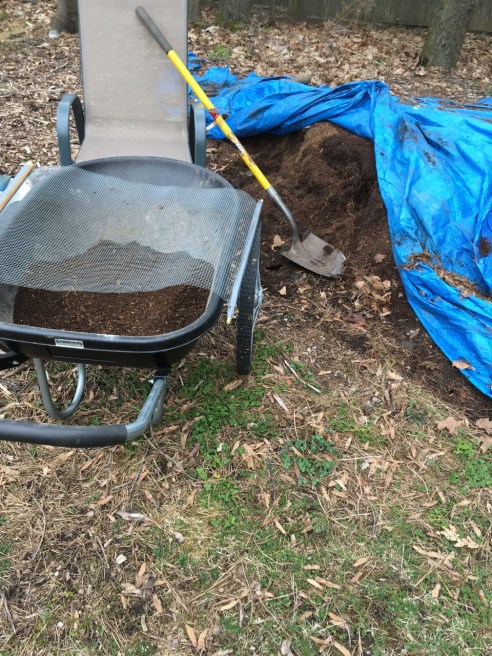
The last few weeks I have been outside a lot, but not writing a lot. I have been adding soil and compost to the hugelkultur mound little by little, and stuffing sod into the sides, but in photos it doesn’t change much. I created a new tool–a screen to sift compost that has become inundated with small roots. It is just two dowels, with a metal screen attached with staples and duct tape, but it fits over the top of the wheelbarrow, and makes it so much easier: I shovel compost from the pile onto the screen, then rub it back and forth with gloved hands to sift out the roots, and the usable compost falls through.Compost sifter
I also put spigots and drain hoses back into six of our rain barrels. They are designed to capture rain from the gutters, fill one barrel, and then overflow into the second barrel, and then overflow through a drain away from the house. The joy of these rain barrels is they can stay out through the winter as long as we remove the spigots and any long hoses. I had to go through the plastic drain hoses and cut off sections that had cracked, but luckily we had enough left to make it work. So I thought they were ready for rain again, but then yesterday as I checked them during our rainstorm, I discovered that one fitting had cracked–we’ll see if I can figure out how to fix that.

Rain barrels setup

Our new mulberry tree from Fedco arrived on Wednesday. Our old one didn’t do well where we had first planted it–too much shade, and then after I transplanted it last year, sadly it didn’t survive. But most of the work was done, because I had prepared such a great bed for it last year–so all I had to do was pull back the mulch, dig a small hole, and place the new baby tree inside. Baby trees aren’t that photogenic, a brown stick with a brown mulch background, so here is a photo of her roots all tangled up and gnarly before I placed her in the hole filled with water. May our tree be blessed in her new home, and provide food for birds and us too!

mulberry roots

Two springs ago, as I was preparing for retirement due to chronic illness, Margy bought me an early retirement gift–a hammock. Lately, after working for a while in the garden, I climb into that hammock and rest–so perfect! It feels a bit like laying on the beach in the sun, or floating on the ocean water. I can relax deeply, let go of trying to carry anything or do anything.  It has been so healing in this time of existential stress and grief for our world. I rock as if held in the arms of the air, the birds singing, blue sky and greening trees surrounding me, sun warming me.  It reminds me that we are held in the embrace of a larger Love, even when we feel so helpless in the face of the troubles that plague our country. May you also find ways to rest your spirit in this beautiful earth!

hammock

“I don’t know how to love him…”

I was watching Jesus Christ Superstar this evening, starring John Legend as Jesus. He is a wonderful Jesus! Each time I see it, it pulls me back to a time in my life that was so deep, so intense. I think of Lori and Tom, the best friends I met in my first week of college, and how the three of us were so in love with Jesus, and all he represented–a life beyond the ambition and greed of our society, something radical, something full of love, a life that let go of material things and chose a different kind of joy. We three were in love with all that. But we often asked each other, how can we follow Jesus’ way in this day and age? And so the song, “I don’t know how to love him,” touched something of that powerful confusion and desire in our hearts.

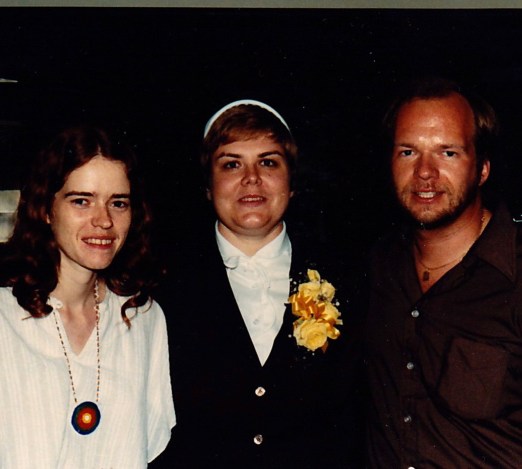
Now, Lori and Tom are gone, dying too soon, so I have no one with whom to reminisce; but the music calls to mind the idealism and passion we inspired in each other.  I have very few pictures of us, maybe none from college. We were so young then. This picture was taken about a year or two after graduation I think, when Lori was making her vows as a Franciscan sister. (Francis of Assisi was another one who inspired our best dreams.) That was how she tried to love Jesus.

Lori, Tom, and I

Me, Lori & Tom, 1977 or so?

Jesus Christ Superstar had debuted on Broadway the year of my high school graduation. We were lucky enough at Aquinas College to have as a professor a Catholic priest, Fr. Philip Hanley, who brought it into our theology class. He said that Jesus Christ Superstar asked all the questions that people had been asking for centuries about Jesus. And that was what theology was all about. Fr. Hanley is dead now, too, but I still remember how he encouraged us to ask all the questions, how he opened up our minds and hearts.

Lori was a nun for most of her life. Tom worked for the church–it was complicated because he was gay. But eventually he was working for the church and living with a long time partner, so that was a blessing. A few years after that photo, I found the Catholic Worker movement, the best example I knew of people trying to actually live the values of the gospel in our day and age. Radical, and a different kind of joy.

Then, in the midst of our peace activism, I found feminism and needed to launch on an even more radical journey that brought me out of the Catholic church, and into a spiritual movement with women becoming free. I came out as a lesbian, and named myself a witch, and eventually became a Unitarian Universalist minister. All of that brought me far from the paths that Lori and Tom had traveled, so we were not as close in later years, though I visited Lori when she was dying from cancer, and our love for each other went beyond all those differences.

The thing is, that idealistic and passionate young woman is still inside, however the years have transformed me. And listening to the musical this time, when Jesus/John Legend sang, “then, I was inspired; now, I’m sad and tired…” it resonated. We had such hope for changing the world, back then. It is hard to see the fruits of our labor as the backlash against social change movements rocks our nation. I don’t know if my life has lived up to the hopes and dreams I held in those days. Did it all mean anything? Yet Jesus asked those questions too, in Jesus Christ Superstar.

And it is complicated for me now, sorting out where Jesus fits into my life as a witch. But he hasn’t gone away. I remember him encouraging me as I set out on my feminist journey.  I am still wondering how to love him.  Still wondering about that radical way of living and loving. It brings tears to my eyes, even as an old tired woman.

Awake in the Night

I wake in the night with pain in my heart for all that is happening in our country, and I feel utterly powerless.  How can we respond to a reign of terror?  How can we respond to cruelty after cruelty promulgated by people in power? Money grabs, land grabs, malevolent neglect, direct abuse, more power grabs.  I have been an activist most of my life, and I believed and hoped that activism might help to change the world for the better.  In some ways, it really has.  But the dream–of a whole society that was rooted in cooperation and mutuality, in care for all of its people–that dream feels lost in a nightmare of empire re-emerging like some multi-headed dragon from the flames of disaster.

In my feelings of powerless, an old friend comes to me.  Jesus sits with me in the dark night. He comforts me, strangely, by reminding me that in many ways I am powerless. I can’t control what “my government” is doing right now.  The idea that it is “my government” is an illusion, democracy has become an illusion, a thin veneer over oligarchy, over fascism.  But Jesus too was powerless: he and his friends had no political power.  He lived his whole life in the shadow of the Roman empire, and that empire killed him.  Yet he was able to respond, to act, to live a life.

How? He prayed, he taught, he healed the sick, he listened, he walked among the ordinary people, in the lowly places.  He recalled the words of the prophet Isaiah:

“The Spirit of the Holy is upon me,
    that one has anointed me
    to proclaim good news to the poor.
That one has sent me to proclaim freedom for the prisoners
    and recovery of sight for the blind,
to set the oppressed free,
to proclaim the time of blessing from the Holy.”

He didn’t concern himself very often with the emperor or king or governor–he was clear that those powers were evil. Rather, he went directly to the poor, the oppressed, the sick, those were the ones who caught the eye of the divine blessing.  And later, when he painted a picture of the end of the world, this was the measure by which all people were judged:

I was hungry and you gave me something to eat, I was thirsty and you gave me something to drink, I was a stranger and you invited me in, I was naked and you clothed me, I was sick and you looked after me, I was in prison and you came to visit me. … Whatsoever you do for the least of these, my relatives, you do for me.”  

There is a certain clarity in all of this. A letting go of all that I cannot control. A shift in focus to what is possible, what really matters. An appreciation for the heroes who are risking their lives to look after the sick, those who are bringing food for the hungry.  A remembrance of the One who is with us in the midst of our powerlessness. Thank you.


helper 485_108321

Photo Source Unknown

Death and All the Stuff

Prompted by sheltering at home during the COVID 19 plague, the question came up: maybe it’s time for Margy and I to update our wills and other legal documents which we last visited in 2012. The basic purpose for us in these documents is to protect each other and make sure that we have the power to make decisions for each other, and inherit from each other. As a lesbian couple who are not married, this is what protects our “next of kin” status.

But each of these documents also has a secondary feature.  What if one of us is not available or able, or dies first–what then, who is next? That has always been a more challenging part of the process. In this age of plague, it is not outside the realm of possibility that both of us could succumb.  Who could we ask to take on the role of health care agent, or financial agent, if we were both incapacitated?

We don’t have children, and our family members are far away, and not always supportive of our identities. We have several good friends, but not a “best” friend, and many live far away. Can we ask any of our local friends to take on these roles? Are they close enough, or not too busy, or would they be overwhelmed by such a request? Who would bury us if we both died? Who are our people?

Similar dilemmas confront us with our wills, and who would inherit if we both were to die. I find that I have new concerns now that didn’t show up in the last will. What would happen to our land and garden that we’ve been so carefully tending? How could we ensure that the land would find new caretakers who would love it as we have? And who would have to sort through all the stuff that fills our little house? My natural temperament is to live simply, to possess little, and treasure those few possessions.  But somehow over all these years, I’ve accumulated a lifetime’s worth of stuff. (How did that happen?)

In the past few months, my mother has been preparing to leave her own house, and move into the home of my sister.  She officially moved yesterday.  All of her nine children and multiple grandchildren were invited to consider things we might like to take from her lifetime’s worth of stuff. But, aside from a few mementos, most of it has nowhere to go.  So even more likely, my own stuff will have nowhere to go.  It occurs to me that if I want to share mementos with people, maybe I should just send them as gifts now.

When I first did a will, I noticed that I most cared about my writing–I wanted there to be a way for thoughts and words to survive, for journals, sermons, essays, to live on in some way, to be a legacy.  That is still true, though now that I have actually published a book, I feel less anxious about it.  It feels like something of me will endure, this book child. But I also have five archive boxes full of journals that I have saved, countless sermons, another unpublished book, and even these blog posts. Sometimes I imagine them in an archive somewhere, discovered by some future historian who will be intrigued by my story. Might I be a spiritual ancestor to someone?

What fuels my need to save the writings? What compels me to write in the first place?

I wonder, does anyone see the whole story, does anyone see each of our stories, whether written or unwritten? Are our lives inscribed in a Book of Life somewhere?  When I was a child, we learned that God could see everything we did. It was somewhat scary then.  But now I find the idea a comfort–I want my life to have a witness. I hope my life will be inscribed in a Book of Life.

Moon, Sun

Full Moon in the west

I wake early this morning and see the shadows of the two cats, sitting upright together on a small table, gazing out through the semi-sheer curtain to the bright full moon.  The moon is called nipawset kisuhs in Passamaquoddy, the one who walks in the night. The sun is espotewset kisuhs, the one who walks in the day.  The moon and the sun are both considered animate, living beings.  That is how it has always seemed to me as well.

And so I am lying quietly awake, lifted by this beautiful light, this moment of magic, as the moon begins her descent into the west, into the branches of trees. We earth beings, cat and human, love the moon.

These days have felt fraught with fears for me, new coronavirus fears adding to the larger fears of ecological destruction, the resurgence of white nationalism and fascism, the horrors being wrought by our government on innocent children and parents who seek refuge from even larger fears of their own. So many fears. Now that I am retired, now that I am not so occupied with constant pressure from work, the fears have more room to rise up from their subconscious depths to trouble me directly.

Yet, the moon.  The moon eases the fears with her beauty.

Something about the moon calls into my memory a poem I wrote many years ago, back when I lived in Boston. That poem was about the sun, and also about fear. I think I want to share it here this morning, though it feels vulnerable to do so. These sacred moments. But perhaps it will be a blessing for someone else who is living into fear. The moon and the sun shine for us all.

The Sun spoke to her sometimes,
early, mostly at dawn,
though dawn usually meant
first glimpse she got each
morning, maybe standing
on the front porch to get the paper,
maybe looking through the window
between branches and buildings.
The Sun spoke to her then.

Is that a prayer?
Seems like she didn’t call out
or ask for anything–maybe
just a heart full of certain
needs–but the Sun seemed so eager.
The Sun seemed eager to name the day.

It was through the window
between the tree branches one time,
and three story buildings,
the Sun gave her a name too.
She never talked about the name,
seemed like it would sound silly
repeated like ordinary words
into conversation.

When the Sun spoke her name,
that was different,
so clear and simple
like words of power are:
First Afraid.
As soon as she heard those words
she didn’t feel afraid any more,
even though she could see so clear
how true it was,
how fear was always first in line
when things came up,
her heart clutching at the moments,
not wanting to let go or let come.
First Afraid.

And there was the sky turning
from pink to yellow
and night was turning right into day.
She sees the moments passing,
and all quiet-like inside,
knows that even her fear
can’t stop that turning,
and her hands relax a little,
her eyes watch, curious.

She remembers a child learning words
and colors and numbers,
the names of things.
All the world fitting
into the hands and mouth,
touched and eaten and spoken
–her mouth so full of power
she can’t help laughing–
words multiplying like popcorn,
words sweet like candy,
she wants to say everything.

But then her mother’s voice
tightens like a lid on a jar
–be careful, be careful–
as if naming were sharp like a knife
or heavy to drop and crush,
words so hot they might burn.
As if she just might eat up
the whole world and leave nothing left
at all, And so she stops to measure,
stops and measures.
First Afraid.

The Sun doesn’t slow down or speed up,
moves surely, gently, warmly.
Caresses with indifferent generosity
across the words
of morning or noontime.
The Sun speaks her.
Puts words back in her mouth
and on her fingers.
Sky turning from pink to yellow
and night turning into day
through the window
between the tree branches
and three story buildings.
The Sun puts words back in her mouth
and on her fingers.

Sun in winter

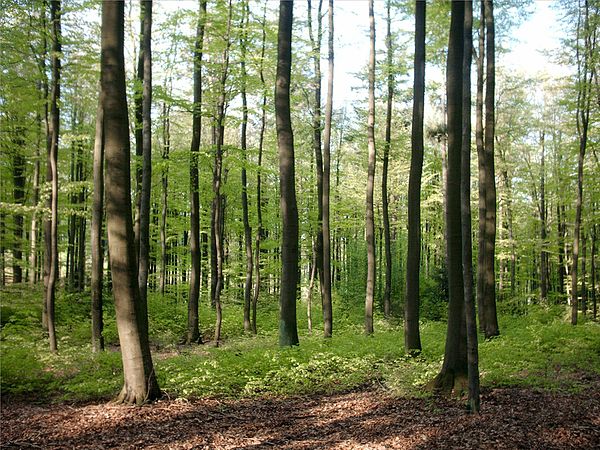
Ancient Beech Forests in Germany

Buchenwald_Frühling

Beech Forest Buchenwald Frühling by Nasenbär (Diskussion) / CC BY-SA 3.0 DE (https://creativecommons.org/licenses/by-sa/3.0/de/deed.en)

I just learned this week that the ancient forests of Germany were beech forests. They were the first trees to grow in the land about 11700 years ago as the ice sheets retreated after the last ice age. If there had been no human beings or human agriculture, the beech forests would have covered the whole of Europe. But human development reduced the forests to a fraction of their former acreage. In 2011 five beech forests in Germany were made UNESCO World Heritage Sites to conserve them. 

I learned this after watching a movie called ‘Call Of The Forest – The Forgotten Wisdom Of Trees,’ a documentary featuring scientist and author Diana Beresford-Kroeger. Along with other people around the world, she interviews Dr. Silke Lanniger and Meinrad Joos, who are involved in German forest preservation. One of them said that Germany is committed to keeping 30% of its land forested. It is a beautiful movie, and I was heartened to learn about the German commitment to its forests.

Mostly, however, I was intrigued because of my own connection to a copper beech tree in Boston, which I have previously written about. The copper beech tree was a primary spiritual anchor for me during the time I lived near to its location in the Forest Hills Cemetery.  I was also intrigued because of my more recent reaching out to my ancient Germanic ancestors.  I realized that they were living in these primordial beech forests, likely during many generations of my relatives. Sometimes the beech trees were considered fairy trees, or a link to all that is magical.

And isn’t it ironic, or magical, that, knowing none of this, I found the beech tree in Boston, or perhaps the beech tree found me?  There are so many synchronicities here. When I wrote about the beech tree, I also wrote about the magic of the runes–that ancient alphabet of the Northern Europeans which has been another link to my Germanic ancestors. Now, when I imagine my ancient Germanic ancestors, I see them in this beautiful forest.

Going back to the film, its message was wider and more universal than merely a link to my own ancestors. In her visits to forests around the world, Beresford-Kroeger speaks so eloquently of the gifts that trees bring to human beings, and also how important they are to the balance of all life on our planet. How important they are to the climate.  Perhaps they might be the most important being for maintaining our life on this earth. My spirituality is a tree spirituality!

Poem for Disappearing

Robin hidden behind berries
It has now been eighteen months since I retired from church leadership, and when I began that new chapter of my life I was not sure what to expect. I was surprised by experiencing an insistent pull toward quietude. I was surprised by how comfortable it felt to be “disappearing,” from a very public role as a minister.
This morning, I stumbled upon this poem by Naomi Shihab Nye.  Perhaps it jumped out at me because I had the privilege yesterday of attending a beautiful ordination ceremony for someone who is entering the start of their ministry.  Perhaps because, at that ceremony, I had a chance to see briefly many people who were in my former church community.  I still feel such tenderness and love for them.
But I don’t have regrets about the decision to retire. As Nye says so well, “It’s not that you don’t love them anymore. You’re trying to remember something too important to forget.” Sometimes I am baffled by this time and by how to decide what to do in it.  This poem speaks to that bafflement.

The Art of Disappearing

When they say Don’t I know you?
say no.

When they invite you to the party
remember what parties are like
before answering.
Someone telling you in a loud voice
they once wrote a poem.
Greasy sausage balls on a paper plate.
Then reply.

If they say We should get together
say why?

It’s not that you don’t love them anymore.
You’re trying to remember something
too important to forget.
Trees. The monastery bell at twilight.
Tell them you have a new project.
It will never be finished.

When someone recognizes you in a grocery store
nod briefly and become a cabbage.
When someone you haven’t seen in ten years
appears at the door,
don’t start singing him all your new songs.
You will never catch up.

Walk around feeling like a leaf.
Know you could tumble any second.
Then decide what to do with your time.

From Words Under the Words: Selected Poems by Naomi Shihab Nye, published by Far Corner Books, 1995.

Water from Brigid’s Well

I was thinking of this visit to Brigid’s wells as we celebrated her feast last night, and blessed ourselves with water collected 4 1/2 years ago.

Myke Johnson's avatarFinding Our Way Home

On our way from the west to the east of Ireland, we stopped in Kildare, the town which was home to St. Brigid, one of the patron saints of Ireland and, according to the stories, an abbess who founded a monastery in 5th and 6th century.  Many stories link her to the older goddess Brigid, goddess of smithcraft, poetry, and healing.  We had read that there were two Brigid’s wells in Kildare–one now designated for the saint, and a pagan well still associated with the goddess.  Apparently, the pagan well wasn’t advertised, but we had read that it could be found near the parking lot of the Japanese Gardens/Irish National Stud.  So we set out to find it.

St. Brigid's Well, Kildare St. Brigid’s Well, Kildare

On the way, close by, we saw a sign for St. Brigid’s well and found that one.  People come to the Brigid’s wells for the healing properties of their waters…

View original post 453 more words

East Frisian Ancient Grandmother

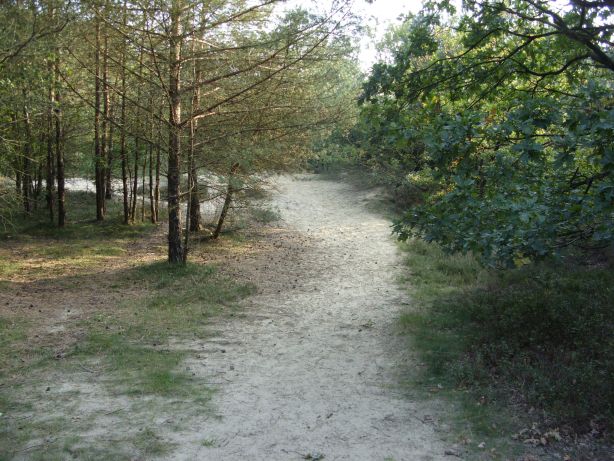
Holle_Sand_-_07

Holle Sand in East Frisia: a nature preserve on the duneland forest, near where my ancestors lived.

Are there any European ancestors who might help us to find a mutually beneficial relationship with the earth in our time? Today I was remembering that this was my original motivation for reaching back to these ancestors. Oh, it has also been helpful to gain a better understanding of how my ancestors fit into the larger story of the colonization of this continent in which I live.

But on a spiritual level, why would I reach for a true connection, if not to ask for help in the struggles we are facing in our time? Much of Australia is burning right now, fascism is running rampant over our country, hurting the plants and animals, and the people of our land, leaders plot for power and violence, and so much is being destroyed.

And I remembered what sparked my heart last spring about my patrilineal East Frisian ancestors. It was a line in a letter, a mocking recounting of a piece of old wives’ advice: “Remain in the land and nourish it.”   I wanted to reach out to those “old wives” to see if they might help me, help us.  During our Ancestor Wounds and Healing workshop in October, I introduced the group to the East Frisian tea ceremony, as part of our ritual of gratitude for the gifts of the ancestors.  We were short on time, and I considered leaving out the tea ceremony, but felt an unmistakable tug from spirit–“No! You must do the tea.”  And so I did.

Two days later I led our group on a trance journey with the intention for each of us to find an ancient ancestor–maybe from centuries ago–for each of us to meet someone who was at one with their land, in harmony with their land and people. So we traveled through time and out of time to make a connection. In that journey, I met my East Frisian ancient many-greats-grandmother, the same one who called for the tea.

When she arrives, I burst into tears and suddenly feel how wounded I am, we are. She is whole, she can traverse deep time and be called upon in any time. I burst into tears and she is loving me, with healing hands, and she knows how all of us have been broken. I felt the holding power of her love to contain the pain of centuries.  She is a healing presence, a witness to it all. She touches my heart, she says, “I can teach you how to laugh, even though the later Germans in your family lost how to feel.” She has a joy deeper than I know. She wants to continue our connection. She says, “Drink the tea ceremony to call me.”  

I was profoundly moved. I didn’t have a name for her that day, but later, a name came to me.  The German/Frisian affectionate name for grandma is Oma or Ooma. But a great-grandmother would be, in German, Ur-grossmutter and I am moved to call this ancient great-grandmother Ur-ma, or Oor-ma. The word also reminds me of the rune Uruz, which represents the aurochs, an ancient wild cattle species, now extinct, that was the symbol of wild strength, persistence, healing, and courage.

At the end of December, Margy and I shared in a rune reading. I used the runes to reach out to Ur-ma, and the first rune I pulled was Uruz.  Sweet.  Then came Nauthiz–which means Need, or difficulty, or struggle. How we are.  Finally I pulled Gebo, which means Gift, and the power of reciprocity which is love.

And so when I reach out to Ur-ma, I drink the tea and I pray: “You have wholeness, we are so broken. Bring your healing energies to our time. We have lost the connection to all beings and the land. We have forgotten our kinship. Help us heal. Help us to love the land, to love the spirit.” And I keep remembering those words, which somehow came down the centuries even so: “Remain in the land and nourish it.”


At Home

Picture by Arla Patch, James Francis

With these last few quiet days at home, Margy and I were finally (after almost four years) able to take down from the attic all of our wall pictures, and decide how we wanted to decorate the walls of our living room and kitchen. It was especially wonderful to place over our fireplace hearth this print, Stewardship of the Earth, by James E. Francis and Arla Patch. We had purchased it several years ago in a fundraiser for Maine Wabanaki REACH.  Here is more information about it from an article in the Friends Journal.

This work of art is a collaboration between James E. Francis, Penobscot artist and director of cultural and historic preservation for the Penobscot Nation, and Arla Patch, artist, teacher, and [at that time] member of the communications subcommittee of the Wabanaki Truth and Reconciliation Commission.

It was made for a western Maine community celebration of the native woman Molly Ockett (c. 1740–1816, Abenaki nation, Pequawket band). The theme of 2013’s MollyOckett Days Festival was “Stewardship of the Earth.” James created the central image of the tree that becomes the earth. Arla created the context based on the European American tradition of quilts. James provided the symbols, which represent the four remaining tribes in the Wabanaki Confederacy: the Penobscot, the Passamaquoddy, the Maliseet, and the Micmac.

A theme of the four directions, which comes from both Native American spirituality and ancient Celtic tradition, is depicted as the night sky for the north; the sun rising over “second island” next to the Passamaquoddy land of Sipayik; the midday sky for the south; and the sun setting over the White Mountains for the west. “Agiocochook” (home of the Great Spirit), also known as Mt. Washington, is included in the western sky.

Blueberries are included for the role they have played in sustaining Maine native peoples historically and to this day. Maple leaves are in the upper corners to honor the development of maple syrup by the Wabanaki.

When we put this picture on the wall, along with a few others around the room, I found myself feeling rooted and joyful, at home in a deeper way than before. It was as if some mysterious magic had created a circle around us, and we were aligning into harmony and beauty.

May that beauty bring us hope and strength as we enter a new decade, a decade that will be pivotal in our collective stewardship of the Earth. May we human beings find a way to live in harmony with all of our relatives on this planet that is our home.