Red Pine

Red Pine[Edited: I learned 2/12/18 that this is actually a pitch pine. See my new blog post.] There is a red pine in the middle of our back yard… the only big tree (40 plus feet) that is not at the edge of the yard. But I have been struggling to create an affectionate relationship with this tree. I have had other very special trees in my life, and I loved the many trees that surrounded our home in North Yarmouth.  So why is this one hard?

I have been reading a lovely book, The Garden Awakening by Mary Reynolds, which is focused on creating a relationship with our land. She talks about trees as the guardians of the land.  So if we want to go deeper with the land, we need to go deeper with the trees.  That got me thinking again about the challenge of the red pine.

Perhaps it started when we first moved here, and were concerned about trees possibly shading the solar panels.  Or perhaps it is tied to my grief about the maple tree that was by the side of our house which we did have to take down because of dangerous branches and solar shading.  I loved that tree, and felt the contradiction so acutely: even though the maple tree was willing, and its wood became the ground layer mulch for our future orchard.  We decided that the solar panels would be okay with the pine tree’s slight shading, but it did get us off to a wary start.

So here it is.  It was identified as a red pine by an arborist who came by.  Right now, I have an intention to go deeper with this tree.  I want to understand all the dimensions of this relationship.  Some things that feel difficult to me:  The branches are all too high to reach, so it feels rather aloof.  When the pinecones drop, and there are lots of them, the ground underneath becomes difficult to walk on.  All around the tree there are old pinecones half buried in the grass from many years past.  If I could pick one word to describe my feeling of the tree, it would be “prickly.”

What helps? Last spring, we held an introduction to permaculture design course at our house, and many of the participants commented on the loveliness of the pine tree. There is a beautiful asymmetry in its branches. Their appreciation of the tree helped me to see its beauty.  The red pine is native to North America.  They can live up to 350-500 years.  Some sources said pine trees are symbols of longevity and wisdom.
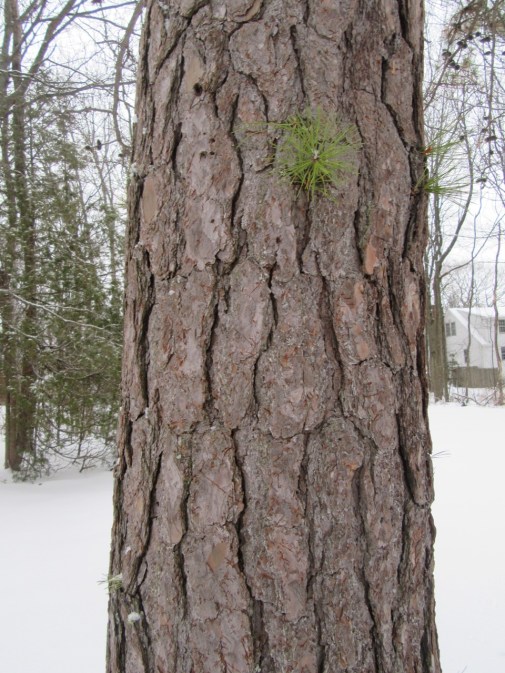
Red Pine BarkOne website mentioned that its roots “are moderately deep and wide spreading. The lateral root masses also send down “sinkers” which anchor the tree very well in the soil. Red pines are very wind firm because of this dense root system.”

Okay, deep roots and anchors in the soil. I like that. I am investigating medicinal uses: one might be pine needle tea, which is good for immune function, bronchitis, and many other ailments.  More to research here.  This morning, I took pictures of the pine, and stood next to it, leaning against the bark.  What do you have to teach me, dear red pine?


Names & Shadows

Shadows

Ousamequin of Pokanoket, the Massasoit “great sachem” (sôgemak).  Weetamoo, also known as Namumpum, female leader/sachem (sôgeskwak) of Pocasset. Wamsutta of Pokanoket, son of Ousamequin, husband of Weetamoo. Wootonakanuske, sister of Weetamoo, wife of Metacom. Metacom also known as Philip, son of Ousamequin, husband of Wootonakanuske. Tuspaquin of Nemasket, son-in-law of Ousamequin, husband of Amie. Amie of Nemasket, daughter of Ousamequin, wife of Tuspaquin. Awashonks of Sakonnet, Conbitant, father of Weetamoo, sachem of Pocasset. Nanamocomuck, Penacook, son of Passaconaway, Penacook. (Wampanoags)

I have been reading Our Beloved Kin: A New History of King Philip’s War, by Lisa Brooks. It is an amazing narrative, in which she goes back to original documents and source material, combined with local Indigenous knowledge to reexamine the stories of the New England colonies and the Indigenous peoples during the later 1600s, particularly the unfolding of hostilities that came to be known as King Philip’s War.

Reading this book has unlocked a deeper process of decolonizing my mind. What I have been most struck by are the individual stories, the actual names of individual people and the places in which they lived, planted, fished, traveled, escaped, returned.  How they were related and how they negotiated and were ambassadors on behalf of their relatives. How they adapted and resisted and strategized. Their names and their stories.

Warrabitta (female leader) of Owaskoag. Skitterygusset, her brother. Sagawetton, her brother, who lived with his wife on the Saco River.  (Wabanaki leaders around Casco Bay).  Canonicus, Miantonomo, sachems, Quaiapin of Woossowenbiskw, female sachem. Mixxano her husband, Scuttup and Quequegunent, her sons. Ninigret, her brother, leader of Niantic. Cojonoquant, cousin of Mixxano. (Narragansett leaders). James Printer, or Wawaus, a Nipmuc scholar from Hassanamesit.

Brooks brings to light people who had been hidden in the narratives told by the English settlers, people who had been hidden in the shadows as “Native people in the wilderness who were conquered by the English settlers.”  But–of course–they had names.  They had towns and regions and farms. They had families, with names.  Our Beloved Kin is a dense and long book (346 pages not counting the notes), slow reading, ultimately devastating because of the betrayals of the colonists which we anticipate throughout. But even the betrayals are identified specifically to people with names, betrayed by other people with names. I have only listed a few of the hundreds of people she identifies.

Because I speak English, I have had to say “female leader” in these lists to note that in fact there were female leaders. Among the Indigenous peoples of this region, the words for Sachem, or leader, were gendered, (sôgemak) (sôgeskwak) but to have a female leader was no more unusual than to have a male leader.  Just thought I should note that.

There is no way to convey here the immensity of what Lisa Brooks brings from out of the shadows into the light. I imagine that a lot of people won’t try to navigate this exposition. But if you care about our relationship to this land, and to the people of this land, it is mind-blowing.


Moon rhythms

IMG_4590

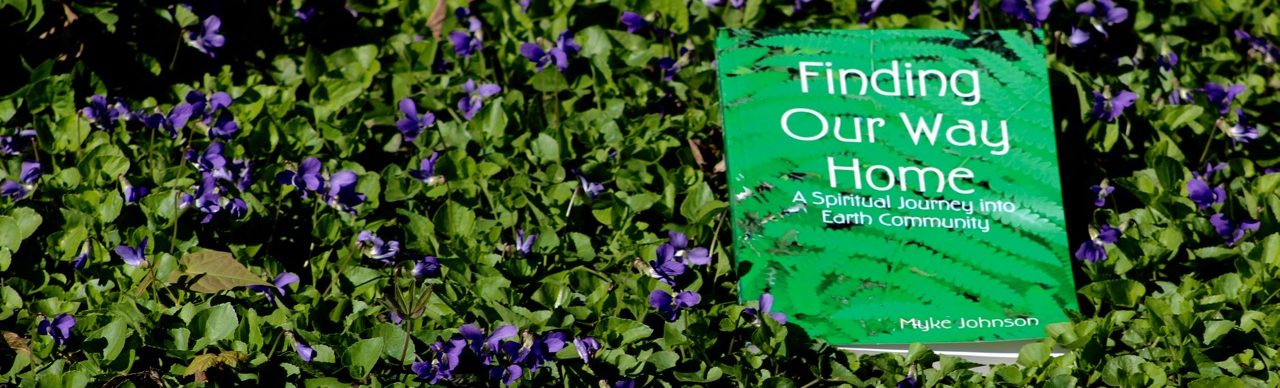
On my walk this morning I saw this lovely waning half moon, and remembered a conversation after our Candlemas ritual.  Most people have no idea how the cycles of the moon work.  We don’t learn about it in school.  Years ago, when I was in my twenties, I was curious about why I saw the moon sometimes in the evening and sometimes in the morning with different degrees of light and shade.  So I investigated. (This was before Google–how did I do that?)  I learned that the moon follows a consistent and lovely rhythm. I talk about it in my book Finding Our Way Home.

The moon is always half in light and half in darkness from the light of the sun. When the moon is full, we are seeing the whole of its light side, because the sun and moon are on opposite sides of our sky. The full moon rises at sunset and stays in the sky all night, setting at sunrise. Then, as the days go by, we see less of the light of the moon and more of its shadow, and it rises about fifty minutes later each day, until there is only a waning crescent in the morning just before and after dawn. About two weeks after the full moon, the moon rises unseen with the sun and sets invisibly with the sun. The night is dark. This is called the dark moon or the new moon. Then a day or two later, a thin waxing crescent appears in the western sky just after sunset and sets soon after. Each day it is seen in the evening for a little longer time until we come round to full moon again.

What is sad and funny to me is when fiction writers misplace the moon–for example most recently, I read a line something like this one: “I saw the waxing gibbous moon in the morning light.”  The thing is, no one will ever see a waxing moon in the morning light.  Waxing moons are only seen in the evening.  Am I a nature snob if I want the moon to be accurately represented in fiction?  The actual realities of the moon’s cycles are beautiful and magical–like a cosmic dance, which it accurately is.  Here is a rather fuzzy photo of a waxing moon, taken about 8 p.m. in April several years ago.

DSC04244

Winter Trees

IMG_0224

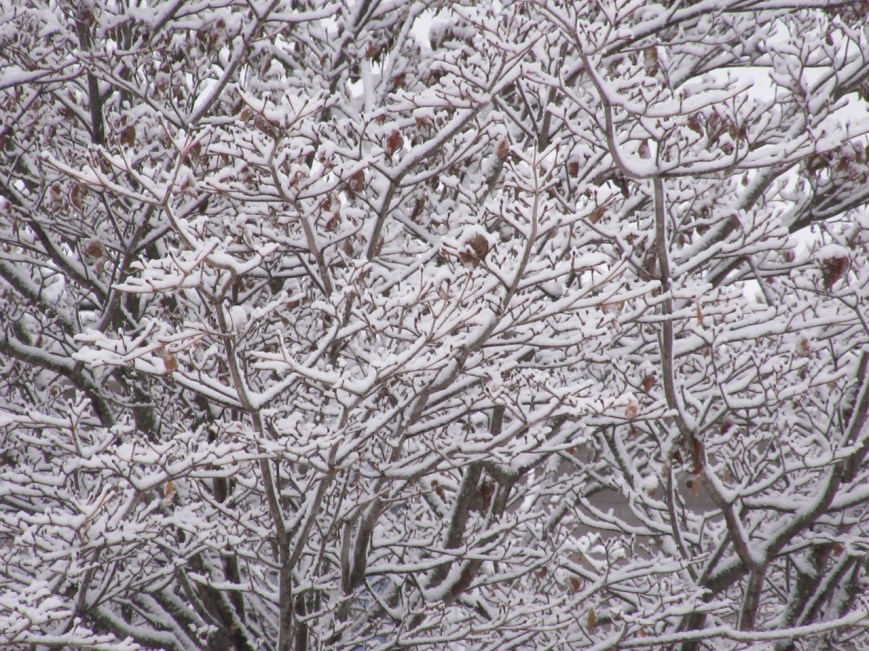
I got off to a slow start today, and waited until afternoon to take a walk, after the sun came out.  The bright light and shadows were playing over the cherry trees we planted last spring.  (Further back are the stakes around the raspberries.) I feel such protective tenderness toward these trees.  They are so little still.  There is no way to tell how they are surviving the ups and downs of winter.  We’ve had long bitter freezes, thaws, ice, snow storms… but so far, no deer nibbling.  Sleep well little ones! Another storm is on the way for tomorrow.

Sky Portal

sky puddle

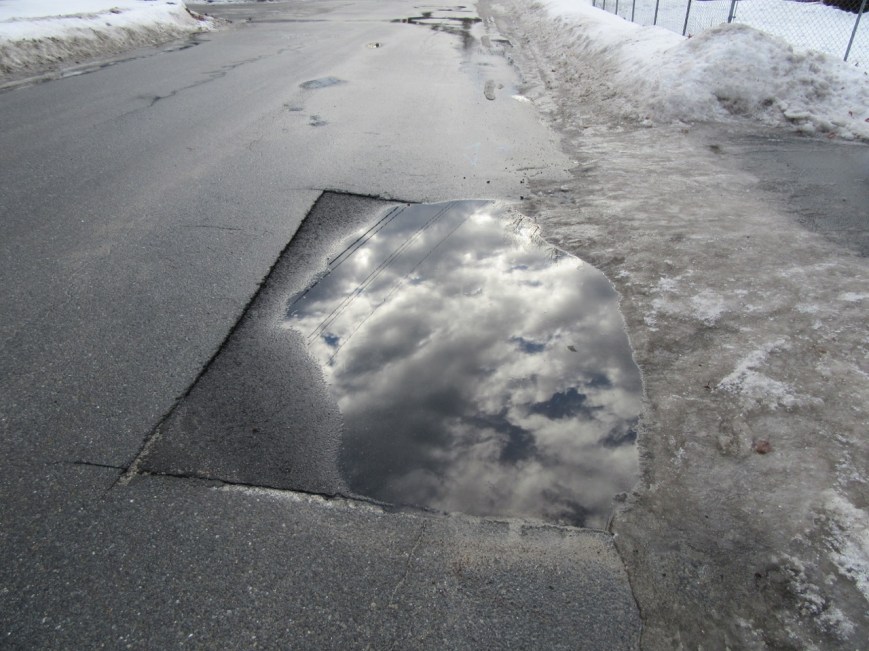
Doesn’t it look like if I were to step across that threshold I might fall into the sky? The thaw of last night has opened up all sorts of cracks in the fabric of space/time.  Meanwhile, I am walking in the morning, paying attention to beauty.  Our congregation is doing a February activity called Fun-a-Day, in which participants choose an activity to do each day that gives them joy. I think mine is this walking with a camera, noticing the beauty that I otherwise might miss. What would yours be?  Feel free to join in!

Finding Inner Wisdom

Woodstove Fire

Wood stove Fire-Photo by Margy Dowzer

During our ritual celebration yesterday evening for Imbolc/Groundhog Day, we scryed with the magic of the fire in our wood stove.  Scrying is a form of seeking wisdom, by gazing into some sort of medium–such as a crystal ball, tea leaves, a bowl of water, a candle flame.  It gets a bad rap on Wikipedia as “unscientific.”  But as one person mentioned last night, while meditation may sometimes be difficult, there is something about quietly staring into a fire with each other that brings one to a state of stillness within.

When we find that stillness, we have access to our own deeper wisdom, and the wisdom of the deeper mystery. Some people see images in the fire. Others notice whatever thoughts or feelings emerge in the stillness of gazing.

Here is what I noticed on the way to the wisdom in me:  First of all, a sense of deep weariness.  Then, a desire to stop doing so much out there in the world, to pay attention to what is happening within.  Then, a feeling of how difficult it is to say no to invitations to activism on issues that are important.  There is so much hard stuff in our world right now, and so many good people are responding.  How do I know when I should be taking action, and when I should be in stillness?

Then, a fear that if I choose to say no, I will disappoint people, lose their love and acceptance. Then, a realization that that motivation, that fear, is not a source of wisdom, but rather a wound that needs healing.  I sat with the fear for a while, gazing still into the fire, opening my heart to the healing energies of the mystery.  We were celebrating Brigid after all, who is a Celtic goddess of healing. We had brought into the circle a small bottle of water from one of Brigid’s wells in Ireland, and I anointed my forehead and heart and hands with some of that water.

Deeper still, I realized that I am in the midst of a profound change.  I am shifting from one identity, one chapter of my life–as the minister of the Allen Avenue Unitarian Universalist Church, to another identity, another chapter–as yet unknown.  What I most desire is something like a cocoon in which to make that transformation, just as the caterpillar encloses itself for its transition to the butterfly.

This “enclosing myself” is not the same as doing nothing at all.  There are activities that directly relate to this transition–processes of ending, closing down, completing the work. I notice how hard it is to turn my attention away from the usual activities of my current/former self, to pay attention to the transition.  And in understanding this, I realize that I have to be courageous enough to say no to some good and important activities and activism. I have to say no, so that I can be courageous enough to say yes to the transformation.

Groundhog Day

IMG_4560

We’ve made it half-way to the Spring Equinox–Groundhog Day, Candlemas, Imbolc according to the Celts… Whatever we call it, I have always liked this festival. Even the birds seem to know that something is up.  On my walks the last couple days, they have been singing so that I notice it.  The height of the sun? The change in the light?  Even though it’s been cold, and today snow was covering everything, they sing.

Today, in my neighborhood, the groundhog would not have seen his shadow–so that means that spring will come early.  But in fact, groundhogs are still in hibernation here, and since technically, it will still be six weeks until spring no matter what, I don’t actually count on the groundhog to confirm the weather.  But this day still awakens the hope that winter won’t last forever.

I was happy to learn that the Groundhog Day tradition comes from Americans with German ancestry–since that is part of my own heritage.  Back in German-speaking lands, it was instead a badger, and originally a bear, whose emergence would predict the weather on Candlemas Day.  Candlemas was a Catholic feast, but was retained even after Protestant Reforms, likely because it was an even earlier pagan feast that had been Christianized. There are sayings in English, French, and Latin as well that correspond to the myth: “If Candlemas is fair and clear, there’ll be two winters in the year.” This attests to its antiquity as a European tradition.

Imbolc is the feast of Brigid, the goddess of smithcraft, poetry, and healing.  When Margy and I visited Ireland, we visited more than one Brigid’s well where the waters are known for their healing properties.  But I also think of this festival as a celebration of fire–fire is the key component of welding and smithcraft, and it is also a symbol of creativity–the inner fire that inspires poetry and art and music.  It is the fire which inspires social change, transformation, and healing.

Years ago, this came together for me in the poem by Cherrie Moraga, “The Welder,” in the book, This Bridge Called My Back: Writings by Radical Women of Color.  It concludes with these lines:

I am now
coming up for air.
Yes, I am
picking up the torch.

I am the welder.
I understand the capacity of heat
to change the shape of things.
I am suited to work
within the realm of sparks
out of control.

I am the welder.
I am taking the power
into my own hands.

Thank you Cherrie Moraga!  And thank you to the singing birds!  Thank you dear neighborhood groundhog for not eating my kale last summer!  And to all of you reading this, may your day be filled with creativity and healing.

What We Give to Each Other

Yesterday I met a Passamaquoddy woman, S—, who talked about how she is trying to remove herself as much as possible from the money economy, to live with the values of a gift economy.  One way she does it is to volunteer a lot in her community.  I was moved by the conversation, and it stirred up questions in me about its application in my own life.  We were part of a gathering hosted by Maine-Wabanaki REACH for Wabanaki and Maine residents to explore together the topic of decolonization.  (If that term is unfamiliar, take a look at my earlier post called Living into History.)

Dish with One Spoon Wampum

Photo from IndianTime.net

Colonization brought the capitalist economy to this continent.  Another Wabanaki participant told us about the One Dish with One Spoon Wampum belt, which was a covenant acknowledging mutual care, first between the Haudenosaunee and then with other Indigenous communities prior to settlement.

The Great Law of Peace speaks of it:

We will have one dish, which means that we will all have equal shares of the game roaming about in the hunting grounds and fields, and then everything will become peaceful among all of the people;

We also heard about how in the Passamaquoddy nation, they are creating a community garden with an orchard of fruit trees, and teaching people how to cultivate them.  As people learn to provide for their community’s own food, true sovereignty becomes possible.

I was thinking about how back at my own home, we are also creating an orchard, but it is a difficult process to undo the individualistic capitalist systems.  To be connected to this land we have to “own” it in the capitalist manner.  We can share it with our friend who has a garden here with us, and we’ve also been blessed by the permaculture community’s support through our Permablitz work party last June.  And we received many of our companion plants in the plant swap last spring.  So we are trying to imagine community as a part of our relationship to this land.  But there is so much further to go.

I had brought flyers with me to the gathering about my book, not sure if it felt like the right place to share.  (Our invitation had mentioned we could bring materials about our related work if we wanted.) The content of the book is so much about how we journey into earth community–how we restore that spiritual relationship with the land and with our neighbors on this land.  How we acknowledge and heal the harm caused by the history of this place. But the book is also a product that I sell. So I was torn.

After our conversation about gift economy, I was moved to give a copy of the book as a gift to S—. I had so appreciated her sharing, and it felt to me like this would be a way to plant a seed–to shift something within me that might grow the possibility of a gift economy in this world, and in my life.  I was surprised when she responded by giving me a gift of her beadwork–beautiful turtles. There is magic in this. May it be blessed.

A No-Win Gamble

The other day I read the “Medicare and You” brochure in preparation for my own “graduation” to Medicare this coming summer.  It has been hard since then to shake a sense of foreboding.  My first reaction to all of it is how can our society treat our elders with such lack of care?  I don’t mean that it is bad that we have Medicare–I wish we had something like Medicare for all–single-payer health care–in our country.  But what we have now seems so bereft of full medical care, that participants are encouraged to buy extra care to cover all the gaps in care.

But it is not merely that you can choose to spend a certain amount per month to cover the gaps–a kind of gambling in itself about whether you will save more than you will spend.  It is that you have to decide between a dozen or more types of options, which kind of product to buy–all seemingly based on making a guess about your own unknown future health needs and prescription needs.  The supposed explanations for the different types of plans amount to gobble-di-gook, if you ask me….

Does anyone besides me see this as a particularly insidious way to torture people?  “You can choose!  Read all this information!  Oh, whatever you choose today will affect your future!”  A gambling game based on what?  (Is it anything besides a way to bring further profit to insurance companies?)  Then in today’s paper I read Michelle Singletary’s column The Color of Money, “Medicare trend causes palpitations,” and felt even worse.  She writes:

New analysis by the Kaiser Family Foundation has found that out-of-pocket health care costs for Medicare beneficiaries are likely to take up half of their average Social Security income by 2030.

I hesitate to blog about this issue because by doing so I have to reveal elements of my own financial situation–and money is one of the last taboos.  But I am feeling bold today. I will admit that despite the many blessings in my life, when I stop working, I will be one of those senior citizens living on a fixed low income.  We have been very lucky–we have a home, with solar panels (lower electricity costs) and a yard for gardens.  But homes also cost money for upkeep.  I worry that eventually I will be one of those who has to decide between medical care and eating.  And I am so angry that elders are put into that position today!

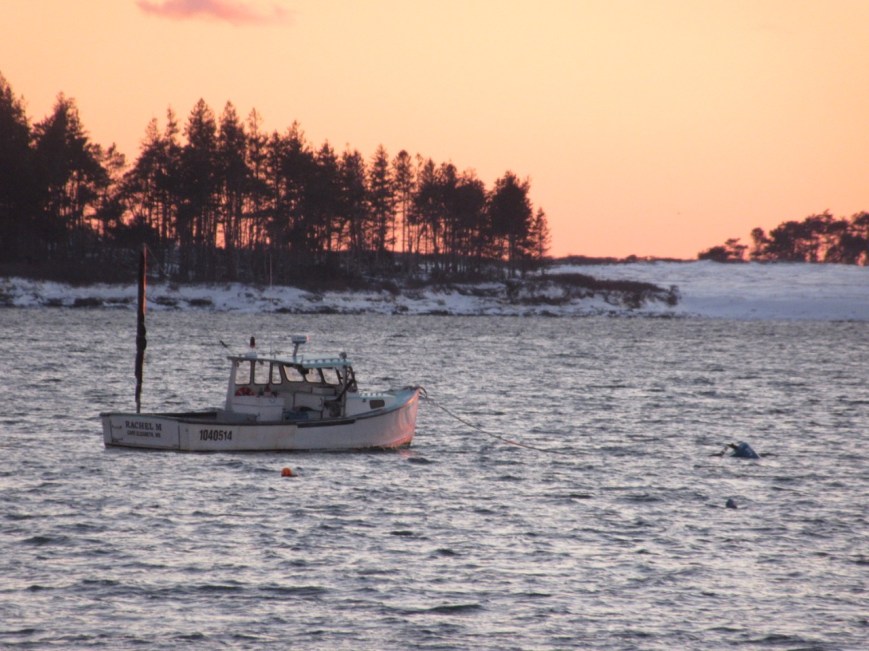
In the world I dream of, “health insurance” would be something paid for by the healthy, to take care of anyone who becomes sick–which eventually will be most of us, as we age. In that world, no one would risk losing their home because they become ill, no one would have to gamble based on unknown future events, no one would be left to die because of a lack of money.  There is a lot more to say about all this, but I have to stop now and go to the ocean… get some perspective.IMG_4237

Deck Roof

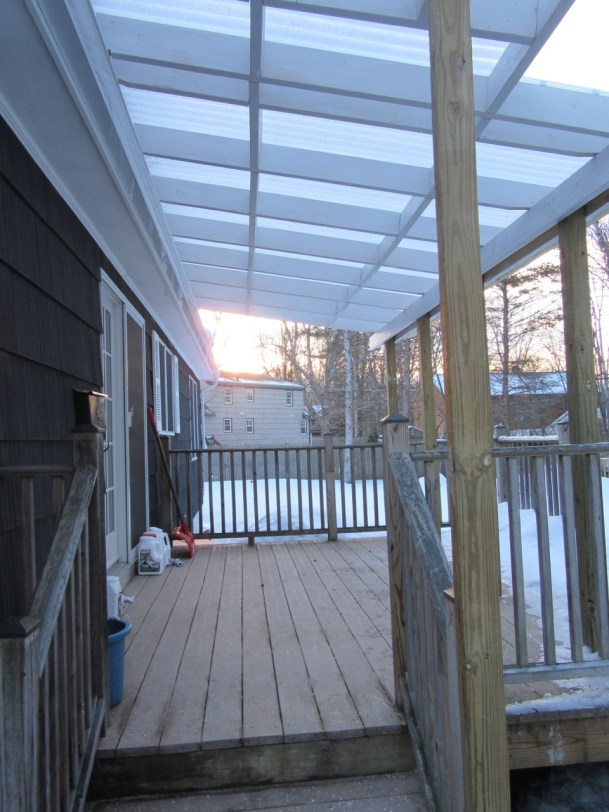
Deck RoofThe first winter after we installed solar panels on our new house, we discovered that when the snow melted on warm winter days, all the snow from the panels came down like an avalanche, right onto the deck, in the path from our back door that we used every day. I was out there shoveling first when the snow fell down, and then when the avalanche came down–sometimes in two or three segments.  And that second snow was always heavy wet and dense. #thingsyouforgottodesignfor

We needed some sort of new plan.  So we came up with an idea with our friend Ian, and he built this partial deck roof, using Tuftex polycarbonate roof panels and wood framing.  It was wider than we first imagined, to use the support beams under the deck for the framing.  Took longer than expected.  Doesn’t everything.  But such a relief now that it is up.  The panels are clear to let the light shine through–though in this photo they have some snow cover.  And they work–the snow avalanche slides down the solar panels, right cross the deck roof and lands in the space beyond.