A Human Being is a part of the whole called by us universe, a part limited in time and space. He experiences himself, his thoughts and feelings as something separated from the rest, a kind of optical delusion of consciousness. This delusion is a kind of prison for us, restricting us to our personal desires and to affection for a few persons nearest us. Our task must be to free ourselves from this prison by widening our circle of compassion to embrace all living creatures and the whole of nature and its beauty.
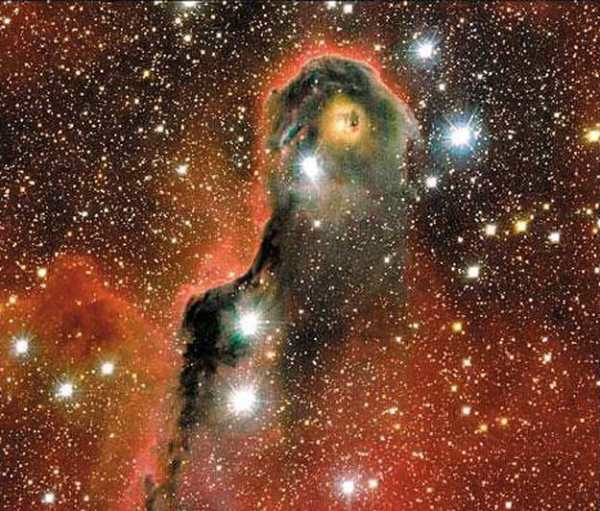
Sand Castles
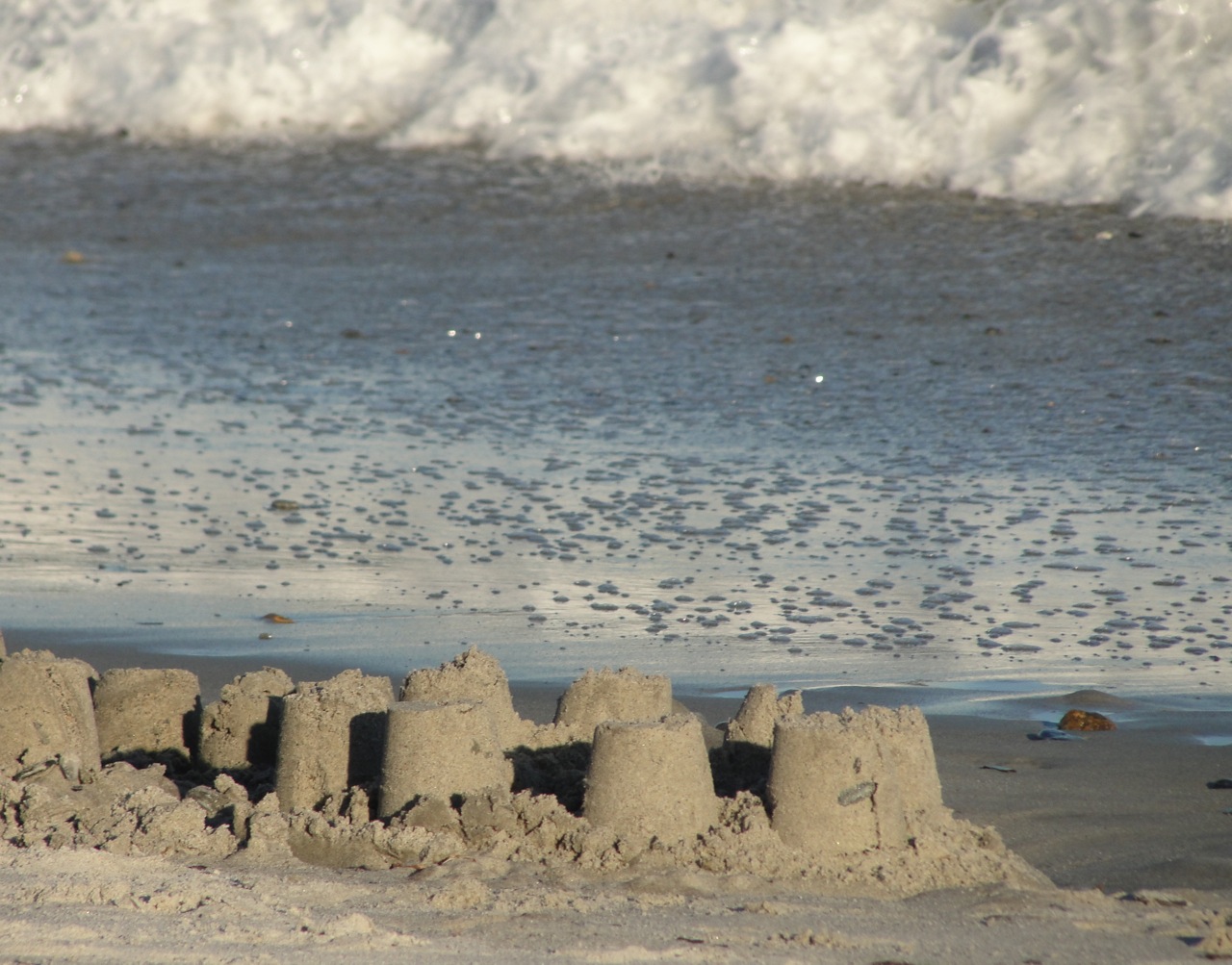
Photo by Margy Dowzer
Harold Kushner tells a story:
I was sitting on a beach one summer day, watching two children, a boy and a girl, playing in the sand. They were hard at work building an elaborate sand castle by the water’s edge, with gates and towers and moats and internal passages. Just when they had nearly finished their project, a big wave came along and knocked it down, reducing it to a heap of wet sand. I expected the children to burst into tears, devastated by what had happened to all their hard work. But they surprised me. Instead, they ran up the shore away from the water, laughing and holding hands, and sat down to build another castle.
All the things in our lives, all the complicated structures we spend so much time and energy creating, are built on sand. Only our relationships to other people endure. Sooner or later, the wave will come along and knock down what we have worked so hard to build up. When that happens, only the person who has somebody’s hand to hold will be able to laugh.
Community as a Spiritual Practice
Here is how it works when we choose community. There will be people in any community who inspire us. And there will be people in any community who rub us the wrong way. Those irritating people are the ones who are the biggest blessings for us. There is a story about a rabbi who was the leader of a spiritual community. There was one member who always gave the rabbi a hard time. The other members of the community hated it.
After many years, this person died. And many people were secretly relieved that they wouldn’t have to put up with him any more. But the rabbi wept at the funeral. When they asked, he said, “That man was the only friend I had. Here I am surrounded by people who revere me. He was the only one who challenged me. I fear that with him gone, I shall stop growing.”
To choose community does not mean to accept abuse, or to let people walk all over us. It does not mean always agreeing with someone, or refraining from speaking our own truths. Community includes challenging each other, arguing with each other, and sometimes saying no. But we don’t write each other off, we don’t speak disparagingly of one another, we don’t give up on each other. We treat each other as if we were treasures to each other. Because that is what we are.
To choose community means to be glad that each other person is here, to assume that they belong here, and to revere them as a part of our family. To choose community means to hold ever ready an attitude of curiosity and respect. To choose community means to look for the insights that the other might offer to expand our own limited viewpoint. To choose community means to assume that even when someone is acting badly, they are doing the best they can do at the moment. When we can practice getting past the irritations that arise in us, we have a chance to discover the magic.
Choosing community is a form of spiritual practice because it opens us to that which is divine within our neighbor. What has been hidden is revealed by the light of love. We come to realize that we are not alone. We are surrounded by family. The divine light is shining in the threads between us, and deep within each person. Dostoyevsky said: “If you love everything you will perceive the Divine Mystery in all things.”

Choosing Community
So often when we hear that we should love one another, it sounds like hard work, like a task, like a moral imperative that would be good to follow, but not very pleasant. And I admit there is something difficult about loving one another. But somewhere in the middle of it, comes a surprise. There really is divinity within each person—and when we see it, it is beautiful, joyful, mysterious, and wonderful. It is like the diamond that Dorothy Day was so quick to give to the homeless woman.
And not only that, when we risk opening our hearts to others, sometimes we experience the divinity that happens in the connections between us. We experience something of that ancient belonging for which we have been yearning. Ubuntu. We experience the oneness of all beings, our part in the family of all things. We realize that we are all gathered in a circle already, we are all part of one dreaming.
Those moments give me energy for the work of creating circles of love and faithfulness. Because we really do have to work at community. We have to make a choice for community. In our society, the bonds are frayed, and the mainstream is drifting toward isolation and competition. There are people who have no one with whom to share their real feelings. So dreaming in circles is about choosing connection, choosing love, joining hands with one other, and then another, finding the people with whom we can cast our lot, those who are similarly looking to manifest ubuntu in our lives.
When we choose community, when we practice loving a particular group of people, we are letting the reality of the universe enter our hearts—we are learning how to experience the reality that we truly are all part of one another. Of course we don’t usually get it right. Otherwise we wouldn’t need to practice. We are not here to try to fix everything in order to create some sort of perfect circle—we are the circle right now, trying to wake up together. Every person is sacred, and we are all one circle. 
Active Love
In the great Russian novel The Brothers Karamazov, a wealthy woman comes to seek advice from a holy and renowned priest, Father Zossima. She is anxious about eternal life, and wants to know how she can be sure of it. Father Zossima tells her, there is no proving the existence of God or eternal life. But there is one way she may be convinced of it. “How?” she asks. “By the experience of active love.” he replies. “Strive to love your neighbor actively and indefatigably. In as far as you advance in love, you will grow surer of the reality of God and of the immortality of your soul.”
The woman goes on to tell him that she loves humanity, so much in fact, that she dreams sometimes of leaving her privileged status and becoming a sister of mercy. She would nurse the afflicted and bind up their wounds. She tells the elder, “I close my eyes and think and dream, and at that moment I feel full of strength to overcome all obstacles.” But then she worries that if the patients did not respond with gratitude, if they were rude or abusive, she would be incapable of continuing to love them. And so she is in despair about her quandary.
He replies,
I am sorry I can say nothing more consoling to you, for love in action is a harsh and dreadful thing compared with love in dreams. Love in dreams is greedy for immediate action, rapidly performed and in the sight of all. Men will even give their lives if only the ordeal does not last too long but is soon over, with all looking on and applauding as though on the stage. But active love is labor and fortitude, and for some people too, perhaps a complete science.
Dorothy Day would often repeat the pronouncement of Father Zossima, “Love in action is a harsh and dreadful thing compared to love in dreams.”
We are here to awaken to that kind of active loving, that vision of divinity within each person. I remember an experience that happened one time when I was flying on an airplane, returning home from an event in Washington, DC. I had settled into my window seat, and started to read a book. I can’t remember now what the Washington event was or what the book was, but something had inspired me to be pondering this connectedness of all beings, this divinity within all beings.
Then, two young men climbed into the seats next to me. The man in the middle leaned his head against the back of the seat and closed his eyes. A while into the flight, he started to be sick—his friend gave him a paper bag, and he vomited, mostly into the bag, but also splashing his friend. I was a little horrified, and imagined them with hangovers from some drinking and partying.
But then it struck me that if I truly believed in the connectedness of all beings, I would realize that these men were my brothers. They were part of me, living in another lifetime, another journey. Something shifted within my heart. Instead of judging them, I was able to feel compassion. We didn’t go on to have a long conversation or anything like that—I think I just asked, are you okay? I remember a flight attendant coming by to check, and asking me if I wanted to change seats. But I said no. I was experiencing something deeper, something taught to me by these unlikely teachers.
Every Person Is Sacred
 One purpose of spirituality is to restore our connection to each other, or rather, to wake up our awareness to the connection that already exists. We are always connected, but we forget, we lose hold of it, we suffer from the illusion that we are separate. Spirituality is our experience of being a part of the larger whole. Spirituality is restoring our awareness of our connection to the earth, to other people, and to the Mystery at the heart of our vast universe. All of it is one.
Every person is sacred, and we are all one family. The early Universalists said that everyone was getting into heaven. As that belief evolved over the years, they began to say that there was something of heaven, something of God, something of truth in all people and all religions. The circle kept expanding. Today, some of my beloved congregation members don’t even believe in heaven, but we all believe in the common circle of human beings. We profess that everyone is sacred and everyone is welcome.
I am reminded of one of my favorite stories about heaven. Everyone was gathered around the pearly gates, waiting for judgment day, when a rumor started going around.
“Did you hear that God’s going to let everybody into heaven?”
“You mean, whether or not you followed the commandments?”
“That’s what I heard! Even murderers and heathens!”
Well, some people started griping.
“I’ve worked hard to be good all my life! I don’t want to be thrown in with sinners!”
And others complained, “I can’t believe he’s going to let in the perverts and the terrorists!”
Finally, God showed up. And sure enough, everyone was welcomed into heaven. But a few proclaimed, “We’re not going in with sinners and heathens!” So they were the only ones who remained outside.
On this spiritual journey, we choose to open our hearts to all people. We learn to see that which is divine in all people. When I think of that kind of vision, I think of a story about Dorothy Day. She was the founder of the Catholic Worker movement, of which I was a part for seven years. Catholic Workers live in houses of hospitality to serve the homeless and poor, while working for peace and justice. One day a donor came into the Catholic Worker house and gave Dorothy Day a diamond ring. Dorothy thanked her for it and put it in her pocket. Later a rather demented homeless lady came in, one of the more irritating regulars at the house. Dorothy took the diamond ring out of her pocket and gave it to the woman.
Someone on the staff said to Dorothy, “Wouldn’t it have been better if we took the ring to the diamond exchange, sold it, and paid that woman’s rent for a year?” Dorothy replied that the woman had her dignity and could do what she liked with the ring. She could sell it for rent money or take a trip to the Bahamas. Or she could enjoy wearing a diamond ring on her hand like the woman who gave it away. “Do you suppose,” Dorothy asked, “that God created diamonds only for the rich?” Dorothy looked for the treasure in each person who came through the door.
Story recounted in the essay “A Harsh and Dreadful Love: Dorothy Day’s Witness to the Gospel” by Jim Forest
Born to Belonging
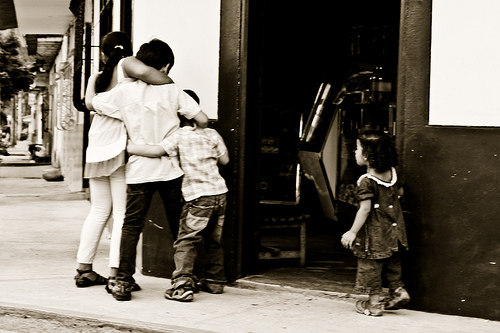
Excluded, Photo by Juan Ferr Alvarez, Flickr Creative Commons
Have you ever felt on the outside of the circle? When I was in third grade, I went to a new school in the middle of the year. It was a Catholic school and when I arrived everyone was in church waiting for morning Mass. I went into the church but I had no clue what to do next. Everyone seemed to be sitting in groups by classes, but I didn’t know where I belonged.
I tentatively edged down into one pew, but the child next to me said, “This is for fifth graders, you don’t belong here.” I tried to move to another spot without being noticed. Again, the child near me looked askance: “You’re not a sixth grader!” I moved to yet another pew, with similar results. I was scared and embarrassed and out of place: I had no way to know where to go. Finally, one of the teachers noticed me, and brought me to where the third graders were supposed to sit.
It was a minor incident, yet a frightening moment of dislocation for a small child. Because my family moved frequently when I was young, that dislocation repeated itself often, and I was left with an unsettled feeling in my heart. I was left with perennial questions: How do we know if we belong or if we do not? What must we do to belong? Perhaps it was those moments of dislocation that made me aware just how important community is.
Activist and writer Mab Segrest wrote about a South African word that describes this essential need for community: ubuntu. “Ubuntu translates as ‘born to belonging.’” Ubuntu expresses the African idea that our human dignity and fulfillment is dependent upon our links to each other in community.
In contrast, our modern American society bases itself on the idea of individualism. John Locke formulated a theory of society as a contractual type of relationship freely entered into by individuals. Locke proposed that in the original state of nature, all humans were free and autonomous individuals, and from that state, they agreed to give up certain aspects of their independence, for mutual benefit and protection.
Today, this individualistic understanding is endemic. But Mab Segrest challenges individualism, and she begins her argument with the experience of motherhood. She writes,
It was after watching Barbara give birth to our daughter, Annie, …that it occurred to me the degree to which this Original Individual was a ridiculously transparent …fiction. None of us start out as individuals, but as fusions of sperm and egg, embedded and growing in the mother’s body for nine months. For months after birth, our consciousness is still merged with its environment, and a sense of the particular and separate self emerges only gradually.2
We start out in relationship, and our unique individuality grows out of that circle of relatedness. Not the other way around. We all need each other in order to flourish and to thrive in life.
To give Locke and others their due—the philosophy of individualism was created in rebellion against the authoritarian structures of an earlier age, the tyranny of church and monarch. To affirm relationship is not to deny the importance of human dignity and freedom. But we must recognize that relatedness comes first, and within that circle of relatedness, we find our inherent worth and dignity.
Feeding the Birds

Photo by Margy Dowzer
It is also possible to make a relationship to animals by feeding them. At our house, we offer sunflower seeds that are loved by cardinals, chickadees, and tufted titmice; suet for the woodpeckers, and thistle for the gold finches. Some of the birds are around all year long, but in late spring it is a delight to see the travelers again. We put out a hummingbird feeder at the beginning of May, and we put out orange slices and wait for the orioles to show up. They bring so much beauty to our ears and eyes.
Thich Naht Hanh says,
When we recognise the virtues, the talent, the beauty of Mother Earth, something is born in us, some kind of connection, love is born… We want to be connected. That is the meaning of love, to be at one. When you love someone you want to say I need you, I take refuge in you. You do anything for the benefit of the Earth and the Earth will do anything for your wellbeing.
When we make a deep connection with one small part of Mother Earth, we are helped to make a connection to the whole of our mother. We are helped to see that we too are a part of the Mother Earth, that we belong here. And then we can honor the whole harmony of connections that make up life. May we find a way to experience the joy that comes with knowing this deep harmony.
Thich Naht Hanh quote from an article by Jo Confino, “Beyond environment: falling back in love with Mother Earth,” Feb 20 2012, The Guardian
Sacred Animals
We may not be able to know and appreciate all the animals and plants, but we sense that something important might emerge if we can know and appreciate one animal. This has led some to have an interest in looking for a “power animal.” I think this interest comes from a desire to be connected to our fellow creatures here on earth. Finding a power animal began in some ancient shamanic traditions but has become popular in the modern spirituality marketplace, where often the idea is romanticized. People look for the exotic and the wild.
But there is another way to find a power animal. First, you can start by thinking about your food. If you eat meat or fish, or eggs or milk, what are the animals that give you their life, so you can have food?
In our culture, it is difficult to honor the animals who are most important to us. Chickens, cattle, and pigs are the most widely eaten animals in the United States. Most of them are raised in horrible conditions. My purpose right now is not to talk about the nightmare of factory farming. But when we begin to open our hearts to our connection with other animals, we have to ask ourselves about the animals we eat for food.

Photo by Margy Dowzer
Let’s focus on the chicken—the animal most eaten in the United States. Sometimes they have been given a bad image in the media—we call someone “chicken” when they are lacking in courage. But chickens lay eggs that feed us, and give their lives to feed us. When allowed to roam a yard, chickens will kill and eat the ticks that can cause Lyme disease. They have their own nobility and useful simple lives. A chicken would be a fine power animal. Except that perhaps we feel too ashamed of how the humans have treated them. If we respected the chickens, how could we consider the agricultural practices that confine them to torturous cages?
To eat is a sacred act. So often, we eat mindlessly. We don’t pay attention. When we eat, we take one part of Mother Earth, and unite it with another part of Mother Earth—our own bodies. Eating is necessary for life, and yet always includes death of some kind, whether of plants or animals. The great mystery of life and death can be present to us every single day, in the ordinary communion of eating a meal. But most of the time we are separated from that mystery because we can pick up our food in the grocery store, without any indication that this food is from living beings.
One of Henry David Thoreau’s practices when he went to the woods was, for a time, to try to catch or grow whatever he ate. He spoke about how needing to kill and prepare one’s meat was something that inclined him toward being a vegetarian. Some people do make that choice, out of respect for the animals. For my part, I try to honor the sacredness of food by thanking the creatures who have given their lives that I might eat. And because of that, I try to buy meats of animals who have been raised with dignity. In our culture, it can be a difficult thing to do. But it all begins by making one simple change—to recognize and celebrate the source of our food at each meal.
The Indigenous Innu people of northern Quebec did rituals in which they asked the caribou spirit to help them in the hunt. They believed that the caribou spirit helped them find caribou to kill and eat. They did rituals after they killed a caribou, and made sure that none of the bones touched the ground. The animal they ate was the animal to which they prayed. We can do that too.
 When I watch our cats looking at the birds outside, it seems to me that they are doing something like praying. We don’t let them go outside—we’ve interrupted their hunting of birds. But when they shiver and chatter in excitement just watching the birds, it seems very much like deep devotion.
Indigenous Elders and Medicine Peoples Council Statement on Fukushima (reblogged)
There are times when I hear or see something that feels deeply important to pass along, in the spirit of connecting to earth, to each other, and to the Mystery within all. I saw this today. You can read it at its original site here:
COUNCIL_FUKUSHIMA_STATEMENT_OCT_2013
Council Statement
This statement reflects the wisdom of the Spiritual People of the Earth, of North and South America, working in unity to restore peace, harmony and balance for our collective future and for all living beings. This statement is written in black and white with a foreign language that is not our own and does not convey the full depth of our concerns.
The Creator created the People of the Earth into the Land at the beginning of Creation and gave us a way of life. This way of life has been passed down generation-to-generation since the beginning. We have not honored this way of life through our own actions and we must live these original instructions in order to restore universal balance and harmony. We are a part of Creation; thus, if we break the Laws of Creation, we destroy ourselves.
We, the Original Caretakers of Mother Earth, have no choice but to follow and uphold the Original Instructions, which sustains the continuity of Life. We recognize our umbilical connection to Mother Earth and understand that she is the source of life, not a resource to be exploited. We speak on behalf of all Creation today, to communicate an urgent message that man has gone too far, placing us in the state of survival. We warned that one day you would not be able to control what you have created. That day is here.
Not heeding warnings from both Nature and the People of the Earth keeps us on the path of self destruction. This self destructive path has led to the Fukushima nuclear crisis, Gulf oil spill, tar sands devastation, pipeline failures, impacts of carbon dioxide emissions and the destruction of ground water through hydraulic fracking, just to name a few. In addition, these activities and development continue to cause the deterioration and destruction of sacred places and sacred waters that are vital for Life.
Powerful technologies are out of control and are threatening the future of all life. The Fukushima nuclear crisis alone is a threat to the future of humanity. Yet, our concern goes far beyond this single threat. Our concern is with the cumulative and compounding devastation that is being wrought by the actions of human beings around the world. It is the combination of resource extraction, genetically modified organisms, moral failures, pollution, introduction of invasive species and much much more that are threatening the future of life on Earth.
The compounding of bad decisions and their corresponding actions are extremely short-sighted. They do not consider the future generations and they do not respect or honor the Creator’s Natural Law. We strongly urge for the governmental authorities to respond with an open invitation to work and consult with us to solve the world’s problems, without war. We must stop waging war against Mother Earth, and ourselves.
We acknowledge that all of these devastating actions originated in human beings who are living without regard for the Earth as the source of life. They have strayed from the Original Instructions by casting aside the Creator’s Natural Law. It is now critical for humanity to acknowledge that we have created a path to self destruction. We must restore the Original Instructions in our lives to halt this devastation.
The sanctity of the Original Instructions has been violated. As a result, the Spiritual People of the Earth were called ceremonially to come together at the home of the Sacred White Buffalo Calf Pipe Bundle. These Spiritual Leaders and those that carry great responsibility for their people from both North and South America came together with the sacred fire for four days at the end of September 2013 to fulfill their sacred responsibilities.
During this time it was revealed that the spirit of destruction gained its’ strength by our spiritually disconnected actions. We are all responsible in varying degrees for calling forth this spirit of destruction, thus we are all bound to begin restoring what we have damaged by helping one another recover our sacred responsibility to the Earth.
We, the Original Caretakers of Mother Earth, offer our spiritual insight, wisdom and vision to the global community to help guide the actions needed to overcome the current threats to all life. We only have to look at our own bodies to recognize the sacred purpose of water on Mother Earth. We respect and honor our spiritual relationship with the lifeblood of Mother Earth. One does not sell or contaminate their mother’s blood. These capitalistic actions must stop and we must recover our sacred relationship with the Spirit of Water.
The People of the Earth understand that the Fukushima nuclear crisis continues to threaten the future of all life. We understand the full implications of this crisis even with the suppression of information and the filtering of truth by the corporate owned media and Nation States. We strongly urge the media, corporations and Nation States to acknowledge and convey the true facts that threaten us, so that the international community may work together to resolve this crisis, based on the foundation of Truth.
We urge the international community, government of Japan and TEPCO to unify efforts to stabilize and re-mediate the nuclear threat posed at the Fukushima Dai-ichi nuclear power plant. To ensure that the Japanese government and TEPCO are supported with qualified personnel and information, we urge the inclusion of today’s nuclear experts from around the world to collaborate, advise and provide technical assistance to prevent further radioactive contamination or worse, a nuclear explosion that may have apocalyptic consequences.
The foundation for peace will be strengthened by restoring the Original Instructions in ourselves. Prophecies have been shared and sacred instructions were given. We, the People of the Earth, were instructed that the original wisdom must be shared again when imbalance and disharmony are upon Mother Earth. In 1994 the sacred white buffalo, the giver of the sacred pipe, returned to the Lakota, Dakota and Nakota people bringing forth the sacred message that the winds of change are here. Since that time many more messengers in the form of white animals have come, telling us to wake up my children. It is time. So listen for the sacred instruction.
All Life is sacred. We come into Life as sacred beings. When we abuse the sacredness of Life we affect all Creation.
We urge all Nations and human beings around the world to work with us, the Original Caretakers of Mother Earth, to restore the Original Instructions and uphold the Creator’s Natural Law as a foundation for all decision making, from this point forward. Our collective future as human beings is in our hands, we must address the Fukushima nuclear crisis and all actions that may violate the Creator’s Natural Law. We have reached the crossroads of life and the end of our existence. We will avert this potentially catastrophic nuclear disaster by coming together with good minds and prayer as a global community of all faiths.
We are the People of the Earth united under the Creator’s Law with a sacred covenant to protect and a responsibility to extend Life for all future generations. We are expressing deep concern for our shared future and urge everyone to awaken spiritually. We must work in unity to help Mother Earth heal so that she can bring back balance and harmony for all her children.
Representatives of the Council
Chief Arvol Looking Horse
19th Generation Keeper of the Sacred White Buffalo Calf Pipe
Spiritual Leader
The Great Sioux Nation
Bobby C. Billie
Clan Leader and Spiritual Leader
Council of the Original Miccosukee
Simanolee Nation Aboriginal Peoples
Faith Spotted Eagle, Tunkan Inajin Win
Brave Heart Society Grandmother/Headswoman & Ihanktonwan Treaty Council
Ihanktonwan Dakota from the Oceti Sakowin
7 Council Fires - ADDITIONAL SIGNATURES TO FOLLOW –
 Finding Our Way Home