Update on Kale

Kale choppingSo right after my last post, I went outside, and cut about 40 big leaves off my kale plants–always from the lower part of the stems.  In between making and eating breakfast and washing dishes, I washed the leaves in groups of ten (by variety), and chopped them up, then washed them again in a salad spinner, which they filled up.

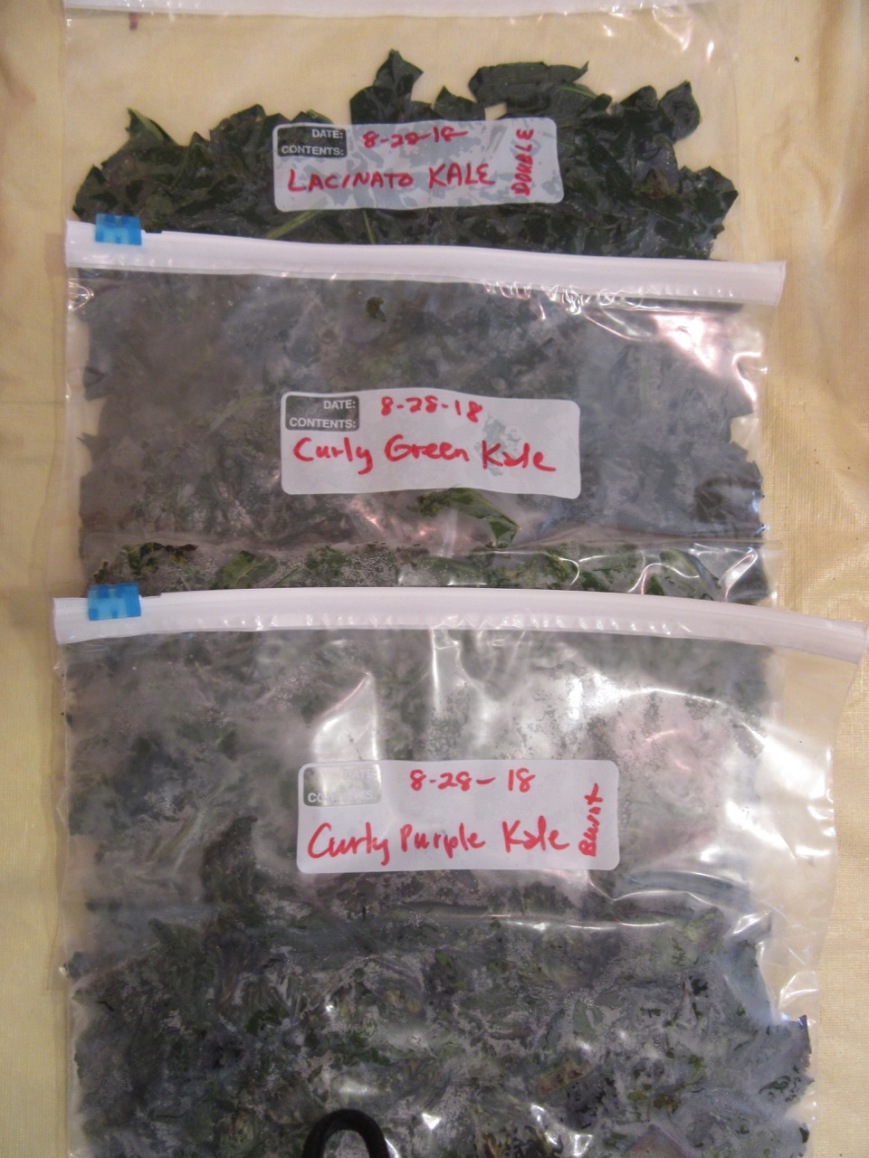
Kale washAfter doing the first batch, which used a lot of water, I figured out that I should save the wash water and bring it out to the garden, where I put it on the kale plants! Then I spinned the kale pieces to dry them, and sautéed them in our big cast iron pan.  I had to start with about half of the batch, then add the second half after the first had cooked down a bit.  I had green curly kale, red or purple curly kale and a double batch of lacinato kale. After sautéing, I cooled them in a bowl in the refrigerator before putting in bags. On the recommendation of other online gardeners, I used a straw to pull out all the air in the bags.

I still have plenty outside on the plants, but now I have these in the freezer.  Ten leaves only filled half a bag, at about 1/2 an inch thick.  That would be about three or four servings in our house, so this is a total of 12-16 servings.    This winter, I will see how they taste.Kale to freeze
Abundance

Myke with kale

[Photo by Margy Dowzer]

The kale has gone crazy this year! I eat some every day, and we’ve given a lot away, but it is still up to my waist in abundance. Not to mention the basil plants, also a few feet tall. Harvesting has always felt like the most challenging part of gardening–how to keep up with everything the earth is producing. I see posts of friends who are canning and drying and freezing–that is all still something I need to learn more about.  I search online for instructions, so information is not the main issue–just the time and energy to keep up with it and carry it out.

Most of our garden this year isn’t even to that stage yet–the fruit trees and bushes are still babies, the asparagus is in its first year.  And perennial herbs will keep coming back each year, whether I harvest them now or not.  In fact, I’ve got thyme drying in the basement, and will probably do some oregano after that is done.  I finally dug up the garlic that I had planted as companions to the fruit trees to help keep away pests.  But I especially feel a responsibility to the annuals like kale and basil.  This is it for them. And they are shining.

Last week, I experimented: I sautéed a dozen large leaves of kale, which cooked down quite a bit, and then I froze it–it only filled a small part of a plastic freezer bag.  I should be doing that with whole bunches of it, but it takes time to wash and cut and sauté and cool and bag.  We’ve been eating basil this week–especially yummy with an heirloom tomato we bought from the coop.  I learned not to put it in the refrigerator, but to keep cut stems in a vase with water.

For now, I just want to say thank you to the earth for creating such abundance!  Give me the strength to receive and cherish and preserve your gifts.  I’d better get outside and harvest some more!

Asparagus Update

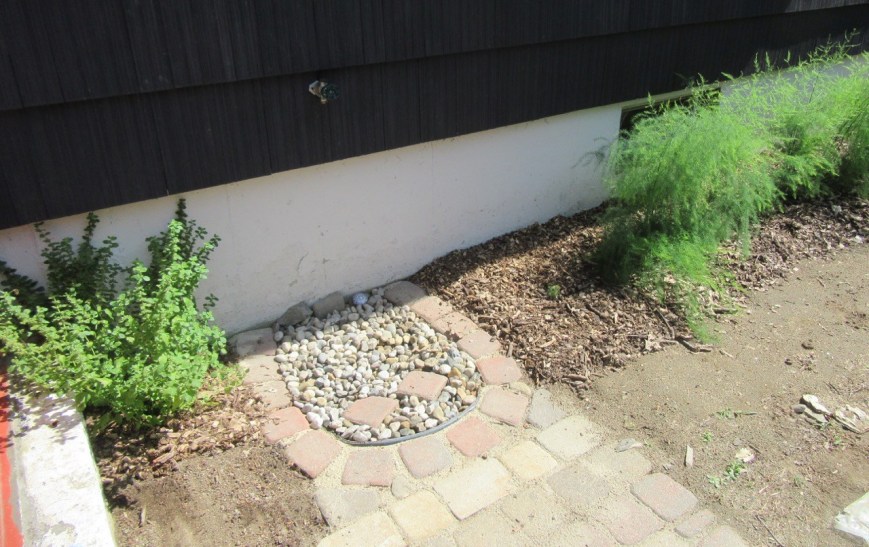
asparagus-bed-spigot-stones-after.jpg

What a pleasure to finally complete the asparagus beds, along with setting pavers and stones into the area under our outdoor water spigot! With so much always “in process” in the garden, little completions are quite satisfying. That is also true for me in other areas. Yesterday, I finally figured out our financial budget for retirement, and that feels so grounding as well, like I am really retired now.

Asparagus Bed BeforeI blogged about planting the crowns last April, near the walls behind the house and next to the garage. [Here is a picture of the “before” trench behind the house.] The instructions were to let the asparagus plants grow in the trench, and add compost and soil bit by bit as they got taller, keeping at least 2 inches above ground.  This was complicated by the fact that some of the plants bolted up in a flash, while others were tiny babies for such a long time–even still.

Asparagus protectorBut last week, with more compost and soil, I finally brought the beds up to level, and then finished them off with a layer of wood chips. In the bed near the garage, I actually created two little pockets with cut out pots for the ones that were still too small, so I could fill the soil around them up to level. They would have been buried! Hopefully, they’ll get enough sun and water to keep growing and come back next year with a flourish.

I also moved our lemon balm plant from near the cherry tree over to the small area just left of the water spigot.  It looks and smells so cheerful there, and will be nicely contained for a plant that I learned has a spreading habit.

We are in the season in which life is bursting out all over, even as we can start to feel the shift toward the autumn.  Days are shortening, and everything seems to be growing as much as it can.  It is amazing to think that all these green plants die back in winter, seal themselves in their roots, and hide as if they didn’t exist at all, only to re-emerge in spring.  So now they are making the most of sun and heat and rain, turning sunlight into sugar for all life in the neighborhood.  The asparagus will die back too, in the winter, but come to life again in the spring–and we’ll be able to share in their bounty from that season forward. I love perennials!

In Between

Banner with cardinalTransitions create a liminal time, a time on the threshold between old and new, between past and future, a sacred time, perhaps a dangerous time.  Yesterday, I turned in my keys to the congregation where I had ministered for 13 years.  My retirement is official.  But who am I now?
It is not that I didn’t have any ideas about what I might like to be doing after I finished that work.  I imagine I will still be on A Spiritual Journey into Earth Community, what this blog is all about.  But what I notice, and have been noticing the last few weeks, is a sense of floating or flying, a sense of directionless.  I haven’t been able to put it into words.  But artist Cathryn Falwell captured it in this beautiful banner she created for me as a retirement gift.  (Thank you Cathryn!) The red cardinal is flying over the terrain of earth, hills, trees, clouds, water.  The landing is not yet in sight.

It is not a fearful time, nor sad really, though I have moments of sadness about letting go. It is not really excited or joyful either. I am not doing a happy dance.  It is “in between” everything. I remember that I wanted to have a sense of spaciousness, an empty space before I filled it with new things.  So perhaps it is a spacious time, though it doesn’t quite feel spacious yet.

I realized a few days ago that summer in Maine always carries a sense of urgency. There is such a short growing season, and the garden clamors for attention. We have reached the solar festival of Lammas, the early harvest celebration.  The garden is full of harvestables–huge kale plants, and basil; the oregano and thyme herb clusters have expanded and gone to flower to the delight of all bees; volunteer blackberries are starting to ripen in the back of the yard and down the street at a vacant lot.  We are also overgrown with crabgrass and could never finish all the weeding that one might do. Plus there are always practical things to attend to–meals, dishes, bills, household maintenance.  Not to mention that the beach also calls us to swimming during these hot sunny days that end so quickly.

So what is spaciousness? How do I float along in this empty and full terrain?  Perhaps I just float along.  Perhaps I just float along, until the next sacred thing emerges.

Opossum sighting

Opossum

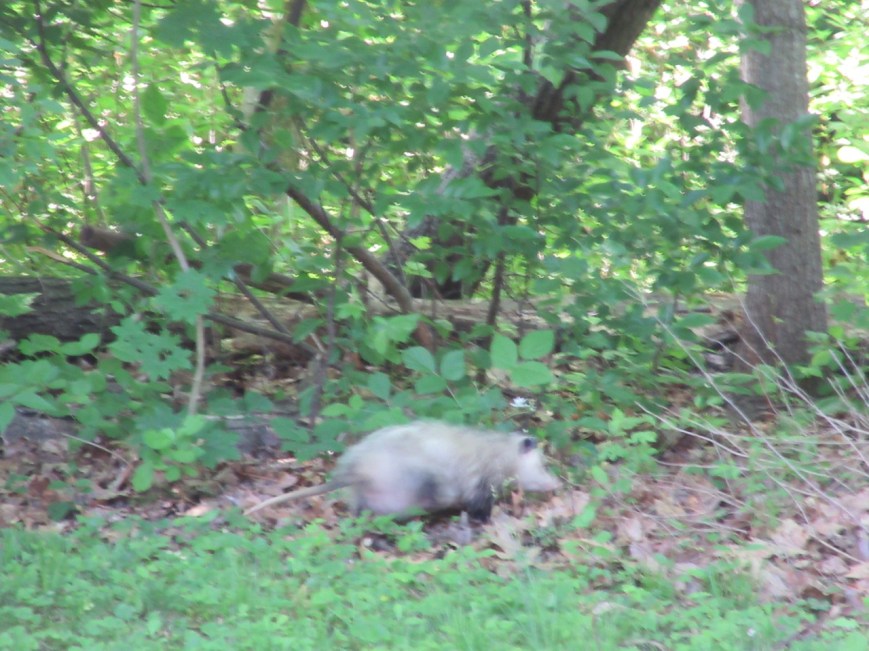
The photo came out a little blurry, but I was delighted to catch a glimpse of this little opossum neighbor, while I was sitting in the screen tent a few mornings ago. When it saw me, it speeded up its walk near the underbrush at the back corner of our yard. I understand that opossums eat ticks, among many other things, so I was glad to see it our neighborhood.

Reading more about them, I learned that they can also eat food from bird feeders and fruit trees.  They are nocturnal.  It will be an interesting balancing act–we intend to grow food for ourselves, yet we also love the critters that show up in this space we share. But perhaps that is the heart of the question–how do we live as neighbors in this land, rather than colonizers/occupiers/dominators?  How do we care for our own needs, while also caring for the needs of other beings on this earth?

Critters


Squirrel on deckSo I was sitting on the deck, just writing in my journal, and this little being came within a few feet, just looking at me.  No fear, just curiosity.  We live together in this beautiful place, and perhaps he/she is acknowledging that?  Or saying “Thank you for the sunflower seeds, but why do you make them so hard to get in that crazy contraption?”
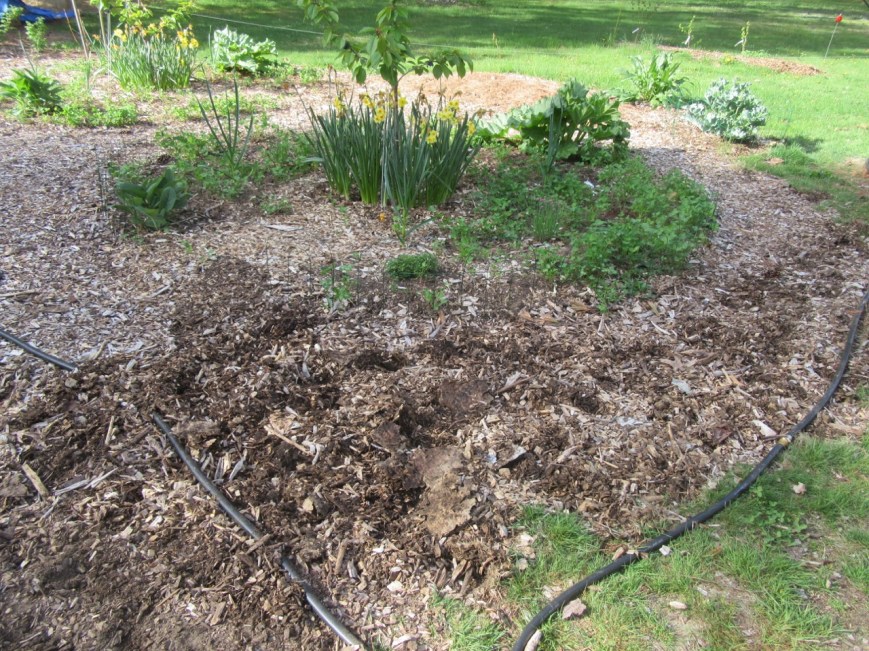
Meanwhile, our nocturnal digger has also returned, very politely avoiding the plants and digging up the paths.  I am assuming it is our resident nearby skunk, though it is here earlier than last summer. This year I haven’t even been trying to straighten everything back again, unless it has dug a hole close to a plant.  But as you can see, everything is getting lush and leafy–rhubarb, sea kale, turkish rocket along the back.  Every tree is surrounded by herbs and clover.Nocturnal digger back

This morning I wandered for an hour in the garden to feel the ground and do last minute care-taking before I fly to see my parents today.  I planted some lovely basil that was a gift, watered the annual bed (and discovered some other little neighbor has eaten one of the broccoli seedlings–oh well I hope you enjoyed it), put more compost on the growing asparagus plants, and also watered the summer sweet bush cuttings that are temporarily in a pile of compost as well waiting to be planted.  Margy will tend the garden while I am gone.

I am thinking of my dad today, my spirit is with his spirit during this journey.  May this day be blessed with safe and smooth travels of whatever kind.

Just Be

Hammock View

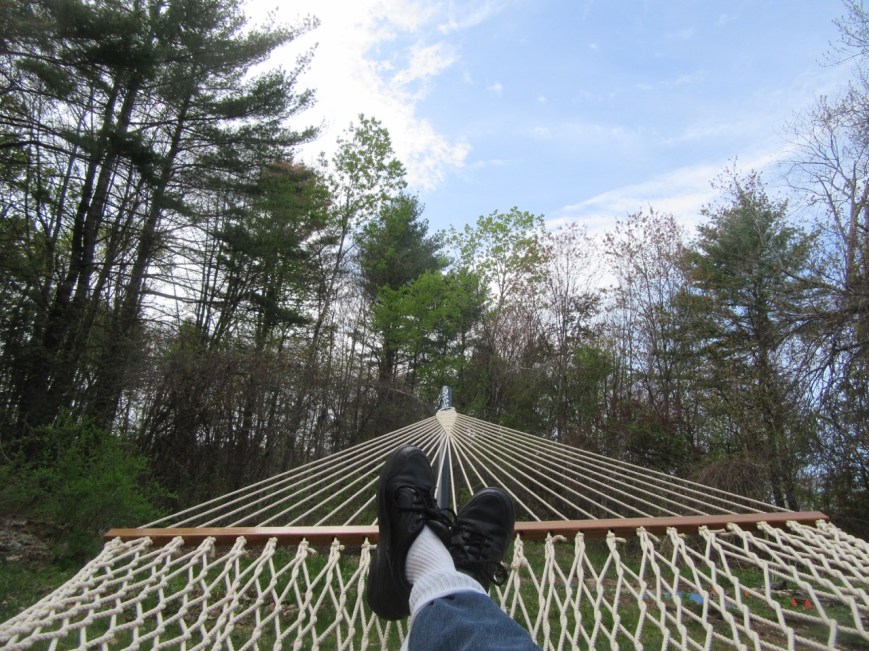
My birthday isn’t until the end of June, but Margy gave me a wonderful free-standing hammock as an early birthday gift.  With all of the working in the garden, it is easy to forget to just BE–to just lie there and watch the sky and the trees and the birds.  It is large enough for both of us, and on Friday afternoon Margy and I were just being in it together.  Several little birds came to check us out in the trees close by–a tufted titmouse was singing, so much louder than one might expect from its small size.  Catbirds, cardinals.  “What is this new nest in the back of the yard?” they seemed to be asking.  “What new thing are you humans doing here?”

But we weren’t doing anything.  We were just being, watching, enjoying, listening, seeing.  On Saturday, I came back and tried again.  I especially like the symbolism of this gift, since this summer I will be retiring from my work at the church.  It is a bittersweet time, because I have loved my work at the church, and I will miss the people there.  But I like to imagine that in retirement I will have more opportunity for just being.  The hammock is a reminder to take that time–to not get caught up in all the projects I might be doing in the yard or the house or out there in the wide world–but to be still and spacious, to relax, to observe, to delight.  Thank you, Margy!  I love this gift!

Hummingbirds?

Hummingbird Feeder

Margy got a new hummingbird feeder for us!  I put it up today, plus our old one too, attached to opposite sides of the beams on our new roof on the deck.  I hope we aren’t too late to catch the migration–we used to put out the feeders when the viburnum near our door (in North Yarmouth) started blossoming, the first week of May.  We’re still figuring out the best timing for here in Portland.  I’ll let you know when we see any.

In the meantime, lots of watering to do, and I also divided some comfrey and some oregano to take to the Plant Swap tomorrow at the Resilience Hub.  Last year we got all of the companion plants we needed for our cherry trees.  The comfrey and oregano seem like basically fool-proof plants, and grew abundantly in the food forest.  So I was confident enough to take some out to share.  This year, I hope to find some kale seedlings, perhaps, and just see what might be there.  Maybe elderberry starts?  It has been a beautiful day in the garden.

Hummingbird Feeder small

Trout Lilies

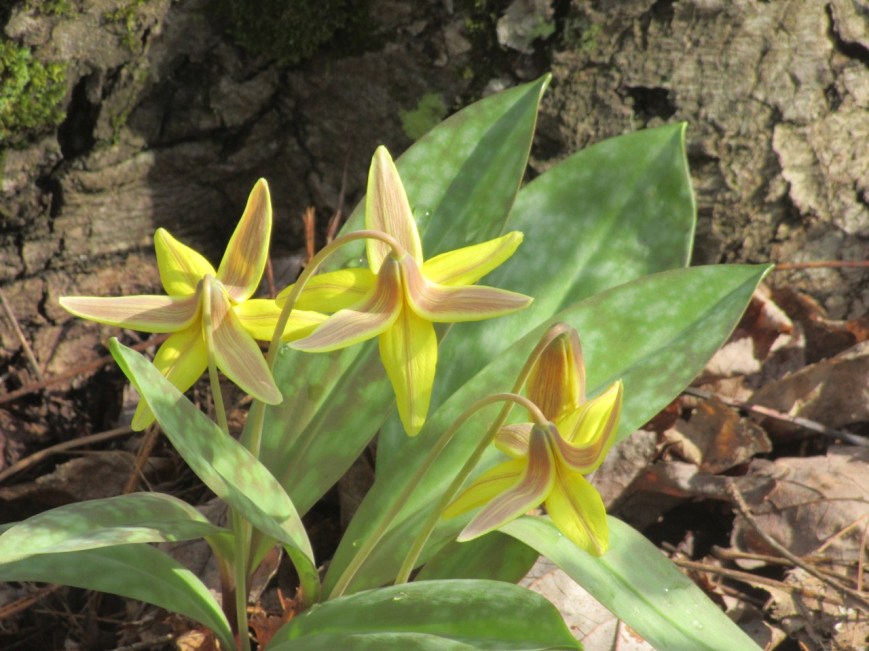
Trout Lilies

With all my working in the garden, I didn’t have a chance to walk by the brook for a few days.  When I came back, I found these little beauties.  The woods is absolutely carpeted with Trout Lilies.  I even thought about transplanting some for our yard, but read that they take several years to settle in and bloom.  So why not just enjoy them where they are?

There is so much beauty everywhere I walk–singing catbirds and cardinals, flowering cherries and magnolias, even just the leaves opening up on the trees are so magnificent.  The ferns are stretching out, and swamp cabbage is green along the brook.  Violets, dandelions and wild strawberries are flowering in the lawn.  Meanwhile life is busy, but I have to steal some moments to stop and enjoy it all.

Pruning

Cherry Tree prunedFriday and Saturday I pruned and trained our young fruit trees.  I did a lot of research beforehand, because it seemed so sad to actually cut them at all.  But the Holistic Orchard book, and most other resources suggest that pruning helps them to grow into a shape that gives them enough support and sunlight for fruit.
Of course, after the research, I realized it might have been better to prune the cherries more drastically last summer, when we first planted them.  But all we have is now.  Here is a photo of the Black Tartarian Cherry with its central leader cut at the top–to promote another tier of scaffolding (outward facing) branches.  The small bud near the top should grow into another central leader.   If I didn’t cut the top, the next outward facing branches would have grown too high up on the leader.

Next, I cut the ends of the first tier of scaffold branches, because they were too long and leggy and uneven.  On this cherry, they are also rather low to the ground, but the only way to remedy that would be to cut them all off, and I couldn’t do that.  I tied them back to encourage them to grow at a better angle to the central leader.  I did this for both cherry trees.  (We had also done this last summer, and took off the ties for the winter)

I also pruned our new young apple tree by making a heading cut on its central leader to promote scaffold branch growth.  For the peach, I did a more drastic cut on the central leader, to create a “vase” shape, where there is no central leader, but four or five main branches, which is the form most recommended for peaches.  Some sources recommend that for cherries too, but we had started with a central leader form last year.  After I was done with all this cutting, I said a prayer to the trees–I am so new at this, that I barely know what I am doing–so please forgive me for that, and grow and thrive anyway!

Funny to think that plants can thrive by being cut back so drastically.  Is there a message in that for humans too?  That the most difficult experiences of our life can shape us for greater beauty and fruitfulness to come?

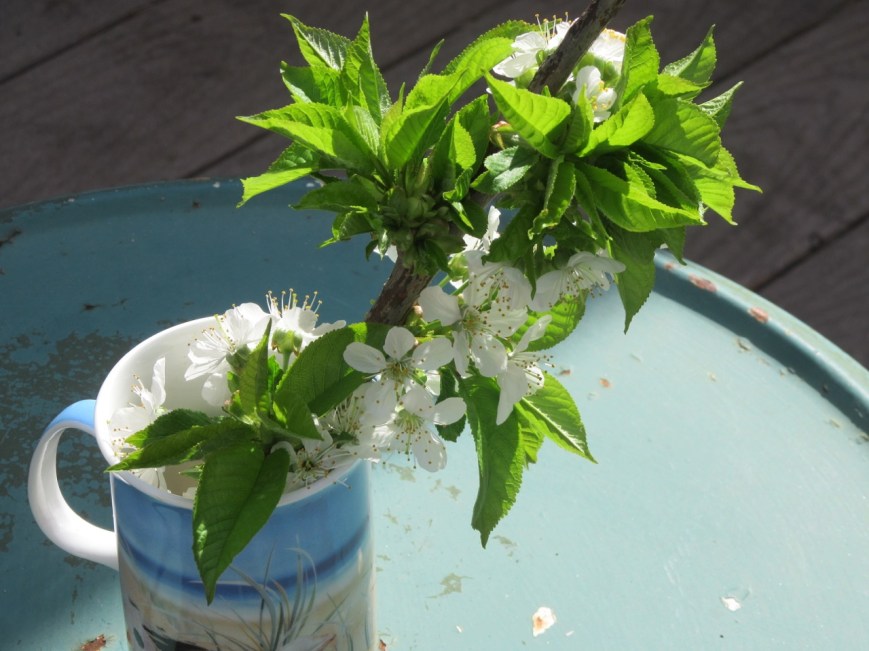
I took a cut branch with cherry blossoms from the Lapins Cherry, and put it in a cup of water on our deck.  Maybe the bees will still want to visit them.  For now, it is a sign of the years to come, when we can let the flowers bloom and hope for fruit.Cherry Blossoms