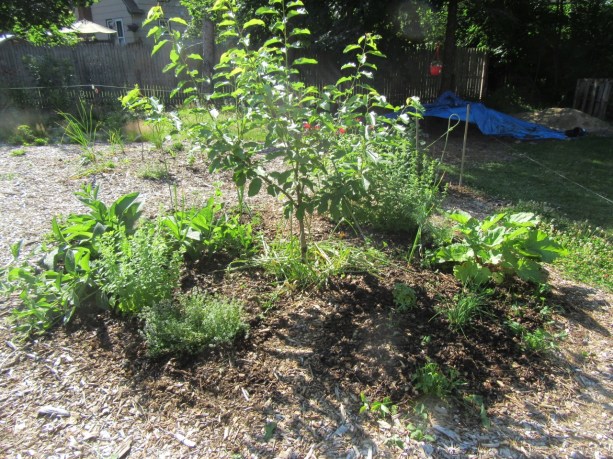
 Newly planted baby bushes are not as photogenic as old trees, but this week I’ve been excited to be planting bushes that have been waiting for two weeks for the ground to thaw. We’ve had so much rain, that on the few non-rain days this last week, Margy and I would be outside for as long as our energy would allow. So far I’ve planted four witch hazel bushes and two winterberries (that is one in the photo, with a mulch from its shredded paper packing material) and three of the spice bushes. Two more of those to go. Margy has been planting clover in the front yard where she did a major crab-grass clearing last summer and fall.
I also took down the winter protection circular “cages” for the orchard trees, and did their first seasonal nutritional spray–a concoction I had learned about from the Holistic Orchard book. (It includes Neem Oil, Karanja Oil, a bit of dish soap, molasses, Fish Hydrolysate, Liquid Kelp, EM-1 microbes, and water, and helps to strengthen the trees own disease prevention and growth.) The orchard trees have their green tips poking out! I am also seeing new shoots of asparagus, sea kale, licorice, rhubarb, elderberry, and lots of chives.
I haven’t had a chance to mention the apple tree grafting workshop I attended at the Resilience Hub on April 7th. I won a ticket to the workshop in a raffle the day before at another event, along with a grafting knife. So, do you remember learning the story of Johnny Appleseed, when you were young? He went across the land, supposedly, planting apple trees in every town and countryside? It was news to me to learn that the apples we eat don’t come from trees that grow from seeds. Rather, they are created from branches-“scions”-of particular varieties grafted onto various root stock.
I did feel pretty clear on the concept of apple tree grafting before I actually went to the workshop–mostly from ordering our apple tree last year from Fedco. But it was harder than it seemed it would be–the actual cutting of scions and root stock, I mean. The basic idea was to form a diagonal cut on the root stock, and a matching cut on the scion of the variety we wanted, and then to form a smaller v-shape cut on each of those bare wood parts to help wed them together. We practiced on spare wood for at least 30 minutes before we started on the root stock and scions. When the cuts matched (the green edges of the bark needed to meet each other), we’d put them together, tape them with grafting tape, and then cut the scion wood to leave just two buds to grow. I am summarizing a bit here.
In the end, I brought home four apple trees that I had grafted, albeit poorly. My chosen root stock was M-111, a semi-dwarf variety, and my scions were Black Oxford and Blue Pearmain. I also learned that they could be grown in a kind of nursery bed, and transplanted to a permanent location next year. So this week, I dug them into our newly designated nursery bed, the one unused circular bed in the orchard, in which I am also growing peas, kale and lettuce (in the photo, the bamboo and string framework are there on the left to support snap peas, and the four apple trees will go in the area to the right.) Now we wait and see if any of them grow! And just for fun, I brought home some more scion wood, to try and graft it onto our ornamental crab apple trees–sometimes that works, and you can get edible fruit from the new branches. Now if it would just stop raining every day.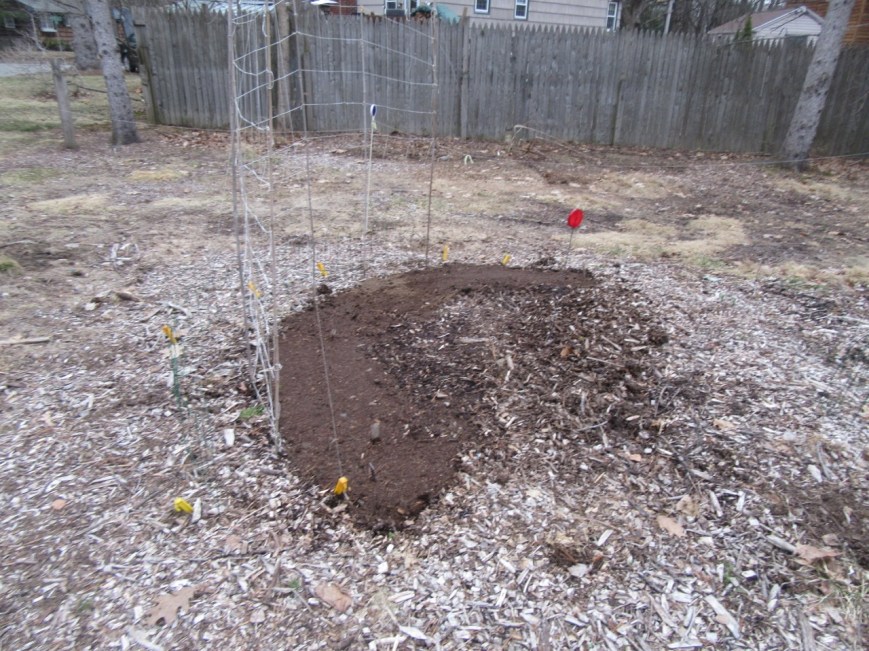


 Nomiya munimqehs kihkanok. N’ciciya wot.
  One thing I love about the snow is how it reveals the lives of our animal neighbors. Here is a squirrel highway, a path between two mounds. Now, I had actually helped to create that path the day before, before the snow. The day before that, Margy got a call from a local arborist that he had some wood chips we could have. For permaculture gardeners, wood chips are a boon, especially hardwood chips, especially lamial hardwood chips, which are from the small branches and leaves of the tree. They provide nutrients to help create the kind of soil that is best for fruit trees.
 So the wood chips were delivered. The next day I noticed that where the big pile landed had kind of blocked off the pathway on the edge of the food forest. Last winter, I had strung a small string across the edges of the food forest as a gentle deterrent to deer who might possibly wander through. We had seen deer tracks before, though we didn’t actually see any last winter. But the idea was to leave one area free for them to traverse, hoping they’d choose that path on the way between the street and the back of the yard.
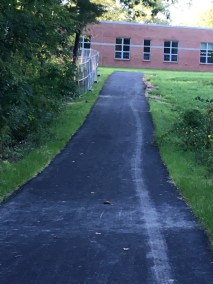 Today I set out on my usual walk around the neighborhood. When I got to the newly paved way that leads over Capisic Brook toward the new Rowe school, I saw a fox cross over at the other end, and slip into the path into the woods (before I could catch them in a photo). So I felt invited to walk that path along the brook as well. I couldn’t see the fox anymore, but I could hear squirrels doing their alarm chatters, and guessed they might be warning others about the fox.
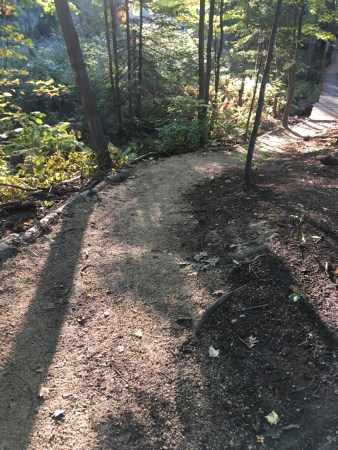 That made me smile. I like to see the evidence of other people caring for the trail.
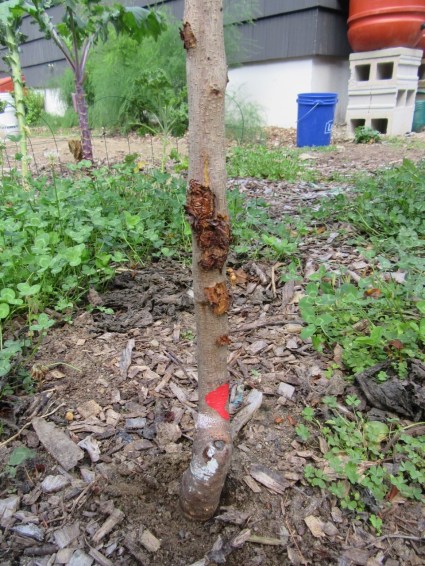 So the latest “too much” were these sores on the peach tree trunk. Our friend Mihku noticed them, and suggested they were peach tree borers. The usual remedy is to cut out the wound with a knife and poke the caterpillars manually. But I couldn’t seem to find any clear culprits, and truthfully, the trunk is so small, I was afraid to do too much.
 Somehow, calling for help from the Spirit, and then taking one small step to do something got me going again. It might not work. The tree is so beautiful and healthy, and has grown so well this first year, that it would break my heart if it is killed by this wound. We’re not a big orchard. Each of our trees is precious and the only one of its kind in our yard. I had also recently purchased some tall stakes, so I staked the tree (not yet in the photo) and also put up stakes for the mulberry tree, the apple tree, and created a border of stakes and string for the raspberry bushes, which are growing fruit now.


