What the garden does with us

Monarch caterpillar on milkweed

While on my morning walk, I suddenly saw a monarch caterpillar on a milkweed that had planted itself in our roadside strip. The next day (today), I saw three more. All we did with the milkweed was let it keep growing where it showed up on its own. There are two plants by the road, and three or four more in a patch out back near the pond. But the monarchs found them all the same.

I have been feeling discouraged lately about my ability to garden. First of all there is the challenge of chronic fatigue that limits my energy such that even one small project outside in the morning can wipe me out for the rest of the day. But then there is the limitation of my own knowledge about the green growing beings. Right now, it is the cherry trees that are struggling with some disease. I am thankful to Aaron Parker of Edgewood Nursery who suggested, after seeing photos, that they are most likely dealing with Cherry Leaf Spot.
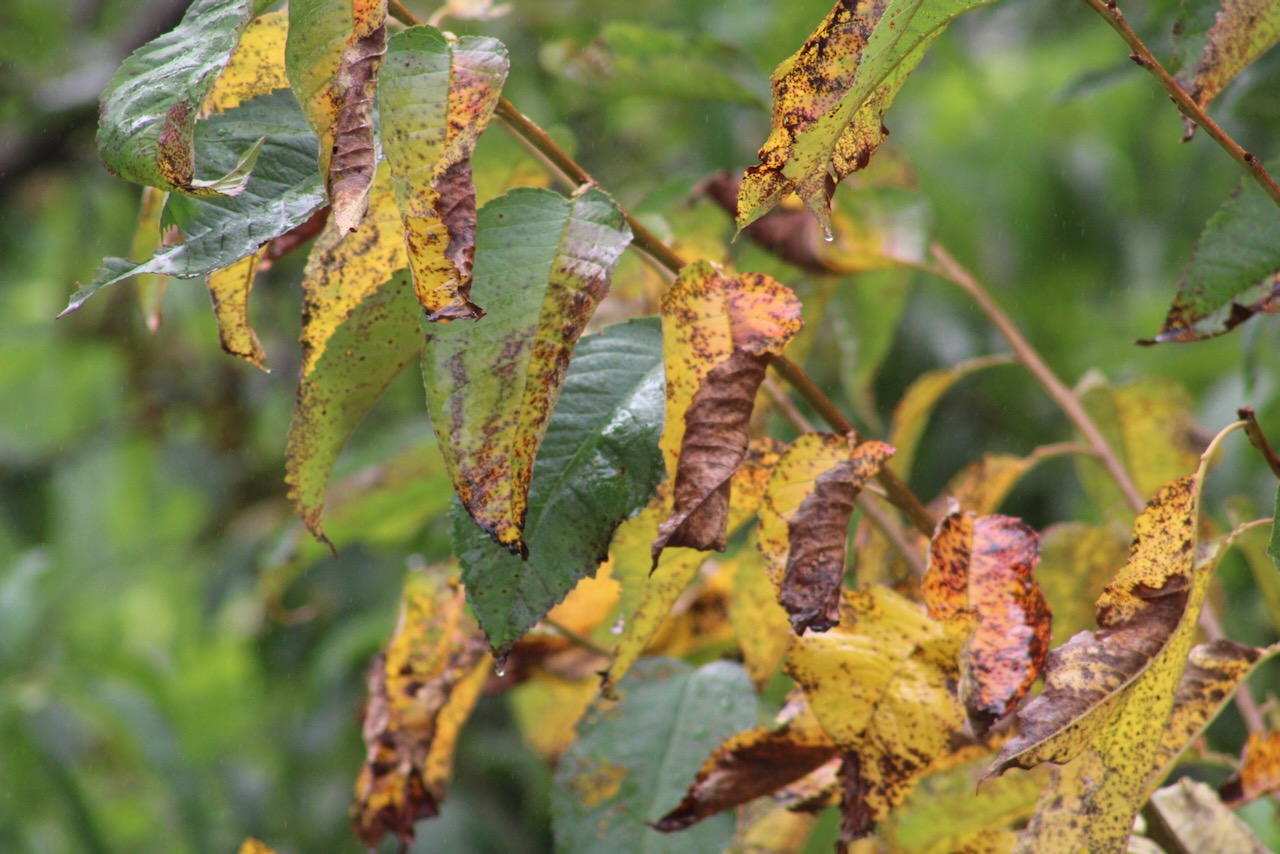
The possible answer is to clean up all the infected leaves on the ground and on the tree, and use an organic probiotic “Monterey complete disease control.” But even so, it might not work. Another website suggests natural remedies such as neem oil, potassium bicarbonate, and copper fungicides, which can be used to manage fungal infections like leaf spot. This season, I hadn’t done any holistic sprays because the sprayer takes a lot of personal energy to use. So I feel sad about the cherry trees, and even though I ordered some of the Monterey remedy, I feel discouraged about how much more work I’ve made for myself. Will it even help?

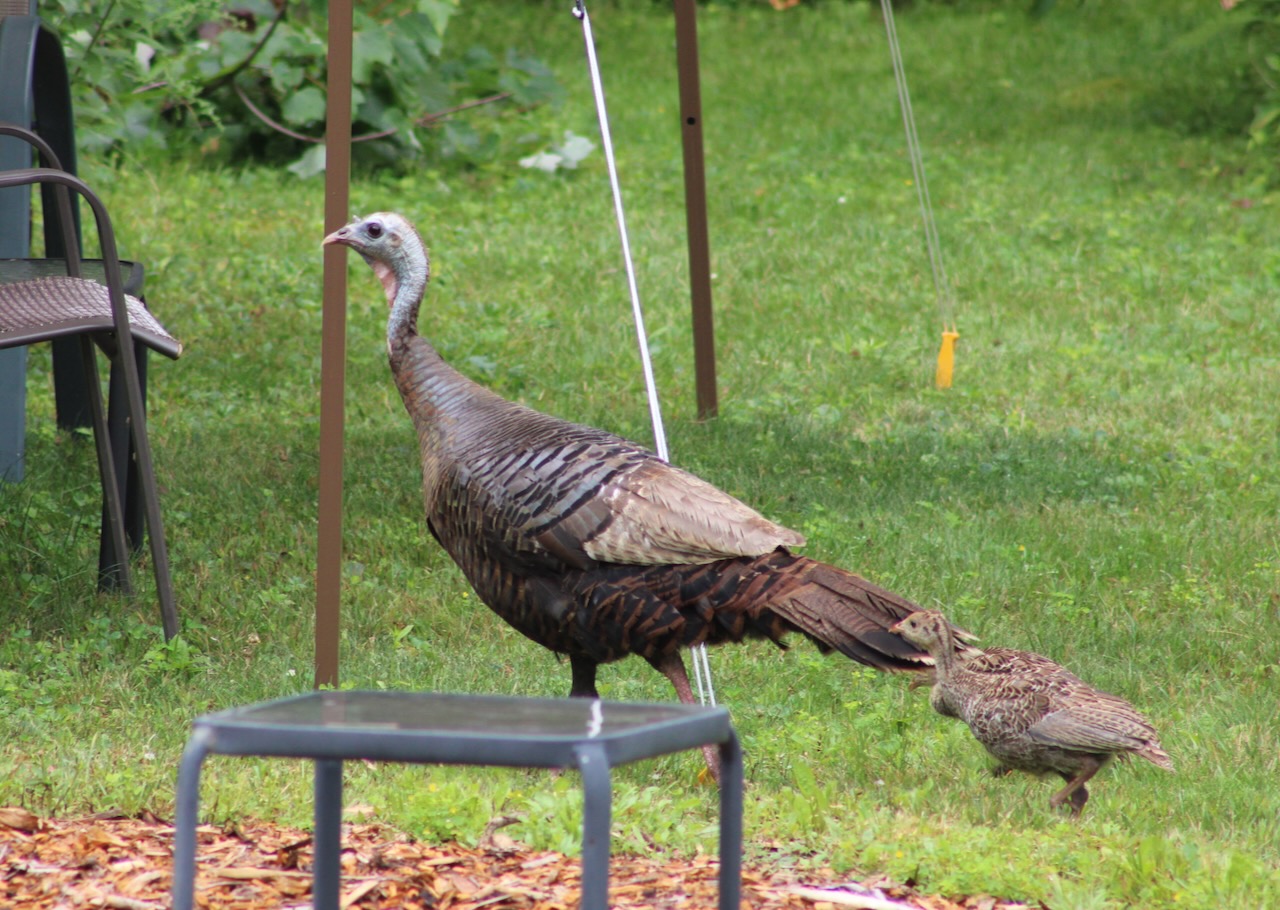
But in the midst of this discouragement, the caterpillars showed up on their own. And meanwhile, a turkey mom and her three babies have wandered through the yard a few times. Here we see them scooting under our canopy where we sit outside in some shade.
Meanwhile, the front raised bed that we didn’t plant decided to grow evening primrose on its own, and today I saw a gold finch happily checking out the yellow flowers. He was too quick to get into the photo. So I guess as a wildlife habitat, we are doing okay!

Then I saw this quote on Facebook this morning, posted by a colleague, and it was a good reminder that it isn’t really about how well we can garden. Something more magical is going on, and I must remember that.

“There was one thing I suddenly knew with absolute certainty: magic is not just something you do or make, it is something the universe does with you. It is our relationship to the Divine. There is nothing more magical than the presence of the sacred in one’s life. It changes everything. … It isn’t something one does to the universe; it’s what a living universe does with us once we have awakened to its Divinity.” Phyllis Curott in Book of Shadows

And maybe, it’s what the garden does with us once we have awakened to its Divinity.

More dragonflies

Yesterday, I went over to the pond in the morning, and saw nine or ten dragonfly nymphs who had climbed up onto leaves. I didn’t see them climbing, but they were holding on to the leaves, and slowly emerging from the husk of their nymph bodies. They were on the sweet flag, the blue flag iris, and the arrowhead plants. They say that nymphs live for two years in the water, so perhaps these were deposited as eggs in the pond two years ago and survived over winters, and now were coming of age all together. Sometimes, the leaf stalks they were clinging to would shake a little, not from the wind, but from the effort of their struggle. Is the photo from later exactly the same, or did it progress a little bit more? Truthfully, I can’t tell.

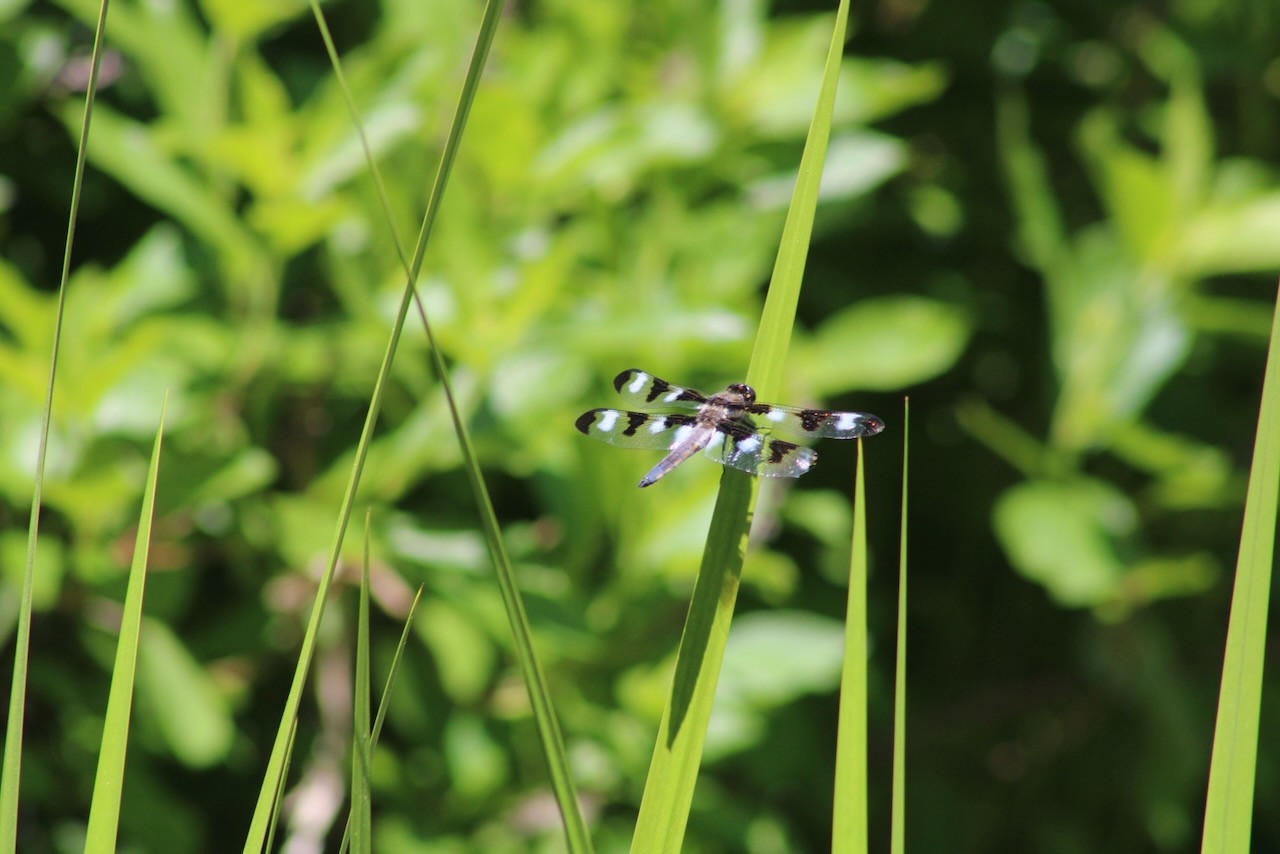
There was an adult dragonfly hovering around close by, it could have been the same one I had seen earlier in the summer. I wondered if it was watching over the nymphs protectively, or perhaps threatened by them, or interested in mating with them? It did stay close. A beautiful creature with black and white spots on its wings and a mostly gray body with black eyes.

I wasn’t able to watch all day, and then we had some rain in the evening. This morning, when I went back, it seemed like all of the creatures on the leaves were just husks of nymph bodies, and there was a new dragonfly at the pond. Turquoise eyes, mostly clear wings, white tail with a black end.

All of it felt quite magical, and also mysterious. An accident that I saw it at all, and yet amazing that I saw some of the process. In Passamaquoddy, the word for dragonfly is “apuciqaha.” According to my teacher, “apuci” means inside out, and “iqaha” refers to the way they fly in any direction. Seeing the adults emerge from inside of the bodies of the nymphs gave me a new sense of the meaning of “inside out.”

Once again, I see how the pond is home to all sorts of life that lives by its own rhythms, and what a privilege to witness some small aspect of that ongoing life.

Dragonflies

Black and white dragonfly on green stalk of iris

I’ve seen dragonflies flying around the pond, mating above the pond, and dipping their tales into the water to lay eggs. I’ve seen dragonfly larvae in the pond swimming around. But until this week, I never knew if any of the larvae had lived long enough to transform into adult dragonflies. During the last few days I saw what I thought might be some sort of insect perched near the bottom of an iris stalk. But with a little research, I now realize that it is an empty husk from which a dragonfly larva has molted.

Dragonfly husk on a green iris stalk over pond.

The pond never ceases to delight with the cycles of life of so many creatures. This month also saw these toads clasped in their mating posture, the male on the back of the larger female. I don’t know if any of the tadpoles from before have survived–just because I don’t see them doesn’t mean that they aren’t hiding somewhere. But they are low on the food chain, eaten by frogs, and also by dragonfly larvae. However, with more eggs in long strings, maybe more tadpoles are on the way.

Male toad clasped to back of larger female toad, in murky pond water.

The heavy rains of the last several days have delighted the tree frogs who are singing in the night. I haven’t seen any of them in the pond this year. Each year it seems that different species choose to inhabit this little pool of water. Thankfully, even on days when I don’t have the energy to tend to the many plants in the garden that would love some attention, I can sit by the pond and appreciate all that it holds.

Upcycling Experiment

They call it “upcycling” now, but I always think of it as the remnant of my time as a Catholic Worker when we always made practical use of whatever was on hand for what was needed. So this week, I upcycled an old screen tent to make a covering for this raised bed. I almost didn’t plant anything this summer, I’ve been so tired. But I happened to stop by the Portland Food Coop and they had organic kale seedlings for sale, and I got drawn in. I added compost and seaweed and turned over the soil in the bed.

This bed has often in past years been visited by critters such as groundhogs who love to chomp on greens, so I knew I had to protect it. (It has chicken wire underneath so that protects it as well.) The groundhog has always been easily put off by some sort of covering over the top. Many years ago I had purchased metal framing that I had repurposed for this bed. I had some netting that I covered it in years past (see a photo here), but I couldn’t find it. I did find the old screen tent in the garage–no longer usable because it had no frame anymore. So then I wondered–maybe this would be better than the netting, which had never kept out cabbage moths that liked to lay their eggs on the kale. Maybe the screen would keep out those pests as well?

So I took a scissors to the old tent, and cobbled it back together in a new shape, using a little superglue and paperclips. I tried to minimize any fabric that would block the sun. On the south end, is the zipper opening, and on the north end I folded over the larger remnants of screening.

To anchor the bottom, I placed some logs that we’d cut from fallen branches of our pitch pine. Once everything was in place, I planted my kale seedlings and watered everything well.

The experiment asks whether they’ll get enough sun through the screen, which does shade them a little, and whether they’ll be protected from cabbage moths? I hope it turns out well!

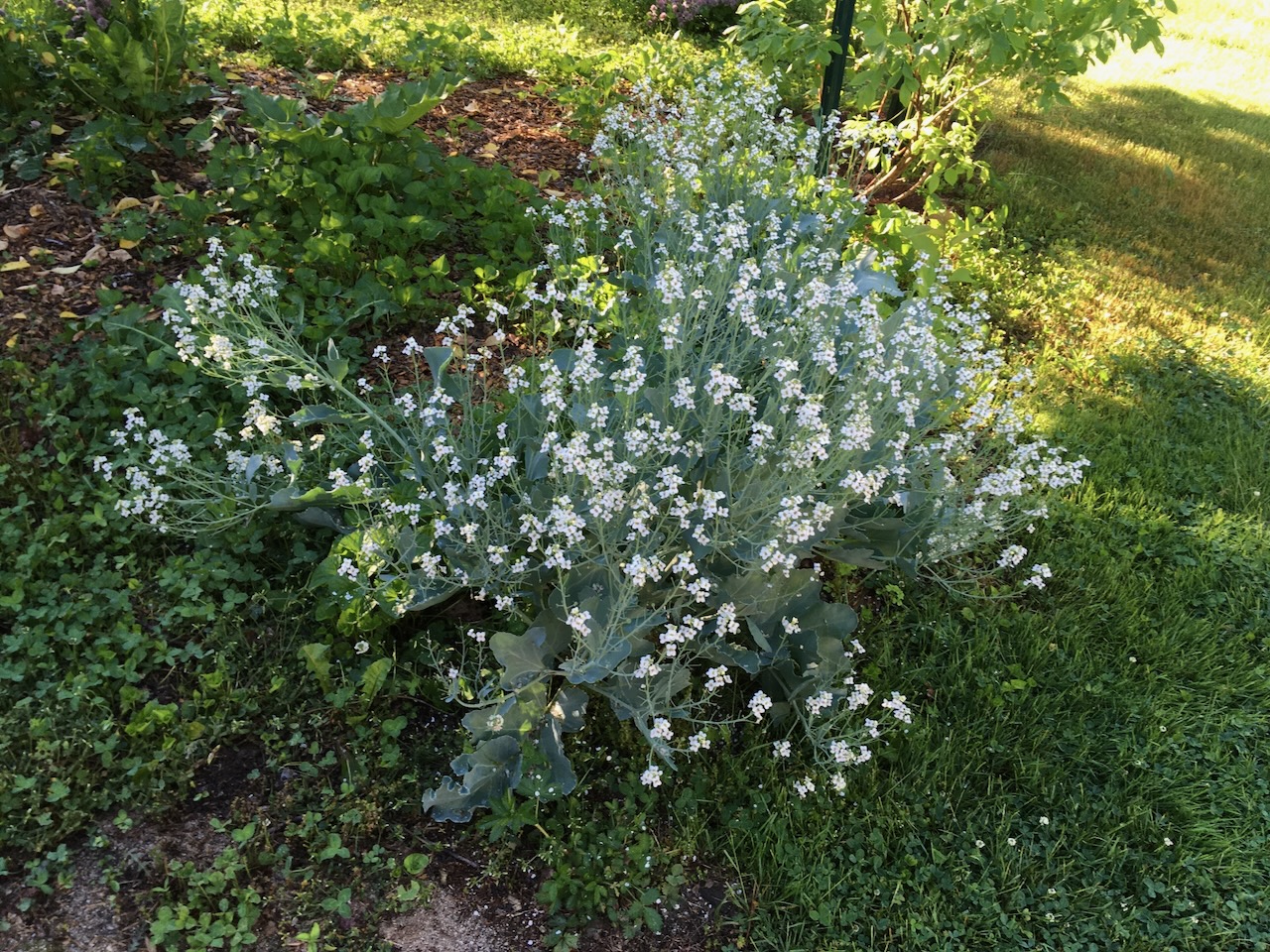
In the meantime, here is a picture of our perennial sea kale, from which we ate several small leaves and buds before it quickly turned to flowering. I love its honey smell.

Life in the Yard

Mallard duck visiting the pond.

Life continues to be abundant in the yard. We’ve had visits by a duck couple, who land on the pond, sometimes walk around the yard looking for food, and then take off again. When I was cleaning up old plants from the pond, I discovered strings of toad spawn, and now we have toad tadpoles swimming around.

I am suspicious that the three bullfrogs who’ve taken up residence might be eating them sometimes, but so far the tadpoles continue to survive. We’ll see.

I don’t seem to have much energy this year, so projects in the yard are moving slow. We finished stacking our firewood, and I cleaned up weeds and refreshed the wood chips around the fire circle. I resonated with something that was mentioned on television at the Chelsea flower show in Britain–gardening is often a lesson in failures. The cherry tree has some problem that causes spots on the leaves and cherries and I don’t think we’ll get any cherries despite our earlier blossoms. Probably the black cherry aphids, but I don’t have the energy to sort it out. So I am appreciating the plants that seem to take care of themselves.

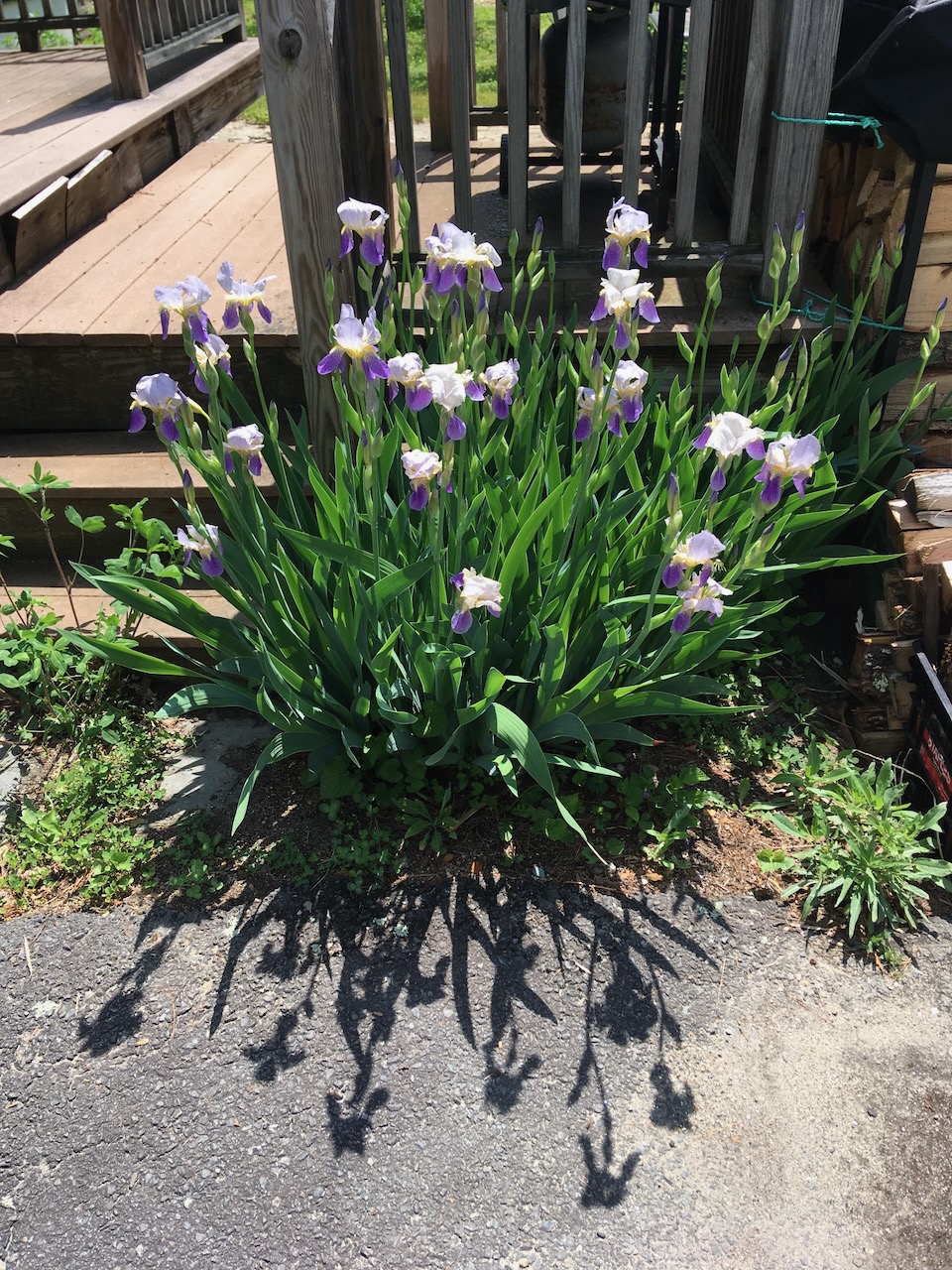
The irises by our deck are thriving this year, so happy and abundant. That sort of makes up for the lack of blue Siberian irises in our front patch–hardly any at all this year. The plants seem to move around, and I am not sure why the blue ones are not doing well. Happily, our neighbor’s are doing great, and I see them out our kitchen window.

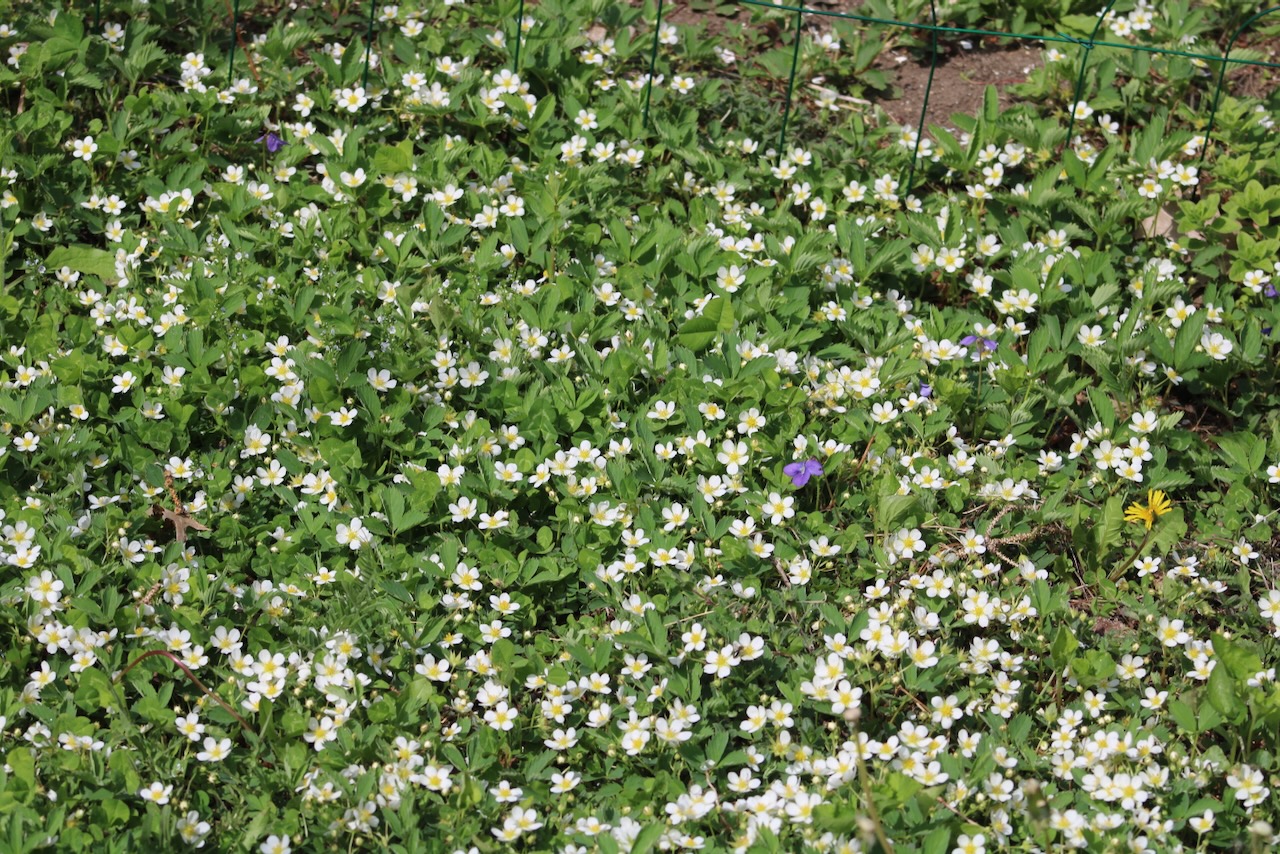
Meanwhile, the wild strawberries were blossoming and spreading everywhere, which is great–good food for birds and bugs. It is an excellent native ground cover. That makes me happy.

Happy Solstice!

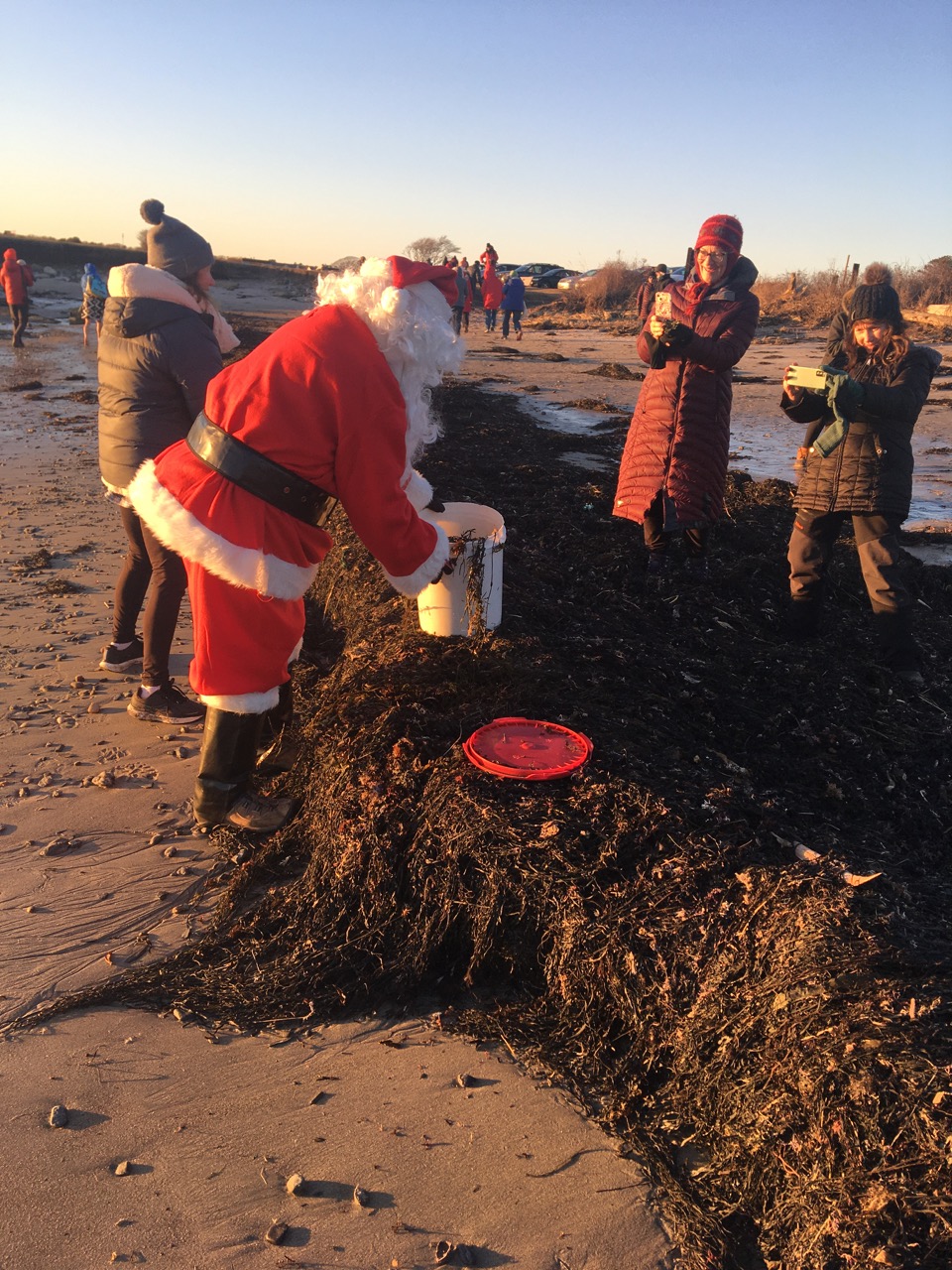
Santa at Kettle Cove Beach.

For a Solstice treat, Margy and I went to Kettle Cove beach a little before sunset. Santa was gathering seaweed for the garden. Now you might not think Santa would be out on Solstice, but the ancient European pagans laid claim to this gentle gift-giver from the north much before St. Nicholas. In fact, in the old old days, they say Santa was female. I think they might be right.

A group of hikers passed by and seaweed-gathering Santa was a big hit, with many photos taken. Job done, it was time for a little rest. Thankfully, there was a handy log nearby to sit on.

Oh look, who is that with Santa? It’s me! I was also sitting on that log. It’s a Santa selfie. The setting sun was bright upon our faces and we gave thanks for all the sun brings to us.

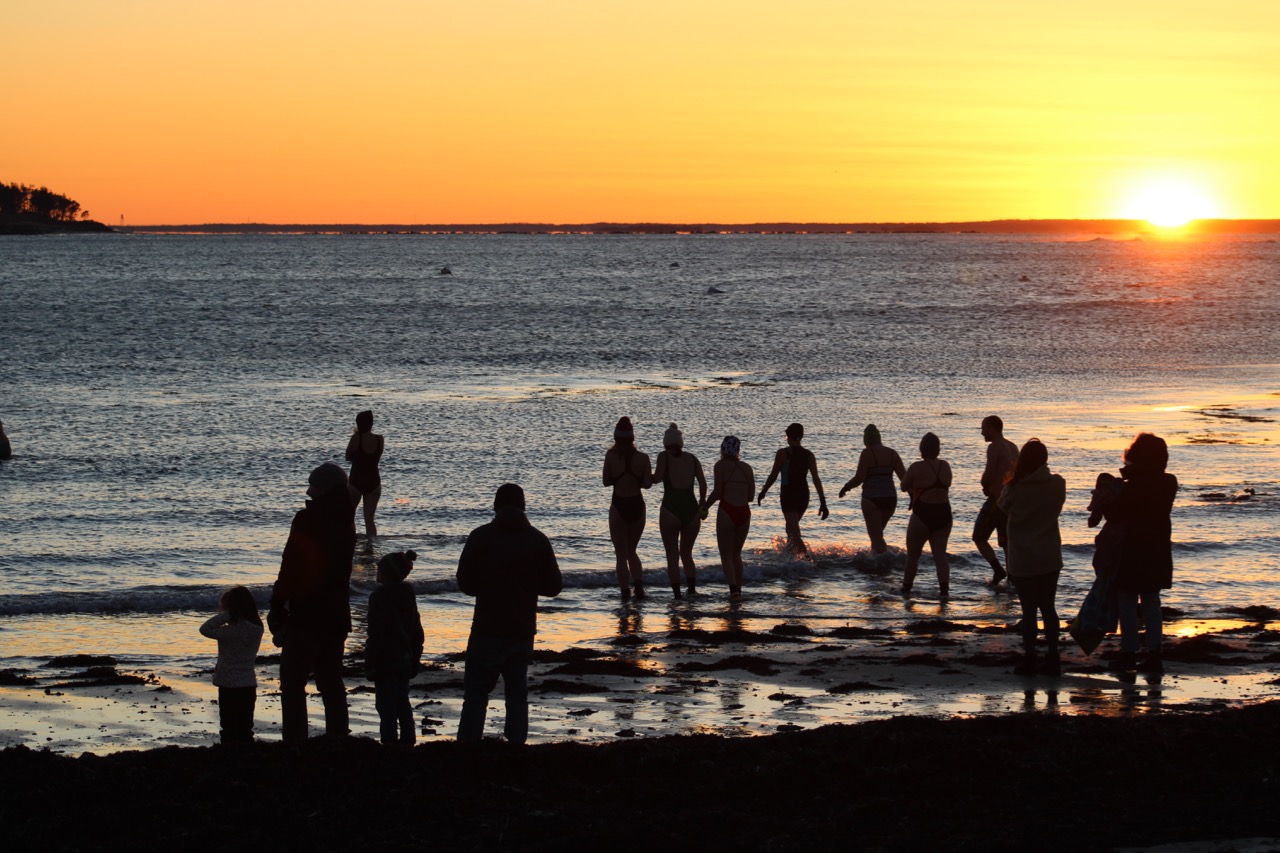
And then we had another surprise treat. The local mermaids came to the beach for a Solstice swim in the cold ocean. We did not join them but we had fun watching them brave the waves.

May all the blessings of this Solstice day be upon you! May the darkness be fruitful, and peace return with the lengthening days, peace upon Gaza, upon Ukraine, upon Sudan, and all the hidden sorrowful places.

Fallen Spruce

It is raining here in the northeast and the wind is blowing mightily, with gusts past 50 miles per hour. This healthy spruce tree suddenly fell down from its very roots. I was inside and heard something, but didn’t realize what had happened until I poked my nose out the door. Thankfully, it just missed our deck! And our house! 

I found this little squirrel within the branches, perched on a cherry tree branch, probably wondering what the heck just happened! And also eating a seed. The spruces are like squirrel highways over here.

I went fully outside into the rain to survey the damage and was amazed by how we lucked out. The spruce landed in the orchard, tucked neatly between the trees. Some orchard tree branches are bent or broken, but not the trunks. Also, it could have hit our house if it had fallen in a different direction, but it did not.

Earlier, I had been worrying about an entirely different spruce–a dead one with a squirrels nest. That one is still standing so far, but this one took me by surprise. The whole root ball had come out of the ground. This photo is from that root, from the bottom of the tree, looking to the top, where you can see how it landed between the white painted trunks of apple and peach. The patterns of the branches are so beautiful, even in its dying.

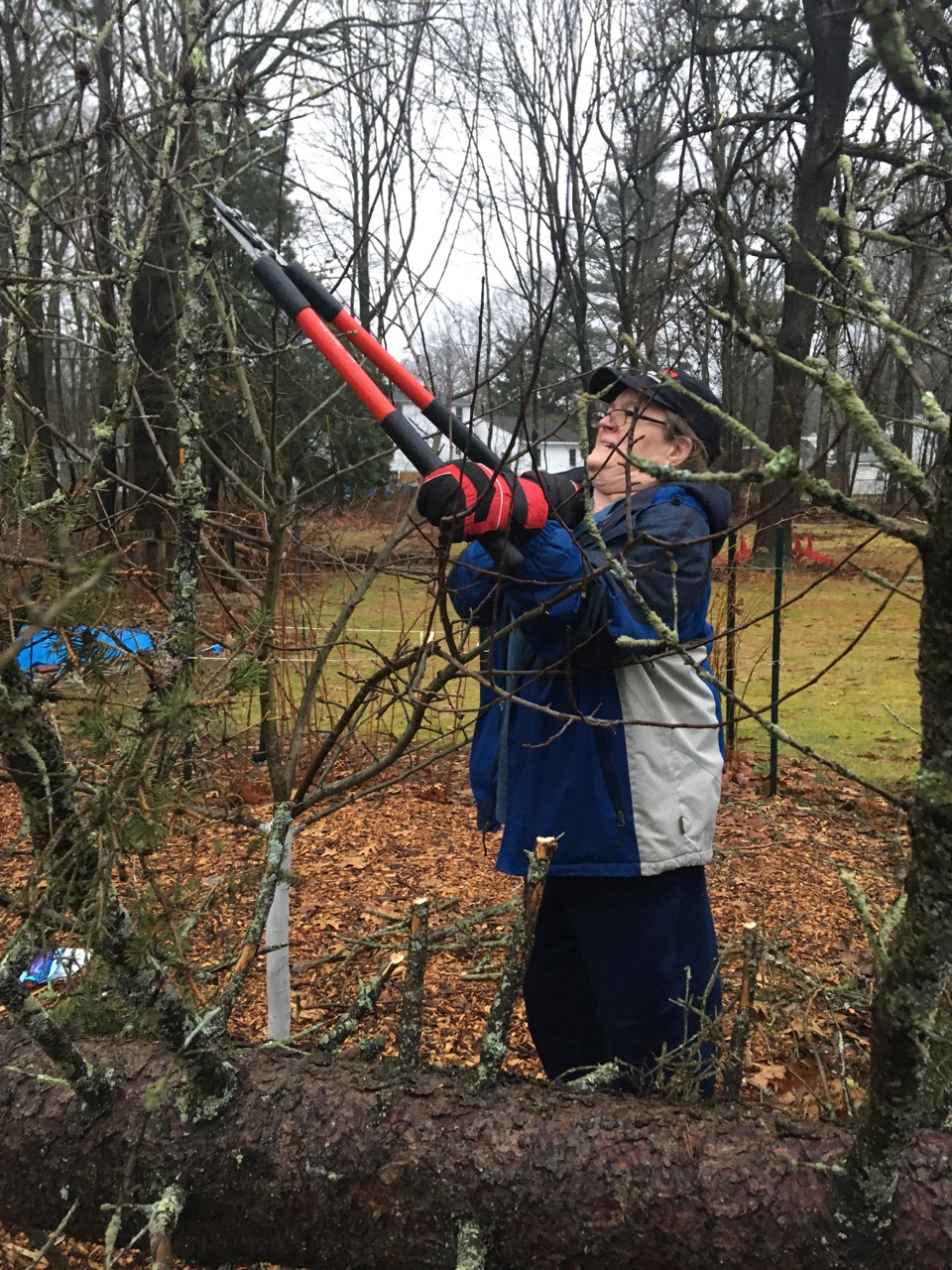
I don’t know how much damage the orchard trees suffered. When Margy got home from an appointment, she went out in the rain immediately to begin cutting spruce branches that were interfering with orchard tree branches. I guess that is something else that I love about her. Going outside in all sorts of weather, and caring about trees. I think if the branches can be freed from where they are bent, they might have a better chance of recovering.

Meanwhile, I am inside thinking about how vulnerable we all are to the wind and weather. How even with so much care put into this orchard, it could be wiped out with a storm. Or a tree could fall on our house. I tend to worry, to imagining worst case scenarios. Yet, I have been so blessed in so many ways, protected from harm by what magic? I can’t put it on “being blessed,” because I don’t think people who face tragedy or catastrophe do so because of not “being blessed.” (I don’t think people being killed in Gaza are outside of the view of that Mystery who blesses all, and who is especially with those who are suffering.)

Luck? Fate? I am reminded of the Chinese story about a farmer whose horse escaped into the hills. When his neighbors came by to sympathize with the old man over his bad luck, the farmer replied, “Bad luck? Good luck? Who knows?” The next day, the horse returned with a beautiful wild stallion. This time the neighbors congratulated the farmer on his good luck. His reply was, “Good luck? Bad luck? Who knows?” Then, when the farmer’s son was attempting to tame the stallion, he fell off its back and broke his leg. Everyone thought this very bad luck. But the farmer again replied, “Bad luck? Good luck? Who knows?”

Some weeks later, the army marched into the village and conscripted every able-bodied youth they found there. When they saw the farmer’s son with his broken leg, they let him off. Now was that good luck or bad luck? Who knows?

When a tree falls I am reminded that the world we live in is much bigger than we can understand or imagine. 

Halloween Frost

Frost on flower

Today is Halloween, that wild holiday of ghosts and ancestors and gifts of sweets. Some say the veil between the worlds is thin during these days. Celtic Samhain, Mexican Dia de Muertos. The day midway between autumn equinox and winter solstice. This morning I woke to our first frost of the season. It is later than usual for Maine, but also earlier this week than I had expected. Still, it drew me out to walk in the dawn’s first light.

I harvested the last of the (now frozen) raspberries. We often don’t get any in the fall because they don’t get enough sun to ripen before the frosts. So we’ve been grateful for several little bonus treats over the last few weeks. I also cut some (frozen) chives, and quickly chopped them up small and put back into a frozen state for use during the winter.

On October 16th, I had dug up the licorice plant, to harvest the roots–they make my favorite herbal remedy–such an energy boost iced as tea with lemon in the summer garden work. I cut off several large roots near the main plant, and all the long extension roots to new plants. After that, I replanted the original plant, and mulched with wood chips all around. Then, and I haven’t yet finished, I wash them with a scrub brush, and cut into small pieces to dry in the herb dryer. It takes quite a bit of my energy, so I can only do small batches at a time. Here is the latest:

licorice root as dug
licorice root washed and cut

So the end of the harvesting is in sight. No more zucchini. Still more kale–that keeps going after the frost. Still some carrots in the front yard beds. Leaves are still falling. Margy did some final mowing and some not-final raking. Much of our back lawn is moss mixed with wild strawberry, clover, grass, and weeds. We love the moss. On more mechanical themes, our garage door was fixed today! (It has been broken since the end of September.) We’ve also had a broken clothes dryer. Appointment scheduled for Friday. I guess these are part of our preparations for winter.

But today, mostly I think about the ancestors, those I loved who have died, and those I never knew who are the roots in my family tree. I had a new thought about my mom’s father, whom we called “Papa.” He was born “Johann” in Austria in 1884, but was “John” in the United States. He left his country with a few friends, who all worked as waiters to pay their way traveling across France, England, Canada, and finally Detroit, Michigan. None of his family of origin were on this side of the Atlantic. He remained friends with those men to the end of his life. He died when I was a young teen, so I don’t have too many memories except of a very quiet, very short man. Even though he lived with our family for a while. But when I look at my own life, I too left the place of my family, and bonded with friends who have been like another family in my life. So maybe we have that in common.

Really, there is so much we don’t know about the lives of our ancestors. All we can do is wonder. During this past year, since last Halloween, my friend Estelle joined the company of the ancestors. She was a true spirit sister. So I honor her today along with those others in my life whom I loved, and who loved me. In that, I have much for which to be thankful.

Gardening Gifts & Challenges

Cluster of many asters with pink centers and white petals.
Asters are blooming!

My favorite part of gardening is when native plants show up and bloom all on their own! Asters are all around the edges of our yard, and in so many other Maine yards in our neighborhood right now. Different varieties, all beloved by pollinators, tiny beautiful blossoms when you look closely.

My least favorite part of gardening is wrestling with the invasive species that show up on their own. For the last three weeks I’ve been pulling buttercup plants that spread all over under the honeycrisp apple tree, and were also just starting to infiltrate the raspberry patch. So first I pulled up all the plants I could, in sections, then I set down cardboard over the area, watered it, and spread a thick layer of wood chips on the cardboard. Handily, the tree is right next to our pile of wood chips. The hope is that the cardboard and wood chips will smother the rest of the buttercup roots that I am not able to eradicate.

Small apple tree with wood chip pile to the left, half circle of cardboard on the ground almost covered in wood chips, and front right plants including buttercup plants.
Halfway done pulling buttercup plants and layering cardboard.

While I was at it, I also pulled up all the oregano under that tree–my other nemesis, though it has its uses as an herb. It was intermixed with the buttercup. I was sad that I had to cover other ground plants like wild strawberry, and I hope they will spread again over the wood chips once things settle down. But finally, it was finished. (For now–I imagine I will have to be on the lookout next season for sneaky little survivors.)

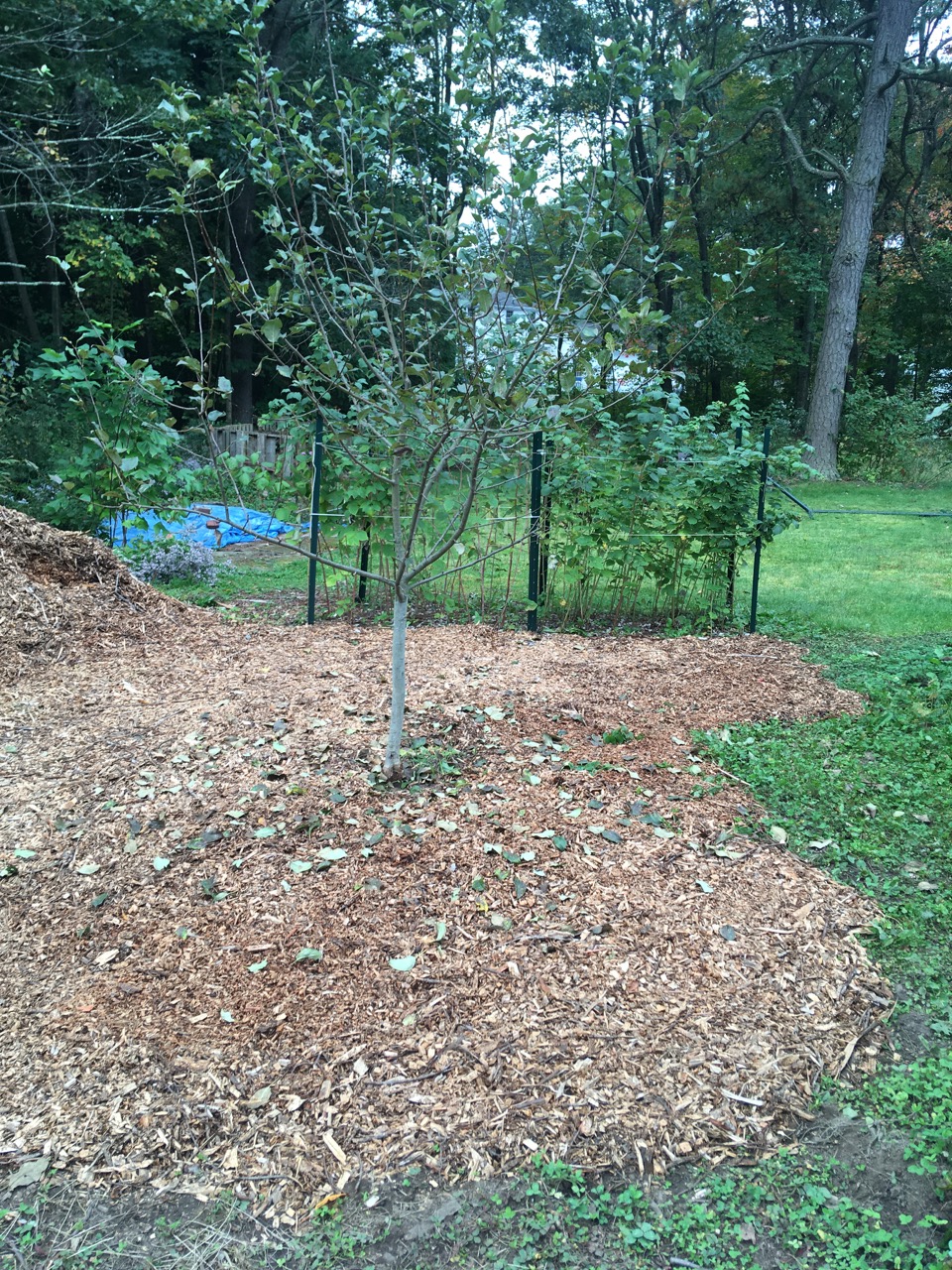
Small apple tree surrounded by wood chips in a big circle. A raspberry patch is visible behind it, and green lawn.
Completed!

Meanwhile, the other least favorite thing about gardening is watching how climate change is disrupting the patterns that nature usually unfolds in each season. Yesterday, I discovered that there were open blossoms on the cherry trees–just a few–but this is October in Maine! Last winter’s unseasonable warming and freezing killed all the blossoms that should have come out in the spring. We have yet to harvest any cherries from these trees beyond one or two. And now this. I have heard that other people are noticing weird blooming out of season on other plants too. I don’t know if the cherry trees will survive. I hope they will. I tend them as well as I can, but there are forces far beyond the little garden here in our yard.

white five petal cherry blosom on branch, with leaves in background.

Meanwhile, I try to be grateful for the gifts that still emerge, the asters and goldenrods, the frogs and birds, and that I am able to go outside to watch and learn.

Boundaries & Buttercups

Green buttercup leaves in a mat/
Buttercup leaves forming a mat.

Earlier this summer, I discovered a few lovely yellow buttercup flowers under the Honeycrisp apple tree. I didn’t think too much about it. They were so pretty. Later, when I was mowing the orchard undergrowth, I mowed those flowers along with everything else. But more recently, I realized that the buttercups had spread all over the ground near that tree, and were crowding out any other plants. So once again, I did some research and discovered that Ranunculus repens, creeping buttercup, is considered invasive in Maine.

I don’t know how it got here. And it is likely that I won’t be able to get rid of it entirely–each plant puts out horizontal stems that take root at its nodes and form new plants at each node. But I have to try. Further research suggested that using a garden fork to loosen the soil and lift up the plants was a good way to pull the plants with their roots. Also, it prefers acidic soil, so adding lime to make the soil less acidic can discourage them. I started pulling them yesterday, and did some more this morning before the rain came.

Small tree with a few apples on its branches, at the ground we see green  all over, except in one area where soil is visible, and a garden fork in the lower right.
Here you can see the section I pulled and the other huge section covered with buttercup plants.

I was complaining about all this to Margy, and she reminded me that a large part of our gardening is removing problematic plants in order to encourage beneficial plants. So while I delight in the violets that spread everywhere, and the wild strawberries–both native ground covers that have flourished in the orchard, I also have to reckon with these invaders that come in from who knows where.

Invasive plants don’t have good boundaries! Now, there are also some native plants that are quite aggressive growers too. One example is Canada anemone, or anemone canadensis, which Sylvia planted in the herb garden. The difference is that native plants have more benefits for the local ecosystem. But I pulled hundreds of these plants to make room for the littlest apple tree. I put down cardboard boundaries around the circle, and over the circle, then covered it with wood chips. I may also use that method for the buttercup areas to see if that helps.

Very small tree in a circle of wood chips, with lush green plants at the back of the circle.
Small Blue Pearmain apple tree, with a ring of Canada Anemone around the back.

So once again, lessons can be learned from plants and the process of tending them in the garden. Plants have many different relationships with each other. Can aggressive or invasive plants eventually find some sort of balance? Some non-native plants find a useful niche and honor the boundaries of plants around them. We might also ask ourselves, How are we in our own relationships with others? Are we aggressively pushing out others to claim all the space and goods for ourselves? Or are we good at sharing space and goods with our neighbors? Are we also careful with our own boundaries, not letting others treat us aggressively?

And I can’t even consider these questions without thinking about the early colonization of this continent by Europeans–they certainly fit the definition of an “invasive species,” destroying so much in their spread across the continent. Yet here we are now. Can we learn to live in harmony with all beings around us?