“Ghost” Trees

Peach (in front) and cherry trees treated with Kaolin clay.

Yesterday, I prepared a mix of kaolin clay and water, and sprayed all the branches of the peach and cherry trees in our little orchard. This is an organic solution to curculio insect pests, among some others. Now they are totally white and look like ghost trees. The leaf buds are starting to open on the cherries, and flowers will be here soon. Last year, our peach tree produced many peaches, but they were almost all destroyed by pest bugs. We got to eat two peaches. (They were delicious by the way.) We had somehow assumed that it might take at least a year for bugs to find them, but bugs are smart. So it was a useful lesson in observation. But this year, we hope to actually eat some peaches.

I have been committed to figuring out how to protect them organically. This spring I started reading once again The Holistic Orchard by Michael Phillips, which has been my guide during my fruit-tree food forest adventure. Each spring I forget what I did the prior year, having only a few trees and a few times to do any part of this project. This time reading, a few more ideas stuck further into my brain, and I found a few new ideas too. First of all, which I didn’t forget, was to try to make sure they have all the nutrients they need in the soil. Phillips had a section about how to interpret soil tests, and last fall, Margy did a soil test for the peach tree bed. Since the fall, I have added more compost, seaweed, some rock dust and green sand which are all long-term nutrient boosters. I also ordered some potassium sulfate of potash because the soil test said the soil was low in potassium, and some alfalfa meal to add some extra nitrogen which was also low. I will add those once the trees are more in flower.

In prior years, I have done the holistic sprays that Phillips recommends, and now I am trying to create my own timeline for which ones come when, so that I don’t have to figure it out each time all over again. I love this book, but it is not well organized for beginning orchardists. Vital information is scattered across various parts of its 400 pages. It is the book of someone who knows way too much about all aspects of orchards for a beginner to have much of a chance. His primary focus has been apples, and other fruits each have their own sections. Still–re-reading it each year seems a good way to go.

I do have to laugh though, because I found the key piece of information I needed for my peach and cherry trees only in a footnote–a footnote! And that footnote said: “Massively coating stone fruits [cherry and peach are stone fruits] with multiple applications of refined kaolin clay for curculio is less than ideal once fruit begins sizing in earnest. Cherries bloom before apples, and with far less leaf showing initially. Surround [brand name of kaolin clay] applied at this critical juncture on the just-about-to-pop flower buds delivers a message to this pest to move onward to other prospects. Curculio makes its way by crawling, particularly early on when temperatures tend to be cooler. The main route to developing fruit is by way of the limb highway, and thus the reason for thorough coverage on the branch structure of the tree. Two applications going into bloom will do the trick in a warm spring, with an additional application as soon as petal fall begins probably necessary in a cooler season.

See what I mean? But yesterday, as the buds on the cherry were just starting to open, I sprayed it with kaolin clay, and then I repeated it once that had dried. Now they are white, and I hope they are protected for now.

It was lovely to be outside. In between applications I did some raking and some lying in the hammock, and eating my lunch under the patio umbrella. What a great way to celebrate Earth week.

Lessons from Other Beings

I feel a deep calling to learn from the other beings who share this earth with us. I was reminded of this calling by a new book I just started reading, Undrowned: Black Feminist Lessons from Marine Mammals, by Alexis Pauline Gumbs. She is observing dolphins, whales, and other mammals who live in the sea, and learning the wisdom they might have for human beings–especially for black women, but also for all of us. “They are queer, fierce, protective of each other, complex, shaped by conflict, and struggling to survive the extractive and militarized conditions humans impose on the ocean.” It is a beautiful and meditative book and I am so grateful. Reading a chapter each night has fed my soul, as well as helped me remember how key it has been in my own path to listen for the wisdom of other creatures–though the ones I learn from are usually closer to home than the sea.

Yesterday morning, inspired, I began to read again my own book, Finding Our Way Home: A Spiritual Journey into Earth Community, remembering. I was remembering the many quiet moments I spent in my former back yard, listening to cardinals, watching slugs crawl through the grass, paying attention to trees, to stars, to the red light of dawn. It was a yard with many mature trees, a long row of huge lilac bushes, incredible privacy, and many critters who were our neighbors–turkeys, deer, birds, squirrels, chipmunks, and occasionally skunks. I was remembering how much those creatures taught me, when I was quiet enough to listen to them.

In our current back yard–we’ve lived here five years now–we can get caught up with work: pruning, planting, soil improvement, garden permaculture projects. It is land more in need of attention from us, ragged, more depleted, invasive vines and bushes clamoring around the edges and in the soil, imbedded in city life, though still surprisingly private once the trees on the edges leaf out. There is more room for gardening–the old place was too shaded by all those mature trees. So we have planted a little food forest, herbs and perennial vegetables, made room for hugelkultur and raised beds and even shared with our friends room to grow herbs and veggies.

But it is easy to get caught up in the work of it–a lot of work. It is easy to forget that other part–the listening to the land itself and the other creatures here, the plants and animals. I remember when we first found this place, feeling from it an unmistakable message: that through making relationship with this small piece of earth, I might learn more about what it means to be in relationship to earth and all her creatures. It was time to think small–right here I could find home, I could find earth community. The work is part of it–we are here to learn to be beneficial members of this tiny ecosystem. It has weathered much neglect and abuse from human beings in its history. But the work is not the only part of it–the listening is the most important part. Sitting quietly, watching, waiting. As spring makes it easier to be outside again, I am ready. I am ready to take my lead from what the land asks, what the land teaches.

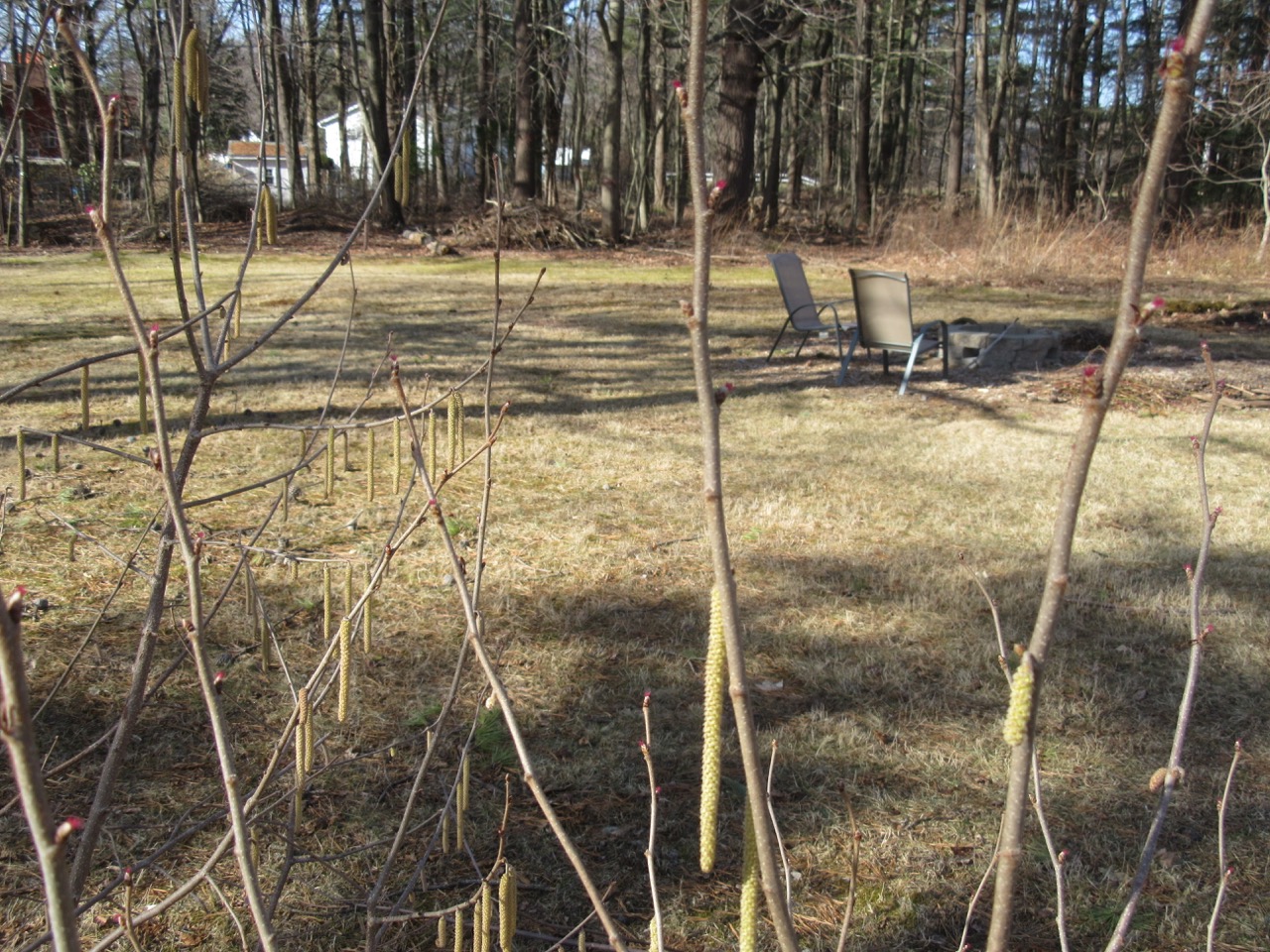
View of the back yard through hazelnut bushes with catkins.

Raised Garden Bed, Part 1

I have to laugh at myself. After hardly having enough energy to keep up with the garden all summer, I took on the idea of creating a new raised bed. It was a 3′ by 6′ by 11″ kit with eight planks of cedar and 4 metal poles to insert in holes at the corners, but I bravely decided to add hardware cloth underneath to protect against little tunneling creatures. (And on that note, I managed to catch a glimpse of a tunneler in the act–turns out to be a tiny star-nosed mole. It seems to especially like to burrow under our wood chip paths. But apparently they are not huge hazards to the garden, so that is good to know. They eat grubs and other insects, not roots.)

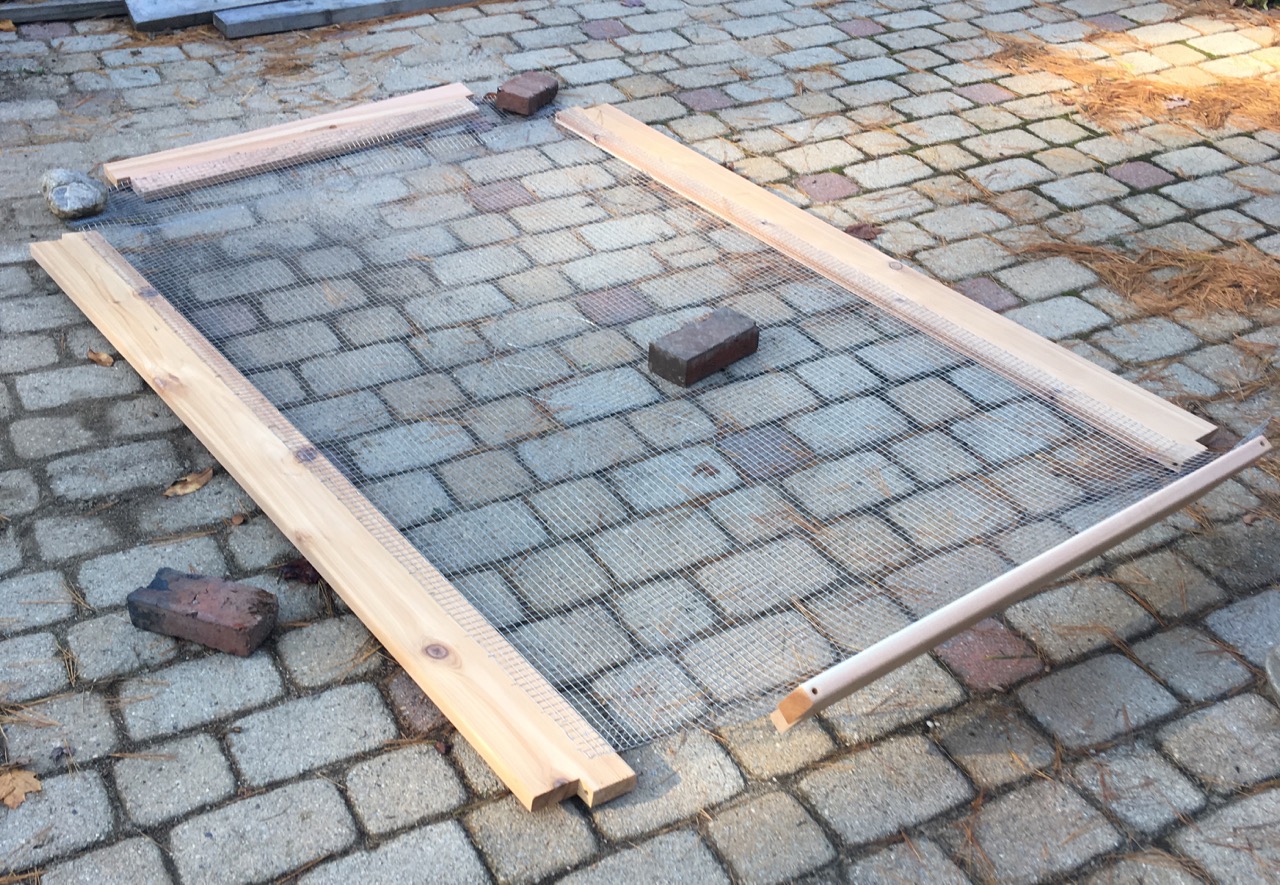
So everything arrived–kit, hardware cloth, staple gun, staples–and I started to figure out how to be able to assemble the 4 foot wide hardware cloth to the boards so it would go 5 or 6 inches into the ground to make room for deeper roots. After a lot of math, several scratches on my hands, and many staples, step one complete:

Hardware cloth stapled to cedar planks.

Margy helped me move the whole thing over to the 3 by 6 hole that I had dug earlier.

Hole dug in ground with dirt in two wheelbarrow on either end.
Hardware cloth and planks over hole.

I assembled the bed by bending in the corners of the hardware cloth so that the ends of the planks met, and then I secured the planks with the metal poles. But it didn’t fit into the hole I had dug–the hole was too shallow. So I tilted the whole assembly over to stand on its side, while I did more digging, piling the extra dirt on a piece of cardboard on the side.

Cedar planks and hardware cloth assembled and on its side next to hole

I repeated this step several times until finally everything fit. Hurray! I added the dirt from the cardboard into the cedar bed, and called it enough for one day. I still have to add the second tier of cedar planks, and all the contents–but that can be a new post.

Cedar bed in/on the ground

Meanwhile, somewhere in the middle of it all, I was happy to take time to collapse in the hammock with Margy. I am sore and exhausted, but it was a good day.

Two pairs of feet side by side in the hammock.

Autumn Colors

The last few days have been so beautiful in our back yard. The autumn color has come to us. The best times are when Margy and I curl up in the hammock together and just look at all we can see: the trees, the sky, the clouds, the birds, the orchard. When the dusk of evening falls, we see bats fly from the trees into the clearing, diving after insects.

It is raining today, but this past week of sunny cool days I felt some new energy to work in the garden. I am weeding and cleaning up scraggly herb plants under the fruit trees–who knew that oregano could get so so wild? Two and a half patches finished and two and a half to go. The plan is to clean them up, then plant a few garlic bulbs around the trees, then refresh them with more compost. I have already sifted some compost from our very root-laden pile and added it to the hazelnut hedge.

Also, what a difference a good hand held pruner makes! I treated myself to buy a really good one, a Felco #8, which arrived at the end of September. I love it! The pruners I had before never did a good job, no matter how much I sharpened them. Now pruning is effortless. I am using them to cut the woody oregano flower shoots. Our mulberry tree (our second attempt to grow one actually) didn’t do well again–we just got two long side branches, so I pruned off the lower branch and trained and staked the higher one to be a new leader–we’ll try again to help it grow next year.

I also finally cut off the dead flowers from the plants near the street. I should have been dead-heading them all along, down to the next leaves, but so it goes. I learned this from watching old episodes of “Gardener’s World” with Monty Don, now available on Amazon Prime. When I am too tired to do much of anything, I’ve been watching that show. I’ve learned a lot, despite the climate in Britain being so much milder than in Maine. For example, I learned that dead plant stalks can sometimes provide beautiful winter structural elements.

Despite feeling like I didn’t have enough energy for everything the garden demanded this year, I got caught up into a new idea. I blame Margy because she put a cedar raised-bed kit into our Amazon save-for-later list. Now that the fruit trees are so much larger, it hasn’t worked as well to grow kale or other veggies around the perimeter of their circular beds. So after some further research, we purchased a kit for a 3′ by 6′ by 11″ raised bed. (I know most permaculture people buy wood and build their own, but sometimes you just need a kit to make it happen. So it goes in our world.)

We are going to place it next to the hugelkultur bed, with a 3 foot path in between, leaving three feet on the other side towards the hazelnut hedge. I’ve marked the space, loosened the soil there with a garden fork, and the other afternoon, I just sat on the ground slowly weeding out the crab grass as evening fell. Not much energy required, and it felt good to have my hands in the dirt. I also ordered some hardware cloth to make a barrier below the raised bed against the many small tunnelers who seem to delight in our wood chip paths. Once everything arrives, we will fill the bed with layers of seaweed, leaves, compost, soil, and so on, giving it the winter to percolate.

Still too much to do in the garden, but I feel delighted by the autumn colors, and the opportunity to learn and plant and grow, and sometimes just to lay in the hammock as the days grow shorter.

Mushrooms Again

Wine Cap Mushrooms in our garden

What elements are necessary for me to experience joy? What if the forests are burning in the west? Can I feel joy here in the east where the forests are not burning? What if fascism has stolen the possibility of democracy? Can I smile and sing a song about humbling ourselves before the trees? What if migrant children are still locked in cages without their families? Can I steal a moment of joy in the morning when the mist covers the sun? When I know my beloved is asleep in our home?

Today there are mushrooms again in the food forest, wine cap mushrooms that we inoculated into our wood chips over a year ago in the spring. We started something, but we don’t have any control over what they now do. I don’t know what elements are necessary for the mycelium to decide, after these months of invisibility underground, now is the time for mushrooms. The mist in the morning? Only they seem to know, and only they decide.

Last night I fell asleep asking the question, “What elements are necessary for me to experience joy?” Or perhaps I was asking its heavy twin question, “How can I dare to feel joy while the earth is suffering, so many people are suffering, the nation is suffering?” How can I be permitted any moments of joy given the reality of our world right now?

I remember when I was part of the Women’s Peace Camp, a peaceful protest next to a nuclear weapons military base–we had many moments of joy–despite the serious nature of our witness: evenings full of music, exciting sexual liaisons, long talks planting seeds of friendship that have grown and endured through time, delicious meals. I remember our wild dance parties and Emma Goldman’s words we often paraphrased: “If I can’t dance, I don’t want to be part of the revolution.”

Someone commented on Facebook the other day that we need to prepare for a disaster–they were worried about the possibility of civil war after the November elections. But when this idea rolls around in my head at 3 in the morning, I am not even sure what disaster to imagine preparing for: no electricity? food systems cut off? hurricanes? loss of social security income? no water? no internet? people in the streets with guns? evacuation? There are so many possible disasters that cannot be “prepared” for.

With age and illness, Margy and I are more isolated now, though certainly not all alone. But I miss being at some sort of front line in community. I can say to myself–we are trying to live a dream of a life more in harmony with the Mother Earth–the downsizing, the solar panels, the food forest. And I don’t forget the importance of choosing to love a woman in the face of patriarchy. Imagining decolonization in the face of white supremacy. But I feel helpless in the face of the destruction of so many people and landscapes across the nation.

It is almost as if all I have to offer now is my profound grief.

So, is it still possible to find joy in this grief time? Is it hiding underground like mycelial networks? Can it spring forth like mushrooms when something decides there is room for it now? Is it me who decides? Can I fully honor the grief that our times require, and yet still find those moments of song, smile, lightness, beauty, gratitude?

Rest


Photo by Margy Dowzer

Margy snapped a photo of me while I was reading in the hammock the other day. She couldn’t know that I felt so restful during that time that I almost wept. With everything happening in our country, and with my body so often exhausted by almost anything I do, there was something about that morning in the hammock that was so restorative, so relaxing. May you find ways to rest!

(I am going to stop here for now, because WordPress has changed its editing format, and I am lost in trying to find the simplest things, or how to get back to the earlier editing format.)

Pesto

This past week’s big garden project was making pesto. I’m not an expert on preserving food from the garden, but discovered that while oregano and thyme were easy to dry, things like chives and basil didn’t work for me to dry. But making pesto and freezing it has been great. We just finished using the last of our pesto from last summer, and it was time to make it again.

So here is my very loose recipe for anyone who might want to try it. First of all, cut big bunches of stalks of basil, parsley, and chives from your garden. And really, any combination of these will work, though I think of basil as the primary ingredient of pesto.

Basil & chives

Basil & Chives & Olive oil

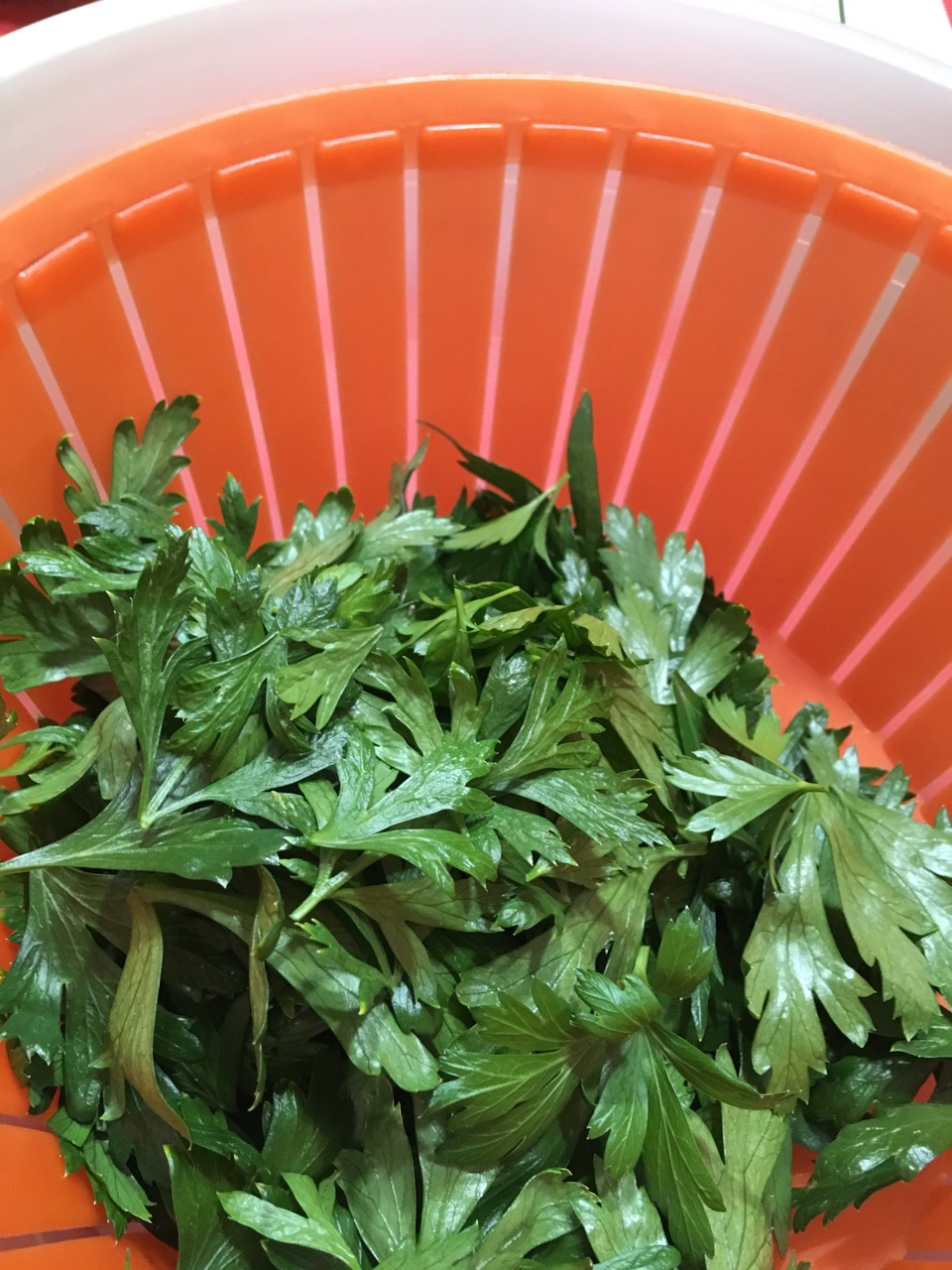
Pinch the basil leaves off the stalks and place in a salad spinner–you can wash and dry them in the spinner. Do the same for parsley–I just cut the leafy parts off the stalks. Our garden is organic, but rinsing deals with any random bugs or dry leaves or other impurities that might be attached.

Parsley

Parsley in the salad spinner.

Chives can be rinsed briefly, and cut with a knife into couple inch lengths. Once these are ready, start with a blender. First, put in 1 cup of olive oil, and then reserve 1/2 cup for use as needed to keep the blender stirring easily. Add the basil and blend, add the parsley and blend, add the chives and blend. Or do this in any order you like. I also added 4 Tablespoons of lemon juice, salt and peper, 1 clove garlic, and some garlic scapes. I don’t do well with too much garlic, but you might want to add more if you like it.

Finally, I added one cup of raw hazelnuts. Traditionally, people use pine nuts, but they are more expensive and since we have hazelnut bushes, it seemed fitting, though our bushes haven’t produced any nuts yet. Later, when we use the pesto, we will add parmesan cheese.

Finally, I line a baking pan with wax paper, and put the pesto mixture on this paper in small lumps–like cookies. Place the whole pan in the freezer until the mixtures have frozen, and then I fold them up in the wax paper and store in freezer bags.

Pesto "cookies"

Pesto “cookies”

Through the winter, we take out the pesto cookies and use as many as we need with baked chicken, with zucchini noodles, with anything that could use a bit of bright flavor. I ended up needing to make two batches because I had so much basil. And the basil plants will grow back again, so we could make more later on. So much fun.

Garden Lessons

Today is the Celtic celebration of Lammas, the early grain harvest festival. I’ve always connected it to the early corn harvest–the time to start eating local corn on the cob in the places I have lived. Our little group that celebrates earth rituals together hasn’t met since COVID, and I feel sad not to see them today. But this morning I was able to bring some zucchini and kale to the Resilience Hub, where a volunteer was collecting produce from gardeners to share with immigrant families in the Portland area. That truly felt like the best way to celebrate this holiday–sharing the surplus of our own harvest for those who need it, in the spirit of reciprocity.

Myke behind the zucchini

Myke standing behind the hugelkultur zucchini! Photo by Margy Dowzer

Lately, I’ve been feeling rather overwhelmed by the gardening endeavor. Take note of my photo behind the hugelkultur zucchini–you almost can’t see me at all. There is watering to do each morning, and I’m harvesting raspberries, the last of the snap peas, chives, zucchini, and kale. Oh–and one cucumber so far.  I learned how to freeze zoodles (zucchini noodles) so that we can save some for the future. I am also freezing most of the raspberries and chives. So all that is wonderful, but still a lot of work.

Added to that, however, has been discovering that each new plant I add to the garden seems to come with its own ecosystem of insect pests and diseases. I was used to Japanese beetles, and shaking them from the leaves of trees into soapy water. I was used to picking off cabbage worms from the kale and squishing them. But then I learned about the squash bug and the squash vine borer. I don’t see any significant damage yet on the zucchini plants, but I’ve seen the bright red and black flying parent of the grubs that can burrow into the stems. This morning, there were some zucchini leaves with powdery mildew. Another yuck.

Now we also seem to have grasshoppers eating the carrot tops and the kale–except for a new variety of kale that I got from a friend, which is too prickly for my taste. (That is ironically maddening! Why don’t you eat that one, grasshoppers?) I did some research and if I wanted I could try garlic spray, or flour on the leaves. But right now I’m just hoping they don’t eat enough to wipe out all the plants. Also, I put more bird seed in the feeder in hopes that some of those birds might also eat grasshoppers.  But there is so much to know, and so many possible pitfalls, even in the context of our organic permaculture polyculture systems.

So like I said, I’ve been feeling overwhelmed by all of it lately. I was thinking back to my original intention with this land–I wanted to restore our mutually beneficial connection to the earth, via this small piece of the earth we are lucky to live upon. And what I am learning is that it is not so easy–I’ve lost so much of the knowledge of plants and ecosystems that my ancestors might have had in the places they called home. I am sure there are long-time gardeners who find a way to learn what they need from the practice of gardening–but I am coming to it late in life, and I can feel that it could take a whole lifetime to become adept at working with ecosystems to nurture wholeness and balance.

It’s not all flowers and romance, this relationship with earth. It’s crabgrass and ticks and mosquitos and so many unknown insects, (beneficial or destructive?), not to mention diseases, viruses, bacteria.  Some aspects of earth are not so easy to love. It’s invasive species and drought and climate change. It’s beyond what I can learn and I’m discovering the limits of my capacity.  So I come to the garden like a prayer: sometimes with awe, sometimes with gratitude, but often with a cry for help, often with a deep painful longing for all that has been lost, often with loneliness. If I can pay close enough attention, finally, I come to the garden with surrender, surrender to this larger dance of life of which I am only a very small movement.

Zucchini Bread

Zucchini Bread

Remember when I said I hoped we’d become those people who ask all their neighbors if they want some zucchini? It’s happening! In the last few days, I’ve picked a whole basket full of zucchini–time to start sharing. Meanwhile, today, I figured out a recipe for gluten-free zucchini bread using almond flour. I explored several recipes I found online, but none were exactly right, so I adapted to create one for my own tastes. I don’t think I’ve ever shared a recipe on this site, but this one turned out great, so here it is:

Preheat oven to 350 degrees.

Mix together:
1 1/2 cups almond flour
1/2 cup coconut flour (or you could use almond flour)
1 teaspoon baking soda
2 teaspoons cinnamon
1/2 teaspoon salt

Beat together:
3 eggs
1/4 cup honey
1 teaspoon vanilla
and add 2 cups of grated zucchini (skins on)

Mix it together well into the flour mix (it will be thick) and spoon into a buttered (or oiled) bread pan. Bake for about 45 minutes. A toothpick should come out clean when you poke it. When finished, take it out of the pan and let it sit on a baking rack for another 45 minutes before slicing.

(A few recipes said to squeeze the grated zucchini in a towel to remove moisture, but I found I didn’t need to do that.)

Meanwhile, the zucchini plants themselves are getting ever bigger, as you can see in the background of the photo. They now dwarf the hugelkultur mound, which had seemed pretty big beforehand.

I guess this sort of makes up for the sad news that our little baby peaches got burrowed into by bugs–likely plum curculio and/or oriental fruit moth, according to my research. I had been hoping that the first year of fruiting the bugs might not find them, but no such luck. Those bugs are so smart! Next year I will try coating the peach tree with Surround, an organic method to deter the curculio pests. Meanwhile, no peaches for this year. However, today, we picked and ate the first and only cherry on the Lapins cherry tree. Since I wasn’t expecting to find any, this one was a nice surprise.

If you live nearby, let us know if you want any zucchinis!

First cherry

Zucchini Plants!

hugelkultur jun 13

Zucchini plants June 13

This was our hugelkultur bed on June 13–the zucchini plants were coming up nicely. The green beans I planted never sprouted–must have been too old.  In the back you can also see a kale plant that is doing great.  And then, in the next two weeks, the zucchini plants just exploded with growth. Here below is a photo from yesterday, June 27. The plants are as high as the hugelkultur mound.

hugelkultur June 27

Zucchini plants June 27

In the background of this photo you might see towels hanging on the side of the deck–we went to the beach on June 26 for our first swim of the season. It was so great. We arrived about 4 p.m. and very few people were there–we never had to be closer than 20 feet from anyone else, though we wore our masks as we walked to the beach. Sand, water, wind, waves, and that restoration that comes from being in mother ocean. So needed!

If you look very close in the photo, or just jump to the next one, you’ll see that yesterday I also found huge yellow flowers inside the zucchini plants.

Zucchini flower June 27

Zucchini flowers June 27

And then, today, we could already see tiny zucchinis forming behind the flowers. I know that people joke about the prolific nature of zucchini plants. But this is my first time growing them, and it is truly amazing how quickly they grow and flower and fruit, and how huge and beautiful they are. Hopefully, they will stay healthy and we’ll be those people asking all our neighbors if anyone wants some zucchini.

Baby zucchini June 28

Baby zucchini! June 28