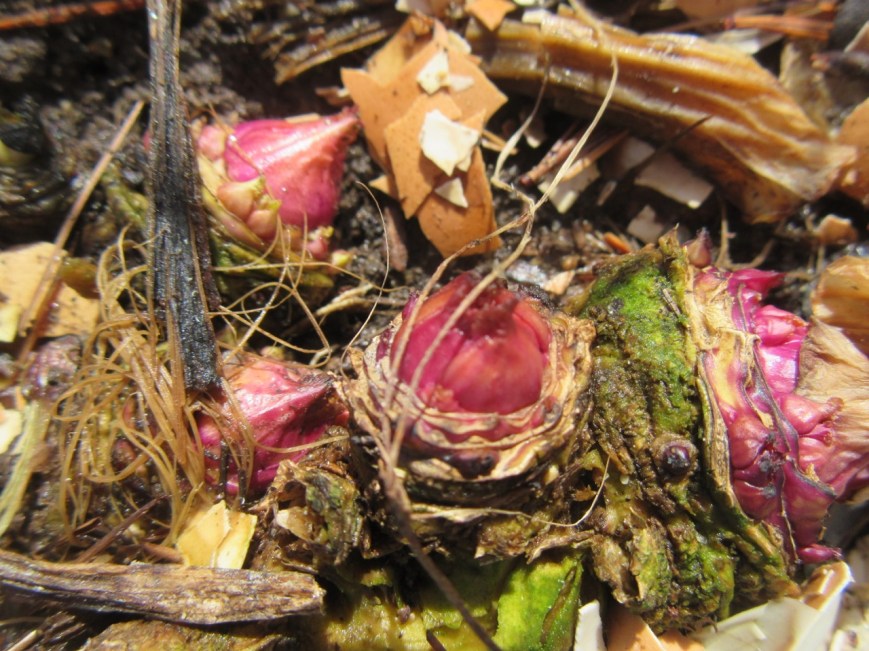
Sea Kale emerging in my garden, April 3rd.
This morning, I have been reading Farming While Black, by Leah Penniman. It is a marvelous book on so many levels–history lesson, gardening guide, liberation manual–and it feels a privilege to learn so much from a work that is actually focused toward Black farmers and gardeners. I knew so little about the skills of enslaved Africans who brought with them to these lands African plants and knowledge of growing them. I knew so little about the work of George Washington Carver who was one of the first to study and promote regenerative land practices. I know so little about multiple plants and their habits and their gifts for us. Get this book!
But then, after reveling in reading all morning, I find myself opening to multiple layers of deep grief underneath the joy of reading the book. Grief for the African peoples who were stolen from their land and enslaved. Grief for these Turtle Island lands, whose balanced ecosystems and soils were so depleted by the cutting of forests, and the plowing under of the soil, as well as by the war waged on their people. And grief for myself and my communities–that we have lost our connection to the ecosystems, we have lost our connection to the wisdoms, we have lost our connection to the plants.
I get overwhelmed with the abundant knowledge in the book, and I remember this feeling in other wonderful books I have read, the feeling that I have no hope of learning everything I need to learn, in the limited years left to me on this planet. I get the feeling that I have no hope of regaining access to the collective wisdom that has been cut off in so many ways. And I realize that this too is part of colonization.
My East Frisian ancestors were some of those who plowed over the fertile prairies back in the 19th century. Grief. But at least they knew how to grow their own food, and provide for their families from their land. I read online recently that in the last two generations, most Americans have lost the capacity to do that. More grief. I don’t know how to do that. And I can’t envision getting to that ability before I die. Plus, it is not really something we can learn from books.
In Farming While Black, I was reading about herbs and their healing properties, and there were too many to take in–even though it was a limited list of the herbs they grow and find to use in their community. I feel lucky if I can learn about two or three herbs in a season. All of us should have been learning the herbs since the early days of childhood wandering in the woods. The plants are our elders, our guides, the wise beings who know how to feed us and heal us and care for us. This separation from the plants is also a part of colonization.
One answer to my dilemma is about community. No one is meant to have all the knowledge on their own. It is okay that I can’t learn it all on my own. But I feel grief too for the fragmentation of communities that has kept us from sharing this learning and wisdom with each other. And I feel grateful for each person who has shared their knowledge of plants with me. I feel grateful for organizations like the Resilience Hub, who bring people together to share so much wisdom of soil and plants and ecosystems.
But for this moment, I want to honor the pain of colonization, honor the pain of what has been lost, honor the pain of so many threads of connection that were torn apart and destroyed, never to be rewoven. It is a long journey to healing.
 I just have to say it once more: kale is amazing! I picked this kale yesterday morning, leaves frozen on the stalk, snow on the ground. I had already picked most of the kale–just leaving a few tiny leaves that didn’t seem big enough for anything. But they must have grown a little in the meager sunlight and freezing snowy weather we’ve been having the last two weeks of November. I don’t know how they do it, but that is why they are so amazing. The plant just isn’t willing to succumb to the freeze/thaw weather that has killed off most of the other plants. So when I was walking through the winter orchard, I found several small frozen leaves, broke them off, and cooked them up for breakfast–they taste great!
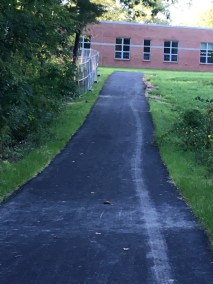 Today I set out on my usual walk around the neighborhood. When I got to the newly paved way that leads over Capisic Brook toward the new Rowe school, I saw a fox cross over at the other end, and slip into the path into the woods (before I could catch them in a photo). So I felt invited to walk that path along the brook as well. I couldn’t see the fox anymore, but I could hear squirrels doing their alarm chatters, and guessed they might be warning others about the fox.
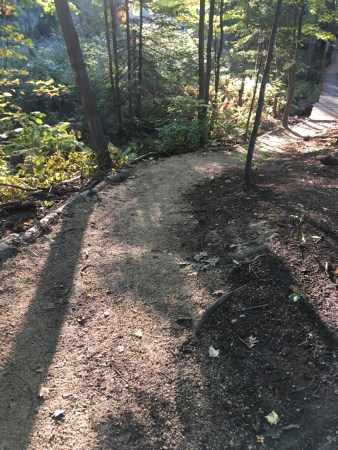 That made me smile. I like to see the evidence of other people caring for the trail.
 Today, as I walked in the woods, I was suddenly seeing all the leaves budding open as if they were little solar energy panels for the plants and trees–only much more beautiful and efficient than the solar energy panels we humans are able to make. We are in those weeks when the plants are waking up and starting their solar production once more. And our own celebration is to make a decision about solar energy, so that panels can be put on our roof as soon as possible.


