Garden Blue

My favorite color in the garden is this blue/purple of the Siberian iris. They’ve multiplied in the roadside garden bed, and blossomed all along the way. And now they are gone. So we had maybe a week to enjoy their beauty. I feel the time rushing by with all these spring and early summer flowers. Nothing goes on and on. With photos we try to capture the moment and make it last a little longer, but nothing really lasts in that way. If we don’t pay attention to the moment, we miss it.

It is easy for me to get caught up in what needs to be done, the projects, the planting and watering, the weeding, the holistic sprays for the orchard. But probably what is most important is to walk around the yard noticing the flowers and plants and critters, noticing the birds and frogs and tadpoles. When we came to this yard, our hope was to nurture our relationship with the land, with all of the wisdom it had to teach us, with all of the tending that it asked of us. It was the tangible finding our way home that my spirit was hungry for.

We’ve been tending this particular small place for about nine years, and we feel such a bond with it. In these times of wars and rumors of wars, walking through the yard restores my soul. What must it be like to live for generations in a place? I can only begin to imagine. One of the crimes of the destruction of Gaza, along with the horrific killing of human beings, is the destruction of the land, the olive trees, the plants, the gardens. All those homes. It makes me weep.

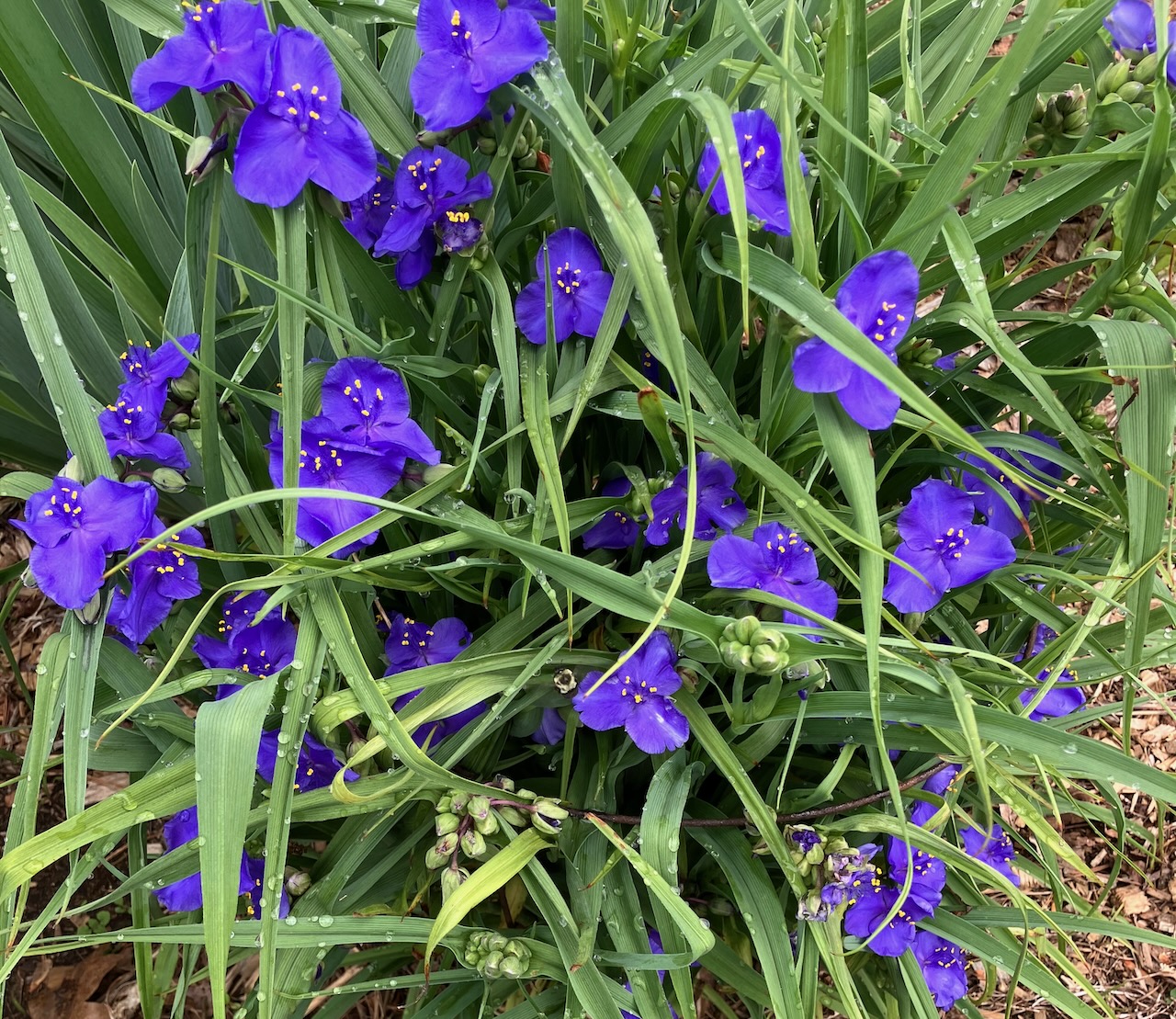
I walk around the garden in the mornings, and I pray. I give thanks for another day of living. Not just my life, but the life all around me, of which I am a part. I am happy to see that the spiderwort plants are blooming, another in that shade of blue/purple. This seems to be the very favorite flower of the bees, and it lasts for a long time, with multiple little buds on each stalk, taking their turn to shine. It is the very diversity and multiplicity of the plants that bring abundance to life in the garden.
Ephemeral

Trout lilies are blooming near the brook.

There is so much beauty in the spring, but it all seems to be moving so fast. I can’t keep up. Mayday has come and gone. Already this season is half over. After two months of physical therapy for my hip and lower back, I am able to walk fifteen minutes and more again. The other day I walked to Capisic brook and onto the path nearby, and saw the trout lilies that usually grow there, a lovely spring ephemeral. American Heritage Dictionary defines ephemeral:

  1. Lasting for a markedly brief time.
  2. Having a short lifespan or a short annual period of aboveground growth. Used especially of plants.

Spring itself and all its beauty feels markedly brief. Is my love of photos a way of trying to hold on to all that is ephemeral? Is my need to write an attempt to halt the relentless flow of time?

I have been drawn outside more and more each day, excited to see daffodils and violets and green shoots coming up everywhere. And, happily, the peach tree is now covered with pink blossoms, and the cherry trees have many blossoms too. Last year, because of the weather, there were none–so these beauties seem fragile and extra special because of that vulnerability.

Peach blossoms on a foggy day.

There are many projects in the yard to attend to. Many branches fell from trees in the storms of winter and early spring. Margy has been cutting them up and hauling them around. Some of these we’re using to make a brush pile in the back corner for wildlife habitat. The other day, I cleared that space of invasive plants. I also set up our eight rain barrels again. We are going to get an new order of firewood, after using up our last old logs in the storms. So we are working on the space for the firewood, and purchased a rack to keep them off the ground.

Yesterday, I added two more pond lilies to the plants in the little pond, and as I was tidying up old dead shoots from other plants, I found strings of toad eggs attached to the old ferns. (So of course I left those.) We haven’t had toad eggs in the pond before. But there are a few frogs beginning to make an appearance–shy ones who have been diving under when they hear me approach.

The robins did not come back to the nest on our back porch that they had used for two years. Maybe that pair are no longer living. I read that their average life span in the wild may be just two years. I also read that they often don’t reuse nest sites–so we were lucky to have them in that spot for two years. Another ephemeral.

Then we discovered a nest in the yew bush near our front door–able to be partly seen from our living room window. So new robins are raising young nearby again. Maybe one of them fledged from the back porch.

Blue robins egg barely visible behind branches.

Is my love of photos a way of trying to hold on to all that is ephemeral? Is my need to write an attempt to halt the relentless flow of time?

I was cuddling with my cat Billie on the couch and suddenly felt a deep sense of our own impermanence. She is 13, I am 70. Senior cat, senior human. How much more time do we have? Someday, I won’t be able to feel her warm little body, with its soft fur and sweet smell, curling up on the pillow near my face. Someday, she will be gone; someday, I will be gone. We too are ephemeral. I want to hold on, but life seems to be about movement, about letting go into the next moment.

The Time of Stones

The seasons have turned abruptly, with our mild autumn days letting go into the first freeze of the year. Sunday was that turning, the frost softened by a bright, bright sun in a blue, blue sky, all the trees blazing with color. A few days before, I had lifted out four special stones that had marked the directions of our fire circle. If we move away in winter, they would be buried under snow and ice, and I wanted to take them with us in our search for greener housing.

One stone is from Nitassinan, from a visit many years ago to Lac St. Jean, a link to my ancestors from the north. Two of the stones are from the Seneca Women’s Peace Camp, a link to those life-transforming months camping on the land. The fourth stone is a rose quartz given to me by a friend long ago.

I think of these stones as I wait for news about the cost of house renovations, and I wait for news from a publisher about my book manuscript. Stones must have such a different view of time than I do. Each morning, I feel a little breathless, wondering if this will be the day something opens up. But a stone must see my whole lifetime as merely a comma in their thousand year journey.

I wonder what they make of my affection, and the travels I carry them on? The time they’ve spent in drawers or boxes? I think they liked being part of the fire circle, half buried in the earth, holding a position of sacredness. To unearth them now is also unearthing my own heart from this beloved place, ready for change, ready for turning, waiting for the way to become clear.

Stones remind me that there is no rush, that our human sense of time is in many ways an illusion. Take the long view. Go where you are carried. Remember everything. Cultivate stillness.Stone Circle

The Eternal Now

Jill Bolte Taylor’s experience in My Stroke of Insight gives me a greater sense of peace about death, and the question of what happens to people when they die. Part of the pain of grief is the worry we have for the well-being of our loved ones who are gone from us. So many people have said to me, “I just hope she is at peace,” or “I just need to know that he is okay.” Perhaps we may feel that way about our own death too.

After her stroke, Taylor was left with a deep peace about death and an abiding sense of gratitude for the gift of life. She wrote,

“Although I may lose these cells and my ability to perceive this three-dimensional world, my energy will merely absorb back into the tranquil sea of euphoria. Knowing this leaves me grateful for the time I have here as well as enthusiastically committed to the well-being of the cells that constitute my life.”

Apple founder Steve Jobs died on October 5th, 2011. He was a man of many talents and many faults, but he found his spiritual center in Zen Buddhism. As his cancer advanced he had a lot of questions about death. In his final moments of being awake, as he lay dying, surrounded by his family, he looked at each of them, and then he looked over their shoulders, past them, and said “Oh wow, oh wow, oh wow!”

Within each of our minds is the gift of time and the gift of the eternal now. We can learn to awaken our consciousness to both of these dimensions, and participate in all aspects of the gift of life. When we welcome these gifts, we are better able to participate in the dance that is life, that is going on in every moment, and all of the time.

Photo by Margy Dowzer

Photo by Margy Dowzer

Quote from JIll Bolte Taylor, My Stroke of Insight, p. 160.

Dancing Out of Time

Fireworks

Photo by Margy Dowzer

Individual consciousness is simultaneously familiar and mysterious. Rene DesCartes said, “I think, therefore I am.” Jill Bolte Taylor was a brain scientist who had a debilitating stroke at the age of thirty-seven. A blood vessel burst in the left side of her brain. Because of her training, she was able to observe her own mind deteriorate as she lost the capacity to think, talk, read, write, or recall any of her life.

But there was a surprise in this—as her left brain shut down, her right brain took over, and she experienced a different form of consciousness—an all-encompassing sense of bliss, a sense of timeless unity with the universe. Years later, after she recovered the skills of the left brain, she wrote the book, My Stroke of Insight, to describe her journey and what she learned. She said:

To the right mind, no time exists other than the present moment, and each moment is vibrant with sensation. Life or death occurs in the present moment. The experience of joy happens in the present moment. Our perception and experience of connection with something that is greater than ourselves occurs in the present moment. To our right mind, the moment of now is timeless and abundant.

During her stroke, Taylor lost the sense of herself as a separate being, she lost the memories that identified her self to her self, yet she gained an experience of herself as the whole universe—there were no boundaries that separated her from everything else. What she describes resonates with the Buddhist understanding of enlightenment, or Nirvana, a shift of consciousness from experiencing time, to experiencing “all is now,” from experiencing space, to experiencing “all is one.”

When I was growing up, eternity was described as what happened to us after we died. But Taylor speaks of eternity as something that can be experienced right now within our own minds. The experience of total peace and total connection is available at any moment. She writes:

The first thing I do to experience my inner peace is to remember that I am part of a greater structure, an eternal flow of energy and molecules from which I cannot be separated. Knowing that I am a part of the cosmic flow makes me feel innately safe and experience my life as heaven on earth. How can I feel vulnerable when I cannot be separated from the greater whole? My left mind thinks of me as a fragile individual capable of losing my life. My right mind realizes that the essence of my being has eternal life.

Since Taylor is a scientist, she brings a different perspective to what is usually perceived as the mystical. She can help our left brain understand and make sense out of the right brain. She can help us to rationally comprehend what the mystics speak of when they talk of being one with the universe, or finding eternity in the present moment. And so perhaps we must reshape our understanding of the spiritual journey. It may be not so much a journey through time, as a journey out of time, from one form of consciousness to another.

Quotes from Jill Bolte Taylor, My Stroke of Insight: A Brain Scientist’s Personal Journey, p. 30 &160.

Creatures of Time

Photo by Udo Kügel Wikimedia Commons

Photo by Udo Kügel Wikimedia Commons

The stars also form a pattern to our eyes in the night sky. They circle around the north star, so that when people take a time-lapse photo, you see the lines in circles around the north star. Of course, it is really the earth that is moving, spinning on its axis pointing toward our north star. Every spinning planet will have its own north star. The ancients used to tell time by the stars. If you were to track the big dipper, you could watch it move around the sky during the night, and if you watched it over many weeks, you’d see it was in a different place in the circle, each month of the year.

We are creatures of time. Our ancestors were watching all these patterns, learning them and tracking them so they might tell their children, marking them so we would know how to plant and harvest and hunt, and dance our own dance of time. They were much wiser than most of us at reading the natural signs of time, though our scientists have followed in their footsteps. And so we mark with our machines the minutes and the hours and the days and the seasons and the years. We look back and we look ahead.

Our relationship with past and future brings us the awareness of our own mortality—that for us, and for all living beings, someday, time will cease. Often, we feel pain about that. We feel broken-hearted when those we love are no longer with us, or when something threatens their lives. We can see that some animals grieve when their companions die, but they don’t seem to anticipate death like we do. Our ancestors also wondered about death, and passed on to us their questions about what happens when we die, and their speculations and beliefs about it.

Some ancestors believed that there was another dimension that opened up after time ended—they called it eternity. There were many theories about what eternity might be like, some of which included endless misery or endless joy, depending upon our actions during our time. Others spoke of a cyclical process of rebirth, that we end one lifetime and begin another, until we experience all that we need to experience. In our own era, all these beliefs survive, as well as more skeptical viewpoints that propose that as creatures of time, death is the end, that there is nothing of the individual consciousness that survives beyond time.

Life Moves In Cycles

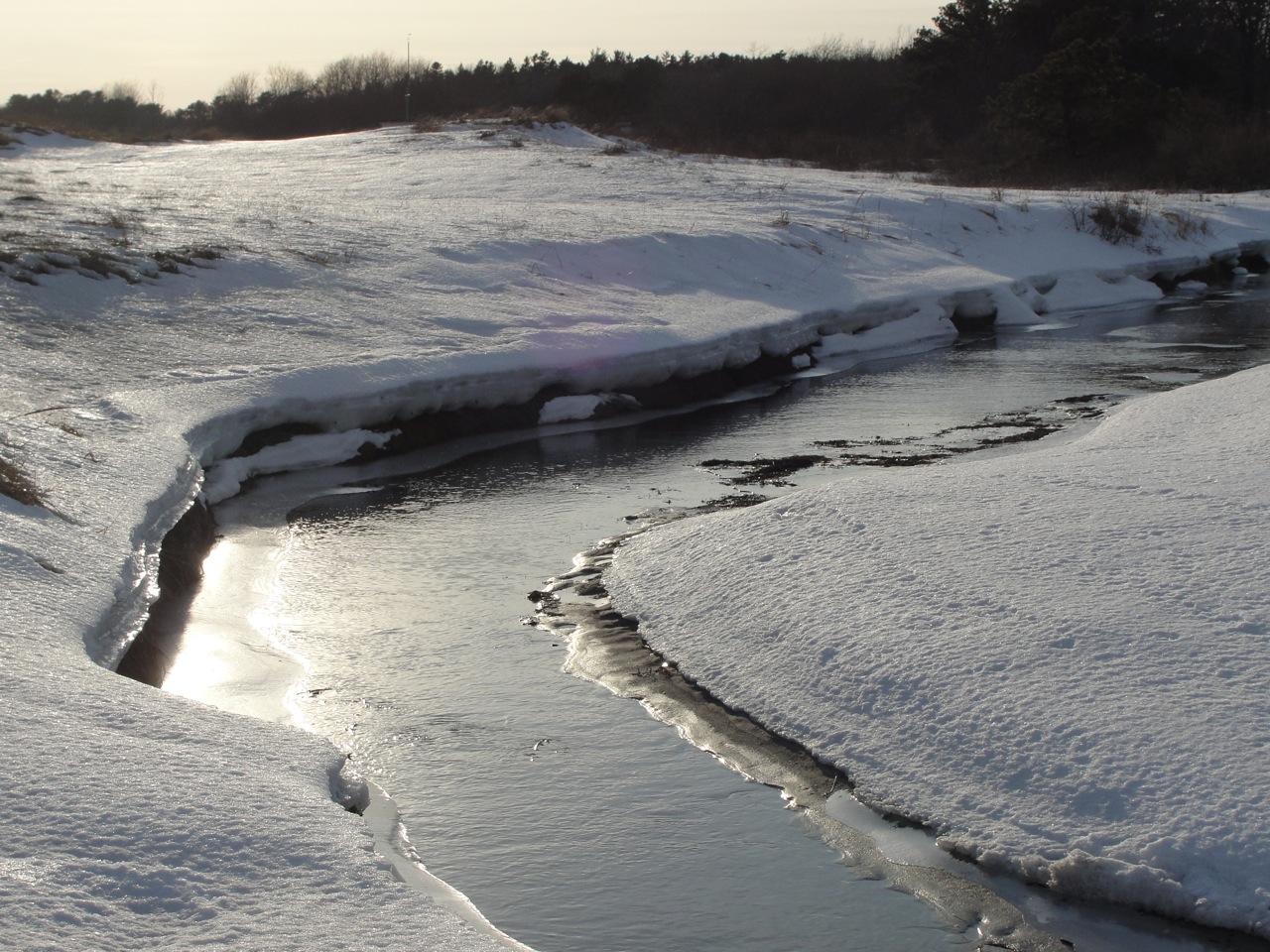
Curve of waterNothing moves in a straight line,
But in arcs, epicycles, spirals and gyres.
Nothing living grows in cubes, cones, or rhomboids,
But we take a little here and we give a little there,
And the wind blows right through us…
Marge Piercy

My colleague the Rabbi fell on some ice in the parking lot of her congregation in December of 2009. Several months later, she was diagnosed with a brain injury, and was unable to work any longer. In 2011, she started a beautiful blog called Brainstorm. In her blog, she described one of the curious ways that her brain is different now. She writes:

I didn’t notice that I no longer broke time up into chunks like minutes, hours, days. In, fact, I didn’t notice there was such a thing as time at all. I still don’t feel time. I don’t know what day it is. I have a watch that tells me and I am learning to memorize that information in rehab. If you and I meet and begin to talk, I will be totally present. I have attained Buddha-hood; there is no before or after — only now.2

Later, she asks, “How long is a year anyway? Is it before lunch or after? And is February leaves, snow, mud or sun? That is how I tell time. … We are either in leaves or mud right now. it is hard to tell.” “Soon we will stack logs for the wood stove. Put on socks and fleece, sit on the porch swing and drink tomato soup in the mugs the children made.  I do not feel months, days or dates, but I haven’t lost the seasons. I never knew how precious they were until I lost every other marker of time’s passage.”

We think that time moves relentlessly in a straight line, going from past to present to future. Similarly, we might imagine our spiritual journey as a going forward from one thing to another. But our relationship to time is mysterious, located in a spot in our brain which can be damaged or destroyed. If that happens, then linear time disappears. But the circular patterns of movement are still observable. All around us there is evidence that life moves in cycles: the earth spinning around its axis each day and night, planets spinning around the sun, tides going in and out, the stars circling round the night sky.

Some cycles are easier to notice than others. Here in Maine, the autumn comes with bright colors and the falling of leaves. Winter is cold and snowy, spring full of mud and new plants, summer warm and full of plentiful greens. These seasonal changes register in a deep layer of our minds.

Poem Excerpt from Marge Piercy, “I Saw Her Dancing,” in Available Light, p. 118.