Orchard Learning

Mottled red apples in green leaves and branches
Our first Honeycrisp apples are almost ready to pick!

Our semi-dwarf apple tree is bearing fruit for the first time this year, and we are excited for the dozen or so apples that will be ripe soon.

How naive I was when I first decided to plant an orchard in our back yard. We started with two dwarf cherry trees in 2017, of the varieties Lapins & Black Tartarian. The next spring we planted a Contender peach tree, the Honeycrisp apple, two blueberry bushes, some raspberries, and three hazelnut bushes. In 2019 I grafted two other apple trees, Black Oxford and Blue Pearmain, this last just transplanted to its new bed this year. (Not to mention our mulberry tree further back in the yard, and three more blueberries planted later.)

I think I imagined that one would put in a lot of effort at the beginning, with preparing the ground, planting the seedlings, adding companion plants, tending, and so forth, then the work would ease and the fruit would be there for the picking in the years to come. Maybe that was some of what attracted me to permaculture and a food forest. Little did I realize that an orchard requires even more tending as the seasons go on.

And there are the ups and downs–the first peach harvest went entirely to the squirrels-we were so sad. Then we had an amazing crop last year, that we ate fresh, shared with the neighbors, and froze, some packages of which are still in the freezer. This season, no peaches at all. We have yet to have a cherry harvest. This would have been the year, I think, but the abundant flower buds were empty from the deep winter freeze. On the other hand, the raspberries are very reliable, and the blueberries have begun to come into their own. And the number of birds have multiplied in our yard, whether or not there is any fruit on the trees. They love the orchard.

All that preamble to say, I did some more pruning this past week! After watching a whole bunch of Youtube videos about summer pruning, I gained the courage to go and cut off a whole lot of branches that were vigorously seeking the sky on the peach tree and the Black Tartarian cherry. (I had already done some pruning on the Lapins because of its black cherry aphid problems.) When I post the “after” pictures below, you might not believe how many branches were piled up on the patio waiting for me to take them to the compost. The trees still look flush with abundance green, though I think their tops might be about three feet lower than before.
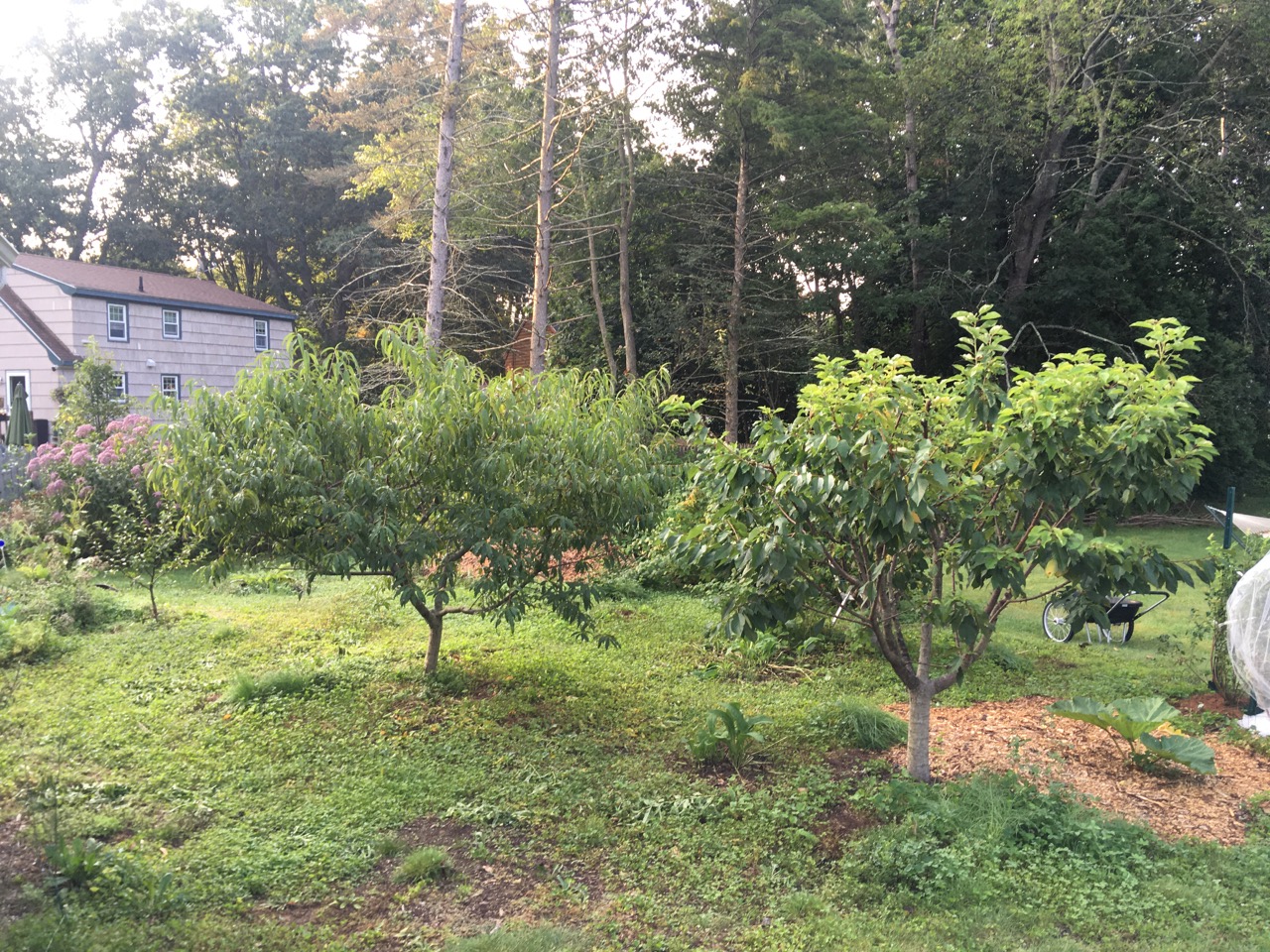
Peach tree and Lapins cherry after pruning.

I also discovered a lot of small curled leaves on the Black Tartarian, without any evidence of aphids. After some research I learned that there is a fungal disease, cherry leaf curl, similar to the peach leaf curl that I dealt with by picking off the affected leaves. I can’t be certain what it is, but I went back around and pruned off any branch ends with those curled leaves on both cherries. All the pruned cherry branches I cut up and put into garbage bags to go out with the trash–three bags full–so they wouldn’t spread the problem.

You might notice from the photo that the companion planting under the trees is now very low to the ground. I have taken to mowing most of it, including the oregano that spreads everywhere, and I put the cuttings in the compost to bring back later. The mowing doesn’t seem to bother anything, it all comes back. Under the Lapins cherry tree, I actually put down some cardboard to inhibit the oregano and then covered it with wood chips. It is an experiment.

Pruned Black Tartarian cherry tree.

This is not to say that the trees won’t also need winter pruning. That is the thing. They will always need lots of pruning, summer and winter. The work is never done. I might do less of it or more of it, depending on my own energy levels. But there is always more work that I could do to tend to their care. Even with my trying-to-be-minimalist approach. (I have read that there are people who secretly plant fruit trees in random places, to great environmentalist applause; but I wonder about who will do the tending.) So while I often wax eloquent about permaculture and gardening, please be warned about the other side: this relationship with garden trees requires a lot of work, more than I ever expected.

I should end this post with a caveat: I consider myself a learning gardener, and none of these reflections should be taken as advice. I have no idea what I am doing at least 50 percent of the time. My intention is creating a mutual relationship with the earth and the plants, and reflecting on that process. As always, I am humbled by it all.
Pond decisions

Sometimes the mental work is as hard as the physical work of building the pond. If you’ve been following along with this project, you know that after digging the hole, after putting down old carpet to protect against invasive bittersweet roots, after placing the underlayment and then the pond liner, we started filling the pond with water a few days ago. That felt so great! But then I felt stuck. The Building Natural Ponds book, by Robert Pavlis, which has been such a great guide to this whole project, suggested using old carpet as an “overlayment” on the planting shelves, to protect against the stones that were to go there. But I had run out of most of the carpet, and also had misgivings about putting old carpet into the actual water of the pond. So what to do?

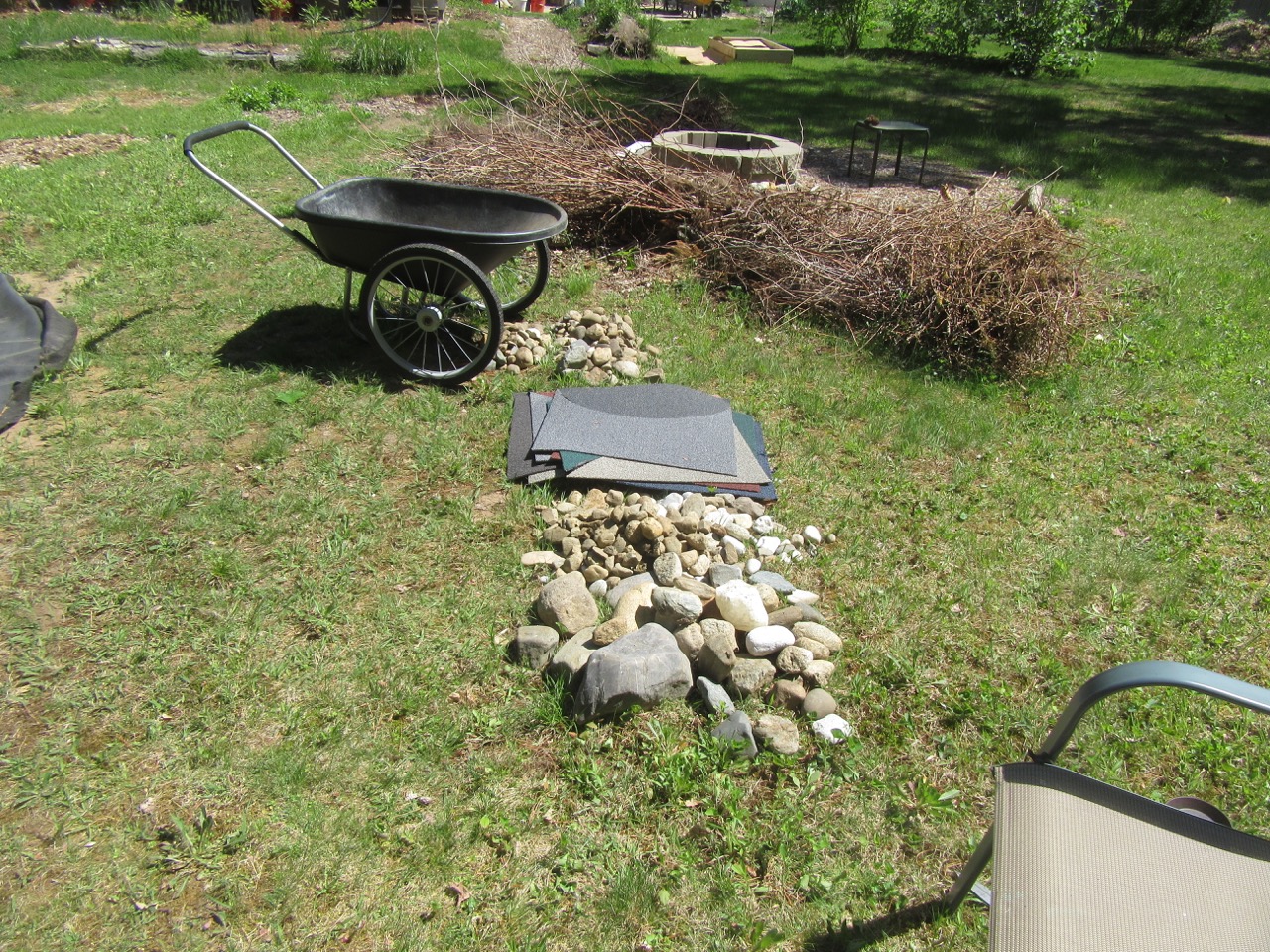
I thought and thought and then posed the question in two Facebook groups–the Building Natural Ponds group and the Northeast Permaculture Network. Then, I went outside and started gathering all the stones I’d been saving for the last five years from around the yard. I had some in five gallon buckets, and some in a pile next to the garage where violets had decided it was the perfect place to bloom. I had to dig under the roots to get all of those stones. But violets are very prolific in our yard, so I wasn’t worried about them. I also brought back the final bits of carpet I had–2 by 2 squares made of eco-friendly nylon.

Photo: Gathering all the stones to use in the pond.

Once that was done, I came back inside and checked my Facebook posts. I had gotten a variety of answers and suggestions from folks, and finally came up with my answer. I would use extra pond liner as an overlayment. Robert Pavlis had thought that idea would work well, so that gave me the confidence to do it. Some folks didn’t bother with any overlayment, but it gives just that added layer of protection against cuts or punctures from stones or little animal claws. So I went back outside, and I bravely made the first snips to cut off the extra pond liner around the edges of the pond. Because the pond wasn’t quite as deep as originally planned, there was quite a bit of extra liner.

Photo: extra pond liner

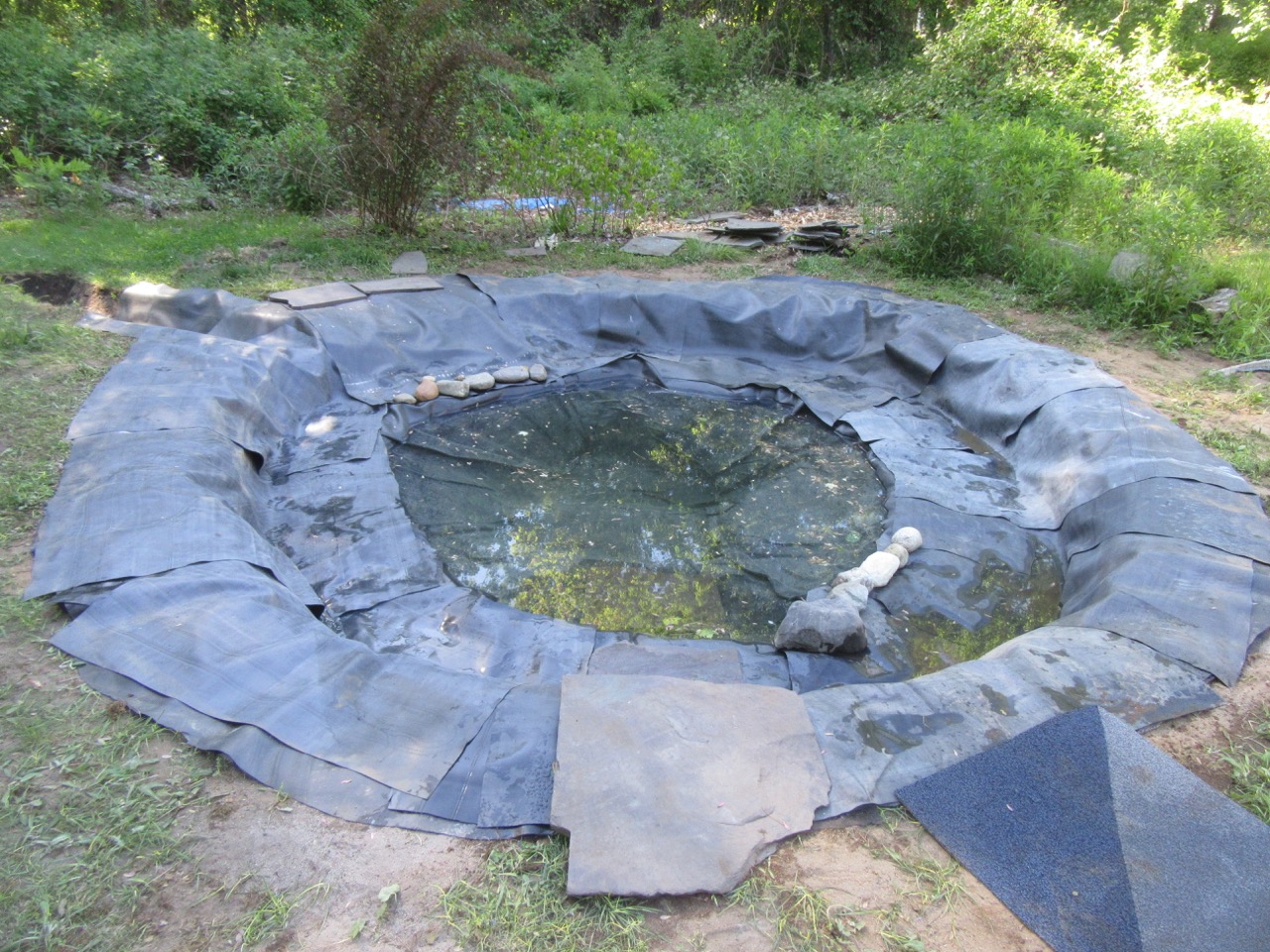
I started cutting it up and laying pieces of it all around the planting ledge, starting with the spot that I hope will be a little incline “beach” for animals to be able to approach. And as it happened, I had just enough liner to cover everything I needed. Then I started putting some stones into place. I did that in bare feet, and an old carpet square worked as a place to wipe off my feet before getting onto the planting ledge. We had some slate pieces that we found here when we first moved here, so I am hoping to use them around the edges of at least part of the circle. But I am also trying out using them for steps into the pond. Once the pond is full of life, it will be slippery, so maybe not. Decisions for later.

Photo: pond with liner overlay done, and stones begun to be placed.

I worked into the late afternoon, but finally came inside for another commitment. Today I am feeling all that work in my body–sore hands, sore muscles. I am eager to continue laying the stones I have–and then I will see how many more I will need. More decisions. The basic idea is to put larger stones around the center of the planting ledge, and larger stones near the outer ring of the planting ledge, then pea stones to fill in–those will be the growing medium for bacteria that clean and filter the water and aquatic plants that clean and filter the water. But as with this whole process, I am taking it step by step. I think if I had really known how much work it would be, I might not have had the temerity to begin. But here I am.

Pond, next steps

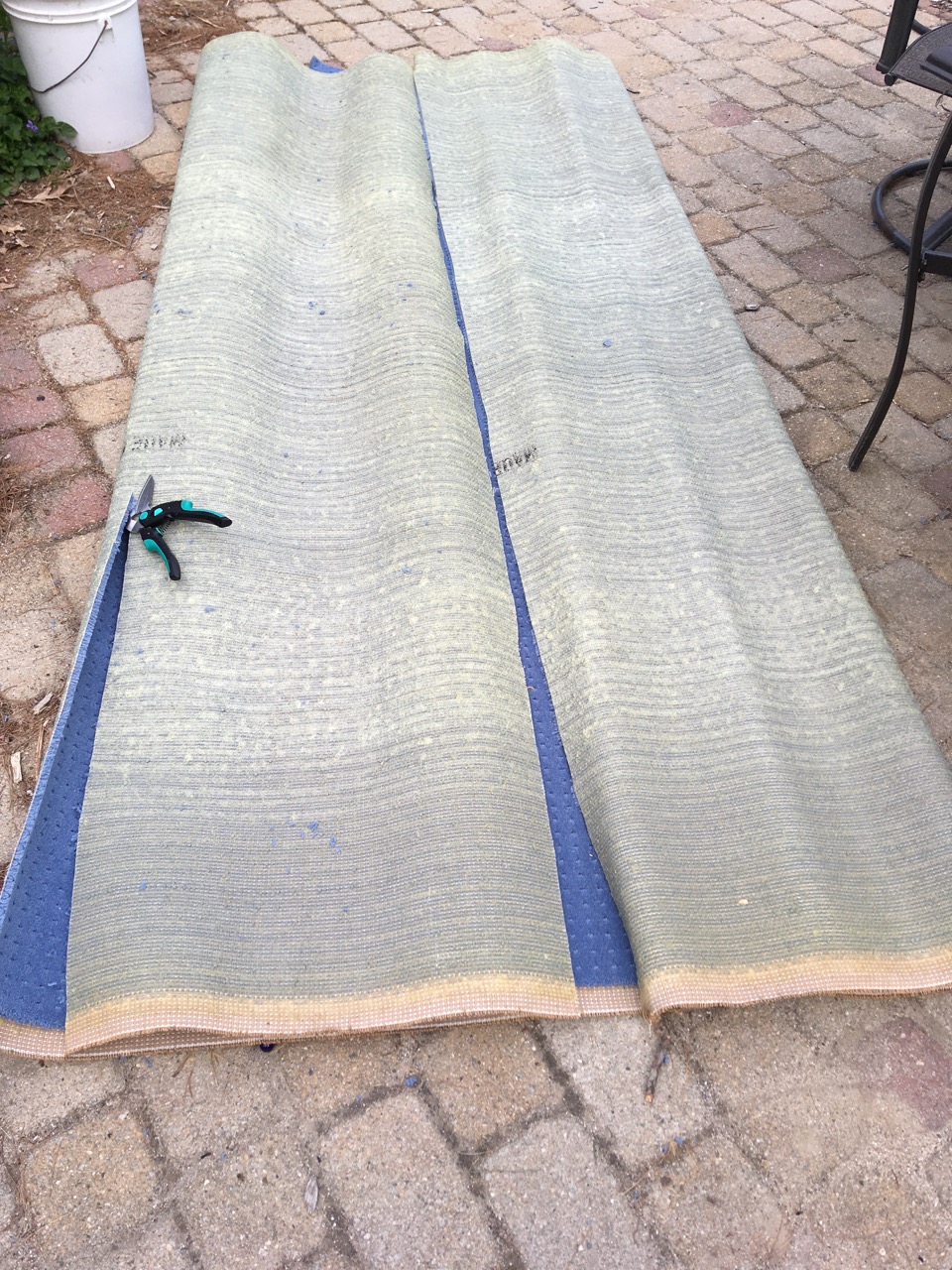
Photo: Cutting old donated carpet in 2 feet+ strips

I had a slow start today. I haven’t talked much lately about living with chronic illness, but for some reason I’ve been feeling much better energy than usual this spring. Still, I have a method for energy use: First of all, I rest when I need to. But what seems to work with garden projects is that I exert myself for a short while–say 10 minutes, or one wheelbarrow load. And then I sit and rest for 10 minutes. I don’t time myself, that is just a guess. I stop when I need to and rest until I can start again. While resting, I drink some iced licorice-root tea–that is a big help. I make a big batch of the tea (boiling licorice root for 15 minutes), and cool it to keep in jars in the fridge. Then I put together a big plastic glass (with a cover to take outside) adding ice and some lemon juice. Licorice root is said to be good for adrenal glands, so maybe this is why it has been so good for my energy.

But for example, this afternoon about 3 p.m., after my slow start, I was able to make my way outside. I started on the next step for the pond–cutting the old carpet (that I collected for free) into strips about 2 feet wide. I started with the biggest carpet piece I had received. Margy bought me a really good pair of carpet cutting scissors. Oh my gosh–they are so sharp and nice and easy to use. So I cut one 8 foot (?) strip, and then I rested. Then I cut another one. It went like that. After I had finished cutting that carpet piece into about 8 strips, I decided to see how it might lay on the pond surface.

But then I had another thought while experimenting. Since the pond is no longer going to be 3 feet deep, but rather about 2 1/2 feet, and since I have a pond liner that is 20 by 20, why not make it a bit wider at the top. (Since the equation for the pond liner size takes into account depth and width and length.) So instead of 11 by 11 1/2, just add a bit more on the half that has a one foot planting shelf, let the pond be closer to 12 by 12, and the planting shelf be a bit wider too. So I started digging again around the top edge. And then I remembered the advice to make a sloping “beach” edge for small critters to be able to get in. So I did some of that. Again, bit by bit.

While doing this further digging, I again saw more bright orange bittersweet roots. This is the biggest reason why we are using carpet strips as an underlayment. Some folks like sand better, but we need something that can stop the roots from puncturing the pond liner.

So the next photo is what it looked like when I called it a day. I was lying in the hammock a bit, resting, and then when I got up I could barely move. That is the other part of this process. I get really exhausted and sore all over. So I came in and took a hot shower, and then took two aspirin, which lately always seems to help. I’ll be down for the evening, but tomorrow, probably ready to start again. Unless I am not. I am sharing all these details to say that I am so grateful I am able to do this outside work, in this rhythm of work and rest. And also, maybe it might be a helpful suggestion for others who don’t have stamina for whatever reason. Work and rest, work and rest, in little segments. It has been a good day.

Photo: the pond, which is wider now (on the left and foreground), with blue carpet strips covering the “beach” area, and going down to the bottom.

Lessons from Other Beings

I feel a deep calling to learn from the other beings who share this earth with us. I was reminded of this calling by a new book I just started reading, Undrowned: Black Feminist Lessons from Marine Mammals, by Alexis Pauline Gumbs. She is observing dolphins, whales, and other mammals who live in the sea, and learning the wisdom they might have for human beings–especially for black women, but also for all of us. “They are queer, fierce, protective of each other, complex, shaped by conflict, and struggling to survive the extractive and militarized conditions humans impose on the ocean.” It is a beautiful and meditative book and I am so grateful. Reading a chapter each night has fed my soul, as well as helped me remember how key it has been in my own path to listen for the wisdom of other creatures–though the ones I learn from are usually closer to home than the sea.

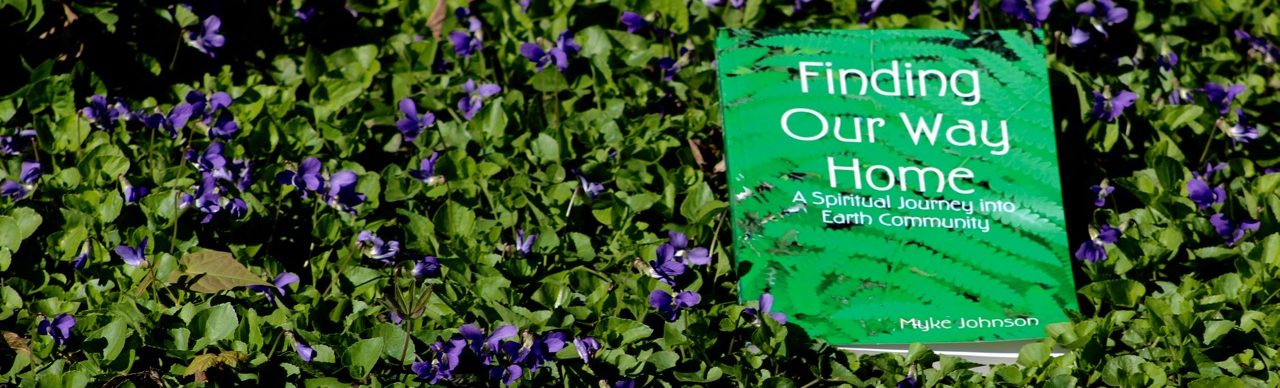
Yesterday morning, inspired, I began to read again my own book, Finding Our Way Home: A Spiritual Journey into Earth Community, remembering. I was remembering the many quiet moments I spent in my former back yard, listening to cardinals, watching slugs crawl through the grass, paying attention to trees, to stars, to the red light of dawn. It was a yard with many mature trees, a long row of huge lilac bushes, incredible privacy, and many critters who were our neighbors–turkeys, deer, birds, squirrels, chipmunks, and occasionally skunks. I was remembering how much those creatures taught me, when I was quiet enough to listen to them.

In our current back yard–we’ve lived here five years now–we can get caught up with work: pruning, planting, soil improvement, garden permaculture projects. It is land more in need of attention from us, ragged, more depleted, invasive vines and bushes clamoring around the edges and in the soil, imbedded in city life, though still surprisingly private once the trees on the edges leaf out. There is more room for gardening–the old place was too shaded by all those mature trees. So we have planted a little food forest, herbs and perennial vegetables, made room for hugelkultur and raised beds and even shared with our friends room to grow herbs and veggies.

But it is easy to get caught up in the work of it–a lot of work. It is easy to forget that other part–the listening to the land itself and the other creatures here, the plants and animals. I remember when we first found this place, feeling from it an unmistakable message: that through making relationship with this small piece of earth, I might learn more about what it means to be in relationship to earth and all her creatures. It was time to think small–right here I could find home, I could find earth community. The work is part of it–we are here to learn to be beneficial members of this tiny ecosystem. It has weathered much neglect and abuse from human beings in its history. But the work is not the only part of it–the listening is the most important part. Sitting quietly, watching, waiting. As spring makes it easier to be outside again, I am ready. I am ready to take my lead from what the land asks, what the land teaches.

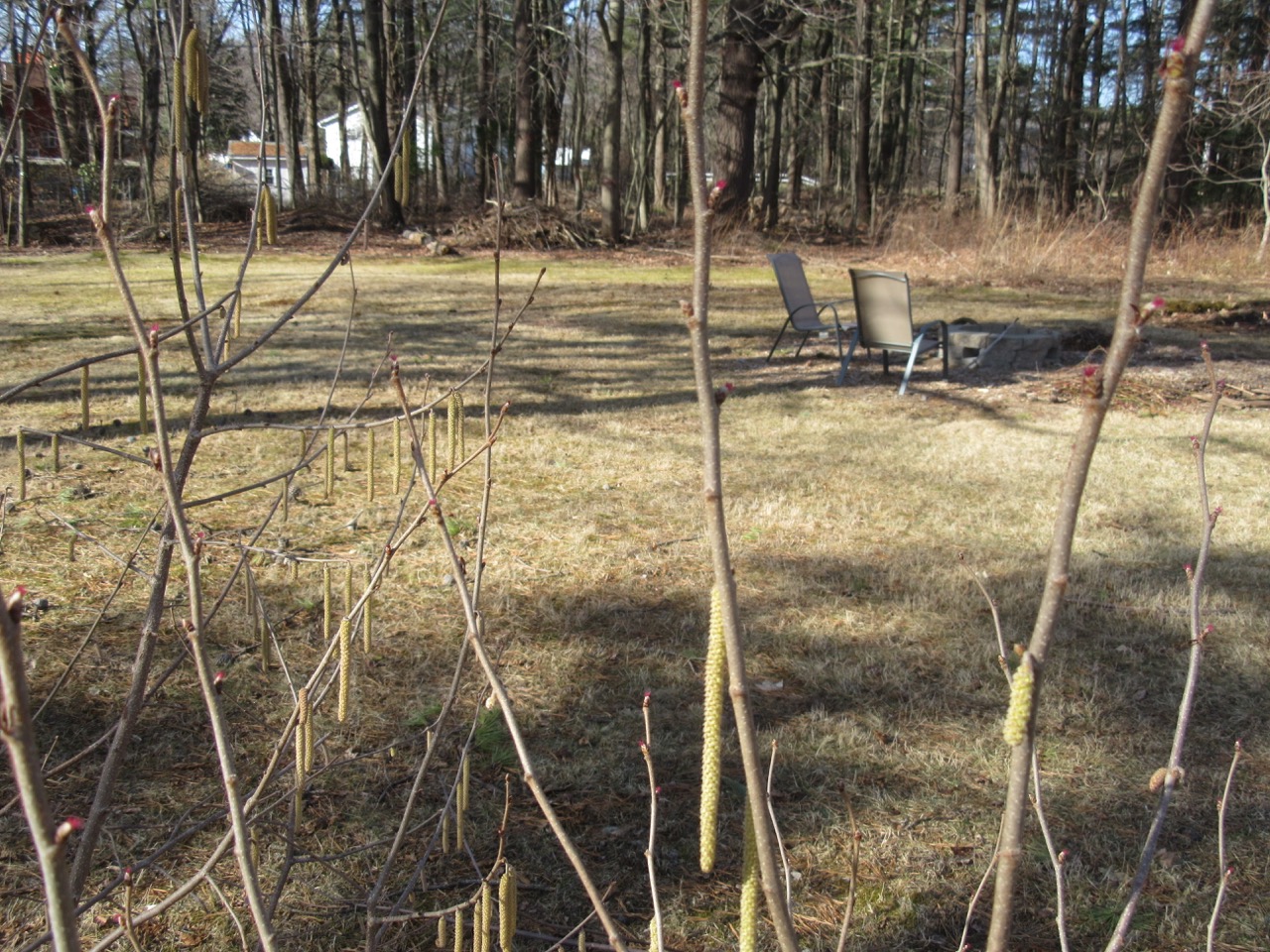
View of the back yard through hazelnut bushes with catkins.

Fear: A Pile of Stones

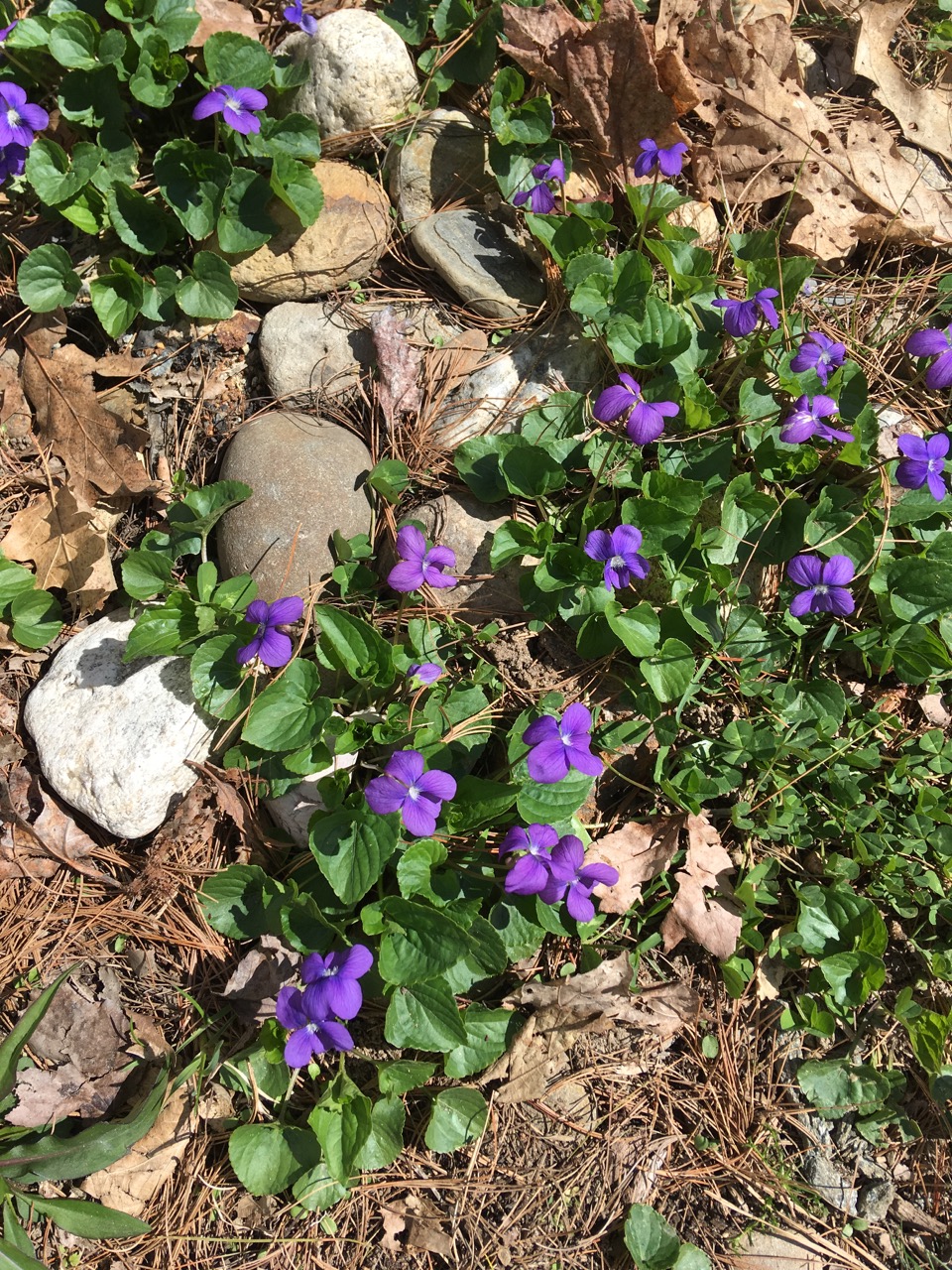
Stones & violetsTwo years ago, when I found any stones in the asparagus bed I was creating, I threw them over to a place next to the garage, until there was a pile of stones there. Then, later, as I found more stones, I added them to the pile. This spring, the violets decided they loved the microclimate it created. So now this pile of stones has become a beautiful violet rock garden.

I woke today feeling so much fear that I was immobilized. If fear is heavy like a stone, if we accumulate all the fears and toss them into a pile, might something beautiful yet emerge? It was a particular kind of fear that arose in me, or it seemed particular to this society. It was triggered by my no longer being able to work. For me, this is not about social distancing and a closed economy, though it helps me to understand the people who are worried about that. For me, it is about chronic illness taking away my energy capacity to work.

Working signifies our ability to take care of ourselves. All our lives we have learned the American “gospel” of individualism–everything is on the individual. In some ways, this individualism freed people to become that which our families could not comprehend. Feminist. Lesbian. Activist. When women were free to work, we were free to make our own decisions about our lives.

But in other ways, it has meant we are flying without a net. If we can no longer work, what happens then? Despite its limitations, I am immensely grateful for the safety net that was created in the cauldron of the great depression–Social Security. In the midst of the heavy burden of individualism, it became a bright light of collective care for all of us. We each contribute and we all can benefit. It enables Margy and I to have our basic necessities in retirement. But this net is now in the hands of robbers and thieves, who would like nothing more to do away with it. And so I feel afraid, my heart heavy with stones.

When I read about how some countries are giving their citizens a monthly income during the pandemic–countries which also, by the way, have free universal health care–when I see what might be done, it makes me feel so sad and so afraid for all of the working people in our country. If people had a guaranteed monthly income, they might not need to clamor for businesses to reopen before this can be done safely. But instead, they are caught between a rock and a hard place–stay home and risk starvation, or go to work and risk death. It is that stark. And the fear becomes a trigger for violence, and the threats of violence. More stones.

I’m not at the stage of seeing any violets yet. I don’t know what beauty might come out of this. I am just throwing stones into a pile.