Unimaginable

Margy and I finally had a chance to see the movie version of the Lin-Manuel Miranda musical Hamilton.  We loved it. I have seen many reviews and commentary on the musical, and I love its capacity to get us thinking and talking about so many issues–I love its lyrical, historical, and political density.  Some commentary is highly critical of the musical, but I love what African-American historian Annette Gordon-Reed has said about how we can love art, and also enter a critical engagement with it.

(First indulge me in one ironic moment about how certain Broadway musicals have so much to say to audiences that can’t afford to go to Broadway. It reminded me of seeing Les Miserables many years ago in a theatre in Boston–my lover’s middle-class parents had given us tickets–and how weird it was to see this revolutionary drama about poor people, side by side with folks who were wearing their furs and jewelry. So Broadway, and most mainstream theater, has never been very accessible to my class location. But I am glad that this one was finally made into a movie.)

Some critics have chided Miranda for making the “founding fathers” more heroic than they were in actuality, and keeping the historical narrative focused on the white elites, despite his casting people of color as these historic figures.  I found myself having a different response. I was thinking about the musical as it speaks to our time, to the situation of black and brown people in 21st century America. The way I experienced it, in the casting of people of color, the revolutionary heroism which has often been attributed to the “founding fathers” is being visually and transgressively applied to black and brown activists of today, illuminating their struggle and their heroism.

I see it in the lyrics (and music) from the song, My Shot:

Hey yo, I’m just like my country
I’m young, scrappy and hungry
And I’m not throwing away my shot…

Come on, let’s go
Rise up
When you’re living on your knees, you rise up

And then the parallels to our own times cut me to my core in one particularly poignant song–It’s Quiet Uptown. We see the Hamiltons grieving the death of their first born son Phillip (who was shot in a duel). And because the characters are people of color, I can’t help but envision the pain of the parents of so many black and brown children killed by police brutality today.

There are moments that the words don’t reach
There is suffering too terrible to name
You hold your child as tight as you can
And push away the unimaginable
The moments when you’re in so deep
It feels easier to just swim down

The Hamiltons move uptown
And learn to live with the unimaginable

The pain is unimaginable, but Hamilton helps us to imagine it. And isn’t that the amazing power of art–to open our hearts and souls to the pain and joy of our different but shared existences?

Of course the musical isn’t everything to everyone–but as an activist who cares about social change, I found it emotionally inspiring and intellectually engaging. Oh, one last thought–if you are like us, and don’t already know all the lyrics to all the songs, it helps to turn on subtitles so you don’t miss a word.

Lin-Manuel Miranda and Phillipa Soo as Alexander and Eliza Hamilton. (Walt Disney Studios Motion Pictures/Disney+)

 

Antiracism: New Learnings

IMG_4524

“Racism Has No Home Here” signs are appearing all around my neighborhood. 

I finally finished reading How to Be an Antiracist by Ibram X. Kendi. A friend loaned me her copy, but it took a while for me to warm up to the book because its approach was jarring to what I previously had held to be important about antiracism.  However, by the time I finished it, my understanding was deepened and changed in profound ways.

Before:

I had spent much of my activist life trying to get folks to understand that racism is systemic–it is more than just direct prejudice against people of another race, or hatred toward people of other races. Rather, it was a whole institutionalization of that prejudice by those in power.  Thus, while individual people of any race could hold prejudice, only white people and white systems could be racist.  Even if individual white people did not harbor direct prejudice, we benefited from these structural systems that kept racism in place. Thus, there was no way for us to be “non-racist.” Rather we must commit to being “antiracist,” and to use the privilege that structural racism had conferred on us to work against racism.

During and After:

So right off, Kendi used examples of how he had been racist in various ways throughout his youth and young adulthood. He brought it back to a personal level, and did not agree that only white people could be racist. So that threw me off a bit. Later he explained it more directly. He wrote:

I thought only White people could be racist and that Black people could not be racist, because Black people did not have power…. This powerless defense, as I call it, emerged in the wake of racist Whites dismissing antiracist policies and ideas as racist in the late 1960s.  …Black voices critical of White racism defended themselves from these charges by saying, “Black people can’t be racist, because Black people don’t have power.”

Like every other racist idea, the powerless defense underestimates Black people and overestimates White people. …[It] does not consider people at all levels of power, from policymakers like politicians and executives who have the power to institute and eliminate racist and antiracist policies, to policy managers like officers and middle managers, empowered to execute or withhold racist and antiracist policies. Every single person actually has the power to protest racist and antiracist policies, to advance them, or, in some small ways, to stall them. …”Institutional power” or “systemic power” or “structural power” is the policy-making and managing power of people, in groups or individually.  … The truth is: Black people can be racist because Black people do have power, even if limited.

Note that I say limited Black power rather than no power. White power controls the United States. But not absolutely. [p. 140-142]  [He then shared multiple examples of Black men in various government positions who advanced policies that were detrimental to people of color, and says:] These were men who used the power they’d been given–no matter how limited and conditional–in inarguably racist ways. [p. 149]

He does not negate structural and institutional racism–but he makes it less covert and more identifiable, by shifting our attention to “policy.” He uses the term “racist policies” instead of “institutional racism.”

Policymakers and policies make societies and institutions, not the other way around. The United States is a racist nation because its policymakers and policies have been racist from the beginning. [p. 223]

Another major shift he articulates is that racist ideas are created by racist policies, and not the other way around.

The history of racist ideas is the history of powerful policy makers erecting racist policies out of self-interest, then producing racist ideas to defend and rationalize the inequitable effects of their policies, while everyday people consume those racist ideas, which in turn sparks ignorance and hate. [p. 230]

So if we want to eradicate racism, we cannot merely use education and persuasion to try to get rid of people’s ignorance and hate, but we must work primarily to change racist policies.

I am pulling out these particular ideas in the book because they changed my own way of thinking about antiracism. Kendi speaks about how if we have incorrect understandings of the problem of racism, that inhibits our ability to be successful in our desire to create an antiracist society.

I would encourage everyone who cares about the problems of racism or other oppressions to get this book and explore all of his ideas, to see which ones might challenge and transform you. It is powerful and essential.

Racist: One who is supporting a racist policy through their actions or inaction or expressing a racist idea.

Antiracist: One who is supporting an antiracist policy through their actions or expressing an antiracist idea.  [p. 13]

Bearing Witness

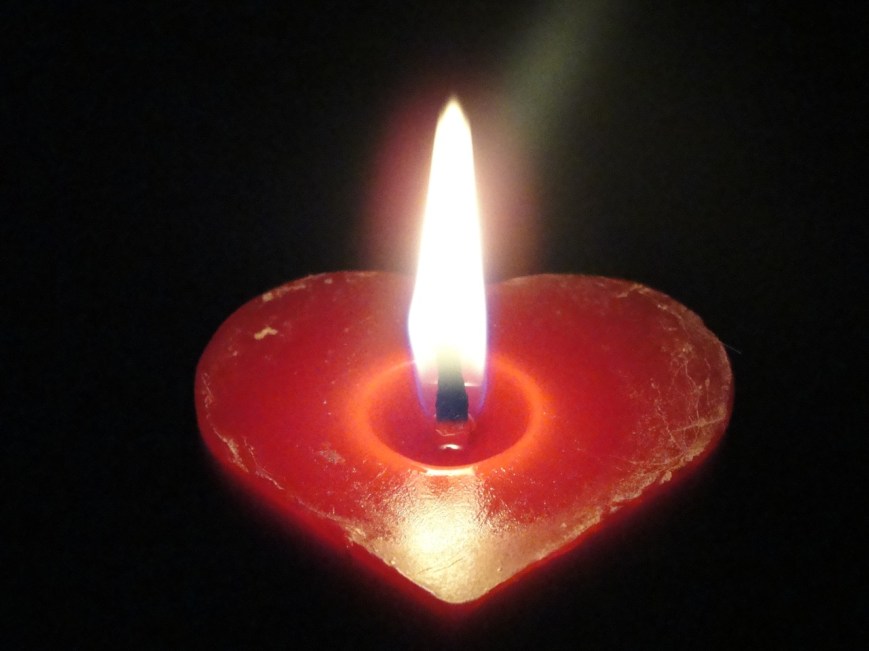
Heart Candle Flame DSC01573

As most people know by now, on May 25th, George Floyd, a 46-year-old African-American man, was killed by a white police officer, Derek Chauvin, who pressed his knee into Floyd’s neck for 8 minutes and 46 seconds, despite him begging for help, and saying “I can’t breathe.”  It was one more brutal death in a seemingly never-ending series of deaths inflicted on African-American men and women by police brutality enforcing systemic racism and white supremacy in the United States.

Because of the courageous video taken by 17-year-old Darnella Frazier, people all over the world actually witnessed the horror of this murder. Thousands of people, in every state, and all around the world have taken to the streets to protest, day after day, night after night, to demand a change. The four officers involved at the scene have been fired from the force and charged with his murder, or the aiding and abetting of his murder. A first step.

It has been difficult for me to write during this. I asked myself–was there anything I could add to the condemnations of white supremacy that have already been said by so many others? And as a white woman–should I be speaking at all? This is a time to center the voices of people of color. But also, how can any of us remain silent? On a very personal level, initially I also felt very discouraged. I have been an activist for my entire adult life. I am not taking credit for anything, this has been my calling in the world. But these days, I have wondered, did anything change? How could we have struggled so long with so little progress?

Bernice Johnson Reagon wrote a song, released in 1988, about activist Ella Baker, using her words to express deep truths about the long journey of activism for racial justice. These excerpts especially move me:

We who believe in freedom cannot rest until it comes…

Until the killing of Black men, Black mother’s sons/ Is as important as the killing of white men, white mother’s sons.

To me young people come first, they have the courage where we fail/ and if I can but shed some light as they carry us through the gale.

The older I get the better I know that the secret of my going on/ Is when the reins are in the hands of the young who dare to run against the storm.

These days, the irony of Baker’s words–we cannot rest–is not lost on me as I deal with a chronic illness that demands that I rest every day, that robs me of my capacity to show up to protest in the streets, or do very much of any other kind of activism. But her words also helped me to articulate one thing I could do. On Wednesday, I lit a red candle at 4 p.m., as a protest at Portland (Maine) City Hall was beginning, led by young activists of color. I offered my prayers and watched a live video feed for the two hour protest, and bore witness to the young people with such courage who dare to run against the storm. Maybe today, all I can do is bear witness in support of these young people, and in that way, “to be one in the number, as we stand against tyranny.”

As the protests began to multiply, in big cities and small towns, in countries all around the world, I felt a glimmer of hope. Sometimes, something breaks open.  Rebecca Solnit, author of Hope in the Dark: Untold Histories, Wild Possibilities, reminds us that the future is unknowable – and that’s a good thing. Why? Because it creates space for creative intervention. The lessons of history teach us that change happens in unexpected ways, and often in seemingly sudden, non-linear ways.

May the words of George Floyd’s six-year-old daughter Gigi prove to be prophetic:  “My daddy changed the world.” #blacklivesmatter


Fear: A Pile of Stones

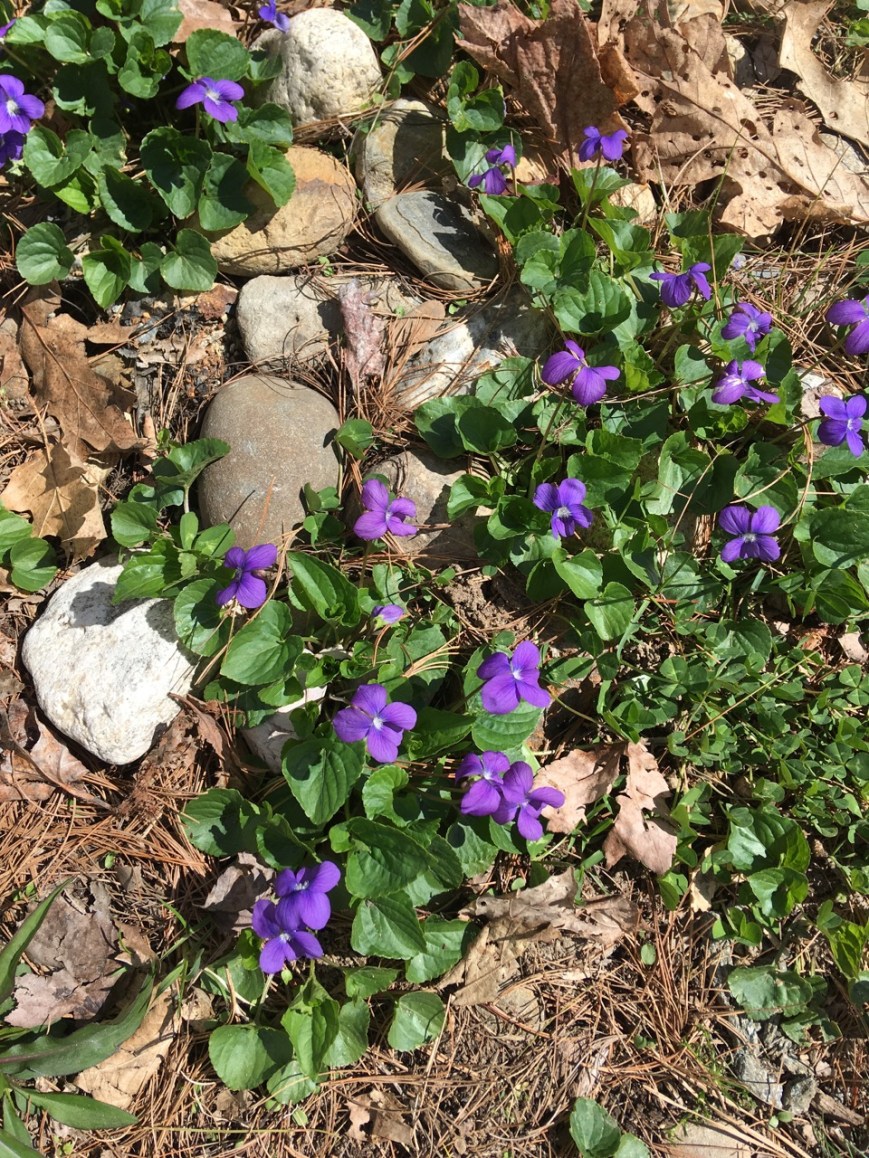
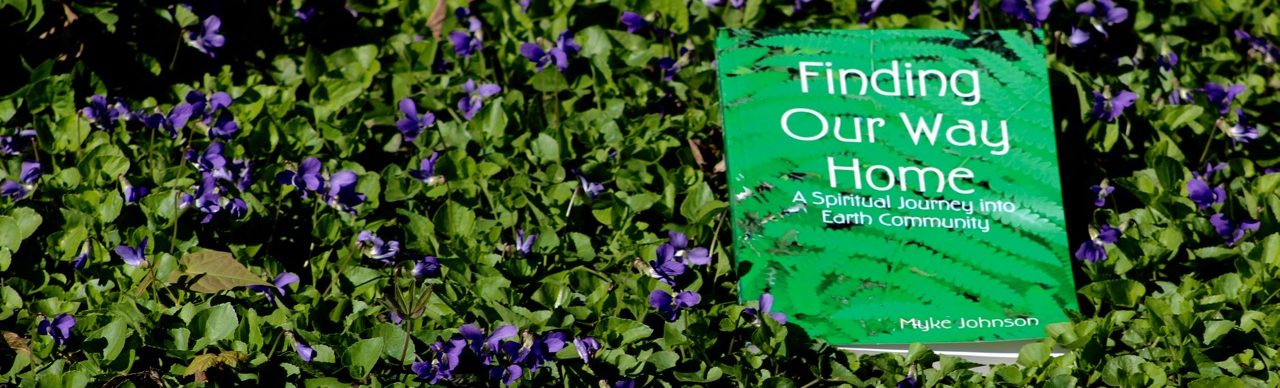
Stones & violetsTwo years ago, when I found any stones in the asparagus bed I was creating, I threw them over to a place next to the garage, until there was a pile of stones there. Then, later, as I found more stones, I added them to the pile. This spring, the violets decided they loved the microclimate it created. So now this pile of stones has become a beautiful violet rock garden.

I woke today feeling so much fear that I was immobilized. If fear is heavy like a stone, if we accumulate all the fears and toss them into a pile, might something beautiful yet emerge? It was a particular kind of fear that arose in me, or it seemed particular to this society. It was triggered by my no longer being able to work. For me, this is not about social distancing and a closed economy, though it helps me to understand the people who are worried about that. For me, it is about chronic illness taking away my energy capacity to work.

Working signifies our ability to take care of ourselves. All our lives we have learned the American “gospel” of individualism–everything is on the individual. In some ways, this individualism freed people to become that which our families could not comprehend. Feminist. Lesbian. Activist. When women were free to work, we were free to make our own decisions about our lives.

But in other ways, it has meant we are flying without a net. If we can no longer work, what happens then? Despite its limitations, I am immensely grateful for the safety net that was created in the cauldron of the great depression–Social Security. In the midst of the heavy burden of individualism, it became a bright light of collective care for all of us. We each contribute and we all can benefit. It enables Margy and I to have our basic necessities in retirement. But this net is now in the hands of robbers and thieves, who would like nothing more to do away with it. And so I feel afraid, my heart heavy with stones.

When I read about how some countries are giving their citizens a monthly income during the pandemic–countries which also, by the way, have free universal health care–when I see what might be done, it makes me feel so sad and so afraid for all of the working people in our country. If people had a guaranteed monthly income, they might not need to clamor for businesses to reopen before this can be done safely. But instead, they are caught between a rock and a hard place–stay home and risk starvation, or go to work and risk death. It is that stark. And the fear becomes a trigger for violence, and the threats of violence. More stones.

I’m not at the stage of seeing any violets yet. I don’t know what beauty might come out of this. I am just throwing stones into a pile.

Awake in the Night

I wake in the night with pain in my heart for all that is happening in our country, and I feel utterly powerless.  How can we respond to a reign of terror?  How can we respond to cruelty after cruelty promulgated by people in power? Money grabs, land grabs, malevolent neglect, direct abuse, more power grabs.  I have been an activist most of my life, and I believed and hoped that activism might help to change the world for the better.  In some ways, it really has.  But the dream–of a whole society that was rooted in cooperation and mutuality, in care for all of its people–that dream feels lost in a nightmare of empire re-emerging like some multi-headed dragon from the flames of disaster.

In my feelings of powerless, an old friend comes to me.  Jesus sits with me in the dark night. He comforts me, strangely, by reminding me that in many ways I am powerless. I can’t control what “my government” is doing right now.  The idea that it is “my government” is an illusion, democracy has become an illusion, a thin veneer over oligarchy, over fascism.  But Jesus too was powerless: he and his friends had no political power.  He lived his whole life in the shadow of the Roman empire, and that empire killed him.  Yet he was able to respond, to act, to live a life.

How? He prayed, he taught, he healed the sick, he listened, he walked among the ordinary people, in the lowly places.  He recalled the words of the prophet Isaiah:

“The Spirit of the Holy is upon me,
    that one has anointed me
    to proclaim good news to the poor.
That one has sent me to proclaim freedom for the prisoners
    and recovery of sight for the blind,
to set the oppressed free,
to proclaim the time of blessing from the Holy.”

He didn’t concern himself very often with the emperor or king or governor–he was clear that those powers were evil. Rather, he went directly to the poor, the oppressed, the sick, those were the ones who caught the eye of the divine blessing.  And later, when he painted a picture of the end of the world, this was the measure by which all people were judged:

I was hungry and you gave me something to eat, I was thirsty and you gave me something to drink, I was a stranger and you invited me in, I was naked and you clothed me, I was sick and you looked after me, I was in prison and you came to visit me. … Whatsoever you do for the least of these, my relatives, you do for me.”  

There is a certain clarity in all of this. A letting go of all that I cannot control. A shift in focus to what is possible, what really matters. An appreciation for the heroes who are risking their lives to look after the sick, those who are bringing food for the hungry.  A remembrance of the One who is with us in the midst of our powerlessness. Thank you.


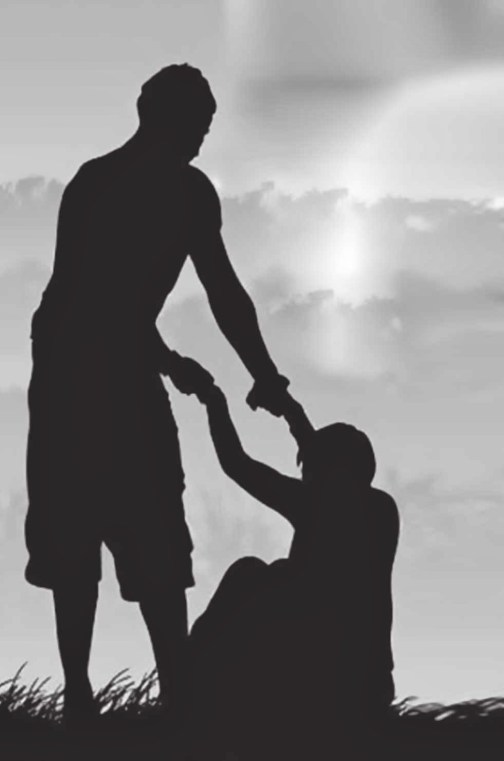
helper 485_108321

Photo Source Unknown

Death and All the Stuff

Prompted by sheltering at home during the COVID 19 plague, the question came up: maybe it’s time for Margy and I to update our wills and other legal documents which we last visited in 2012. The basic purpose for us in these documents is to protect each other and make sure that we have the power to make decisions for each other, and inherit from each other. As a lesbian couple who are not married, this is what protects our “next of kin” status.

But each of these documents also has a secondary feature.  What if one of us is not available or able, or dies first–what then, who is next? That has always been a more challenging part of the process. In this age of plague, it is not outside the realm of possibility that both of us could succumb.  Who could we ask to take on the role of health care agent, or financial agent, if we were both incapacitated?

We don’t have children, and our family members are far away, and not always supportive of our identities. We have several good friends, but not a “best” friend, and many live far away. Can we ask any of our local friends to take on these roles? Are they close enough, or not too busy, or would they be overwhelmed by such a request? Who would bury us if we both died? Who are our people?

Similar dilemmas confront us with our wills, and who would inherit if we both were to die. I find that I have new concerns now that didn’t show up in the last will. What would happen to our land and garden that we’ve been so carefully tending? How could we ensure that the land would find new caretakers who would love it as we have? And who would have to sort through all the stuff that fills our little house? My natural temperament is to live simply, to possess little, and treasure those few possessions.  But somehow over all these years, I’ve accumulated a lifetime’s worth of stuff. (How did that happen?)

In the past few months, my mother has been preparing to leave her own house, and move into the home of my sister.  She officially moved yesterday.  All of her nine children and multiple grandchildren were invited to consider things we might like to take from her lifetime’s worth of stuff. But, aside from a few mementos, most of it has nowhere to go.  So even more likely, my own stuff will have nowhere to go.  It occurs to me that if I want to share mementos with people, maybe I should just send them as gifts now.

When I first did a will, I noticed that I most cared about my writing–I wanted there to be a way for thoughts and words to survive, for journals, sermons, essays, to live on in some way, to be a legacy.  That is still true, though now that I have actually published a book, I feel less anxious about it.  It feels like something of me will endure, this book child. But I also have five archive boxes full of journals that I have saved, countless sermons, another unpublished book, and even these blog posts. Sometimes I imagine them in an archive somewhere, discovered by some future historian who will be intrigued by my story. Might I be a spiritual ancestor to someone?

What fuels my need to save the writings? What compels me to write in the first place?

I wonder, does anyone see the whole story, does anyone see each of our stories, whether written or unwritten? Are our lives inscribed in a Book of Life somewhere?  When I was a child, we learned that God could see everything we did. It was somewhat scary then.  But now I find the idea a comfort–I want my life to have a witness. I hope my life will be inscribed in a Book of Life.

From a distance

Margy at Kettle Cove

We’ve begun the time of social distancing in the age of COVID 19.  Someone else called it physical distancing, since we need to keep reaching out to each other in other social ways. Margy and I are both over sixty and have various health issues. So we are among those with elevated risk. But going outside is very much permitted and helpful during this time.  We went to Kettle Cove on Saturday–beautiful ocean, sunshine, stones on the beach. It was very windy and the brisk cool air felt bracing to our souls.

I often like to look for sea glass when I walk on the beach, but this time I only took photos–photos of water, photos of Margy, photos of stones. So I was surprised, when I was looking at the photos later, to notice what looked like two pieces of sea glass–and they were the rare red and orange ones! (I have never found them on the beach before.) Can you see them in this photo? I just want to reach in and pick them up. It is both exciting and a bit frustrating to see them right there.Sea glass?

But perhaps they are an apt metaphor for times like this–we can see (and hear), but not touch, all those we love and like, all those with whom we are bound together in community.  We still have the virtual connections of phone and internet. In the past few days, I’ve reached out to distant and local friends by phone and text and Facebook and email, and others have reached out to me: checking in on each other, reaffirming our bonds, our love. That is something else we can do in this age of COVID 19.

We are so interconnected, all of us, in such a myriad of interdependency. The last time I was out and about was to grocery shop on Thursday at the Portland Food Coop and Hannaford, trying to use hand sanitizer as much as possible of course. Thursday was the day Maine reported its first tested case of COVID 19.  (And of course, without testing available, there were likely many other cases unknown.)  But then we had an emergency–our hot water tank was suddenly spewing water out into the basement. So thankfully, a plumber came out Thursday night to help shut everything down, then came on Saturday to install a new hot water heater, with a helper. It reminds me that plumbing emergencies don’t take a break during pandemics.

So there will continue to be interactions that are vital for life. As we seek to limit such interactions, we notice them all the more.  I feel such gratitude for plumbers and electricians, for people working in grocery stores, for those delivering packages and mail, those keeping gas stations open so we can drive to the beach, those keeping phone and internet systems functioning.  And my prayers each day go to all the workers who have to keep on working, to put food on the table and pay the rent.  And my prayers go to those caring for elders in nursing homes, those working in hospitals, those bringing food and shelter to people without homes, and all the other front-line soldiers of compassion. My prayers to all the front-line soldiers of compassion.


The Ongoing Struggle

I learned another new word in Passamaquoddy:  Mocahantuwok, which means wicked devils. I am not sure if the word is used in a friendly teasing way, or in a serious condemning way. But in a serious way, I have been thinking about using it for certain people in Washington DC who are bent on undermining the processes and hopes of democracy in this country.  You can guess who I mean.

It is not the worst time in our country’s history.  That might have to be the initial conquest of these lands, and the direct genocide of millions of Indigenous people.  (That oppression still continues of course, but perhaps in more indirect ways.)  Another contender for the worst time would be the 250 years of enslavement of captured African peoples. (That oppression also continues, also in more indirect ways.)  I don’t believe there was a golden age of American democracy, that we are now on the verge of losing.

But I do believe there was a dream of America that had something to do with democracy, cooperation, and reciprocity. I think about the poem of Black American, Langston Hughes, written in 1938.

Let America be the dream the dreamers dreamed–
Let it be that great strong land of love
Where never kings connive nor tyrants scheme
That any man be crushed by one above.
(It never was America to me.)

O, let my land be a land where Liberty
Is crowned with no false patriotic wreath,
But opportunity is real, and life is free,
Equality is in the air we breathe.
(There’s never been equality for me,
Nor freedom in this “homeland of the free.”)

…Let America Be America again.
Let it be the dream it used to be.

Let America be the dream the dreamers dreamed! This dream was not only dreamed in America either. In learning more about my ancestors in Europe, I was struck by the ongoing struggles between the forces of domination, empire, and greed and the forces of reciprocity, cooperation, and shared power.  For example, my East Frisian ancestors valued their freedom and resisted domination, resisted being forced into feudalism. Friesland actually means Free Land.

But those relational values were even more striking among my early Innu ancestors on this continent. I remember reading parts of the record that the Jesuits wrote about the Innu during early conquest times. How horrified the Jesuits were that the Innu people would only follow the lead of their leaders if they agreed with them. (Democracy!) How horrified they were that a man might agree to a contract, but if he went home and his wife disagreed, he thought he should be able to get out of that contract. (Power was meant to be shared!)

Those are the same values we are now struggling over, in Washington, and all over this country, once again and still. Will we create a society in which all people are included, in which power is reciprocal and we cooperate for the good of all? Or will some mocahantuwok create a society in which they dominate over others, accumulate as much as they can, and destroy the rest of the people and the world?

It is no easy struggle.  I don’t know how we achieve our goal.  But I know I choose to live by the values of reciprocity, cooperation, and democracy in every way possible, and I choose to align myself with others who share those values. Perhaps each time we do that, in all areas of our lives, we contribute some spark of energy that makes the dream more possible.

Sunrise

Winter dawn