Snowing

Snow falling near our pitch pine

It is snowing right now, so lovely. We have had very little snow this winter in Maine. Today’s snow will be turning to rain in a couple hours they say, so I take some moments to appreciate it. But mostly right now I am thinking about sorrow and grief. A dear friend’s loved one who just died from COVID. Another friend who is sick from some unknown thing. People within my circle of friends and relatives who are struggling with loneliness and depression and worry. I am holding all of them in my heart today, as the snow falls so gently and kindly.

In Maine, they are opening up vaccination appointments to people in our age group next week. For us personally, this is both good news and not quite so good. We would have already been in the next age group, 65-69, but instead they’ve opened it up to everyone 60-69, so there will be 200,000 people looking for appointments in the next weeks, instead of 90,000. Maine has switched to an entirely age-based plan, aside from health care workers and congregate living elders who also have priority. I feel for my younger friends dealing with precarious medical situations in themselves or their families. Lots of folks are feeling upset that they will have to wait longer, though the hope is to vaccinate all adults by midsummer, and sooner if more vaccine becomes available.

Apparently, from a public health perspective, more lives can be saved by using age-based criteria, age being a major indicator of possible death and serious illness from COVID. (At least here in Maine, which has a significantly older population than some other states.) And more vaccines can be given out sooner if providers don’t have to deal with all sorts of paperwork and screening issues, which would be needed if they were to account for medical conditions. I had my moments of frustration about our spots in the long line, but then was able to shift focus to a wider lens. We, like everyone else, look forward to the day when we can more safely navigate our lives, go back to physical therapy, or catch up on delayed medical care. Not to mention gathering with friends, seeing loved ones, or just going out for a meal. But we’re all waiting, and we are in this together, even as we are feeling so much alone.

So I come back to a sense of patience, gentle like the falling snowflakes, letting go of the merely individual view and taking the wider view of all of us as a people, navigating this terrible pandemic in the best way we are able, together. I feel this patience especially now that our national government is also concerned with the health of the people, and is responding with a coordinated and extensive response. I still feel so angry that the previous administration ignored all the wisdom of public health, left local and state governments to fend for themselves, and abandoned half a million people to die. If they had responded immediately and cooperatively, so many lives could have been saved. Unforgivable. Unforgivable.

I weep for those who have died, and for those who are left behind in grief. I weep for our country, in the throes of its struggle between individualistic power grabbing and collective compassion for all. Today, my sadness is my prayer, and the gentle falling of snowflakes.

Ice Beauty

No matter how many years I have lived, I am still brought to utter delight by the icy beauty of plants in the sunshine, after a freezing rain. There is nothing so bright, so crystalline, so shimmering!

I have lived most of my life in Northern areas of the United States (except for 6 months in Texas when I was seven.) So we here are accustomed to all sorts of wintery weather. But today I am also thinking of my relatives in Texas who are in their own icy cold, so rare in that place that they are dealing with burst water pipes, lack of heat, lack of electricity. I wish for them and all their neighbors warmth, help, and support to face the challenges.

These are the among the dangers we face more and more from climate change, or as some say so accurately, climate catastrophe. I wish we could come together as one earth community to begin to live differently, to live as if our lives are totally dependent on our mother Earth and all of her beings. Because we are. And even working together we will face difficult days ahead. So much has already been lost and altered. And still, we must also be so compassionate during these difficult times, because unless we love, we can never come together as one earth community. And we must keep hold of joy and beauty, or we will lose hope altogether.

So I am sharing these photos from around our yard for beauty. May the beauty of nature help us in all of our troubling times!

Icy tree branches sparkling in the sun.
Icy plants against the fence.
Icy St. John’s Wort through the window.
Icy yew branches just outside the door.

Winter Solstice

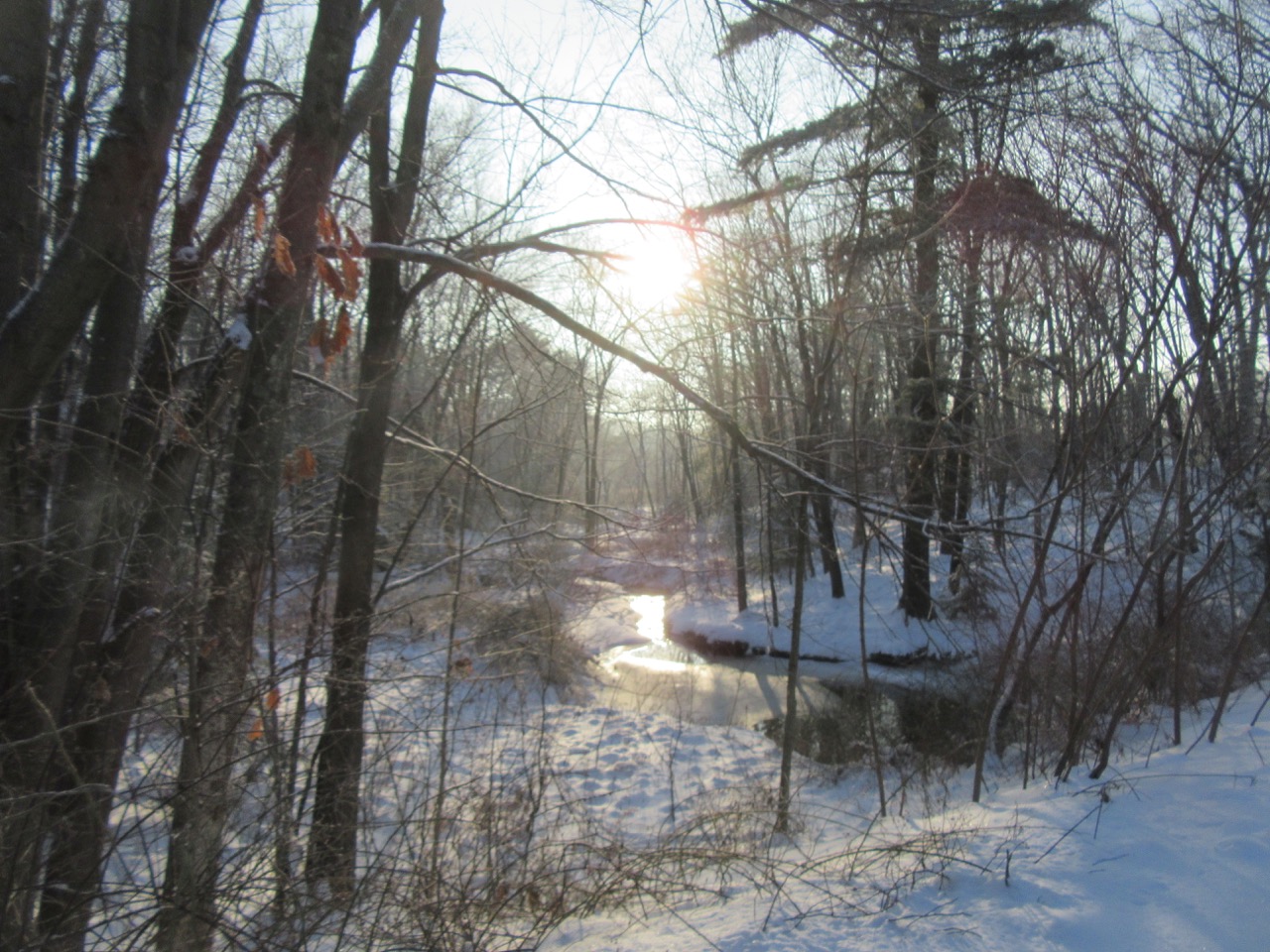
Sun shining over brook on winter solstice morning

It is the morning of winter solstice. I take a walk to the brook. The new sun is shining in a misty sky, fresh and gentle. Snow covers the ground here in the homelands of the Wabanaki, the stolen land called Maine. I am awestruck by so much beauty everywhere, grateful for the brook and its trees, for the light of the sun, for this neighborhood walk. Now that the gardening work is asleep under the snow, I am trying to go back to taking walks in the morning.

Kisuhs koti-apacuhse” is the Passamaquoddy/Wolastoqey way to say the winter solstice. It literally means “the sun comes back walking.” So maybe I, too, can come back walking–nkoti-apacuhs nil na. Today I was able to do my 20 minute circuit. Some days ago, I had started with 10 minutes, then 15–by going slightly different ways to the brook and back. For some reason, perhaps a new supplement I am taking, my energy has been returning in the mornings again. It is much easier to walk on sunny days than on cloudy ones. By the way, the sun is also known as the one who walks in the day, espotewset kisuhs.

Tonight just after sunset, there will be a conjunction of Jupiter and Saturn low in the southwest sky–perhaps it will be too cloudy to see it here–we’d have to drive somewhere in any case, because the southwest of our yard is thick with tall pine trees. I think of Jupiter as the planet of expansiveness and generosity, Saturn as the planet of limitations and boundaries. 2020 has certainly been a year of limitations and boundaries for so many. So perhaps these opposites coming together give a glimmer of new hope, that we might find our way out of this restrictive place we’ve been in. Ironically, it has been through restrictions that we have had the hope of surviving, but we also need generosity to ensure our survival as a people together, to come out the other side with possibility. Can we learn both boundaries and generosity? Can we find a way out of the individualistic greed demon that plagues our society? I pray we can.

I pray that this Solstice may be a turning toward greater light and truth, a recognition of the interwoven fate of all humankind, all life kind, on our beloved planet earth.

What’s Next?

Fruit trees with painted trunks.

Today I felt filled with an enormous dread, watching the attempted coup by a president who won’t acknowledge the results of a valid election, watching the followers who enable him to keep undermining the vote. I had felt relieved after the votes were counted. Perhaps we were back to more ordinary times and struggles–certainly the struggles were not over, but some semblance of a social order were on track to be restored.

But then I read an account by someone who had lived through a coup in their own country, Sri Lanka, who said that America is already having one right now, and I sank into a kind of terror. I won’t repeat their story here–you can read it via the link. Just to say that undermining faith in the results of an election can disrupt the very fabric of a fragile democracy, and is an invitation to ongoing chaos.

In my dread, I went outside–into a cloudy warm day–perhaps the last of these summer-like days–where Margy was working in the yard. She got in the hammock with me and I could just feel all the feelings of terror, but with the comfort of love, the comfort of the earth and sky. I certainly don’t have the answers for what we can do, what anyone can do, about this coup. I hope someone who might have the power and the answers is talking about it somewhere.

The other thing that, ironically, has relieved my anxieties about the election and the coup is a novel I have been reading about climate change. It is the latest work by Kim Stanley Robinson, The Ministry for the Future. Set in the very near future, the title refers to an international agency that is formed to be a voice for future generations in the international arena. It’s a fragmented sort of novel, with each chapter a small piece in a larger fabric, and only a few on-going characters to help keep the thread going. Like in some of his other works, Robinson’s characters are trying out all sorts of ideas to turn around or mitigate the catastrophes of climate warming. Perhaps it will get more hopeful as I keep reading, but for now, it is sobering. So the terrors of a coup are replaced by the terrors of climate catastrophe–but those terrors are more familiar to me.

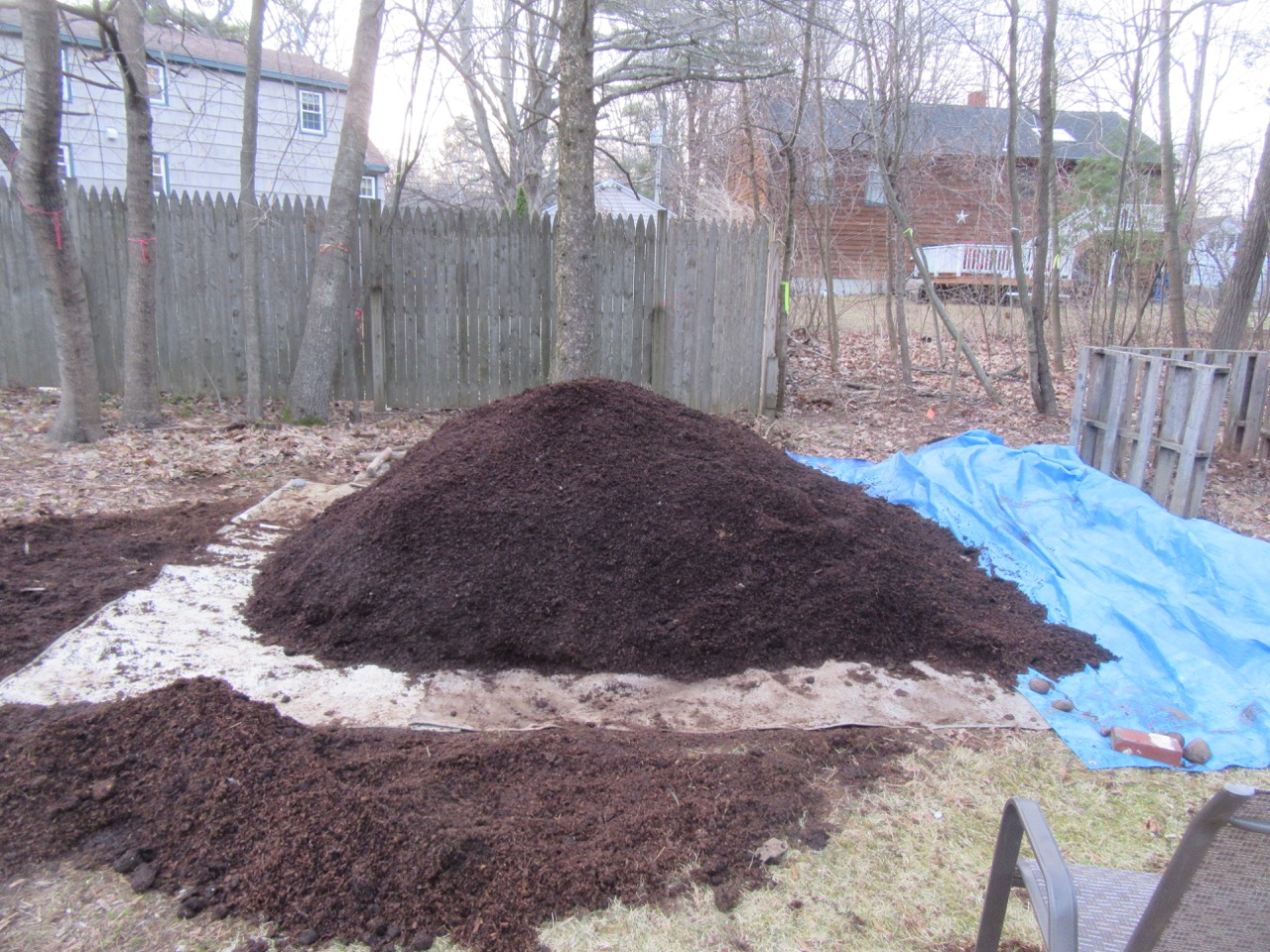
In the meantime, Margy and I seize the opportunity of our own strange weather to replenish the soil in our little part of the earth–another visit to the beach to get more seaweed, more sifting of compost (to get the roots and stones out) to put near the fruit trees, raspberries, bushes in the back of the yard. As much compost as I can sift, I put it somewhere. As much seaweed as we can collect, we put it somewhere.

For the fruit trees, also, a few weeks ago I painted their trunks white. There is a whole story to this. I had read about painting the trunks of trees white to protect them from sun damage in the winter, to protect from insects burrowing. But when I first read about it, people were talking about using latex paint, and that didn’t feel true to the spirit of organic permaculture.

Then, this fall, searching the web for another project–looking for food safe paints–I came across milk paint. This is the old-fashioned white wash that Tom Sawyer used, that most people used before the modern age. It’s made of natural ingredients: milk proteins, lime, and pigments. It has no VOCs to emit, no scents to be allergic to. It came in a powder that I mixed with water, in the amount I needed for the trees. The powder will last a long time, but the mixed paint only a couple weeks. So I painted the tree trunks. You can use it for lots of things, not just trees. Finding resources that cause no harm to the earth–that help the earth–these are like little miracles that never cease to delight me.

Raised Garden Bed, Part 2

After putting in the structure of my cedar raised garden bed, I have been gradually filling it with layers of compostable material along with the soil I had taken out. This is called “sheet mulching” or “lasagna gardening” and is a great easy method to enrich the soil. In its most complete form, sheet mulching includes laying down cardboard or newspapers on top of whatever is growing on the ground (lawn, etc.) without any digging required. But since I wanted to have a deeper root zone in this raised bed, I did weed the soil and dig down deeper. Autumn is an excellent time to sheet mulch because the bed will have all winter to decompose and be ready for planting in the spring.

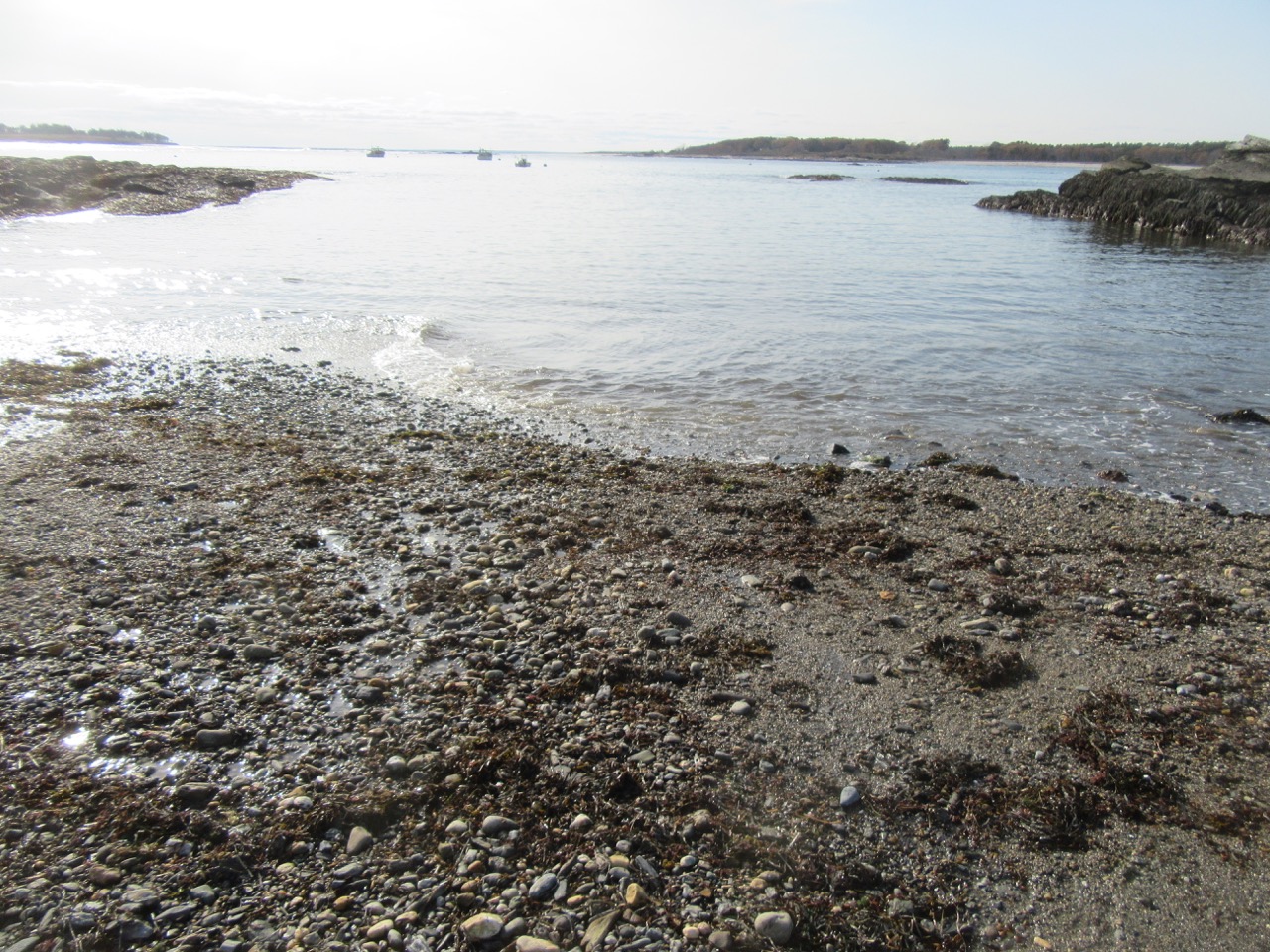
This is a form of composting in place, so you alternate layers using amendments rich in nitrogen (called “green”) or carbon (“brown”), but it also depends on what you happen to have in your yard. A basic permaculture principle is that waste is just nourishment for another part of the life cycle. So we are taking “waste” and giving it a chance to grow food next year. We have lots of leaves in our yard, so that is an important source of “brown”, and we also live within a half hour of the beach, so we use seaweed gathered at the shore as a source of “green.” I had a chance to go to Kettle Cove on Sunday to gather a bunch.

Kettle cove beach with seaweed.

Here is my list of layers from the bottom (5 inches below ground level) up, with some photos along the way:

  • soil from the site
  • rock dust: I added some handfuls of rock dust, which adds trace minerals (I had collected a bucket-full a few years ago from a local quarry.)
Rock dust over soil in raised bed.
Rock Dust over soil
  • a bit of old seaweed, collected earlier this year.
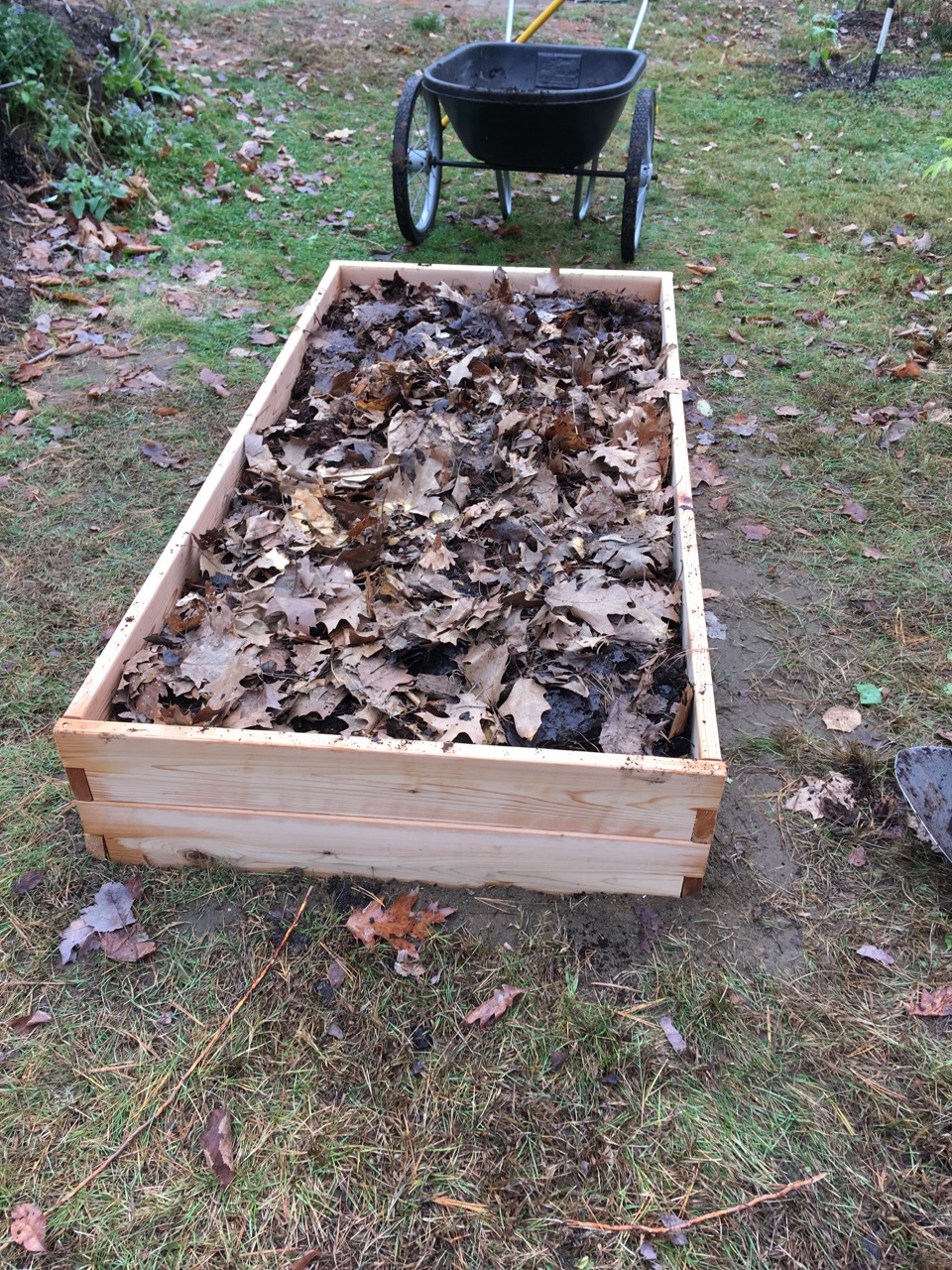
  • leaves mixed with a little bit of grass clippings, from Margy’s leaf collecting.
  • a few branches (I remembered this from my hugelkultur adventures) These are good for water retention, slow release of nutrients—I just added a few, and then buried them in the leaves—I could have done a lot more, but also didn’t want to limit the roots.
leaves, branches
  • more soil
  • After my trip to the beach, I added more fresh seaweed, a generous layer of it: seaweed is a great source for nitrogen, potassium, phosphate and magnesium, and many trace minerals. Note, I also added the second layer of cedar planks to bring it to its full height of 11 inches.
Seaweed in the raised bed.
  • more dried leaves with a little bit of grass clippings
  • composted coffee chaff (which was in a barrel we kept next to our compost bin to add after kitchen scraps: after a couple years it composted itself!)
  • more soil
  • a couple inches of composted manure: we have a pile of it from last year, but we have to sift it because it has become full of roots.
  • green cuttings from garden cleanup.
Garden cuttings over compost.
  • leaf mould from leaves left in a barrel for a couple years
  • more leaves to top it off.

And today it is complete! The rest will be done by winter, and soil creatures and time.

Raised Garden Bed, Part 1

I have to laugh at myself. After hardly having enough energy to keep up with the garden all summer, I took on the idea of creating a new raised bed. It was a 3′ by 6′ by 11″ kit with eight planks of cedar and 4 metal poles to insert in holes at the corners, but I bravely decided to add hardware cloth underneath to protect against little tunneling creatures. (And on that note, I managed to catch a glimpse of a tunneler in the act–turns out to be a tiny star-nosed mole. It seems to especially like to burrow under our wood chip paths. But apparently they are not huge hazards to the garden, so that is good to know. They eat grubs and other insects, not roots.)

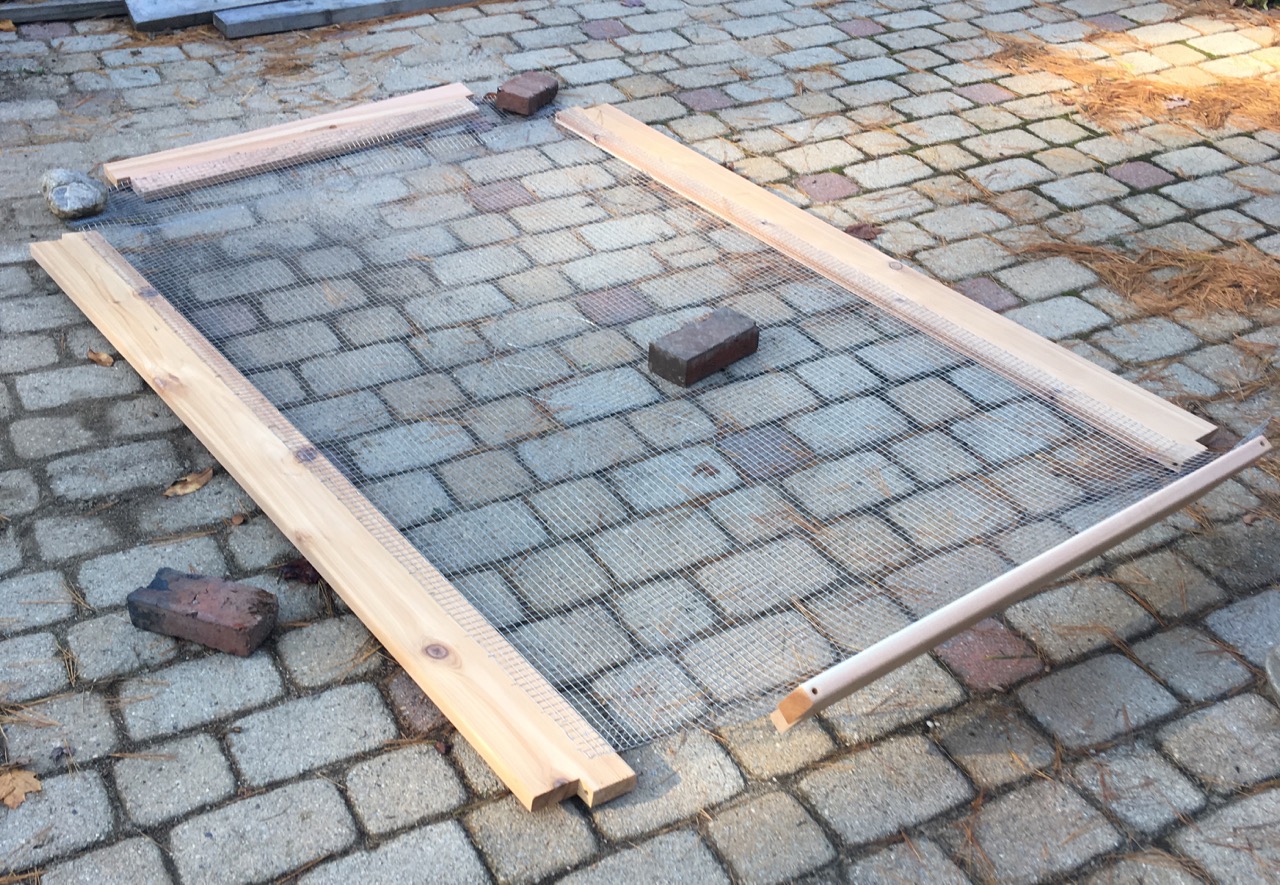
So everything arrived–kit, hardware cloth, staple gun, staples–and I started to figure out how to be able to assemble the 4 foot wide hardware cloth to the boards so it would go 5 or 6 inches into the ground to make room for deeper roots. After a lot of math, several scratches on my hands, and many staples, step one complete:

Hardware cloth stapled to cedar planks.

Margy helped me move the whole thing over to the 3 by 6 hole that I had dug earlier.

Hole dug in ground with dirt in two wheelbarrow on either end.
Hardware cloth and planks over hole.

I assembled the bed by bending in the corners of the hardware cloth so that the ends of the planks met, and then I secured the planks with the metal poles. But it didn’t fit into the hole I had dug–the hole was too shallow. So I tilted the whole assembly over to stand on its side, while I did more digging, piling the extra dirt on a piece of cardboard on the side.

Cedar planks and hardware cloth assembled and on its side next to hole

I repeated this step several times until finally everything fit. Hurray! I added the dirt from the cardboard into the cedar bed, and called it enough for one day. I still have to add the second tier of cedar planks, and all the contents–but that can be a new post.

Cedar bed in/on the ground

Meanwhile, somewhere in the middle of it all, I was happy to take time to collapse in the hammock with Margy. I am sore and exhausted, but it was a good day.

Two pairs of feet side by side in the hammock.

Autumn Colors

The last few days have been so beautiful in our back yard. The autumn color has come to us. The best times are when Margy and I curl up in the hammock together and just look at all we can see: the trees, the sky, the clouds, the birds, the orchard. When the dusk of evening falls, we see bats fly from the trees into the clearing, diving after insects.

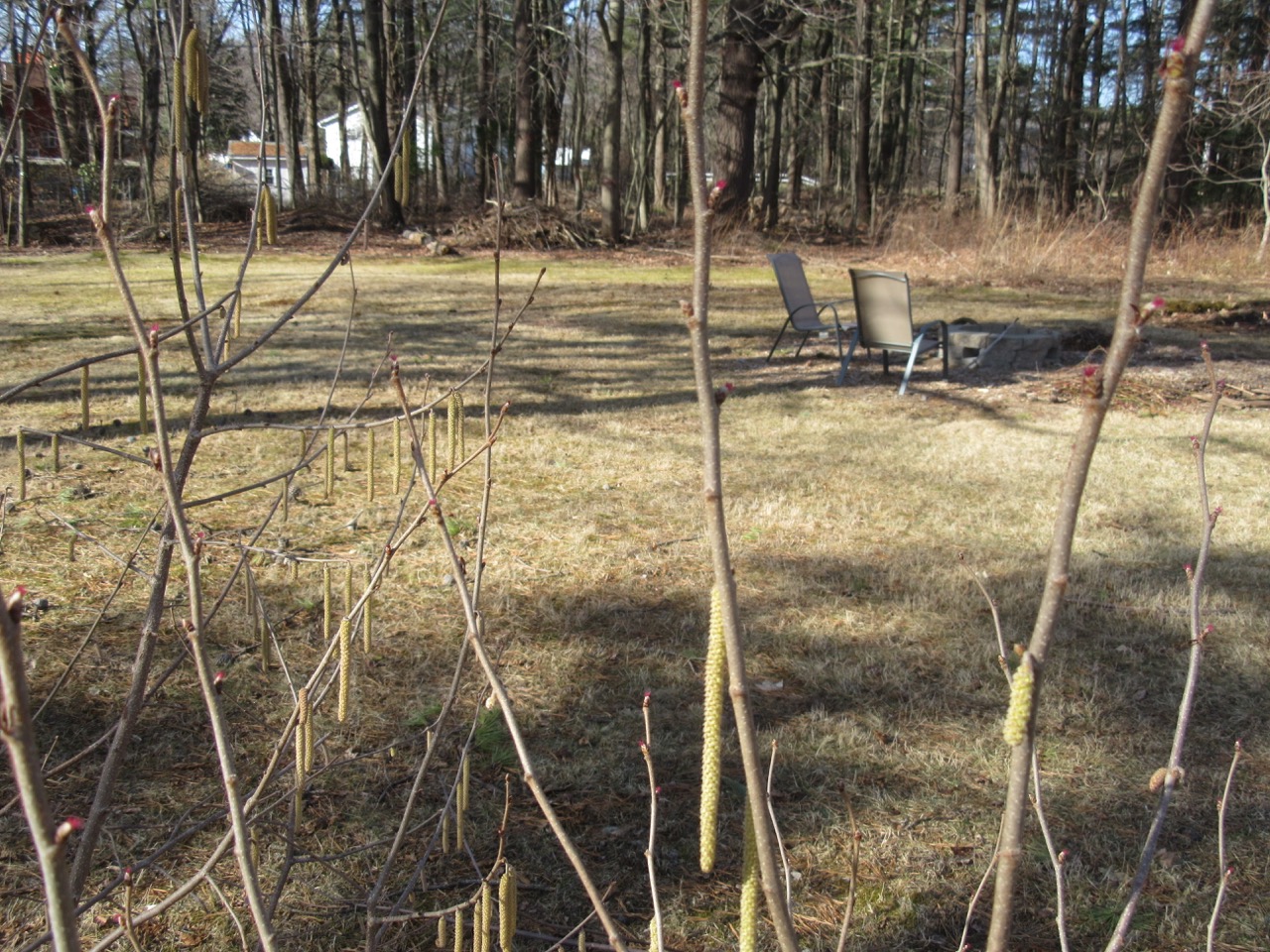
It is raining today, but this past week of sunny cool days I felt some new energy to work in the garden. I am weeding and cleaning up scraggly herb plants under the fruit trees–who knew that oregano could get so so wild? Two and a half patches finished and two and a half to go. The plan is to clean them up, then plant a few garlic bulbs around the trees, then refresh them with more compost. I have already sifted some compost from our very root-laden pile and added it to the hazelnut hedge.

Also, what a difference a good hand held pruner makes! I treated myself to buy a really good one, a Felco #8, which arrived at the end of September. I love it! The pruners I had before never did a good job, no matter how much I sharpened them. Now pruning is effortless. I am using them to cut the woody oregano flower shoots. Our mulberry tree (our second attempt to grow one actually) didn’t do well again–we just got two long side branches, so I pruned off the lower branch and trained and staked the higher one to be a new leader–we’ll try again to help it grow next year.

I also finally cut off the dead flowers from the plants near the street. I should have been dead-heading them all along, down to the next leaves, but so it goes. I learned this from watching old episodes of “Gardener’s World” with Monty Don, now available on Amazon Prime. When I am too tired to do much of anything, I’ve been watching that show. I’ve learned a lot, despite the climate in Britain being so much milder than in Maine. For example, I learned that dead plant stalks can sometimes provide beautiful winter structural elements.

Despite feeling like I didn’t have enough energy for everything the garden demanded this year, I got caught up into a new idea. I blame Margy because she put a cedar raised-bed kit into our Amazon save-for-later list. Now that the fruit trees are so much larger, it hasn’t worked as well to grow kale or other veggies around the perimeter of their circular beds. So after some further research, we purchased a kit for a 3′ by 6′ by 11″ raised bed. (I know most permaculture people buy wood and build their own, but sometimes you just need a kit to make it happen. So it goes in our world.)

We are going to place it next to the hugelkultur bed, with a 3 foot path in between, leaving three feet on the other side towards the hazelnut hedge. I’ve marked the space, loosened the soil there with a garden fork, and the other afternoon, I just sat on the ground slowly weeding out the crab grass as evening fell. Not much energy required, and it felt good to have my hands in the dirt. I also ordered some hardware cloth to make a barrier below the raised bed against the many small tunnelers who seem to delight in our wood chip paths. Once everything arrives, we will fill the bed with layers of seaweed, leaves, compost, soil, and so on, giving it the winter to percolate.

Still too much to do in the garden, but I feel delighted by the autumn colors, and the opportunity to learn and plant and grow, and sometimes just to lay in the hammock as the days grow shorter.

Grounding

Range Pond October 1

A shift has happened in my spirit, and I feel grounded in a way I haven’t felt for several weeks. I’m not sure why, but a few things have happened this week that might be related.

Three days ago, after windy rain, the power went out about 9:30 in the morning. Happily, I’d already eaten breakfast and installed a new shop light in the garage. (As a friend framed it on Facebook one day, it was a project that took two months and fifteen minutes.) So I took a short walk and discovered a few blocks away that a tree had fallen on some wires. It might be a while. I had an appointment to pick up groceries from the store, but also happily, when I called, they said it would be okay to wait until our power was back on.

Waiting for the next several hours, I noticed that my mind was in a kind of tormented withdrawal from its usual access to constant stimulation. No social media (saving my phone battery for more important things), no book to read (saving my phone, etc.), no television shows. Not enough energy to do a project. A really uncomfortable stillness. Margy and I ate lunch on the patio, and I noticed it was much easier to deal with my mind outside, so after lunch I pruned out some raspberry canes. Finally, the electricity came back–and then it was groceries to pick up and process.

Two days ago, in the morning I facilitated a very productive meeting of our Decolonizing Faith Project. We are moving toward completion of a Zoom version of our workshop for faith communities. That felt good.

Later that day, Margy and I decided to go on a rare outing. We took a drive to search for beautiful autumn color, and found our way out to Range Pond, about forty minutes from where we live. (And by the way, for those who aren’t from around here, I don’t know why but Range Pond is pronounced Rang Pond.) I took my shoes off and waded in the still warm water, delighted to watch the sun ripple off the sand. Sun, water, trees: a healing balm for our souls.

Yesterday morning, after a long night’s sleep, I woke quite early and was writing in my journal, surprised at how peaceful and grounded I felt. I remembered–and this is key I think–I remembered that throughout my adult life there has never been a time I did not hate the atrocities committed by our government. (Wars, empire, ravaging the earth for profit, oppression of people of color, you know the list.) Yes, lately, those atrocities have intensified. But I had protested every administration, and realistically, felt little power to stop those atrocities.

I also remembered that when I was part of the Catholic Worker movement, I learned that resistance can take the form of personalism: we attempt to live out our values personally, and in community–we fed the hungry, housed the homeless, welcomed the “stranger.” We treated all people with respect, and practiced peaceful ways to resolve conflicts. We also protested, not merely to try to change the government, but also to keep clarity in the values we affirmed.

And I remembered that that has always been my own best path of resistance. (That’s why Margy and I chose to green our own living situation, to plant a garden, to learn to more deeply love the land we are living on.) When I was active as the minister of a congregation for many years, I needed to widen my perspective, to hold and affirm many ways of living our values. But now that I am retired, now that I am chronically ill, I am coming back to the core of my own journey. And it is okay to do what I can, and not to be tormented by what I have no power to change.

So all of that was grounding my spirit as the sun was rising yesterday.

And then, later, I did check Facebook, and saw everyone posting about the president getting a positive test for COVID19, and speculating about whether it was true, and what it might mean. And I really do honor the angst that people are feeling about the state of our country, and the election coming up, and the possible undermining of democracy, and so much more. But this time, I didn’t lose my balance. I didn’t get hooked into the chaos. I remembered that I don’t have to loudly condemn every atrocity or agonize over all the pain that I cannot alleviate. It is not a moral necessity to be panicked and despairing over all the evil in the world.

I remembered my own path, my own calling, the small ways that I can live into a vision of mutuality, of respect, of healing. I am writing to help myself remember, for those times that I forget again and again. And perhaps to help you remember your own calling, if you have forgotten in the midst of these strange times. May our many small actions be joined together by the great Mystery into the beauty that is possible.

Mushrooms Again

Wine Cap Mushrooms in our garden

What elements are necessary for me to experience joy? What if the forests are burning in the west? Can I feel joy here in the east where the forests are not burning? What if fascism has stolen the possibility of democracy? Can I smile and sing a song about humbling ourselves before the trees? What if migrant children are still locked in cages without their families? Can I steal a moment of joy in the morning when the mist covers the sun? When I know my beloved is asleep in our home?

Today there are mushrooms again in the food forest, wine cap mushrooms that we inoculated into our wood chips over a year ago in the spring. We started something, but we don’t have any control over what they now do. I don’t know what elements are necessary for the mycelium to decide, after these months of invisibility underground, now is the time for mushrooms. The mist in the morning? Only they seem to know, and only they decide.

Last night I fell asleep asking the question, “What elements are necessary for me to experience joy?” Or perhaps I was asking its heavy twin question, “How can I dare to feel joy while the earth is suffering, so many people are suffering, the nation is suffering?” How can I be permitted any moments of joy given the reality of our world right now?

I remember when I was part of the Women’s Peace Camp, a peaceful protest next to a nuclear weapons military base–we had many moments of joy–despite the serious nature of our witness: evenings full of music, exciting sexual liaisons, long talks planting seeds of friendship that have grown and endured through time, delicious meals. I remember our wild dance parties and Emma Goldman’s words we often paraphrased: “If I can’t dance, I don’t want to be part of the revolution.”

Someone commented on Facebook the other day that we need to prepare for a disaster–they were worried about the possibility of civil war after the November elections. But when this idea rolls around in my head at 3 in the morning, I am not even sure what disaster to imagine preparing for: no electricity? food systems cut off? hurricanes? loss of social security income? no water? no internet? people in the streets with guns? evacuation? There are so many possible disasters that cannot be “prepared” for.

With age and illness, Margy and I are more isolated now, though certainly not all alone. But I miss being at some sort of front line in community. I can say to myself–we are trying to live a dream of a life more in harmony with the Mother Earth–the downsizing, the solar panels, the food forest. And I don’t forget the importance of choosing to love a woman in the face of patriarchy. Imagining decolonization in the face of white supremacy. But I feel helpless in the face of the destruction of so many people and landscapes across the nation.

It is almost as if all I have to offer now is my profound grief.

So, is it still possible to find joy in this grief time? Is it hiding underground like mycelial networks? Can it spring forth like mushrooms when something decides there is room for it now? Is it me who decides? Can I fully honor the grief that our times require, and yet still find those moments of song, smile, lightness, beauty, gratitude?

Pesto

This past week’s big garden project was making pesto. I’m not an expert on preserving food from the garden, but discovered that while oregano and thyme were easy to dry, things like chives and basil didn’t work for me to dry. But making pesto and freezing it has been great. We just finished using the last of our pesto from last summer, and it was time to make it again.

So here is my very loose recipe for anyone who might want to try it. First of all, cut big bunches of stalks of basil, parsley, and chives from your garden. And really, any combination of these will work, though I think of basil as the primary ingredient of pesto.

Basil & chives

Basil & Chives & Olive oil

Pinch the basil leaves off the stalks and place in a salad spinner–you can wash and dry them in the spinner. Do the same for parsley–I just cut the leafy parts off the stalks. Our garden is organic, but rinsing deals with any random bugs or dry leaves or other impurities that might be attached.

Parsley

Parsley in the salad spinner.

Chives can be rinsed briefly, and cut with a knife into couple inch lengths. Once these are ready, start with a blender. First, put in 1 cup of olive oil, and then reserve 1/2 cup for use as needed to keep the blender stirring easily. Add the basil and blend, add the parsley and blend, add the chives and blend. Or do this in any order you like. I also added 4 Tablespoons of lemon juice, salt and peper, 1 clove garlic, and some garlic scapes. I don’t do well with too much garlic, but you might want to add more if you like it.

Finally, I added one cup of raw hazelnuts. Traditionally, people use pine nuts, but they are more expensive and since we have hazelnut bushes, it seemed fitting, though our bushes haven’t produced any nuts yet. Later, when we use the pesto, we will add parmesan cheese.

Finally, I line a baking pan with wax paper, and put the pesto mixture on this paper in small lumps–like cookies. Place the whole pan in the freezer until the mixtures have frozen, and then I fold them up in the wax paper and store in freezer bags.

Pesto "cookies"

Pesto “cookies”

Through the winter, we take out the pesto cookies and use as many as we need with baked chicken, with zucchini noodles, with anything that could use a bit of bright flavor. I ended up needing to make two batches because I had so much basil. And the basil plants will grow back again, so we could make more later on. So much fun.