At 4 a.m. this morning, I woke in the dark of the night to pee. On the way back to bed, I saw a shadow outside the window. It was a bright night, with white snow on the ground, and a clouded sky backlit by a full moon. I opened the curtain and saw that the shadow was a small deer by the bird feeder. It was investigating the seeds on the ground below, and perhaps the water in the heated bird bath. Then it walked toward me and made its way through the orchard, passing over to the side of the house and then toward the road.
So beautiful. Things that are hidden, and then revealed. I had seen deer tracks since the snow fell a few days ago, but we rarely see the creatures themselves as they pass through our yard. What a thing to be awake at 4, and gazing toward the windows. As I lay back down in bed, I wanted to remember the blessing of the moment, not lose it to sleep. So I fed phrases to my mind, like “that which is hidden” and made associations, like, “I should pull up the small green fence around the licorice patch, so the deer won’t get caught in it if the snow covers it.” I took this photo this morning. Of course, the deer is gone, hidden again. But some tracks remain, reminding me of all that I cannot see.
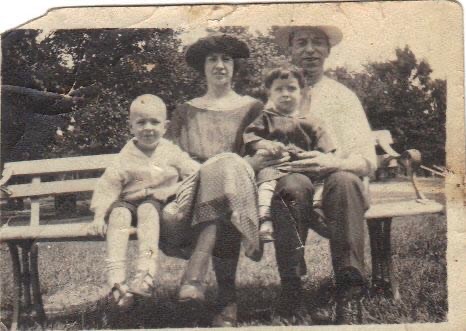
All of this also made me think of a photo I recently discovered, that I had never seen before. One of my relatives had posted it. It is a picture of my grandmother Yvonne (née Tremblay), with grandfather John Hochreiter and their two oldest children, about 1921. I had seen a photo of Yvonne when she married, in 1916, and a photo when she was holding me as a baby, sometime before she died in June of 1954. But this one brought to life a young woman in her early twenties, surrounding by her family. So much of her life was hidden from me, not by any conscious decision by anyone. My mother was the youngest of eight children, so perhaps this time before her birth was hidden from her as well. What a gift to get a small glimpse into their lives, over one hundred years ago now.
Last night before I fell asleep I prayed to the Spirits I have known. The moon, the cardinals, the frogs, mother Earth. Is seeing the deer a sign of connection? That my prayers are heard? Spirits, thank you for the gift of seeing that which is usually hidden. May we always remember that so much is hidden.
A little magic has emerged in my life. For a long time, I didn’t have the energy to go on walks, except for a minimal 5-minute walk to the end of our street. But somehow my energy has lifted a little, and for the last several days I have been able to walk to Capisic Brook, where it goes under the walkway to the elementary school, about 15 minutes total. It started January 2nd when, as I entered my driveway, I felt the presence of the Marie Madeleines, my ancestors from Îlets-Jérémie. “We are still with you.” They would have spent so much time walking in their lives. So I felt them walking with me in the early morning, greeting the dawn.
I heard the message from these ancestors: “You need new boots. Walking will be needed.” It was true that my boots were quite old and my feet were feeling it. So when I got back home, I did some online research, and then called a local store. After arranging it, I went in with a mask on, tried them on and bought myself some new boots. (The ones I wanted were on sale!) When I am lucky enough to hear a clear directive, I find it is so beneficial to follow it. And so I have kept walking almost every morning before breakfast. Even in the snowstorm, even in the first rainstorm. Yesterday I couldn’t get myself out there, but today the sun helped.
All these storms have been a challenge. We expect snow in winter in Maine. I like snow. But we’ve only had one snowstorm. There have been at least three huge rain and wind storms–first, when the spruce tree fell into the orchard, another January 9th into the 10th, and then yesterday which mostly caused damage at the shore during high tide. I took this photo of the brook at flood level on the 10th–because the branches of Capisic Brook flow through deep ravines, it doesn’t come onto roads in our neighborhood.
After the rainstorm, January 10
I can’t help but wonder what these weather changes mean for the future. Will rain and wind be the new winter, alternating with snow and cold? Someone posted (on Facebook-but no attribution) this little diagram that showed how climate warming destabilizes the polar vortex causing the extreme colds and unusual warms we are seeing right now. My sister in Montana reported -34 degrees, and Texas at 40 degrees, while we were up to 50 degrees.
While often I am most inclined to grieve or be afraid of all of this, I am also hearing the message that we must find a way to keep loving our changing earth mother, keep loving through the ups and downs. Perhaps it is also about the magic of walking–keep walking through the storms. I don’t know the answers but I am so grateful for the moments of connection and care.
Today is Halloween, that wild holiday of ghosts and ancestors and gifts of sweets. Some say the veil between the worlds is thin during these days. Celtic Samhain, Mexican Dia de Muertos. The day midway between autumn equinox and winter solstice. This morning I woke to our first frost of the season. It is later than usual for Maine, but also earlier this week than I had expected. Still, it drew me out to walk in the dawn’s first light.
I harvested the last of the (now frozen) raspberries. We often don’t get any in the fall because they don’t get enough sun to ripen before the frosts. So we’ve been grateful for several little bonus treats over the last few weeks. I also cut some (frozen) chives, and quickly chopped them up small and put back into a frozen state for use during the winter.
On October 16th, I had dug up the licorice plant, to harvest the roots–they make my favorite herbal remedy–such an energy boost iced as tea with lemon in the summer garden work. I cut off several large roots near the main plant, and all the long extension roots to new plants. After that, I replanted the original plant, and mulched with wood chips all around. Then, and I haven’t yet finished, I wash them with a scrub brush, and cut into small pieces to dry in the herb dryer. It takes quite a bit of my energy, so I can only do small batches at a time. Here is the latest:
licorice root as dug
licorice root washed and cut
So the end of the harvesting is in sight. No more zucchini. Still more kale–that keeps going after the frost. Still some carrots in the front yard beds. Leaves are still falling. Margy did some final mowing and some not-final raking. Much of our back lawn is moss mixed with wild strawberry, clover, grass, and weeds. We love the moss. On more mechanical themes, our garage door was fixed today! (It has been broken since the end of September.) We’ve also had a broken clothes dryer. Appointment scheduled for Friday. I guess these are part of our preparations for winter.
But today, mostly I think about the ancestors, those I loved who have died, and those I never knew who are the roots in my family tree. I had a new thought about my mom’s father, whom we called “Papa.” He was born “Johann” in Austria in 1884, but was “John” in the United States. He left his country with a few friends, who all worked as waiters to pay their way traveling across France, England, Canada, and finally Detroit, Michigan. None of his family of origin were on this side of the Atlantic. He remained friends with those men to the end of his life. He died when I was a young teen, so I don’t have too many memories except of a very quiet, very short man. Even though he lived with our family for a while. But when I look at my own life, I too left the place of my family, and bonded with friends who have been like another family in my life. So maybe we have that in common.
Really, there is so much we don’t know about the lives of our ancestors. All we can do is wonder. During this past year, since last Halloween, my friend Estelle joined the company of the ancestors. She was a true spirit sister. So I honor her today along with those others in my life whom I loved, and who loved me. In that, I have much for which to be thankful.
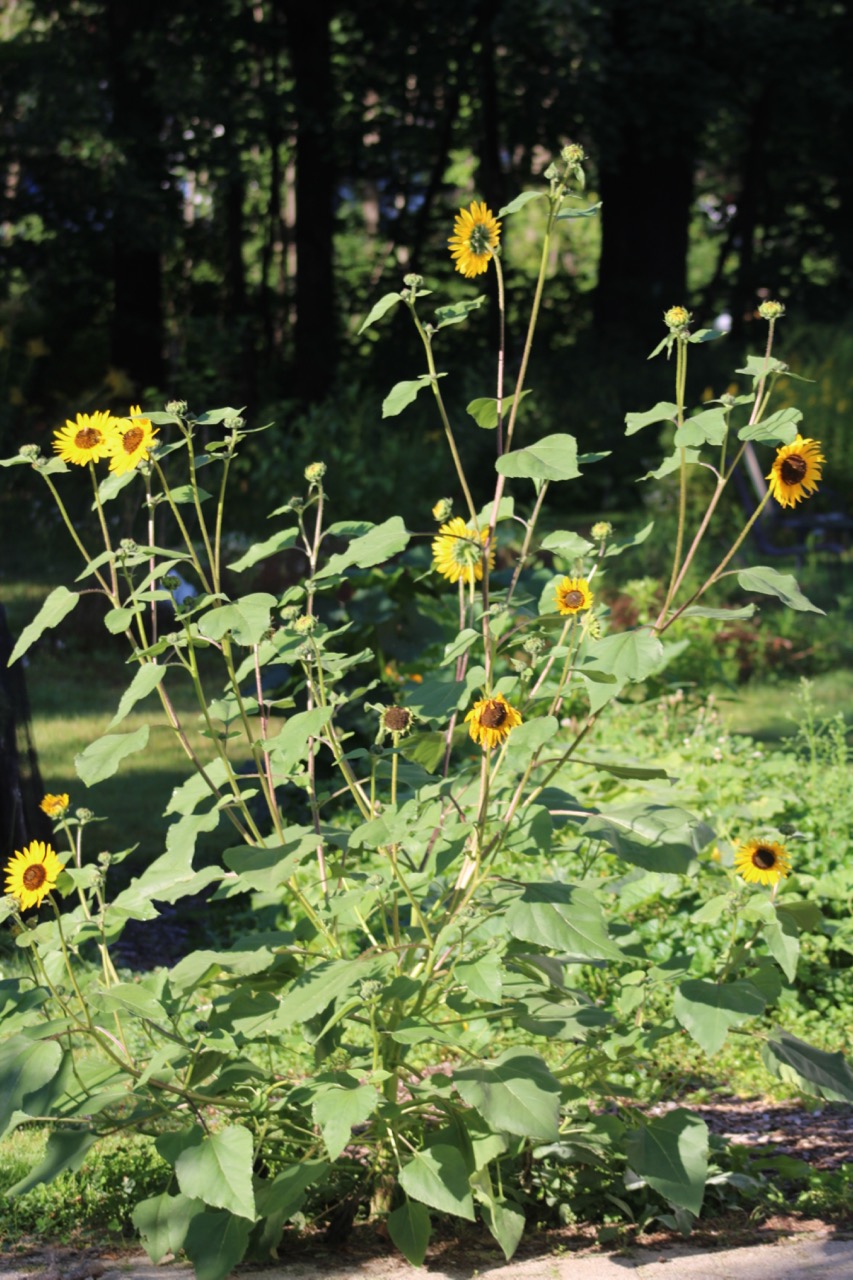
This year one volunteer sunflower plant came up next to the patio, starting small. Now it has expanded into this multi-branched extravagantly flowering giant! Doing a little research, it seems to be a native wild sunflower, because of its branching habit and the size of its flowers, and its continuing blooms. It is still one plant though, a community of flowers that is connected at the root, and much loved by all sorts of bees, other insects, and birds. It is easy to see how they belong to this place and to each other.
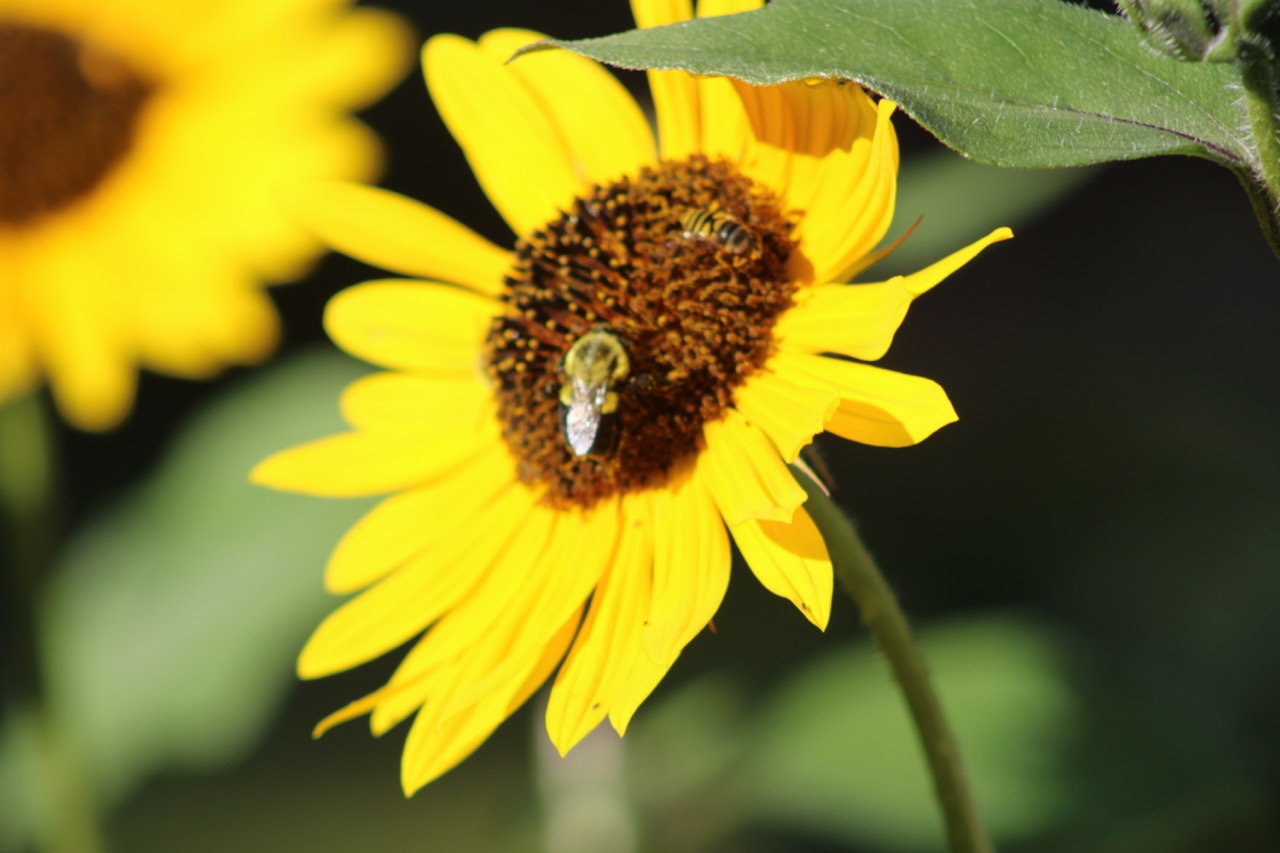
Bumblebee and honey bee on center of the sunflower.
What does belonging mean? It is easy for me to get caught in a “not-belonging” wound, the scar of a childhood moving from place to place, always starting on the outside, trying to find my way in, feeling invisible and unconnected. It is not that I haven’t had some times of belonging–there was the group of friends at college, the group of activists at the Catholic Worker or the women’s peace camp, the lesbian community in Boston. Changing perspective sometimes took me away from earlier forms of belonging, sometimes into new communities–sometimes not. In some ways I belong to my family of origin, but my lesbian identity and feminist politics created a deep barrier.
On this personal journey, becoming a UU minister created an avenue for me to nurture community, to bring other people into a sense of belonging. And in that ministry, I had a form of belonging, too, right at the center of community, but also always a bit set apart in my role. And it also meant moving once again. Even though I have retired, I am still a bit set apart because of the role of a minister. Reflecting on it, I’ve also experienced a form of belonging in my connections with ministry colleagues. But the wound continues to shape the ways I navigate the current chapter of my life. I continue to wonder, “Where do I belong?”
As I explore various facets of belonging, the feeling remains elusive. Do I belong to this place like the sunflower and the bees? I am not indigenous to this land, it is Wabanaki land. When I reach back to my own ancestors, language is a barrier between us–I don’t speak the German of my father’s ancestors. I don’t speak French (even if I understand a little), the language of my Quebec ancestors, and even of my distant Innu relatives in these times. I don’t belong to Nitassinan (which would be my matrilineal homeland) or Quebec or Austria or Germany. I don’t belong to an ethnic community. What does belonging mean in white America, especially for those of us who reject the racism of its founding?
All these thoughts are coming round in a scattered fashion. When the feelings come up in me of “not-belonging,” it helps me to remember these childhood wounds, these societal wounds. I can acknowledge and honor those feelings but then make a choice to open my heart to new possibilities of interconnection. I am becoming interconnected to this land, as I tend the trees, appreciate the wildflowers, make habitat for birds and frogs, eat the blueberries that grow. There is a reciprocity that is developing between us. I must choose to open my heart to new people as well–not dwelling in the old fear that there will be no room for me, but being curious about the ways that we might be interconnected already, or the ways that we might find to connect right now.
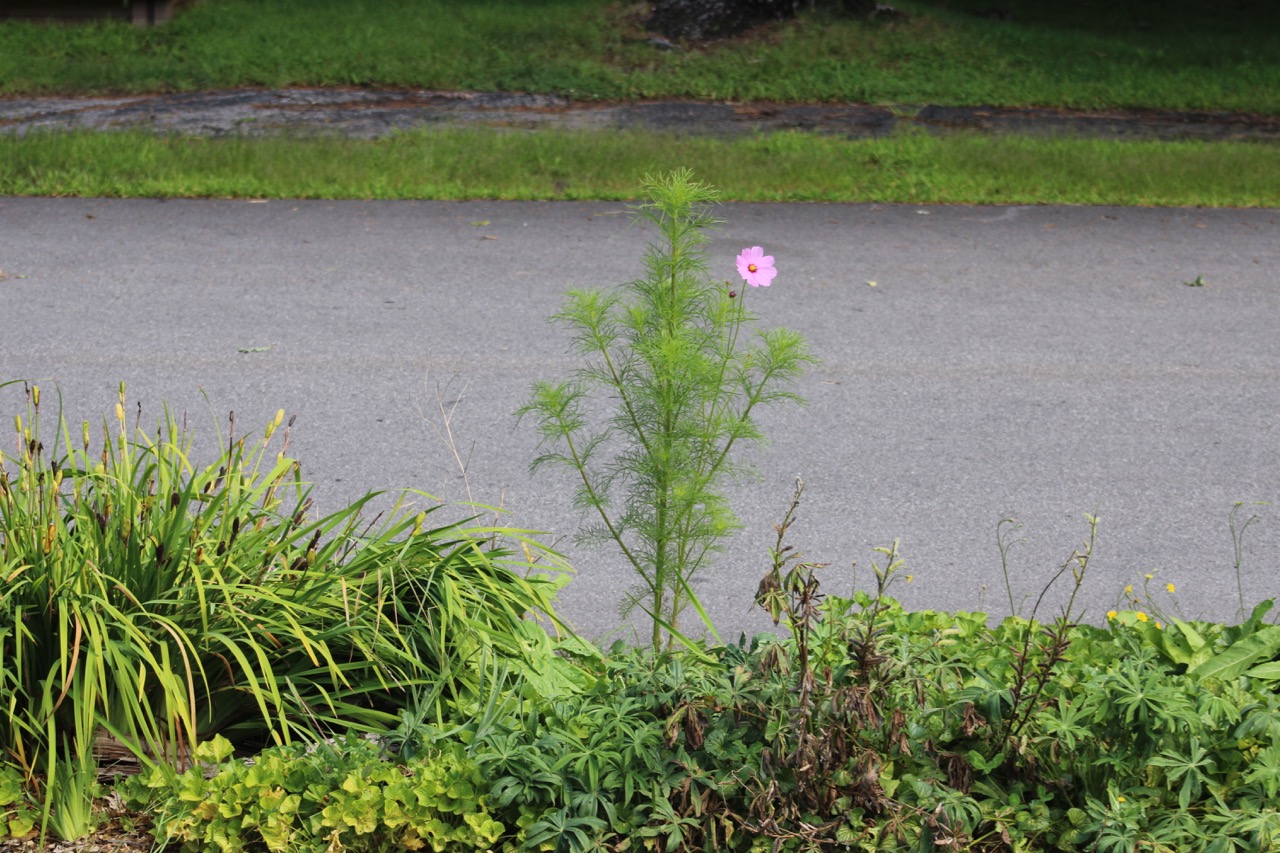
Today I see one more lesson about belonging in a tall pink cosmos flower that we didn’t choose or plant, but somehow it rooted itself next to the road we live on. It is now blooming on its own after the rest of the plants have faded. It is not in the “color scheme” of the roadside garden bed. I guess its motto is a variation of the old adage: “Bloom where you are planted.” Bloom wherever your seed happens to land.
Yesterday, going through old files on my laptop, I found a letter from October 1994 that I never sent–so really, more of a letter to myself. It described how my Innu ancestors would interrupt my daily life with their insistence on being recognized and acknowledged. I hadn’t thought about that for a long time, and wanted to remember it by including some excerpts of those reflections here. What a magical time it was.
“A few weeks ago, a friend from Vermont told me he had heard a rumor that Yvette Michel, an Innu leader from Maliotenam, was coming to visit me in Boston. This was the first odd thing. I certainly hadn’t heard anything about it. I had met her very briefly but didn’t expect her to remember me. A few days later I learned from someone else that she was doing a speaking tour in New England for the Coalition for Nitassinan. The Coalition was a group of activist traditionalists. Nitassinan is the Innu name for Innu territory, meaning ‘our land.’
“Then, I got a message from Mary Frongillo, a white woman who has been living in the community of Maliotenam for a couple years. We had spoken once before by phone. She said they had heard there was a Native spiritual gathering of some kind in Boston the coming weekend, and someone had told them I would know about it. Well, I didn’t know anything, but I made a few phone calls and found out about a gathering a couple hours away from Boston. That’s when I got a hint that maybe I should go too. But I didn’t know how I’d be able to get there, and I couldn’t afford a donation (to help with food for the elders), etc.
“Still, it felt like spirits were interrupting my regularly scheduled programs for a special bulletin. So when I called Mary back, I told her all the info, and that I was thinking about coming. She said they would be near Boston before hand and could give me a ride there and back, and we could be a camp together. So that’s when I cancelled everything, and decided to go for it. By Friday afternoon I was sitting in the sun in front of our two little tents, watching eagles fly overhead, trying to follow French (Yvette speaks French and Innu) through a mixture of translation and memory. The weekend weather seemed totally in love with us–it was sunny and warm during the day, cold and clear at night. I felt afraid at first, being shy, and especially without my favorite power: easy words.
“But eventually, I relaxed into a bilingual state of consciousness, full of the earth again and taking in so many little stories and practices of Innu culture, in a way in which I had never before had the opportunity. Things like bannock, a simple Innu bread, which we ate with our meals. I watched Yvette make two loaves, stirring flour and salt and baking powder together with water, forming a flat round loaf, pressed into a cast iron pan with flour in it, cooked about half an hour on each side. Mary was a wonderful translator, in the wider sense of the term, for she told me many things from her experience, things which someone notices because they are not from that place.
“During the last two years, the more I reckon with being white, the more the Innu part of me asserts its presence. I now believe I need both of those parts. The better white person I can be, the better I can also be Innu. So the white person fights the racism I see in the New Age theft of symbol and ritual, and searches out the spiritual wisdoms of European ancestors. And I do believe white women need to be doing this–we need to search out our own ancestral traditions and powers of the earth, rather than turn to Native or African American women as a kind of ‘spiritual surrogate.’
“But in the meantime, whenever I have thought I should let go of my desire for the Innu part of me (‘I’m not Indian enough for it to count–five generations back.’ ‘Don’t be a wannabe.’ ‘I should just be white, acknowledge my privilege and leave it at that.’) it hasn’t been supported by the spirits. It was after I was learning the Runes, and creating a link to Freya, ancestor goddess of Northern Europe, that I first met people who were helping the Innu and learned about their struggle against hydrodams. I said to myself, I am chasing after my European ancestors, but the Innu ancestors are chasing after me. A month later I was in Quebec city testifying against the dams, and meeting members of the Coalition for Nitassinan. That was another spirit interruption.
“So even as I was trying to be more ‘successful’ as a white person–ie. using my educational privilege, trying to make more money than just barely getting by, still in service to my values–I was interrupted to spend a weekend on the earth, on Indian time, in a setting where people don’t have much at all but share what they have with who needs it–all these values that exist in Innu culture, (and in other Native cultures), and which I wish existed more in our culture.”
A confession: there is a kind of envy that sometimes creeps up in me when I notice famous people, like authors with many popular books, or those widely praised or described as “influencers” and “visionaries.” (Especially when those books are most similar to my own one book.) I grapple with the fact that in the great scheme of worldly success I often feel like a nobody, and more so in my life today with chronic illness and retirement isolation. Margy reminds me that it is only human to feel such feelings. My critical thinking also notes that in the capitalist system, these hierarchies are meant to elicit self-hate and hunger. Hierarchy and domination are the underpinnings of all oppression.
Taking a brief walk today, I imagine my ancestors curious and baffled at this strange descendent who is a writer, who has strange cravings for fame. They never thought about such things. Then I remembered a poem I wrote many years ago, and went looking for it. I had titled it The Inner Wounds of Class Oppression. It is still a healing incantation for me.
Every day, envy gnaws at your fingers.
Your eyes watch the movers and shakers
climbing into dream cars, Going Places.
You want to be Somebody.  You would ride,
eyes averted from the rear view mirror
where all of the Nobodies recede
like small dark flies to brush away
from smooth shoulders.

Every day, anger fills your gut like a pile of bricks.
Your own hard shoulders ache to reach in
and hurl them forward one by one.
Your ears would strain to hear the glass
shattering and rubber squealing,
as the fine white shine of the dream machine
careens sidelong off the grade
into a deep obituary.

Every day, you clutch at the bark of trees,
knees trembling, moved and shaken.
Your fingertips feel for hidden messages
left there on some other blue morning when somebody
was repeating poems into gnarled crevices,
quiet voice seeping down the edges of roots
into rock under sand:  Remember who you are.
Precious as soil.  Worthy of the sun.
I have been posting recently about my latest research concerning my Innu third great grandmother, and because of that I want to write today some clarification about identity and relationship. The more I am learning about Indigenous people–through study, through language, through cultural sharing by Indigenous people–the more I understand that I am not Indigenous. This might not even need to be said, except that there is currently a problem of people with ancestors even more distant or nebulous than mine trying to use those ancestors as a way to claim status as Indigenous or Métis, to get benefits from governments, or preference in hiring or hunting rights, for example. Sometimes they actually use this to try to take away benefits from Indigenous communities.
Years ago, when I was still just beginning to learn about all this, I wasn’t sure if I was permitted to claim an Indigenous identity, or a Métis identity. A few times I did, out of my own ignorance. And it is not simple for those of us who are mostly something else, but want to honor our Indigenous ancestors. Even so, I can’t imagine trying to use it to take something away from Indigenous or Métis communities. What I hope for is to be a good relative, a friend, to use my position in this society to act in support of Indigenous communities.
For my latest presentation in our Passamaquoddy language class, I found myself drawn to a word in Passamaquoddy that has been used to describe non-Indigenous people: “Wenuhc.” What does it mean? Some definitions say, “white person.” And that is partly true—it refers to white people. But, its roots come from an old meaning. When, they say, strangers came here to Wabanaki land, the Native people said, “Wenuhc?” It meant, “Who are they?” It also held a question, like, “Where are they from?”
When I ask the question of myself, it comes out: “Wen nil?” “Who am I?” The traditional way to introduce oneself is by naming the place where you come from, and your relatives, the people you come from. But for me, as a wenuhc, that wasn’t so simple. The more I played with the concepts, the more confusing it became—which certainly is a characteristic of many of us living in the mainstream culture of the United States. I want to share some of what I wrote—but mostly just the English translation:
The early strangers said, “We are Englishmen.” I speak English, but my roots are not English—so am I English? Wen nil? Who am I? Three of my grandparents have Germanic roots. But, I can’t speak German. I have German roots, but am I German? Wen nil? Who am I? My grandmother came from Quebec, and she spoke French. I can speak French, a little. I have French roots, but am I French?
Wen nil? Who am I? My grandmother’s great grandmother is named Marie Madeleine. She was Innu. She spoke Innu. Now, I know how to speak Innu a little, only a very few words. I have Innu roots, but am I Innu? Now, I can also speak Passamaquoddy a little, but I am not Passamaquoddy.
Wen nil? Who am I? I don’t know. I am a wenuhc woman, a “who are they?” woman. I am far away from family. Sixteen years ago, I came to Wabanaki land in order to work. Now, I am done working. So, what am I doing? Am I a preacher? Am I a witch? Am I a writer? Am I a gardener? Wen nil? Who am I? Tama nuceyaw? Where am I from? All my grandparents lived in cities. Now, I live in the city, Portland. Am I lost? How do I find myself? Am I a stranger? Am I your friend? Am I foolish? Am I wise? I don’t know. Wen nil? Who am I? I am confused.
What I learn from this Passamaquoddy writing process is that I am not well connected to a place or to my relatives. My being a lesbian, my being a justice activist, my moving around a lot, all contributed to a feeling and reality of being disconnected from place and family. And given the injustice I found all around me in “American” culture, I don’t regret the need I felt to resist it, to break away from it. But in some ways, that is a very “American” way of being. “America” celebrates individual identity and mobility. It defines who we are by what we do.
When I seek to find my way into relationship with the earth, with all beings of the earth, with the ancestors, with spirit, when I begin to value this relatedness, I see more clearly how I have been cut off from places and people that I might have been from. And I see more and more clearly how I am not Indigenous. I am wenuhc. I am “Who are they?”
And that truth is real, it is okay. “Who am I?” is an open question. It is why I make a spiritual journey into earth community. I can learn. As I learn to be thankful for everything, I begin to feel how I am related to everything, despite being wenuhc.
Note: I first learned about the word “wenuhc” from my Passamaquoddy language teacher Roger Paul. More recently, the organization I volunteer with, Wabanaki REACH, posted about this word on its Facebook page, quoting Rebecca Sockbeson (Penobscot), 2019.
Photo: Pileated woodpecker on a pine tree near our house. The woodpecker is a symbol of friendship for Wabanaki people.
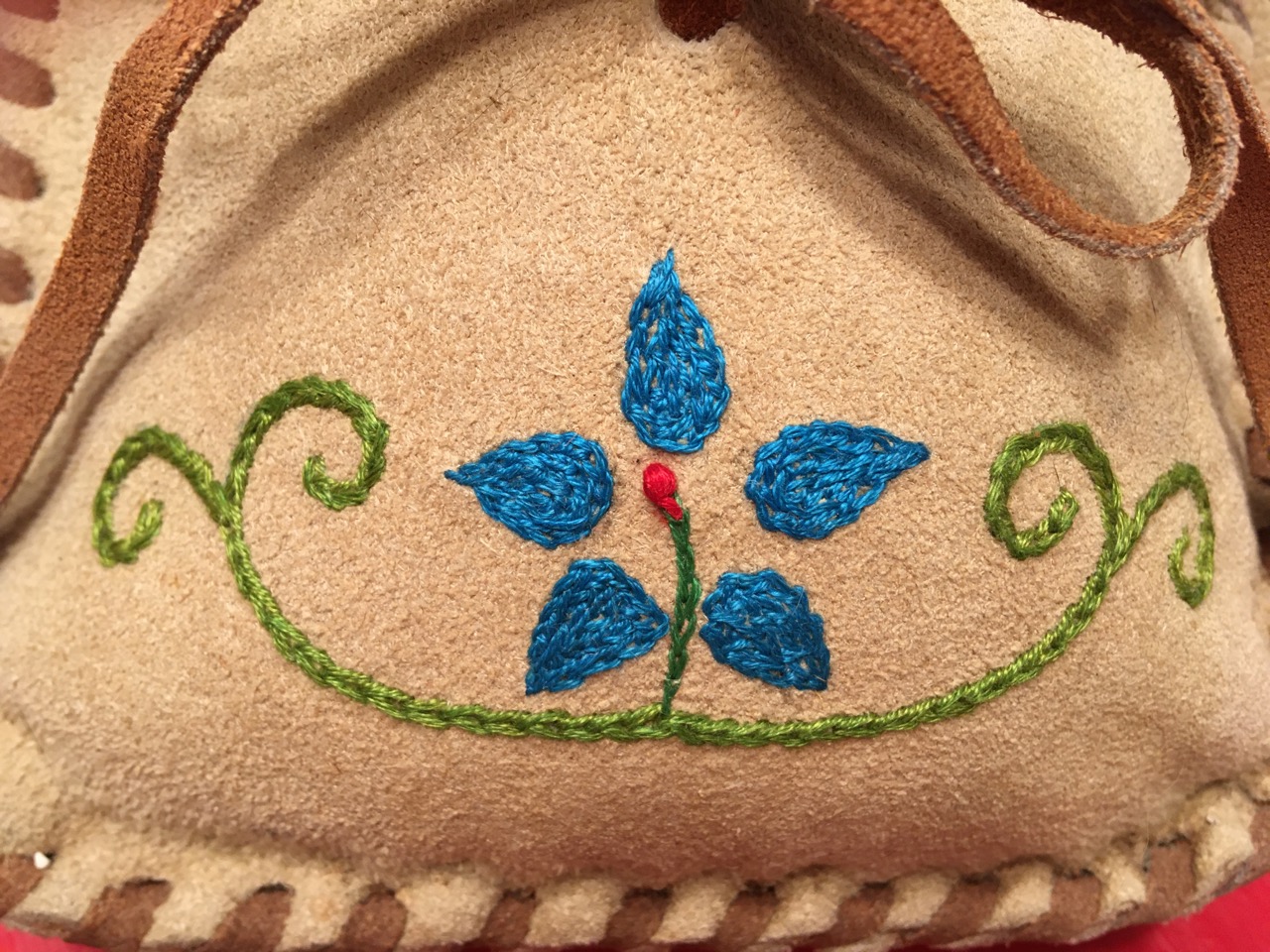
Innu embroidery on a leather bag from Lac St. Jean
“Even if you don’t know who your ancestors are, your ancestors know who you are.”
@drxicana Dra. Vanessa M. Bustamante
I think I am coming to the end of myintensivesearch for the family of my Innu third-great-grandmother Marie Madeleine. I have found the most likely Marie Madeleine of the many that I researched, though I cannot have conclusive proof of any connection. Here is what I found.
Marie Madeleine Napeteiashu was baptized June 6, 1803 at Îlets-Jérémie. She was at that time about 7 years old, “or even more,” so her birth would have been 1796 or perhaps a bit earlier. By that time, the priests started recording the father’s Innu name as a surname for the children, so she does not have her own personal Innu name listed. Certainly, she would have had an Innu name that she used for the first seven years of her life and beyond. Her brother Simon Napeteiashu was also baptized at the same time, and said to be about 4 ½ years old, so born in late 1798 or early 1799. Their parents were Napeteiashu, who did not have a Christian name, and Catherine Mitiskue. Their godparents were Simon Tshinapesuan & Marie Madeleine Iskuamiskuskueu, elders in the community who were also parents or godparents to other Marie-Madeleines I researched. Both brother and sister were named for their godparents.
I was able to find an older brother as well, Jacques Nahabanueskum (later also called Jacques Napeteiashu), who was baptized 6/19/1786, at 2 years old, at Îlets-Jérémie, his parents listed, with a slight variation as Nepiteiashu and Catherine Matshiskueu. I think the name Napeteiashu might mean “male fox” if you stretch the spelling a bit—napeiatsheshu. Mitiskue seems a combination of bead/mitish, and woman/skue, so “bead woman.” Matshiskueu means “ugly woman.” I’m not sure about Nahabanueskum. Sometimes the Innu names changed over time.
Sadly, I did not see any further clearly identifiable records for Marie-Madeleine’s parents. Today I spent hours looking at earlier records to see if I could find Catherine. I found many Catherines, but none with her Innu name or a clear link to identify. Unlike for some of the other families I researched, there weren’t multiple prior generations in the baptism accounts; I could open the mystery no further. Perhaps this family’s connection to the priests at the trading posts was more tenuous, at least prior to Jacques, with the father Napeteiashu unbaptized, and the children not baptized until they were 2, 4, or 7 years old. I would have thought there might have been more children between Jacques 1784 and Marie Madeleine 1796, but I could find no record of them. Perhaps might this family have been more tied to their own Innu culture in the forest, and warier of the trading posts?
However, I did find many other records for Marie Madeleine’s brother, Jacques Nahabanueskum. In May 14, 1804, he was married to Monique Peshabanukueu at Îlets-Jérémie, (with his parents identified as Napeteiashu and Catherine Mitiskue.) They had several children baptized through the following years, with their father’s Innu name listed as their surname: Agnes, 1809, Rose, 1810, Marie, 1812, Charles, 1814, all at Îlets-Jérémie, then Jacques 1818 at Riviere Godbout, and an unnamed child who died 1821, then Monique, 1822, at Îlets-Jérémie. Jacques died before 1824, when his widow remarried to Jacques Tshiuteshish, widower of Marie des Anges Tshimatshueu. The children of that Jacques and Marie des Anges would also have been part of an extended family: Simon, Beatrix, Christine, Hélène, and possibly more.
I also found a possible later link for Marie Madeleine’s brother Simon, as Simon Napitaietshunwith Marie Catherine Tshiatshe, parents of a daughter Marie, baptized in 1819, and a son Simon, baptized in 1821, both in Mingan.
One clue that led me to identify this woman as the most likely choice is in the record for the baptism of my own Marie Madeleine’s son Simon, in 1833, at Îlets-Jérémie, where she is identified as “sauvage du dit poste,” which means, translating the racist imagery, “Indian of said post.” And so it seemed to me it might be identifying her place of origin. Of the women on my list of possibilities, within the right time frame, she was the only one who was baptized at Îlets-Jérémie. Now, on the other side, I know that her husband Peter McLeod was a clerk of that post in 1833. But she, along with two other Indian couples baptizing their children were all identified as Indians of that post.
Another reason I find her a compelling possibility is her age. Born about 1796, that would make her about 50 years old at the birth of Marie Madeleine’s last child of record, Marie Sylvie, born in 1846. Late age, but possible. It also means that she would be 53 at the time of her death in 1849, where she was identified as “about 60 years old.” Close enough. I also thought about the fact of her father being unbaptized—and whether that might make it more likely that she would partner with a Protestant man, quite a divide in those days between Catholic and Protestant, but perhaps not unlike the divide between Catholics and the non-baptized. Until the year of her death, when it was conducted in a Catholic ceremony, her marriage to Peter McLeod was not considered a “legitimate” marriage.
A more ambiguous reason I am drawn to her has to do with the network of relationships she seems to be embedded in. My Marie Madeleine named one of her sons, Simon, at Îlets-Jérémie. This would have been the name of her brother, but also another Simon. When her daughter Angèle was baptized in 1836, her godparents were listed as Simon and Angèle, who possibly match a couple named Simon Utshinitsiu and Angèle Neukapne. (No godparents were listed for Simon’s baptism.) This couple appears often in the records, and this Simon is the son of Jacques Tshiuteshish, (whom Monique married after the death of Marie Madeleine’s brother Jacques).
There were several instances of people being in the same place for ceremonies at the same time. Here is just one example. In 1812, on the day after the baptism of Jacques and Monique’s child Marie at Îlets-Jérémie, Simon and Angele’s child Charlotte Utshinitsiu is being baptized there. It is hard to articulate those connections, but to see the names again and again, led to a feeling of interconnection between the families, that might have followed through into the baptisms of my Marie Madeleine’s children Simon and Angele.
The unfortunate thing about this Marie Madeleine is that there is little information about further ancestors. But with her there is a definite link to a place and a community. Might I be related to the place called Îlets-Jérémie/Jeremy Islets? In Innu, it is called Ishkuamishkᵘ, which one source said means “where you can find polar bears” but is also similar to the word for a female beaver ishkuemishkᵘ. Now, to further clarify, generally speaking the Innu went into the woods in fall, winter, and spring to hunt, and came to the posts only in summer, to trade and to connect with the priests who did the baptisms, marriages, burials, and such. And they didn’t necessarily just go to one post, while avoiding others, but they usually were found at ones that were close to each other. So there definitely seemed a connection to Îlets-Jérémie, over many years.
I feel a strange sort of sadness as I let go of further hunting. The records are so sparse, so much is unknown. And yet I have learned so much, I have a sense of the community that I had no awareness of before this search. All I had was her baptismal name, really, and the place where she lived the last few years of her life. And now I have this sense of visiting her world of 200 years ago, learning the places of the trading posts, which were first of all gathering places for Innu people before colonization. I glimpsed the multiple inter-relationships, I scanned hundreds of Innu names, I observed the seasons of gathering and then going into the forest, the births and the deaths. I could see that she was born into a world of mostly Innu people, and by the end of her life in 1849, the increasing number of settlers outnumbered the Innu. But in that world, one joy was she was able to bear many children, and to live to be in her 50s, which was old for that time. My imagination is now richly populated with all of these people I have glimpsed through the strange window of the scratchy French handwriting of the missionary priests.
I come back to the message I received in the middle of this journey. It was like all these women whispered in my ear, “We are all your relatives! As you search for us, and find our stories, we are pleased, and take you under our wings. We are all your relatives.” So I welcome them all now. And remember, “Even if you don’t know who your ancestors are, your ancestors know who you are.”
Photo of the full moon, taken before the cloud cover and the eclipse
I’m starting to write this early in the morning. The clouds are covering the sky, and the eclipse of the full moon is happening now, invisible, but I can feel it in how dark the outside has become. A funny thing about aging—I saw the most amazing full eclipse of the moon when we lived on Cape Cod—October 28, 2004, the night the Red Sox won the world series after an 86 year “curse of the Bambino.” We were watching the game, and intermittently going to the front door of our house, to watch the passage of the eclipse right there. As it was covered by the earth’s shadow, the moon got full deep red. Then the Red Sox won. What a magical night! So back to the funny thing about aging—after that experience, and with an older tired body, I don’t have the same urge to watch eclipses of the moon—especially if it involves getting up in the middle of the night. Tired body, cloud cover, greater memories. Yet here I am awake.
And somehow, it does seem a fitting time to write about another of the Marie Madeleines I have been researching. I’ll start by saying I don’t think she is my actual ancestor, though there is no conclusive proof to rule her out. At first, she was just another name, Marie Madeleine Utsinitsiu, baptized in Chicoutimi July 16, 1805, at about 4 years old, “fille naturelle” of Alphonse Utsinitsiu and Marie Kukuminash. “Fille naturelle” means she is the daughter of parents who are not married, at least by the church. At first when I began to research her, nothing seemed to fit together. But now I think I do have a picture, and I am not sure what to feel about it.
Her father Alphonse, in other records also called Alphonse Ukuinigsiu, was born in 1745 in Chicoutimi, so he was about 54 when she was born. I was able to find six of his other children, with 3 different mothers, only one of whom he was married to. Then he had one more marriage to Marie Louise Utshisk, in 1797, the record indicating it was “rehabilitated” which implies that there was something irregular about their union, and the marriage made it right.
But then it got weird to me. Because Marie Louise Utshisk is the mother of Marie Kukuminash. This means that Alphonse had a child, four actually, with the daughter of his last wife! I will come back to that. Marie Louise Utshisk has her own interesting series of marriages and children. Born in 1746, she was married to Jean Tshinupesuan, and with him had five children, four before Marie was born around 1781. In 1784, she also had a child with Bernard Pilote, who was French, a trading post clerk. She was 51 when she married Alphonse in 1797.
Her daughter Marie Kukuminash was herself married in 1793, at the age of 12, to Andre Tshinusheu, who was then 40 (and a widower with a child, Margaret Kukuminash, five years younger than Marie). Marie had a child with him, Marie Josephe Enukesh, in 1795, at 14, and then Andre died in 1796. The following year, her mother married Alphonse Ukuinigsiu. Then, about 1801, Marie Madeleine was born, the daughter of Marie Kukuminash at age 20 and Alphonse Utsinitsiu at age 56. Ironically, Kukuminash means “old woman” in the Innu language. Later they had three more children, Protais, Pierre, and Agathe, still unmarried, all these children baptized in 1811, but ages not given. I found a record of the death of Agathe in 1816, where she is listed as 10 years old, and the daughter of Alfonse and Marie Louise. But perhaps this was a cover-up of her actual mother.
This family is kind of the opposite of some of the others I researched, who seemed upstanding members of the Innu Catholic communities of the trading posts. Part of me wants to set aside my judgements and see them as people living in extended family community, freer about sexual relationships than the priests would like, having children, and finding partners in arrangements that enabled the group to function for hunting and trapping and gathering. People couldn’t be “single”—everyone needed a group to belong to, and when a partner died, it was necessary to find a new one, or your family couldn’t survive. And marrying young was not unusual either at that time.
But, I also feel creeped out about Alphonse having those four children with the 20-year-old daughter of his 54-year-old wife. Is it just an example of male creepiness, familiar to us in our own time? Or is there something that is hidden by the passage of time and the inadequacy of any records? The death of Alphonse “Ukunikushu” was May 12, 1813, 68 years old, recorded July 15, 1816 at the ceremony of his burial. (Note: these ceremonies did not happen usually at actual burials, but were a religious ceremony to account for the death.)
But, you see, I don’t really know what happened to most of these women and children. Not all deaths were recorded, and scrolling through the records year after year, I eventually notice that people don’t appear again. I didn’t see any further records for Marie Kukuminash. Into the later 1800s, the priests often recorded only first names of people, and it gets harder and harder to identify them. It is still possible that this Marie Madeleine could be my ancestor. A chaotic family life with many marriages and liaisons would certainly fit with her getting together with Peter McLeod, a Protestant clerk of the posts, without benefit of marriage. And Peter and Marie Madeleine later lived in the Chicoutimi area after 1844.
However, more likely, I think I might have found this Marie Madeleine, in the marriage record of Marie Madeleine Kukuminu to Joseph Akamkash, 06/25/1821 in Chicoutimi, with no other details given. Marie Madeleine “Utsinutsiu” would be about 20, and perhaps she adopted the name of her mother? Also it is in Chicoutimi, the same community. There weren’t other Marie Madeleines that I found in that community. These are the only real clues I have about this. This Marie Madeleine and Joseph appear clearly two more times, with the baptism of their children, also named Marie Madeleine and Joseph, and then appear with just their Christian names with possibly 5 other children, some being baptized, some being buried, and Joseph being married in 1839. All these records are in Chicoutimi or Tadoussac, nearby. So, I think it might be the same person, which is why she couldn’t be my own ancestor Marie Madeleine.
I learned a lot by hunting for this family, sparse though the details were. It raised so many questions for me too, all the important information that was never recorded. Surely some of the Innu people and their relationships were broken by the impact of colonization. I wonder about alcohol, I wonder about disease. I wonder about sexual predation by the clerks or priests. And yet, also, I feel heartened by the possibility of Marie Madeleine Kukuminau and Joseph Akamkash making family once again, and caring for children through many years in the place they called home.
After being away for a day, I have a new realization to share in my hunt for MarieMadeleine. Because, after 1802 or so, priests started recording names using the father’s Innu name like a surname, it occurred to me to look for Marie Madeleine Katshisheskueit as Marie Madeleine Tshinushiu, using her father Antoine Tshinushiu’s name.
Then I noticed that I had already made note of a marriage of a Marie Madeleine Tshinushiu on the 26th of July, 1815, father listed as Antoine Tshinushiu. However, the mother was not listed as Anne Kukuminau, her actual mother, but rather Genevieve Matshiskueu. Coming back to that, I realized that Marie Madeleine might be living with her aunt Genevieve, and that could be a reason for her name mistakenly appearing, albeit with a different Innu name, as her mother. In fact, it made sense that this was her: right name, right father. Also, it took place in Ilêts Jérémie, where so many other events have taken place.
She was married to Protais Atikurnu, widower of Catherine Kaskamisku. The day before, there was a marriage for Christophe Atikurnu, Protais and Catherine’s son, with Elizabeth Prituttekan. I also found listings on the same page of the deaths of two children of Protais and Catherine, at Tadoussac, Martin age 8 and Angelique age 5. Many losses that year, but life goes on.
So then I started searching for records after that time for any of those names. In 1817, there was a child Dominique, age 10 months, son of Protais Atikuriniu and Marie Madeleine Uashbanukueu. I had read that sometimes Innu people changed their Innu names, and though I hadn’t seen many examples of that, I think it is reasonable to conclude that this was the same Marie Madeleine, since her husband was the same. In 1818, Protais Atikuiniu & Marie Madeleine Pashabanukueu are listed as godparents for a child’s baptism in Portneuf. Again, that is a very slight difference in the name, that might even be a misspelling. In 1820, there was a child Prisque, age 9 months, son of Protais Attikurnu and Marie Madeleine (no Innu name given), and that same day, a child of Christophe and Elizabeth was also baptized at Portneuf. That might indicate that they were all living together as an extended family group. Continuing through the records through 1833, I didn’t happen to see any further mention.
Since she has this husband and these children, I think what it means is that I need to let go of Marie Madeleine Katshisheskueit/ Tshinushiu/Pashabanukueu in my hunt for my own great-great-great-grandmother. The process of elimination is the path forward, so this is a big step. Still, it is a bit hard to let go, after spending so much time and energy learning about her and her family. She has a big family! I guess that is why I wanted to blog about her today, to share this path of clues, to feel gratitude for the life she lived, and all of her relatives. And to remember the message I felt a while back, that all of these ancestors are my ancestors in some way.
And thank you to all of you who read these musings–these last several posts have been so personal to my own life, to my search for my own matrilineal ancestors. I don’t know for sure why I feel so pulled to do all of this searching, but I am trying to follow the path that my heart leads me, to trust the intuition that guides me through these days of our COVID solitude. I am remembering a line from one of my favorite authors, Linda Hogan, from her book, Dwellings, [p. 40], “The ceremony is a point of return. It takes us toward the place of balance, our place in the community of all things.” Finding my ancestors helps me to understand my place in the community of all things.







 Finding Our Way Home