This earth love is a balancing act. We love critters in the yard, after all, they live here too, and have the right to be here. They bring so much joy to us. But we want to grow food too. The last time we bought organic broccoli at Hannafords, it was $8 for one crown. These twelve broccoli plants in this raised bed will be very valuable food for us. I’ve also planted cucumber seeds here. So we try to use gentle methods to discourage the critters from eating the plants we want for our food.
Margy saw a groundhog poke its head up out of a hole in the grass, over near the fence. There was a burrow underneath where a spruce tree fell before, and after it was removed there was still a mound of old roots and dirt. Groundhogs can be the worst for eating garden food, despite how cute they are. At times, we’ve used human pee to mark a line around the beds. Last year, we covered that bed with an old screen tent to protect the kale–and it did. All of it is a kind of communication, with respect.
This year, I am trying out a new method for deterring critters from the garden bed–putting pine cones in between the plants as mulch. (I saw it on Facebook.) Apparently many critters do not like the prickly feel of the pine cones under their feet–and these pine cones are very prickly. They come from our pitch pine, and we have tons of them everywhere. Margy had a bag full of them in the garage, so I used those first, and then started twisting them off fallen branches under the pitch pine. I had to wear gloves to do it, that’s how prickly they are. I’m putting them in the hugel mound as well.
We’ll see how it works.
In the meantime, in critter news, a few days ago we saw a mother turkey walk through the yard with about ten baby turkeys. Ducks stop in to take a dip in the pond. The frogs hang out there, and the tadpoles are getting big. They like to linger under the lily pads. The robin has four new eggs she is incubating. The chipmunks fill up on sunflower seeds at the bird feeder, but are also eating the maple seeds that blew all over the yard.
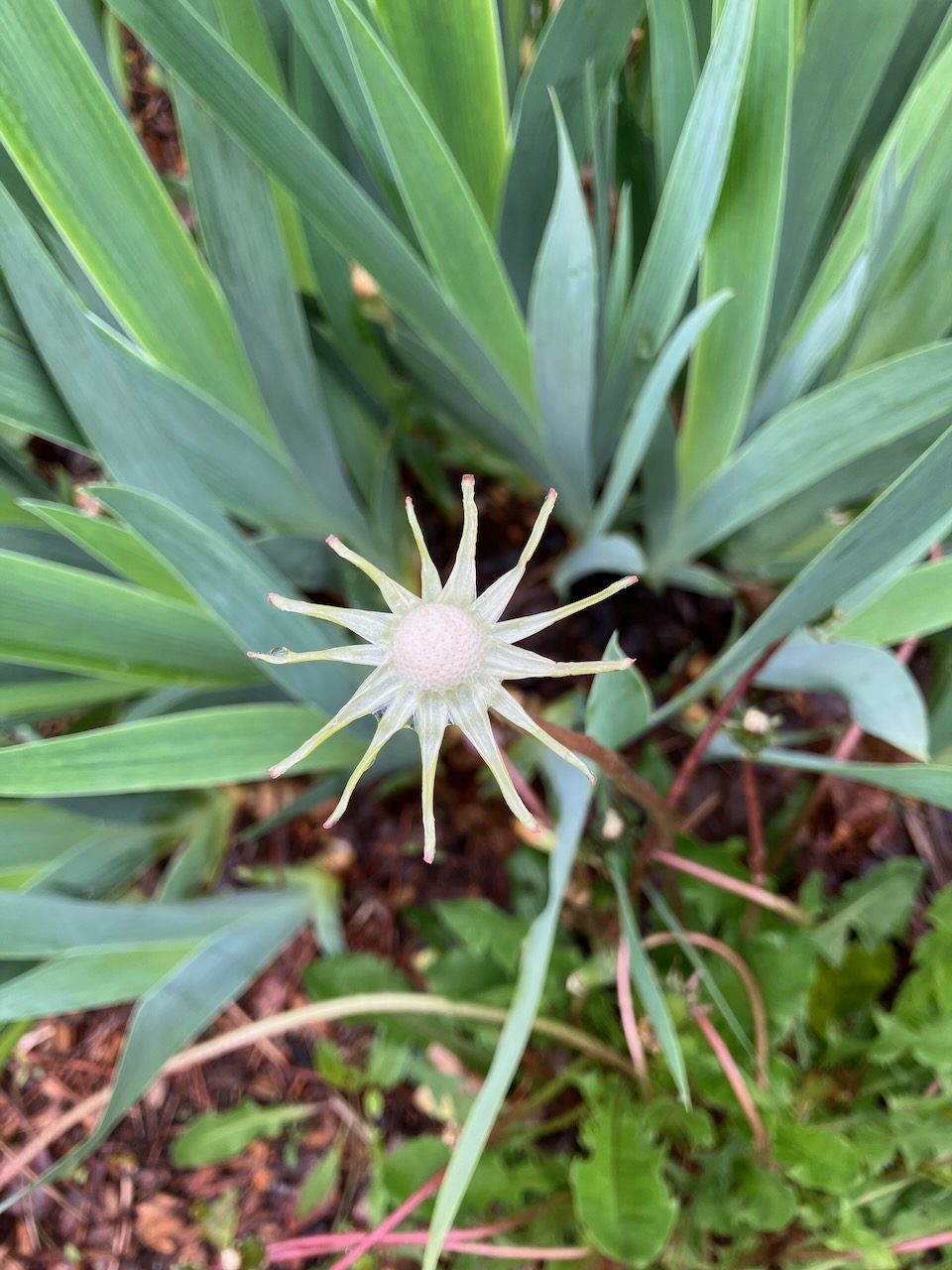
And sometimes, beauty emerges in unlikely ways–this is a dandelion after the rain washed away all the fluffy seeds. A perfect star.
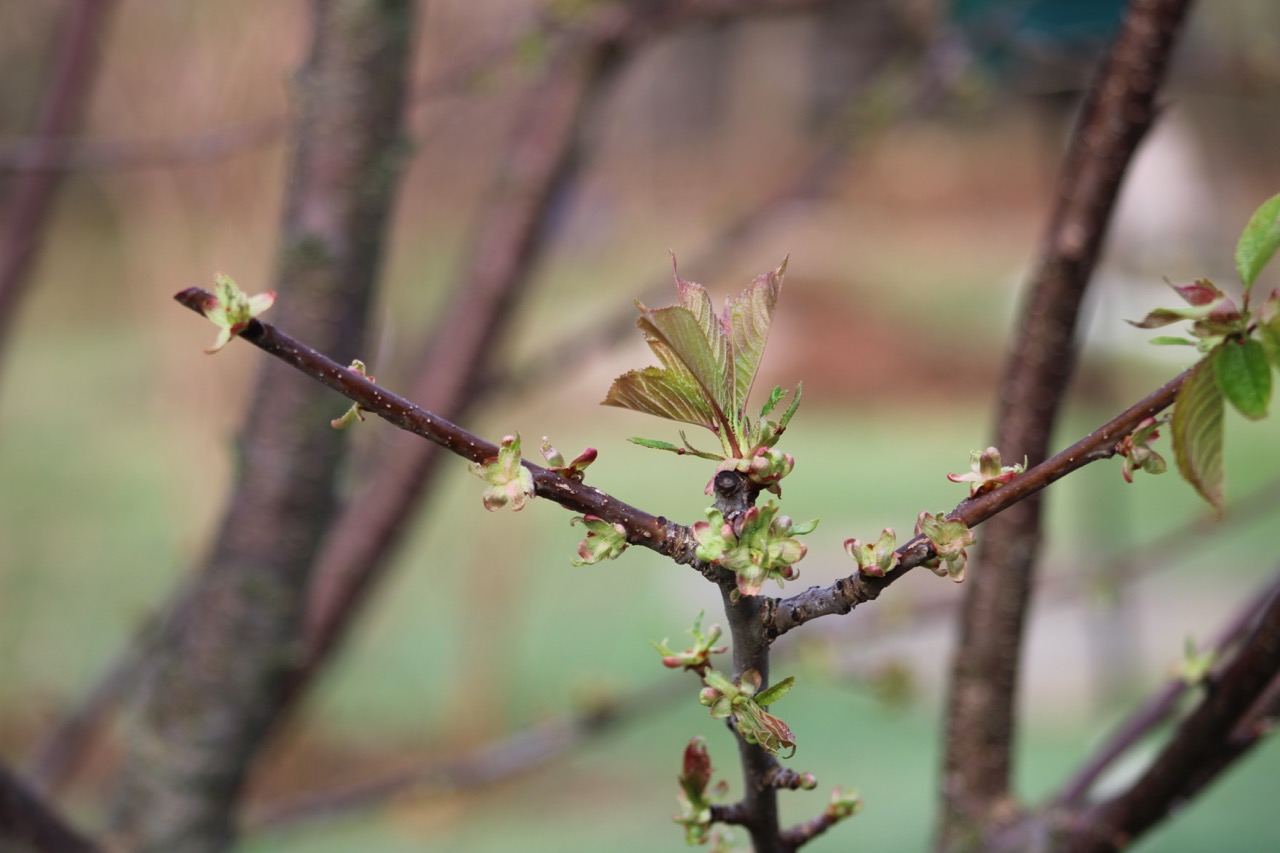
The cherry trees and peach tree have no blossoms on them at all. The cherry trees had the buds that should open into blossoms, but when they opened, they were empty. At first I worried that I’d done something wrong. But on connecting with other gardeners in Maine I learned that many people are facing this problem with all their stone fruits. Apparently, the most likely cause is the weird weather over the winter, with mild times alternating with a deep freeze. They didn’t stand a chance.
I feel sad about it–there were really so many buds on the cherry trees this year. In prior years we just had a very few blossoms, and I was hopeful that this year we’d see our first real fruiting. I also feel glad that the leaves are opening–I heard that some people’s trees actually died. I am glad ours are alive. But this is a lesson about climate change. Global warming increases the unpredictability of the weather, and the temperature swings are part of that. What food we can grow becomes more unpredictable.
We don’t rely on our little garden for our food–we are really just learners in this process. When we get a harvest, it is exciting–and thankfully, we still have peaches from last year’s abundance in our freezer. It looks like the blueberries and raspberries will be fine. I’ve already eaten sea kale and some asparagus. But I can feel the vulnerability of what it means to face a shifting climate, even in these small ways. How many larger ways are unfolding all over our planet? Severe heat and drought in many places, floods in other regions. For too many people actual starvation is real. I feel so powerless in the face of these huge problems.
When we first moved to this place, our hope was to form a deeper connection to the earth and all her creatures, through our connection to this small piece of land. I have to say it isn’t easy. We know so little, and we are surrounded by challenges larger than we are. For just one example, Margy spends hours pulling and cutting invasive plants around the borders of our land–Asian bittersweet, multiflora rose, Norway maples. The way it is with invasives, that job will never be over. Plants have their own personalities, and some are very aggressive even if they are native plants or desired plants, so there is the endless pulling and pruning to keep things in some sort of balance. (Oregano and wood anemone, I’m looking at you! Everywhere!)
But maybe these are the lessons we are learning about making a deeper connection to the earth. Plant by plant is the only way we get to know them. Whole Indigenous communities were needed to foster the balance of all beings, and we are just two old non-Indigenous humans. Some of our neighbors seem to be in a similar venture to ours, and others seem just the opposite.
Still, I have to hope that the love we offer to this place can be a small seed of healing, maybe even its own “aggressive” form of healing, spreading into the broken places. I draw hope from the birds who seem to multiply and who enjoy the yard so much. I draw hope from the violets blooming everywhere they want to bloom. I draw hope from the turkey who visited the other day and made a dust bath in the patchy lawn. There is something so wonderful about a community of creatures who share one place.
The good part, for which I am grateful, is that our neighbor came to our door to talk to us. He asked whether we would mind if they took down trees in the area between our two properties. He wasn’t sure of its status, but I told him it was a “paper road” that likely would never be built. I told him we would NOT want those trees taken down, that they provide privacy between the two yards. The neighbors want to garden in the way back of their yard, but don’t get enough sun. I suggested that the boundary trees are to their north, so wouldn’t affect their sun. He said it was just as a way for the machinery to get into the back, but they could do it a different way and not take down those trees. He wanted to respect our wishes. So that is the good part. And I like that they want to garden.
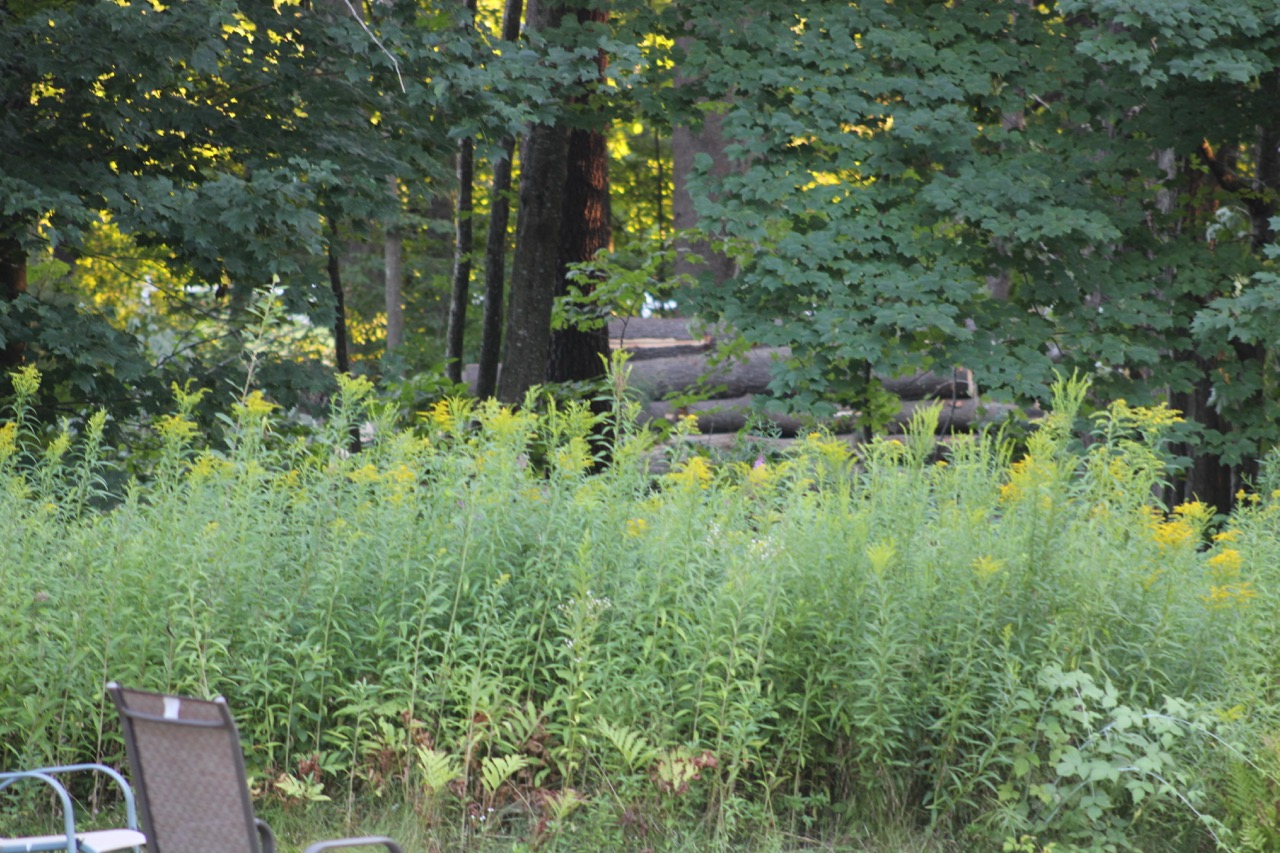
Felled pines behind our big pine, behind our back yard, with goldenrod in front.
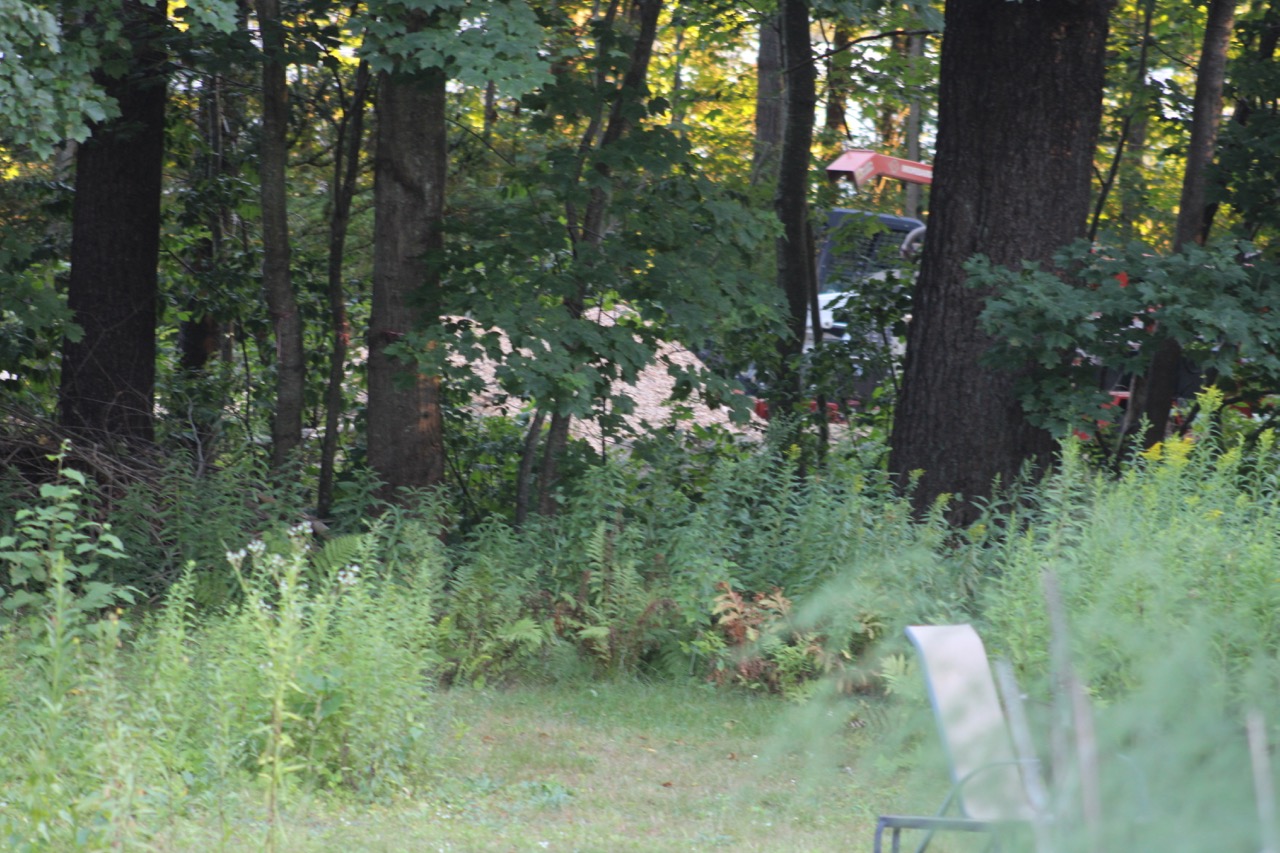
But the rest is so bad. Loud machines have been working all day yesterday and today, felling tall pines, and chipping up branches. Sometimes we feel the ground shake in our house when the trees fall. Our thin strip of protected trees does not hide what they are doing, light comes through and all the visuals of machines, and trees being cut down. The cherished privacy of our back yard is no longer what it was. But most of all, I think about all that habitat lost and wonder how many birds’ nests have been destroyed. Many many birds yesterday were making alarm calls. Early this morning, a pungent skunk-spray smell came through my windows. I imagine that the skunk has been dislodged in some way, and perhaps came across our yard and encountered one of the little cats that hunt here. I think about how we love the wildlife that come through our yard, and how the trees and underbrush, on the so-called “undeveloped” land, have been a mini-wildlife corridor for deer, turkeys, skunks, groundhogs, sometimes even foxes.
Through the trees, we can see the big machines, the pile of wood chips.
I try not to make the neighbor an enemy in my mind–after all, he wants to create a garden, so there is love for the earth there too. We live in the city, in a neighborhood near little brooks in sunken areas that continue to provide wildlife a refuge. But just in the six years we have lived here, acres of trees have been cut down in our neighborhood. Each tree down means more carbon in the atmosphere, more warming, more drought. I think about the long history of cutting the great forests of North America for settlers’ farms and gardens and cities.
And this is how the wider world feels to me right now as well. Slowly falling down around us, more and more “developed,” less and less room for wildlife and trees. I don’t even know how to feel this sadness. It is too deep, too fundamental. Even as Margy and I try to love this small piece of land, to learn from it how to live in mutuality with the earth, all around us the path of destruction seems to hold sway. I think about the great pine in our back yard on the paper road, the one that is over 100 years old, and how she must feel to sense the destruction of her family of trees nearby. I think the trees know. They know that we are destroying our only home, our only planet. And so we grieve together.
Photo: Tiny frog sitting on a large stone at the edge of the pond
Today the frog in the pond let me take its picture! I came outside this morning and just sat for a while at the edge of the pond, writing in my journal and being quiet under a cloudy sky. It felt a little bit peculiar to be done with the work of building the pond. To let go of the strange obsession for finding stones that has filled the last several weeks. I have been working on the pond since April! I didn’t see the frog at first. I was glancing around at the yard, and all the ways that Margy and I get overwhelmed trying to care for the land. We are old, we are disabled, we are ignorant of the many needs of plants, just beginners. It is hard to be good stewards of the land. There is always more to do than we can do. So I make a decision to let go: let go of the burden of it, let go of the overwhelm, let go of trying to do more than we can. Here I am, it’s a new day: be amazed at life!
At some point, I decided to walk around the edge of the pond to look at how the plants are doing. And then I suddenly saw the frog, sitting quietly. No plops into the water, no jumping away. Just sitting quietly, paying no mind to me while I was also sitting quietly, and now walking quietly. (Perhaps it has figured out that we people who come to this pond are no threat–we can share the pond?) It was on a big stone at the bottom of the beach, with its eyes out of the water and its very tiny body in the water. Its head maybe a half inch long, its body another inch, long folded legs. It let me take its picture many times. When I walked back to my chair, this is how it looked from over there, almost invisible, but now visible to me:
Photo: Can you see the tiny frog on the mottled stone near the deeper water, five stones to the right of the red stone?
When I came back inside, I did more research, and this frog seems to be of the species called the green frog–the most common frog in our region-it can be green, olive, brown. (One site joked–close your eyes and think of a frog–that is the green frog.) It is likely a female, because the tympanum–the round “ear” circles behind its eyes–are the same size as its eyes. In males, they are larger.
UPDATE: I’VE GONE ROUND AND ROUND ON THE IDENTIFICATION OF THIS FROG. I WONDERED IF IT COULD BE A FEMALE BULLFROG, BECAUSE THE DORSAL-LATERAL RIDGES GO BEHIND THE EARS, RATHER THAN DOWN THE BACK. BUT THEN I REALIZED IT WAS MUCH TOO SMALL FOR A BULLFROG. I AM BACK TO THINKING IT IS A GREEN FROG. SEE THIS CAN YOU ID THE FROG SITE.
I sat with the frog for quite a bit longer, until some raindrops started falling on the water, on me, on the frog. I stood and looked away for a moment, and when I looked back she was gone without a sound. What a lovely teacher she was for the practice of sitting quietly, for letting go, and being amazed by life.
Photo: A bulk order of small round stones of many sizes
This week has been a big adventure in stones. In my last post about my pond project, I mentioned that I needed to get a pickup truck, to go to a store that had “2 inch round stones” in bulk. Well, I did some research, and put on my big girl pants, and rented a pickup truck from Home Depot. I drove to Estabrooks, where a clerk rang me up for a half cubic yard of the stones. But then they were informed by the people in bulk orders that they didn’t carry 2 inch round stones. Despite a clerk reassuring me two days earlier that they had them. So a manager came by, and explained that the previous clerk was wrong, they didn’t carry them any more, and had no way to order that amount from a possible supplier. She was very apologetic about the mistake, and gave me a $40 gift card to compensate me for the truck rental.
So truthfully, I was proud of myself for doing something I hadn’t done before–renting the truck–and they did treat me well and took responsibility for their mistake. But I was disappointed, and back to square one for finding stones. I started looking again at the notes I had made before, and noticed that I had written down another possible source for stones–but the information online wasn’t very complete. (I think people who sell stones in bulk don’t really like to work on websites.) So I called New England Specialty Stones, left a message and got a call back a few hours later. They were happy to deliver a half yard of 1 1/2 inch round stones to my house, with a delivery charge, and the total price was $76 dollars–less than what it would cost for my earlier Estabrooks adventure. The stones arrived on Thursday, and were expertly dumped on the tarp I had placed on our patio. I felt such relief and joy to see those stones.
Some parts of the pond project have been step-by-step, like digging a hole. But other parts have required a big push on my part, with some help from others–like laying the pond liner, or getting a bulk order of stones. Now that the stones have been delivered, I am back to the step-by-step processes. The person I spoke with about these stones mentioned that they’d need to be washed, to use them for a pond. So I started doing that today.
Photo: Stone rinse #1 of 5
It took five rinses before the water was relatively clear. But I did have the idea to dump out the “dirty” water onto the beds around my fruit and nut trees. I am thinking that this stone dust is likely a very good soil amendment–like the granite dust I put around the tree beds earlier on. Once rinsed, the stones are actually quite pretty and colorful, with a great variety of sizes and shapes.
Photo: rinsed stones
Once rinsed, I take them via the wheelbarrow back to the pond area to use. Load by load. First of all I rebuilt the stone “beach” that is an incline for critters to be able to access the water, to get in and out easily. I mentioned before that after my first attempt I was worried it was too steep. So I removed those stones, lifted up the liner and underliner, and dug it out deeper–I took away a whole wheelbarrow full of soil to make a longer gentler incline. Then I positioned larger stones at the bottom inner edge, and also at the lower outer edge, to be a stronger support for the stones on the incline. Now, it feels sturdy and very usable. Once the pond is filled, the water will reach about halfway up that incline.
Photo: Rebuilt stone “beach” for critter access
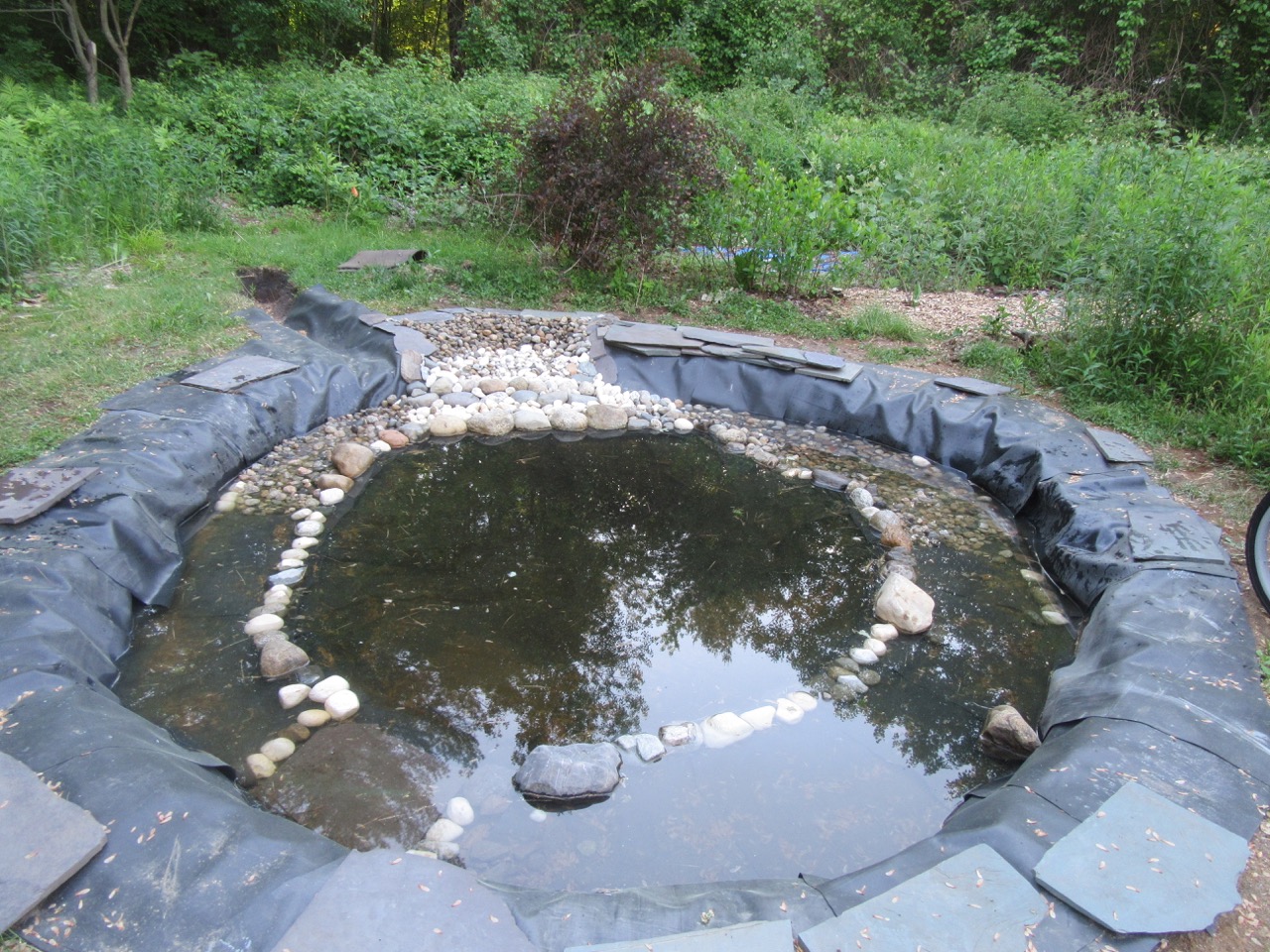
The beach completed, I started bringing back stones to put on the planting ledge. I positioned a few of the larger stones I had previously found into spots along the inner edge of the ledge, and then shoveled lots of the small stones behind them. Well, I did this wheelbarrow by wheelbarrow, after five rinses of the stones each time. I think I did about 5 or 6 wheelbarrows this evening. I have seen some beautiful ponds on the Building Natural Ponds Facebook group–with large rocks covering every part of the pond liner. I don’t think that will be my pond. I don’t have access to that kind of rock. My goal is to cover the planting ledge with these small stones, and then finish filling the pond. Then I will start putting plants there, and eventually, they’ll hide the pond liner going up the side from the ledge to the top. But that might take a while. Once I’ve put plants in, I’ll use whatever stones I have left to cover the liner at ground level. Or come up with another idea. But I am excited that critters will have access, and I am happy to be back in a step-by-step process.
The other day, I was talking to a group of friends, and articulated why this work is so important to me. With all of the pain of our world, the injustices past and present, the dangers of environmental degradation and climate change, why do I work in the garden, why do I make a pond? For me, to make relationship with this little piece of land, to love and care for this land, is a spiritual practice. I am only one small person, but I hope by learning to love this small piece of land I can make a prayer, make magic, for humankind to learn to love the earth. I pray that we can stop exploiting the earth and find a different sort of relationship to the earth. A relationship built on respect and mutuality and humility. A relationship in which we understand the sacredness of the earth. A relationship of gratitude, for water, for soil, for stones, for plants. That is the magic that lives in each stone.
Photo: Pond tonight, after putting some stones on the planting ledges
More on my adventures in digging a small pond! Yesterday I finished digging the first layer of the pond, down to the level of the planting shelf, about 1 foot. I checked whether it was fairly level after I was done. And then I did some math to figure out what 1/2 to 1/3 of the total surface area would be, which is the best size for the planting shelves.
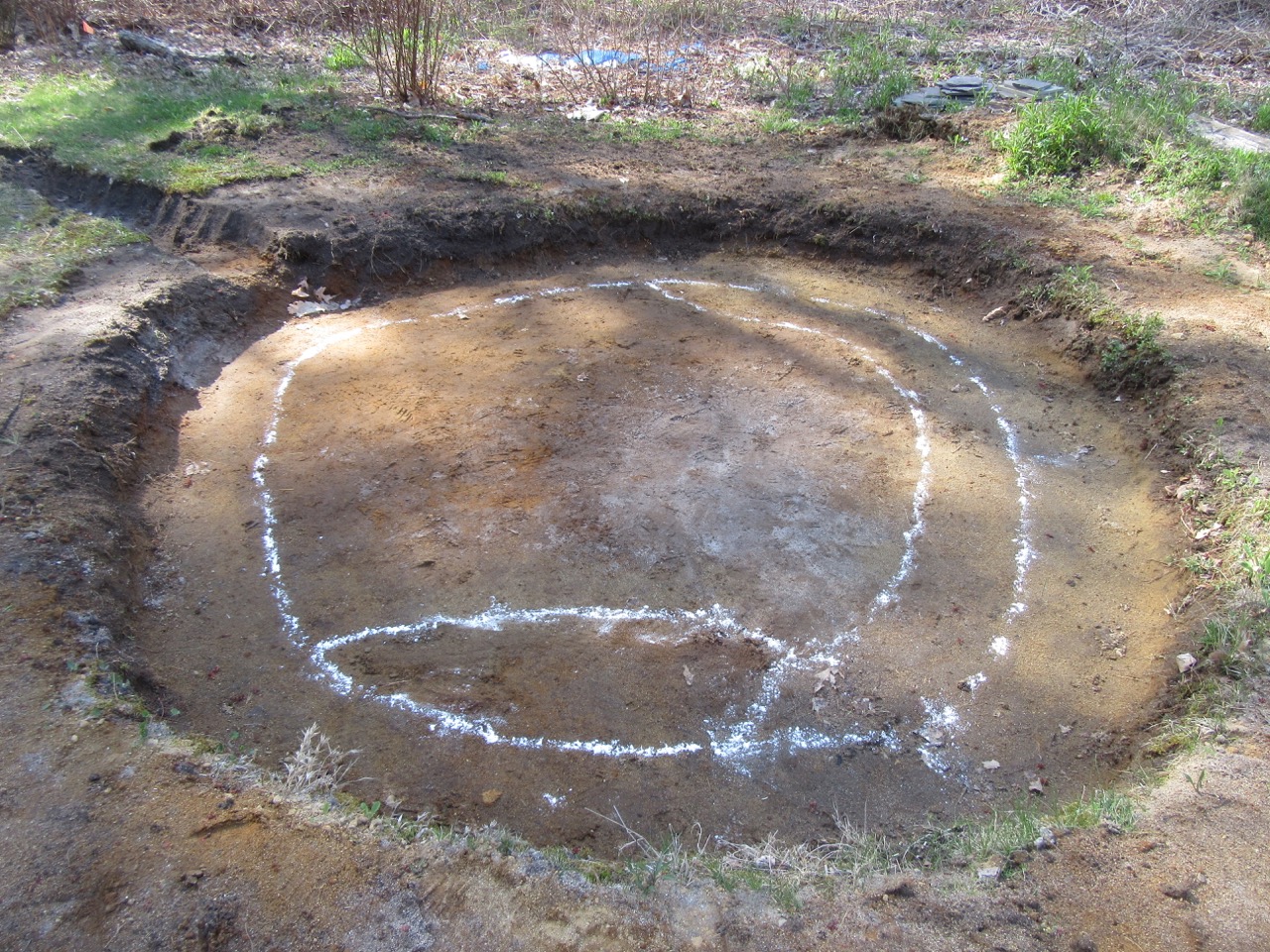
For those who might wonder, here is how I worked on that: Using a website that computes circle area, I found that for my 11′ by 11.5′ pond, the total surface area was about 100 square feet. If I made a planting shelf one foot deep, the resulting circle would be 9′ by 9.5′, with a surface area of 67 square feet, meaning the planting shelf included 33 square feet. I was surprised that just 1 foot at the edge already brought it to 1/3 of the area. Doing two feet would leave a circle of 7′ by 7.5′, or 41 square feet, with 59 square feet for planting. So I took half of that, and decided to do 1 foot wide on one half, with 2 feet wide on the other half, approximately. Even though the math is exact, the actual pond will be less so, but it gave me an idea of what I was aiming for. I marked it out with white flour, including a spot for a step, that would be dug to 1 more foot down, to make it easier to get in and out of the pond center.
Pond layer one, with my rough markings for planting shelves and a step
Meanwhile, I’ve heard back from folks who have bits and pieces of carpet–I had asked for at least 2 feet wide, and the responses have ranged from 2′ by 2′, to a medium size carpet. I picked up some yesterday, and will do more today. It has been fun to have these interactions with folks, limited as they are–so rare for me in a time of COVID. Since I don’t have a truck, the smaller pieces actually work because they fit in the back of my car.
Meanwhile, the pond liner was delivered yesterday too! A very heavy box was dropped in our driveway by UPS. (I think I remember that it was going to be 138 pounds) Unable to lift it myself, or even together with Margy, she had the idea to roll it onto a larger piece of cardboard (which we always have in our garage for various garden projects) and then we could pull that cardboard together along the driveway to a better spot–and it worked. So it is waiting by the side of our house. It made me realize, though, that when I actually install the liner in the pond, I will definitely need help from a few friends.
Four years ago, the pond was part of our original plan for our permablitz–when twenty-some people came by and helped us with all manner of garden projects. (If you are curious about that, you can find more here.) It was such a humbling and gratifying experience to be gifted with the energy of so many to begin to create this permaculture garden where we live. With everything else going on that day, it was decided that the pond would be too much to attempt. But it is wonderful to remember how community enables us to live better with our land, how the gift of each other’s time and energy enriches all who participate. With COVID we’ve been on our own so much, and yet even so, we rely on the help of others–delivery people, for example, and neighbors who have picked up needed items in stores. It has brought us closer together with our neighbors actually. We are so programmed by our society to try to be self-sufficient. It is hard to be reminded of our need for each other–and yet that need is a blessing.
Meanwhile, it was also a blessing to be digging on my own, outside in a beautiful sunny day. Squirrels were playing, birds singing, daffodils shining bright yellow, and the cherry and peach trees are beginning to blossom. I started on the next layer of the pond. Our soil is very sandy and compacted–we had an inch of rain fall on Friday, and none of it stayed in the depression that I had already dug. So the recommendation is to slope the sides as we go down so it doesn’t collapse. Step by step, and with a little help, I think it can be done.
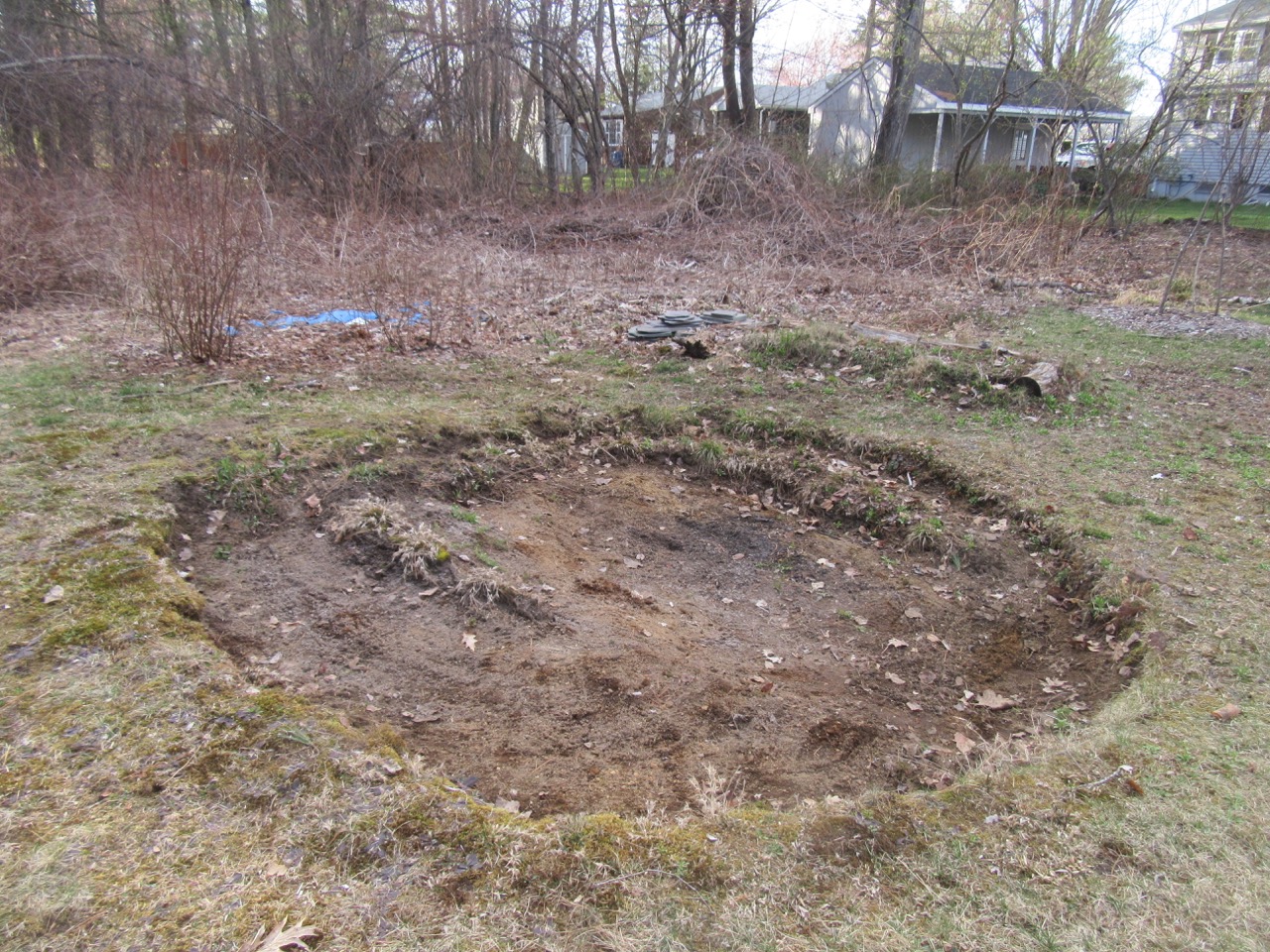
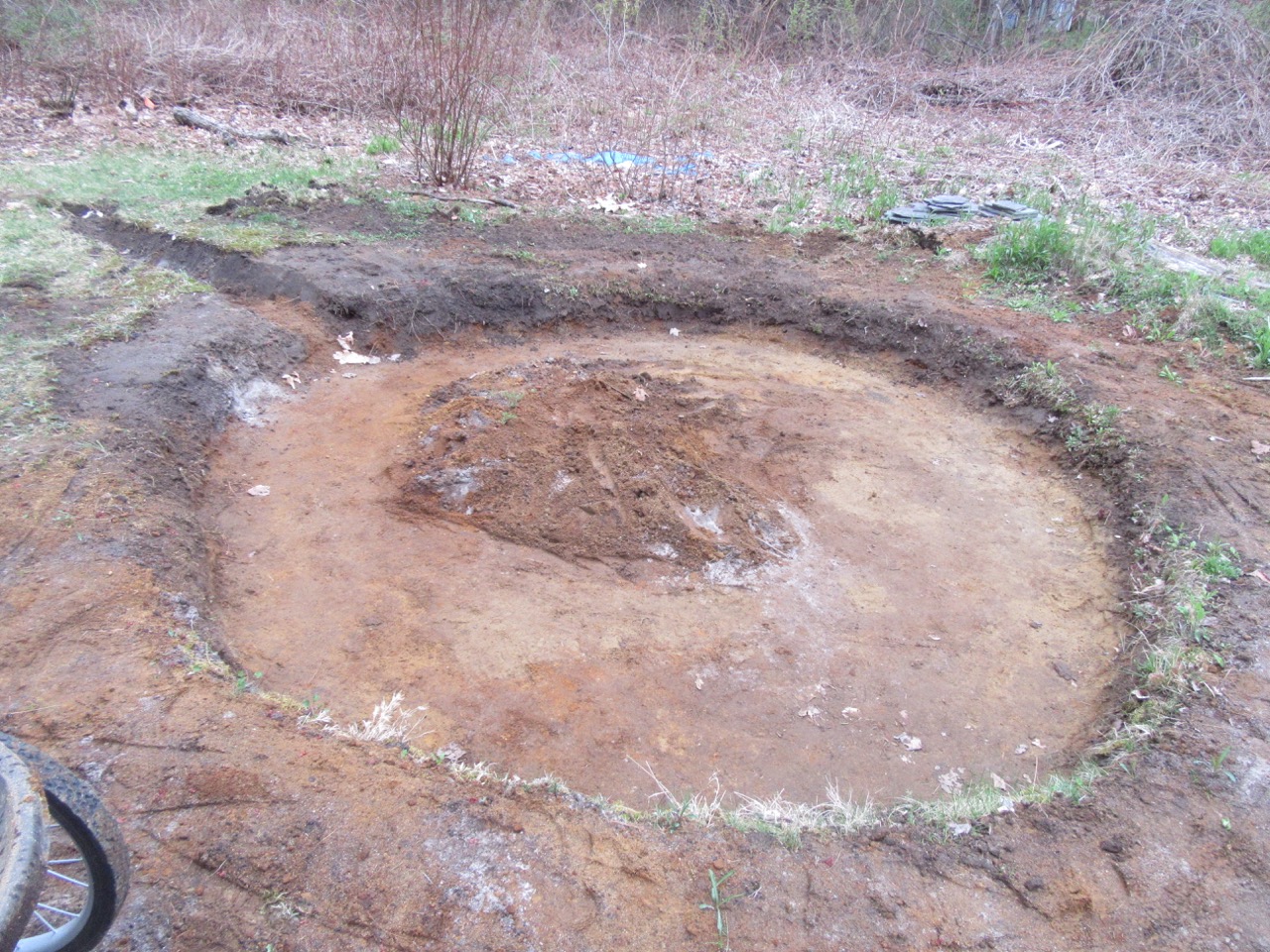
In our permaculture design for our land from 2017, we included a little pond, about 11 by 12 feet round. Every so often, I would dig in it a bit, and find a place to put that soil. Finding a spot for what is dug up is actually a major issue in digging a pond. Some of the topsoil made its way into what is now a bed for blueberries. But mostly, I didn’t have the energy to take on another big project.
The future pond, as it looked with what I dug out before this year.
However, this spring I felt a burst of energy each time I went into the yard, and I felt the future pond calling to me! So I read once again Robert Pavlis’s book Building Natural Ponds, and made a list of everything I would need. I talked it over with Margy. The biggest expense is buying a pond liner, recommended 45 mil EPDM rubber. For our size pond, with the deepest part 3 feet deep, we’d need a 20 by 20 foot liner. (Formula: width plus 2x depth plus 2 feet for edge, times length plus 2x depth plus 2 feet.) Other needs include old carpet strips to lay over the ground under the liner, to protect against roots and rocks–and we’ve got bittersweet roots, so this might be essential. It will need lots of stones to line the planting shelves and the edges, and then a number of pond plants, to serve to clean the water, and of course to look beautiful. This kind of natural pond does not have any mechanical filters–just plants. So 1/2 to 1/3 of the pond is made up of planting “shelves” that are only about 8-12 inches deep.
Why include a pond? One reason is that it brings more water into the landscape. For some sites, ponds are a way to store water, but that won’t be as big a need for our site. We have rain barrels for that. We can use water from the rain barrels to fill the pond, and refill as needed. For us, a pond will mostly be for wildlife, like frogs and birds. We are told that if you build it, the frogs will come. And for us, another reason is to be able to look at the beauty of the water and water plants, when we are sitting in the yard. What a good reminder of the sacredness of water.
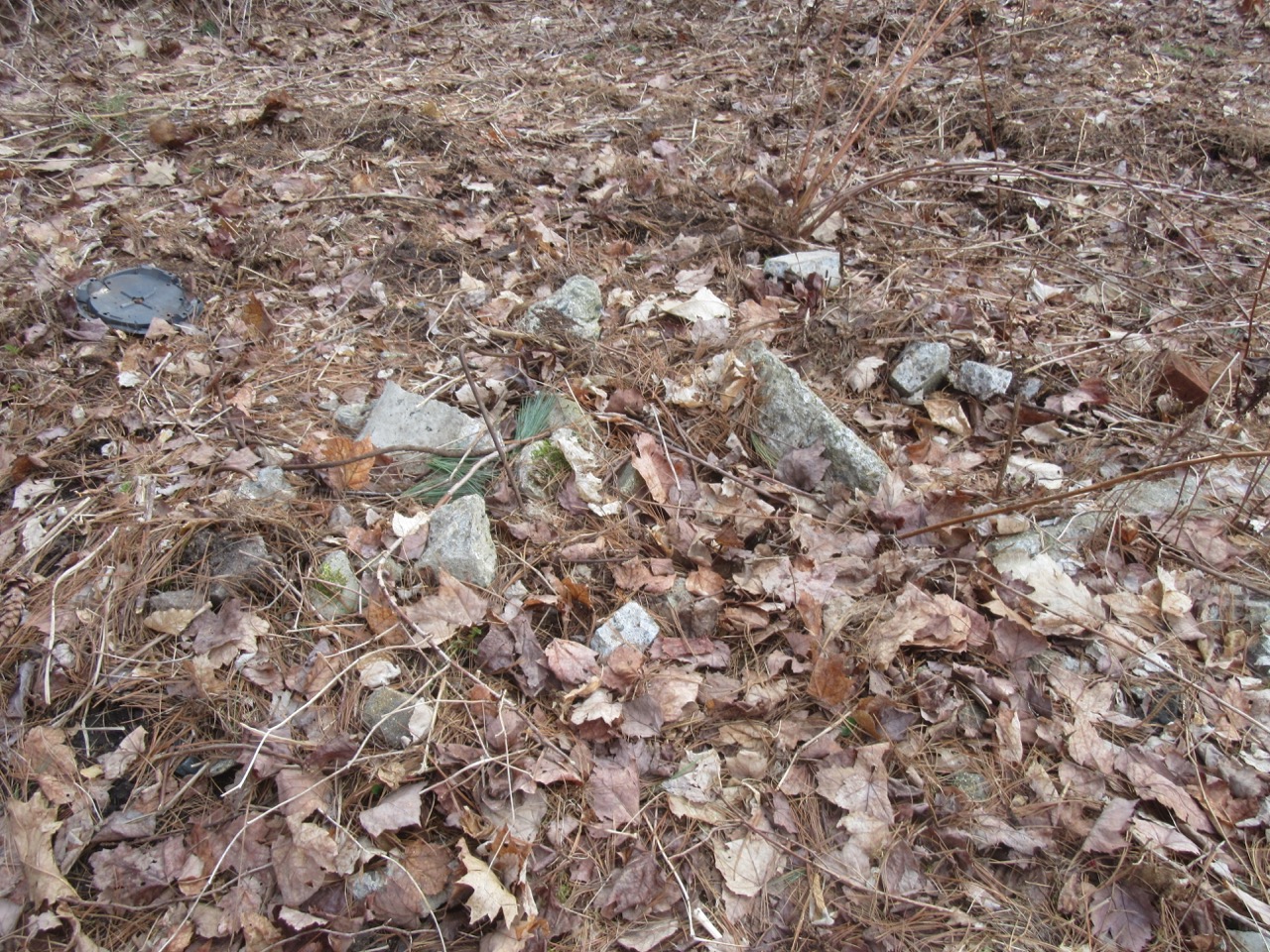
The biggest amount of work to make the pond is the digging. But we finally figured out a place to put the dirt. In the back corner of our yard, some former resident dumped a pile of concrete and metal demolition junk. We’d thought about trying to haul it away, but that would be a huge job, and cost money to take away. Most years, it has been covered with wild raspberries that don’t bear any fruit because it is too shady. This spring, I pulled out much of the raspberries and some invasives, and got a good look at the junk underneath. Concrete, metal, demolition debris.
Old demolition debris in the back of the yard.
So this is where we will put the sandy under-soil I dig from the pond. Then I’ll put cardboard over the resulting mound (to rein in the invasives), put down some compost and other soil on top of the cardboard, and then plant some shade loving plants on the mound. Another project.
A few days ago, I started an overflow spillway, an area on the edge of the pond that is 4 inches lower, so if the pond gets too full, the water has a place to go. I figured out, from the book, that it didn’t have to go very far, maybe 8 feet away or so, where the water could sink into our sandy soil. Then, the last few days, I have been slowly digging out the first layer, to the depth of the planting shelves. Here is how much I was able to finish by today.
It’s hard to tell that the depth of the pond is now about 1 foot, except for the part in the center that I didn’t finish to that level yet.
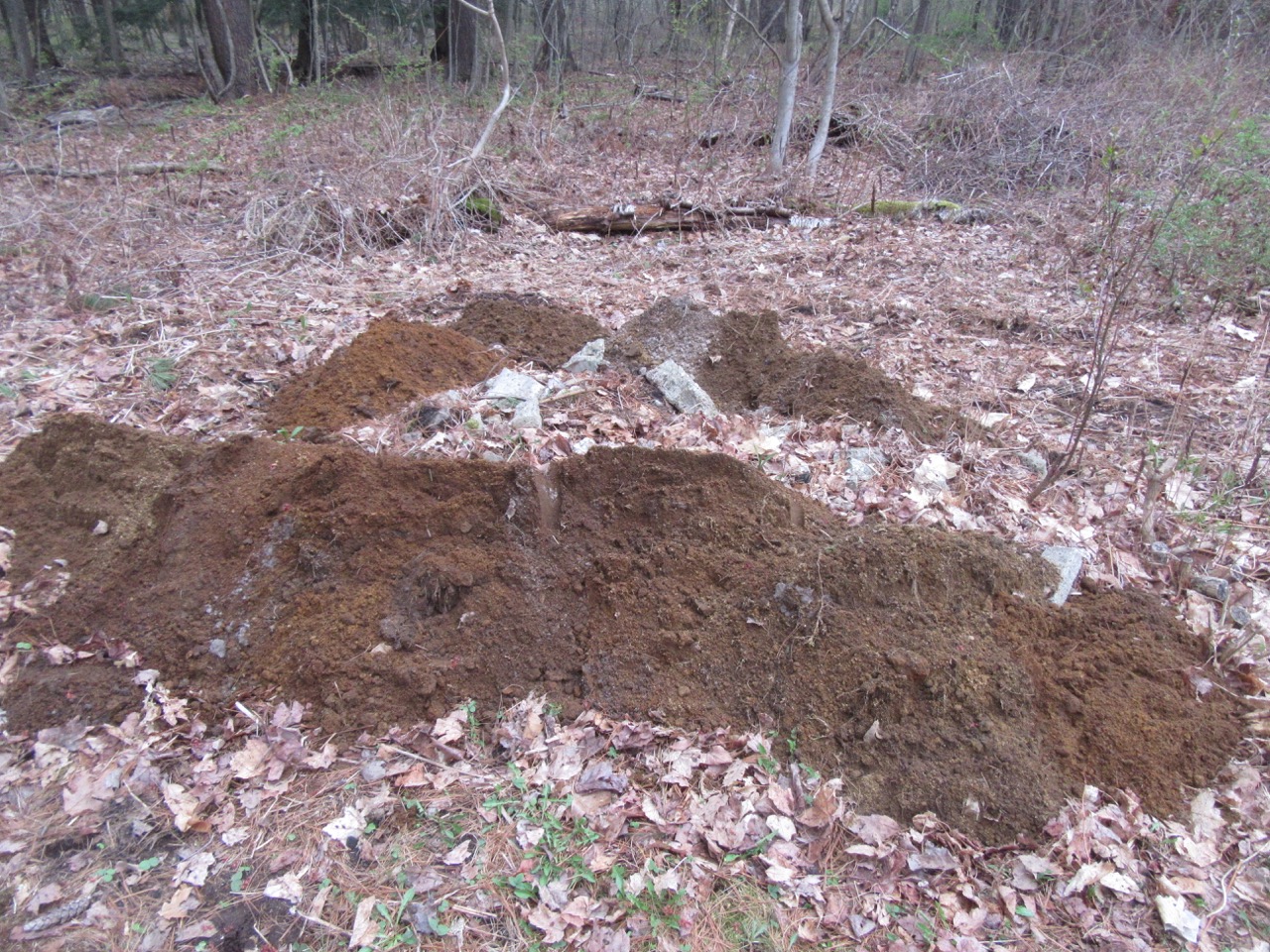
I shovel out the dirt into a wheelbarrow, using a level to try to keep the pond surface level–which will be important–then I bring that dirt over to the demolition pile, and dump it there. It doesn’t actually look like that much, but I hauled away several wheelbarrows full just in the last couple days. I don’t know what the former residents did with this part of the yard, but it seems like there are some ashes and charcoal buried in the future pond, along with a very rusty sandy soil. Oh, and here is what the junk corner looks like now.
Junk pile beginning to disappear under dirt piles.
So, yesterday, I ordered a pond liner. I was able to find a liner, with an underlayer, for $438. I also posted on “buy nothing” and “freecycle” pages requesting old carpet strips. I’ll keep you updated. This is going to happen!
I feel a deep calling to learn from the other beings who share this earth with us. I was reminded of this calling by a new book I just started reading, Undrowned: Black FeministLessons from Marine Mammals, by Alexis Pauline Gumbs. She is observing dolphins, whales, and other mammals who live in the sea, and learning the wisdom they might have for human beings–especially for black women, but also for all of us. “They are queer, fierce, protective of each other, complex, shaped by conflict, and struggling to survive the extractive and militarized conditions humans impose on the ocean.” It is a beautiful and meditative book and I am so grateful. Reading a chapter each night has fed my soul, as well as helped me remember how key it has been in my own path to listen for the wisdom of other creatures–though the ones I learn from are usually closer to home than the sea.
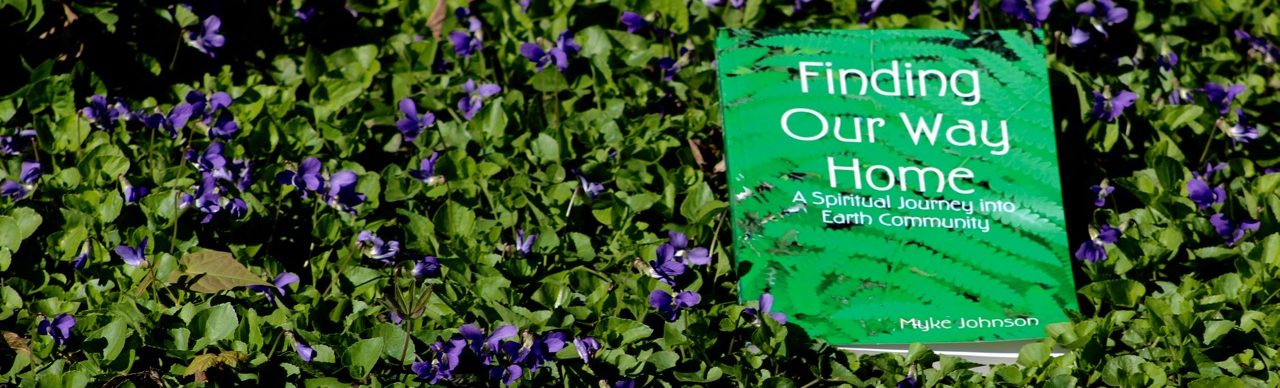
Yesterday morning, inspired, I began to read again my own book, Finding Our Way Home: A Spiritual Journey into Earth Community, remembering. I was remembering the many quiet moments I spent in my former back yard, listening to cardinals, watching slugs crawl through the grass, paying attention to trees, to stars, to the red light of dawn. It was a yard with many mature trees, a long row of huge lilac bushes, incredible privacy, and many critters who were our neighbors–turkeys, deer, birds, squirrels, chipmunks, and occasionally skunks. I was remembering how much those creatures taught me, when I was quiet enough to listen to them.
In our current back yard–we’ve lived here five years now–we can get caught up with work: pruning, planting, soil improvement, garden permaculture projects. It is land more in need of attention from us, ragged, more depleted, invasive vines and bushes clamoring around the edges and in the soil, imbedded in city life, though still surprisingly private once the trees on the edges leaf out. There is more room for gardening–the old place was too shaded by all those mature trees. So we have planted a little food forest, herbs and perennial vegetables, made room for hugelkultur and raised beds and even shared with our friends room to grow herbs and veggies.
But it is easy to get caught up in the work of it–a lot of work. It is easy to forget that other part–the listening to the land itself and the other creatures here, the plants and animals. I remember when we first found this place, feeling from it an unmistakable message: that through making relationship with this small piece of earth, I might learn more about what it means to be in relationship to earth and all her creatures. It was time to think small–right here I could find home, I could find earth community. The work is part of it–we are here to learn to be beneficial members of this tiny ecosystem. It has weathered much neglect and abuse from human beings in its history. But the work is not the only part of it–the listening is the most important part. Sitting quietly, watching, waiting. As spring makes it easier to be outside again, I am ready. I am ready to take my lead from what the land asks, what the land teaches.
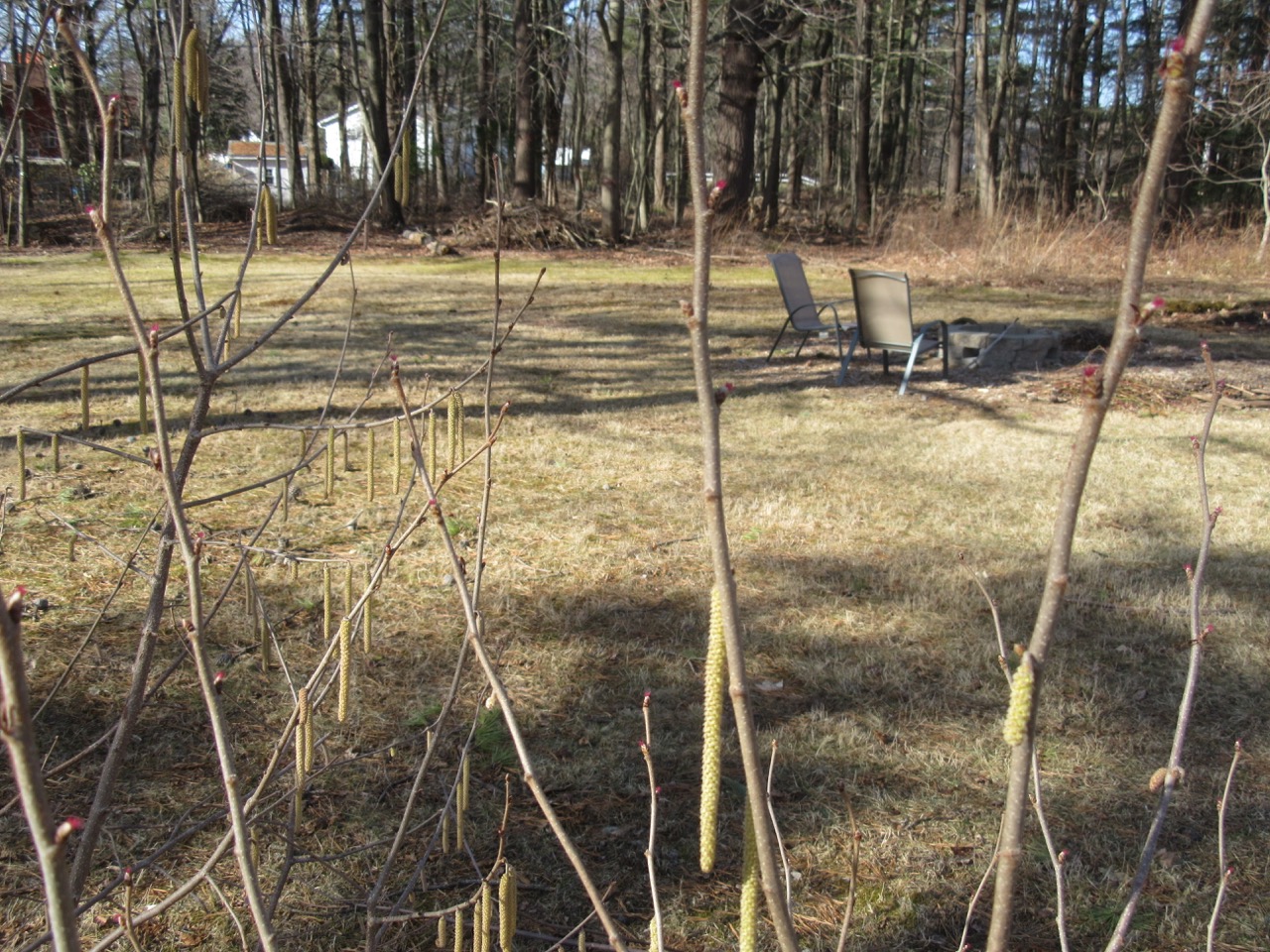
View of the back yard through hazelnut bushes with catkins.
During the spring, Margy was talking about wanting to plant sunflowers this year. But as it happened, she was busy with too many other garden projects to actually do it. So imagine our delight when the garden planted its own sunflowers! They came up under the bird feeder, now sitting empty for the summer, but where sunflower seeds were the food we offered to the birds (and squirrels) all winter.
Lately, the garden plants have felt mostly like children who need our care and attention. With the dry hot weather, they’ve needed a lot of watering. Yesterday, I did another foliar spray for the fruit trees, to help them ward off Japanese beetles, which I also have been picking off every day and dropping in soapy water. And there have also been lovely raspberries to harvest each day, and snap peas (almost gone now) and kale and basil to gather and preserve.
So this gift of flowers emerging without any effort on our part–perhaps the land is reminding us that she loves us as we love her?
It has been one year since my retirement began. One of its themes has been to find connection with this small portion of the Mother Earth, this land we are so lucky to call our home. As non-Indigenous people, we are trying to heal a long wounded history of our people’s disconnection from land. Our ancestors left their home places generations ago. If our society had an understanding of earth connection, it could not destroy earth life as it destroys, with such thoughtlessness–pollution, clearcutting of forests, poisoning of soil with pesticides, trash dumping, mining, fracking… the long list of ecological destructions that are endangering us all.
So in our small corner of the world, we are trying to reweave those threads of interconnection, reawaken the truth–long dormant in our bodies–that we are not separate from the earth–we are the earth. As we tend the land, as we care for the plants, as we pay attention each day, we hope that a shifting occurs–that we move from domination patterns to partnership patterns in our relationship to Earth. We know how small we are–yet hope that if we can shift our own patterns, it might in some way ripple out to the larger patterns. Because we are interconnected. Because that is the magic.
The gift sunflowers remind me that the land herself is eager to be in partnership with her human children. She loves us and wants wholeness for all.
Yesterday evening, eight of us danced around the pitch pine in our yard, dressing it up with rainbow ribbons for May Day. Did you know that the original Maypoles were not cut wooden poles, but live trees? It makes sense to me, coming from people who worshiped among the trees, who honored and revered the trees. And so what better way to celebrate the full arrival of spring, the arrival of the May, than to celebrate the tree with an ancient dance?
Earlier, I had attached eight ribbons to a small metal ring, and then Sylvia tossed a rock-tied string over a branch so we could lift the ribbons to a good height for dancing. Margy went to a field close to where we used to live to pick forsythia branches to decorate the bottom of the tree. In this time of the earth awakening, we joined our life energy to that of the earth, that we might all be full of life and regeneration. It was a magical moment to be weaving in and out between each other, with our bright colors, dancing on the earth, and finally surrounding the tree, hands joined in a circle.
After a rain-filled night, I took photos this morning. We keep hoping for more warmth…it is only in the 40s today. But we’ve finally finished planting all the bushes. I set up the rain barrels (by putting in their spigots and re-attaching their overflow hoses), and yesterday I found smaller containers for storing a big bag of Kaolin clay (an organic product used for certain orchard pests). Tending and planting and tending.
When I pay attention to what is happening to our planet, I feel so much despair, I feel overwhelmed. I know it is better to plant trees, than to cut them down. I know it is a good thing to tend this small plot of land. But even with many of us planting trees, or protesting, or changing our lives, do we have the power to stop the destruction? No, I think not. But what came to me the other day was this. If we are out there, planting a tree, putting our hands in the soil, watering a seed, dancing on the ground, or even lying in a hammock under a pitch pine, perhaps we can learn to hear the voice of the earth. Perhaps she will see us there, and take pity on us. Perhaps she will open our ears and hearts and guide us into regeneration and healing. This is my hope.







 Yesterday evening, eight of us danced around the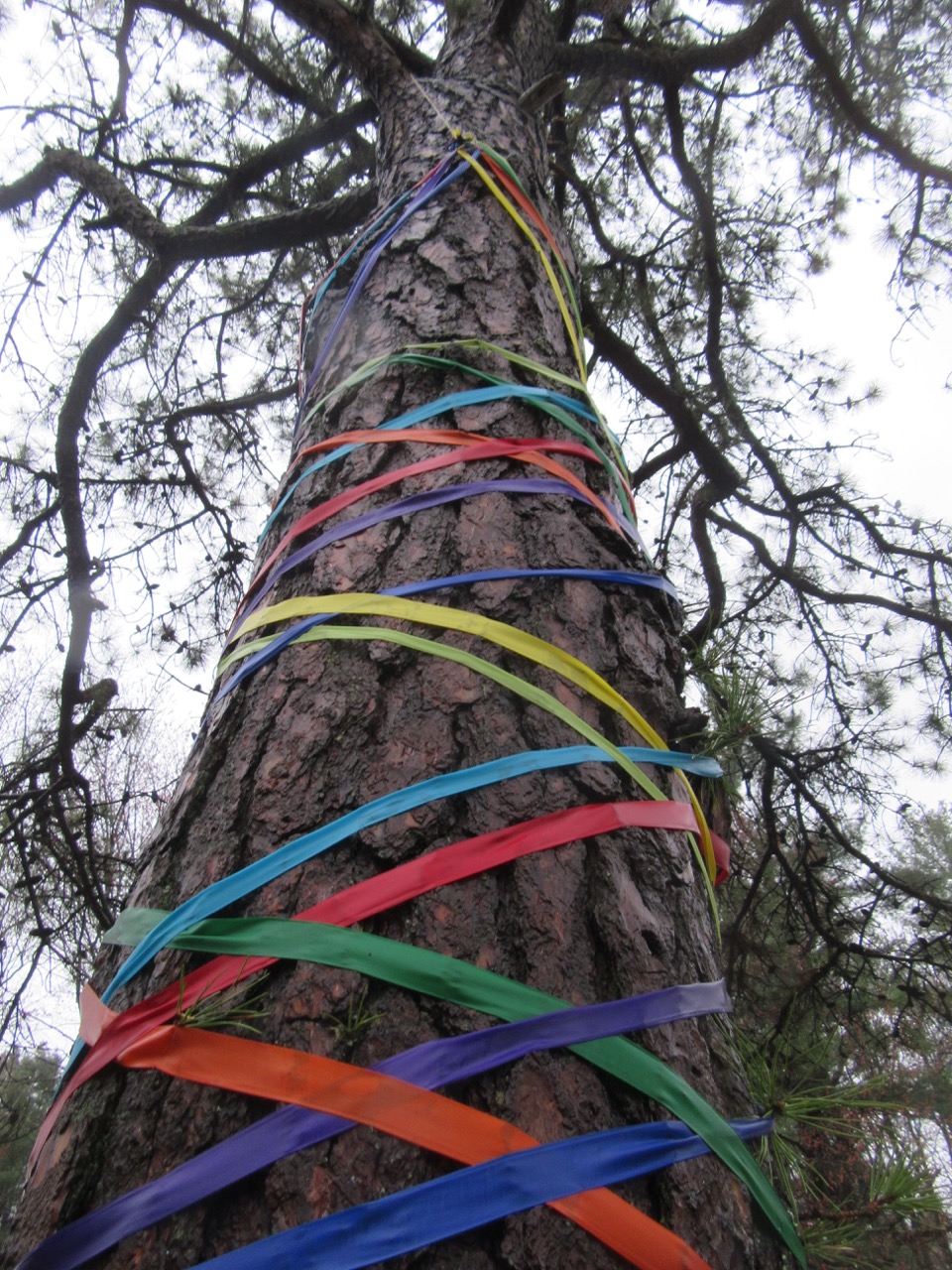
 Finding Our Way Home