Counting Tree Rings

Cut pine

During the construction for the new Hall School, they have cut down acres of trees.  It truly breaks my heart.  Especially when I saw a stack of huge pines from the front of the school.  This one I measured at about 33 inches in diameter–just about the same as our beloved old white pine in our yard, though I didn’t have a way to tell how high up on the trunk it would have been.  Why do people cut down the old ones?

I tried to count the rings using my photos–and determined that it was at least 120-125 years old, if not more.  That means that this tree was around back in 1897, when my grandmother Yvonne was born.  It also might mean that our white pine, if it isn’t 162 years old as we estimated by circumference is likely at least 122 years old.  I would guess that there were similar circumstances for all of these pines in the neighborhood.

IMG_5008You see, I have been walking around the neighborhood looking for any other large pines I can find, and measuring them.  I haven’t found one larger than ours yet. Yesterday near the brook and the school, I found one that measured 102″ in circumference–just like ours.  It was wrapped in caution tape–does that mean leave it alone?  It is right next to an access drive of some kind next to the school. I hope the tape means leave it alone.

There are two more white pines in yards at the crossroads of our street that I want to measure when I get a chance, plus one right next door that rises a few feet away from our garage.  I think these might be similar in age to ours.  It would be easier to measure with two people doing it, plus I feel a bit awkward about going into people’s yards without a conversation.

What the close-by pines say to me is that when someone was building houses in this neighborhood in 1967 or so, they decided not to cut down these special old trees.  I am grateful for that.  But are they the remnants of a much larger family?


More White Pines

White Pine near Capisic

There is another old white pine that I see on my morning walks, next to the the Capisic Brook near my home.  Even as the old white pine at my home sent me on a search for the history of this land, so both of these pines lead me into a search for their spiritual meaning.  Maine is called the Pine Tree state, and the White Pine is the state tree.

When settlers first came to this land, they found old growth forests with white pines being the tallest of the trees in the east.  Many of them were cut down to use as masts on the English ships. In fact, any straight tree over 24 inches in diameter was marked for use by the king, but people often ignored that marking.  I read that the old-growth trees were all cut by the mid 1800s.

In the same article, they identify two old pines found in Acadia National Park as 154 and 147 years old.  That made me wonder if the method I had used to date the white pine in our back yard was accurate–if that pine was actually 162 years old, it should be on the EasternOldList.  On the other hand, if the land was undeveloped for a hundred fifty years, (just a blank space on the map) perhaps it would not be so impossible that it should be counted among these old ones.

Pine needles are full of vitamin C, and the inner bark was also edible–made into a kind of flour by the Wabanaki people here.  Among the Haudenosaunee, the white pine was the Tree of Peace–symbol of their confederation of nations, the five nations symbolized in the five needles in one packet, and the agreements they made to keep peace among their nations.

Modern science has discovered that pine trees release compounds known as phytoncides, airborne chemicals which protect the trees through anti-fungal and anti-bacterial properties.  These compounds also support the “natural killer” cells of our human immune system.  So walking in the woods has actually been proven to be good for our physical and mental health.

While searching the internet for the meaning of the white pine, I found that another blogger The Druid’s Garden posted this:

In my experience, these trees retain their roles as peacemakers for us today in order to rebuild human-land connections. Often on damaged lands, even if no other spirits or trees are open to communication, the White Pine will be the intermediary.

Since my purpose in learning about the trees on my land is to rebuild our human-land connection, I may see if our white pine is willing to offer that mediation.

Little Neighbor

Skunk

Look closely. Surprised to see her in the light of day, but I think this skunk was trying to make her way home, much to the chagrin of our neighbor’s dog.  I don’t know if this is my gardening friend from last summer, but if not, I would guess it is a family member. She (or he?) is following her own corridor–how important these small stands of trees and shrubs are for our animal neighbors. But as to where she was headed–strange–under a fence or under a deck? Right into our human neighbor’s yard.

There were also some strange tracks in the snow two days ago in our yard.  Bigger than the usual squirrel tracks–now I think that maybe they were hers as well.  Margy took this photo. I read that skunks are rather inactive in winter, though not true hibernators.  But they begin to be more active, looking for a mate in spring.

tracks

Tracks by Margy Dowzer

Cedar

cedar leavesI seem to have unleashed a thirst for learning the names of all the trees who live with us on this land to which Margy and I belong. Today, I am exploring the cedar tree in our southeastern boundary area. I had always wondered about the difference between cedars and arborvitaes, and now I know that they are the same, really, here where we live.  There are a lot of names for this species which is native to southeastern Canada and northeastern United States–Eastern White Cedar, Northern White Cedar, White Cedar, False Cedar (because it is not related to European cedars).  Its Latin name is Thuja occidentalis.  

Cedar trunkIt was first called Arborvitae by French explorers when Indigenous people gave them tea  made of its leaves as a treatment for scurvy.  Arborvitae means “tree of life.”  Now, arborvitae is the name used by horticulturists, and there are many cultivars of the tree that are sold for landscaping.  The Anishinaabe people called the tree Nookomis Giizhik or Grandmother Cedar, because of its importance as a sacred and medicinal tree, associated with one of the four directions.

This has been a special tree to me personally in most of the places I have lived–Michigan, Chicago, northern New York state, Massachusetts, and Maine, and I appreciate that my matrilineal ancestors also knew this tree in Quebec/Nitassinan.  The Innu word for this tree is Massishk.  The tea from its leaves contains an abundance of Vitamin C, and can be used as a medicine.  (Note–being cautious, it is recommended that pregnant women should not use cedar tea because the compound thujone within it.)

From Sean Sherman (The Sioux Chef’s Indigenous Kitchen):

The tea of simmered branches is used to treat fevers and rheumatic complaints, chest colds, and flu. This brew is delicious warm or cold and is simple to make. Just simmer 2 cups of fresh cedar in 4 cups of boiling water for about 10 minutes until the water becomes a golden color. Strain off the cedar and sweeten with maple syrup, to taste.


The Red Bird is Singing

cardinal at dawn

On my walk this morning at sunrise, I heard the cardinal singing, and then, for the first time this season, I was able to see him up high in the trees.  There is a symphony of birds each morning, that has been going on for a couple weeks–since around Groundhog Day actually.  I read that birds have photoreceptors in the bases of their brains that record the length of the dark period each day. As the darkness shortens, and as days lengthen, birds get spring fever.  Just like us.  So their songs signal that spring is just around the corner.  Or at least that we are halfway there.  Maybe we in Maine should call Groundhog Day, “Bird Song Day” instead.

The Importance of Naming

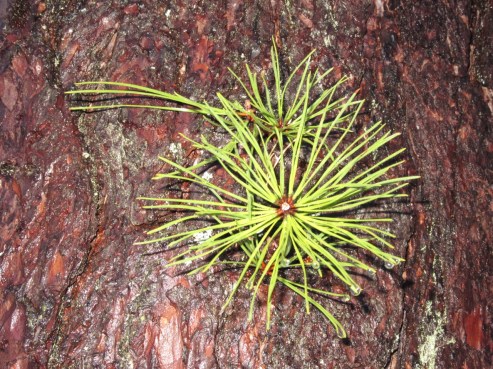
Pitch Pine needlesIn my attempts to get closer to the pine in our yard, I made an important discovery today.  It is not a red pine, it is a pitch pine. I discovered that its needles come in groups of three–and the red pine comes in groups of two.  So then I went searching for a resource I remembered from a couple years ago–an identification guide of the pines of Maine, and confirmed everything.

It is a funny thing.  I had used that resource earlier to identify the tree as a pitch pine, especially because of its habit of small patches of needles coming out of the trunk–as in the picture above.  But then the arborist said no, it was a red pine, and so I deferred to their judgment. Perhaps that is one of the lessons for me to learn–arborists don’t necessarily have intimate knowledge of all tree species. Sometimes it takes detective work, which is easier with the many resources that are available online.

So this naming is making a big difference in my relationship with the pine.  Now I understand the prickly feeling–according the guide, “Pitch pine cones have a sharp prickle at the end of each scale.”  They are prickly!  It also says, “Branches are horizontal, rigid, contorted and form an open crown.”  That describes so perfectly the irregular beauty of its shape.  “Pitch pine attains a diameter of 1–2 feet, and a height of only 30–40 feet.”  These height numbers relieve the anxiety I had about the tree possibly growing to shade our solar panels–it is likely fully mature at its current height.

What else?  It is native to eastern North America. It can live to be 200 years old. It tends to grow in acidic, sandy, and low-nutrient soils. It is a “pioneer species” and is often the first tree to vegetate a site after it has been cleared. So perhaps it speaks to the history of this land–that this land was cleared, that it was depleted. The tree can also regenerate itself–if the main trunk is cut or damaged by fire it can re-sprout using epicormic shoots, which is unusual for a conifer.  (This might make it a candidate for coppicing or pollarding–the practice of cutting a tree to use the wood, after which the tree regrows.)

According to Wikipedia, “Pitch pine provides a habitat and offers food for many wildlife species. They are used as cover and nesting for birds such as the pine warbler, wild turkey, blue jays, black-capped chickadees, black-and-white warblers, and chestnut-sided warblers. Small mammals and birds eat the seeds.”

I feel like the tree and I are starting all over again with getting to know each other–now that I know the tree’s actual family and species–now that I know its family name.

Red Pine

Red Pine[Edited: I learned 2/12/18 that this is actually a pitch pine. See my new blog post.] There is a red pine in the middle of our back yard… the only big tree (40 plus feet) that is not at the edge of the yard. But I have been struggling to create an affectionate relationship with this tree. I have had other very special trees in my life, and I loved the many trees that surrounded our home in North Yarmouth.  So why is this one hard?

I have been reading a lovely book, The Garden Awakening by Mary Reynolds, which is focused on creating a relationship with our land. She talks about trees as the guardians of the land.  So if we want to go deeper with the land, we need to go deeper with the trees.  That got me thinking again about the challenge of the red pine.

Perhaps it started when we first moved here, and were concerned about trees possibly shading the solar panels.  Or perhaps it is tied to my grief about the maple tree that was by the side of our house which we did have to take down because of dangerous branches and solar shading.  I loved that tree, and felt the contradiction so acutely: even though the maple tree was willing, and its wood became the ground layer mulch for our future orchard.  We decided that the solar panels would be okay with the pine tree’s slight shading, but it did get us off to a wary start.

So here it is.  It was identified as a red pine by an arborist who came by.  Right now, I have an intention to go deeper with this tree.  I want to understand all the dimensions of this relationship.  Some things that feel difficult to me:  The branches are all too high to reach, so it feels rather aloof.  When the pinecones drop, and there are lots of them, the ground underneath becomes difficult to walk on.  All around the tree there are old pinecones half buried in the grass from many years past.  If I could pick one word to describe my feeling of the tree, it would be “prickly.”

What helps? Last spring, we held an introduction to permaculture design course at our house, and many of the participants commented on the loveliness of the pine tree. There is a beautiful asymmetry in its branches. Their appreciation of the tree helped me to see its beauty.  The red pine is native to North America.  They can live up to 350-500 years.  Some sources said pine trees are symbols of longevity and wisdom.
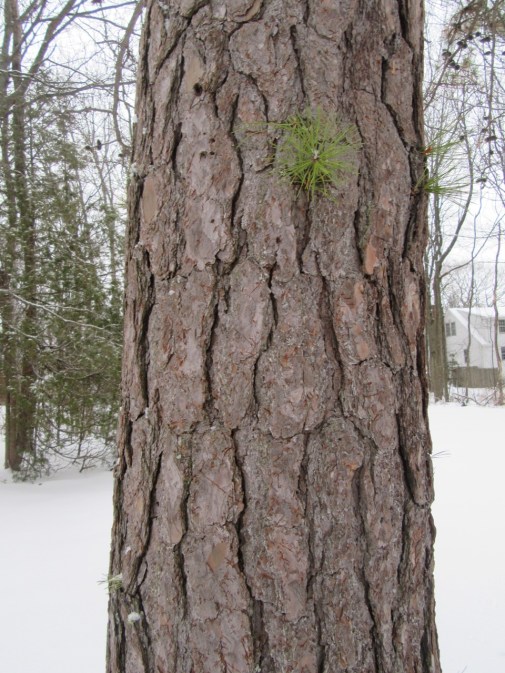
Red Pine BarkOne website mentioned that its roots “are moderately deep and wide spreading. The lateral root masses also send down “sinkers” which anchor the tree very well in the soil. Red pines are very wind firm because of this dense root system.”

Okay, deep roots and anchors in the soil. I like that. I am investigating medicinal uses: one might be pine needle tea, which is good for immune function, bronchitis, and many other ailments.  More to research here.  This morning, I took pictures of the pine, and stood next to it, leaning against the bark.  What do you have to teach me, dear red pine?
 

A No-Win Gamble

The other day I read the “Medicare and You” brochure in preparation for my own “graduation” to Medicare this coming summer.  It has been hard since then to shake a sense of foreboding.  My first reaction to all of it is how can our society treat our elders with such lack of care?  I don’t mean that it is bad that we have Medicare–I wish we had something like Medicare for all–single-payer health care–in our country.  But what we have now seems so bereft of full medical care, that participants are encouraged to buy extra care to cover all the gaps in care.

But it is not merely that you can choose to spend a certain amount per month to cover the gaps–a kind of gambling in itself about whether you will save more than you will spend.  It is that you have to decide between a dozen or more types of options, which kind of product to buy–all seemingly based on making a guess about your own unknown future health needs and prescription needs.  The supposed explanations for the different types of plans amount to gobble-di-gook, if you ask me….

Does anyone besides me see this as a particularly insidious way to torture people?  “You can choose!  Read all this information!  Oh, whatever you choose today will affect your future!”  A gambling game based on what?  (Is it anything besides a way to bring further profit to insurance companies?)  Then in today’s paper I read Michelle Singletary’s column The Color of Money, “Medicare trend causes palpitations,” and felt even worse.  She writes:

New analysis by the Kaiser Family Foundation has found that out-of-pocket health care costs for Medicare beneficiaries are likely to take up half of their average Social Security income by 2030.

I hesitate to blog about this issue because by doing so I have to reveal elements of my own financial situation–and money is one of the last taboos.  But I am feeling bold today. I will admit that despite the many blessings in my life, when I stop working, I will be one of those senior citizens living on a fixed low income.  We have been very lucky–we have a home, with solar panels (lower electricity costs) and a yard for gardens.  But homes also cost money for upkeep.  I worry that eventually I will be one of those who has to decide between medical care and eating.  And I am so angry that elders are put into that position today!

In the world I dream of, “health insurance” would be something paid for by the healthy, to take care of anyone who becomes sick–which eventually will be most of us, as we age. In that world, no one would risk losing their home because they become ill, no one would have to gamble based on unknown future events, no one would be left to die because of a lack of money.  There is a lot more to say about all this, but I have to stop now and go to the ocean… get some perspective.IMG_4237

Deck Roof

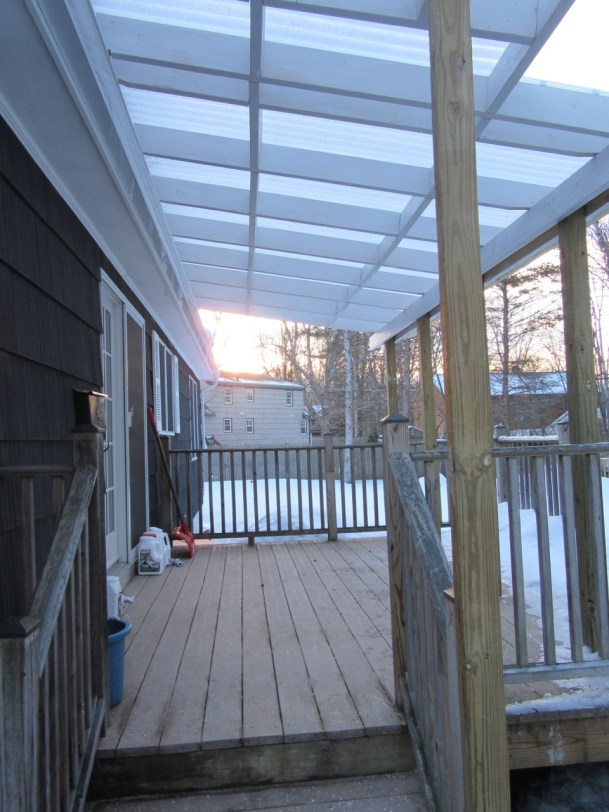
Deck RoofThe first winter after we installed solar panels on our new house, we discovered that when the snow melted on warm winter days, all the snow from the panels came down like an avalanche, right onto the deck, in the path from our back door that we used every day. I was out there shoveling first when the snow fell down, and then when the avalanche came down–sometimes in two or three segments.  And that second snow was always heavy wet and dense. #thingsyouforgottodesignfor

We needed some sort of new plan.  So we came up with an idea with our friend Ian, and he built this partial deck roof, using Tuftex polycarbonate roof panels and wood framing.  It was wider than we first imagined, to use the support beams under the deck for the framing.  Took longer than expected.  Doesn’t everything.  But such a relief now that it is up.  The panels are clear to let the light shine through–though in this photo they have some snow cover.  And they work–the snow avalanche slides down the solar panels, right cross the deck roof and lands in the space beyond.