Spring Arrives in Maine

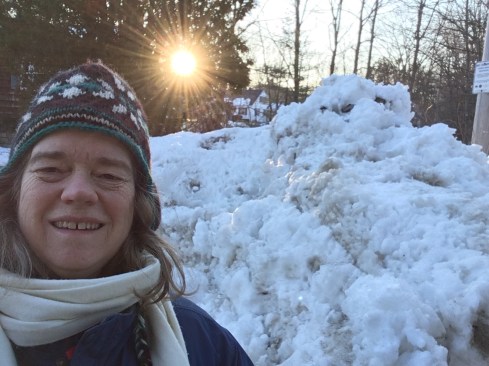
Spring Arrives in MaineToday is the first day of spring everywhere in the Northern Hemisphere.  What it looks like in my neighborhood is huge piles of snow and a really cold morning, but with a bright sun leading us into a clear day.

Margy and I hosted an Equinox ritual at our house last night.  It was a small group of five this time, and most of us were weary from the winter, so our ritual was simple and low key.  We named the friends who had joined us for Solstice and Imbolc, and sent blessings to all of them.  (You know who you are!)  We shared thoughts and readings about our lives and about winter and spring.  We talked about what we wanted to let go from the winter season, and what intentions we wanted to carry into this new season.

I thought about the next several weeks until Mayday.  The snow will disappear, and the ground thaw, and begin to fill with green.  Our plants will arrive from Fedco:  an apple tree, a peach tree, two blueberry bushes, three hazelnut bushes, a mulberry tree, a licorice plant, 25 asparagus plants, and 3 golden seal plants.  By Mayday, I hope they will be in the ground.  Our friends volunteered to help with the planting.

I remember when we first imagined this new home, when we began to lay out our intentions to find greener housing in the summer of 2015.  Our intentions included creating a permaculture garden, and having space in our living room for people to gather.  And here we are!  Living those dreams into reality.  The magic of deeply felt intentions can be surprisingly powerful.

Large scale hydro is not clean energy

I sent a letter today responding to a Portland Press Herald Maine Voices column about Central Maine Power’s push for transmission lines through Maine to bring Canadian hydro power to Massachusetts.   I agree with the column, by the way, but an issue that troubles me is the statement often repeated in the Press Herald that Canadian hydropower is clean renewable energy.  Large scale hydropower cannot truly be considered clean and renewable energy.

First of all, large scale hydro floods huge areas of the best land in the northern climate—river valleys that are home to the most diverse plant and animal life in the region. The resulting reservoirs are not the same as natural rivers or lakes. They become contaminated with methyl-mercury, poisoning the fish and any who eat them. Methane gas is emitted from the decomposition of flooded plant life. And because of silt build up, the dams may not last more than several decades.

Secondly, these dams are being built in the territories of indigenous Cree, Innu, and Inuit peoples, with a destructive effect on their culture, lifestyle, food sources, hunting and fishing, burial sites, and ultimately, their sovereignty. The LaGrande project was built in the 1970s without any consultation with the Cree or Inuit, and then later projects have been and still are initiated without giving any true choice to the people who have lived along these rivers for millenia.

photo-hydro-quebec-99-185-7-12

[La Grande 1 Generating Station]

We know that Maine Governor LePage is not interested in renewable energy, nor is he concerned with the rights and sovereignty of indigenous peoples, as witnessed in this government’s actions toward the Penobscot people and their river. But the rest of us who live in Maine must be better than that.  We should support true renewable energy, and also support the human rights of indigenous people both here and in the lands to the north.

Turkeys Visiting

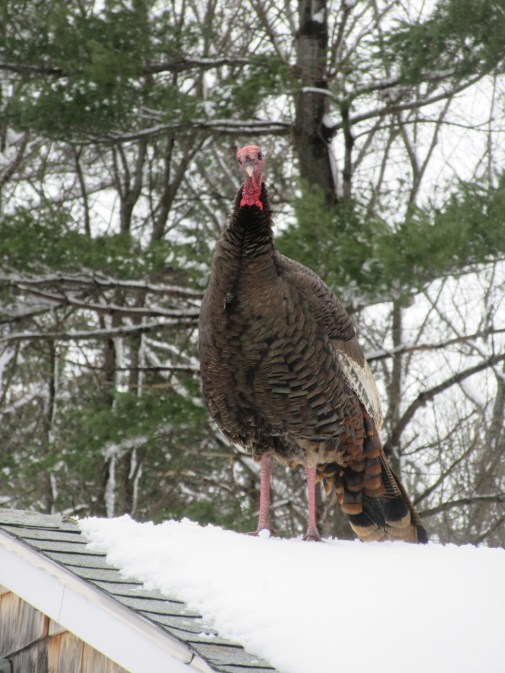
Turkey on Garage Roof

Yesterday, I looked out a window and saw a turkey in the driveway.  When I went on the deck to get a closer look, it flew up to the maple tree in our neighbors yard.  But then I looked up and discovered two turkeys on the garage roof, another roosting in the pitch pine, more in the spruce and small maple on the other side of the house–we were surrounded!

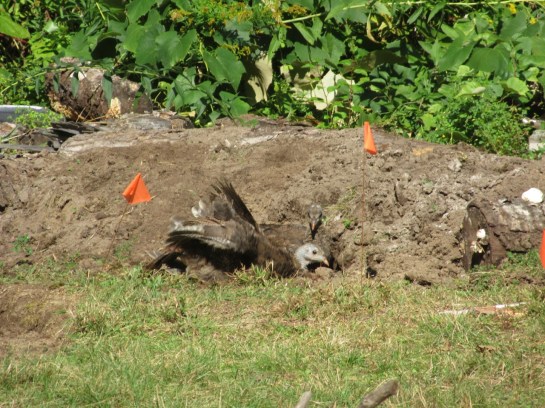
The one on the roof seemed to enjoy our conversation–it was looking at me so intently as I spoke.  I wonder if this is the same family that visited often during the summer and played in the dirt in and near our future pond?  They were younger then, of course.  But maybe? If you look closely you can see two of them in the photo below, from their visit in September. This morning on my walk, they were out walking too.  Perhaps the deep snow has disrupted wherever they were hanging out during the winter.  But they look very fat and healthy.  A visit from wild neighbors always makes my day!

Turkeys in dirt

Drawn to Water

Ducks in Brook

On my morning walks, I am always drawn to water.  Often happily surprised by other creatures who are also drawn to water.  Like these three ducks at Capisic Brook.  Is this some ancient DNA memory, the walk to the water?  Women walking to water through untold centuries.  Before the water came to us in pipes, which was not so long ago. Before the water in brooks became no longer drinkable–though the animals still drink there.  And yet, even with all that has been lost, still so beautiful to my soul.

Counting Tree Rings

Cut pine

During the construction for the new Hall School, they have cut down acres of trees.  It truly breaks my heart.  Especially when I saw a stack of huge pines from the front of the school.  This one I measured at about 33 inches in diameter–just about the same as our beloved old white pine in our yard, though I didn’t have a way to tell how high up on the trunk it would have been.  Why do people cut down the old ones?

I tried to count the rings using my photos–and determined that it was at least 120-125 years old, if not more.  That means that this tree was around back in 1897, when my grandmother Yvonne was born.  It also might mean that our white pine, if it isn’t 162 years old as we estimated by circumference is likely at least 122 years old.  I would guess that there were similar circumstances for all of these pines in the neighborhood.

IMG_5008You see, I have been walking around the neighborhood looking for any other large pines I can find, and measuring them.  I haven’t found one larger than ours yet. Yesterday near the brook and the school, I found one that measured 102″ in circumference–just like ours.  It was wrapped in caution tape–does that mean leave it alone?  It is right next to an access drive of some kind next to the school. I hope the tape means leave it alone.

There are two more white pines in yards at the crossroads of our street that I want to measure when I get a chance, plus one right next door that rises a few feet away from our garage.  I think these might be similar in age to ours.  It would be easier to measure with two people doing it, plus I feel a bit awkward about going into people’s yards without a conversation.

What the close-by pines say to me is that when someone was building houses in this neighborhood in 1967 or so, they decided not to cut down these special old trees.  I am grateful for that.  But are they the remnants of a much larger family?


More White Pines

White Pine near Capisic

There is another old white pine that I see on my morning walks, next to the the Capisic Brook near my home.  Even as the old white pine at my home sent me on a search for the history of this land, so both of these pines lead me into a search for their spiritual meaning.  Maine is called the Pine Tree state, and the White Pine is the state tree.

When settlers first came to this land, they found old growth forests with white pines being the tallest of the trees in the east.  Many of them were cut down to use as masts on the English ships. In fact, any straight tree over 24 inches in diameter was marked for use by the king, but people often ignored that marking.  I read that the old-growth trees were all cut by the mid 1800s.

In the same article, they identify two old pines found in Acadia National Park as 154 and 147 years old.  That made me wonder if the method I had used to date the white pine in our back yard was accurate–if that pine was actually 162 years old, it should be on the EasternOldList.  On the other hand, if the land was undeveloped for a hundred fifty years, (just a blank space on the map) perhaps it would not be so impossible that it should be counted among these old ones.

Pine needles are full of vitamin C, and the inner bark was also edible–made into a kind of flour by the Wabanaki people here.  Among the Haudenosaunee, the white pine was the Tree of Peace–symbol of their confederation of nations, the five nations symbolized in the five needles in one packet, and the agreements they made to keep peace among their nations.

Modern science has discovered that pine trees release compounds known as phytoncides, airborne chemicals which protect the trees through anti-fungal and anti-bacterial properties.  These compounds also support the “natural killer” cells of our human immune system.  So walking in the woods has actually been proven to be good for our physical and mental health.

While searching the internet for the meaning of the white pine, I found that another blogger The Druid’s Garden posted this:

In my experience, these trees retain their roles as peacemakers for us today in order to rebuild human-land connections. Often on damaged lands, even if no other spirits or trees are open to communication, the White Pine will be the intermediary.

Since my purpose in learning about the trees on my land is to rebuild our human-land connection, I may see if our white pine is willing to offer that mediation.

Little Neighbor

Skunk

Look closely. Surprised to see her in the light of day, but I think this skunk was trying to make her way home, much to the chagrin of our neighbor’s dog.  I don’t know if this is my gardening friend from last summer, but if not, I would guess it is a family member. She (or he?) is following her own corridor–how important these small stands of trees and shrubs are for our animal neighbors. But as to where she was headed–strange–under a fence or under a deck? Right into our human neighbor’s yard.

There were also some strange tracks in the snow two days ago in our yard.  Bigger than the usual squirrel tracks–now I think that maybe they were hers as well.  Margy took this photo. I read that skunks are rather inactive in winter, though not true hibernators.  But they begin to be more active, looking for a mate in spring.

tracks

Tracks by Margy Dowzer

Cedar

cedar leavesI seem to have unleashed a thirst for learning the names of all the trees who live with us on this land to which Margy and I belong. Today, I am exploring the cedar tree in our southeastern boundary area. I had always wondered about the difference between cedars and arborvitaes, and now I know that they are the same, really, here where we live.  There are a lot of names for this species which is native to southeastern Canada and northeastern United States–Eastern White Cedar, Northern White Cedar, White Cedar, False Cedar (because it is not related to European cedars).  Its Latin name is Thuja occidentalis.  

Cedar trunkIt was first called Arborvitae by French explorers when Indigenous people gave them tea  made of its leaves as a treatment for scurvy.  Arborvitae means “tree of life.”  Now, arborvitae is the name used by horticulturists, and there are many cultivars of the tree that are sold for landscaping.  The Anishinaabe people called the tree Nookomis Giizhik or Grandmother Cedar, because of its importance as a sacred and medicinal tree, associated with one of the four directions.

This has been a special tree to me personally in most of the places I have lived–Michigan, Chicago, northern New York state, Massachusetts, and Maine, and I appreciate that my matrilineal ancestors also knew this tree in Quebec/Nitassinan.  The Innu word for this tree is Massishk.  The tea from its leaves contains an abundance of Vitamin C, and can be used as a medicine.  (Note–being cautious, it is recommended that pregnant women should not use cedar tea because the compound thujone within it.)

From Sean Sherman (The Sioux Chef’s Indigenous Kitchen):

The tea of simmered branches is used to treat fevers and rheumatic complaints, chest colds, and flu. This brew is delicious warm or cold and is simple to make. Just simmer 2 cups of fresh cedar in 4 cups of boiling water for about 10 minutes until the water becomes a golden color. Strain off the cedar and sweeten with maple syrup, to taste.