There are two robins in or near the nest on our back porch.
The robins are trying once again–for the third time–to raise young in a nest on our back porch. The two previous times either the eggs never hatched, or the young died very soon after. I hesitate to even post this, for fear they will fail again–but, this time, both the father and mother are staying close to each other, and seem to be taking turns on nest duties. I have learned that they open their beaks as a way to cool off in the heat. I wonder if they are new parents, and just didn’t get their parenting act together before? I hope they make it this time!
Meanwhile, goldfinches are enjoying the sunflowers that planted themselves under the bird feeder, as well as the evening primroses that planted themselves near our porch. This little female was perched on that sunflower for at least twenty minutes, just taking her time with a meal.
Female Goldfinch eating seeds of the sunflower.
In these hot dry days here in Maine, I just go outside in the early morning to water the veggies or trees, and to pick blueberries or raspberries, now almost done. But looking out the window brings many moments of joy because of these birds who live in our yard. I learned the Passamaquoddy words for goldfinch–wisawiyehs–and robin–ankuwiposehehs. (wisawi refers to yellow and ankuwi refers to farther, perhaps because they migrate) For them I am always grateful.
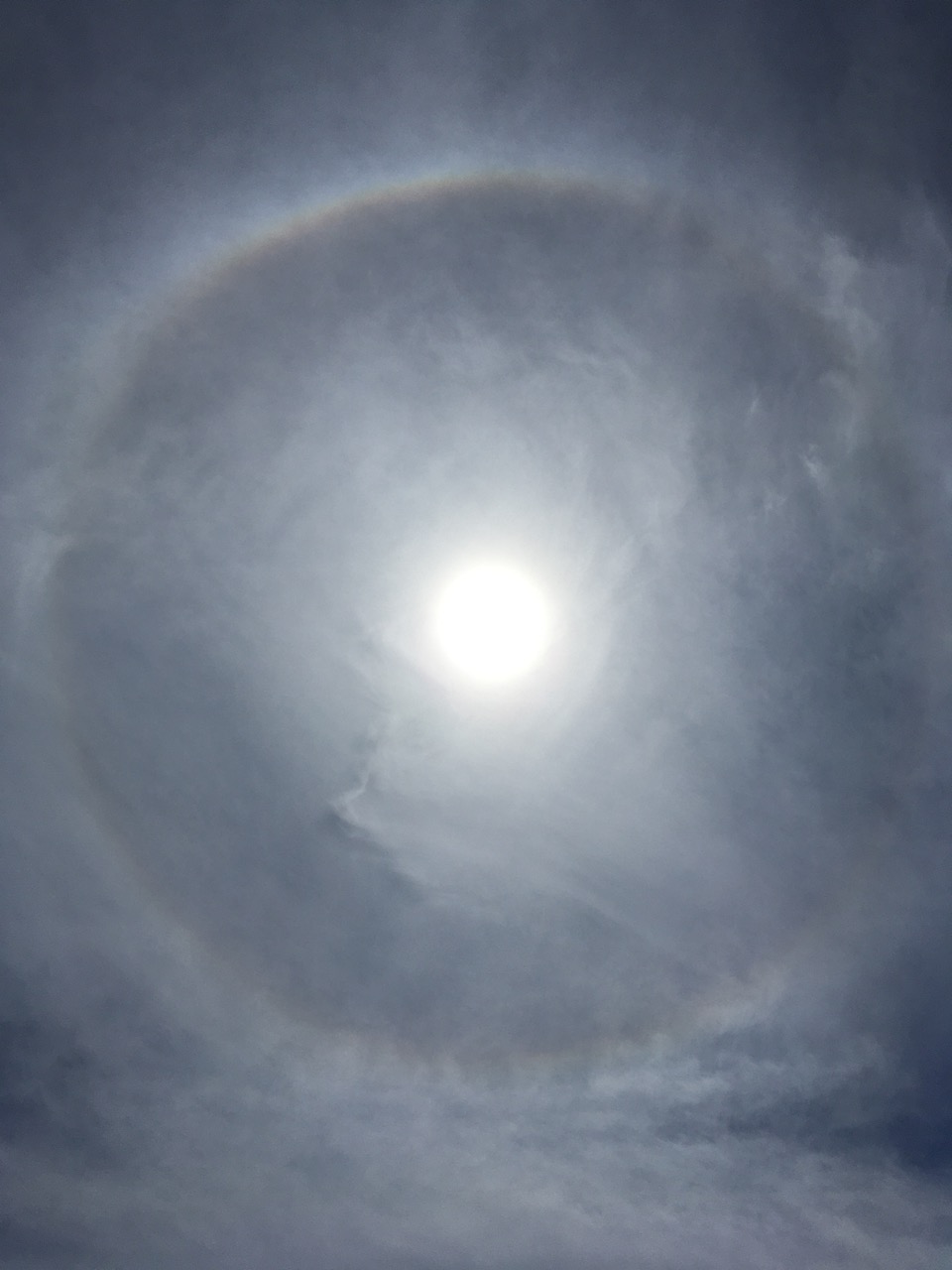
We finally made it to the ocean on Wednesday! Between Margy’s knee surgery and physical therapy, and my general fatigue, we just couldn’t do it before, despite it being our favorite summer outing. But Wednesday afternoon, we drove to Kettle Cove. We stopped for ice cream at the nearby stand first, coffee ice cream with hot fudge for me, and a strawberry hot fudge sundae for Margy. Then we negotiated road repairs, and finally parked the car near the beach. Kettle Cove was our choice because the path between the car and the beach was not too long for Margy to negotiate with her cane. Plus we love this little beach and cove. We sat in our beach chairs for a while, and that was when I noticed the sun halo in the sky, and took this photo.
Then I went into the water and swam a little bit. It was just lovely. I can’t even describe how happy it made me feel. Then, afterwards, I sat with the sun’s warmth on my skin, a slight breeze blowing, and that felt like heaven. It has been harder to visit the ocean since being chronically ill. Not only the effort to drive there, but the coldness of the water sometimes triggers me into not being able to get warm again. But this time, I felt deliciously cool in the water, and deliciously warm afterwards in the sun. However, full disclosure, after we got home, I took a shower and then collapsed, exhausted over my whole body. It seems I can’t write much lately without writing about chronic illness, and how it has re-shaped my days.
Sometimes I feel envious of the adventures that friends post on Facebook. I have to shift my heart around and remember to be thankful for the blessings in our life here, even though it might be small in scope. To have food, a home, a garden–I am so grateful for those, and I don’t take them for granted. To have love in my life–that my partner stretches her energy to visit the beach with me, and stays longer than comfortable for her, so I got to experience my little heaven. And my love for her too, to leave sooner than I might have wanted, so she can get home and rest. I am so grateful for our love for each other.
A sun halo is said to be a good omen, that might predict rain (or snow in winter). We did get a much needed, drenching thunderstorm last night. Our garden is so grateful for that. And I am grateful for the ocean, challenging to my body, but still a ceremony of healing for my spirit.
Right now the garden is happy with berries: the raspberries are loaded with fruit, and this is the first year for a blueberry harvest. We planted these blueberry bushes in 2017. This year, I put up some fence posts and draped the berry bushes with gauzy fabric after the berries started to form. (Tried it first without the posts, but the weight bent the bushes over when it rained.) This is to keep the birds from eating all the berries. But we have three younger plants in the back that I left open. And the raspberries do fine on their own. So every other day, I go out and pick a bowlful of ripe berries.
Blueberry bushes wrapped with tulle fabric
The fabric barrier is a bit ironic really. I don’t mean to discourage the birds at all. But expert gardener’s advice says that they will eat all the blueberries before we can. I think of myself as a very novice gardener. Our garden only provides us with a very modest harvest. Last year the squirrels took all the peaches, and cabbage moths are now eating a lot of the kale. I have given up on the idea of creating a food forest that will provide all our needs. This year, I haven’t had the energy to give any of it much attention at all.
But somehow, in the midst of it all, the garden keeps giving back to us in unexpected ways. The orchard has become a bird heaven. We now regularly see cardinals, a robin couple (who, after two failed attempts, are again playing with the nest on our porch), gold finches, house finches, sparrows, chickadees, catbirds, starling visitors, not to mention the turkey mom and her two babies that keep coming through, and so many more. The small birds love perching in the fruit trees–and I love seeing them there. They ate the few cherries, which I didn’t try to protect. I think they are also eating a lot of bugs. They even love perching on top of the stakes in the zucchini bed. We provide sunflower seeds in the bird feeder, and they planted sunflowers all around it with the droppings. So we are gifted with all this beauty.
Sunflowers in bloom around a green bird feeder with a small sparrow on it.
This has been a summer of much gifted beauty. Another example is the wild evening primrose. I pulled all of the primrose plants that had sprouted up in the orchard, because I knew they would be too tall and block the paths. But I purposely left the ones on the other side of our back porch, this one in front of irises that bloomed earlier. And now they sparkle a bit like a Christmas tree in July.
Tall evening primrose in bloom
Each year I do learn a bit more about how to garden. This year, it seems that what I am learning most of all is how much the earth gifts to us and to all her creatures, how generous and abundant she is, when we merely open to her and open to other creatures, and stop trying so hard to make something specific happen. I am feeling the interconnected family of beings, and especially the joy of birds who now find a home in our yard. It’s amazing! Finally, I just want to also express gratitude for a monarch butterfly who came to visit a few days ago.
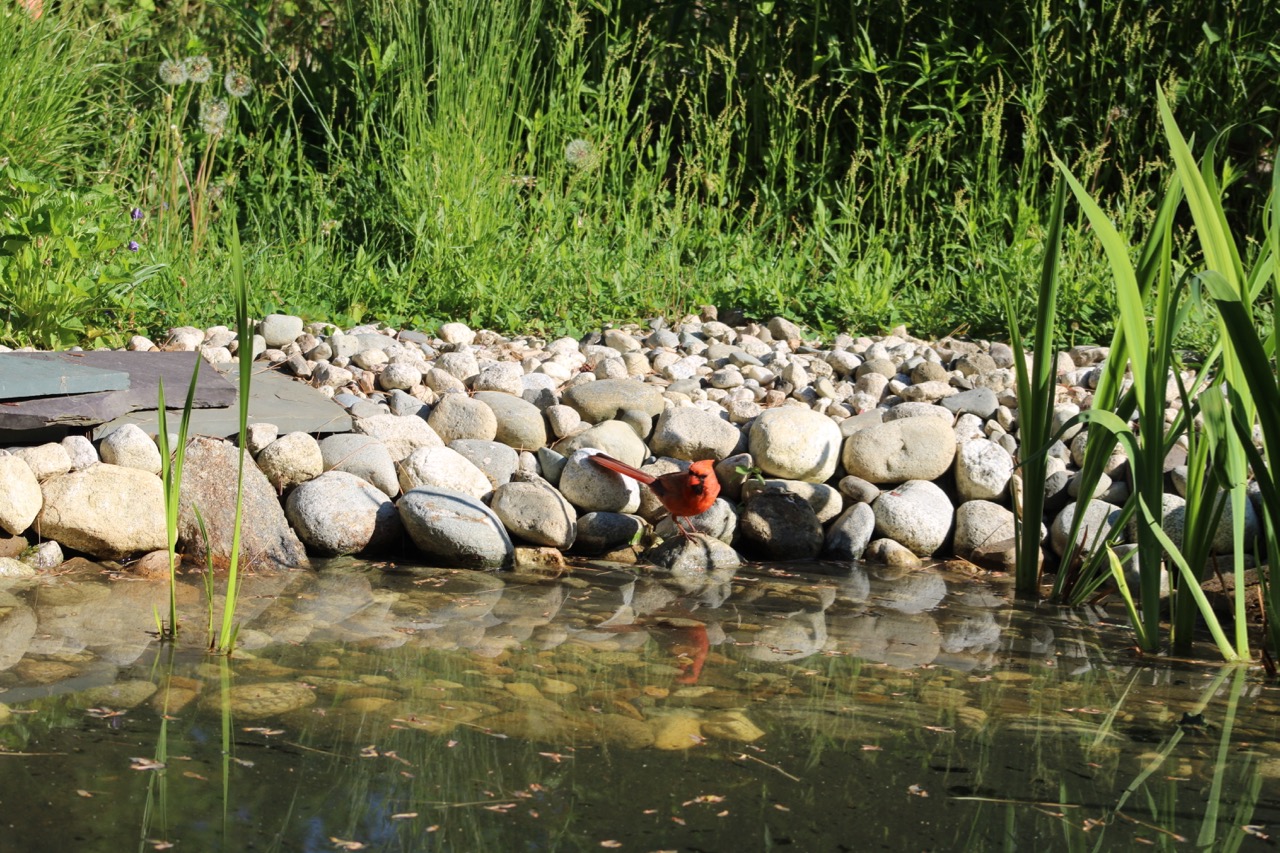
Today is the new moon. This morning I sat near the pond, reading my journal from the date of the last new moon, as is my practice. Then along came this cardinal landing on a rock on the other side of the pond, about 12 feet away from me. After I took this photo, it flew away, but then he came back a little while later, and took a sip of water. We know that having the pond is beneficial to all sorts of wildlife in the yard, but this is the first time I actually observed a bird taking a drink, especially with me sitting right there. I am grateful for this cardinal’s visit, and his acceptance of my presence in his ecosystem.
Some thoughts to remember from the journal: It is good to be claimed by this ecosystem. It is good to listen to the earth, to the plants and all beings, and to the spirits, and to follow their lead about what to do to tend this garden, and when.
What a beautiful dawn the other day, all the branches coated with light snowy adornment! I’ve been feeling grateful these days. In particular, I’ve been thinking about how lucky I have been to study the Passamaquoddy language with Roger Paul during the last 3 1/2 years. I recently saw an article published a few years ago, by Taté Walker, “3 Questions to Ask Yourself Before Learning an Indigenous Language as a Non-Native.” It got me reflecting about the questions, some of which I had already considered when I began. #1 Why am I learning this language? #2 How will I center tribal perspectives as I learn this language? #3 How will I handle criticism from Indigenous people? Today, I also have a fourth question which I will explore.
I looked back to my earlier posts to remember my thoughts about why I was learning this language. I had asked permission from the teacher, and also from my Wabanaki friend who was going to take the class, and both had been very welcoming. Roger has talked about how his elders had decided it was time to share the language with others beyond the community. On a very practical level, it was hoped that by increasing the number of registrations, the class was more likely to be offered at USM, so more available to Wabanaki students who wanted to learn.
On a deeper level, I wrote that it was a way to begin to decolonize my mind, “I want to think differently”–Nkoti piluwitahas. I also had the thought that, ideally, any of us who came to live in Wabanaki territory should learn the original language of this land, as respectful visitors. Also, years ago, an Indigenous woman had said, “If you really want to understand our spirituality, you must learn our language.” It stayed in my mind though I can’t remember now who it was who said it. (This was during the time I was working on the issue of cultural appropriation by white people of Indigenous spiritualities.)
Today, thinking about it again, I know I had the privilege of retiring from work right at the time the class began, and there was a program for seniors to enroll in university classes for free. Everything came together so easily. My heart led me into it and the door opened. I think perhaps, too, though I didn’t realize it at the time, it was a way to connect to my own Innu ancestors.
During the process of taking these classes, I have learned so much about the perspectives and history of Wabanaki people. I have learned how few people are now fluent in the language, because of forced assimilation, and because of the terror of the boarding schools and day schools, where children were punished for speaking their language. I have learned that for me to learn the language is a privilege that many Wabanaki people do not have, if only because they are busy trying to survive in the English-speaking world. I understand that if I were to speak the language in most contexts, it might be a painful trigger for Native people who carry so much trauma about the loss of their language. So mostly, I haven’t tried to speak it except in our class contexts. And though I am beginning to understand more than I could have imagined, I am humbled too by how difficult it is for me to speak any of it, except for carefully constructed dialogues. I am truly still a beginner.
But the question closest to my heart these days is this: Since I have been granted this gift of learning the Passamaquoddy language, how can I give back? From this course, I’ve learned gratitude and the importance of reciprocity: so what is my responsibility now, as the recipient of such a gift of knowledge? Bearing in mind that I’m not training to be a professional teacher, and I have so little energy anyway because of chronic illness. I have done some activities in solidarity to Wabanaki concerns–but these are not related to language. I don’t have an answer right now. But I am holding this question closely. How can I give back? What is my responsibility in light of the gift of this knowledge? It may be that by holding the question, an answer will be revealed.
Tonight I feel grateful to participate in the virtual opening ceremony for the Healing Turtle Island gathering. Songs, prayers in Indigenous languages, stories of grief, woundedness, devastating loss, and yet, gratitude. How do we bring healing, bring back balance in our relationships, with each other, with the earth, with spirit? This weekend will be filled with many speakers… (anyone can join on Facebook, or on Zoom, just follow the link). I don’t have a lot of words right now but one of the strange blessings of the pandemic is that because this gathering is virtual, I am able to participate. I was present for the very first gathering here in Wabanaki land, the eastern door. There will be 21 gatherings all together.
This photo is of two deer whom we sighted in our backyard on Tuesday–there were four all together. They were a gift in the midst of a painful week. I found myself just sitting on the back porch watching as they took their time amidst the trees and brush. Sitting still and watching. I feel the presence of such a compassionate Spirit through these visitors from the natural world.
Today, September 29, is my great grandmother Claudia’s birthday–she was born in 1865. I never got to meet her, but I was named for her (my middle name) and so I have felt a connection to her for quite a while. This week I was once again caught in the throes of this strange yearning obsession to try to understand the lives of my matrilineal forbears. I happened to be looking at a document about Claudia that I compiled a few years ago, and it mentioned a resource–the “General Catalogue of the Entire Montagnais Nation.” [Except the title was in Latin and the book was in French. Denis Brassard, Catalogus generalis totius Montanensium Gentis of Father Jean-Joseph Roy, 1785-1795 ]
It was a record of baptisms and other religious rites at the King’s Posts (Postes du Roi) in the Saguenay River area and North Shore of the St. Lawrence River of Quebec, in the 18th century. The Postes du Roi were the site of trading between the Innu/Montagnais and the French/British. They were also the site of missionary priests coming round to offer religious instruction and ceremonies to the Innu people. (The French called the Indigenous people of this region Montagnais, but since then, the people have reclaimed their own word, Innu.)
Claudia’s mother was Angele McLeod, and her mother was Marie-Madeleine, who was identified as “Montagnaise” in any records I had been able to find. But I had been unable to go any further back in her family, and only had estimates of her birth to be about 1789, perhaps linked to a Post du Roi. So I went looking for that book, which was available in a digital format for not so much expense. And it had a built-in translation function, which helped a lot since my French is shaky. The first half of the book was a description of how things were at the Postes du Roi. The Innu generally spent fall/winter/spring in the inland forests, hunting and gathering, and then came to the shores of the Saguenay or St. Lawrence in the summer, to fish and gather with each other. The Posts were built at these established summer gathering places to foster the fur trade, and the conversion of Innu people to Catholicism by the priests.
By searching record by record through the hundreds in the chart, I was able to find two Marie-Madeleines (Maria Magdalena) whose births were within 10 years of 1789: 1795, 1797. The Innu people did not use surnames, but rather single descriptive names, so each record included a Christian name (in Latin) and a personal name for the child in the Innu language. I found Marie Madeleine Katshisheiskueit (record #1065), and Marie Madeleine Manitukueu (record #1079). I don’t know that I will ever be able to establish a definite link between one of them and my Marie Madeleine, but one of them could be related to me. My Marie Madeleine eventually was married to Peter McLeod who worked for the King’s Posts in many places. And she was identified as Catholic, so it would be likely for her to be in these records.
Finding these names is touching a deep place in my spirit. I can’t even describe it. And deeper still, was searching out the meanings of the Innu names in the language. I was able to determine that Katshisheiskueit likely means “Hard-working/female” and her parents’ names were Antonius/ Tshinusheu which means “Northern Pike”, and Anna/ Kukuminau, which means “old woman” or “wife.” (Now the parents were only about 16 then, so likely it was an endearment, or Tshinusheu just said–“that’s my wife.”)
Manitukueu has something to do with Spirit–Manitu is the Innu word for Spirit. But I couldn’t find an exact reference. Manitushiu means someone who uses spiritual or mental power. “kueu” seems to be a common verb ending signifying something being or having. It is like detective work–and I wouldn’t be able to do any of it if I hadn’t been studying Passamaquoddy, which is related to the Innu language. Words are formed polysynthetically, with smaller parts joined together to create long descriptive concepts in one word. So I search the online Innu dictionary, with my framework of Passamaquoddy, and try to recreate what they might mean.
Manitukueu’s parent’s names were also challenging. Her father was Simeon Tshinapesuan, and the closest word I could find was something meaning “slips on a rock”, or “slippery.” Her mother was Marie Madeleine Tshuamiskuskueu, part of which meant “finding it by detecting it with body or feet.” But then I lucked out because her own birth record called it Iskamiskuskueu–which means “from Jeremy Islets,” and she was from Jeremy Islets. According to another source, this Innu name of that place meant “where you can see polar bears.” (Where you can find polar bears?) I guess I was rather far off.
So, it’s hard to trace “family trees” without surnames, but each child was listed with their parents, and by going through again searching for the parents’ names, I could find their parents too. And in fact, there were a few generations in each of their families to be found in the charts, with a lot of holding a magnifying glass over my computer screen so I could read the small letters in the charts. Much more still to do.
It is a whole world uncovered to me. And whether or not one of these women is my actual relation, this is the world she lived in, the world she came out from to enter a path that eventually would lead her daughters and granddaughters into other worlds. I never imagined that I might learn the Innu name of my great, great, great grandmother… and now there are all these names dancing in my mind, trying to form in my mouth, bringing much depth to my heart. I feel such gratitude and curiosity.
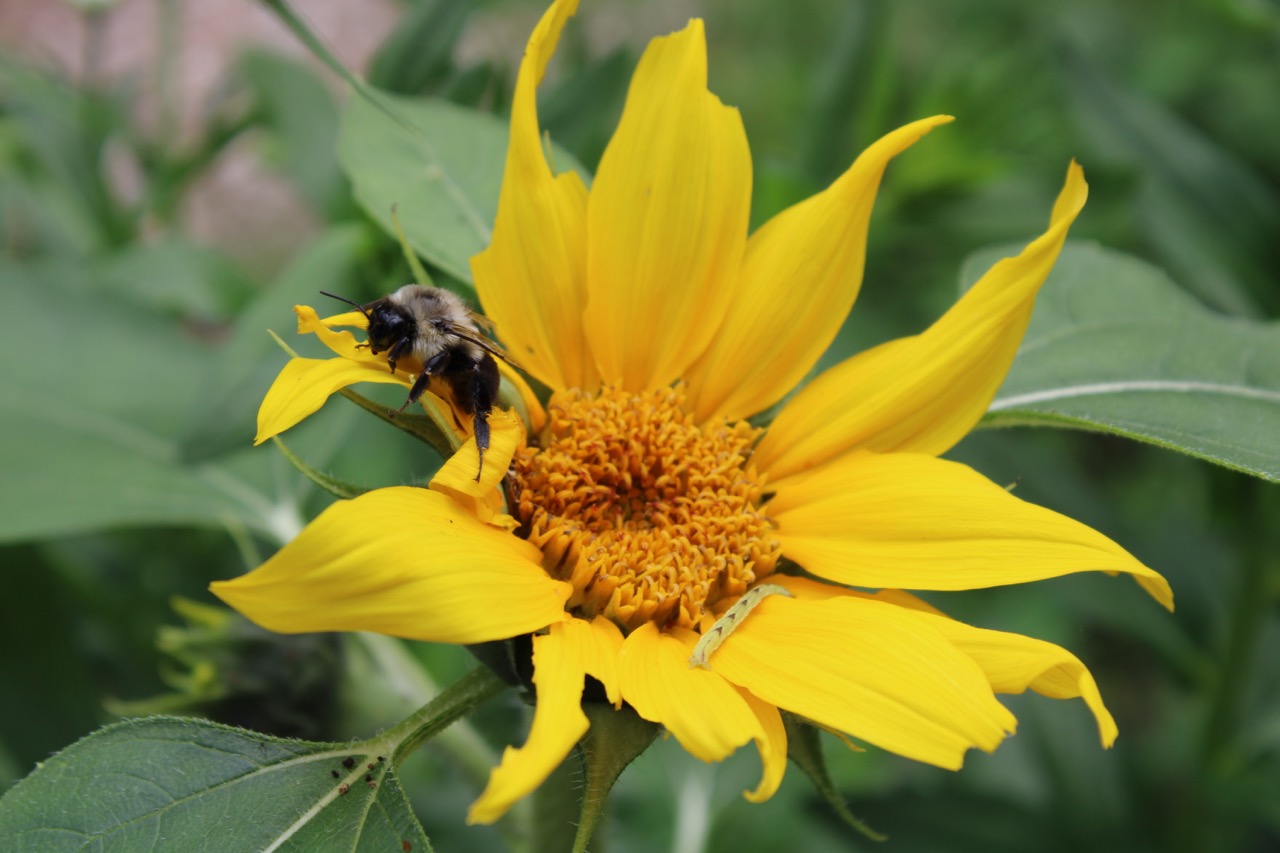
Yellow sunflower planted by squirrels, with a bee inside.
After grieving for the lost peaches, I wanted to remember that many other harvests are doing abundantly well. I am trying a new method with my zucchini plants: tie the stems to stakes, and prune the leaves below the active flowers and fruits. So yesterday, I pruned out many lower leaves, and finally tried the staking idea–the zucchinis seem to grow with a mind of their own, rather than with anything like straight stems, but I was able to do a bit of it. The method is supposed to reduce powdery mildew and maybe other issues. As I write, I am trying out a recipe for zucchini/cheddar/chive bread. Our zucchinis have been abundant.
Raised bed with kale and carrots, under a staked and supported netting.
After putting a netting over the raised bed when the ground hog came by, we haven’t seen her again. The kale is doing fine–since it takes a bit of work to undo the netting, I have only harvested in big batches. I’ve sauteed some batches to freeze. There is more in the fridge waiting for me to do another batch.
Cucumber plant on the hugelkultur mound, with wood chip paths on every side.
We’ve already harvested several cucumbers from this lovely set of vines growing on the south end of the hugelkultur mound. We have just been eating them raw–so much sweeter than the ones we can buy at the store. And a few weeks ago, I put down cardboard and old grocery bags to lay out paths all around the mound, and from the garage door to the patio and the paths, then covered them with a thick layer of wood chips. These wood chips were from the invasive Norway maples we took down earlier.
The raspberries are finished bearing fruit. Finally, I just want to mention the chives, parsley, thyme and oregano, which continue to yield throughout the summer. I truly am grateful for these gifts from the plant world, that bring us such tasty and healthy food.
Photo: A bulk order of small round stones of many sizes
This week has been a big adventure in stones. In my last post about my pond project, I mentioned that I needed to get a pickup truck, to go to a store that had “2 inch round stones” in bulk. Well, I did some research, and put on my big girl pants, and rented a pickup truck from Home Depot. I drove to Estabrooks, where a clerk rang me up for a half cubic yard of the stones. But then they were informed by the people in bulk orders that they didn’t carry 2 inch round stones. Despite a clerk reassuring me two days earlier that they had them. So a manager came by, and explained that the previous clerk was wrong, they didn’t carry them any more, and had no way to order that amount from a possible supplier. She was very apologetic about the mistake, and gave me a $40 gift card to compensate me for the truck rental.
So truthfully, I was proud of myself for doing something I hadn’t done before–renting the truck–and they did treat me well and took responsibility for their mistake. But I was disappointed, and back to square one for finding stones. I started looking again at the notes I had made before, and noticed that I had written down another possible source for stones–but the information online wasn’t very complete. (I think people who sell stones in bulk don’t really like to work on websites.) So I called New England Specialty Stones, left a message and got a call back a few hours later. They were happy to deliver a half yard of 1 1/2 inch round stones to my house, with a delivery charge, and the total price was $76 dollars–less than what it would cost for my earlier Estabrooks adventure. The stones arrived on Thursday, and were expertly dumped on the tarp I had placed on our patio. I felt such relief and joy to see those stones.
Some parts of the pond project have been step-by-step, like digging a hole. But other parts have required a big push on my part, with some help from others–like laying the pond liner, or getting a bulk order of stones. Now that the stones have been delivered, I am back to the step-by-step processes. The person I spoke with about these stones mentioned that they’d need to be washed, to use them for a pond. So I started doing that today.
Photo: Stone rinse #1 of 5
It took five rinses before the water was relatively clear. But I did have the idea to dump out the “dirty” water onto the beds around my fruit and nut trees. I am thinking that this stone dust is likely a very good soil amendment–like the granite dust I put around the tree beds earlier on. Once rinsed, the stones are actually quite pretty and colorful, with a great variety of sizes and shapes.
Photo: rinsed stones
Once rinsed, I take them via the wheelbarrow back to the pond area to use. Load by load. First of all I rebuilt the stone “beach” that is an incline for critters to be able to access the water, to get in and out easily. I mentioned before that after my first attempt I was worried it was too steep. So I removed those stones, lifted up the liner and underliner, and dug it out deeper–I took away a whole wheelbarrow full of soil to make a longer gentler incline. Then I positioned larger stones at the bottom inner edge, and also at the lower outer edge, to be a stronger support for the stones on the incline. Now, it feels sturdy and very usable. Once the pond is filled, the water will reach about halfway up that incline.
Photo: Rebuilt stone “beach” for critter access
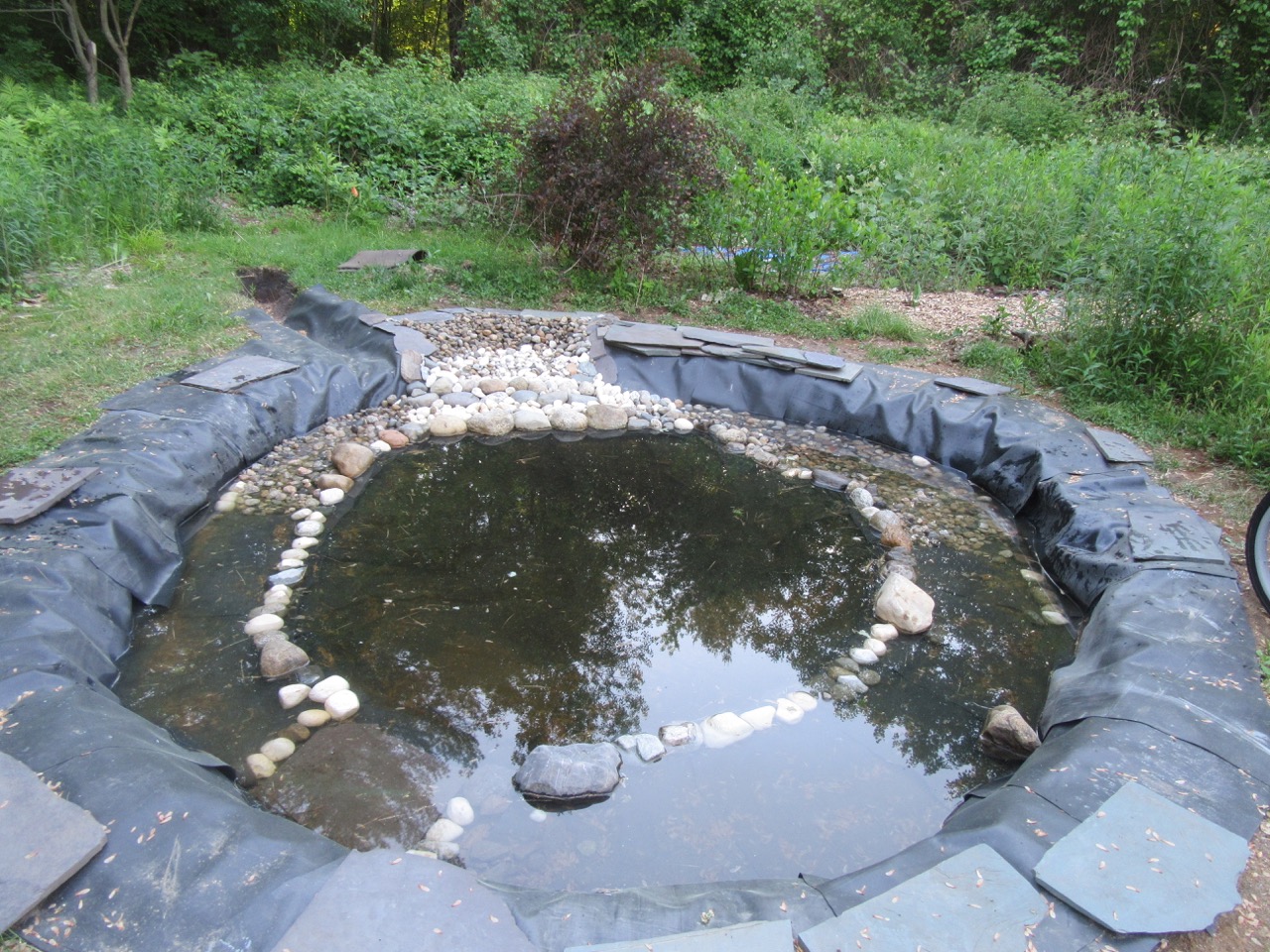
The beach completed, I started bringing back stones to put on the planting ledge. I positioned a few of the larger stones I had previously found into spots along the inner edge of the ledge, and then shoveled lots of the small stones behind them. Well, I did this wheelbarrow by wheelbarrow, after five rinses of the stones each time. I think I did about 5 or 6 wheelbarrows this evening. I have seen some beautiful ponds on the Building Natural Ponds Facebook group–with large rocks covering every part of the pond liner. I don’t think that will be my pond. I don’t have access to that kind of rock. My goal is to cover the planting ledge with these small stones, and then finish filling the pond. Then I will start putting plants there, and eventually, they’ll hide the pond liner going up the side from the ledge to the top. But that might take a while. Once I’ve put plants in, I’ll use whatever stones I have left to cover the liner at ground level. Or come up with another idea. But I am excited that critters will have access, and I am happy to be back in a step-by-step process.
The other day, I was talking to a group of friends, and articulated why this work is so important to me. With all of the pain of our world, the injustices past and present, the dangers of environmental degradation and climate change, why do I work in the garden, why do I make a pond? For me, to make relationship with this little piece of land, to love and care for this land, is a spiritual practice. I am only one small person, but I hope by learning to love this small piece of land I can make a prayer, make magic, for humankind to learn to love the earth. I pray that we can stop exploiting the earth and find a different sort of relationship to the earth. A relationship built on respect and mutuality and humility. A relationship in which we understand the sacredness of the earth. A relationship of gratitude, for water, for soil, for stones, for plants. That is the magic that lives in each stone.
Photo: Pond tonight, after putting some stones on the planting ledges
Sometimes the mental work is as hard as the physical work of building the pond. If you’ve been following along with this project, you know that after digging the hole, after putting down old carpet to protect against invasive bittersweet roots, after placing the underlayment and then the pond liner, we started filling the pond with water a few days ago. That felt so great! But then I felt stuck. The Building Natural Ponds book, by Robert Pavlis, which has been such a great guide to this whole project, suggested using old carpet as an “overlayment” on the planting shelves, to protect against the stones that were to go there. But I had run out of most of the carpet, and also had misgivings about putting old carpet into the actual water of the pond. So what to do?
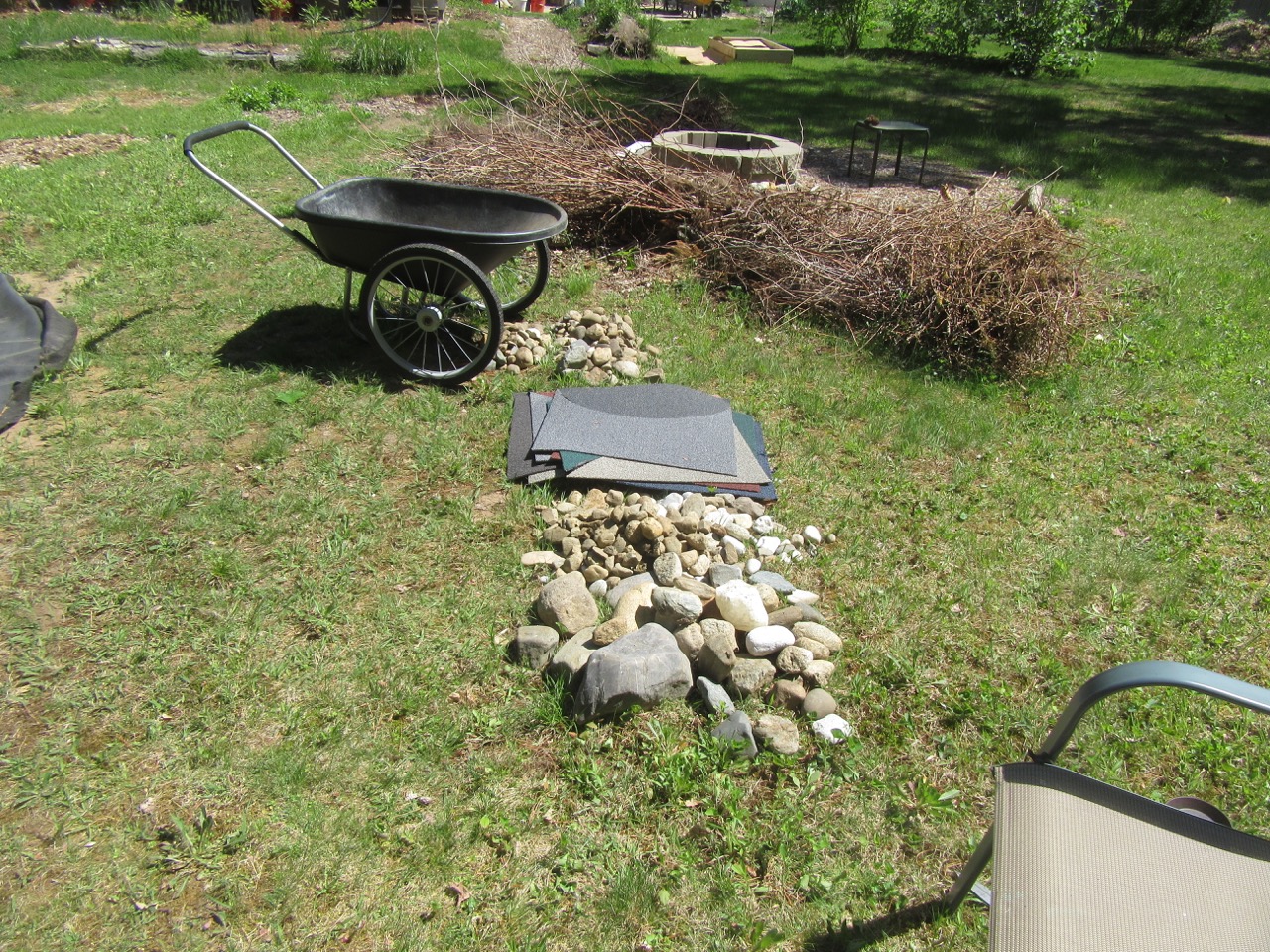
I thought and thought and then posed the question in two Facebook groups–the Building Natural Ponds group and the Northeast Permaculture Network. Then, I went outside and started gathering all the stones I’d been saving for the last five years from around the yard. I had some in five gallon buckets, and some in a pile next to the garage where violets had decided it was the perfect place to bloom. I had to dig under the roots to get all of those stones. But violets are very prolific in our yard, so I wasn’t worried about them. I also brought back the final bits of carpet I had–2 by 2 squares made of eco-friendly nylon.
Photo: Gathering all the stones to use in the pond.
Once that was done, I came back inside and checked my Facebook posts. I had gotten a variety of answers and suggestions from folks, and finally came up with my answer. I would use extra pond liner as an overlayment. Robert Pavlis had thought that idea would work well, so that gave me the confidence to do it. Some folks didn’t bother with any overlayment, but it gives just that added layer of protection against cuts or punctures from stones or little animal claws. So I went back outside, and I bravely made the first snips to cut off the extra pond liner around the edges of the pond. Because the pond wasn’t quite as deep as originally planned, there was quite a bit of extra liner.
Photo: extra pond liner
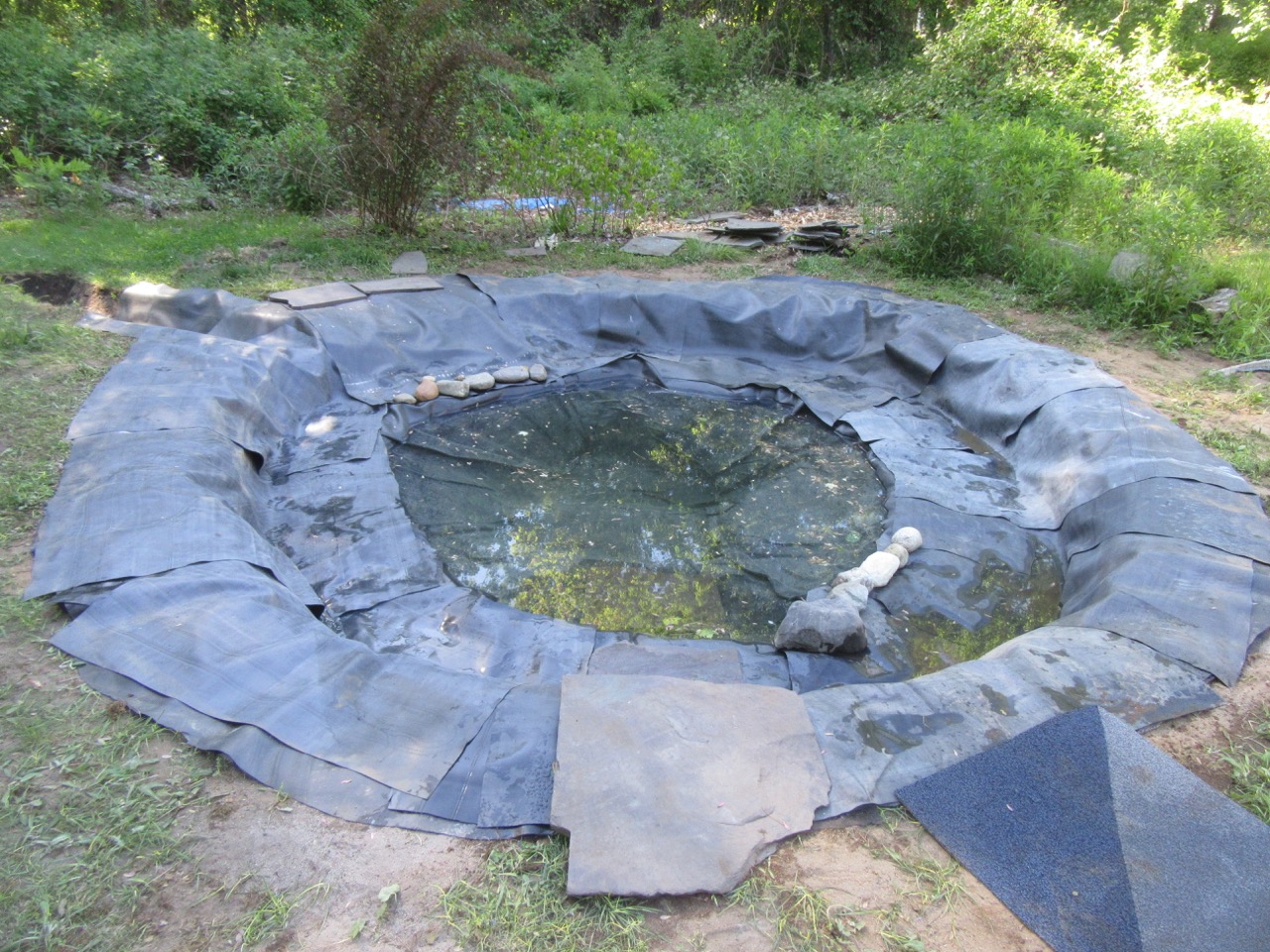
I started cutting it up and laying pieces of it all around the planting ledge, starting with the spot that I hope will be a little incline “beach” for animals to be able to approach. And as it happened, I had just enough liner to cover everything I needed. Then I started putting some stones into place. I did that in bare feet, and an old carpet square worked as a place to wipe off my feet before getting onto the planting ledge. We had some slate pieces that we found here when we first moved here, so I am hoping to use them around the edges of at least part of the circle. But I am also trying out using them for steps into the pond. Once the pond is full of life, it will be slippery, so maybe not. Decisions for later.
Photo: pond with liner overlay done, and stones begun to be placed.
I worked into the late afternoon, but finally came inside for another commitment. Today I am feeling all that work in my body–sore hands, sore muscles. I am eager to continue laying the stones I have–and then I will see how many more I will need. More decisions. The basic idea is to put larger stones around the center of the planting ledge, and larger stones near the outer ring of the planting ledge, then pea stones to fill in–those will be the growing medium for bacteria that clean and filter the water and aquatic plants that clean and filter the water. But as with this whole process, I am taking it step by step. I think if I had really known how much work it would be, I might not have had the temerity to begin. But here I am.









 Finding Our Way Home