No Kings

Three inflatable frog people standing in front of a building at an anti-ICE demonstration in Portland, OR. Text:  Exodus 8:2-6 "But if you refuse to let them go, I will plague your whole country with frogs... The frogs shall come up on you and on your people and on all your officials."

In the midst of cruelty and oppression, where does hope emerge? For me, it was seeing the protesters in Portland, Oregon dress in inflatable frog costumes, exposing the lie that Portland was a war zone, or that protesters were violent. In the face of armed and masked ICE agents, people responded with this creative and playful spontaneity. First there was one frog, and then it expanded to many frogs, and other silly costumed beings. Then someone else remembered this quote from Exodus about the plague of frogs. Perfect.

October 18th is NO KINGS day, and thousands of peaceful protests are planned for across the country. I can’t go out to one, but I can voice my support here. Support for democracy, support for the beautiful diversity that can make our communities full and alive, support for immigrants, support for trans siblings, and all queer people, support for disabled people and black people and indigenous people, Asian and Latino/a/x people. We need to keep expressing our vision of a multi-cultural country bound together by equality, justice, and full participation.

May the frogs multiply and spread the good word. Keep hope alive!

Green frog sitting in pond water, nearby there is a bee on a rock, and black tadpoles swimming around, and maple seeds floating.
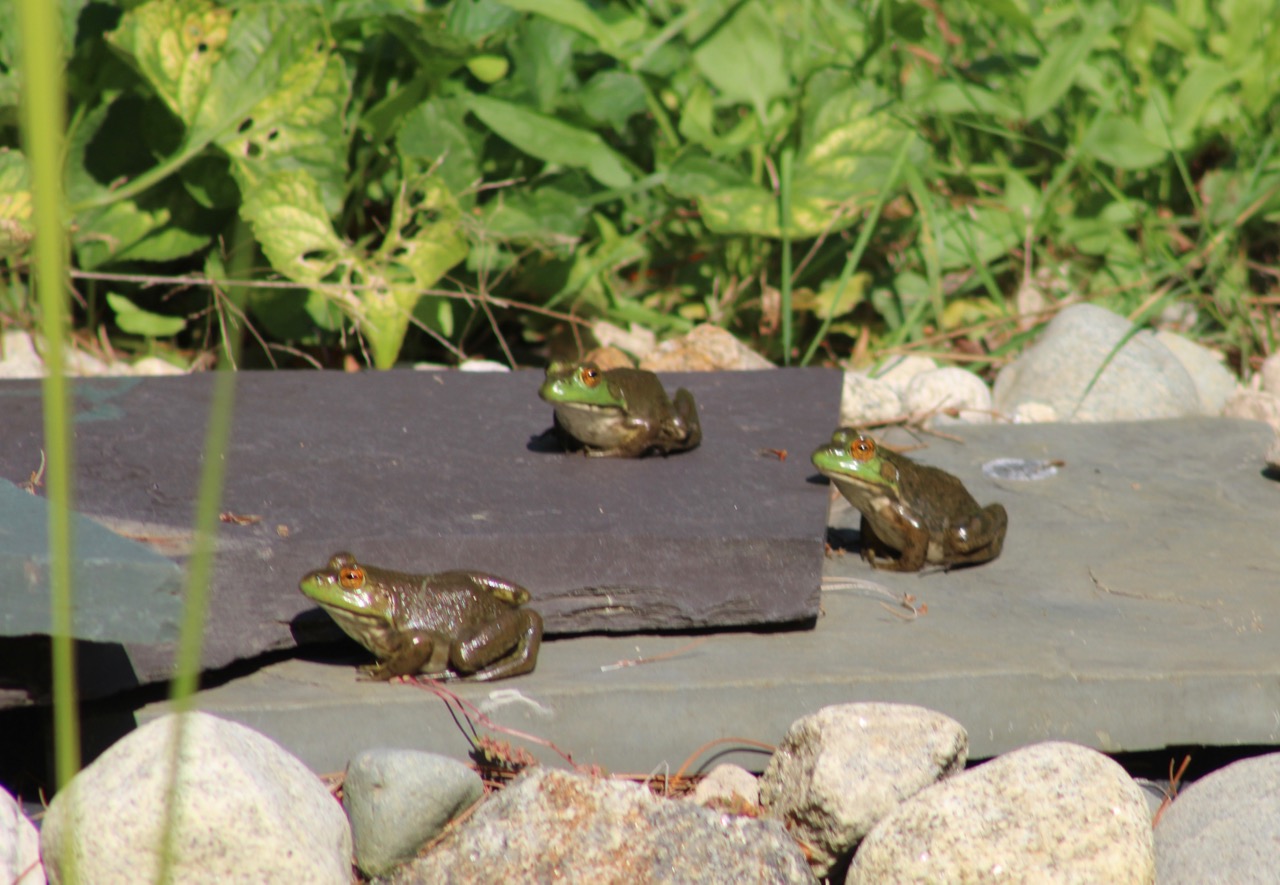
Three frogs sitting on slate rocks
three more frogs on rocks and in water

Kindness or cruelty?

White woman on left of phot with tan baseball cap and rust shirt, just visible at hands, holding a phone facing pebbled shoreline with horseshoe crabs in the water mating, and huge boulders on the other side.

The other day, Margy and I went to Maquoit Bay to see horseshoe crabs that had come to shore to mate. Margy especially loves horseshoe crabs and has learned a great deal about them. It was shortly after high tide, and we noticed that a few of the crabs had wandered behind and between big boulders placed on the site, in a way that they were trapped. (Much worse than what can be seen in the photo above.) As the tide continued to go out, it was likely that they would be stuck high and dry. So we very carefully lifted them out by the sides of their shells, (never lift them by their spikey tails!) and placed them in the water where they were free to move where they wanted.

To us, it felt like a simple act of kindness for a fellow creature on this planet. We see someone in a vulnerable position, and do our best to be a helper.

I have been astonished and horrified by the cruelty I’ve witnessed (as reported via social media) of people in positions of power in our government. Separating families as they come out from immigration courts. Detaining a young child with leukemia. Sending migrants to horrible prisons in countries to which they have no connection. Terrorizing people as they garden, or shop, or go to work, while wearing masks and refusing identification. Detaining a pregnant woman and offering no medical care. Such is the state of DHS and ICE activity in our country. Cruelty seems to be the point.

I am thinking also of the people in Gaza, who are still being starved and bombed, and shot by IDF soldiers even as they line up to try to get food. Some soldiers even admitted that they were ordered to shoot deliberately at unarmed Gazans waiting for humanitarian aid. I feel so helpless to stop the harm, to stop the genocide.

It seems there is no end to cruelty. It has been troubling me greatly. And I wonder why? Why be as cruel as a human can be to fellow human beings? Don’t all religious and ethical traditions lift up our common human bonds and encourage us to love our neighbor, and love the stranger in our midst? What does it do to the human beings behind the masks or the guns to act with violence and cruelty every day?

Are the people in charge in our country trying to instigate retaliatory violence to justify further oppression? Is it some oligarchic strategy of conquest? Is it a way to convince themselves that some human beings are not really human beings? Are they truly this cruel and this evil? And then, how can they convince ordinary people to follow along? Ordinary people who might value kindness over cruelty.

All I can do is to keep speaking out about it, to share the daily reports of the people who have been detained or killed, to see their names, to weep. I recently decided to do one more thing, to purchase a keffiyeh from Palestine. This traditional scarf was worn as a headdress or face covering, and in recent years has come to symbolize the Palestinian yearning for freedom. For those of us who are not Palestinian, it symbolizes solidarity. For me, I am moved by the fact that it was made by Palestinians in the West Bank, touched by their hands, their hopes. And now it is touched by my hands, my hopes for them. I feel that spiritual and physical connection. I wear it for the children being starved in Gaza, for the families being bombed in their tents or apartments. I wear it for all the helpers who do whatever they can to help, in the midst of so much cruelty. I wear it as a symbol of connection between human beings,

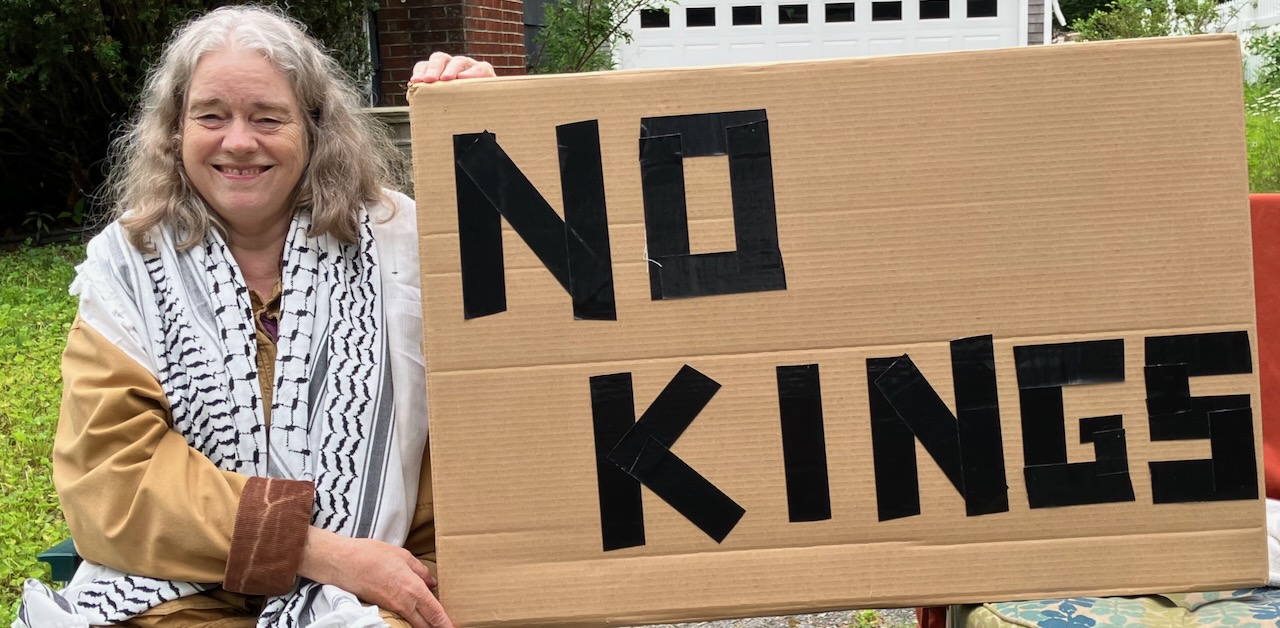
Myke, a white woman with reddish gray hair, wearing a black and white Palestinian keffiyeh wrapped over her shoulders.

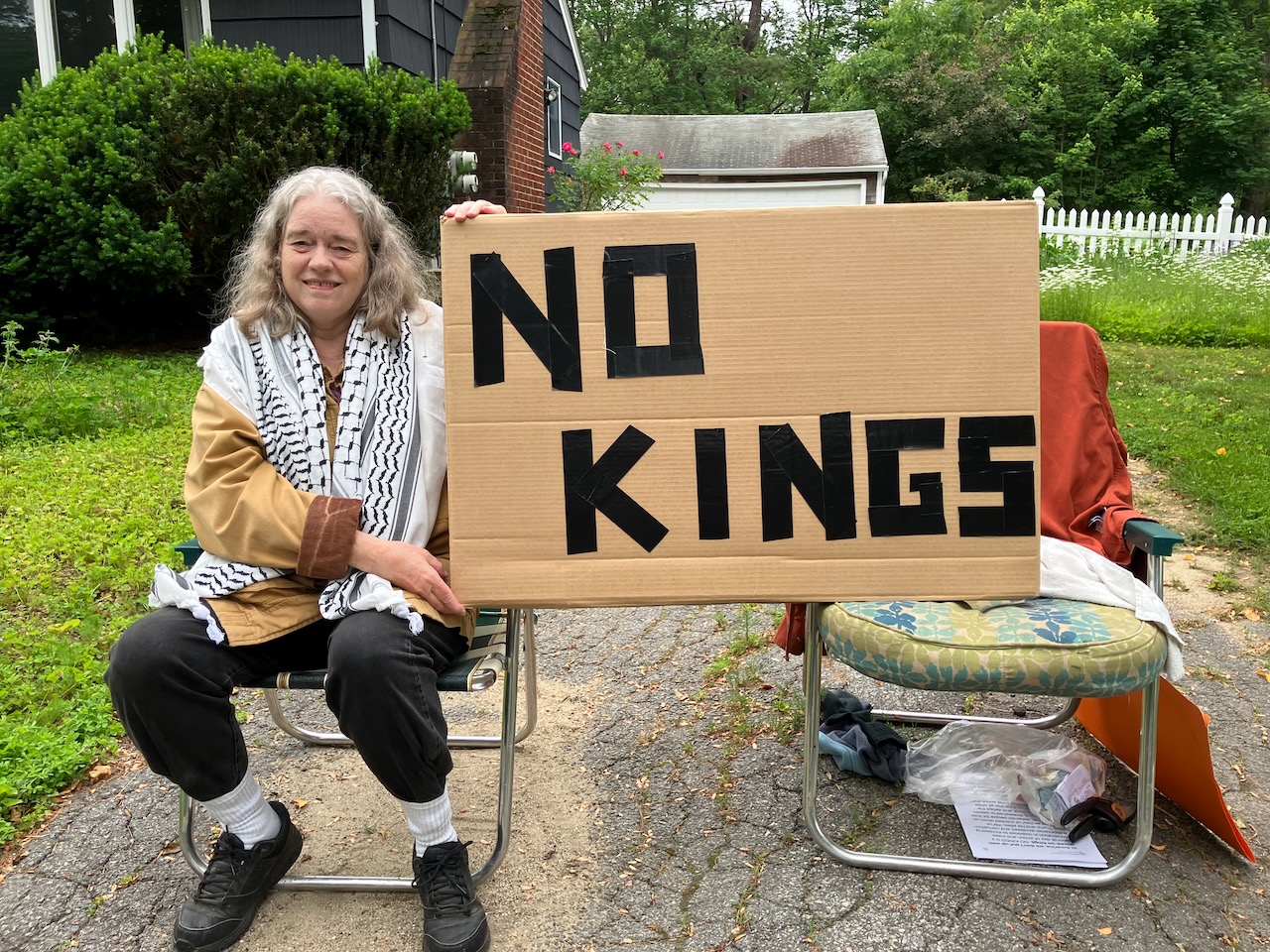
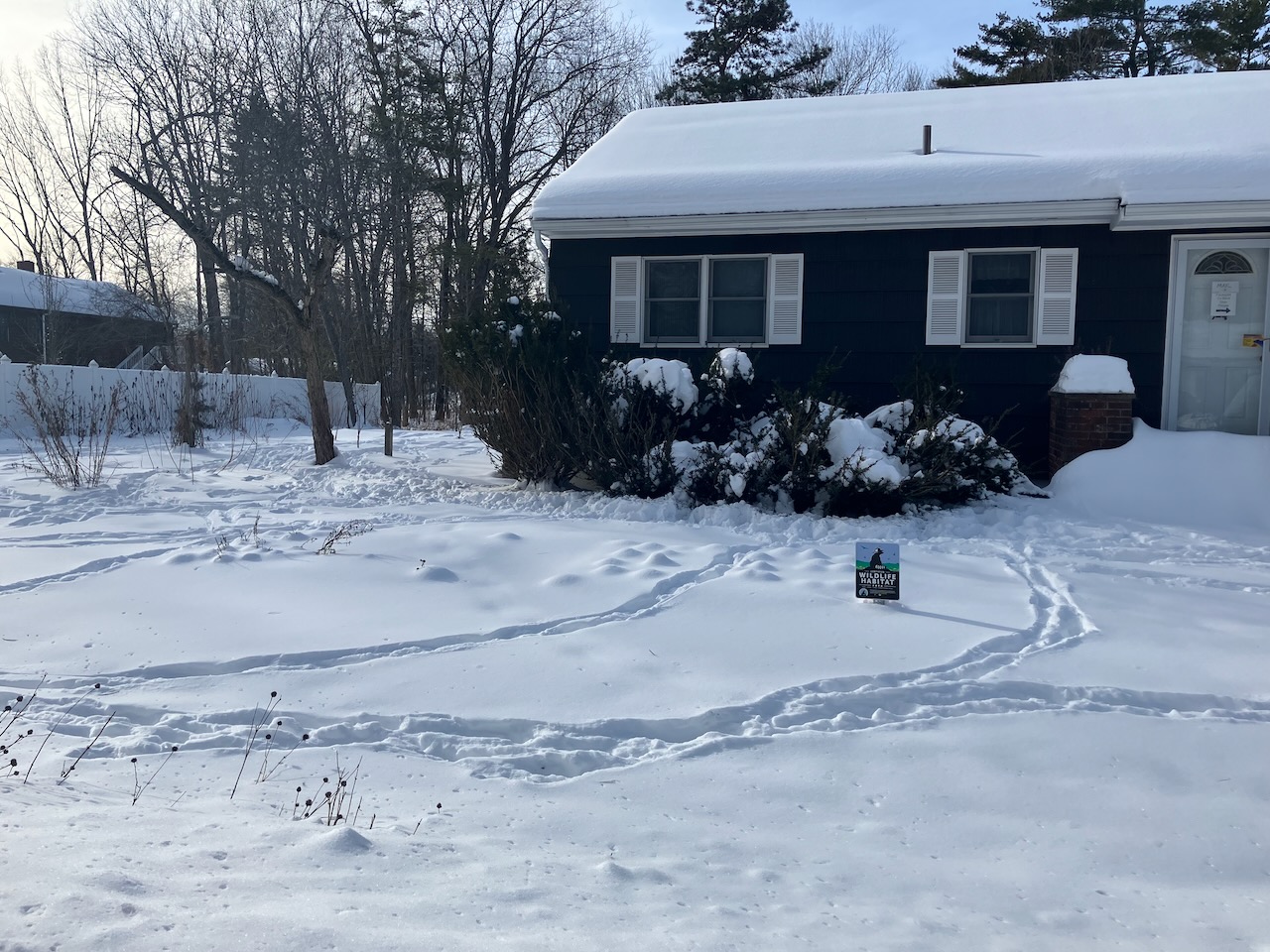
On June 14, Margy and I couldn’t go to one of the thousands of No Kings rallies to protest the usurping of power that this regime is attempting. (This is life with chronic illness…) So we decided to sit in our own driveway with a sign, and bear witness in our neighborhood. During that hour and a half, we had about 20 positive responses from people driving by or walking by. A few people looked away but no one was angry or negative. Because we were out there, we also learned that a few neighbors had gone downtown to the rally as well. This photo was taken by Margy… it is her empty chair on the right. So we were two of the millions who protested that day!

Big cardboard sign saying "no Kings" held by Myke, seated, wearing keffiyeh, resting on second chair.

I hope that if I keep speaking up, it will inspire others to speak up as well. I think of the Ella Baker quote in the song by Sweet Honey in the Rock: “I want to be one in the number as we stand against tyranny.” Never let their cruelty cause us to lose our kindness. Never let their cruelty cause us to lose our sense of human connection.

Even the Humblest of Beings

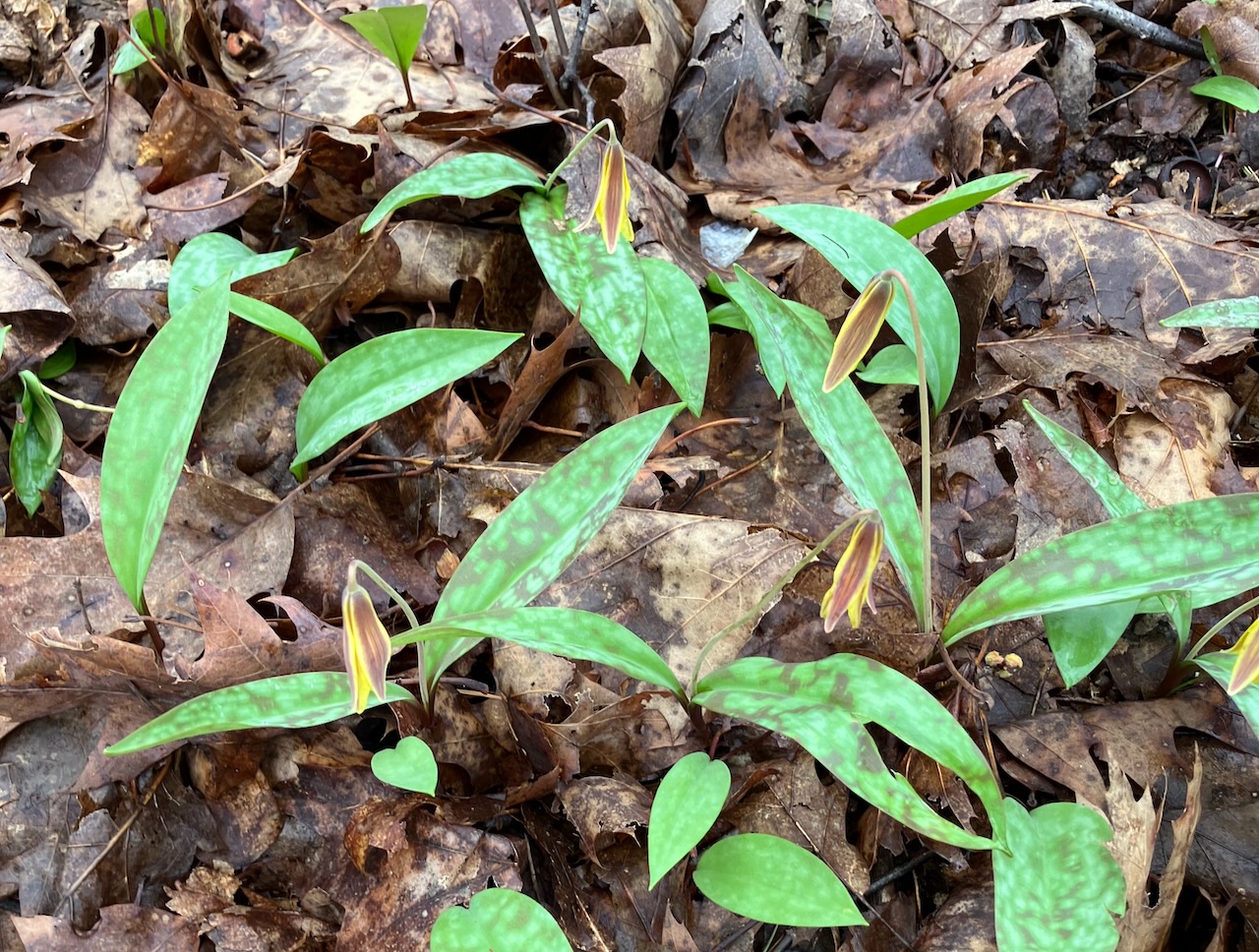
trout lilies in old leaves, with mottled green leaves, and yellow and brown blooms

The trout lilies bloomed last week before several days of rain. This photo was from May 5th. Today the blooms are already fading or gone. The trout lilies live near a path by the Capisic Brook that I visit most mornings, though I don’t always make it as far as that path. I was glad to walk a little further to see these lovely small beauties.

I want to continue to post from the Universal Declaration of Human Rights, which I started a couple weeks ago. It is such a good reminder that every person, no matter how humble, or seemingly insignificant, is worthy of dignity. (In this quote of the declaration from 1948, for simplicity, I am using the original language, in which the pronouns he/his/him were understood to refer to all people).

Article 12: No one shall be subjected to arbitrary interference with his privacy, family, home, or correspondence, nor to attacks upon his honor and reputation. Everyone has the right to the protection of the law against such interference or attacks.

Article 13: (1) Everyone has the right to freedom of movement and residence within the borders of each state. (2) Everyone has the right to leave any country, including his own, and to return to his country.

Article 14: (1) Everyone has the right to seek and to enjoy in other countries asylum from persecution. (2) This right may not be invoked in the case of prosecutions genuinely arising from nonpolitical crimes or from acts contrary to the purposes and principles of the United Nations.

Article 15: (1) Everyone has the right to a nationality. (2) No one shall be arbitrarily deprived of his nationality nor denied the right to change his nationality.

Can you read them again? So important in the light of what is happening to migrants today in our country. Everyone has the right to seek asylum. Every one has the right to a country, or to leave a country. Everyone has the right of return. And yet so many are denied that right. We have to keep speaking up for what we know is right, even if our societies have never fully lived up to these values.

Declaration of Human Rights 1948

Bluebird perched on top of turquoise colored umbrella

As I was cleaning out files in the basement, I came across a copy of the Universal Declaration of Human Rights, adopted December 10, 1948 by the United Nations General Assembly. It feels timely to post sections of this declaration here. There are 30 articles in the Declaration, along with its preamble. (I’ll post more in future days.) We’ve got to speak up for what we believe! Our current government is betraying these ideals in multiple ways, particularly by denying due process to immigrants arrested and imprisoned, or renditioned to foreign prisons. Resist!

Article 1: All human beings are born free and equal in dignity and rights. They are endowed with reason and conscience and should act toward one another in a spirit of brotherhood.

Article 2: Everyone is entitled to all the rights and freedoms set forth in this Declaration, without distinction of any kind, such as race, color, sex, language, religion, political or other opinion, national of social origin, property, birth, or other status. Furthermore, no distinction shall be made on the basis of the political, jurisdictional, or international status of the country or territory to which a person belongs, whether it be independent, trust, non-self-governing, or under any other limitation of sovereignty.

Article 3: Everyone has the right to life, liberty, and security of person.

Article 4: No one shall be held in slavery or servitude; slavery and the slave trade shall be prohibited in all their forms.

Article 5: No one shall be subjected to torture or to cruel, inhuman, or degrading treatment or punishment.

Article 6: Everyone has the right to recognition everywhere as a person before the law.

Article 7: All are equal before the law and are entitled without any discrimination to equal protection of the law. All are entitled to equal protection against any discrimination in violation of this Declaration and against any incitement to such discrimination.

Your silence will not protect you

Multiple bluish white flowers with green leaves in a bunch on the grass.

I am living in the strangest of paradoxes. A hateful dictator has taken over our country, but today my life looks about the same as yesterday. I wake up in the morning, the sun is shining through my windows, and the birds are singing. I see these bright spring flowers on my walk. And yet, US-made bombs are being targeted on children in Gaza, they are dying in flames or slowly starving because food aid has been locked out by the Israeli government. International students (here in the U.S. on legitimate visas) are being kidnapped and jailed by ICE and threatened with deportation for having spoken up against this genocide in Gaza.

And I can’t stop thinking about Kilmar Abrego Garcia being detained by “administrative error” and sent to the one country his immigration status said he could not be sent to (El Salvador), because of danger from gangs; and now he is trapped in a hellish prison there because the president will not bring him back. This regime is renditioning hundreds of people without trial to this “prison” in El Salvador–and really, without trial it is not a “prison” but an extra-judicial concentration camp. All the people the president sent there should be brought back to the U.S. If some of them are gangsters and criminals, they should face trials–everyone has human rights, or no one does. But the president jokes instead about sending “homegrowns” to El Salvador next.

So since I’ve spoken up publicly about genocide in Gaza, and about immigrants being deprived of human rights, does that mean that they will come for me one day? Maybe it does. But I can’t live my deepest ethics without bridging the gap between the bright sunshine of today’s ordinary morning and the nightmare that is going on all around us, just at a little distance from my house at the moment. Every day I read about more atrocities taking place, and I try to do the little that I can do: to bear witness, to speak up about them, to share my outrage, to protest the injustice. The temptation is to get quiet, to try to hide under the radar. But I do believe, as lesbian poet warrior Audre Lorde said, “Your silence will not protect you.”

The more of us who resist, the more chance we have to reverse this nightmare.

Small Days & Big Thoughts

Tending a garden focuses our attention on the here and now, the daily patterns and seasonal patterns. We have already begun to gather food–this from my lunch the other day: sea kale, asparagus, and wine cap mushrooms which sprang up near the carrots seeds I had planted in the food forest. (We had inoculated the wood chips with mushroom spore a year ago so we knew how to identify them.)

Food from Garden

But while I was not in the garden, I decided to re-read Octavia Butler’s Parable of the Sower and Parable of the Talents. I was inspired by watching an online presentation of  Toshi Reagon’s concert production inspired by Parable of the Sower.  A powerful dystopia first published back in 1993, Parable of the Sower follows the story of Lauren Oya Olamina, as she faces the destruction of society all around her from environmental devastation and a widening divide between rich and poor. Eerily, the novel begins in the year “2024.” Eerily, in the second novel, there is a dangerous president who is going to “Make America Great Again.”

For those who don’t know her, get to know her!  Octavia Butler is an African American feminist sci-fi writer, who died in 2006.  I think I have read and loved all of her novels.  Her own experience of oppression shapes the way she tackles complex issues, painful realities, and paradoxical truths. These two books fit into that realm of sci-fi which asks the question, “What if things keep going the way they are?”  When her family’s neighborhood is destroyed, Lauren Olamina sets out on a journey north, and creates a new religion, gathering a few followers as she goes. She calls it Earthseed, and there are excerpts of her Earthseed writings within the novel, starting with these words:

All that you touch, You Change

All that you Change, Changes you

The only lasting truth Is Change.

God Is Change.

When I finished Parable of the Talents, I wondered whether Octavia actually believed the Earthseed ideas, or whether it was a fictional exercise in imagining a modern founder of a new religion. I found an article that suggested that her journals reveal Earthseed did align with her own beliefs. I can find much inspiration in Earthseed, though parts of it don’t work for me. I’ve always experienced the divine as more personal and loving, rather than the impersonal force of change that Lauren Olamina elucidates.  But if I had had the experiences that Lauren had, that Octavia had, might I experience a different sort of divinity as well? Still, never to leave it simple, Octavia has another major character–Lauren’s brother–raise the same criticism and choose a personal God.

I cannot say enough how much I love Octavia’s writing, but it is also devastating to read. Somehow when the writing is beautiful enough, I can bear the challenge.  (Spoiler alert!) For example, in Parable of the Talents, Acorn, the first community of Earthseed, is attacked and the children are all taken from their families, and adopted away into “Christian” families. Later, when the adults in the community finally escape from their captivity, they search for the children, but mostly cannot find them. Parable of the Talents is narrated by Lauren’s daughter who was taken when she was only a baby–and she doesn’t meet her mother until many years later when she has become an adult. However, they never recover from everything that has happened in between. Devastating.

I think about the children of the Disappeared in Argentina who were stolen and adopted by the murderers of their parents. I think about Indigenous children taken from their families over many decades, losing their language and culture, traumatized. I think about enslaved African-Americans whose children were sold away, and how much they struggled to reunite when slavery finally ended.  I think about the migrant children at the border right now being separated from their families and locked in cages, deported alone, or adopted to others.

In this way, the dystopia of the Parables isn’t really a future danger, but a present reality.  Just as in the novel many people were walking along the highway trying to find a way to survive, migrant people are right now walking along the roads north, facing danger from robbers, murderers, rapists, and smugglers, and then at the U.S. border being locked in cages, their children taken.  Undocumented people have no protections other than what they can give to each other in communities.  All the while a semblance of “ordinary life” goes on for other people like myself (except for COVID 19–but we are safe in homes with food).  I find myself wanting to talk with others about all the ideas that Octavia Butler raises, so many more than I can even hint at.

In the story, the Acorn community for a while was able to live by the work of their hands. They plant a garden and harvest the fruit of the trees. They go day by day until they no longer can. Meanwhile, our cherry trees are forming their first few little green cherry starts. I am so awed by it. Day by day, we are learning to partner with the earth for food.

Cherry start

Orphan Mystery

Margareta Graue

Margaretha Graue Henneke Englemann, 1890s

One of the first stories I heard about an ancestor was that of my great-great grandmother, Margareta, on my dad’s side of the family. My grandfather Heie Johnson wrote about her in a little notebook, and I have a copy of that story in his handwriting. He said:

Margareta Graue Henneke Engelman was born in Westphalia Germany, no dates. Parents died when grandma was 12 (she told of having to carry water for cows with a yoke until neighbors & friends interceded.) Seems she was given over to someone as bond servant. When she grew up, the brother of her husband, grandfather Henneke, came to US went to Calif. found gold. Sent for his bride & grandma Graue Henneke & her husband. Grandma’s husband died leaving her several small children. (Don’t know what happened to brother Henneke & wife). Later grandma married Menke Engelman. He was killed by a runaway team of horses & plow when our mom was very young. Grandma Henneke Engelman is buried somewhere in Kansas. Mom and I went to see Grandpa’s (Engelman) grave one time but I can’t remember the name of cemetery. I do remember that the tombstone needed attention. Wonder if it is still there. I often wondered what Grandpa looked like. That seems to be about all I can remember. Doesn’t sound like much does it? However I do feel thankful that they all came over when they did.

I feel thankful that my grandfather preserved this story! I’ve always thought of her as someone who overcame much adversity.  Since then, I’ve learned a lot more about her life, but her parents and the exact place of her birth have remained a mystery, even after 30 years research by my cousin Jim.

However, I am beginning to wonder if she too might be from East Friesland, like all the others of my grandfather’s ancestors. Here is why: according to a census in 1880, she described her birthplace, and the birthplace of her parents, as “Hanover.” The Kingdom of Hanover lasted from 1814 to 1866, at which time it became a province of Prussia. Margareta was born about 1827-9, and emigrated about 1861, so even though this area is now part of Germany, she would have known it as Hanover.  And, Hanover included East Friesland during that time, where notes seem to indicate that she was married to her first husband, Johann Heinrich Henneke, about 1852, [though I haven’t seen a source for this] and perhaps birthed her first children.

I excerpted this brief history of Hanover from another genealogy site:

Until 1708, Hanover had been a minor principality within the Holy Roman Empire. In 1708, its lands were combined with most of the Duchy of Brunswick-Lüneburg and became an electorate (essentially, a voting member state) of the Holy Roman Empire. Its rulers belonged to the dynastic lineage of the House of Hanover. …The status quo persisted until 1803 when Hanover was conquered by both Napoleon and the Kingdom of Prussia. In 1806, …16 states from the Holy Roman Empire, including Hanover, were joined together to form the rather weak Confederation of the Rhine. In 1807, the Treaty of Tilsit declared that Hanover would be joined with part of Prussia to create the Kingdom of Westphalia, ruled by Napoleon’s brother Jérôme Bonaparte. Westphalia joined the Confederation of the Rhine soon after… When Napoleon was finally defeated in 1813, it spelled the end for both the Confederation of the Rhine and the Kingdom of Westphalia. Rulership over Hanover reverted back to the House of Hanover.

The Congress of Vienna of 1815 …created the German Confederation, a loosely-knit group of 39 Germanic nation-states of which Hanover was a member. …The March Revolution in 1848 caused Hanover to temporarily leave the German Confederation, but after they failed, it rejoined in 1850. Hanover remained within the German Confederation until the Austro-Prussian War (or “Seven Weeks War”) in 1866.

Map_GermanConfederation

1815-1866 Kingdom of Hanover/Konigreich Hannover, in yellow, near the top.

But my grandfather said she was born in Westphalia, so I looked more closely at the Kingdom of Westphalia, which included Hannover (striped and purple on map) but didn’t include East Friesland, which came under the rule of Holland during those years. So another possibility is that she was born in an area of Hanover that was also included in the Kingdom of Westphalia during that time.

Westphalia

1808 confederation of the Rhine

Finally, down below, there is a map of the Province of Westphalia, after the kingdom was dissolved and it was part of Prussia. It is adjacent to Hannover, and just south of East Friesland. So it wouldn’t be impossible for her to be from there, later traveling north into Hannover, or East Friesland.  A further argument for this place is that both parents of her husband Johann Heinrich Henneke were born there. So perhaps they met up in Westphalia, and then moved to Hanover. However, another argument for East Friesland is that when her first husband died, in Illinois, she later married Meenke Engelmann, who was from East Friesland. People tended to cluster with others from their own regions and who spoke their own dialects.

I have been so interested in this question, since one of the reasons I am exploring my ancestors is to find out their connections to the lands that they lived in before they came to America. I also want to tell more about the family she created, but that will be another post. For now, her original home sadly remains a mystery, but I am so thankful to have her photo and part of her story.

Johann Hochreiter

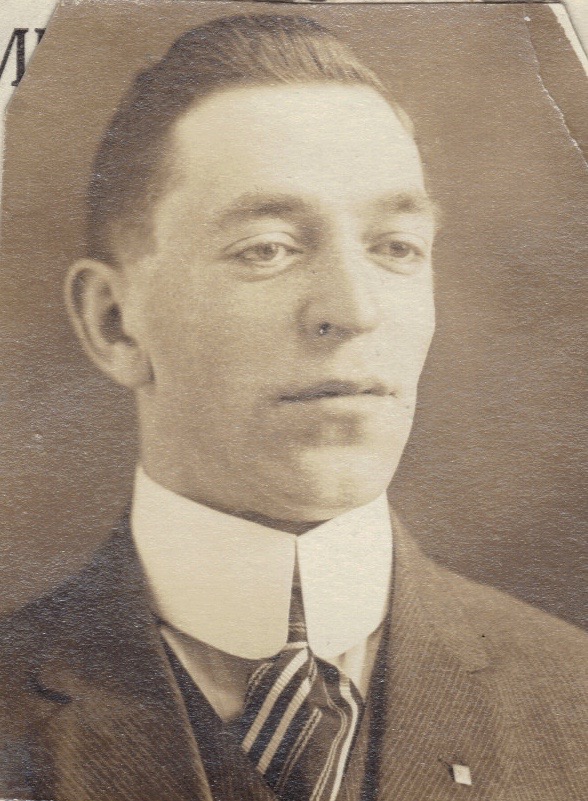
John Hochreiter at 31

John Hochreiter at 31

My most recent ancestor immigrant to this continent was my grandfather, John Hochreiter. He was born “Johann” on June 1, 1884 in Linz, Austria, when it was part of the Austro-Hungarian Empire. His father, Johann Hochreiter (senior), born 1857, was a day-laborer originally from the village of Waldschlag, (now part of the town of Oberneukirchen), in the northern part of Upper Austria, an area called Mühlviertel. From the information I can gather, the next few generations of ancestors were from that area as well. His mother was born Anna Bartl, about 1851, daughter of the weaver Michael Bartl and his wife Katharina.

I turned to etymology for some clues this time. The name “Hochreiter” originally meant those persons who made higher-lying surfaces arable, who cleared forested areas for farms. “Wald schlag might mean “Forest Strike”, and “Ober neu kirchen” is “Upper New Churches.” According to Wikipedia, settlement and then village life probably started in the area of ​​the municipality Oberneukirchen in the 12th century. The spread and colonization of the forest clearing areas and the religious care of the settlers soon made a chapel or church building required.  One last etymology: “Mühlviertel” translates “Mill Quarter.” The Oberneukirchen economy was centered around agriculture and weaving for several centuries.

However, Johann and Anna did not stay in this rural area, the place of their families. For some reason, I would guess related to work, they moved about 25 kilometers south to the city of Linz where Johann was a day-laborer. It was in the city that their children were born—they had at least five sons, Johann (junior) in 1884, Georg in 1885, Franz in 1888, Franz Joseph in 1892, and Julius in 1895. (I seem to remember hearing stories that my grandfather was the oldest of several brothers—even eight, but that number might be a error.) They later also died in the city of Linz, in 1933 and 1930.

My mom told of a story that my grandfather as a young man had carried bread on his back to deliver it, or another story was that he delivered beer by horse-drawn cart. But in any case, at some point he became a waiter, and remained so until his retirement many years later. He left Linz in his twenties, somewhere about 1910 or 11, with a group of buddies, working as waiters in hotels as they traveled, going first to France, and then England. Finally they took the ship called “Lake Manitoba” and landed in Quebec, Canada on June 16, 1912. Then, he worked as a waiter at the new, and very grand, Chateau Laurier hotel in Ottawa, Ontario, Canada. It was there he met my grandmother, Yvonne Tremblay, who worked as a chamber maid.

In late 1915, John emigrated once again, traveling via Windsor to Detroit, Michigan. By this point, Canada had entered the first World War, and he was registered as an “enemy alien.” I wonder if that contributed to his decision to come to the United States, which was still a neutral country. (According to that registration, in 1915 at 31 he was 5’3”, weighed 125 pounds, and had dark hair, and wore glasses.) He soon sent for Yvonne, and they were married in Detroit on January 14, 1916. She was just 18.

John & Yvonne Hochreiter 1916

John and Yvonne in Detroit 1916

They stayed in Detroit, and he worked as a room service waiter at the Hotel Statler (which had been completed earlier in 1915), until he retired (at 70) after my grandmother died in l954.

When I have wondered about why he left Austria, I haven’t found clear answers. It was a few years before war would break out there, so I don’t think it was about that. It seems perhaps he and his friends were looking for adventure, and they’d found a way to do it even without many financial resources.  As waiters, they could work wherever they could find hotel jobs.  I was impressed that these men continued to be friends years later in Detroit. My grandfather was a quiet man, and he died when I was only 13, so I never felt that I knew him very well.

Ironically, even though my siblings and I are of 25% Austrian ancestry, and our grandfather was the most recent immigrant of our heritage, I found it difficult to find a sense of connection to that culture and place. It has bewildered me as I have continued to explore the region in Austria from which he came. I’ll write more in a future post.

Ancestors & Colonization: Quebec

When I was exploring my German immigrant ancestors in the context of decolonization, I was struck by the feeling that they arrived after the major struggles of colonization in their part of the country.  For my dad’s family who arrived in the mid-1800s, it was a generation earlier that treaties were pressed upon the Indigenous peoples of those lands, who were forced to move further west or to Oklahoma.  In another branch of my family, my mom’s father was from Austria, and immigrated even later, via Canada, to Detroit in late 1915.

I wonder if these Germanic immigrants even thought about it, or if so, maybe it was like, “We just got here, we don’t have anything to do with those struggles you all had before.” Though, of course, the German farmers benefitted from those earlier actions, because now land was available for low prices. But it can leave a feeling of distant non-involvement, a sense that colonization wasn’t very much about my family.  My mom’s mother was also an immigrant to the United States, but her background is more complex, because she came from Quebec.

When I was younger, the very first ancestors I was curious about were those of my grandmother, born Yvonne Tremblay.  That intensified when I became a feminist, and wanted to learn about my motherline.  Plus, as I have written about elsewhere, she was “part Indian,” and I was curious about that. It turned out that Quebec province kept very good records, and I was able to learn a lot, even before the age of the internet.  But I wasn’t asking questions then about colonization or decolonization.  So this week, I decided to reopen that window of exploration, to see what I could find.

While the information available about my Scottish and Innu ancestors stops with Peter Macleod and Marie Madeleine Montagnaise, (my great-great-great-grandparents), the information about my French ancestors in Quebec goes back to some of the original colonizers.  Yesterday, I learned that one ancestor, Jean Guyon, my 11th great-grandfather, arrived in 1634. But not to get egotistical about it, they say three out of four Quebecois descend from him. And in fact, I am descended from him via four separate lines of ancestry. I am including this monument to the first Tremblays in Quebec, Pierre Tremblay and Ozanne Achon, who arrived in 1657.

Pierre Trembly Ozanne Achon

Today, in my family tree, I accidentally came upon the name Helene Desportes, my 9th great-grandmother. Her birth was listed as 1620 in Quebec, and it turns out she is said to be the first white child born in Canada, though she might have been born on the ship just before arrival. One of my methods is to do an internet search for any of these early names, and I learned there is a recent biography about her, Helene’s World: Helene Desportes of Seventeenth-Century Quebec, by Susan McNelley.

Suddenly, there is a whole new world to explore–okay that was the wrong phrase to use–in my decolonization understanding.


Missouri Germans in the Civil War

I felt an odd sense of relief and satisfaction to learn that my German Missouri ancestors were on the Union side of the Civil War.  While recovering from my latest gardening exploits, I was watching episodes of the Ken Burns documentary “The West.”  I was surprised by the series’ level of truth-telling in stories about colonization, about racism, about the violence endemic to the history of the United States. It has been quite an eye-opener about the “settlement” of the West, and I recommend it to all students of decolonization.

In the episode about the lead-up to the Civil War, I learned that Missouri and Kansas were the site of the heaviest civilian conflict and bloodshed before and during the war.  Earlier, in 1820, Missouri was admitted to the Union as a slave state, in conjunction with Maine being admitted as a free state, in the compromise to keep a balance between the free and slave states.  When the Kansas territory was “opened for settlement” in the 1850s it was decided to let the residents vote on whether they would be a slave state or free state.

[“Opened for settlement,” of course, meant the removal and theft of the land from the Arapaho, Comanche, Osage, Kansa, Kiowa, Missouri, Otoe, and Pawnee peoples, plus a dozen more eastern tribes who had been relocated to Kansas/Oklahoma in what was to be their land forever. But moving on for now to the slavery question…]

This new Kansas territory turned into a tinderbox of the national tensions between slavery vs. freedom for African-Americans–white Abolitionists from New England, and white pro-slavery Missourians (with their enslaved people with them) were among those who rushed to live in Kansas to influence the direction it would go.  Eventually, after much bloodshed, burning, looting, and turmoil, Kansas joined the Union in 1861 as a free state.

But my own curiosity shifted from Kansas over to what happened in Missouri, where my Heisler/Gerling ancestors had settled in the 1850s. I had thought they were on the side of the Union, so what were they doing in a slave state?  Ken Burns didn’t tell their story, but I went hunting on the internet to sort it out.  There I found the rather satisfying news that the German emigrants in Missouri were in fact opposed to slavery, and avid supporters of the Union.  They had emigrated after a failed revolution for democracy in 1848 in the German lands, and held dear the ideals of freedom and equality.  According to Patrick Young, in an article that was part of a series, The Immigrants’ Civil War,

[German Americans] saw parallels in the military coups in the German states in 1848 that ended the democratic dream in Europe. One of the exiled revolutionaries, August Willich, wrote after the attack on Fort Sumter that Germans needed to “protect their new republican homeland against the aristocracy of the South.”

Their influence was part of what kept Missouri in the Union.  According to another article by Patrick Young,

Missouri was a border state. That meant that it was a slave state lying between the Confederacy and the free states of the North. In the 1850s, Missouri had been the staging ground for pro-slavery terror raids against free soil towns in Kansas, but by 1861, the state’s wealthy slaveholding class was being challenged for power from an unlikely quarter.

German immigrants had moved into the state in large numbers in the 1850s. Most crowded into the fast growing industrial metropolis of St. Louis. Others started small German-speaking rural communities, [Note–that would include my ancestors] where they found themselves expected to defer to nearby slaveholders who expressed their worth in the number of humans they owned. The Germans had come to America for freedom, and they resented both slavery and the power it gave slaveholders over Missouri politics. When the Germans became citizens, they quickly formed the state’s most consistently anti-slavery electorate.

Thomas HeislerWhen I look at the lists of Union and Confederate soldiers from Missouri, none of my direct ancestors are included, though there were two Heisler men listed as Union soldiers. It’s possible that my great-great grandfather, Johann Heisler, was too old to enlist–he would have been 40 years old in 1860, with young children. My great grandfather, Thomas Heisler was born in 1857–only a toddler when the war began. Maybe they just tried to farm their land, and keep the peace with their neighbors.  One family story says the four Heisler brothers had left Germany to avoid being drafted into the military there. [Note: see addendum about another brother’s service in the Union Army.]

But it sounds like the war came to everyone’s land.  From the same article:

Even before the war, pro-slavery raiders had tried to drive German farmers out of rural Missouri. Now bringing about the submission or eradication of the Unionist German community became an imperative for Confederates.

Historian Ella Lonn wrote that after the Germans foiled the takeover [by the Missouri Confederates] of the [St. Louis] arsenal and fired into the mob:

“The hatred that Missouri Confederates felt for the Germans was frightful…German farmers were shot down, their fields laid waste, and their houses burned.” 9

German immigrants responded by supplying nearly half the soldiers raised by Missouri for the Union cause over the next four years.9 In that state, the war would take on the vicious character of a guerrilla struggle between Germans trying to make a place in a free America, and native-born Confederates trying to drive them out.

The Germans refused to leave.

So, in the midst of so much that is soul crushing about the history of this country, that’s a satisfying story to learn! There were many other stories about the Germans in Missouri of that time–too numerous to include, but check out the series, The Immigrants’ Civil War. I am inspired in my own work against racism to know they were carrying those values of equality and freedom from their homeland.