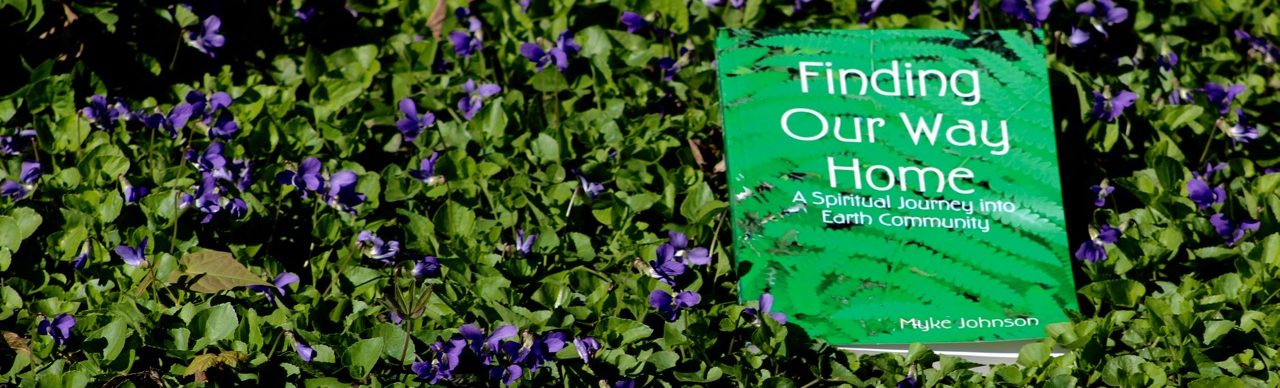
What Does It Mean for Me to Be Austrian?

So I come round to the question, What does it mean for me to be of 1/4 Austrian heritage? All of my ancestor research has been linked to my quest to understand the colonization process, and how my family fits into that long history. How might I be connected to my Austrian ancestors, and how were they connected to the land where they lived?  What might I learn from them? I have had very mixed and often troubled feelings during this particular search.
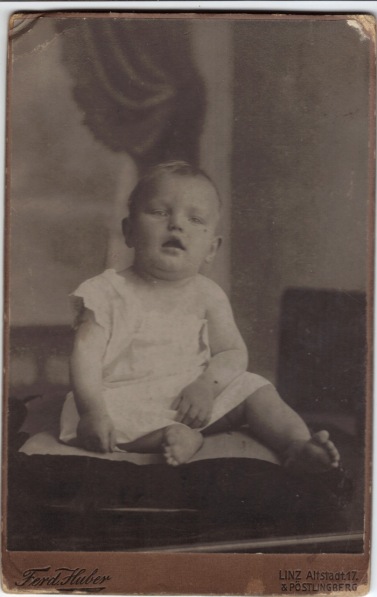
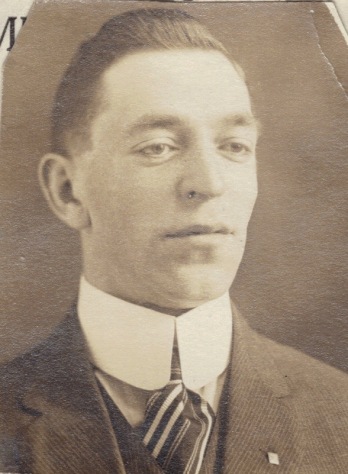
John Hochreiter Baby in Linz

Johann Hochreiter as a baby, in Linz

Linz, the city where my grandfather Hochreiter was born in 1884 and lived until 1910, was also the home of Adolf Hitler for several years, from 1898 to 1907. It is not a connection I feel good about. Wikipedia noted, “Like many Austrian Germans, Hitler began to develop German nationalist ideas from a young age.[34] He expressed loyalty only to Germany, despising the declining Habsburg Monarchy and its rule over an ethnically variegated empire.[35][36]”  Learning the history of Austria’s connection and disconnection from other Germanic states, (see my last post) helps me to understand this somewhat, but the outcome was terrifying.

I was glad to read that in 1996, Linz became the first city in Austria to deal intensively with its own Nazi past.  There was widespread research by the municipal archives, and the culture of remembrance extended to the construction of monuments for the victims of National Socialism. But of course all of these events, including both World Wars, were after my own ancestor had emigrated to North America.

In my family, we didn’t really learn anything about Austria when we were growing up. As far as I can tell, there were no cultural aspects that were carried forward to us, except that, ironically and randomly, the only classical music album in our house was Johann Strauss’s Vienna Waltzes, including “The Blue Danube.”

In fact, it is the Danube River (German Donau) which has called most strongly to my heart, of all that I have learned about Austria.  (Not insignificantly, the Danube also flows through the city of Ulm where the Swabian line of my ancestors is located.) The Danube begins in the Black Forest and flows through southern Germany and through Austria, and then on to the Black Sea. The Danube valley in Austria is north of the Alps, and one of the most fertile and populous regions of Austria. This river is at the center of all its history and culture, and was the major East-West transport on the continent of Europe.

Linked to its location on the Danube, the Linz area was settled continuously, from the late Stone Age Neolithic period, in 4000 BCE. They have also found early Bronze Age urn sites and burial sites from the Hallstatt-period. In the first century AD, the Romans constructed a wood-and-earth fort to secure the important Danube river crossing to control traffic and for military reasons. They named it Lentia. In the second century it was expanded into a stone fort. It was part of the Roman frontier called the limes.

The official history site for the city of Linz notes there were many Goth invasions during the second century and that by the end of the 4th century A.D., the indigenous population is thought to have withdrawn to the easily defensible district of Martinsfeld in reaction to the advance of peoples from the East and West.

Upper Austria on the Danube seems to have been a crossroads of many peoples–who knows whether our ancient ancestors were part of the Roman colonizer settlements, or were the “Barbarian” hordes on the other side of the river? Or some combination of the peoples from “the East and the West”? In my personal DNA analysis, there seem to be fragments (less than 2%) of Italian and Eastern European ancestry–maybe they met along the Danube river in Austria.

So much is up to conjecture and imagination, except that it is clear they were of the so-called “lower” classes. Maybe my very ancient ancestors lived along the river, and then later migrated north to clear the forests and farm. Maybe they were a part of the Peasant Uprisings in 1626, or one of the 62 known uprisings in Upper Austria between 1356 and 1849. Maybe they were not. Day laborers. Weavers. Farmers. But in any case, around 1884, they left their rural connection to land and became urban city dwellers, and thus also came my grandfather to the cities of Ottawa, Ontario, and then to Detroit, Michigan. So much is lost in the translation. But I am glad to make the acquaintance of the great river Danube.
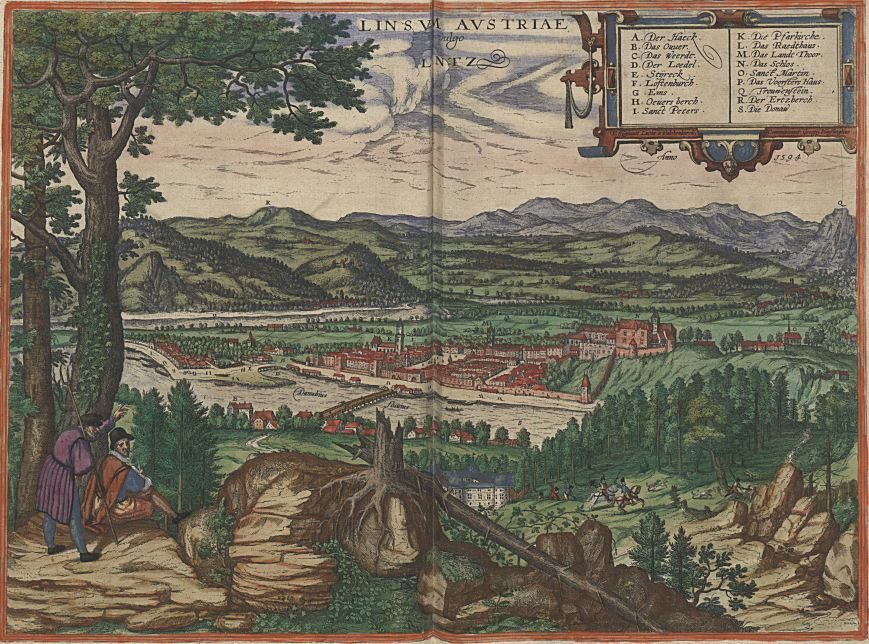
LINSVM_AVSTRIAE_Anno_1594.jpeg

Linz in the year 1594.

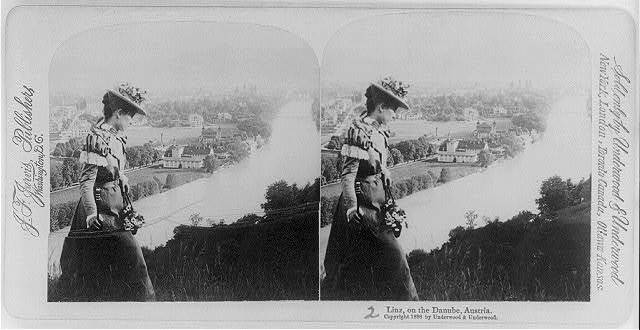
linz-on-the-danube-austria-640

Linz on the Danube, date ?1889
Austrian Questions

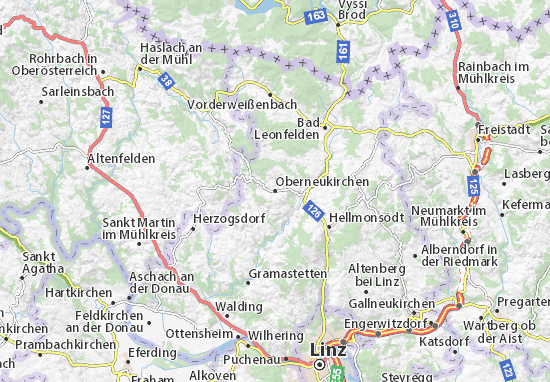
In searching to understand my Austrian heritage, I was able to find a few further generations of the Hochreiter family who lived in the Mühlviertel. This region consists of the four Upper Austrian districts that lie north of the river Danube: Rohrbach, Urfahr-Umgebung (where my ancestors were from), Freistadt and Perg. The parts of the state capital Linz that lie north of the Danube also belong to the Mühlviertel.

My grandfather Johann’s father, as I have said, was also named Johann Hochreiter. Johann, Sr. was the son of Michael Hochreiter (who would be my great-great-grandfather), born in 1832 in Waldschlag (now Oberneukirchen) and Theresia Foisner (my great-great-grandmother) who was born in 1828. She had an earlier marriage to Joseph Waldhör in 1851, at age 23. (Joseph was born in Unterwaldschlag, also Oberneukirchen). They had two sons, and then later Theresia married Michael Hochreither in Oberneukirchen on 13th of July 7, 1856, when she was age 28 and Michael was 24. They had four sons: Johann, Franz, Joseph, and Matthias, all of whom lived to marry and have children. (The records I have don’t indicate if there were any other children who did not survive.)

I also found each of their parents listed: Theresia’s parents were Michael Foisner and Cäcilia Pichler. Michael’s parents were Philipp Hochreiter (who came from Bad Leonfelden) and Theresia Rammerstorfer.

One of the ways I try to learn about my ancestors is simply to look up their towns on Google Maps. Bad Leonfelden is about 12-13 kilometers northeast of Oberneukirchen, and 28 kilometers north of Linz.  When I zoomed into Bad Leonfelden, a few businesses appeared with “Hochreiter” in the name. So that’s cool. Bad means “bath” in German, and there are spa mud baths in the town. It is only 6 kilometers south of the border with the Czech Republic.Oberneukirchen

A Wikipedia listing for Oberneukirchen said that settlement and then village life probably started in the area in the 12th century.  Around the year 1500 agriculture and the weaving industry served as the main source of income. Very important was the trade in flax and linen, and also in wood, wine and salt. So it is possible that my ancestors lived there a very long time.  In the Napoleonic Wars (1803-1815), the area was occupied several times, and in 1809 there were major fires that destroyed many buildings in Oberneukirchen.

But what did it mean to be Austrian? After learning about the Swabian roots of some other Germanic ancestors, I wondered what kind of “Germanic” the Austrians might be. I found out the question has many historical complications. Some sources indicate that the Austrians and Bavarians were essentially the same culturally and linguistically. Austria is just to the east of Bavaria. But when Germany was nationalizing from smaller kingdoms and duchies and so on, Austria was a rival to Prussia, and there were also fierce Protestant/Catholic rivalries.  According to Leif Jerram, (Senior Lecturer in History, University of Manchester, UK) on Quora.com,

Historically, Bavaria and Austria were much more similar. At the time of the formation of the modern state of Germany in the 1860s-70s, Bavarian politicians very much wanted Austria inside the new nation – they shared Roman Catholicism. Further, at that time, Bavaria tended to be more liberal and tolerant than the rest of the new state of Germany, and they wished to be able to preserve that. The Prussian elites who forced the unification of Germany, however (through warfare and blackmail), wanted to ensure that a) Catholics would be in a minority in the new nation, and b) that Prussian aristocratic elites would not face any competition for political power. If Austria were included, then many more Catholics would be included in the new state, and the might of the Austrian empire (such as it was – let’s say its wealth and prestige) would mean Prussian aristocratic landholders would have to make many compromises. So, Austria was excluded from the new state, and Catholics were vigorously persecuted as a minority for the first 20-or-so years of its foundation.

The history of the place seems incredibly complex, (but that seems true of most places I’ve tried to learn about in Europe.) A decisive moment for these developments was the Austro-Prussian War, in the summer of 1866.  Each side had ally states who were part of the loosely bound German Confederation, but the Prussians won that seven week war, and shaped the resulting eventual German Empire to the exclusion of Austria. The Austro-Hungarian Empire was then established in 1867 in the aftermath, as a constitutional monarchy (with Austria and Hungary as equal partners) that lasted until 1918.

So my grandfather’s parents and grandparents would have lived through these and other–often violent–transitions, but who knows how much or how little they were involved or effected by them personally in their small rural villages.  All of this helps me to understand just a little of the complex relationship between Austria and Germany in the World Wars of the twentieth century, (though my grandfather and all of my other Germanic ancestors) were gone from Europe by then. In each of those conflicts, there were some people who wanted Austria to be part of a wider Germany, and in the resulting peace treaties, that was explicitly forbidden. No wonder I find it all very confusing.


Johann Hochreiter

John Hochreiter at 31

John Hochreiter at 31

My most recent ancestor immigrant to this continent was my grandfather, John Hochreiter. He was born “Johann” on June 1, 1884 in Linz, Austria, when it was part of the Austro-Hungarian Empire. His father, Johann Hochreiter (senior), born 1857, was a day-laborer originally from the village of Waldschlag, (now part of the town of Oberneukirchen), in the northern part of Upper Austria, an area called Mühlviertel. From the information I can gather, the next few generations of ancestors were from that area as well. His mother was born Anna Bartl, about 1851, daughter of the weaver Michael Bartl and his wife Katharina.

I turned to etymology for some clues this time. The name “Hochreiter” originally meant those persons who made higher-lying surfaces arable, who cleared forested areas for farms. “Wald schlag might mean “Forest Strike”, and “Ober neu kirchen” is “Upper New Churches.” According to Wikipedia, settlement and then village life probably started in the area of ​​the municipality Oberneukirchen in the 12th century. The spread and colonization of the forest clearing areas and the religious care of the settlers soon made a chapel or church building required.  One last etymology: “Mühlviertel” translates “Mill Quarter.” The Oberneukirchen economy was centered around agriculture and weaving for several centuries.

However, Johann and Anna did not stay in this rural area, the place of their families. For some reason, I would guess related to work, they moved about 25 kilometers south to the city of Linz where Johann was a day-laborer. It was in the city that their children were born—they had at least five sons, Johann (junior) in 1884, Georg in 1885, Franz in 1888, Franz Joseph in 1892, and Julius in 1895. (I seem to remember hearing stories that my grandfather was the oldest of several brothers—even eight, but that number might be a error.) They later also died in the city of Linz, in 1933 and 1930.

My mom told of a story that my grandfather as a young man had carried bread on his back to deliver it, or another story was that he delivered beer by horse-drawn cart. But in any case, at some point he became a waiter, and remained so until his retirement many years later. He left Linz in his twenties, somewhere about 1910 or 11, with a group of buddies, working as waiters in hotels as they traveled, going first to France, and then England. Finally they took the ship called “Lake Manitoba” and landed in Quebec, Canada on June 16, 1912. Then, he worked as a waiter at the new, and very grand, Chateau Laurier hotel in Ottawa, Ontario, Canada. It was there he met my grandmother, Yvonne Tremblay, who worked as a chamber maid.

In late 1915, John emigrated once again, traveling via Windsor to Detroit, Michigan. By this point, Canada had entered the first World War, and he was registered as an “enemy alien.” I wonder if that contributed to his decision to come to the United States, which was still a neutral country. (According to that registration, in 1915 at 31 he was 5’3”, weighed 125 pounds, and had dark hair, and wore glasses.) He soon sent for Yvonne, and they were married in Detroit on January 14, 1916. She was just 18.

John & Yvonne Hochreiter 1916

John and Yvonne in Detroit 1916

They stayed in Detroit, and he worked as a room service waiter at the Hotel Statler (which had been completed earlier in 1915), until he retired (at 70) after my grandmother died in l954.

When I have wondered about why he left Austria, I haven’t found clear answers. It was a few years before war would break out there, so I don’t think it was about that. It seems perhaps he and his friends were looking for adventure, and they’d found a way to do it even without many financial resources.  As waiters, they could work wherever they could find hotel jobs.  I was impressed that these men continued to be friends years later in Detroit. My grandfather was a quiet man, and he died when I was only 13, so I never felt that I knew him very well.

Ironically, even though my siblings and I are of 25% Austrian ancestry, and our grandfather was the most recent immigrant of our heritage, I found it difficult to find a sense of connection to that culture and place. It has bewildered me as I have continued to explore the region in Austria from which he came. I’ll write more in a future post.

Swabian Roots

I have been delving into the stories of my ancestors again, and the last few days I was researching my great-great-great grandparents, Johann Nepomuk Heisler (b. 1781 in Westerstetten) and Barbara (Zeller) Heisler (b. 1788 in Tomerdingen). They lived in the small town of Westerstetten, in the Swabian Alb, now a part of Germany. 

Johann was a shoemaker and farmer. They were married in 1805, when he was 24 and she was 17, and moved into their house at Haupstrasse 19 in 1806. [The house was built in 1757 and was still there at the turn of this century.] The first of their children was born in 1806, when Barbara was 18. They had 14 children, but several died in childhood, and Barbara herself died at the age of 37 in October of 1825, one week after the birth of her last child. I would say it is likely that she died of childbirth related issues. At that time, only eight children were still living.

Four years later, in 1829, when Johann married his second wife, Magdalena Rimmele, who was 45, only six of the children remained: Jacob was 20, Martha was 13 (and died 5 years later), Nikolas was 11, Johann was 9, Augustin was 8 and Anton was 4. The youngest four boys would eventually emigrate to the United States—but I will talk more about that in separate stories. [One of which can be found here.]

It is uncertain how long the family ancestors had lived in Westerstetten. Their parents are just identified as “German,” in the records I have. But we might conclude that they were from the area of the Swabian Alb, because Johann Nepomuk Heisler’s grandfather Johann Leonhard Heisler is listed as born in Essingen in the north part of the Swabian Alb. His great-great-grandfather is also listed as born in Essingen, and that one’s wife was born in Westerstetten. So the family were most likely of Swabian heritage.

That whole region was part of the Swabian Alb, centered in the city of Ulm, but including both Westerstetten, and Tomerdingen which were each perhaps 15-17 kilometers north of Ulm. Their small town at that time however was on the edge of rival political entities, and they would have experienced many transitions in the early 1800s.

From 1414 to 1803, Westerstetten, and Tomerdingen as well, were part of the territory of Elchingen Abbey, a Benedictine monastery. For much of its history, Elchingen was one of the 40-odd self-ruling imperial abbeys of the Holy Roman Empire and, as such, was a virtually independent state that contained several villages aside from the monastery itself. This meant it was independent of the jurisdiction of any lord, and answered directly to the Holy Roman Emperor. Perhaps the devout Catholicism of the Heislers is related to their connection to the Abbey. 

Like all the imperial abbeys, Elchingen lost its independence in the course of the German Mediatisation in 1803 (a secularisation and land redistribution process put in place by the French conquests of Napolean) and the monastery was dissolved. When this happened, the village of Westerstetten was given to the “Elector (and then Kingdom) of Bavaria” along with Elchingen, and the city of Ulm. Seven years later, in 1810, the border between Bavaria and Württemberg was re-negotiated and Westerstetten and Ulm both became part of the “Kingdom of Württemberg.”

The Heislers were most likely struggling villagers during all of this. According to one Wikipedia entry, life was extremely hard in the Swabian Alb. There was a lack of water and the soil was poor in quality. For many villages fetching water required a long journey by horse. Since water often needed to be stored over a long time, it became stagnant. Thus disinfection via alcohol was very popular: “Most” (cider) was mixed with water and even given to babies.

I wonder how much the decision to send four sons to the United States was influenced by these difficult conditions, and by the tumultuous political landscape. As it turned out, only one son remained behind, of all of the 14 children. In 1978, my grandmother Lucille Heisler Johnson wrote to her sister, “I remember Papa (Thomas Heisler) telling us about his father and two brothers coming over from Germany. They all had to be under twenty-one because they left Germany to avoid military service.” The last brother came later on his own. I am beginning to imagine these ancestors.

Abbey of Elchingen

Map of Württemberg before the French Revolutionary Wars, showing the Free Imperial City of Ulm, separating the two parts of the Imperial Abbey of Elchingen, with the Danube shown running through the centre of the image. Cropped from German States Before and since the French Revolution: II. Wurtemberg, from The Historical Atlas by William R. Shepherd, 1923, from the Perry-Castañeda map collection. Public Domain 


The Power of Memory

Presumpscott River

I just finished reading Ta-Nehisi Coates’ The Water Dancer, a powerful novel set in the days of slavery and the underground railroad, told through the voice of one young man who is among “the tasked.” There is so much I could say about this story.  Starting with this word, “tasked.” Coates never has his characters who are in bondage call themselves “slaves,” but rather, “the tasked.” And this subtle shift of language helps to transport us beyond the familiar words (of the masters) that have been written as history, into the direct perspective of those who were counted as property.

Even though I learned about slavery from my early days in school, it was easy to discount (even by benign repetition) the pervasive way this institution shaped the whole of our nation from its beginnings, it was easy to mask its reach and extent and corruption.  I grew up in the north, and it was easy to think of it as something far away, other.  But in recounting exploits of folks in the underground railroad, Coates makes clear that people in the north weren’t safe from slavery, or immune to its power. Any person of African descent could be captured off the streets of Philadelphia and transported away into bondage. A person of European descent who devoted themselves to ending slavery risked being murdered.  It was everywhere in this country.

It is not that the novel opened my eyes to some new knowledge, but that it helped me remember what I have already known, and bring it alive in a vivid way.  The whole practice and institution of slavery makes a lie of any notion of “greatest country” or “good old days” or “American dream.”  From the earliest settler invasions in 1619, through the creation of the “United States,” through the Civil War, up to 1865–246 years–the country was bound up in these practices of forced labor, torture, separation of families, sexual abuse. We are part of a horrible legacy that still shapes everything about our country, even though there are strong incentives for us to “forget.”

In The Water Dancer, the central character, Hiram Walker, has a magical gift that is tied to the power of memory.  He was a precocious child with a photographic memory of everything, except for the memory of his mother, who was sold away from him when he was only a young boy.  That trauma erased all memories of her from his consciousness. But later, crossing a bridge over the river Goose, the bridge where so many people had been lost into the deeper south, he sees a vision of his mother dancing with a water jar on her head.

The story begins here.  On the first page he says,

“knowing now the awesome power of memory, how it can open a blue door from one world to another, how it can move us from mountains to meadows, from green woods to fields caked in snow, knowing now that memory can fold the land like cloth, and knowing, too, how I had pushed my memory of her into the “down there” of my mind, how I forgot, but did not forget, I know now that this story, this Conduction, had to begin there on that fantastic bridge between the land of the living and the land of the lost.”

He doesn’t come into the power of his own magical gifts until he can awaken the full memory of all that he has lost, and the painfulness of that loss. And perhaps we too will never find healing for all that we face in our world today, until we open our minds to the painfulness of what we call the “past,” (because it is never “past”), until we are willing to face it as it lives within the “down there” of this land we call home.

The Water Dancer creates that kind of magic, conjures the power of memory to transform all that we are.

Ancestor Wounds and Healing

I’m on my way to the Wild Maine Witch Camp!  My friend Sylvia and I are leading one of the morning workshop series (called a Path), on the topic of Ancestor Wounds and Healing. 

Our intention in this path, is to open our lives to the blessings of our ancestors and to healing the wounds we carry from them. This work, for us, is rooted in our understanding that our path as witches is tied up with collective liberation from colonization and oppression, from patriarchy and racism. Connecting with our ancestors is a way to wrestle with our collective history and all that it includes, in order to bring healing and liberation in our times.

I have been blogging about this process with my own ancestors for the last several months, discovering more about the experience of my German and East Frisian immigrant ancestors, and the Quebec story of my French, Innu and Scottish ancestors. I’ve been asking questions about how the stories of my ancestors fit into the larger story of colonization, of relationship to the land, of migration, and belonging. Perhaps I have also been wrestling with the question of whether my European ancestors might have any blessings to offer me. That story is so tangled and broken.

I am looking forward to sharing this work with a group of people in the context of our lives as witches. Our tools will include experiential magical practice, music and chanting, personal sharing, guided meditation and trance work, sacred herbs, and the wisdom of each person in the circle. We will draw on Joanna Macy’s Work that Reconnects which is based on a cycle of four movements that we will use through our four days together. We will begin with gratitude, then move into honoring our pain, then seeing our connections with new eyes, and finally, going forth.

Perhaps I am hoping to discover if this message from Linda Hogan, Chickasaw writer, also might apply to me:

Walking. I am listening to a deeper way.

Suddenly all my ancestors are behind me.

Be still, they say. Watch and listen.

You are the result of the love of thousands.

Biddeford Pool beach

Meanwhile in the Garden

Winecap MushroomsA few fun surprises this week in the garden. Way back in May, I had inoculated the wood chips near the fruit trees with Wine Cap mushroom spores.  Then nothing happened all summer, so I figured maybe it wasn’t moist enough and didn’t take.  But this week suddenly, beautiful big mushrooms started sprouting with a reddish tint to their caps. Being cautious, I checked the package again, and also researched Wine Caps on the internet–I was relieved to discover there are no poisonous look-alikes. First Mushrooms
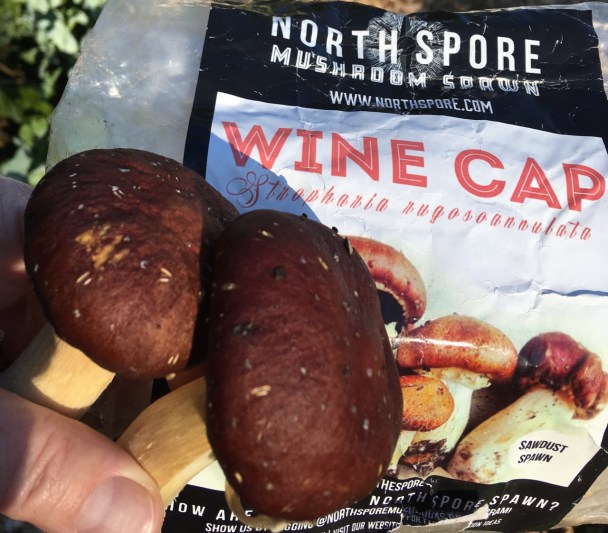
Since then we’ve had fresh mushrooms in our eggs and in a batch of spaghetti sauce. The mushrooms keep popping up all over the orchard. They should come back again each year now.  What a marvelous thing to get food right from the ground!

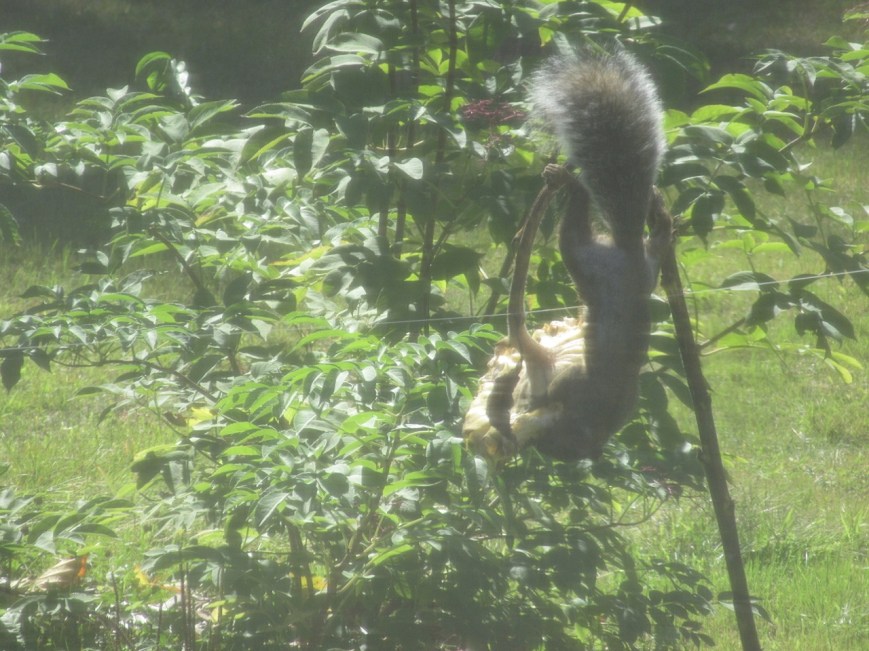
Speaking of food from the ground, the squirrel was excited to discover that one of our volunteer sunflowers had seeds on it. Just like she would do on our bird feeder in the winter, she hung upside down to get to the meaty morsels.Squirrel on Sunflower

Were they really there? Later, I checked for myself. Certainly enough for a little snack. I think this is the same squirrel that decided she should build a nest this week under our solar panels, in a spot behind a cross board that supports our deck roof.  Not good!  (Squirrels can chew the wiring and mess up the solar panel system, we discovered.) Each morning and evening Margy or I would climb on a ladder to pull out small branches and leaves and grass to undo what she had built. We’ve got a plan to cut off some branches on our ornamental crabapple that form a super-highway from the materials to the roof.

But one day, while I was on the ladder pulling out stuff, she came running down the gutter and stopped short when she saw me. I said to her, “You can’t build a nest here! This is our house. Go find a nice tree.”

I don’t know if it was my stern suggestion, or the pile of “stolen” nesting material that was scattered on the deck beneath the ladder, or sheer discouragement from all her work being undone each day, but the last two days she has not replenished her spot. (We’re still going to prune the tree though!) Maybe the sunflower seeds were a little something to sweeten the agreement. We try to find a balance with our plant and animal neighbors in this place. Giving and receiving in gratitude.

Sunflower Seeds

Garden Updates

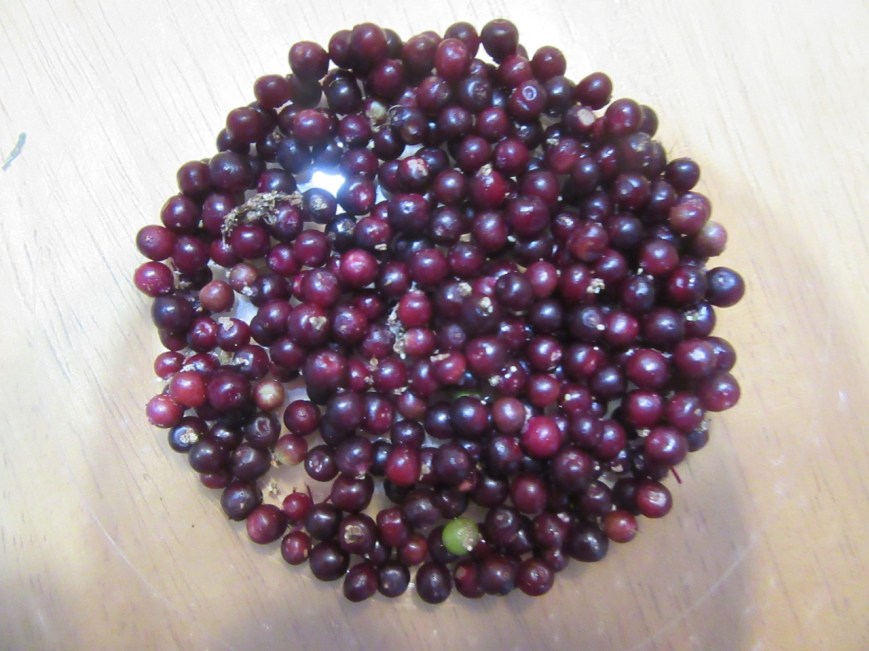
Elderberries ripeThis week there were a few exciting new developments in the garden. We harvested our very first elderberries—maybe a whole half cup of them! Earlier in the summer, I was worried about whether something was wrong with the elder flowers, and perhaps there was, but eventually they created a spotty bunch of green berries. I must admit, I hadn’t gone by the bush for several days, but when I went out the other day, they were purple. I ate one that was quite sweet, but Margy tasted a sour one, not as ripe. Elderberry harvest 2019Not enough to make elderberry syrup, or really much of anything, but enough to be enthused about future possibilities. Margy and I will have to celebrate with a berry eating ritual.
Another new development: I saw a few catkins on our hazelnut bushes! I hadn’t known to expect them, but when I  looked it up, I learned that these are the male part of the plant’s reproductive system. They will stay on the plant through the fall and winter, and then in very early spring they start lengthening and unfurling.  When the female flowers open at the tips of branches, they pollenate. Hazelnut catkinsThere are only a few catkins right now, but they are a harbinger of future crops of hazelnuts. In my last batch of pesto, I used hazelnuts from the Food Coop to add to basil, parsley, chives and garlic from the garden, plus olive oil and lemon of course. So we can’t quite do it only from our garden, but maybe more and more.
I also processed oregano and thyme that had been drying in the basement herb dryer for longer than they needed to be, and did another batch of frozen chives, and frozen kale for the winter. Our harvest is limited more by my own energy than by the earth energy.

If anyone local would like oregano or thyme or chives, please let me know—they are flourishing in the garden still, and I’d be happy to share—also lemon balm, comfrey, and dill. They have all been very enthusiastic.

Miracle of Ocean

Crescent Beach September

Yesterday late afternoon, with the weather up to 80 degrees, I went to Crescent Beach. Would it be the last day warm enough for me to go in the water? Maybe, maybe not. But without expectations, I set up my chair on the sand, and walked down to the edge of the water to feel the cold splashing on my feet. Its temperature was mildly cold not frigid, much warmer than early summer. There were a few more waves than usual. Only a small group of children were in the water, jumping into the waves as they broke on the shore.

I have become a bit timid about waves, as I have gotten older. The tide was low, and there were lots of round stones to walk over, so I came back to my chair and put on some swim shoes, so I’d have better balance. Then I walked back out and stepped right in. I moved quickly through the breaking waves and past them to about my waist level. The rhythms of the water rose up to my shoulders, and then back down, lifted me up and down, too, but gently. I dove into one wave to cover my head, but then I just stood facing the sea, watching the waves come in, letting them carry me up and down.

Here’s the amazing thing: after being in the water, the waves, for a long time, and then staying longer still, I began to be washed in a sense of joy and happiness. It felt miraculous because this whole past week, I had been feeling exhausted and achy–a classic flare up of the auto-immune conditions I struggle with. But somehow the water washed all of that away, and I was filled with a physical sense of well-being and playfulness.

When I go into the water, I usually pray to the Mother Ocean, I give her my worries and struggles. She is one kind of divine presence, larger than I can ever be, and the source of all life. But it wasn’t my small prayer that shifted me–it was the very energy and power of her presence all around me, it was the waves dancing with me, it was my body responding to the waves. It was unexpected.

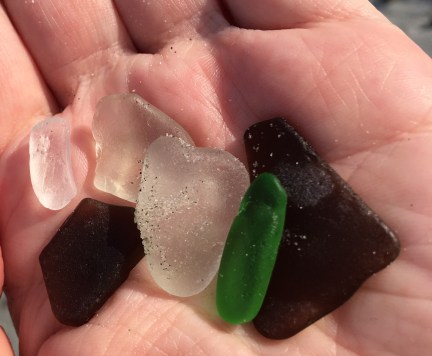
Filled with this lovely happiness, when I came out of the water, I walked along the shore looking at stones and shells, and I found several pieces of sea glass. I love that the ocean can transform these broken bits of human invention into tokens of beauty. Since I have been thinking lately about the ancestors, it came to me that sea glass is a kind of gift from people who came before. I’ve read that it can take 20-40 years in the waves, sometimes longer, for glass to be tumbled to create this patina. So someone a long or short time ago made the glass, touched it, discarded it.  I am holding this connection, broken yet made whole again, and so I prayed for friends and family who needed healing.Seaglass

After my walk, I sat in my chair and ate some yogurt mixed with cocoa, honey, cacao nibs, and blueberries. I started reading the novel Barkskins by Annie Proulx, which begins with French settlers in Quebec taking down the forest. (Another way to try to understand colonization.)  Isn’t it a picture of happiness, to read in a chair on the beach, sun on my shoulders?

monarch catepillarOn my walk back to the car, one more fun surprise. This colorful monarch caterpillar on a milkweed plant just past the beach roses.

I wish I could share with you the happiness of being in the ocean, of walking on the shore finding sea glass, of reading on the beach on a September evening, of finding a monarch on a milkweed.

But the happiness was triggered by actually being in the ocean with its waves dancing me up and down. So if you are feeling timid about walking into the waves, whether literal or metaphorical, please know that on the other side little miracles might happen. Joy might find you.