At Home

Picture by Arla Patch, James Francis

With these last few quiet days at home, Margy and I were finally (after almost four years) able to take down from the attic all of our wall pictures, and decide how we wanted to decorate the walls of our living room and kitchen. It was especially wonderful to place over our fireplace hearth this print, Stewardship of the Earth, by James E. Francis and Arla Patch. We had purchased it several years ago in a fundraiser for Maine Wabanaki REACH.  Here is more information about it from an article in the Friends Journal.

This work of art is a collaboration between James E. Francis, Penobscot artist and director of cultural and historic preservation for the Penobscot Nation, and Arla Patch, artist, teacher, and [at that time] member of the communications subcommittee of the Wabanaki Truth and Reconciliation Commission.

It was made for a western Maine community celebration of the native woman Molly Ockett (c. 1740–1816, Abenaki nation, Pequawket band). The theme of 2013’s MollyOckett Days Festival was “Stewardship of the Earth.” James created the central image of the tree that becomes the earth. Arla created the context based on the European American tradition of quilts. James provided the symbols, which represent the four remaining tribes in the Wabanaki Confederacy: the Penobscot, the Passamaquoddy, the Maliseet, and the Micmac.

A theme of the four directions, which comes from both Native American spirituality and ancient Celtic tradition, is depicted as the night sky for the north; the sun rising over “second island” next to the Passamaquoddy land of Sipayik; the midday sky for the south; and the sun setting over the White Mountains for the west. “Agiocochook” (home of the Great Spirit), also known as Mt. Washington, is included in the western sky.

Blueberries are included for the role they have played in sustaining Maine native peoples historically and to this day. Maple leaves are in the upper corners to honor the development of maple syrup by the Wabanaki.

When we put this picture on the wall, along with a few others around the room, I found myself feeling rooted and joyful, at home in a deeper way than before. It was as if some mysterious magic had created a circle around us, and we were aligning into harmony and beauty.

May that beauty bring us hope and strength as we enter a new decade, a decade that will be pivotal in our collective stewardship of the Earth. May we human beings find a way to live in harmony with all of our relatives on this planet that is our home.
Mothers and Grandmothers

In the early days of my feminist awakening, I began to trace the ancestry of my mother line, to learn who my grandmothers might be, and what land we originally came from. I learned this: my matrilineal great-great-great-grandmother was an Innu woman, identified in the records as Marie Madeleine, Montagnaise. She married a Scottish trapper who worked for the Hudson Bay Company in Quebec. His name was Peter Macleod, and he called her Marie de Terres Rompues, after the place where they came to live on the Saguenay River. Her name might be translated, Marie of Broken Lands, which resonates with what came later.

When I have been able to travel to Quebec, to the place the Innu call Nitasinnan [our land], I have felt the presence of the ghosts of my ancestors in the land. The very first time I drove into Chicoutimi on the Saguenay River, I came upon a book on the shelves of the Welcome Center in the rest area—it was about my ancestor Peter Macleod and his family. There have been other encounters over the years, a feeling of my ancestors reaching out to me as I reach out to them.

Learning about their stories has been an important part of my journey. I discovered many dislocations and relocations that occurred for my grandmothers, ways they were separated daughter from mother, separated from the land and the people from which they came. Marie de Terres Rompues bore several children with Peter MacLeod. Her daughter, Angele, was only twelve when her mother died, and Peter married another wife; Angele’s stepmother was a white woman. I wonder if Angele kept a connection to her Innu relatives? She was married at the age of twenty to a French Quebecois farmer, Joseph Tremblay, and they lived in the area of Peribonka near Lac St. Jean. I only know one story about them, from a census report. One year, all their grain burned in May, and they replanted with fresh grain but all of it was frozen and “not fit to be threshed.”

Her daughter Claudia was only eighteen when Angele died. At twenty-two, Claudia married Ferdinand, and during an economic downturn in their region, they moved over four hundred miles away to the town of Hull in the suburbs of Ottawa. Later, they traveled over seventeen hundred miles to the Black Hills of South Dakota, where Ferdinand worked in the mica mines for five years, during the boom years when Westinghouse Electric was producing over $100,000 per year in mica. Then the mines closed.

Their daughter, my grandmother Yvonne, was born in Hull in 1897; she was nine when they moved to the Black Hills, and fourteen when they returned to Quebec. She became a chamber maid in a hotel in the Canadian capital city of Ottawa, where she met Johann, an Austrian immigrant working as a waiter. At seventeen, she followed him five hundred miles to the United States, marrying at the border in Detroit Michigan.

My mother tells me Yvonne and her sisters worried that someone might think they looked Indian. Did she fear prejudice learned in Quebec, or in South Dakota? In Detroit, she became fully assimilated into the white and English-speaking world. Most of the stories were lost, but she did tell my mother they were part-Indian, and my mom grew up feeling proud of that heritage. There were occasional visits to family in Canada. When my mother was a four years old, the news came of Claudia’s death at the age of seventy-three.

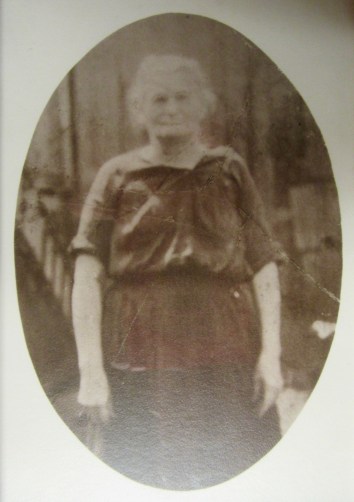
Claudia Tremblay

My great-grandmother, Claudia Tremblay, age/date unknown

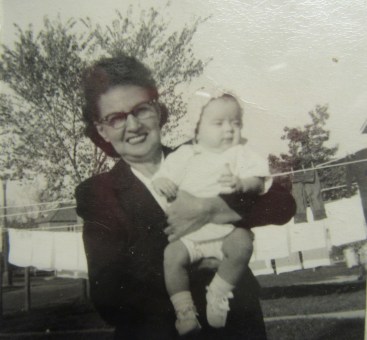
My mother was not quite twenty-one when her mother, Yvonne, died. I was a baby then. I have a picture [below] of my grandmother holding me in her arms. When I ponder this story of my mothers and grandmothers, I am struck by how most of these women lost their mothers before, or just as they were entering, adulthood. None of them had a chance to be with their grandmothers. They each turned to the life and the culture of their husbands. And I am struck by the many miles each generation traveled away from the place in which they might have felt a sense of belonging to the land. My mother, too, followed her husband on his travels across the United States. I grew up during those travels and none of those places ever truly felt like home. I didn’t know any other way.

Grandmother Yvonne with Myke

My grandmother Yvonne holding me as a baby.

It has been a long and important process for me to reclaim these stories and reweave a connection to my grandmothers.

[This story first appeared in my book, Finding Our Way Home: A Spiritual Journey into Earth Community.]

Where are the birds?

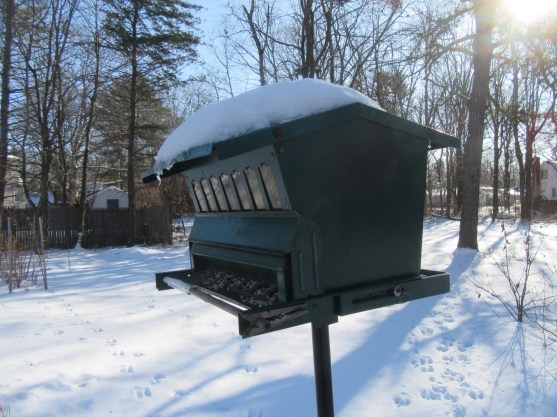
Bird Feeder no birds

We have always had birds in our back yard in the winter, coming to our feeder, or rooting around on the ground. But this year, we’ve seen almost none at all. We didn’t fill the feeder over the summer–but many birds visited during that time, in the orchard and in the nearby trees and all over the place. So we expected that filling it up again would bring the usual winter birds. But I can count on one hand the birds I’ve seen. And no cardinals.

In trying to comprehend this, I noticed that only one other thing has changed. The lot behind our neighbor’s house–not visible in this photo–had been overgrown with bittersweet, and then the vines took down part of a big maple tree. Plus Margy had been cutting a lot of the invasive bittersweet.  So that field has less tree and vine cover, which some birds may have preferred.  More ominously, I’ve read that in North America the total number of birds has declined by 25% in the last fifty years.  Is it finally affecting our own yard?

I have seen a few birds here and there on my walk in the neighborhood, and there have been a few in the crabapples in the front yard. But despite our full feeder, plus a thistle feeder, and even a suet cake, no one is around.  It seems so strange and empty.  Have you noticed fewer birds where you live?

All of this got me thinking sadly about extinction, and I happened to see a documentary about the early Neanderthal humans, who lived in Europe and Asia for several hundred thousand years, before becoming extinct about 40,000 years ago. According to the DNA testing company “23 and Me”, all modern humans, except for those from sub-Saharan Africa, have between 1 and 4 % Neanderthal DNA, from interbreeding of the two related species. So the Neanderthals can be counted among my ancestors too. By the way, they were much smarter and more cultured than the myths that were taught about them early on.

There are a lot of theories about why they went extinct. But this particular documentary, Neanderthal Apocalypse, made the hypothesis that one factor was the eruption of a super-volcano near present day Naples 39,000 years ago. However that might have effected the Neanderthals, I found myself more focused on what it might do to us today. If a super-volcano were to erupt in our time, ash and debris would cover miles and miles of land, and kill all vegetation, crops, and the animals who rely on them (including us.)  Ashes and toxic gases would rise up into the upper atmosphere and block out sunlight, plunging a large portion of the earth into a volcanic winter. Civilization over.

Now this might be a depressing thing to think about, but for some reason, I didn’t feel depressed. Instead, I was reminded of how very powerful the Earth really is.  We are so small, and so reliant on all of the Earth’s interwoven life.  So, in a funny way, I felt less afraid. We humans know some things, and the activity of our species is causing damage to the climate, and wreaking havoc everywhere. But so much is beyond our control and even our understanding. It is profoundly humbling and reminds me to be grateful for how the earth provides everything we need.

So I come round to this Winter Solstice holiday, today, and say thanks to the Earth for birthing us, for feeding us, for fire that warms us in winter, for so much beauty that inspires our lives.  And I say a prayer for the birds: please come back to once again feast with us in this little patch of land we call home.


What Does It Mean for Me to Be Austrian?

So I come round to the question, What does it mean for me to be of 1/4 Austrian heritage? All of my ancestor research has been linked to my quest to understand the colonization process, and how my family fits into that long history. How might I be connected to my Austrian ancestors, and how were they connected to the land where they lived?  What might I learn from them? I have had very mixed and often troubled feelings during this particular search.

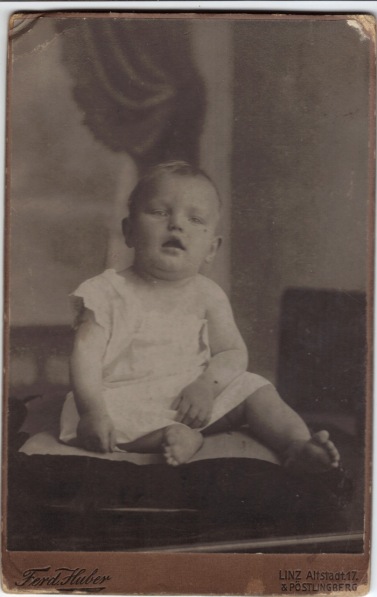
John Hochreiter Baby in Linz

Johann Hochreiter as a baby, in Linz

Linz, the city where my grandfather Hochreiter was born in 1884 and lived until 1910, was also the home of Adolf Hitler for several years, from 1898 to 1907. It is not a connection I feel good about. Wikipedia noted, “Like many Austrian Germans, Hitler began to develop German nationalist ideas from a young age.[34] He expressed loyalty only to Germany, despising the declining Habsburg Monarchy and its rule over an ethnically variegated empire.[35][36]”  Learning the history of Austria’s connection and disconnection from other Germanic states, (see my last post) helps me to understand this somewhat, but the outcome was terrifying.

I was glad to read that in 1996, Linz became the first city in Austria to deal intensively with its own Nazi past.  There was widespread research by the municipal archives, and the culture of remembrance extended to the construction of monuments for the victims of National Socialism. But of course all of these events, including both World Wars, were after my own ancestor had emigrated to North America.

In my family, we didn’t really learn anything about Austria when we were growing up. As far as I can tell, there were no cultural aspects that were carried forward to us, except that, ironically and randomly, the only classical music album in our house was Johann Strauss’s Vienna Waltzes, including “The Blue Danube.”

In fact, it is the Danube River (German Donau) which has called most strongly to my heart, of all that I have learned about Austria.  (Not insignificantly, the Danube also flows through the city of Ulm where the Swabian line of my ancestors is located.) The Danube begins in the Black Forest and flows through southern Germany and through Austria, and then on to the Black Sea. The Danube valley in Austria is north of the Alps, and one of the most fertile and populous regions of Austria. This river is at the center of all its history and culture, and was the major East-West transport on the continent of Europe.

Linked to its location on the Danube, the Linz area was settled continuously, from the late Stone Age Neolithic period, in 4000 BCE. They have also found early Bronze Age urn sites and burial sites from the Hallstatt-period. In the first century AD, the Romans constructed a wood-and-earth fort to secure the important Danube river crossing to control traffic and for military reasons. They named it Lentia. In the second century it was expanded into a stone fort. It was part of the Roman frontier called the limes.

The official history site for the city of Linz notes there were many Goth invasions during the second century and that by the end of the 4th century A.D., the indigenous population is thought to have withdrawn to the easily defensible district of Martinsfeld in reaction to the advance of peoples from the East and West.

Upper Austria on the Danube seems to have been a crossroads of many peoples–who knows whether our ancient ancestors were part of the Roman colonizer settlements, or were the “Barbarian” hordes on the other side of the river? Or some combination of the peoples from “the East and the West”? In my personal DNA analysis, there seem to be fragments (less than 2%) of Italian and Eastern European ancestry–maybe they met along the Danube river in Austria.

So much is up to conjecture and imagination, except that it is clear they were of the so-called “lower” classes. Maybe my very ancient ancestors lived along the river, and then later migrated north to clear the forests and farm. Maybe they were a part of the Peasant Uprisings in 1626, or one of the 62 known uprisings in Upper Austria between 1356 and 1849. Maybe they were not. Day laborers. Weavers. Farmers. But in any case, around 1884, they left their rural connection to land and became urban city dwellers, and thus also came my grandfather to the cities of Ottawa, Ontario, and then to Detroit, Michigan. So much is lost in the translation. But I am glad to make the acquaintance of the great river Danube.

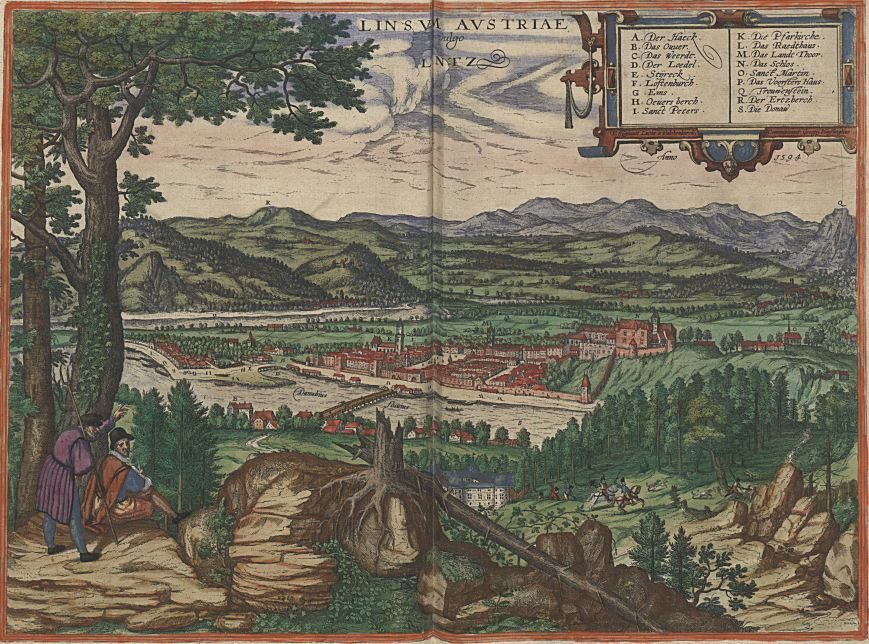
LINSVM_AVSTRIAE_Anno_1594.jpeg

Linz in the year 1594.

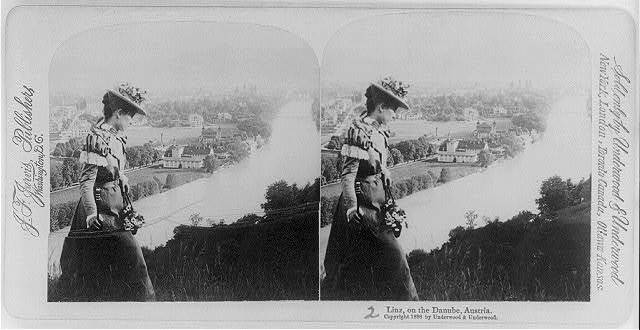
linz-on-the-danube-austria-640

Linz on the Danube, date ?1889

Meanwhile in the Garden

Winecap MushroomsA few fun surprises this week in the garden. Way back in May, I had inoculated the wood chips near the fruit trees with Wine Cap mushroom spores.  Then nothing happened all summer, so I figured maybe it wasn’t moist enough and didn’t take.  But this week suddenly, beautiful big mushrooms started sprouting with a reddish tint to their caps. Being cautious, I checked the package again, and also researched Wine Caps on the internet–I was relieved to discover there are no poisonous look-alikes. First Mushrooms
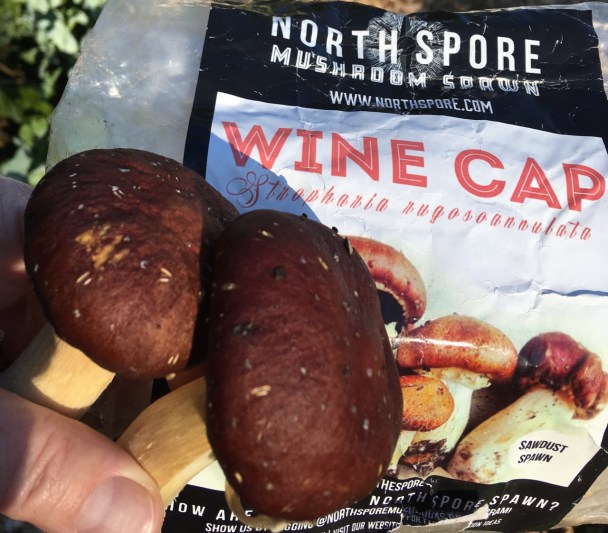
Since then we’ve had fresh mushrooms in our eggs and in a batch of spaghetti sauce. The mushrooms keep popping up all over the orchard. They should come back again each year now.  What a marvelous thing to get food right from the ground!

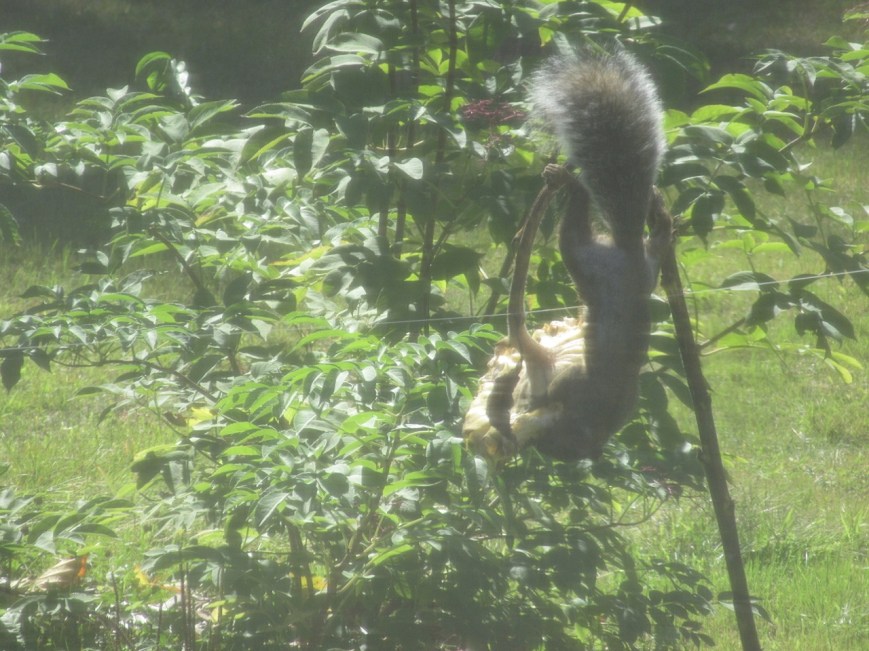
Speaking of food from the ground, the squirrel was excited to discover that one of our volunteer sunflowers had seeds on it. Just like she would do on our bird feeder in the winter, she hung upside down to get to the meaty morsels.Squirrel on Sunflower

Were they really there? Later, I checked for myself. Certainly enough for a little snack. I think this is the same squirrel that decided she should build a nest this week under our solar panels, in a spot behind a cross board that supports our deck roof.  Not good!  (Squirrels can chew the wiring and mess up the solar panel system, we discovered.) Each morning and evening Margy or I would climb on a ladder to pull out small branches and leaves and grass to undo what she had built. We’ve got a plan to cut off some branches on our ornamental crabapple that form a super-highway from the materials to the roof.

But one day, while I was on the ladder pulling out stuff, she came running down the gutter and stopped short when she saw me. I said to her, “You can’t build a nest here! This is our house. Go find a nice tree.”

I don’t know if it was my stern suggestion, or the pile of “stolen” nesting material that was scattered on the deck beneath the ladder, or sheer discouragement from all her work being undone each day, but the last two days she has not replenished her spot. (We’re still going to prune the tree though!) Maybe the sunflower seeds were a little something to sweeten the agreement. We try to find a balance with our plant and animal neighbors in this place. Giving and receiving in gratitude.

Sunflower Seeds

Ancestors: Clearing the Forests

I just finished reading Barkskins by Annie Proulx. It is a 300-year-plus epic novel, beginning with the stories of two French settlers who arrive in Quebec in 1693, who become involved in cutting down the trees of the forest. One runs away to make a fortune starting with the beaver pelt trade, and the other ends up marrying a Mi’kmaw woman.  We then encounter the lives of the descendants of these two men, through a relentless series of clear-cutting the forests of this continent and beyond, partly from the perspective of lumber company entrepreneurs trying to get wealthy, and Mi’kmaw logging laborers risking their lives and health working for the lumber companies, when they can no longer live in their traditional ways because the forests are being destroyed.

Any attempt to summarize does an injustice to the complex multi-generational stories Proulx weaves from the characters she creates, and the overarching sense of doom one feels, looking at it from our current perspective. I was glad to see that she consulted with Roger Lewis, a Mi’kmaw scholar, ethnologist and curator of the Nova Scotia Museum of Natural History. I would be curious what my Mi’kmaw friends think of the stories she wove of their histories.

While I was reading the early chapters, I also was researching my Scottish ancestor, (great-great-great grandfather) Peter MacLeod (sometimes spelled McLeod), who came to Quebec in the late 18th century. He too was involved in the beaver pelt trade, and then in the logging industry, and married a Montagnais (Innu) woman, (or possibly two.)

Peter MacLeod

Peter MacLeod, senior

I found this excerpt about his activities, loosely translated from the French by Google:

The Simard-McLeod tandem is behind the construction of the first sawmill on the Riviere Noire, whose work began in 1834. Thomas Simard, assisted by Charles Dufour, Peter McLeod Sr., who was responsible for the construction of the building, worked with the merchant Hubert Simon to build the Port-au-Saumon, Port-au-Persil and Riviere Noire mills.

“[…] Many of these characters employed by the lessees of the king’s posts will later participate in the early days of the Saguenay colonization. The best known are the brothers Thomas and Michel Simard, Peter McLeod father and son, Cyriac Buckell, Alexandre Murdock, Simon Ross and the Verreau family. Associates in several Charlevoix companies, Thomas Simard and Peter McLeod Jr. represent the pivotal era of the opening of the Saguenay to colonization, at the time of the transfer of an economy based on the fur trade to that of logging. “

Peter MacLeod Jr., my great-great-great uncle, was half-Scottish, and half-Montagnais/Innu. He was the founder of the city of Chicoutimi, and he is more well known than his father.  But the Dictionary of Canadian Biography under his entry, says this about his father:

Engineer, surveyor, and officer in the British army, he entered the service of the North West Company, and on its merger with the Hudson’s Bay Company in 1821 he became the confidential agent of William Lampson, the lessee of the king’s posts. He occupied this position until 1831, when the HBC secured the leasing rights.

It was during his time as Lampson’s agent that McLeod Sr became interested in lumbering in the Charlevoix region. Acting virtually as a timber contractor, he built sawmills for rental in La Malbaie, served as a timber supplier, and obtained felling rights. From 1827 to 1836 he became one of the principal sources of timber for William Price, who was then established at La Malbaie. In September 1836 he entrusted his eldest son with the responsibility for his facilities and commitments. But Peter’s assumption of control evidently did not produce very satisfactory results. From 1837 to 1842 the McLeods’ debts to Price continued to grow, and by the end of the latter year had reached £2,200. It is in the context of indebtedness, and also of Price’s desire to be the first timber contractor established as far up the Saguenay as Chicoutimi, that the partnership between Price and the McLeods must be seen.

Price could not himself acquire the felling rights and the letters patent on mill sites or on land in the region because of the prerogatives over this territory granted to the HBC until 2 Oct. 1842, and its antagonism towards him. He therefore proposed to use McLeod Jr to push farther inland along the Saguenay. With the help of the Société des Vingt et Un, McLeod had established himself between Tadoussac and Grande-Baie by 1837. Since, as a Montagnais on his mother’s side, he had natural rights to circulate freely among the king’s posts and to settle there, Price would be able, through him, to thwart the HBC and achieve his goal of exploiting the region’s rich pine stands. This prospect prompted the agreement between Price and the McLeods.

It is probably true that most of the settlers were engaging in the logging industry, if they were not clearing land for farming.  But learning this information while reading the novel Barkskins made it really come alive for me, in such a sad way.  These men who were trying to make their fortunes, these men who were caught between two worlds, these forests that were thought to be never-ending, but weren’t.

So much was lost, so much was invisible to the settlers, who saw trees as merely a way to sell lumber and make money, and saw the rivers as a way to power the sawmills and transport the lumber. My ancestors in Quebec were a part of all of that. It feels heavy. But I am grateful for the novel Barkskins that revealed so much what it must have been like for those who lived it.


First Quote from:  UNIVERSITÉ DU QUÉBEC, MÉMOIRE PRÉSENTÉ À L’UNIVERSITÉ DU QUÉBEC À CHICOUTIMI COMME EXIGENCE PARTIELLE DE LA MAÎTRISE EN ÉTUDES ET INTERVENTIONS RÉGIONALES PAR ÉRIC TREMBLAY , L’OUVERTURE DU SAGUENAY À LA COLONISATION (1821-1842), JUILLET 2015

Garden Updates

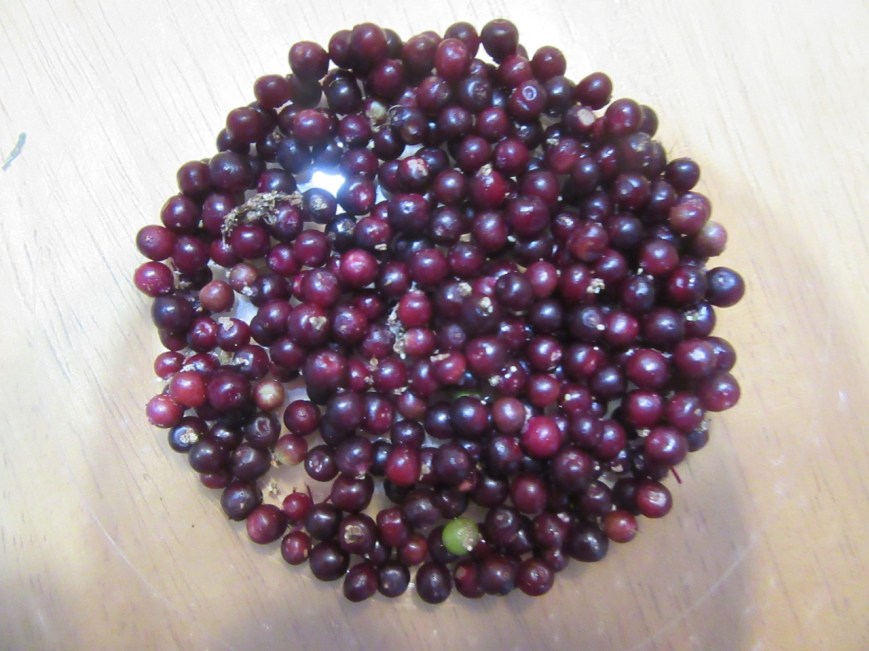
Elderberries ripeThis week there were a few exciting new developments in the garden. We harvested our very first elderberries—maybe a whole half cup of them! Earlier in the summer, I was worried about whether something was wrong with the elder flowers, and perhaps there was, but eventually they created a spotty bunch of green berries. I must admit, I hadn’t gone by the bush for several days, but when I went out the other day, they were purple. I ate one that was quite sweet, but Margy tasted a sour one, not as ripe. Elderberry harvest 2019Not enough to make elderberry syrup, or really much of anything, but enough to be enthused about future possibilities. Margy and I will have to celebrate with a berry eating ritual.
Another new development: I saw a few catkins on our hazelnut bushes! I hadn’t known to expect them, but when I  looked it up, I learned that these are the male part of the plant’s reproductive system. They will stay on the plant through the fall and winter, and then in very early spring they start lengthening and unfurling.  When the female flowers open at the tips of branches, they pollenate. Hazelnut catkinsThere are only a few catkins right now, but they are a harbinger of future crops of hazelnuts. In my last batch of pesto, I used hazelnuts from the Food Coop to add to basil, parsley, chives and garlic from the garden, plus olive oil and lemon of course. So we can’t quite do it only from our garden, but maybe more and more.
I also processed oregano and thyme that had been drying in the basement herb dryer for longer than they needed to be, and did another batch of frozen chives, and frozen kale for the winter. Our harvest is limited more by my own energy than by the earth energy.

If anyone local would like oregano or thyme or chives, please let me know—they are flourishing in the garden still, and I’d be happy to share—also lemon balm, comfrey, and dill. They have all been very enthusiastic.

Miracle of Ocean

Crescent Beach September

Yesterday late afternoon, with the weather up to 80 degrees, I went to Crescent Beach. Would it be the last day warm enough for me to go in the water? Maybe, maybe not. But without expectations, I set up my chair on the sand, and walked down to the edge of the water to feel the cold splashing on my feet. Its temperature was mildly cold not frigid, much warmer than early summer. There were a few more waves than usual. Only a small group of children were in the water, jumping into the waves as they broke on the shore.

I have become a bit timid about waves, as I have gotten older. The tide was low, and there were lots of round stones to walk over, so I came back to my chair and put on some swim shoes, so I’d have better balance. Then I walked back out and stepped right in. I moved quickly through the breaking waves and past them to about my waist level. The rhythms of the water rose up to my shoulders, and then back down, lifted me up and down, too, but gently. I dove into one wave to cover my head, but then I just stood facing the sea, watching the waves come in, letting them carry me up and down.

Here’s the amazing thing: after being in the water, the waves, for a long time, and then staying longer still, I began to be washed in a sense of joy and happiness. It felt miraculous because this whole past week, I had been feeling exhausted and achy–a classic flare up of the auto-immune conditions I struggle with. But somehow the water washed all of that away, and I was filled with a physical sense of well-being and playfulness.

When I go into the water, I usually pray to the Mother Ocean, I give her my worries and struggles. She is one kind of divine presence, larger than I can ever be, and the source of all life. But it wasn’t my small prayer that shifted me–it was the very energy and power of her presence all around me, it was the waves dancing with me, it was my body responding to the waves. It was unexpected.

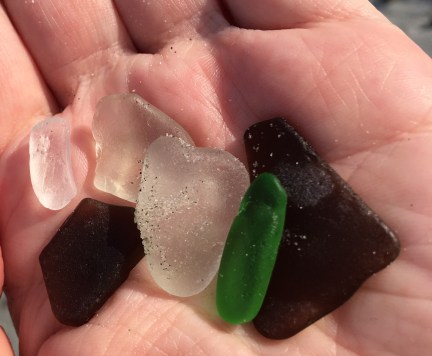
Filled with this lovely happiness, when I came out of the water, I walked along the shore looking at stones and shells, and I found several pieces of sea glass. I love that the ocean can transform these broken bits of human invention into tokens of beauty. Since I have been thinking lately about the ancestors, it came to me that sea glass is a kind of gift from people who came before. I’ve read that it can take 20-40 years in the waves, sometimes longer, for glass to be tumbled to create this patina. So someone a long or short time ago made the glass, touched it, discarded it.  I am holding this connection, broken yet made whole again, and so I prayed for friends and family who needed healing.Seaglass

After my walk, I sat in my chair and ate some yogurt mixed with cocoa, honey, cacao nibs, and blueberries. I started reading the novel Barkskins by Annie Proulx, which begins with French settlers in Quebec taking down the forest. (Another way to try to understand colonization.)  Isn’t it a picture of happiness, to read in a chair on the beach, sun on my shoulders?

monarch catepillarOn my walk back to the car, one more fun surprise. This colorful monarch caterpillar on a milkweed plant just past the beach roses.

I wish I could share with you the happiness of being in the ocean, of walking on the shore finding sea glass, of reading on the beach on a September evening, of finding a monarch on a milkweed.

But the happiness was triggered by actually being in the ocean with its waves dancing me up and down. So if you are feeling timid about walking into the waves, whether literal or metaphorical, please know that on the other side little miracles might happen. Joy might find you.


The Flowing

Orchard August 2019

The other morning I woke from a dream, in which I was thinking about Wabanaki languages. Wabanaki languages are a flowing. Everything is moving. Verbs are central. Verbs change shape to fit who is acting, who is moving, how many, and who or what their object might be. For example, Wiku is a verb for identifying where someone dwells. (The k is pronounced like g.) As in, Wiku Portland, meaning, “He/or/she lives in Portland.” But to say, “I live in Portland,” would be Nwik Portland.  “Where do you live?”  Tama kwik?

Even many nouns are flowing, changing, shapeshifting. Like the word for home. The noun, Wik, means a home. But “my home” is nik. “At our home” is nikonuk. “At your home” is kikonuk. The words flow depending on who lives there, or if you are going there. And the words for “mother” are related to the words for home. Wikuwossol, nikuwoss, kikuwoss. “His/or/her mother, my mother, your mother.” Flowing. Shapeshifting. Full of relationship.

English, on the other hand, is filled with many more nouns than verbs. Since contact with the colonizers, Wabanaki languages have had to add more nouns to the lexicon, to translate from English or French. Some of these nouns were created from verbs by adding an ending that, by itself, means “bait.” For example, koselomol, means “I love you.”  But to turn the verb “love” into a noun, you must say kseltomuwakon. Wakon means “bait.” So perhaps to make these nouns we must capture the verb, trap it with our bait, to stop its movement for a moment.

We colonizers live in solid houses with lots of things/nouns in them. The Indigenous peoples of northern places used to live in easily movable homes, with fewer things, to follow the hunt in winter, to fish the shores in summer. Everything was a movement, a dance, a shape-shifting. (Of course, many southern Indigenous peoples were/are farmers, stayed in one place. I don’t have any exposure to how their languages work.) But I notice the tendency in me to look for solid things, to struggle with the endless flow.  To try to put things in their places, get organized.  Make vocabulary flash cards to capture the words into my brain. (Even though the Wabanaki Languages class I am taking is on summer break, I have been listening to the recordings from the class, and continuing to study.)

Still, the garden in this place, at our home, nikonuk, also tries to teach me about flow, if I can be open to it. Every week is filled with different patterns and growing and shapeshifting. This week, no more snap peas or raspberries. But the basil has come back again after I harvested most of its leaves a while ago. The young fruit trees are wild and leafy. The bee balm is dying, and prone to powdery mildew. My nephew and his girlfriend helped me put wood chips on the paths during their visit a couple weeks ago. It rained during the night last night. Every day is different. There is no way to get the garden in shape, in form, once and for all. It demands relationship, interaction, flowing, it demands the verb “gardening.”

In Passamaquoddy, kihke means “He/she gardens or plants,” and kihkan is a garden. It is also another form of the verb.