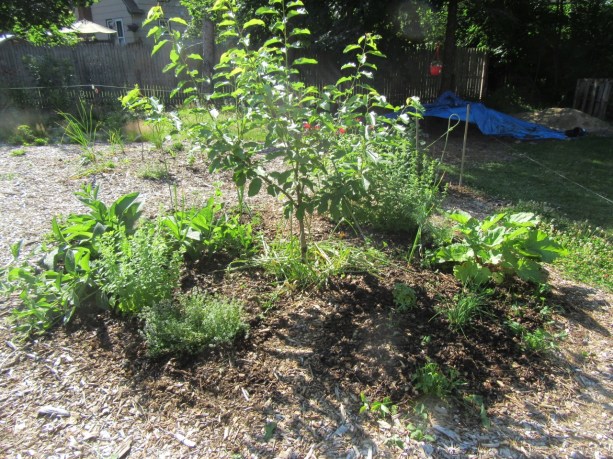
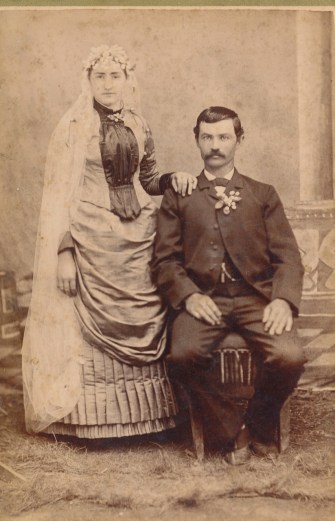
One of my hopes in exploring the stories of my ancestors is to see what cultural wisdom I might reclaim from everything that got lost in translation, especially regarding their relationship to land. Today I was diving deep into internet stories about East Friesland, the ancestral land of my great grandfather Henry Johnson. His parents and grandparents had traveled from East Friesland to Illinois via New Orleans in the 1850s.
His father, Heye Broer Janssen traveled to the U.S. on the ship “Fannie” with 16 total family members including his parents Broer Janssen Martens and Geske Alber Schoen, arriving in New Orleans October 28, 1851. (The name Martens was dropped in the U.S. and they were called Janssen and then Johnson. Previously in East Friesland, people took the first name of their father as their last name.) Henry’s mother, Helena Hinrich Janssen arrived in New Orleans on November 8, 1854 with her parents Heinrich Johann H. Janssen and Esse Classen Beckman. Her parents died a few years later, and she and her brothers and sisters were cared for by relatives and neighbors. Heye and Helena (Lena) married in 1862, and Henry was born in 1865, the second of ten children.
I must offer thanks again to my cousin Jim Pattyn for all his work in exploring the genealogy of our common ancestors. In my search for their relationship to their land, I found myself recording all the towns in which they had lived in East Friesland, in fact for many generations prior: Firrel, Grossoldendorf, Kleinsander, Kleinoldendorf, Hesel, Moordorf, Schwerindorf, Strackholt, Remel. These small towns are all within about 30 miles of each other in the center of East Friesland, somewhat near the larger town of Aurich.

East Friesland Map: Photo by NordNordWest – own work, using Ostfriesland de.svg by Enricopedia., CC BY-SA 2.5, https://commons.wikimedia.org/w/index.php?curid=5273792
In a letter dated April 16, 1846, from Alton, Illinois, one of my distant relatives (Heie Keiser) encouraged his family back in East Friesland to come join him. He praised the opportunities in his new home. I was struck by one of his closing statements. He wrote:
And also think not as the old wives used to say, “Remain in the land and nourish it.” We agree much more with the poet, when he says, “Hail to you Columbus, glory be to you, be highly honored forever.’ You have shown us the way out of hard servitude.”
The East Frisians had a deep love of independence and freedom, and they resonated with the “American dream.” I appreciate their love of freedom, but in my study of the process of colonization, I cringe at their praise of Columbus–one can see that they jumped at the chance to be part of the settling of this land that was new to them. They were able to work hard and acquire their own land to farm and to cherish.
But as a feminist scholar, I also like to notice wisdom that is hidden by being contradicted. I wonder, who were the “old wives” who had offered this different sort of wisdom that was being rejected: “Remain in the land and nourish it.” That is a heritage I want to claim today, the heritage of the old wives, the ones who stayed. (I think it also filtered into the ones who came to the U.S., because from what I can gather, the East Frisians were careful farmers who took care of their land so that it might continue productive for long years.)
I also heard about another custom of German immigrants (not sure from which parts of Germany) who carried in their pockets across the ocean some of the soil from their homes, so that at least they might be buried with some of the soil of their own land. In this exploration of the ancestors and their relationship to land, there is something to grieve and also something to be thankful for. I think that what Margy and I are trying to do with our land here in Portland might fit into that old wives’ wisdom–remain in the land and nourish it.
 In 1803, when the United States made the Louisiana Purchase agreement with France, they claimed ownership of Osage territory. According to educational materials of the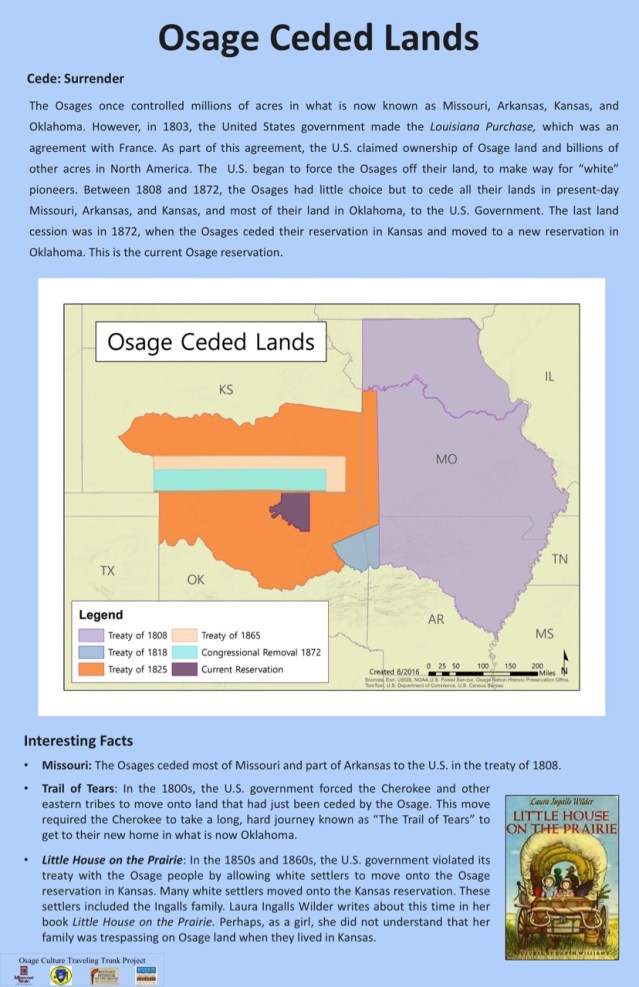



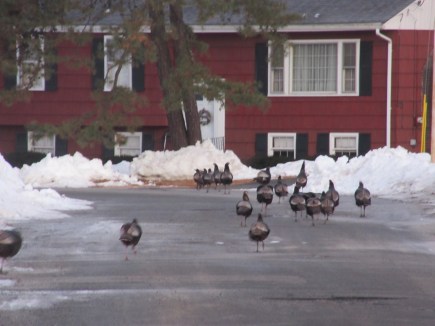 I was not disappointed. First of all, there was the waning moon shining bright in the western sky. Then there was the gang of turkeys marching down the end of my street. Twenty strong, they roam the place like they own it, and they do, as much as we do. Around the corner, a neighbor walks her little dog: Sparkles is still a puppy and just can’t contain herself when I approach. She is trying to learn not to jump. But she jumps. So we say our good mornings with enthusiasm.
 On my own again, around another corner, I hear a cardinal singing. He is already looking for a mate, or marking out his territory. I can see him in the tree, his characteristic shape visible with its tufted head, even though he is too far away to see the brightness of his red feathers.


 After a stormy snow all day long, the sky cleared long enough for me to watch the beauty and mystery of the lunar eclipse, in the crisp cold wind blowing through our back yard. I am not usually awake this late, but something called me out when I saw the sky had cleared. I kept warm by shoveling the walkway, and I prayed for our troubled world. Actually, it felt like the moon itself warmed my body and soul.