I am sharing this essay written by Dawn Neptune Adams, as part of her work as Racial and Social Justice Consultant at the Peace and Justice Center of Eastern Maine. Please note the action items included!
(It was falsely reported to FB as “abusive” and is now a censored link. I am copying it here as one more way to amplify Indigenous voices on issues that are vitally important to everyone.)
Moving Forward:
Indigenous Issues and the Newly-Elected Governor, Janet Mills
By Dawn Neptune Adams, November, 2018
Congratulations! We all survived the midterm elections. Now, where do we go from here? Newly-elected Governor Janet Mills is known for her work in opposition to Indigenous issues during her time as Attorney General. Three of the most pressing issues are presented in the following essay, along with steps in moving forward:
1. VAWA
Native Womxn are three times more likely to suffer from violent crimes than any other group of womxn. According to statistics, 80% of these crimes are committed by non-Native men. Mills fought to keep Wabanaki Womxn from protections under the Violence Against Women Act of 2013, stating that our communities are not sovereign but are municipalities and therefore not eligible for the additional safeguards put in place by the Federal Government, for every Federally-recognized tribe in the Nation but those in Maine and Alaska.
Moving forward, an updated version of Legislative bill LD 268 “An Act regarding Penobscot Nation’s and Passamaquoddy Tribes’ Authority to exercise Jurisdiction under Federal Tribal Law and Order Act of 2010 and the Federal Violence Against Women Reauthorization Act of 2013” must be introduced and passed. Any attempt on the part of Governor Mills to veto the bill should be met with resistance.
A comment was requested from Penobscot Nation Ambassador Maulian Dana, who answered: “We are committed to working out the kinks in the potential jurisdictional issues that have been barriers in the past. This may mean looking at how the [Maine Indian Land Claims] Settlement Act is being interpreted and used not in the best interest of tribal sovereignty. It is on the radar of the new Governor and we are hopeful we can reach some deeper understanding.”
2. Penobscot Nation vs. Attorney General Janet Mills
 The Penobscot River has always been home to the People of the Penobscot Nation. As the Attorney General listed in the lawsuit Penobscot Nation vs. AG Janet Mills, Mills has vociferously defended the State’s opinion that the Water flowing in the Penobscot River surrounding the 200+ islands that make up the Penobscot Nation, was not part of Penobscot Territory. This contradicts Treaties and past interpretations of the Maine Indian Land Claims Settlement Act (MILCSA). The State of Maine and a consortium of 17 Industrial and municipal intervenors, represented by the lobbying firm Pierce Atwood, opposed Penobscot stewardship of the main stem of the River in a manner said by the Federal Government to be in violation of Federal Indian law, and tantamount to an “unlawful territorial taking” of 61 miles of River.
In December of 2015, the U.S. District Court in Portland, Maine, reaffirmed the Tribe’s Treaty-reserved sustenance fishing rights, but decided in favor of the State in redefining the definition of “Tribal Waters.” In the First Circuit Court of Appeals, one of three judges issued a dissenting opinion. Judge Juan Torruella wrote an argument reaffirming the Penobscot territory to include both the land and the water, in which he cited the Treaties of 1796, 1818, and 1833; and legal precedents set in previous agreements which support Tribal stewardship of the River.
Moving forward, the Penobscot Nation has one more level of appeals called an “en banc review” in which the case is heard by a large panel of judges and is usually reserved for complicated or unusual cases. This option is currently being discussed by Tribal leaders. We will need the support of all of our friends and coalitions to keep Industrial interests from framing the narrative in a way that suggests the Penobscot People are trying to exclude anyone from using the River; the Penobscot Nation is simply defending itself against territorial theft and a termination attempt. The River is our Relative and we are determined to protect her health for future generations of ALL the people of Wabanaki Territory.
*Update* January 5, 2019 thanks to Community Water Justice “Jerry Reid was just appointed by Gov Janet Mills to serve as the next Commissioner of the Department of Environmental Protection (DEP). Anti-water protector. Oppressor of Native people.
Mr. Reid fought in court against the Penobscot Nation to their inherent fishing rights and claimed that the Penobscot River was not part of their reservation. He sided with the water-polluting corporations in the Penobscot Nation vs Mills case. He also absurdly claimed in court that the Penobscots only ever fished from the shoreline and not from the water, as though he had never heard of fishing from a canoe or watercraft.
This appointment tells us clearly where Gov. Mills stands with indigenous people. We who stand for the protection of our water and the Wabanaki demand better in state leadership for the people of Maine.
This appointment will first need approval from the Environment and Natural Resources Committee and if approved there, will move forward for approval by the Senate. Please email members of the Committee (below) AND your Senator to ‘ought not approve’ Mr Reid’s appointment:
Ralph Tucker (D) – (Chair) Ralph.Tucker@legislature.maine.gov
Brownie Carson (D) – Brownie.Carson@legislature.maine.gov
Justin Chenette (D) – Justin.Chenette@legislature.maine.gov
Robert Foley – (R) – Robert.Foley@legislature.maine.gov
Mick Devin (D) – Michael.Devin@legislature.maine.gov
Jessica Fay (D) – Jessica.Fay@legislature.maine.gov
Stanley Paige Ziegler Jr (D) – StanleyPaige.Zeigler@legislature.maine.gov
Lori Gramlich (D) – Lori.Gramlich@legislature.maine.gov
Daniel Hobbs (D) – Daniel.Hobbs@legislature.maine.gov
Richard Campbell (R) – Richard.Campbell@legislature.maine.gov
Peter Lyford (R) – Peter.Lyford@legislature.maine.gov
Thomas Skolfield (R) – Thomas.Skolfield@legislature.maine.gov
Chris Johansen (R) – Chris.Johansen@legislature.maine.gov
Search by town to find your State Senator here:
https://legislature.maine.gov/senat…/find-your-state-senator
#WaterIsLife #ProtectOurWater #HonorTheTreaties #ProtectNativeSovereignty #RespectEachOther #Maine #BeBetter “
3. Maine vs. the EPA
Clean water and fish on the dinner table should be a right for all of the people in Wabanaki Territory, now called Maine. In 2014, the State of Maine’s DEP tried unsuccessfully to set water standards so low as to allow only 1.4 ounces of fish from Tribal Waters per day. This equals a portion the size of almost one-half of a deck of playing cards; not even close to the definition of sustenance. The EPA refused these standards, fulfilling the Federal Government’s trust responsibility to uphold Treaty-reserved sustenance fishing rights, and in 2016, insisted on water standards in Tribal Waters that would allow for safe consumption of 10 ounces of fish per day. This resulted in the lawsuit Maine vs. the EPA, in which AG Mills stood with Industrial interests and Gov. LePage in opposition to clean water for all of us. Later, Mills petitioned Trump’s former EPA administrator, Scott Pruitt, to withdraw the standards set by his predecessor. The EPA is now poised to rollback these Water quality standards.
At the current time, Scientists from the Penobscot Nation Dept. of Natural Resources recommend NO freshwater fish consumption for Womxn who are pregnant, nursing, or planning to become pregnant; nor for any child under the age of eight. For anyone else, recommended consumption of fish from the Penobscot River is 10 ounces per month.
Moving forward, resistance to this regression in water quality standards is of the utmost importance. Because Penobscot people eat more fish than surrounding populations, the cancer rate is five times higher in our communities than in the communities of our neighbors. Our cultural connection to the River includes eating fish, just as our Ancestors have done since time began here in this beautiful place we now call Maine. Clean water is in the best interest of ALL the people of Maine, and we must make sure that Industrial interests and Trump’s EPA no longer have an ally in the Blaine House nor in the Attorney General’s office, as they did while LePage was Governor.
In all of the issues outlined above, the recurring theme is the question of sovereignty and misinterpretation of the Maine Indian Land Claims Settlement Act. The Act was signed with the understanding that any ambiguities should favor of the Tribe and that the MILCSA never abrogated our Treaty rights. I look forward to standing with you in the protection of our Relatives.



 I just have to say it once more: kale is amazing! I picked this kale yesterday morning, leaves frozen on the stalk, snow on the ground. I had already picked most of the kale–just leaving a few tiny leaves that didn’t seem big enough for anything. But they must have grown a little in the meager sunlight and freezing snowy weather we’ve been having the last two weeks of November. I don’t know how they do it, but that is why they are so amazing. The plant just isn’t willing to succumb to the freeze/thaw weather that has killed off most of the other plants. So when I was walking through the winter orchard, I found several small frozen leaves, broke them off, and cooked them up for breakfast–they taste great!
 Nomiya munimqehs kihkanok. N’ciciya wot.
  One thing I love about the snow is how it reveals the lives of our animal neighbors. Here is a squirrel highway, a path between two mounds. Now, I had actually helped to create that path the day before, before the snow. The day before that, Margy got a call from a local arborist that he had some wood chips we could have. For permaculture gardeners, wood chips are a boon, especially hardwood chips, especially lamial hardwood chips, which are from the small branches and leaves of the tree. They provide nutrients to help create the kind of soil that is best for fruit trees.
 So the wood chips were delivered. The next day I noticed that where the big pile landed had kind of blocked off the pathway on the edge of the food forest. Last winter, I had strung a small string across the edges of the food forest as a gentle deterrent to deer who might possibly wander through. We had seen deer tracks before, though we didn’t actually see any last winter. But the idea was to leave one area free for them to traverse, hoping they’d choose that path on the way between the street and the back of the yard.
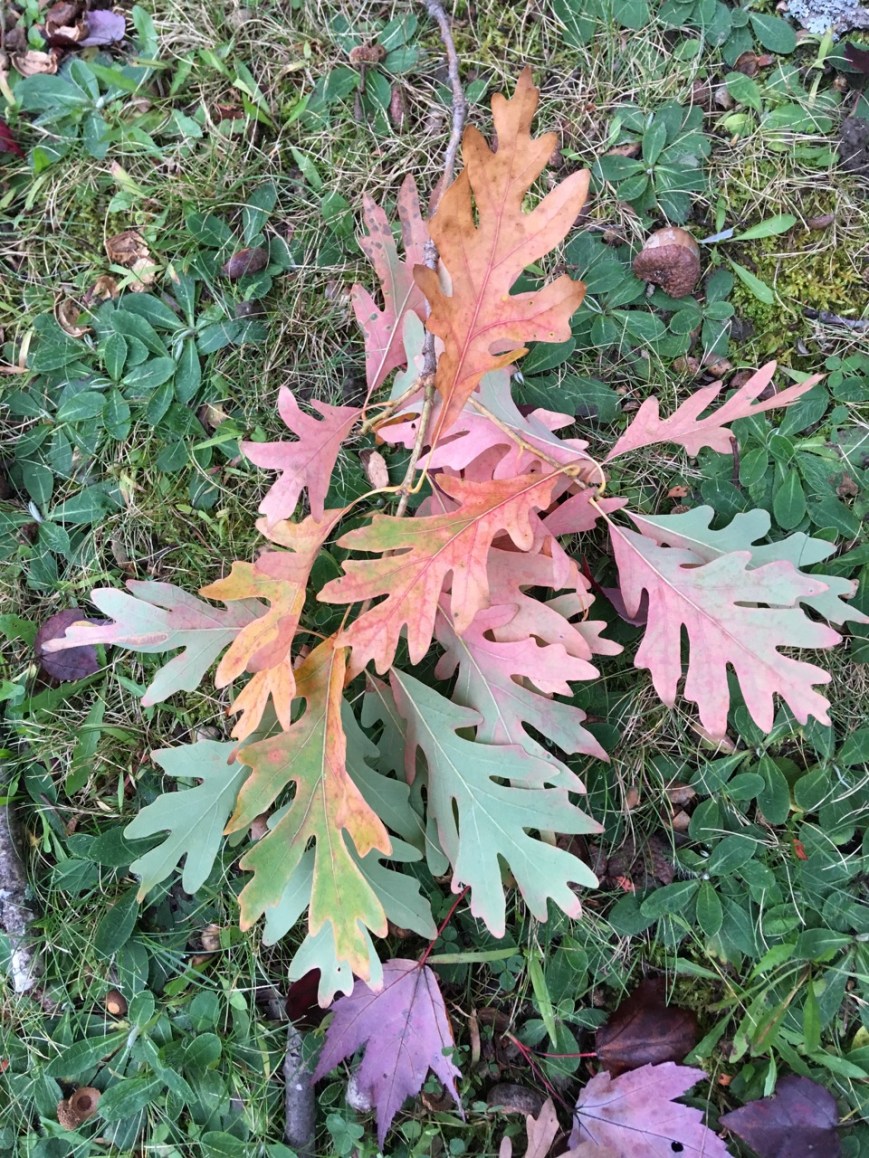 I seem to be writing on trees these days. This morning, I happened to notice this photo I took a month ago, rainbow colored leaves of the
  It must have been a big machine that cut down the grandmother pine tree. I found no disturbance around the stump when I climbed up to it to offer my grief and respect. The weeds and small brush nearby were there as before, with only fresh wood shavings and pine sap falling over the edges of the stump. Nothing huge crashed to the ground when they took her. So it must have been a big machine.

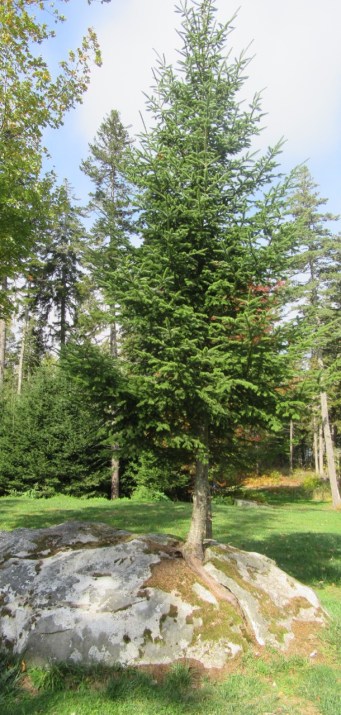 Life holds a strength that will not be extinguished, that will crack open the most oppressive of constraints. When I was in Tenant’s Harbor, a few weeks ago, I saw this spruce tree growing out of a huge boulder. Its roots were literally embedded in a crack in the rock itself. I wondered if a seed had found a tiny patch of soil within a crack, or if in fact, the seed, rooting, had created the crack in the rock. But however it first took hold, the roots were now literally splitting the rock in two.

