The Old White Pine

White pine familyContinuing my passion of learning about the mature trees in our yard, I found myself drawn to the biggest tree here–a white pine near the southwest corner of our land.  It is among several smaller pines that extend into the undeveloped land near our yard.  I found a resource that helps estimate the age of a tree.  It goes like this:  measure the circumference of the tree at about chest height (54 inches).  Divide by 3.14 (pi) to get the diameter of the trunk.  Multiply that number by the “growth factor” of the tree, which can be found on a chart.  In the case of white pine, the growth factor is five.

So today, I measured its girth as about 102″, which gives a diameter of about 32.5″.  Multiplied by five, the estimate of the tree’s age is 162 years old.  That means it might have begun its life around the year 1856.  I was intrigued by what might have been going on during that time, and discovered some interesting historical facts about our land.  At that time, we were part of Saccarappa–in 1871 Saccarappa divided into Westbrook and Deering, and we were likely part of Deering after that, before Deering was incorporated into Portland.  In 1855, the Evergreen Cemetery was established, just several blocks around the corner from us. In 1854, S.D. Warren bought the mill in Westbrook at Amancongan, which had in ancient days been a Native farm site.

I followed my questions down the internet wormhole, and made some other discoveries. This land first came into the record of English settlers when the sagamore (leader) Skitterygussett signed a deed with the fisherman Francis Small in 1657.  In many historical accounts, they claim Small bought the land “from the marshes and uplands of Capissic” to the fishing falls at Amancongan on the south side of the Presumpscot River. But my new favorite book by Lisa Brooks, Our Beloved Kin, actually talks about this very deed on page 21.

She says that Small pledged an annual “pay” of “one trading coat,” which was a symbolic recognition of Skitterygusset’s leadership, and “one gallon of liquor.”

The exchange of wampum and tobacco, as Small later testified, in this and subsequent agreements, sealed a pledge to share space, creating a negotiated relationship as much as an economic transaction.  He later sold the rights to part of this tract, including a mill privilege at Capissic, to John Phillips, who transferred it to his son-in-law George Munjoy, both of whom had come to Casco from Boston.

Brooks explores the significance of this and other deeds from the perspective of the Indigenous people who contracted them.  In reference to a similar deed, she says:

…these leaders of Cascoak were entrusted with diplomacy. Thus, part of their role  was to create responsible relationships with the newcomers.  With [these agreements], they gave [particular families] permission to live [on these lands,] but negotiated some of the terms of sharing space and required “acknowledgement” of their continuing relationship to and leadership in this place.  As Alice Nash has observed, such “deeds should be read more like proto-treaties” or councils in which rights, land use, and jurisdiction were negotiated, rather “than as simple property transactions.”

While I was looking at a modern day map to place these descriptions, I noticed that the public housing development in our neighborhood is called Sagamore Village–most likely in a (perhaps misguided) recognition of the sagamore who negotiated that first deed about this land.

There were many more complications after that first deed–all of the settlers were gone from the area during 1690 to 1730, because of conflicts with the Indigenous inhabitants.  Later, when people came back or new settlers came, they had disputes on who actually “owned” the land, the heirs of the first deed makers, or the new settlers.  But that is a different story than today’s.

The white pine tree inspired me to explore the history it may have seen, and I found myself drawn much deeper.  I wonder now, was this pine descended from earlier pines that were cut down to send posts for ship’s masts to England?  How many other stories might be hidden in its branches and roots?

Cedar

cedar leavesI seem to have unleashed a thirst for learning the names of all the trees who live with us on this land to which Margy and I belong. Today, I am exploring the cedar tree in our southeastern boundary area. I had always wondered about the difference between cedars and arborvitaes, and now I know that they are the same, really, here where we live.  There are a lot of names for this species which is native to southeastern Canada and northeastern United States–Eastern White Cedar, Northern White Cedar, White Cedar, False Cedar (because it is not related to European cedars).  Its Latin name is Thuja occidentalis.  

Cedar trunkIt was first called Arborvitae by French explorers when Indigenous people gave them tea  made of its leaves as a treatment for scurvy.  Arborvitae means “tree of life.”  Now, arborvitae is the name used by horticulturists, and there are many cultivars of the tree that are sold for landscaping.  The Anishinaabe people called the tree Nookomis Giizhik or Grandmother Cedar, because of its importance as a sacred and medicinal tree, associated with one of the four directions.
This has been a special tree to me personally in most of the places I have lived–Michigan, Chicago, northern New York state, Massachusetts, and Maine, and I appreciate that my matrilineal ancestors also knew this tree in Quebec/Nitassinan.  The Innu word for this tree is Massishk.  The tea from its leaves contains an abundance of Vitamin C, and can be used as a medicine.  (Note–being cautious, it is recommended that pregnant women should not use cedar tea because the compound thujone within it.)

From Sean Sherman (The Sioux Chef’s Indigenous Kitchen):

The tea of simmered branches is used to treat fevers and rheumatic complaints, chest colds, and flu. This brew is delicious warm or cold and is simple to make. Just simmer 2 cups of fresh cedar in 4 cups of boiling water for about 10 minutes until the water becomes a golden color. Strain off the cedar and sweeten with maple syrup, to taste.


The Red Bird is Singing

cardinal at dawn

On my walk this morning at sunrise, I heard the cardinal singing, and then, for the first time this season, I was able to see him up high in the trees.  There is a symphony of birds each morning, that has been going on for a couple weeks–since around Groundhog Day actually.  I read that birds have photoreceptors in the bases of their brains that record the length of the dark period each day. As the darkness shortens, and as days lengthen, birds get spring fever.  Just like us.  So their songs signal that spring is just around the corner.  Or at least that we are halfway there.  Maybe we in Maine should call Groundhog Day, “Bird Song Day” instead.

The Importance of Naming

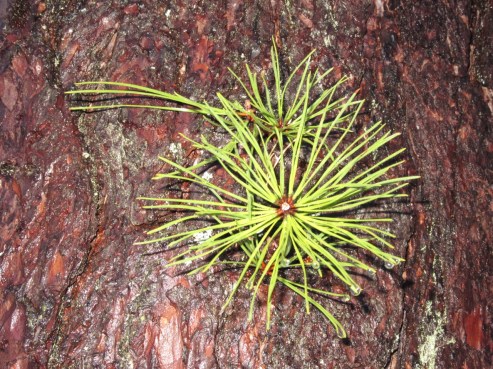
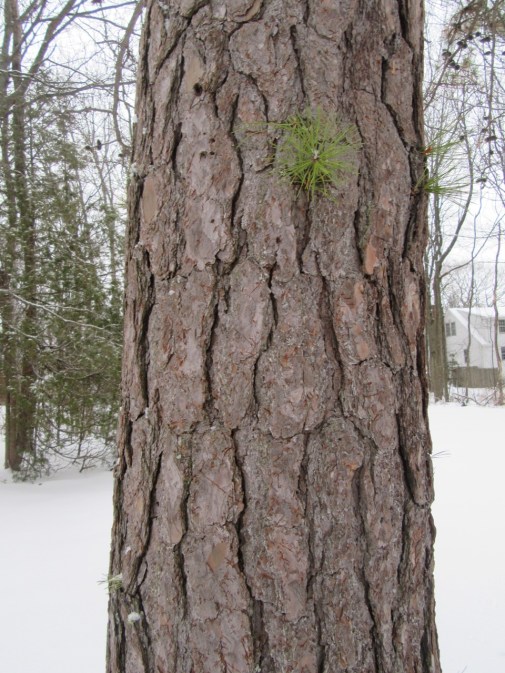
Pitch Pine needlesIn my attempts to get closer to the pine in our yard, I made an important discovery today.  It is not a red pine, it is a pitch pine. I discovered that its needles come in groups of three–and the red pine comes in groups of two.  So then I went searching for a resource I remembered from a couple years ago–an identification guide of the pines of Maine, and confirmed everything.

It is a funny thing.  I had used that resource earlier to identify the tree as a pitch pine, especially because of its habit of small patches of needles coming out of the trunk–as in the picture above.  But then the arborist said no, it was a red pine, and so I deferred to their judgment. Perhaps that is one of the lessons for me to learn–arborists don’t necessarily have intimate knowledge of all tree species. Sometimes it takes detective work, which is easier with the many resources that are available online.

So this naming is making a big difference in my relationship with the pine.  Now I understand the prickly feeling–according the guide, “Pitch pine cones have a sharp prickle at the end of each scale.”  They are prickly!  It also says, “Branches are horizontal, rigid, contorted and form an open crown.”  That describes so perfectly the irregular beauty of its shape.  “Pitch pine attains a diameter of 1–2 feet, and a height of only 30–40 feet.”  These height numbers relieve the anxiety I had about the tree possibly growing to shade our solar panels–it is likely fully mature at its current height.

What else?  It is native to eastern North America. It can live to be 200 years old. It tends to grow in acidic, sandy, and low-nutrient soils. It is a “pioneer species” and is often the first tree to vegetate a site after it has been cleared. So perhaps it speaks to the history of this land–that this land was cleared, that it was depleted. The tree can also regenerate itself–if the main trunk is cut or damaged by fire it can re-sprout using epicormic shoots, which is unusual for a conifer.  (This might make it a candidate for coppicing or pollarding–the practice of cutting a tree to use the wood, after which the tree regrows.)

According to Wikipedia, “Pitch pine provides a habitat and offers food for many wildlife species. They are used as cover and nesting for birds such as the pine warbler, wild turkey, blue jays, black-capped chickadees, black-and-white warblers, and chestnut-sided warblers. Small mammals and birds eat the seeds.”

I feel like the tree and I are starting all over again with getting to know each other–now that I know the tree’s actual family and species–now that I know its family name.

Red Pine

Red Pine[Edited: I learned 2/12/18 that this is actually a pitch pine. See my new blog post.] There is a red pine in the middle of our back yard… the only big tree (40 plus feet) that is not at the edge of the yard. But I have been struggling to create an affectionate relationship with this tree. I have had other very special trees in my life, and I loved the many trees that surrounded our home in North Yarmouth.  So why is this one hard?
I have been reading a lovely book, The Garden Awakening by Mary Reynolds, which is focused on creating a relationship with our land. She talks about trees as the guardians of the land.  So if we want to go deeper with the land, we need to go deeper with the trees.  That got me thinking again about the challenge of the red pine.

Perhaps it started when we first moved here, and were concerned about trees possibly shading the solar panels.  Or perhaps it is tied to my grief about the maple tree that was by the side of our house which we did have to take down because of dangerous branches and solar shading.  I loved that tree, and felt the contradiction so acutely: even though the maple tree was willing, and its wood became the ground layer mulch for our future orchard.  We decided that the solar panels would be okay with the pine tree’s slight shading, but it did get us off to a wary start.

So here it is.  It was identified as a red pine by an arborist who came by.  Right now, I have an intention to go deeper with this tree.  I want to understand all the dimensions of this relationship.  Some things that feel difficult to me:  The branches are all too high to reach, so it feels rather aloof.  When the pinecones drop, and there are lots of them, the ground underneath becomes difficult to walk on.  All around the tree there are old pinecones half buried in the grass from many years past.  If I could pick one word to describe my feeling of the tree, it would be “prickly.”

What helps? Last spring, we held an introduction to permaculture design course at our house, and many of the participants commented on the loveliness of the pine tree. There is a beautiful asymmetry in its branches. Their appreciation of the tree helped me to see its beauty.  The red pine is native to North America.  They can live up to 350-500 years.  Some sources said pine trees are symbols of longevity and wisdom.

Red Pine BarkOne website mentioned that its roots “are moderately deep and wide spreading. The lateral root masses also send down “sinkers” which anchor the tree very well in the soil. Red pines are very wind firm because of this dense root system.”

Okay, deep roots and anchors in the soil. I like that. I am investigating medicinal uses: one might be pine needle tea, which is good for immune function, bronchitis, and many other ailments.  More to research here.  This morning, I took pictures of the pine, and stood next to it, leaning against the bark.  What do you have to teach me, dear red pine?


Moon rhythms

IMG_4590

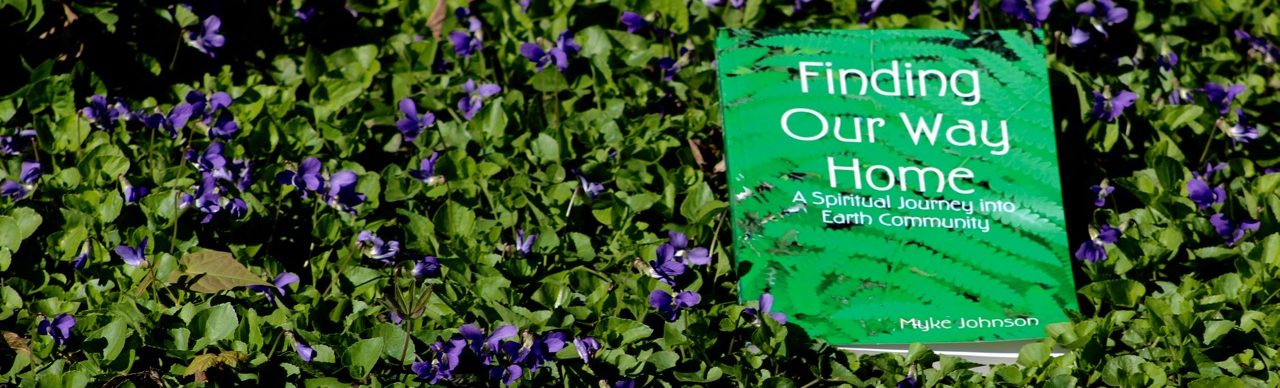
On my walk this morning I saw this lovely waning half moon, and remembered a conversation after our Candlemas ritual.  Most people have no idea how the cycles of the moon work.  We don’t learn about it in school.  Years ago, when I was in my twenties, I was curious about why I saw the moon sometimes in the evening and sometimes in the morning with different degrees of light and shade.  So I investigated. (This was before Google–how did I do that?)  I learned that the moon follows a consistent and lovely rhythm. I talk about it in my book Finding Our Way Home.

The moon is always half in light and half in darkness from the light of the sun. When the moon is full, we are seeing the whole of its light side, because the sun and moon are on opposite sides of our sky. The full moon rises at sunset and stays in the sky all night, setting at sunrise. Then, as the days go by, we see less of the light of the moon and more of its shadow, and it rises about fifty minutes later each day, until there is only a waning crescent in the morning just before and after dawn. About two weeks after the full moon, the moon rises unseen with the sun and sets invisibly with the sun. The night is dark. This is called the dark moon or the new moon. Then a day or two later, a thin waxing crescent appears in the western sky just after sunset and sets soon after. Each day it is seen in the evening for a little longer time until we come round to full moon again.

What is sad and funny to me is when fiction writers misplace the moon–for example most recently, I read a line something like this one: “I saw the waxing gibbous moon in the morning light.”  The thing is, no one will ever see a waxing moon in the morning light.  Waxing moons are only seen in the evening.  Am I a nature snob if I want the moon to be accurately represented in fiction?  The actual realities of the moon’s cycles are beautiful and magical–like a cosmic dance, which it accurately is.  Here is a rather fuzzy photo of a waxing moon, taken about 8 p.m. in April several years ago.

DSC04244

Winter Trees

IMG_0224

I got off to a slow start today, and waited until afternoon to take a walk, after the sun came out.  The bright light and shadows were playing over the cherry trees we planted last spring.  (Further back are the stakes around the raspberries.) I feel such protective tenderness toward these trees.  They are so little still.  There is no way to tell how they are surviving the ups and downs of winter.  We’ve had long bitter freezes, thaws, ice, snow storms… but so far, no deer nibbling.  Sleep well little ones! Another storm is on the way for tomorrow.

Groundhog Day

IMG_4560

We’ve made it half-way to the Spring Equinox–Groundhog Day, Candlemas, Imbolc according to the Celts… Whatever we call it, I have always liked this festival. Even the birds seem to know that something is up.  On my walks the last couple days, they have been singing so that I notice it.  The height of the sun? The change in the light?  Even though it’s been cold, and today snow was covering everything, they sing.

Today, in my neighborhood, the groundhog would not have seen his shadow–so that means that spring will come early.  But in fact, groundhogs are still in hibernation here, and since technically, it will still be six weeks until spring no matter what, I don’t actually count on the groundhog to confirm the weather.  But this day still awakens the hope that winter won’t last forever.

I was happy to learn that the Groundhog Day tradition comes from Americans with German ancestry–since that is part of my own heritage.  Back in German-speaking lands, it was instead a badger, and originally a bear, whose emergence would predict the weather on Candlemas Day.  Candlemas was a Catholic feast, but was retained even after Protestant Reforms, likely because it was an even earlier pagan feast that had been Christianized. There are sayings in English, French, and Latin as well that correspond to the myth: “If Candlemas is fair and clear, there’ll be two winters in the year.” This attests to its antiquity as a European tradition.

Imbolc is the feast of Brigid, the goddess of smithcraft, poetry, and healing.  When Margy and I visited Ireland, we visited more than one Brigid’s well where the waters are known for their healing properties.  But I also think of this festival as a celebration of fire–fire is the key component of welding and smithcraft, and it is also a symbol of creativity–the inner fire that inspires poetry and art and music.  It is the fire which inspires social change, transformation, and healing.

Years ago, this came together for me in the poem by Cherrie Moraga, “The Welder,” in the book, This Bridge Called My Back: Writings by Radical Women of Color.  It concludes with these lines:

I am now
coming up for air.
Yes, I am
picking up the torch.

I am the welder.
I understand the capacity of heat
to change the shape of things.
I am suited to work
within the realm of sparks
out of control.

I am the welder.
I am taking the power
into my own hands.

Thank you Cherrie Moraga!  And thank you to the singing birds!  Thank you dear neighborhood groundhog for not eating my kale last summer!  And to all of you reading this, may your day be filled with creativity and healing.

Deck Roof

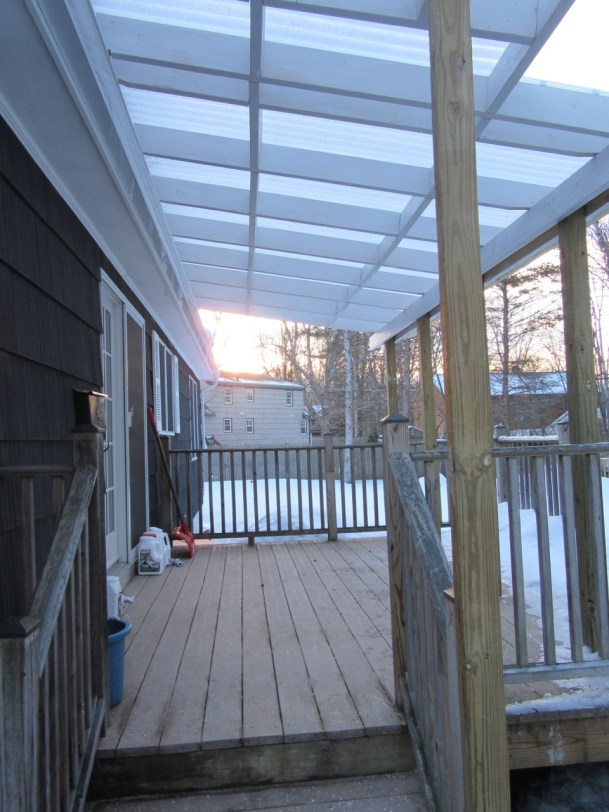
Deck RoofThe first winter after we installed solar panels on our new house, we discovered that when the snow melted on warm winter days, all the snow from the panels came down like an avalanche, right onto the deck, in the path from our back door that we used every day. I was out there shoveling first when the snow fell down, and then when the avalanche came down–sometimes in two or three segments.  And that second snow was always heavy wet and dense. #thingsyouforgottodesignfor

We needed some sort of new plan.  So we came up with an idea with our friend Ian, and he built this partial deck roof, using Tuftex polycarbonate roof panels and wood framing.  It was wider than we first imagined, to use the support beams under the deck for the framing.  Took longer than expected.  Doesn’t everything.  But such a relief now that it is up.  The panels are clear to let the light shine through–though in this photo they have some snow cover.  And they work–the snow avalanche slides down the solar panels, right cross the deck roof and lands in the space beyond.

Robins Flocking

Robins in Tree

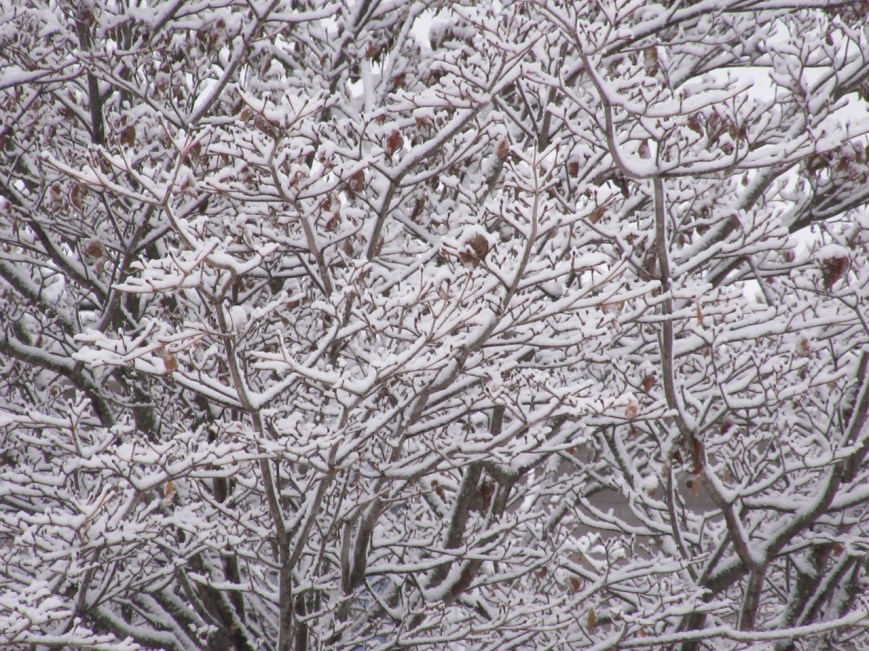
Almost every morning, I take a walk around my neighborhood.  Even on cold days, or icy days, I never regret going outside.  I never know what I might see.  One day, a whole flock of robins had gathered in these ice-coated branches. I heard them before I saw them.

Today it was very icy.  I walked a few blocks down the street, and then ventured over a slick snow mound to get to the path by the brook.  Someone had cut a few steps into the huge pile, but once I reached the top, I just sat and slid the rest of the way down the other side.  After I stood up again I realized that I was committed now–there would be no way to get back up from that side.

So I walked over to where the trail began, and looked at the shininess of the frozen rain-covered snow.  In order to keep from slipping, even with yak-trax on my boots, I ended up stomping through the crust at the edges of the path.  Still, this has been my favorite part of my morning walk, to be next to the flowing water, surrounded by trees, breathing in the freshened air.

Even in the city there are these pockets of wild nature.  Even with construction going on just beyond the view of my lens.  Even when I think I want to stay inside, there so many wordless reasons to put on heavy coat, hat, scarf, and boots and greet my earthly neighbors.

icy path