
To Be of Use

Biddeford Pool Ocean view

One evening, during my first year in college, my best friend Lori and I were sitting in the quiet candlelit chapel of our campus. A few other people were also there, scattered about the pews. I remember feeling we each seemed so isolated in our private meditations. I was moved to reach out and take the hand of my friend. Little did I realize, at that very moment, she had been wrestling with her own inner spiritual struggles.

Feeling a certain despair, she had just prayed, “God if you are real, I need a sign. It doesn’t have to be a miracle; I just need you to touch me in some way.” Then, I innocently took her hand, and it was the touch of God she experienced.

I shared this story with my colleagues last week.  From Wednesday through Friday, I was on retreat with other Unitarian Universalist ministers at Biddeford Pool, by the sea.  They had invited me, because of my upcoming retirement, to share my “Odyssey,” my story of ministry.  So on Thursday evening, I talked about the long path and the many transformations that have been a part of that ministry journey, starting with this story of my being used unknowingly by the Spirit.

Years ago, even as a child, I had opened my life to that Spirit, that Mystery, that flowing River of Life.  Ministry has meant, for me, at root, that opening to be of use.  At different times in my life, that has included many different types of work.  Most lately, as a minister in a congregation, I have been preaching, offering pastoral care, teaching, writing, going to many meetings.  But ministry is not always about our intentions or our plans or our activities.

I shared another story that happened only a few years ago.  At that time, I was planning to join my congregation at our annual retreat at Ferry Beach.  We were happy to be including a visiting UU minister from Burundi, and I was going to drive him to the retreat.  But then I got sick with a bad cold or flu–can’t remember which.  I called a member of the congregation to see if she could give him a ride instead.  She did, and later she told me that it had changed her life.  She was transformed by hearing his story, and she eventually went to visit Burundi with other UUs.

I was struck by how even our limitations–even getting sick–even being missing–can be an occasion of unknowingly triggering a blessing for someone’s life.  If we are in the flow of Spirit, the flow of the River, even our flaws can be of use.  This gives me great comfort as I deal with health issues that drain my energy and interrupt my intentions and activities, and are the impetus for my decision to retire this year.  I remind myself to trust in that same Spirit who has been undergirding my life and my ministry for all these many years.  Trust in the flow of the River.


Planting the Orchard

Peach Tree

[Contender Peach]

The new trees are here!  Once the frost was off the morning, I went out and started planting.  I took the eight bare root trees out of the box first and letting their roots soak in fish/seaweed solution, while I started digging in the beds we’d already prepared last June.

I had a fright before I went outside–I thought to take a look at planting suggestions in the Holistic Orchard book, and he suggests putting Rock Phosphate and Wood Ash in the holes–I hadn’t been thinking of that.  But then I found a bag of Rock Phosphate in the garage from last year, and we have a can of wood ashes, so we were all set.  These help the roots to get a good start.

I started with the “Contender” Peach tree, since it seemed to have the biggest roots.  It was a job to get all of them spread out and under the soil.  I feel my age when I am digging and kneeling in the dirt moving things around, and then getting up again.  I was happy to use water from our rain barrels to give it a good soaking.  This is a self-fertile tree, so one will do fine by itself.

Myke & Jersey Blueberry

[Myke & the Blueberry, Photo by Margy Dowzer]

After a short rest, I decided to plant the two blueberry bushes next–because they were little and easy.  We got one “Blueray,” and one “Jersey.”  Then I moved on to the “Honeycrisp” Apple.  The apple needs another tree for fertilization, but we’ve got a lot of wild crabapples around so that should do.

Finally, I planted three Hazelnut bushes. We decided to get an experimental hybrid hazelnut, Corylus Cross.  These shrubs are produced from crosses of three hazelnut species: American hazelnut, Corylus americana; beaked hazelnut, C. cornuta; and European hazelnut, C. avellana.  The nuts from these shrubs will likely be larger than American hazelnuts, because they are crossed with the European variety–(which is the kind that we usually can find in the store–small enough as it is.)

Margy diggingMeanwhile, Margy came out, and we talked again about where to position the “Illinois Everbearing” Mulberry tree.  We decided to get the mulberry because birds love them, and they can draw birds away from the other fruit. Plus the fruit is good for people too.  But we didn’t have a bed ready, and we decided to put this one further back in the yard–partly because it is a standard size and we don’t want it to shade the solar panels. Our other fruit trees are dwarf or semi-dwarf.  Margy took on this project and is still working on it.  After planting 7 trees or bushes, I am taking a break!  We still have the small plants to do, but I can hardly lift my arms.
Asparagus Beds

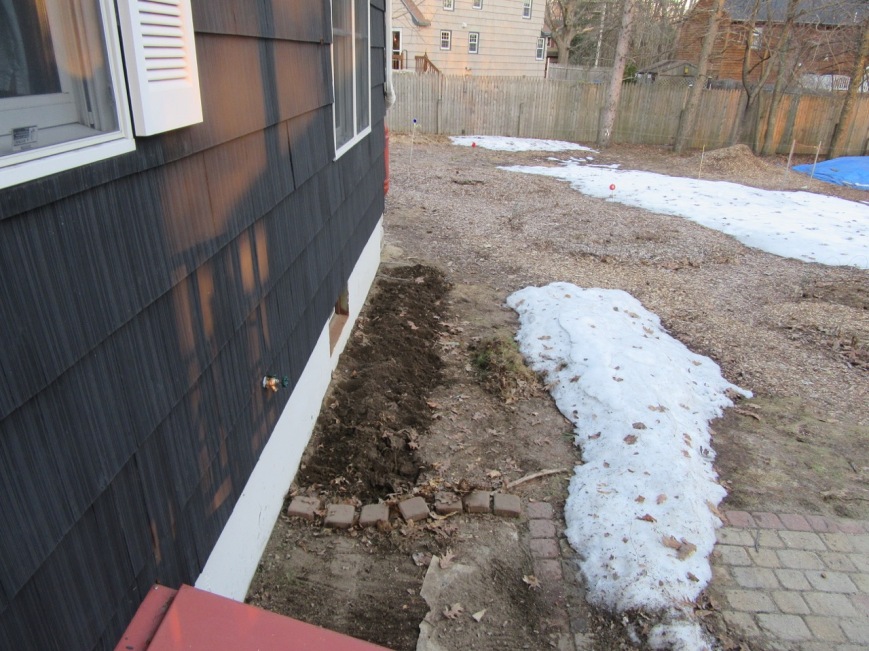
Asparagus BedOur plants from Fedco are being delivered some time today!  And, I still have to dig the beds for the 25 asparagus plants.  I started the other day, by turning over the soil behind the house, and getting rid of any weeds there.  Saturday I dug a trench, and then put some compost in the trench.  It still needs more compost!  I also got rid of a no longer used drainage area filled with small stones and dirt–I moved the stones and dirt to under our water spigot.

Aparagus Bed part 2My understanding is that for asparagus crowns, you make a mound in the middle of the trench, and then position the roots around it, each crown about a foot apart, and cover with a couple inches of soil, gradually filling the trench as the small plants grow, keeping a couple inches of shoot exposed.  This particular bed has room for about 12 of the plants–so today I will try to dig another bed near the garage.

I am feeling a little bit panicked and excited about all the plants to plant:  along with 25 asparagus crowns, there will be an apple tree, a peach tree, two blueberry bushes, three hazelnut bushes, (those garden beds have been ready since last summer).  Also a mulberry tree which we hope to put further back in our yard.  Also a licorice plant, and 3 golden seal plants which will go into pots until frost danger is past.  Our friend said we could put them in her greenhouse for a few weeks.

So, not much time to write, but I wanted to make a log of the garden’s progress. Now out to dig for a while before going to the office.

Planting Peas

Planting peas

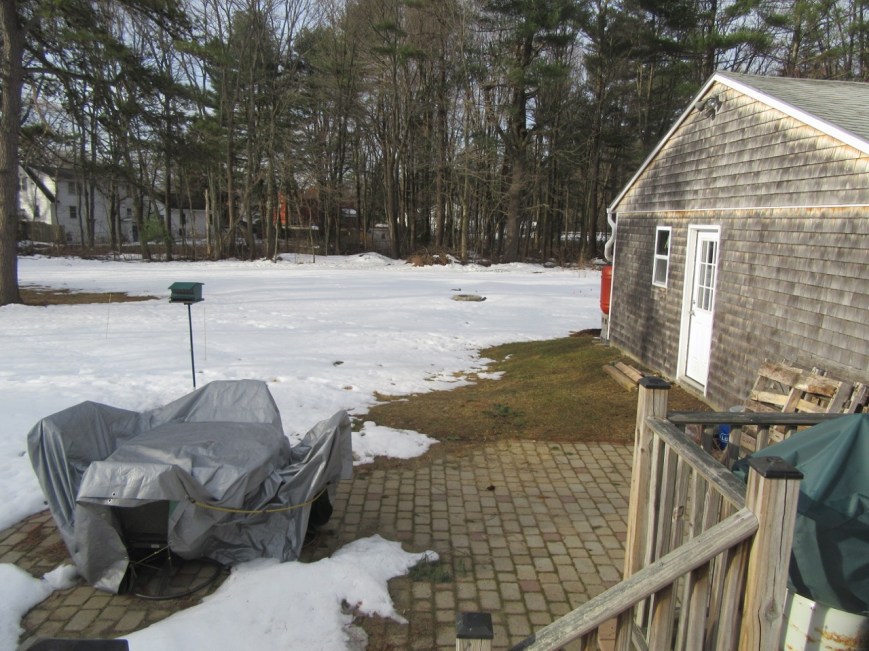
Friday, March 30, on the day before the full moon, I planted 32 sugar snap peas in the garden bed that I created last fall.  It seems early, but the ground was workable, and I set up the string trellis for them to climb, and re-attached the rain barrels near the back of the garage to make it easy to water them.  (And today it is raining!)  We’ll see how they do.  I will plant more a couple weeks later so that we get peas ripening in stages.  And we’ll add lettuce and carrots and spinach which like to grow with peas, and maybe other things too.  Last year I focused on perennials, but this will be an annual bed.

We noticed last spring that this area was free of snow before other parts of the yard, and got some good sun.  In permaculture, observation always comes first!  So we put this spot into our plan for a veggie bed.  Then, as I was starting to dig out the pond late last summer, I needed to put that top soil somewhere.  So I laid down cardboard over the grass in this spot, and then added layers of soil with compost and grass clippings and other amendments to create a raised bed.  There is still a long ways to go before the pond will be done–who knows how many more raised beds it will inspire?

By the way, that long black hose you can see in the photo is an overflow from the rain barrels, and eventually will be attached to another length of hose to be the water source for our pond.


Daffodils Awake

Daffodil shoots

The snow cover is gradually melting, and in the midst of a brown world, these shoots of green appear.  Last fall, I planted a multitude of daffodil bulbs and also some garlic, as companion plants for the cherries and other (future) fruit trees in the orchard.  So thrilling to see them emerge as the snow melts.

This dance begins so secretly, this creeping green… yet with an inevitable chorus soon to come, soon to be bursting everywhere.  I love these quiet first notes.

Mirror

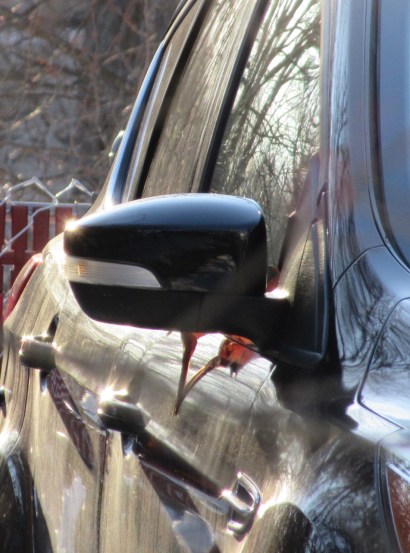
Cardinal looking at side mirror – Version 2The other day on my walk, I saw a male cardinal fly back and forth to a side mirror on an automobile.  I could imagine his inner dialogue: Who is that other cardinal who is invading my territory?  I will scare him away by attacking him!  Hey, he is still there!  Get out of my territory, you interloper.  Stay away from my nest.  Go on!  Get away. Hey, you’re still there.  I’ll show you who’s boss!
Sadly, the drama continued as I walked on.  But every once in a while, he sat proudly on top, as if he was satisfied that the foe had been vanquished.

We never do that, do we?  Imagine that the enemy is out there, and we’d better keep our guard up–only to discover that the enemy is ourselves?  Or that, in fact, we are the only ones in the arena of our lives?  Maybe it doesn’t matter what we think the other folks are doing–maybe competition is like that mirror–there is no one here but us.

Cardinal on side mirror – Version 2


Synchronicity

Today I woke late, so I started my walk late–and just as I was coming out onto our street, I said hello to a woman who was walking with her big black dog.  Turns out, she grew up in our house–her family built it. Her dad, who passed away earlier this year, had a huge garden in the back yard. He used a rototiller, and brought in manure and loam, and involved all the neighbor children in planting vegetables.  He’d give them a stick and point to its length and say plant the seeds this far apart.

He planted a peach tree–which did very well, (sadly no longer here) and lots of raspberries and blackberries–which are still coming up behind the garage on the land just next to ours which had belonged to them.  (It still belongs to her mother who lives in a house we can see from our yard–which we already knew.)  Her dad would do the planting and her mother liked to weed.

The big spruce tree next door would be lit up like a Christmas tree every year, to the delight of all the kids.  The man who lived there was in the fire department, so when the tree got tall, he would put on the lights with a fire truck ladder.  (Sadly, that spruce, along with the others in our yard are no longer doing very well.)  At that time, all the families in the neighborhood knew each other, and the kids played together all the time.  She also spoke about the delight of wandering into the big woods behind the house.

She was thrilled about our solar panels and our rain barrels, and hoped she might do that where she now lives on an island.  She is staying with her mother a few nights a week while she takes a class in town. I invited her to come back sometime when the snow had cleared and we were able to be out in the yard.

It delights me to know that there were gardens in this place fifty years ago, and people who were tending to it with care. It delights me that a small unexpected change in my routine led to an unexpected encounter.  Meanwhile, the snow is melting, and the ground will soon be workable–maybe peas this weekend?

back yard

The Back Yard


Boundaries

Boundary

[The side boundary two weeks ago.]

Boundaries in land are something of a legal fiction.  The land can’t really be owned by anyone.  But they do matter, because we can only protect the land that is within the boundaries identified as “ours” by pieces of paper.

The other day, a neighbor who lives to the side of the back of our yard mentioned that they might want to put in a fence.  We were alarmed that they might cut some trees, but then they said they were not planning to do that.  But they got a little riled by our asking about the trees.

The thing is, we didn’t get a chance to say this, but we had thought that the trees between our properties were on water district land, because our deed identifies our boundary as bordering on water district land.  [You can see the line of trees and bushes behind our compost bins in this photo from two weeks ago.]  But today I did some research and discovered that their deed in fact includes at least some of the water district land, and perhaps might come right up to ours.

It is all both explicit and very vague on our deed, especially in reference to the back half–because it refers to the old Portland Gardens plan.  For example, where that part of our land begins is stated to be about 99 feet across, while the back line of our property is stated to be 161 feet across.  But it is unclear exactly how and where it is anchored or where it expands–it doesn’t correspond to what was mowed as lawn.  (And it would cost thousands to get a survey, we were told.)  And if you look on the current tax map, the water district land seems to be 53 feet across between the properties.  But I don’t see how there are that many feet between us, even if all the “hedge row” is included.

However, the deed for the neighbor’s yard cites an iron pipe at the corner boundary next to their road, and then “83.31 feet to an iron pipe and land now or formerly of the Portland Water District.”  The wording is odd–but I found an earlier deed that ceded some 56 feet of PWD land (on that side) to that parcel–and it makes sense, they couldn’t have built a house on the land without it.  Then it angles back to a narrow point further back.  Sometimes I wonder if it is all something of a fiction–maybe the plan for Portland Gardens didn’t really match the actual land, and nobody actually has the number of feet listed.

But all day today I have been worried about the trees.  The black cherry and the cedar.  The ones I haven’t learned the names of yet.  We love the trees for themselves, and also for the privacy they create in this place during the summer.  Margy has spent a lot of time cutting down bittersweet from these trees.  And I’ve been wondering where the boundary really is.  There is too much snow right now to hunt for that iron pipe.  But I surely will as soon as enough has melted.  It all feels so vulnerable.

Cascoak

Our Beloved KinI was excited to hear Lisa Brooks speak at the Maine Historical Society last night.  Lisa is the author of Our Beloved Kin: A New History of King Philip’s War, which is an amazing narrative.  She goes back to original documents and source material, combined with local Indigenous knowledge to reexamine the stories of the New England colonies and the Indigenous peoples during the later 1600s, particularly the unfolding of hostilities that came to be known as King Philip’s War.  I wrote about some of my first impressions in an earlier post.
In her talk, she focused on the parts of the book that were about Wabanaki territory, what we now know as Maine.  One of the things I especially noticed was the name of this place–greater Portland–before it was occupied by settlers–Cascoak.  The Fore River used to be called the Casco River.

I learned more about Skitterygusset, the sachem who first made an agreement for a settler to live near Capisic Brook and its uplands (where Margy and I now live).  Lisa talked about how after the deaths from disease that happened during first contact, many native people were building new alliances between regions, through marriage and family relationships.  Thus, Skitterygusset cannot be understood apart from his relationship to his sister, Warrabitta, who was the leader of Owaskoag (now Scarborough).  Women were often rulers, especially in places where planting fields were located, since women were responsible for the planting fields.  Owashkoag was a sweetgrass gathering place.  Their brother, Sagawetton, lived with his wife on the Saco River.

In settler narratives, when they talk about Indian raids, they write as if the hostilities were random acts of violence.  But Lisa talked about how the raids were focused on settlers who were upsetting the balance of communal subsistence living.  One example was the settlers who had built their houses at Amancongon, which was an important planting field on the Presumpscot River (now part of Westbrook).  Another target was to burn the mills, set up at falls on multiple rivers.  By the time of the “Indian wars” there were 50 saw mills that had been built: they cut and harvested the huge white pines of the forest, processing 1000 feet a day of pine board.  Destruction of the forests meant destruction of the game that was hunted.  The mills also prevented fish from migrating upriver, thus cutting off another important source of food.

I have to stop for now, but I was newly inspired in my quest to understand the history of this place.  I can’t recommend this book highly enough!


Spring Arrives in Maine

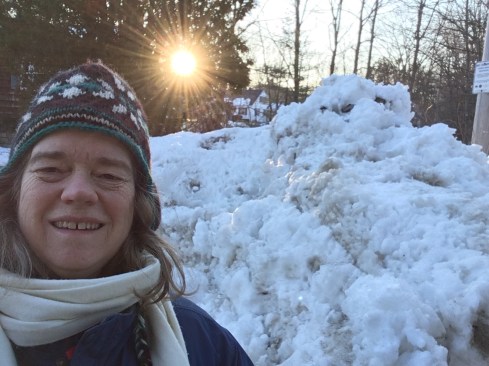
Spring Arrives in MaineToday is the first day of spring everywhere in the Northern Hemisphere.  What it looks like in my neighborhood is huge piles of snow and a really cold morning, but with a bright sun leading us into a clear day.

Margy and I hosted an Equinox ritual at our house last night.  It was a small group of five this time, and most of us were weary from the winter, so our ritual was simple and low key.  We named the friends who had joined us for Solstice and Imbolc, and sent blessings to all of them.  (You know who you are!)  We shared thoughts and readings about our lives and about winter and spring.  We talked about what we wanted to let go from the winter season, and what intentions we wanted to carry into this new season.

I thought about the next several weeks until Mayday.  The snow will disappear, and the ground thaw, and begin to fill with green.  Our plants will arrive from Fedco:  an apple tree, a peach tree, two blueberry bushes, three hazelnut bushes, a mulberry tree, a licorice plant, 25 asparagus plants, and 3 golden seal plants.  By Mayday, I hope they will be in the ground.  Our friends volunteered to help with the planting.

I remember when we first imagined this new home, when we began to lay out our intentions to find greener housing in the summer of 2015.  Our intentions included creating a permaculture garden, and having space in our living room for people to gather.  And here we are!  Living those dreams into reality.  The magic of deeply felt intentions can be surprisingly powerful.