I have much less energy than I used to. I notice it in my spiritual practices. I don’t seem to do rituals anymore such as lighting candles or building a fire in the yard. I haven’t written a blog post for a month. All that I still do is to write in my journal each morning, and if I can, take a short walk to the nearby Capisic Brook. During each of these, I express gratitude for my life, and sometimes I ask for help. This is my spiritual practice now.
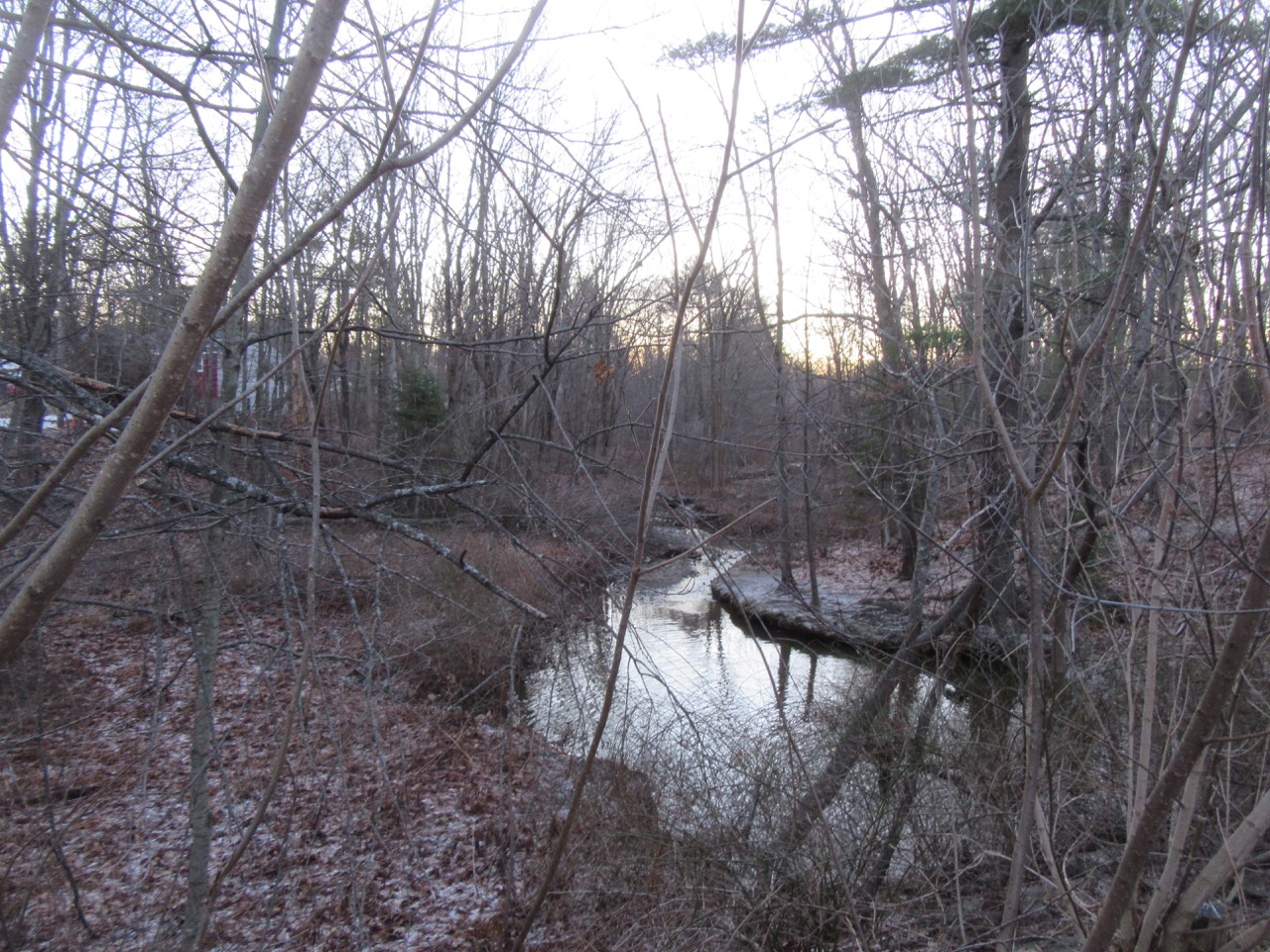
I am grateful for a new day of living. When I reach the brook, I turn to the four directions. To the East, I express my gratitude for the sky, for birds, for their singing. To the South, I am grateful for the sun, for fire, for plants. To the west, I am grateful for water, for the brook, for snow on the ground. To the North, I am grateful for soil, for animals, for the earth.
I am still trying to learn and speak Passamaquoddy/Wolastoqey, so I speak these gratitudes in the Wabanaki language of this place. I can do these sentences, but I’ve reached a point in my learning that is very challenging. I don’t know if it is my tired brain that can’t move forward, or if it is the differences between the shape of the language and the shape of English. My teachers seem pleased with my progress, but I can’t seem to get my mind to think in the language even when I am listening to the language. Still, one of the primary lessons I have learned is the importance of gratitude, so perhaps that will be enough if I can’t do more. I am grateful for the gift of learning the language.
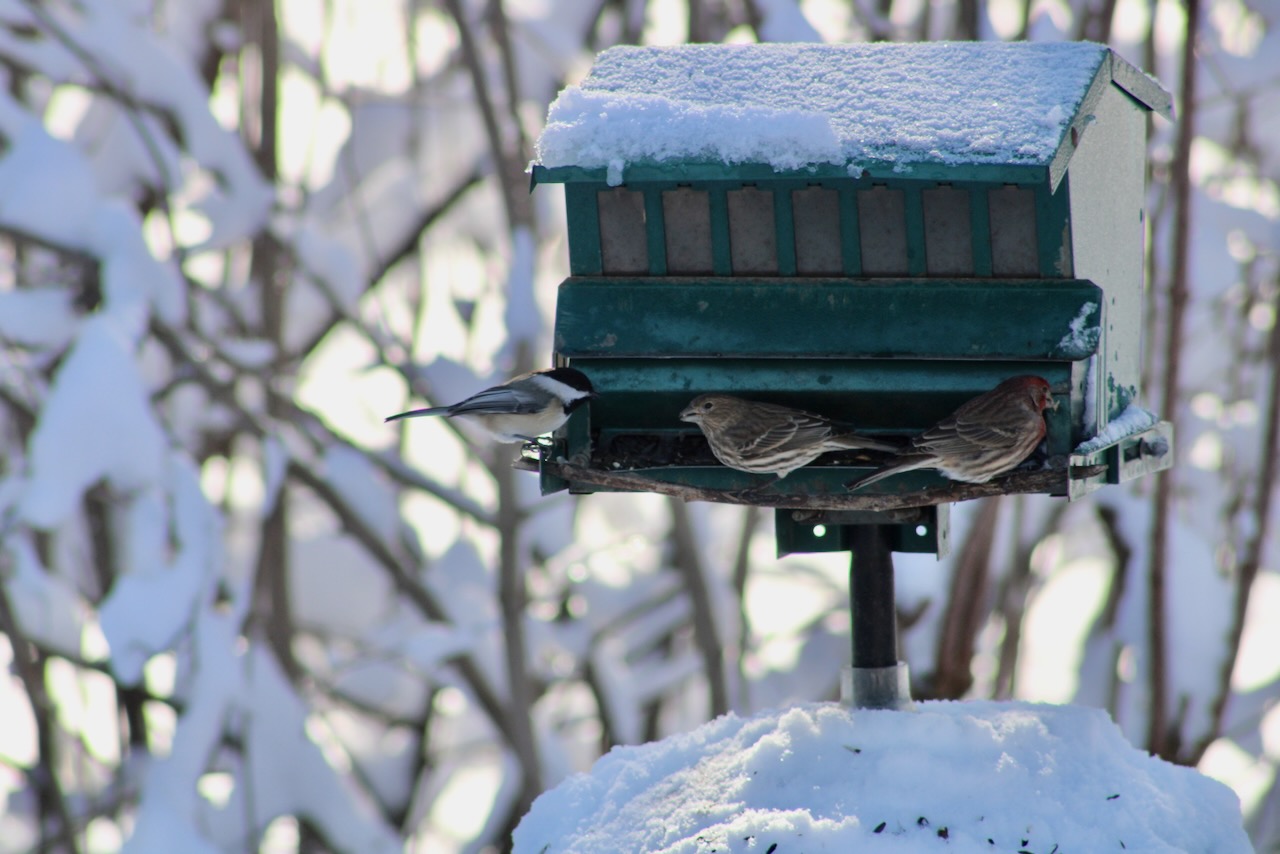
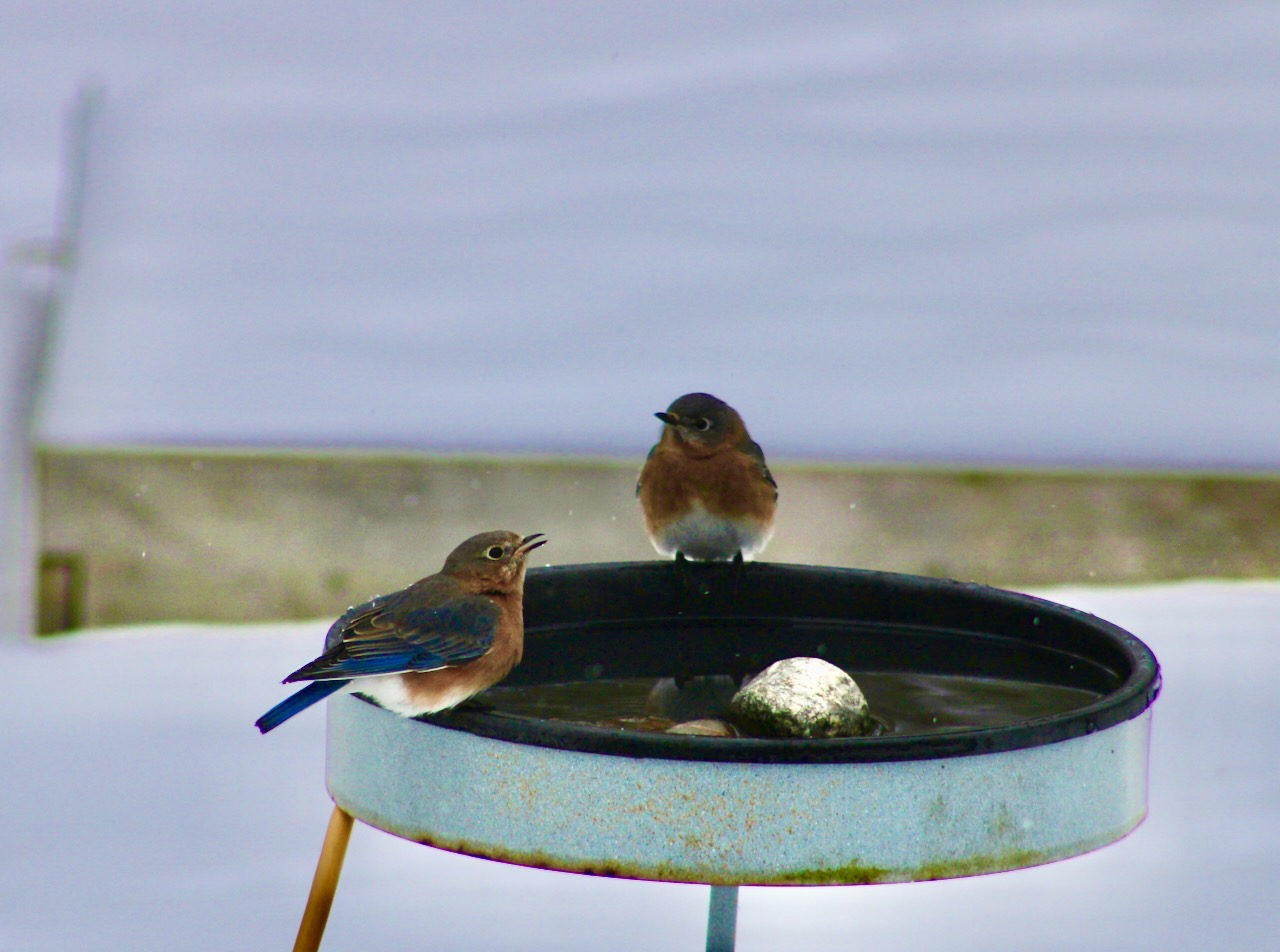
I still have my questions about what this time of my life is all about. The limits of illness keep me from activism in a time of great oppression and cruelty in our country. Genocide continues and my heart hurts with not being able to do anything. I count it a good day when I can bring fresh water to the birds, fill the feeder with new sunflower seeds, and then do our dishes and prepare meals to eat. Still, the birds continue with their small lives, happy to eat the seeds and drink water. So perhaps they are my teachers. Grateful for food and water. Can it be enough?
There is so much beauty in the spring, but it all seems to be moving so fast. I can’t keep up. Mayday has come and gone. Already this season is half over. After two months of physical therapy for my hip and lower back, I am able to walk fifteen minutes and more again. The other day I walked to Capisic brook and onto the path nearby, and saw the trout lilies that usually grow there, a lovely spring ephemeral. American Heritage Dictionary defines ephemeral:
Lasting for a markedly brief time.
Having a short lifespan or a short annual period of aboveground growth. Used especially of plants.
Spring itself and all its beauty feels markedly brief. Is my love of photos a way of trying to hold on to all that is ephemeral? Is my need to write an attempt to halt the relentless flow of time?
I have been drawn outside more and more each day, excited to see daffodils and violets and green shoots coming up everywhere. And, happily, the peach tree is now covered with pink blossoms, and the cherry trees have many blossoms too. Last year, because of the weather, there were none–so these beauties seem fragile and extra special because of that vulnerability.
Peach blossoms on a foggy day.
There are many projects in the yard to attend to. Many branches fell from trees in the storms of winter and early spring. Margy has been cutting them up and hauling them around. Some of these we’re using to make a brush pile in the back corner for wildlife habitat. The other day, I cleared that space of invasive plants. I also set up our eight rain barrels again. We are going to get an new order of firewood, after using up our last old logs in the storms. So we are working on the space for the firewood, and purchased a rack to keep them off the ground.
Yesterday, I added two more pond lilies to the plants in the little pond, and as I was tidying up old dead shoots from other plants, I found strings of toad eggs attached to the old ferns. (So of course I left those.) We haven’t had toad eggs in the pond before. But there are a few frogs beginning to make an appearance–shy ones who have been diving under when they hear me approach.
The robins did not come back to the nest on our back porch that they had used for two years. Maybe that pair are no longer living. I read that their average life span in the wild may be just two years. I also read that they often don’t reuse nest sites–so we were lucky to have them in that spot for two years. Another ephemeral.
Then we discovered a nest in the yew bush near our front door–able to be partly seen from our living room window. So new robins are raising young nearby again. Maybe one of them fledged from the back porch.
Blue robins egg barely visible behind branches.
Is my love of photos a way of trying to hold on to all that is ephemeral? Is my need to write an attempt to halt the relentless flow of time?
I was cuddling with my cat Billie on the couch and suddenly felt a deep sense of our own impermanence. She is 13, I am 70. Senior cat, senior human. How much more time do we have? Someday, I won’t be able to feel her warm little body, with its soft fur and sweet smell, curling up on the pillow near my face. Someday, she will be gone; someday, I will be gone. We too are ephemeral. I want to hold on, but life seems to be about movement, about letting go into the next moment.
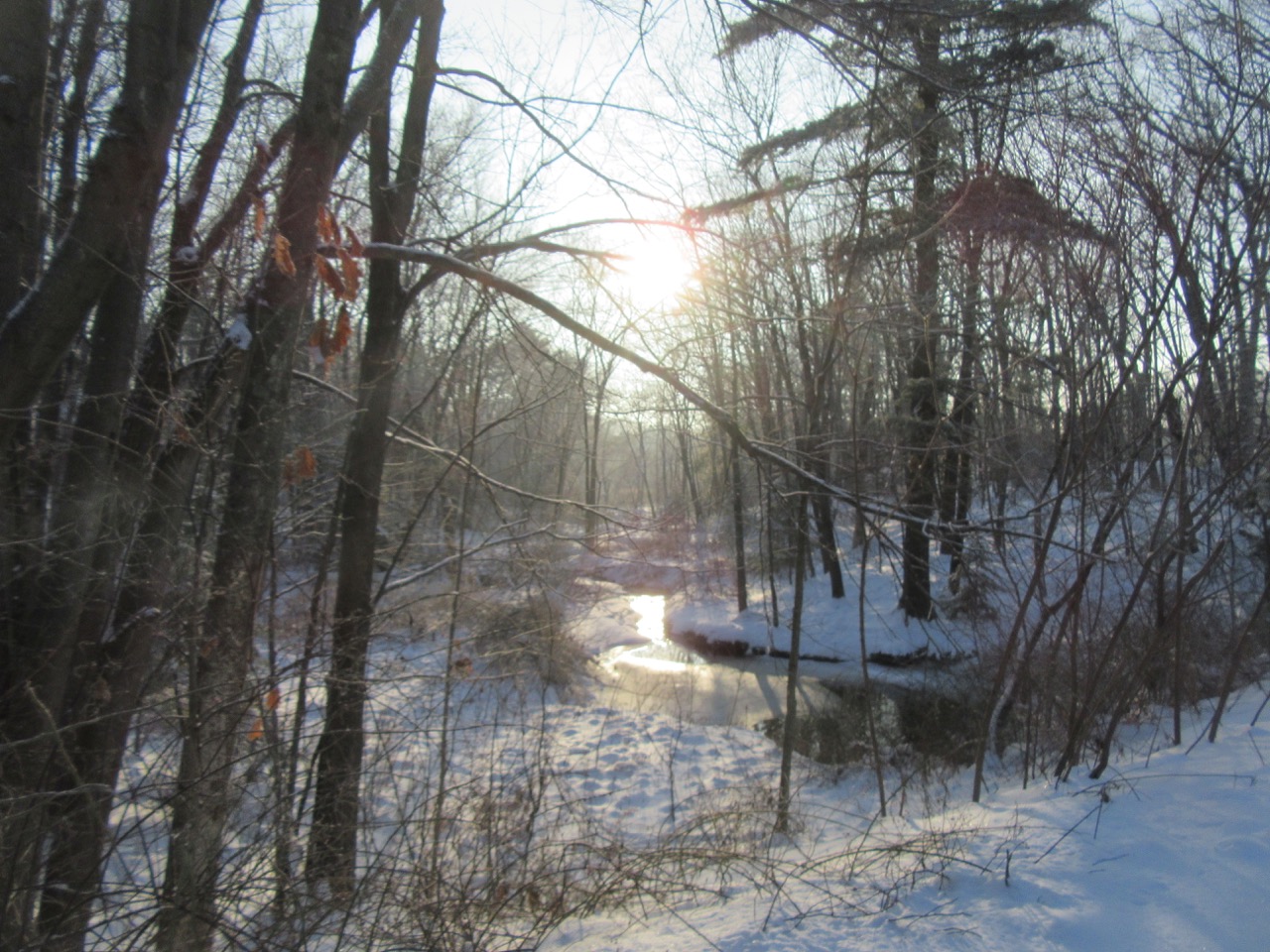
Snow coats every branch as the sun rises through the trees.
What a beautiful morning today! I took a little walk to the end of the block, where these photos are from. The road was icy, and I have a strange new pain in my ankle, so I didn’t want to try to get all the way to the brook near the school. But the brook also runs by the end of our street, and so that is where I saw it today. We are surrounded by various branches of Capisic Brook in our neighborhood, and it shapes the roads and layout and character of our neighborhood.
You can see the brook at the bottom of this photo, deep in the ravine.
I am grateful for the beauty of the snow on branches. I am grateful for the flowing of the brook. I am grateful for a new morning. I am grateful for a little walk. I am grateful for a neighbor who plows our driveway. I am grateful for the sun shining on white snow.
A little magic has emerged in my life. For a long time, I didn’t have the energy to go on walks, except for a minimal 5-minute walk to the end of our street. But somehow my energy has lifted a little, and for the last several days I have been able to walk to Capisic Brook, where it goes under the walkway to the elementary school, about 15 minutes total. It started January 2nd when, as I entered my driveway, I felt the presence of the Marie Madeleines, my ancestors from Îlets-Jérémie. “We are still with you.” They would have spent so much time walking in their lives. So I felt them walking with me in the early morning, greeting the dawn.
I heard the message from these ancestors: “You need new boots. Walking will be needed.” It was true that my boots were quite old and my feet were feeling it. So when I got back home, I did some online research, and then called a local store. After arranging it, I went in with a mask on, tried them on and bought myself some new boots. (The ones I wanted were on sale!) When I am lucky enough to hear a clear directive, I find it is so beneficial to follow it. And so I have kept walking almost every morning before breakfast. Even in the snowstorm, even in the first rainstorm. Yesterday I couldn’t get myself out there, but today the sun helped.
All these storms have been a challenge. We expect snow in winter in Maine. I like snow. But we’ve only had one snowstorm. There have been at least three huge rain and wind storms–first, when the spruce tree fell into the orchard, another January 9th into the 10th, and then yesterday which mostly caused damage at the shore during high tide. I took this photo of the brook at flood level on the 10th–because the branches of Capisic Brook flow through deep ravines, it doesn’t come onto roads in our neighborhood.
After the rainstorm, January 10
I can’t help but wonder what these weather changes mean for the future. Will rain and wind be the new winter, alternating with snow and cold? Someone posted (on Facebook-but no attribution) this little diagram that showed how climate warming destabilizes the polar vortex causing the extreme colds and unusual warms we are seeing right now. My sister in Montana reported -34 degrees, and Texas at 40 degrees, while we were up to 50 degrees.
While often I am most inclined to grieve or be afraid of all of this, I am also hearing the message that we must find a way to keep loving our changing earth mother, keep loving through the ups and downs. Perhaps it is also about the magic of walking–keep walking through the storms. I don’t know the answers but I am so grateful for the moments of connection and care.
Two people have reached out to me in the last few weeks to ask about the origins of the name of our little Capisic brook. They accurately assumed that it was a Wabanaki name, as are many waterways in what is now Maine, and wondered about its original meaning. I have wondered that too, though when I asked Wabanaki friends, no one was quite sure. So recently I began some research about it.
Capisic Brook has several branches winding through our neighborhood, with three headwaters: the north branch starts east of Forest Avenue near the intersection with Allen Avenue, the main stem in a wooded area within Evergreen Cemetery, and the west branch just east of I-95 near the intersection with Warren Avenue. Sadly, it receives run-off from development and roadways, and its water quality is significantly impaired. After these feeder branches join together it crosses under Brighton Avenue, flowing into Capisic Pond, which was originally created in the 1600s by a dam for a grist mill. Eventually Capisic Brook feeds into the Fore River. [I want to note here that the Fore River was called Casco by the Wabanaki people who lived here.]
All of this land is Wabanaki land. I wrote about its history in a previous post, noting that it was the chief Skitterygusset who first made an agreement for a settler to live near Capisic Brook and its uplands. While the settlers thought of these agreements as deeds of sale, a Wabanaki interpretation was something more like a treaty: an agreement to co-exist, and to render offerings each year for the use of the land and water. Unfortunately, the settlers kept taking more and more of the land and waterways. That is the painful legacy of colonization. Any story must include this legacy.
For those of us who live here now, if we are paying attention, the presence of the brook is everywhere in the neighborhood, showing up in the patterns of the roads, and the deep ravines with trees and brush. It most likely contributes to the wildlife that still frequents our yards. When I go for a walk, I seem to find myself heading to places where I can see the brook, in one segment or another. Despite the pollution and development, the brook has its own powerful presence in this place, that cannot be denied.
So what about the name? I have been privileged to study a Wabanaki language, Passamaquoddy/Wolostoqey, for the last five years with Roger Paul. One thing I learned is that the languages are polysynthetic–words are formed from the combination of smaller syllables, with root segments, prefixes, and suffixes, that combine to form new meanings. The word “Capisic,” as such, is not in the online Passamaquoddy/Wolastoqey dictionary. So I began to look at its parts. First of all, early spellings by settlers were not consistent or necessarily accurate to the actual Wabanaki words. It is likely that it has changed over the years. But I listened to how it sounded, and converted it as well as I could to the spelling system which has been used for the last 40 years–and is used in the online dictionary: ‘Kahpisik.
Now, it is more likely that the dialect here was Abenaki, and their recent spelling system is different, but I was working with what I knew best, and all of the Wabanaki languages are intelligible to each other, so that seemed not unreasonable. Here is what I was able to find: first of all, the final two letters “ik” are most likely a “locative” signifying that the word is a location. So then I looked at Kahpis. Sometimes, an “is” signifies something small, though that is less certain in this case. “Pis” can also mean “in” or “into.” I found the syllable “Kahp” in the prefix “kahpota” meaning to climb down or disembark, and also the verb “kahpotassu,” used in the context of transportation, meaning she or he gets off, gets out, disembarks, steps down. I couldn’t find other uses for “kahp.”
Many Wabanaki location words are the descriptions of what might take place there. Because of the physical characteristics of the brook, I am wondering if Kahpisik might refer to “the [small] place where we disembark [from our canoes].” The brook was unlikely to be a navigable stream, so people traveling on the Casco (Fore) River, coming to this brook, would have to disembark. So maybe that is what the name refers to.
I want to acknowledge that I am not an expert in the language, and merely hope to be a respectful and curious student. I checked in with Roger and he thought it was possible that this meaning might be on the right track. If others can tell me a more accurate meaning, or source for a meaning, I will update this post.
But in the meantime, it is helpful to think about this place in relation to its own history, to the people who lived here, live here still, and love this land and water. I imagine it used to be great drinking water, filtered as it was through gently sloping forest. Animals and birds still drink from it today, polluted though it is. I am grateful to be able to walk to the brook, to see the water and the plants, and sometimes birds and animals who visit. I am glad to see awakening environmental consciousness that seeks to purify its waters again, or at least mitigate its pollution. We belong to our watershed, and when we can imagine ourselves located in such a way, we are more likely to care for our home.
I am writing on the New Moon day, while in Congress our representatives are debating the impeachment of President Trump. On the New Moon, I always read my journal from the day of the last New Moon, and I note recurring themes in my days. One recurring theme for me this moon has been feeling empty and lost–I asked in my journal several times, “What is my purpose in this time of my life?” I am an elder now, and because of chronic illness, my energy is limited. What does it mean to be an elder in these times?
One of my images for the Divine Mystery is the River–the flow, the great unfolding of all things, the mysterious energy that holds us in its flowing. So one day, I prayed: I do not know my purpose–I open to your flowing oh River, I open to your flowing, and thank you.
I went outside after that, and there were tiny bits of hail on the dry ground. I started on a walk down the street and around the corner and directly toward the Capisic Brook near my house. Part-way there, I slid on a small patch of ice hidden under the scattered hail and landed on my back and elbow. I was bruised but okay, and even continued on to the brook and back, though I felt shaky about it into the next day, and have been sore since then.
The tiny hail on the ground in our back yard that day.
So reading my journal, I couldn’t help but notice that this fall came directly after my prayer to the River about my purpose, my surrender to the flowing. I wondered, “What’s that about, Spirit? What kind of answer to prayer is that?” I remembered a story about St. Teresa of Avila, who after a bad day had a fall of her own into the mud. She challenged God then, “Why?” and God said, “That is how I treat my friends.” She replied, “That is why you have so few!” (These were the Catholic stories I grew up on.)
I do know that the Spirit has a sense of humor, but might this fall mean something more subtle, like “Now is not the time to move forward or worry about having a purpose?” “Or, what?” And so today I sat quietly with Spirit, and with Billie kitty on my arm, seeking help to understand. Here is what came to me.
Don’t worry. The answer is to live into the answer by a hundred small intuitions. Joy. Love. As an elder, to let go of fixing, to be rooted in joy and love. You learn to end a day, or a life, by living into each day, each life. Feel the feelings. I didn’t knock you over, but it is in the nature of life to fall and to get up, to be wounded and to heal, to encounter hidden dangers without warning, to take time for recovery and to build resilience, to be broken and to be one with the whole.
As an eldest child, you felt responsible for everything. As an elder, you can learn that you are not responsible for everything. And yes, that is frightening. But you can feel the fear and rest in my love. You can lead as you have been leading, by sharing the skills and sharing the responsibility with each other, caring and connecting, just as you are.
And so here I am, in this hermitage life, trying to listen to the flow of the Spirit, learning a new way of being, an elder way of being, not responsible for everything. Even in this hermitage, the storms of the outside world rage into our lives through internet and television, and our power to act is so small. I hope and pray that those who can act, will do the right thing, do the brave thing, will hold fast to the good and resist greed and racism and violence and fascism. I hope and pray for a world in which all people care for each other and care for the earth. It is a frightening time. So I feel those feelings, and remember the next part–to rest in the love of Spirit.
Capisic Brook, the little stream that reminds me of the deep River.
It is the morning of winter solstice. I take a walk to the brook. The new sun is shining in a misty sky, fresh and gentle. Snow covers the ground here in the homelands of the Wabanaki, the stolen land called Maine. I am awestruck by so much beauty everywhere, grateful for the brook and its trees, for the light of the sun, for this neighborhood walk. Now that the gardening work is asleep under the snow, I am trying to go back to taking walks in the morning.
“Kisuhs koti-apacuhse” is the Passamaquoddy/Wolastoqey way to say the winter solstice. It literally means “the sun comes back walking.” So maybe I, too, can come back walking–nkoti-apacuhs nil na. Today I was able to do my 20 minute circuit. Some days ago, I had started with 10 minutes, then 15–by going slightly different ways to the brook and back. For some reason, perhaps a new supplement I am taking, my energy has been returning in the mornings again. It is much easier to walk on sunny days than on cloudy ones. By the way, the sun is also known as the one who walks in the day, espotewset kisuhs.
Tonight just after sunset, there will be a conjunction of Jupiter and Saturn low in the southwest sky–perhaps it will be too cloudy to see it here–we’d have to drive somewhere in any case, because the southwest of our yard is thick with tall pine trees. I think of Jupiter as the planet of expansiveness and generosity, Saturn as the planet of limitations and boundaries. 2020 has certainly been a year of limitations and boundaries for so many. So perhaps these opposites coming together give a glimmer of new hope, that we might find our way out of this restrictive place we’ve been in. Ironically, it has been through restrictions that we have had the hope of surviving, but we also need generosity to ensure our survival as a people together, to come out the other side with possibility. Can we learn both boundaries and generosity? Can we find a way out of the individualistic greed demon that plagues our society? I pray we can.
I pray that this Solstice may be a turning toward greater light and truth, a recognition of the interwoven fate of all humankind, all life kind, on our beloved planet earth.
At winter solstice, the sun begins to rise earlier each morning, but only by about one minute every couple days. As we approach the spring equinox, the changes begin to quicken, each day the sun rises earlier by one or two minutes a day. It doesn’t sound like much of a difference, but I feel this sense of speeding up. This morning, I woke at 6, and found myself jumping out of bed, wanting to get outside as quickly as possible, so as not to miss the dawn.
I was not disappointed. First of all, there was the waning moon shining bright in the western sky. Then there was the gang of turkeys marching down the end of my street. Twenty strong, they roam the place like they own it, and they do, as much as we do. Around the corner, a neighbor walks her little dog: Sparkles is still a puppy and just can’t contain herself when I approach. She is trying to learn not to jump. But she jumps. So we say our good mornings with enthusiasm.
On my own again, around another corner, I hear a cardinal singing. He is already looking for a mate, or marking out his territory. I can see him in the tree, his characteristic shape visible with its tufted head, even though he is too far away to see the brightness of his red feathers.
The streets are a mix of clear pavement and icy patches, so I make my way carefully, no rushing. But I feel buoyant in the early morning light. Finally, I approach the brook, and look over to the east, where I catch my first glimpse of the sun rising through the thicket of trees.
I am a morning person, but I usually don’t like to get up before 6 a.m. Just before sunrise is my favorite time of the day, but if it gets too early, I have a hard time making it out of bed. In this regard, I will be saved by Daylight Savings Time on March 10. The sunrise would have been at 6:03 that day, but we jump our clocks ahead, so it slides back to 7:03. Then we have all the days until April 15 before it approaches 6 a.m. again. Nonetheless, everything is starting to wake up now. Buds are starting to appear on the fruit trees. Birds are singing. They know.
[True happiness is not in buying things, but in being thankful for all that we already have. You can ignore any ads that appear at the end of these posts.]
I saw a group of cardinals on my walk today! I haven’t seen them all winter, but as I stood still, watching the beauty of Capisic Brook, first one and then another and then more appeared in the distance. You can’t really see them in the photo, but after the brook bends to the right, and then to the left–they were there in the bushes near the water. Then, as I was walking home, I heard a cardinal sing in the trees nearer my house. Joy!
I was thinking more about the fun wheel I created the other day. I put “Walk” as something to do under the element of fire, but really, my morning walks include all the elements. Fire is for the movement of my body, and sometimes, the bright sun rising. But I almost always walk to the brook–which is water. And I am connecting to the trees and the land and sometimes little animals–which is earth. Hearing the songs of birds, breathing in the invigorating air, well that is air.
Sometimes the walk feels like a chore–getting out there in the cold–it’s exercise, you know, good for me, I should do it, etc. And my usual definition of fun is something I don’t have to do–no “shoulds.” But often, even usually, once I get out there, a walk is a doorway into moments of delight, moments like seeing the cardinals today, or finding turkeys in the street, or sometimes near the brook, catching a glimpse of a fox or a raccoon. Moments of surprise and moments of joy.
What might you do today to open a doorway into possibility, into moments of joy?
It must have been a big machine that cut down the grandmother pine tree. I found no disturbance around the stump when I climbed up to it to offer my grief and respect. The weeds and small brush nearby were there as before, with only fresh wood shavings and pine sap falling over the edges of the stump. Nothing huge crashed to the ground when they took her. So it must have been a big machine.
I discovered her absence on my walk near Capisic Brook the day before, but didn’t have the strength to approach her while there were lots of workmen in the Rowe school construction zone nearby. Ironically, they were making a children’s playground, spreading wood chips and such–perhaps that was that her wood they were using? But why?
I met this tree last winter when I was measuring old white pines around my neighborhood, after I discovered that our white pine was definitely over 100 years old, and perhaps even 160 years, according to her circumference. At that time, I was also mourning all the cut pines for the construction of the new elementary school. I found this pine with a yellow tape around her trunk. She was one hundred and two inches in circumference, just like the white pine in our yard. That is when I knew she was one of the grandmother trees. I made an inquiry on the school’s Facebook page, but the person who responded didn’t know about the situation of the tree.
And now the white pine is gone. I went to the place where she had stood, and expressed my sadness, and I did the best I could to honor her. I counted her rings, making small markings after each 25. (You can see those marks if you look very closely at the photo above.) I got to 100, and then the outer rings were too difficult to see clearly–but I guess there were at least 20 more–so 120 years old? Maybe even 130? That would mean she was likely a small sapling in the year 1897 when both of my grandmothers were born. She observed a century of animal and human life from her vantage point above the brook.
People in U.S. society are still thinking of trees merely as resources for our needs and wants. But we have to begin opening our minds to the idea that the trees have their own lives, their own being-ness. Scholars are learning that the forest is a living community of trees and other plants and animals and fungi, all interconnected in a network underground, supporting each other and all of life.
Recently, I had a chance to read The Overstory by Richard Powers. The novel tells the story of several people, all with some significant connection to a tree or trees, who come together to protect old growth forests in the northwest United States. Powers borrows from actual science and activism in telling his fictionalized version. I especially loved the character of the woman botanist whose research suggested that trees were communicating and caring for each other. Because of that hypothesis, she lost all her funding and academic connections. Eventually she found her way into work as a forest ranger, until decades later when other scientists caught up with her insights. Two other characters spend a year living in one of the oldest redwoods, to try to protect it from the logging company.
Of course, the forest between the Rowe School (formerly Hall School) and Capisic Brook is already badly degraded. It is not old growth or pristine. It is encroached upon by invasive plants and runoff pollutants. But it is still a living system, a wetland, a wild community in the midst of city streets and buildings. And so I walk along its path, I cherish it, I pick up litter. I try to bear witness.


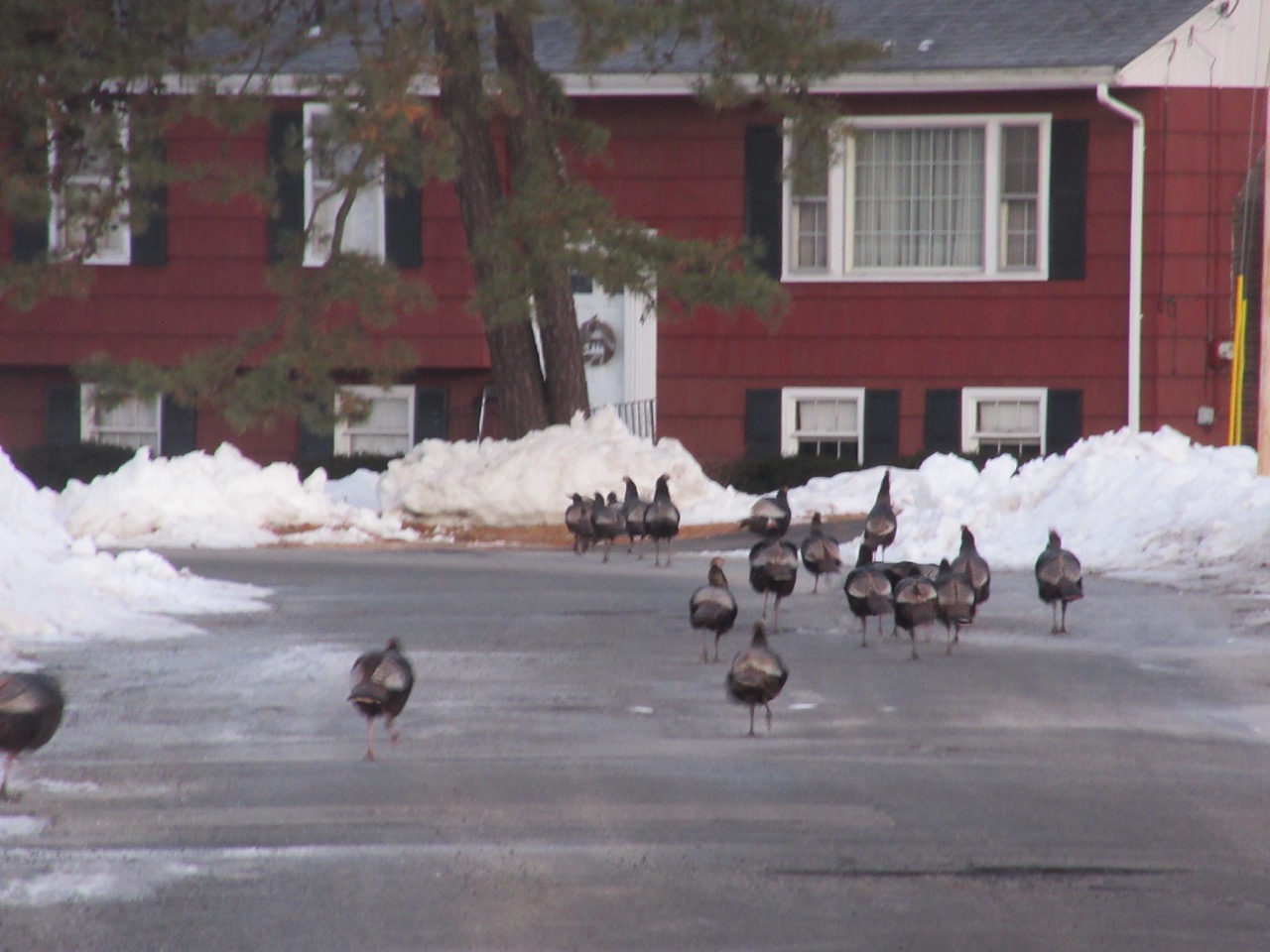 I was not disappointed. First of all, there was the waning moon shining bright in the western sky. Then there was the gang of turkeys marching down the end of my street. Twenty strong, they roam the place like they own it, and they do, as much as we do. Around the corner, a neighbor walks her little dog: Sparkles is still a puppy and just can’t contain herself when I approach. She is trying to learn not to jump. But she jumps. So we say our good mornings with enthusiasm.
 On my own again, around another corner, I hear a cardinal singing. He is already looking for a mate, or marking out his territory. I can see him in the tree, his characteristic shape visible with its tufted head, even though he is too far away to see the brightness of his red feathers.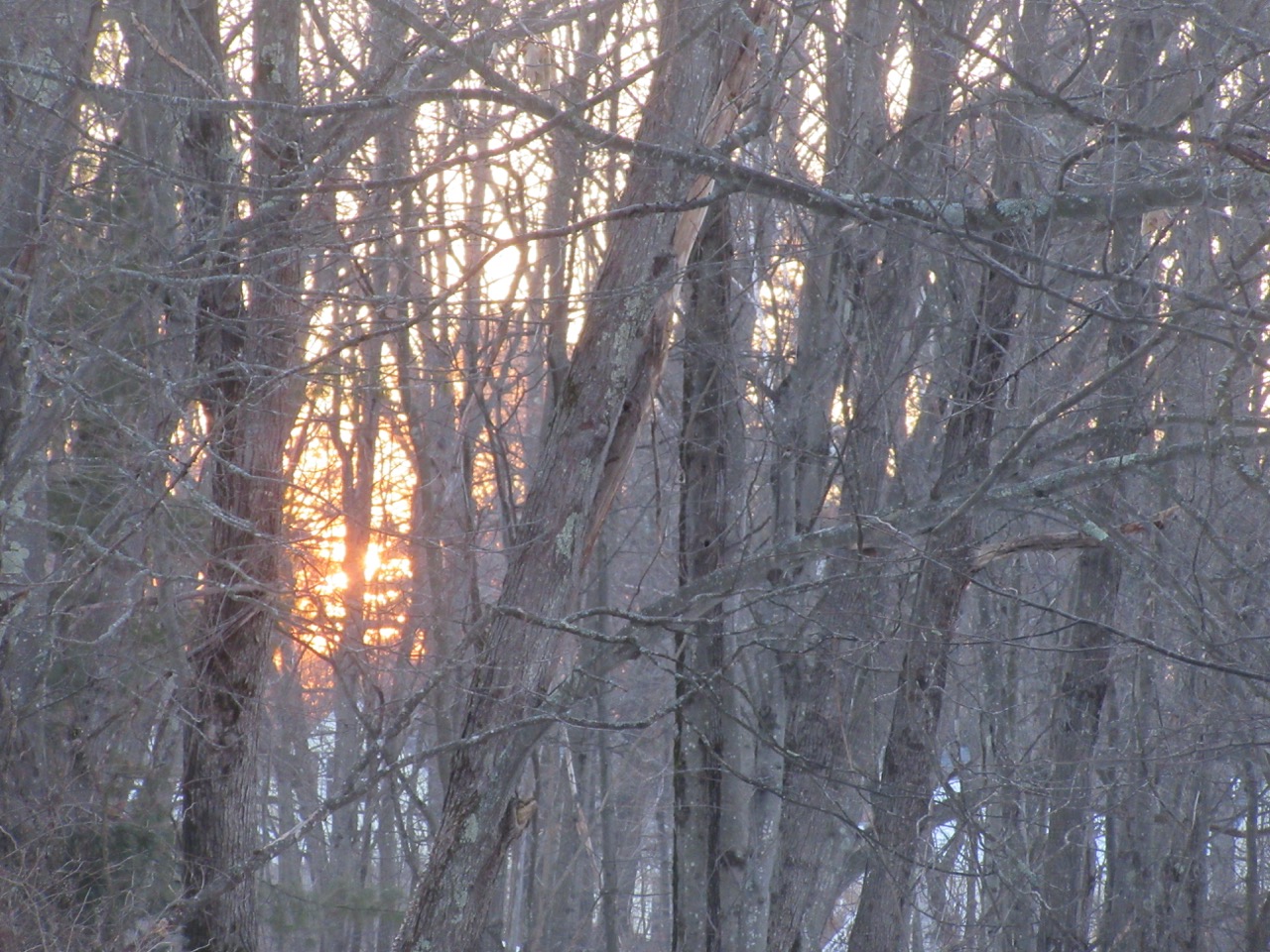

 It must have been a big machine that cut down the grandmother pine tree. I found no disturbance around the stump when I climbed up to it to offer my grief and respect. The weeds and small brush nearby were there as before, with only fresh wood shavings and pine sap falling over the edges of the stump. Nothing huge crashed to the ground when they took her. So it must have been a big machine.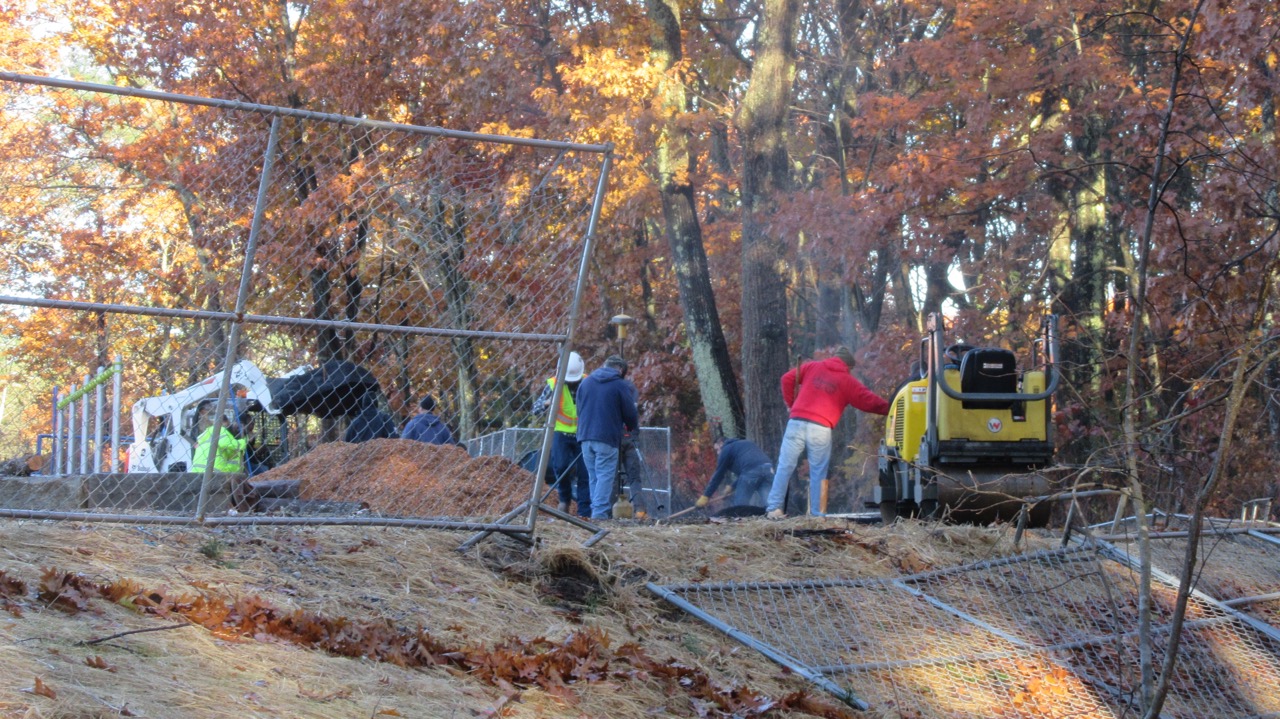

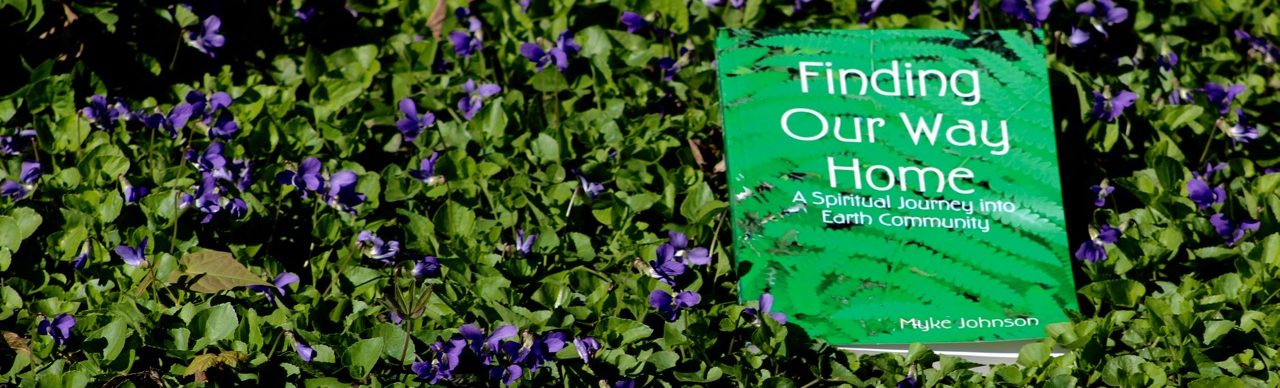
 Finding Our Way Home